Synopsis of My GPS Technology Workshop This is a lesson about global navigating and the Global Position System (GPS).  We’ll retrace the footsteps and sea passages of prior explorers.  We’ll take a look at the history of navigation and explore the Global Positioning System (GPS).  Then we’ll use GPS receivers to locate our position on the Earth and go geocaching (which is a high-tech treasure hunt in the woods using GPS). Presented by Mark N. Lewellen [email_address]
Class Objectives Brief History of Navigation How Latitude/Longitude (coordinates) are used Understand the basic concepts of how GPS works Introduction to Geocaching Hands-on experience using a GPS Receiver (GPSr) outdoors Full course is about 3-4 hours but can be scaled back to fit
These questions and many more will be answered at my GPS Workshop What would you use to find your way at sea? Hint: It might depend on knowing the time! Did you know the Magnetic Compass was first invented in China but was  not  originally used for Navigation? Could you figure out your present location with this?  Do you know how to use a GPS Garmin Handheld?
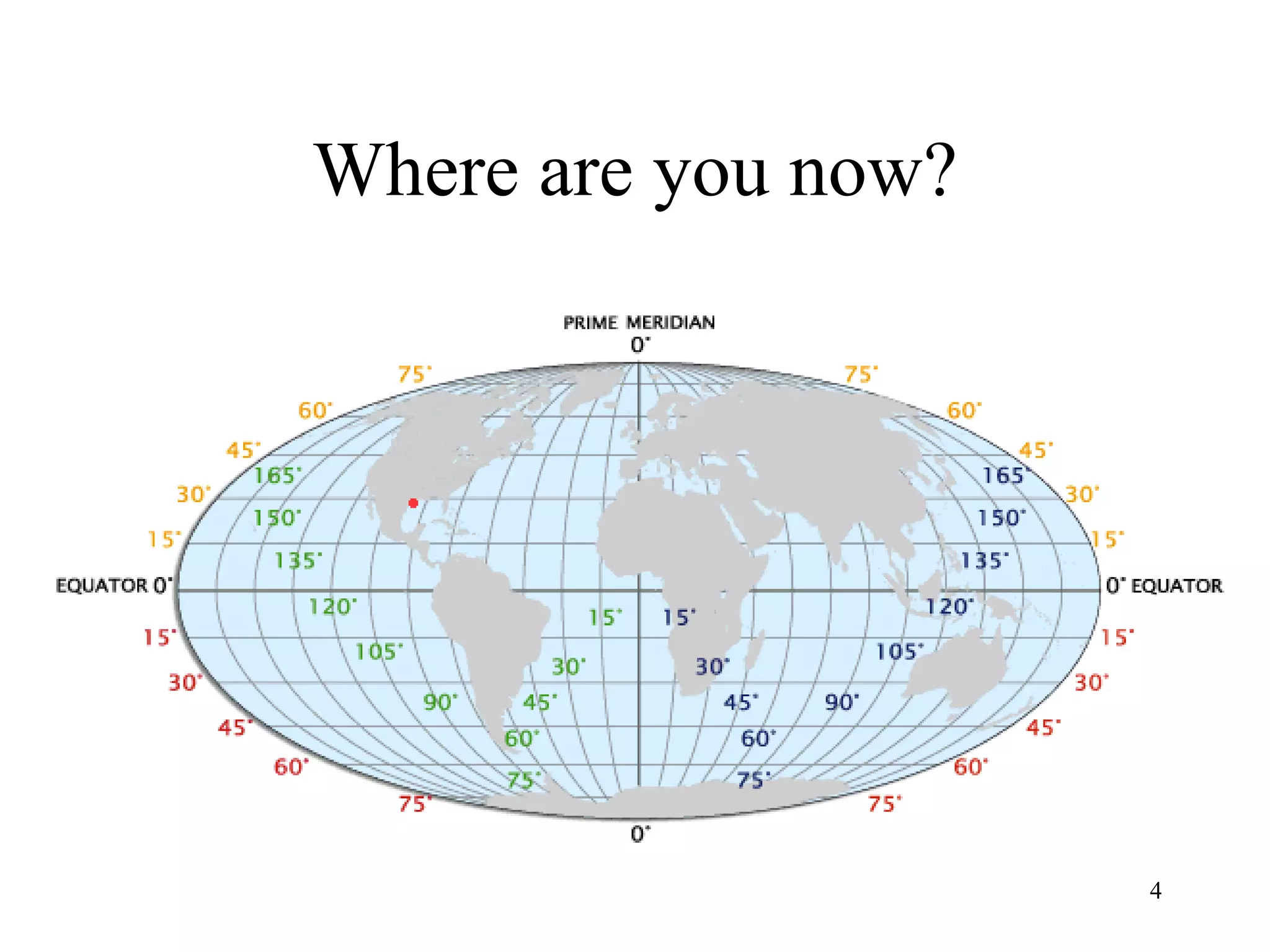
Where are you now?
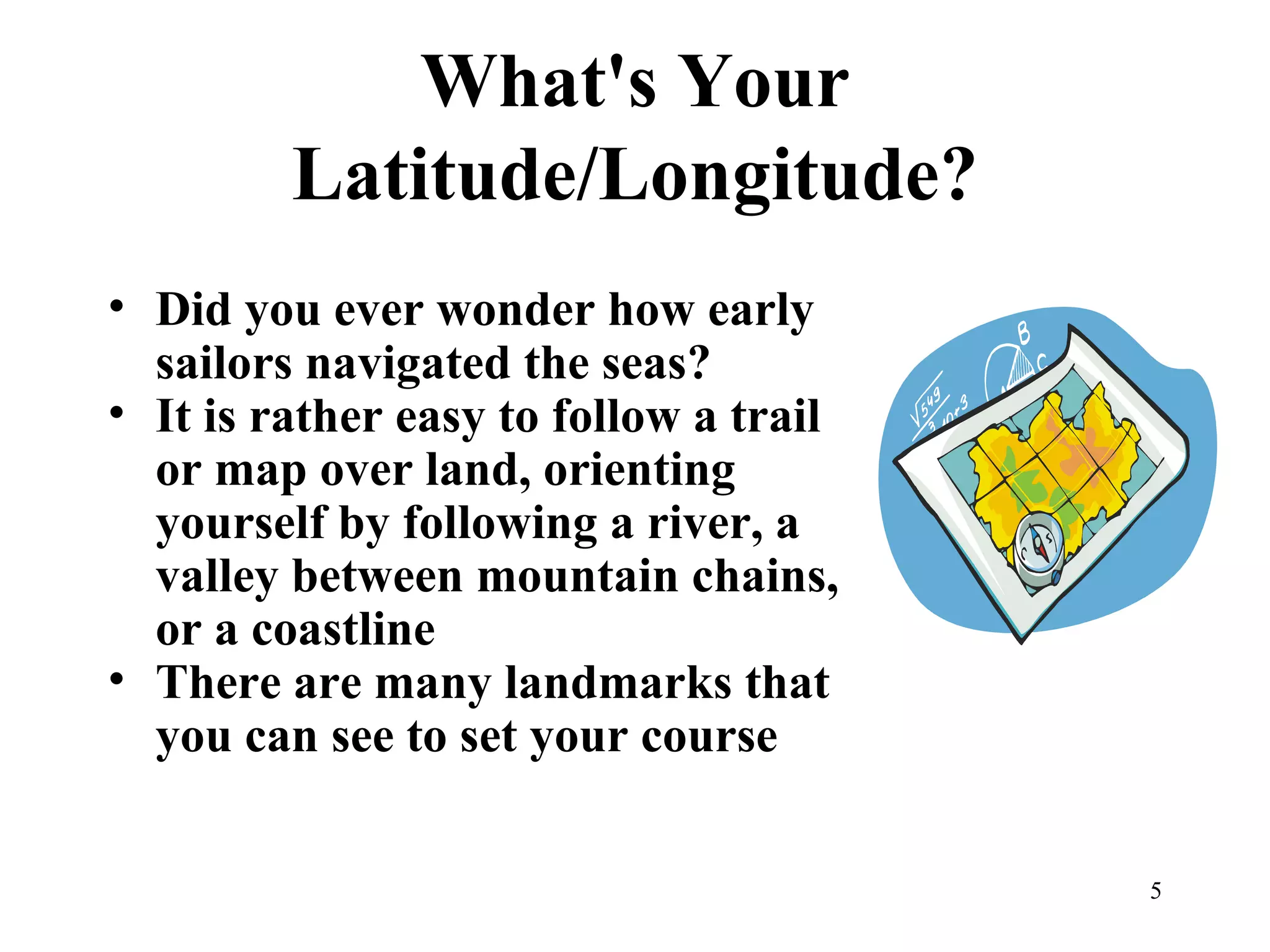
What's Your Latitude/Longitude? Did you ever wonder how early sailors navigated the seas? It is rather easy to follow a trail or map over land, orienting yourself by following a river, a valley between mountain chains, or a coastline There are many landmarks that you can see to set your course
GPS GPS is a constellation of satellites that emit electronic signals while orbiting the Earth A GPS receiver gathers the signals from multiple satellites overhead, then triangulates those signals to calculate its precise location Those receivers can be hand-held or mounted in ships, aircraft and vehicles Global Positioning System
Exercise #1 Question? What  else  does GPS stand for? Answer G reat for  P ublic  S chools
Introduction to Geocaching “ Geo” meaning “Earth” “ Cache” meaning “Storage”
What is Geocaching? Geocaching is a high-tech treasure hunt in the woods using GPS Enter the cache coordinates into your GPSr Try to find it yourself!
Basic Geocaching Find a cache Take something, leave something Sign the logbook and website HAVE FUN!!!! Finding a Cache Sign the Logbook Have Fun!!
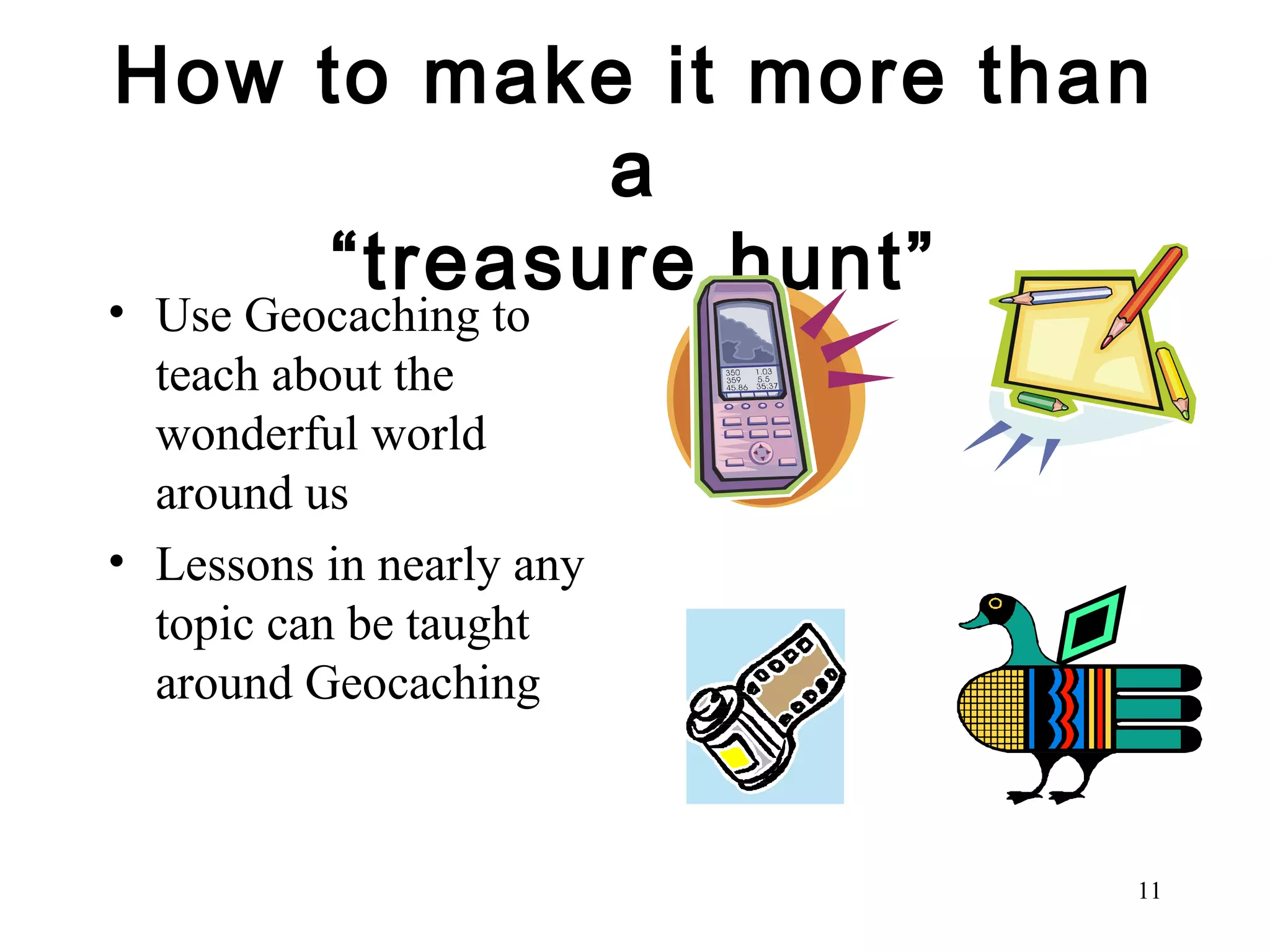
How to make it more than a “treasure hunt” Use Geocaching to teach about the wonderful world around us Lessons in nearly any topic can be taught around Geocaching
Sources www.geocaching.com www.todayscacher.com www.groundspeak.com www.garmin.com Main website for geocaching Articles and Forums On-line Store (Travel Bugs) GPS and other accessories Please contact me for more information Or to schedule a workshop: Mark N. Lewellen [email_address]

Gps Slides Slideshare

  • 1.
    Synopsis of MyGPS Technology Workshop This is a lesson about global navigating and the Global Position System (GPS). We’ll retrace the footsteps and sea passages of prior explorers. We’ll take a look at the history of navigation and explore the Global Positioning System (GPS). Then we’ll use GPS receivers to locate our position on the Earth and go geocaching (which is a high-tech treasure hunt in the woods using GPS). Presented by Mark N. Lewellen [email_address]
  • 2.
    Class Objectives BriefHistory of Navigation How Latitude/Longitude (coordinates) are used Understand the basic concepts of how GPS works Introduction to Geocaching Hands-on experience using a GPS Receiver (GPSr) outdoors Full course is about 3-4 hours but can be scaled back to fit
  • 3.
    These questions andmany more will be answered at my GPS Workshop What would you use to find your way at sea? Hint: It might depend on knowing the time! Did you know the Magnetic Compass was first invented in China but was not originally used for Navigation? Could you figure out your present location with this? Do you know how to use a GPS Garmin Handheld?
  • 4.
  • 5.
    What's Your Latitude/Longitude?Did you ever wonder how early sailors navigated the seas? It is rather easy to follow a trail or map over land, orienting yourself by following a river, a valley between mountain chains, or a coastline There are many landmarks that you can see to set your course
  • 6.
    GPS GPS isa constellation of satellites that emit electronic signals while orbiting the Earth A GPS receiver gathers the signals from multiple satellites overhead, then triangulates those signals to calculate its precise location Those receivers can be hand-held or mounted in ships, aircraft and vehicles Global Positioning System
  • 7.
    Exercise #1 Question?What else does GPS stand for? Answer G reat for P ublic S chools
  • 8.
    Introduction to Geocaching“ Geo” meaning “Earth” “ Cache” meaning “Storage”
  • 9.
    What is Geocaching?Geocaching is a high-tech treasure hunt in the woods using GPS Enter the cache coordinates into your GPSr Try to find it yourself!
  • 10.
    Basic Geocaching Finda cache Take something, leave something Sign the logbook and website HAVE FUN!!!! Finding a Cache Sign the Logbook Have Fun!!
  • 11.
    How to makeit more than a “treasure hunt” Use Geocaching to teach about the wonderful world around us Lessons in nearly any topic can be taught around Geocaching
  • 12.
    Sources www.geocaching.com www.todayscacher.comwww.groundspeak.com www.garmin.com Main website for geocaching Articles and Forums On-line Store (Travel Bugs) GPS and other accessories Please contact me for more information Or to schedule a workshop: Mark N. Lewellen [email_address]