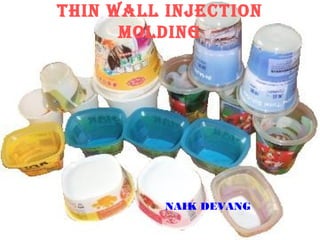
Thin wall injecTion
molding
NAIK DEVANG
why design wiTh PlasTic ?
• Excellent Barrier resistance
• Non Toxic Properties
• Odorless
• Easily formed into complex
shapes
• Wide choice of appearance,
colors and transparencies
maTerial ProPerTy for Thin wall
molding
• Improved flow ability : permits luxury with odd
geometry in shapes
• •Low density & packing weight permits affordable
cost to performance
• •Excellent toughness to withstand against content
• •Optimal combination of flow, impact resistance &
stiffness
• •Stack ability for ease of bulk transport.
• •Excellent stiffness for the freedom of attractive
shape & size
• •Superior clarity & crystalline for the product
visibility.
Thin-Wall injecTion
Molding
• What is “ Thin Wall Injection Molding’’ ?
–• Wall thickness often <0.6 mm
–• Parts with flow ratio >150
–• High Injection pressure
–• High Injection speed
–• Applications for containers in
packaging and storage as well as
disposable use.
FasT cycling Molding – Key
RequiReMenTs
• A mold which is capable to run fast
cycles for a long period
• A capable injection molding machine
• Consistency in Raw Material
• Production environment with essential
well define Auxiliaries
• Cooling water for molding machine
• Fast and precise machine movements
for prolonged period..
• Chilled water for mold
• Energy saving operation
Reasons FoR “Thin Wall injecTion
Molding”
• Less material per part means less
material cost per part
• Thinner wall thickness means
shorter cooling time and therefore
shorter cycle time resulting
towards,
• Higher Productivity
–High Profitability
Machine Selection
criteria
• Higher cavity pressures result in
higher necessary Clamp forces.
• High Injection Pressure with > 2200
bar.
• High acceleration with accumulator-
power > 350 mm/s.
• Faster Response of controller within 2
mili seconds to be synchronized by
Smart hydraulic for the shortest cycle
time.
Machine Setting for “Thin Wall Injection
Molding”
• Nearly no holding or packing necessary
• Often Injection against mechanical stop in
the injection unit with no cushion
• Start injection before clamp force is fully
built for better venting
• Short cooling time
• Optimized machine movements for short
cycle time
• Parallel machine movements
Selection of injection
Unit
• Important factors:
–•Screw torque
–•Melt temperature
–•Injection rate and pressure
–•Cycle time - cooling time
–•Plasticizing rate
–•Repeatability
–•Screw Geometry
Mould Selection criteria for
“thin Wall injection Molding”
• Short runner channels to reduce flow
length and pressure losses
• • Hot runner is preferred compared to
cold runner systems
• • Gate bigger in size because of higher
volume flow through cross section
• • Special arrangement for gating like
cascade or sequential injection; per part
multi-gating
liMitationS of “thin-Wall
injection Molding”
• To high material stress
• • Flow properties of material
• • Residence time for material
because of smaller shot weights
• • Economical situation, related to
investment costs compared
advantages
•thank you
TWIM

Thin wall injection molding

  • 1.
  • 2.
    why design wiThPlasTic ? • Excellent Barrier resistance • Non Toxic Properties • Odorless • Easily formed into complex shapes • Wide choice of appearance, colors and transparencies
  • 3.
    maTerial ProPerTy forThin wall molding • Improved flow ability : permits luxury with odd geometry in shapes • •Low density & packing weight permits affordable cost to performance • •Excellent toughness to withstand against content • •Optimal combination of flow, impact resistance & stiffness • •Stack ability for ease of bulk transport. • •Excellent stiffness for the freedom of attractive shape & size • •Superior clarity & crystalline for the product visibility.
  • 4.
    Thin-Wall injecTion Molding • Whatis “ Thin Wall Injection Molding’’ ? –• Wall thickness often <0.6 mm –• Parts with flow ratio >150 –• High Injection pressure –• High Injection speed –• Applications for containers in packaging and storage as well as disposable use.
  • 5.
    FasT cycling Molding– Key RequiReMenTs • A mold which is capable to run fast cycles for a long period • A capable injection molding machine • Consistency in Raw Material • Production environment with essential well define Auxiliaries • Cooling water for molding machine • Fast and precise machine movements for prolonged period.. • Chilled water for mold • Energy saving operation
  • 6.
    Reasons FoR “ThinWall injecTion Molding” • Less material per part means less material cost per part • Thinner wall thickness means shorter cooling time and therefore shorter cycle time resulting towards, • Higher Productivity –High Profitability
  • 7.
    Machine Selection criteria • Highercavity pressures result in higher necessary Clamp forces. • High Injection Pressure with > 2200 bar. • High acceleration with accumulator- power > 350 mm/s. • Faster Response of controller within 2 mili seconds to be synchronized by Smart hydraulic for the shortest cycle time.
  • 8.
    Machine Setting for“Thin Wall Injection Molding” • Nearly no holding or packing necessary • Often Injection against mechanical stop in the injection unit with no cushion • Start injection before clamp force is fully built for better venting • Short cooling time • Optimized machine movements for short cycle time • Parallel machine movements
  • 9.
    Selection of injection Unit •Important factors: –•Screw torque –•Melt temperature –•Injection rate and pressure –•Cycle time - cooling time –•Plasticizing rate –•Repeatability –•Screw Geometry
  • 10.
    Mould Selection criteriafor “thin Wall injection Molding” • Short runner channels to reduce flow length and pressure losses • • Hot runner is preferred compared to cold runner systems • • Gate bigger in size because of higher volume flow through cross section • • Special arrangement for gating like cascade or sequential injection; per part multi-gating
  • 11.
    liMitationS of “thin-Wall injectionMolding” • To high material stress • • Flow properties of material • • Residence time for material because of smaller shot weights • • Economical situation, related to investment costs compared advantages
  • 12.