CORPORATE TRAINING
AND PLANNING
CALENDERING PROCESS
CORPORATE TRAINING
AND PLANNING
CALENDERING PROCESS
BASIC PRINCIPLE
• Calendaring is the process of squeezing a
plastic melt between two or more counter
rotating cylinders or rolls to form a
continuous film and sheet.
• The art of forming a plastic sheet has
been adopted from the technique of
making paper, metal and rubber in
industries
CORPORATE TRAINING
AND PLANNING
Introduction
• Both rigid and plasticized compounds of
PVC resin can be used in calendaring
process.
• The sheet is formed in the range of 0.1 to
1.0 mm and above thickness. The sheet
can be transparent, colored, embossed,
printed or laminated form.
CORPORATE TRAINING
AND PLANNING
Plastic material and its
Compound
• The PVC resin is generally processed in
calendaring plant, and it needs blending,
mixing and compounding by addition of
suitable chemicals called as additives and
fillers to make compound before
processing in the calendering plant.
• Other then PVC resin ABS, PE, PP and
Styrene are also used for calendering
process.
CORPORATE TRAINING
AND PLANNING
Compound formulation
• PVC resin for rigid compounds made either by the
suspension or bulk polymerization process is best in
the 1.7 to2.0 relative viscosity range.
• Homopolymer grades are used alone and in
combination with 2 to 10 percent acetate copolymer.
• Heat stabilizers are needed, when heated PVC
naturally tends to degrade, first by yellowing then by
turning dark brown and losing its physical properties.
• Many types of stabilizers are used, Metallic salts,
mixed metal salts, organotins and tin mercaptides are
the major categories.
CORPORATE TRAINING
AND PLANNING
Compound formulation
• Stabilizers added to a formula between 0.1 and
5.0 percent to retard degradation by tying up
hydrochloric acid (HCL) generated by the heat of
processing.
• Plasticizers are used to make PVC soft and
flexible but thereby lower melt viscosity, modulus
and transition temperature.
• Two common plasticizer groups are in use such
as Dioctyl phthalate(DOP) and Epoxidized
soyabean oil.
CORPORATE TRAINING
AND PLANNING
Compound formulation
• Impact modifiers are used to absorb shock to
improve impact resistance of PVC compound.
The selection of ABS, MBS, Chlorinated
polyethylene( CPE) or acrylic polymer chosen
on the basis of their impact efficiency, clarity,
weather ability and stress whitening, as well as
their processing characteristics
• Process aids assist stabilization and increase
the melt strength of the sheet during
calendering and post processes such as
thermoforming.
CORPORATE TRAINING
AND PLANNING
Compound formulation
• Lubricants are added to reduce the tendency
of PVC to stick to the hot metal rolls of
Calender
• Lubricants are either external or internal
depending on where they are most effective.
Stearic acid or zinc and inorganic stearates
and soaps are classified as internal lubricant.
Paraffin and polyethylene waxes are external.
CORPORATE TRAINING
AND PLANNING
Coloring materials and
fillers
The pigments or dyes which can
withstand temperatures of processing at
about 180°C should be considered.
Pigments which are suitable for coloring
plastic materials are metallic salts, lead,
Cadmium based and also organic
colors are used.
CORPORATE TRAINING
AND PLANNING
Coloring materials and
fillers
• Inorganic materials in the form of fine powder
can be added in the Plastic compound which
helps to reduce cost and improve properties.
The popular fillers are china clay (a hydrated
aluminum silicate) and the various grades of
chalks (Calcium Carbonates). Also red mud
(hydrated aluminum silicate) is also used as
fillers. The fillers improve the modulus and the
low temperature crack resistance is reduced
CORPORATE TRAINING
AND PLANNING
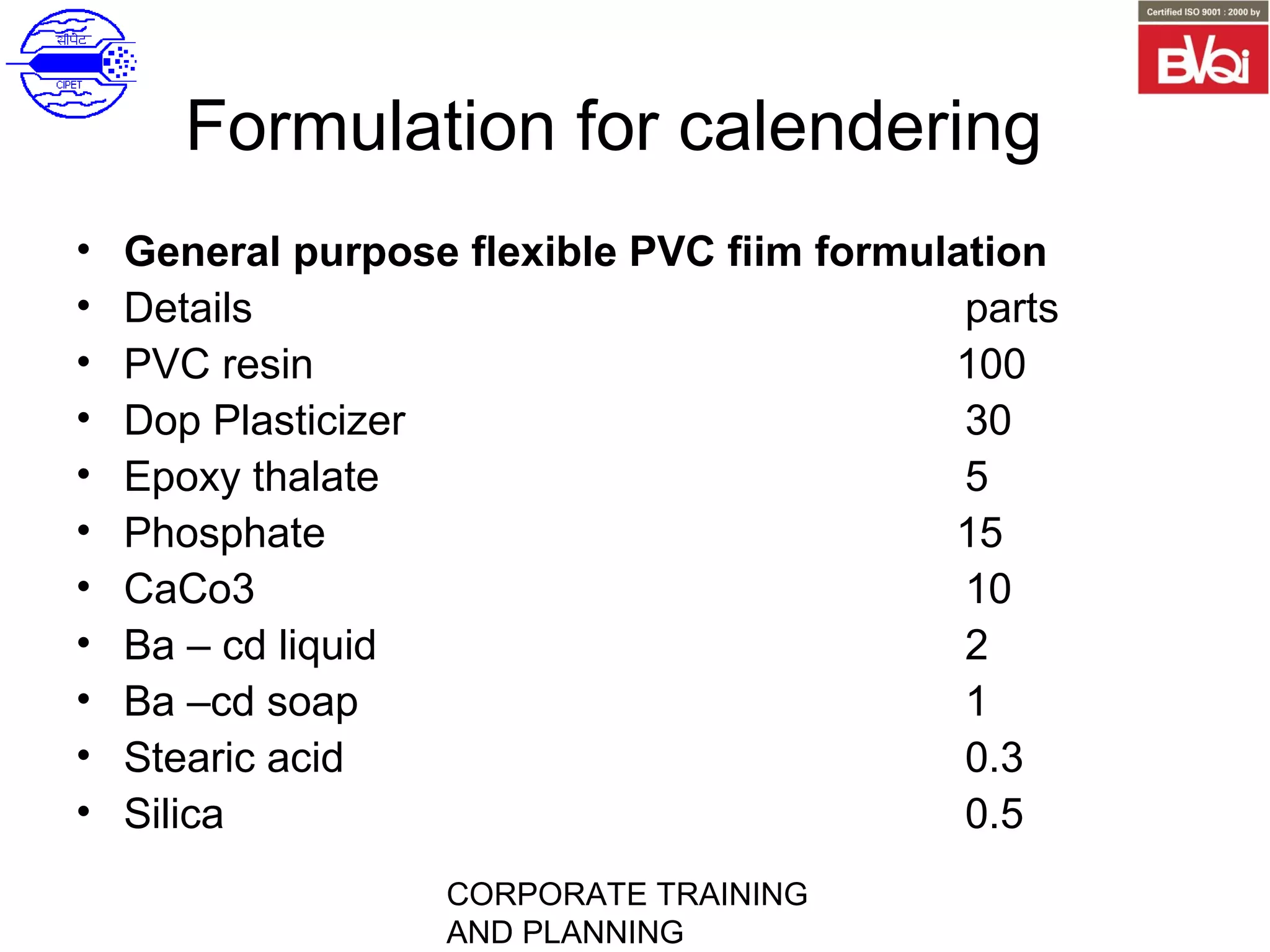
Formulation for calendering
• General purpose flexible PVC fiim formulation
• Details parts
• PVC resin 100
• Dop Plasticizer 30
• Epoxy thalate 5
• Phosphate 15
• CaCo3 10
• Ba – cd liquid 2
• Ba –cd soap 1
• Stearic acid 0.3
• Silica 0.5
CORPORATE TRAINING
AND PLANNING
Compound preparation
(Blending & Fluxing)
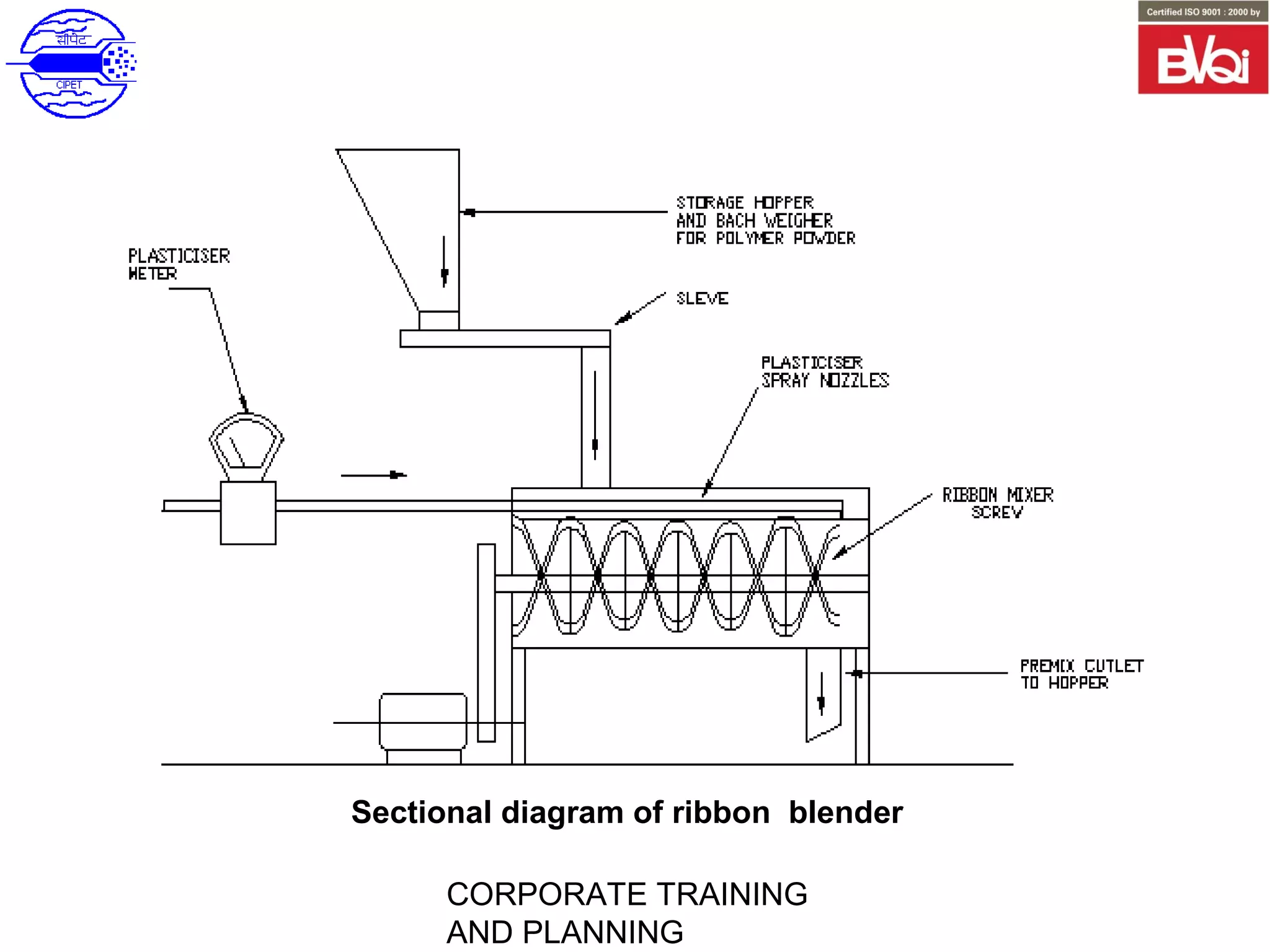
• The resin is premixed and blended with
stabilizers and other additives by using Ribbon
blender or High speed mixture. The premixing is
done up to 80°C for better absorption and
soaking of the resin.
• After blending of the two compounds, it is fed to
a fluxing machine. Fluxing is done under
temperature at about 150°C.
• Fluxing can be done in banbury mixture or a
continuous extruder
• The residence time of the plastic flux at high
temperature must be limited.
CORPORATE TRAINING
AND PLANNING
Sectional diagram of ribbon blender
CORPORATE TRAINING
AND PLANNING
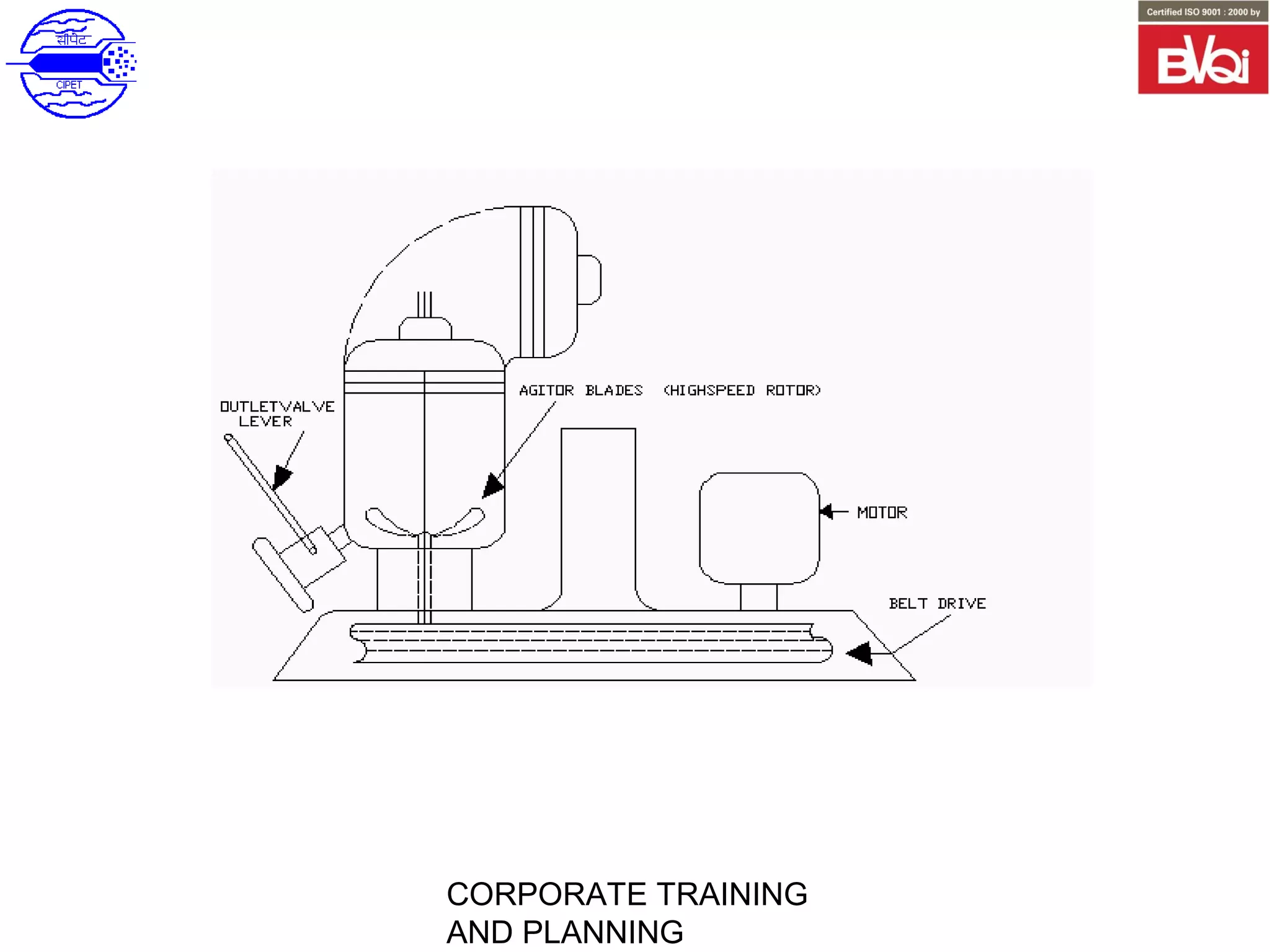
sectional diagram of a high speed mixture
Fig No. 2
CORPORATE TRAINING
AND PLANNING
CORPORATE TRAINING
AND PLANNING
CORPORATE TRAINING
AND PLANNING
Calendering process with
plant details
• The rolls are heated either by steam or hot
oil and roll temperature ranges from 150°
to 180°C.
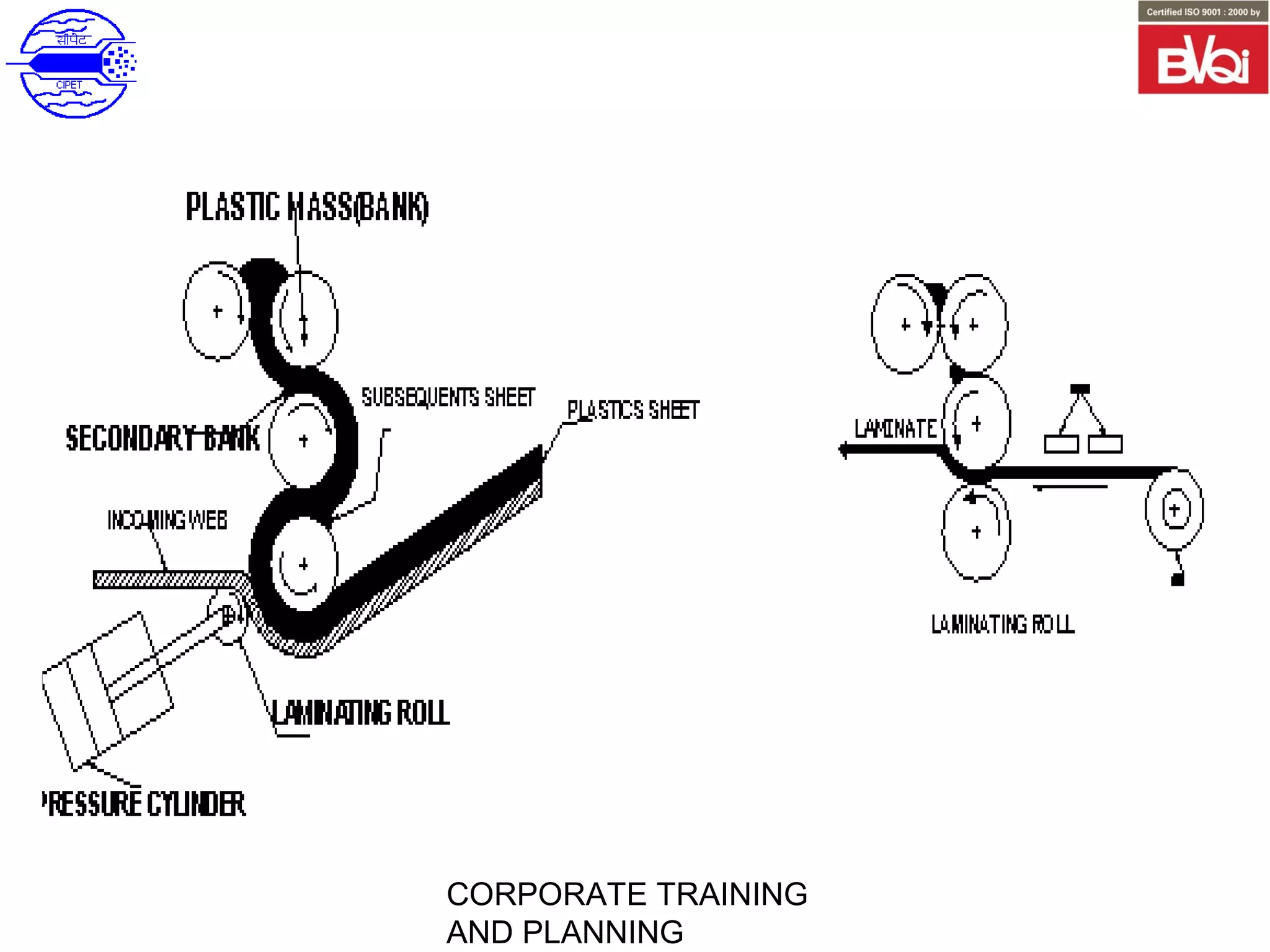
• Fluxed material delivered to the first
calendar nip is regulated to form a rolling
bank. The sheet passing the first nip forms
another bank between the second and
third rolls, at the final nip, the desired
thickness is obtained from the smallest
bank possible to minimize stress in the
sheet.
CORPORATE TRAINING
AND PLANNING
CORPORATE TRAINING
AND PLANNING
Take off roll
Sheet
CORPORATE TRAINING
AND PLANNING
Embossing and laminating
• To create leather like grain or other
surface structure, the hot sheet coming
from the stripper rolls is passed between a
steel roll nipped by a rubber roll that forces
the PVC into the grain.
• To laminate another sheet or a fabric to
the calendared sheet, it may be nipped
against the sheet on the last calendar roll
or a laminating station may be installed in
place of the embossing rolls.
CORPORATE TRAINING
AND PLANNING
Calendering process with
plant details
• After fluxing and gelation, either a two roll
mill or an extruder is used to form strands
or any acceptable forms.
• Melt is maintained and delivered to the
calender at around 140-160°C.
• The calender roll squeezes a plastic melt
into a flat sheet.
CORPORATE TRAINING
AND PLANNING
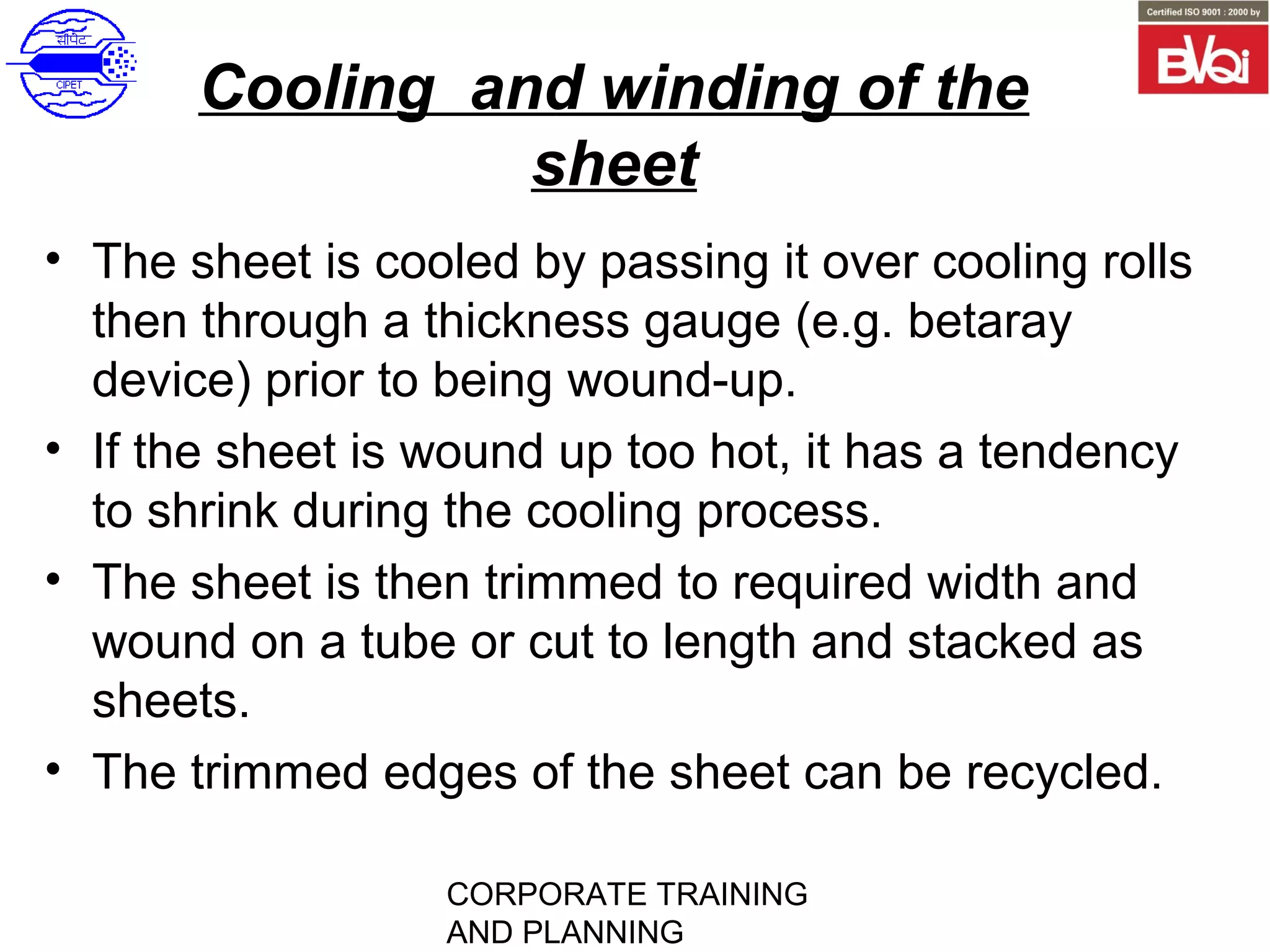
Cooling and winding of the
sheet
• The sheet is cooled by passing it over cooling rolls
then through a thickness gauge (e.g. betaray
device) prior to being wound-up.
• If the sheet is wound up too hot, it has a tendency
to shrink during the cooling process.
• The sheet is then trimmed to required width and
wound on a tube or cut to length and stacked as
sheets.
• The trimmed edges of the sheet can be recycled.
CORPORATE TRAINING
AND PLANNING
Precautions to be taken
during processing
• Preparation of stock for calendering,
conditions on the calender, the take off,
thickness measurements, and control to wind
up.
• Other considerations include whether the
plastic is laminated to a fabric on the
calender. Whether the web is embossed or
slit in line; what finish is required (glossy,
matt or semi-matt).
CORPORATE TRAINING
AND PLANNING
Types of calenders
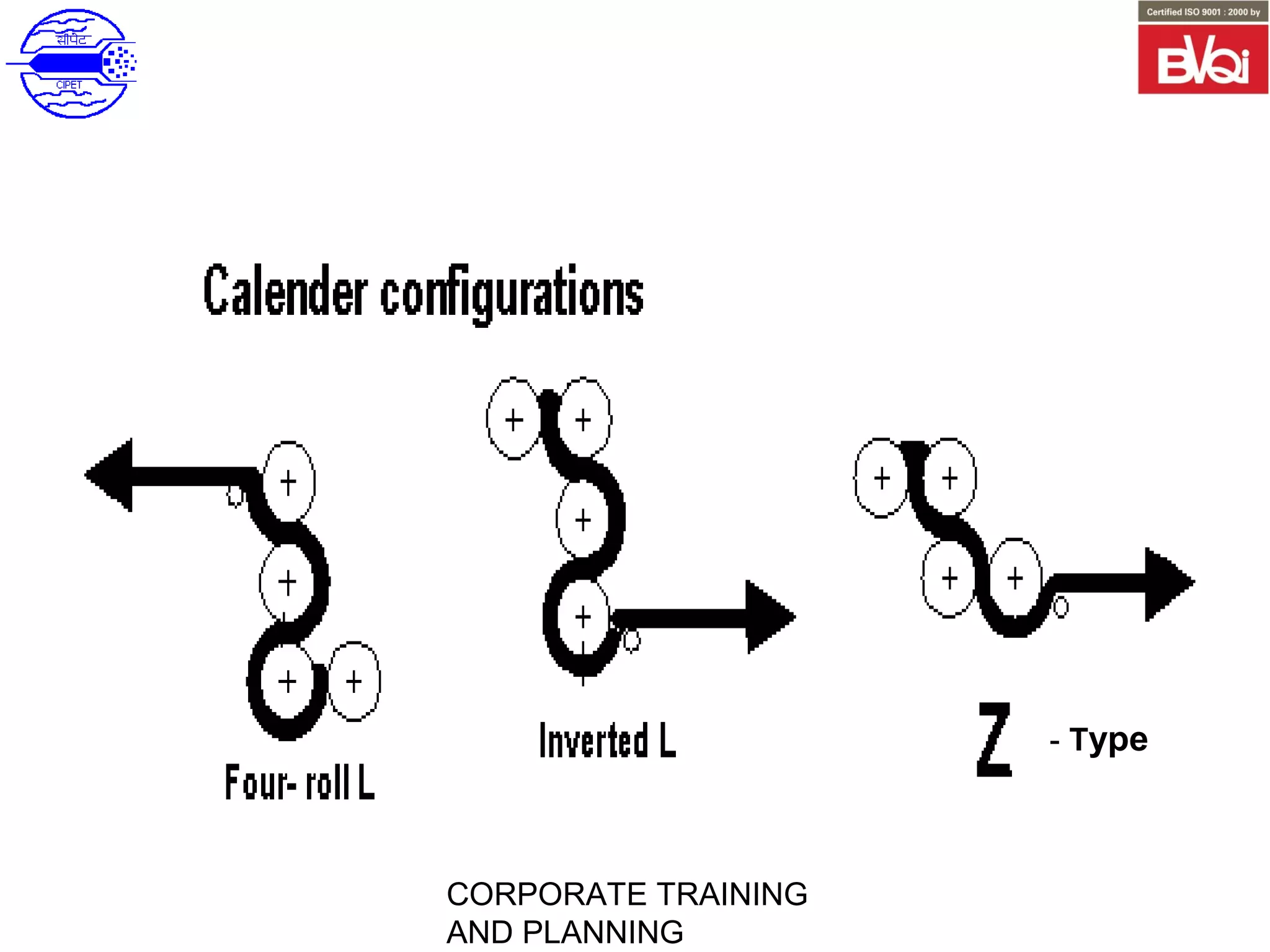
• Superimposed calenders (I –Type)
• Offset calenders (L or Inverted L Type)
• Z type of Calenders
 The ‘ I ‘ type calender rolls has the
advantage of taking up a minimum of floor
space and offers the designer a more
simple problem for the strength of the side
frames and gives good visibility.
CORPORATE TRAINING
AND PLANNING
Types of calenders
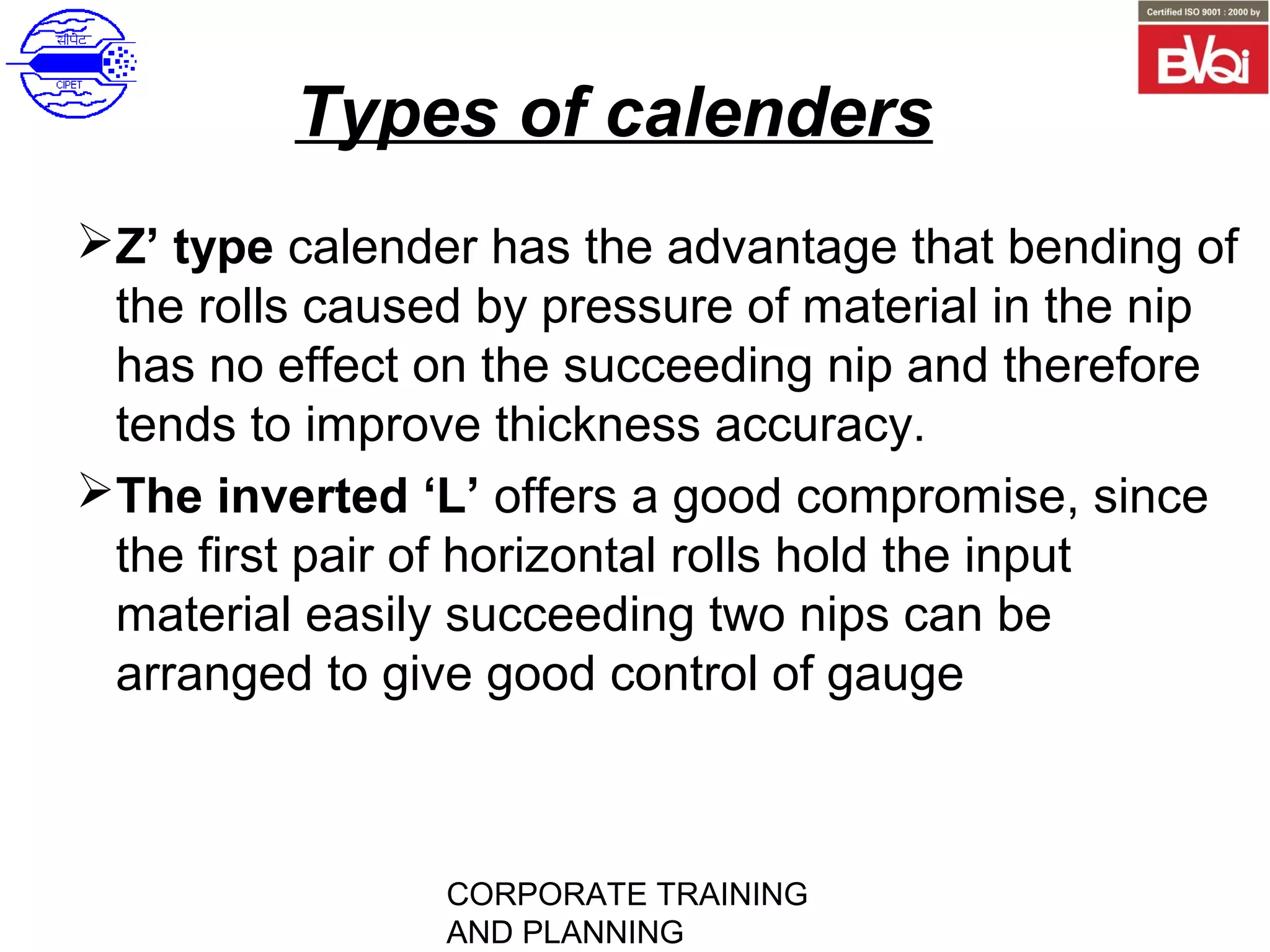
Z’ type calender has the advantage that bending of
the rolls caused by pressure of material in the nip
has no effect on the succeeding nip and therefore
tends to improve thickness accuracy.
The inverted ‘L’ offers a good compromise, since
the first pair of horizontal rolls hold the input
material easily succeeding two nips can be
arranged to give good control of gauge
CORPORATE TRAINING
AND PLANNING
- Type
CORPORATE TRAINING
AND PLANNING
CORPORATE TRAINING
AND PLANNING
Calender rolls and its
Heating arrangement
Calendar rolls are normally made of chilled
cast iron. Calendars are also made with steel
rolls which are more resistant and which
exhibits less deflection under the pressure of
the material in the nip.
Heating system
• High pressure steam is used on calendaring
plants. Working pressure range – 680-1380
KN/m and a temperature range 120-185°C.
CORPORATE TRAINING
AND PLANNING
Typical drilled calendar roll
CORPORATE TRAINING
AND PLANNING
• High pressure hot water (H.P.H.W.),This is
effective method to heat and cool the calender
rolls by circulating H.P.W.H. through each roll.
• The hot oil can be circulated through the rolls to
achieve the high operating temperature.
Processing Parameters
The processing parameter needs to be set
and control are temperature, speed, pressure
and the nip gap.
CORPORATE TRAINING
AND PLANNING
Examples:
Roll No. Roll Temp.(°C) Speed( m/min.)
1st
165 80
2nd
168 82
3rd
171 85
4th
174 88
Nip gap between rollers:
Roll No. Nip Gap
1st
- 2nd
High
2nd
-3rd
Medium
3rd
-4th
Low
CORPORATE TRAINING
AND PLANNING
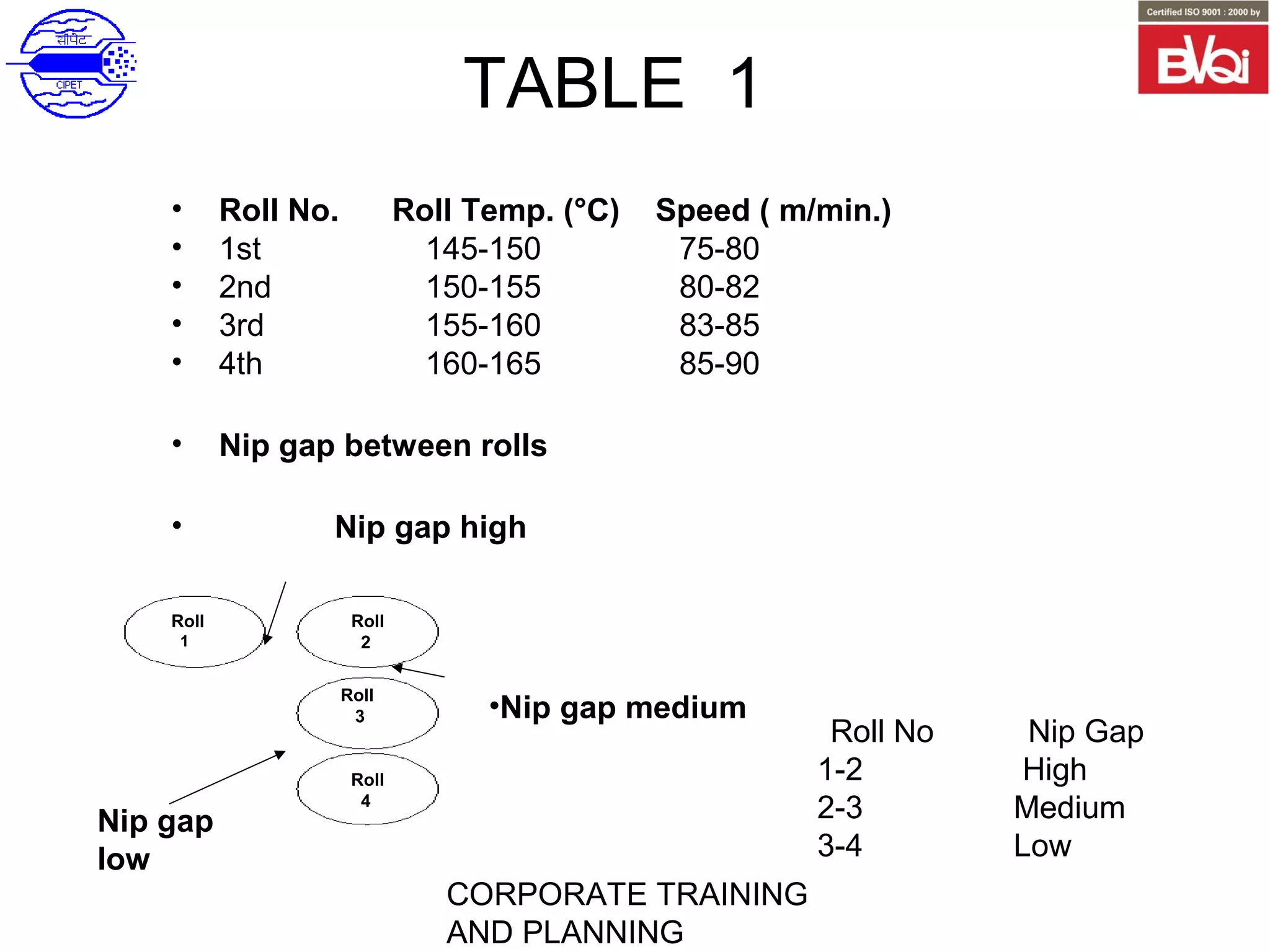
TABLE 1
• Roll No. Roll Temp. (°C) Speed ( m/min.)
• 1st 145-150 75-80
• 2nd 150-155 80-82
• 3rd 155-160 83-85
• 4th 160-165 85-90
• Nip gap between rolls
• Nip gap high
Roll No Nip Gap
1-2 High
2-3 Medium
3-4 Low
Nip gap
low
•Nip gap medium
Roll
1
Roll
2
Roll
3
Roll
4
CORPORATE TRAINING
AND PLANNING
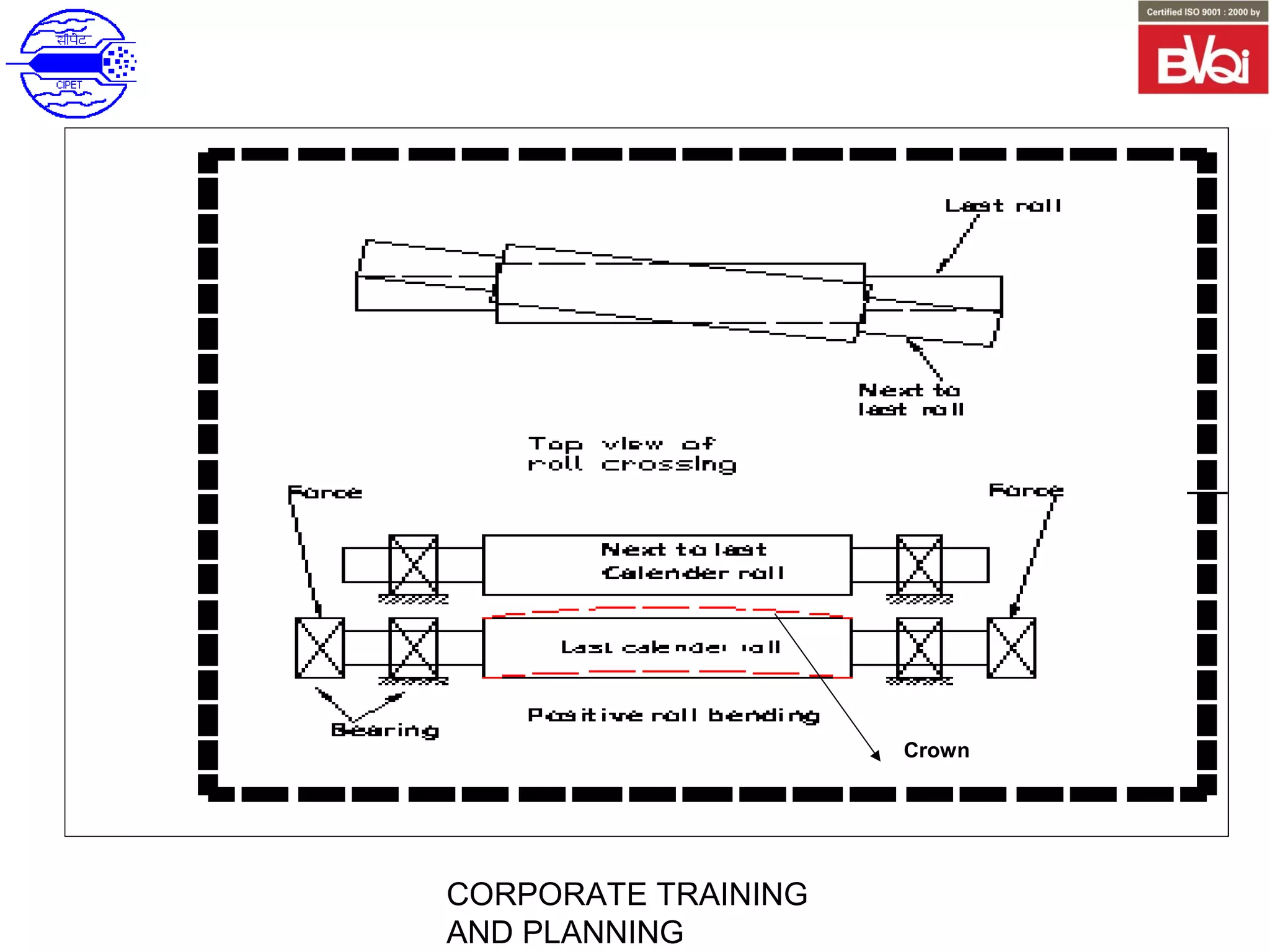
Mechanism against Roll bending
• The calender lines during operation generate very high
forces exerted on the rolls to squeeze the plastic melt into
a thin web or sheet. High forces can bend the rolls.
• Crowned rolls , which have a greater diameter in the
middle than at the edges
• Crossing the rolls slightly, thus increasing the nip of
opening at either end of the rolls.
• Roll bending, where the bending movement is applied to
the end of each roll by having a second bearing on each
roll neck, which is then loaded by a hydraulic cylinder.
CORPORATE TRAINING
AND PLANNING
Crown
CORPORATE TRAINING
AND PLANNING
Troubleshooting in calendaring
process
Faults Causes
Compound formulation The use of wrong ingredients or wrong quantities
Poor gauges Improper temperature
Improper compound
Improper flow
Streaks Poor compounding
improper temperature
Contamination
Thickness variation Bent / deflection in rolls
Mis alignmentt
Film curling or side bending Wrong roll design
Non uniform roll temperature
Discoloration Regrind material Poor compound
Quality of Pigment
CORPORATE TRAINING
AND PLANNING
Advantages of Calendering Process
• Delivery/ output of a calender is high
• Versatile in product design and pattern and permits
lamination & embossing without additional equipment.
• Increase in maximum width of film / sheet.
• Better control of film / sheet thickness.
• The properties are more uniform across the width of the
product.
• Better optical properties due to cooling chilled rolls.
• PVC being heat sensitive material, it is safer by
calendering process than extrusion process.
CORPORATE TRAINING
AND PLANNING
Applications
• The applications include sheets in hospitals,
Printer blankets, rain coats, table cloths, draperies,
water tank liners, wall covers, thermoform sheets,
packaging applications, medical applications,
stationery items, files, folders, luggage bag
applications, counter tops, flooring, upholstery,
automobiles applications, and Toys.
• They may be heat-sealed, heat shrunk for blister
packaging or used plain as wrapping materials,
mulches, swimming pool liners, reservoir films,
vapor barriers.

7. calendering process (1)

  • 1.
  • 2.
    CORPORATE TRAINING AND PLANNING CALENDERINGPROCESS BASIC PRINCIPLE • Calendaring is the process of squeezing a plastic melt between two or more counter rotating cylinders or rolls to form a continuous film and sheet. • The art of forming a plastic sheet has been adopted from the technique of making paper, metal and rubber in industries
  • 3.
    CORPORATE TRAINING AND PLANNING Introduction •Both rigid and plasticized compounds of PVC resin can be used in calendaring process. • The sheet is formed in the range of 0.1 to 1.0 mm and above thickness. The sheet can be transparent, colored, embossed, printed or laminated form.
  • 4.
    CORPORATE TRAINING AND PLANNING Plasticmaterial and its Compound • The PVC resin is generally processed in calendaring plant, and it needs blending, mixing and compounding by addition of suitable chemicals called as additives and fillers to make compound before processing in the calendering plant. • Other then PVC resin ABS, PE, PP and Styrene are also used for calendering process.
  • 5.
    CORPORATE TRAINING AND PLANNING Compoundformulation • PVC resin for rigid compounds made either by the suspension or bulk polymerization process is best in the 1.7 to2.0 relative viscosity range. • Homopolymer grades are used alone and in combination with 2 to 10 percent acetate copolymer. • Heat stabilizers are needed, when heated PVC naturally tends to degrade, first by yellowing then by turning dark brown and losing its physical properties. • Many types of stabilizers are used, Metallic salts, mixed metal salts, organotins and tin mercaptides are the major categories.
  • 6.
    CORPORATE TRAINING AND PLANNING Compoundformulation • Stabilizers added to a formula between 0.1 and 5.0 percent to retard degradation by tying up hydrochloric acid (HCL) generated by the heat of processing. • Plasticizers are used to make PVC soft and flexible but thereby lower melt viscosity, modulus and transition temperature. • Two common plasticizer groups are in use such as Dioctyl phthalate(DOP) and Epoxidized soyabean oil.
  • 7.
    CORPORATE TRAINING AND PLANNING Compoundformulation • Impact modifiers are used to absorb shock to improve impact resistance of PVC compound. The selection of ABS, MBS, Chlorinated polyethylene( CPE) or acrylic polymer chosen on the basis of their impact efficiency, clarity, weather ability and stress whitening, as well as their processing characteristics • Process aids assist stabilization and increase the melt strength of the sheet during calendering and post processes such as thermoforming.
  • 8.
    CORPORATE TRAINING AND PLANNING Compoundformulation • Lubricants are added to reduce the tendency of PVC to stick to the hot metal rolls of Calender • Lubricants are either external or internal depending on where they are most effective. Stearic acid or zinc and inorganic stearates and soaps are classified as internal lubricant. Paraffin and polyethylene waxes are external.
  • 9.
    CORPORATE TRAINING AND PLANNING Coloringmaterials and fillers The pigments or dyes which can withstand temperatures of processing at about 180°C should be considered. Pigments which are suitable for coloring plastic materials are metallic salts, lead, Cadmium based and also organic colors are used.
  • 10.
    CORPORATE TRAINING AND PLANNING Coloringmaterials and fillers • Inorganic materials in the form of fine powder can be added in the Plastic compound which helps to reduce cost and improve properties. The popular fillers are china clay (a hydrated aluminum silicate) and the various grades of chalks (Calcium Carbonates). Also red mud (hydrated aluminum silicate) is also used as fillers. The fillers improve the modulus and the low temperature crack resistance is reduced
  • 11.
    CORPORATE TRAINING AND PLANNING Formulationfor calendering • General purpose flexible PVC fiim formulation • Details parts • PVC resin 100 • Dop Plasticizer 30 • Epoxy thalate 5 • Phosphate 15 • CaCo3 10 • Ba – cd liquid 2 • Ba –cd soap 1 • Stearic acid 0.3 • Silica 0.5
  • 12.
    CORPORATE TRAINING AND PLANNING Compoundpreparation (Blending & Fluxing) • The resin is premixed and blended with stabilizers and other additives by using Ribbon blender or High speed mixture. The premixing is done up to 80°C for better absorption and soaking of the resin. • After blending of the two compounds, it is fed to a fluxing machine. Fluxing is done under temperature at about 150°C. • Fluxing can be done in banbury mixture or a continuous extruder • The residence time of the plastic flux at high temperature must be limited.
  • 13.
  • 14.
    CORPORATE TRAINING AND PLANNING sectionaldiagram of a high speed mixture Fig No. 2
  • 15.
  • 16.
  • 17.
    CORPORATE TRAINING AND PLANNING Calenderingprocess with plant details • The rolls are heated either by steam or hot oil and roll temperature ranges from 150° to 180°C. • Fluxed material delivered to the first calendar nip is regulated to form a rolling bank. The sheet passing the first nip forms another bank between the second and third rolls, at the final nip, the desired thickness is obtained from the smallest bank possible to minimize stress in the sheet.
  • 18.
  • 19.
  • 20.
    CORPORATE TRAINING AND PLANNING Embossingand laminating • To create leather like grain or other surface structure, the hot sheet coming from the stripper rolls is passed between a steel roll nipped by a rubber roll that forces the PVC into the grain. • To laminate another sheet or a fabric to the calendared sheet, it may be nipped against the sheet on the last calendar roll or a laminating station may be installed in place of the embossing rolls.
  • 21.
    CORPORATE TRAINING AND PLANNING Calenderingprocess with plant details • After fluxing and gelation, either a two roll mill or an extruder is used to form strands or any acceptable forms. • Melt is maintained and delivered to the calender at around 140-160°C. • The calender roll squeezes a plastic melt into a flat sheet.
  • 22.
    CORPORATE TRAINING AND PLANNING Coolingand winding of the sheet • The sheet is cooled by passing it over cooling rolls then through a thickness gauge (e.g. betaray device) prior to being wound-up. • If the sheet is wound up too hot, it has a tendency to shrink during the cooling process. • The sheet is then trimmed to required width and wound on a tube or cut to length and stacked as sheets. • The trimmed edges of the sheet can be recycled.
  • 23.
    CORPORATE TRAINING AND PLANNING Precautionsto be taken during processing • Preparation of stock for calendering, conditions on the calender, the take off, thickness measurements, and control to wind up. • Other considerations include whether the plastic is laminated to a fabric on the calender. Whether the web is embossed or slit in line; what finish is required (glossy, matt or semi-matt).
  • 24.
    CORPORATE TRAINING AND PLANNING Typesof calenders • Superimposed calenders (I –Type) • Offset calenders (L or Inverted L Type) • Z type of Calenders  The ‘ I ‘ type calender rolls has the advantage of taking up a minimum of floor space and offers the designer a more simple problem for the strength of the side frames and gives good visibility.
  • 25.
    CORPORATE TRAINING AND PLANNING Typesof calenders Z’ type calender has the advantage that bending of the rolls caused by pressure of material in the nip has no effect on the succeeding nip and therefore tends to improve thickness accuracy. The inverted ‘L’ offers a good compromise, since the first pair of horizontal rolls hold the input material easily succeeding two nips can be arranged to give good control of gauge
  • 26.
  • 27.
  • 28.
    CORPORATE TRAINING AND PLANNING Calenderrolls and its Heating arrangement Calendar rolls are normally made of chilled cast iron. Calendars are also made with steel rolls which are more resistant and which exhibits less deflection under the pressure of the material in the nip. Heating system • High pressure steam is used on calendaring plants. Working pressure range – 680-1380 KN/m and a temperature range 120-185°C.
  • 29.
  • 30.
    CORPORATE TRAINING AND PLANNING •High pressure hot water (H.P.H.W.),This is effective method to heat and cool the calender rolls by circulating H.P.W.H. through each roll. • The hot oil can be circulated through the rolls to achieve the high operating temperature. Processing Parameters The processing parameter needs to be set and control are temperature, speed, pressure and the nip gap.
  • 31.
    CORPORATE TRAINING AND PLANNING Examples: RollNo. Roll Temp.(°C) Speed( m/min.) 1st 165 80 2nd 168 82 3rd 171 85 4th 174 88 Nip gap between rollers: Roll No. Nip Gap 1st - 2nd High 2nd -3rd Medium 3rd -4th Low
  • 32.
    CORPORATE TRAINING AND PLANNING TABLE1 • Roll No. Roll Temp. (°C) Speed ( m/min.) • 1st 145-150 75-80 • 2nd 150-155 80-82 • 3rd 155-160 83-85 • 4th 160-165 85-90 • Nip gap between rolls • Nip gap high Roll No Nip Gap 1-2 High 2-3 Medium 3-4 Low Nip gap low •Nip gap medium Roll 1 Roll 2 Roll 3 Roll 4
  • 33.
    CORPORATE TRAINING AND PLANNING Mechanismagainst Roll bending • The calender lines during operation generate very high forces exerted on the rolls to squeeze the plastic melt into a thin web or sheet. High forces can bend the rolls. • Crowned rolls , which have a greater diameter in the middle than at the edges • Crossing the rolls slightly, thus increasing the nip of opening at either end of the rolls. • Roll bending, where the bending movement is applied to the end of each roll by having a second bearing on each roll neck, which is then loaded by a hydraulic cylinder.
  • 34.
  • 35.
    CORPORATE TRAINING AND PLANNING Troubleshootingin calendaring process Faults Causes Compound formulation The use of wrong ingredients or wrong quantities Poor gauges Improper temperature Improper compound Improper flow Streaks Poor compounding improper temperature Contamination Thickness variation Bent / deflection in rolls Mis alignmentt Film curling or side bending Wrong roll design Non uniform roll temperature Discoloration Regrind material Poor compound Quality of Pigment
  • 36.
    CORPORATE TRAINING AND PLANNING Advantagesof Calendering Process • Delivery/ output of a calender is high • Versatile in product design and pattern and permits lamination & embossing without additional equipment. • Increase in maximum width of film / sheet. • Better control of film / sheet thickness. • The properties are more uniform across the width of the product. • Better optical properties due to cooling chilled rolls. • PVC being heat sensitive material, it is safer by calendering process than extrusion process.
  • 37.
    CORPORATE TRAINING AND PLANNING Applications •The applications include sheets in hospitals, Printer blankets, rain coats, table cloths, draperies, water tank liners, wall covers, thermoform sheets, packaging applications, medical applications, stationery items, files, folders, luggage bag applications, counter tops, flooring, upholstery, automobiles applications, and Toys. • They may be heat-sealed, heat shrunk for blister packaging or used plain as wrapping materials, mulches, swimming pool liners, reservoir films, vapor barriers.