Tuesday, August 1
- an investigation about a
scientific problem (question)
- a problem-solving process
using the scientific method
GOALS
IP
8/19/2014 3
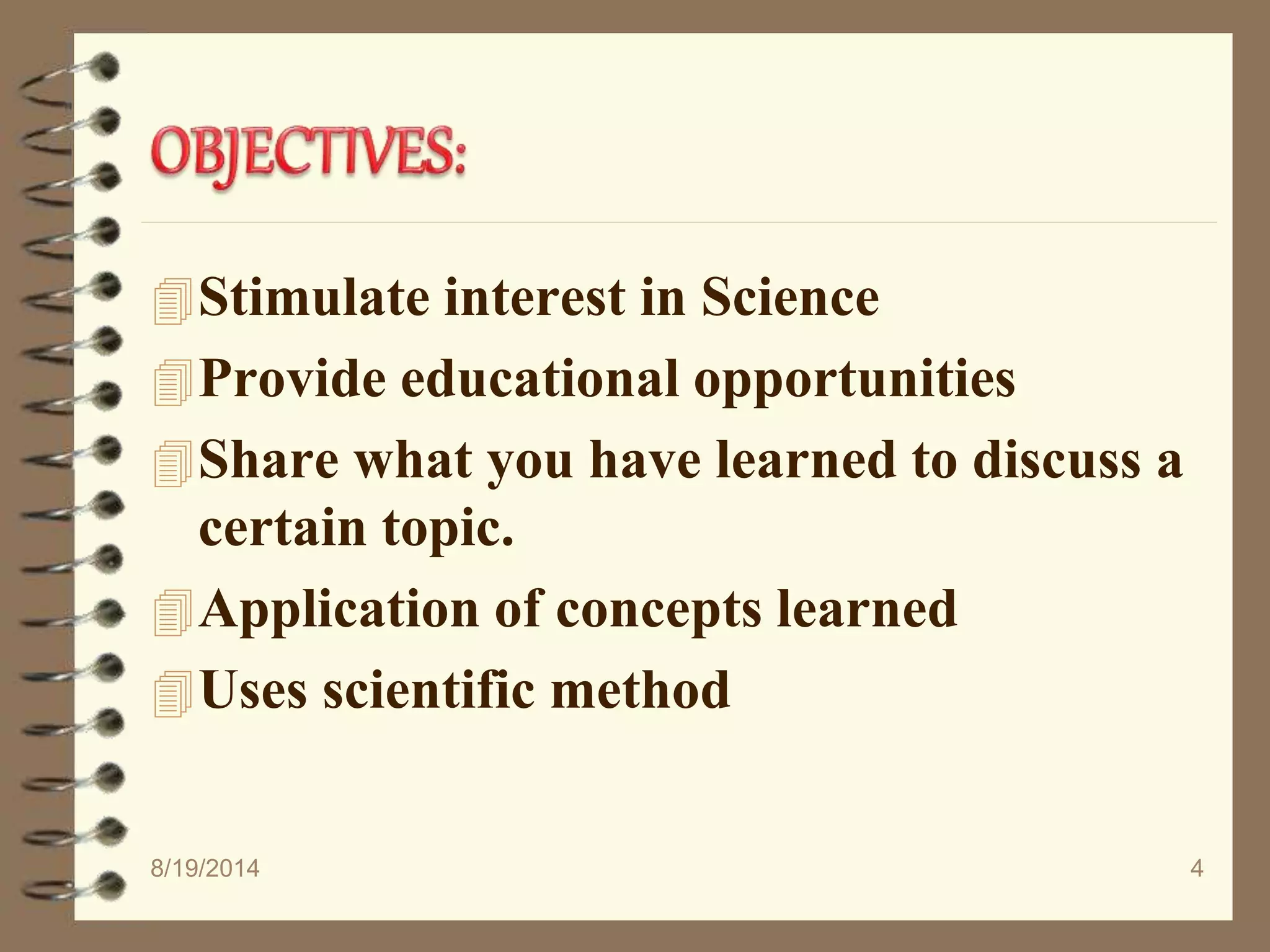
Stimulate interest in Science
Provide educational opportunities
Share what you have learned to discuss a
certain topic.
Application of concepts learned
Uses scientific method
8/19/2014 4
8/19/2014 5
8/19/2014 6
Parts of a Scientific Research Paper
Title Page
Abstract
Acknowledgment
Table of Contents
CHAPTER I-INTRODUCTION
A. Background of the Study
B. Statement of the Problem
C. Hypothesis
D. Significance of the Study
E. Scope and Limitation
F. Definition of Terms
CHAPTER II- REVIEW OF RELATED LITERATURE
CHAPTER III-METHODOLOGY
A. Materials
B. Procedures
CHAPTER IV-RESULTS AND DISCUSSION
A. Findings
B. Analysis of Data
CHAPTER V- CONCLUSION
CHAPTER VI-RECOMMENDATION
Bibliography
8/19/2014 7
8/19/2014 8
8/19/2014 9
8/19/2014 10
accurate
rules in grammar, correct spelling & correct
punctuation.
I, MY, ME & MINE
PAST
8/19/2014 11
PHASE I : THE PROPOSAL (20 points)
The proposal is a detailed written plan of how the project will
be done. It is like designing an experiment. Since it is yet to be
done, the future tense of the verb is used.
PHASE II: THE INVESTIGATION (20 points)
As soon as your proposal is approved you can
now start investigating. Your procedure will be your
guide. Keep track of all your observations and data
by placing them on a table. Document also your
works by photographs, videos, etc.
8/19/2014 12
PHASE III. THE OUTPUT (60 points)
After conducting the investigation you are now ready to
organize your gathered data and present your findings. The output
has three levels:
1. THE WRITTEN REPORT (20 points)
A recall of all the things you did to solve your
problem. The mode of the verb is in the past tense.
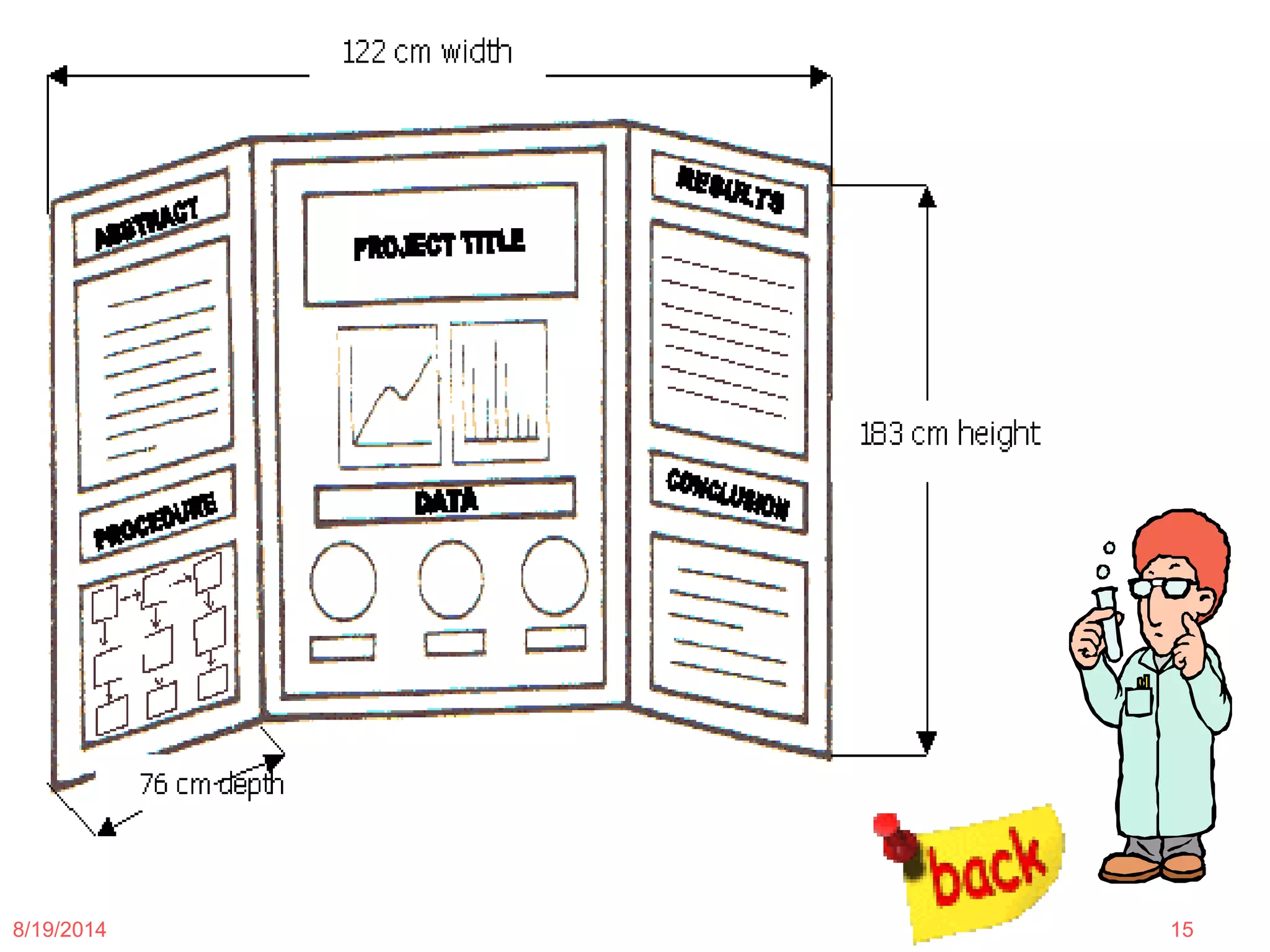
2. THE EXHIBIT (20 points)
It is a showcase of your IP mounted on a board.
It must attract viewers so that they may get interested
to your IP.
3. THE ORAL DEFENSE (20 points)
You will present your work to a panel of judges and
they will ask you questions about your project.
8/19/2014 13
TASKS TARGET
DATE
TEACHER’S
DEADLINE
1. Submission of Problem and Title Aug. 16
2. Submission of Chapter 1 Oct 15
3. Submission of Chapter 2 Oct 31
4. Submission of Chapter 3 Nov 19
5. Investigation Period ASAP
6. Submission of Chapter 4 Dec 3
7. Submission of Chapters 5&6 Dec 14
8. Abstract, Table of Contents,
Acknowledgement, Bibliography
Jan 7
9. Oral Defense Jan 14- Feb 8
Feb 18 Final Paper
Feb 25-28 Exhibit
8/19/2014 14
Ethics Statement…
Scientific fraud and misconduct
are not condoned at any level of
research or competition. Plagiarism, use
or presentation of other researcher's
work as one's own forgery of approval
signature and fabrication or falsification
of data will not be tolerated. Fraudulent
projects will fail to qualify for
GRADUATION.
8/19/2014 15
8/19/2014 16
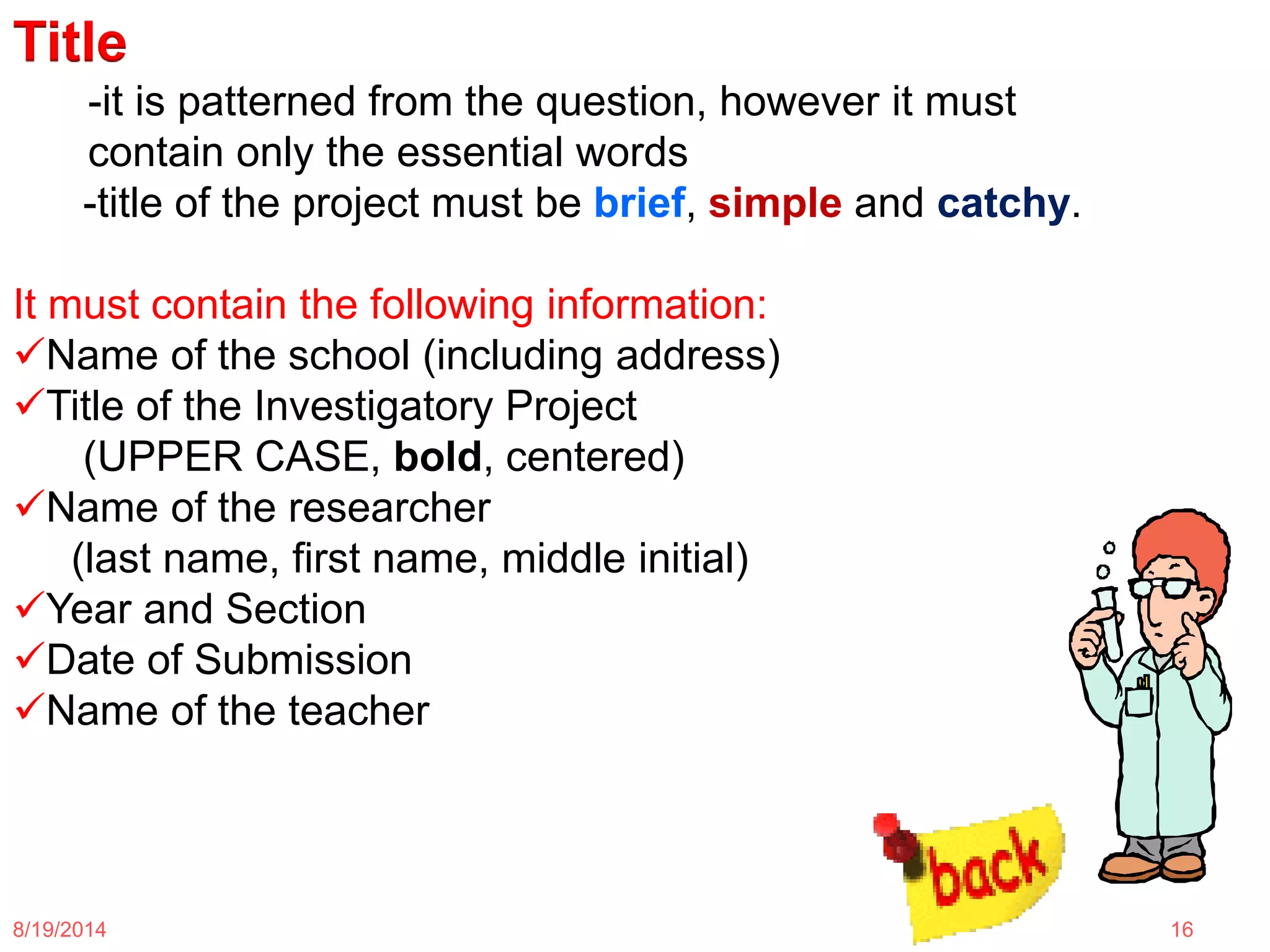
Title
-it is patterned from the question, however it must
contain only the essential words
-title of the project must be brief, simple and catchy.
It must contain the following information:
Name of the school (including address)
Title of the Investigatory Project
(UPPER CASE, bold, centered)
Name of the researcher
(last name, first name, middle initial)
Year and Section
Date of Submission
Name of the teacher
8/19/2014 17
Abstract
-should consist of short, concise descriptions of
the problem & its solution. It must be one page
only, single-spaced (with a maximum of 250
words), typewritten in Times New Roman style; font size
11.
Sometimes judges do not have time to study all the details of
your work, they only read the abstract, thus it’s called the
SHOW WINDOW of your project.
It must also state the following:
Purpose, Procedure used, Results, Conclusion
8/19/2014 18
Acknowledgement
-contains the names of people & agencies
that helped in the conduct of the work
described.
8/19/2014 19
Table of Contents
-lists the different parts of the whole report
with the
corresponding page number of each part.
The
wording & grammar of the chapter titles,
heading
& title of tables & figures should be
consistent.
8/19/2014 20
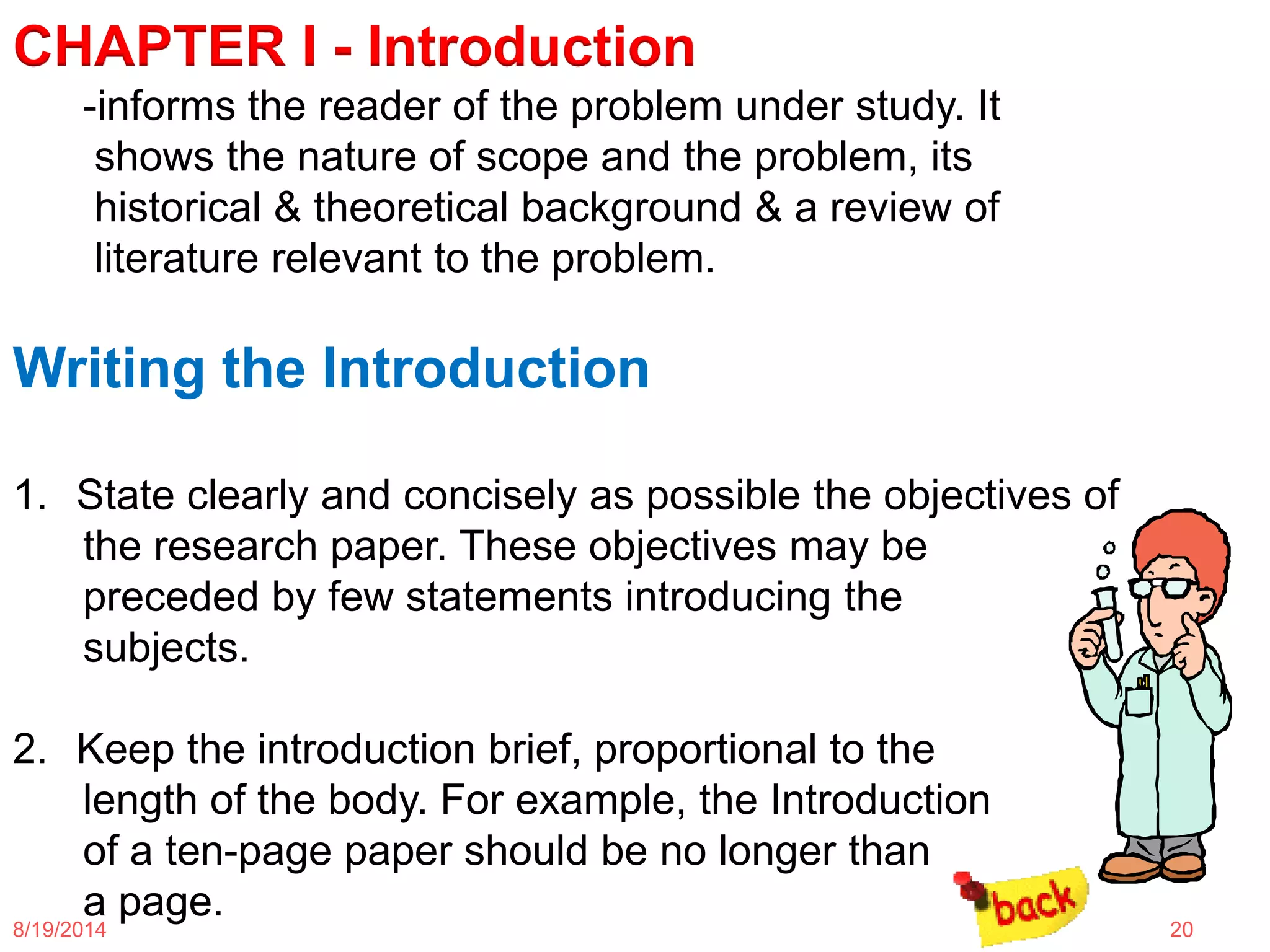
CHAPTER I - Introduction
-informs the reader of the problem under study. It
shows the nature of scope and the problem, its
historical & theoretical background & a review of
literature relevant to the problem.
Writing the Introduction
1. State clearly and concisely as possible the objectives of
the research paper. These objectives may be
preceded by few statements introducing the
subjects.
2. Keep the introduction brief, proportional to the
length of the body. For example, the Introduction
of a ten-page paper should be no longer than
a page.
8/19/2014 21
Background of the Study
-states the rationale of the study. It explains briefly why
the investigator chose this study to work on.
Rationale or the underlying principle should answer the
following questions:
How did you arrive at that kind of problem
Why do you like to investigate that kind of problem
where in fact there are hundreds of problems out
there?
8/19/2014 22
Statement of the Problem
-it is stated as a question/scientific inquiry
-the nature & scope of the problem should be presented
with clarity
What are the characteristics of a good problem?
It should be of great interest to you.
It should have practical value to you.
It should not be over researched.
 It should be within your experience.
It can be finished within an allotted time.
It should not carry legal or moral impediments.
8/19/2014 23
Hypothesis-tentative explanation
3 Types
 Null
 Alternative
 If and Then (to be used in our IP)
8/19/2014 24
Significance of the Study
-the importance of the study is explained in this part
8/19/2014 25
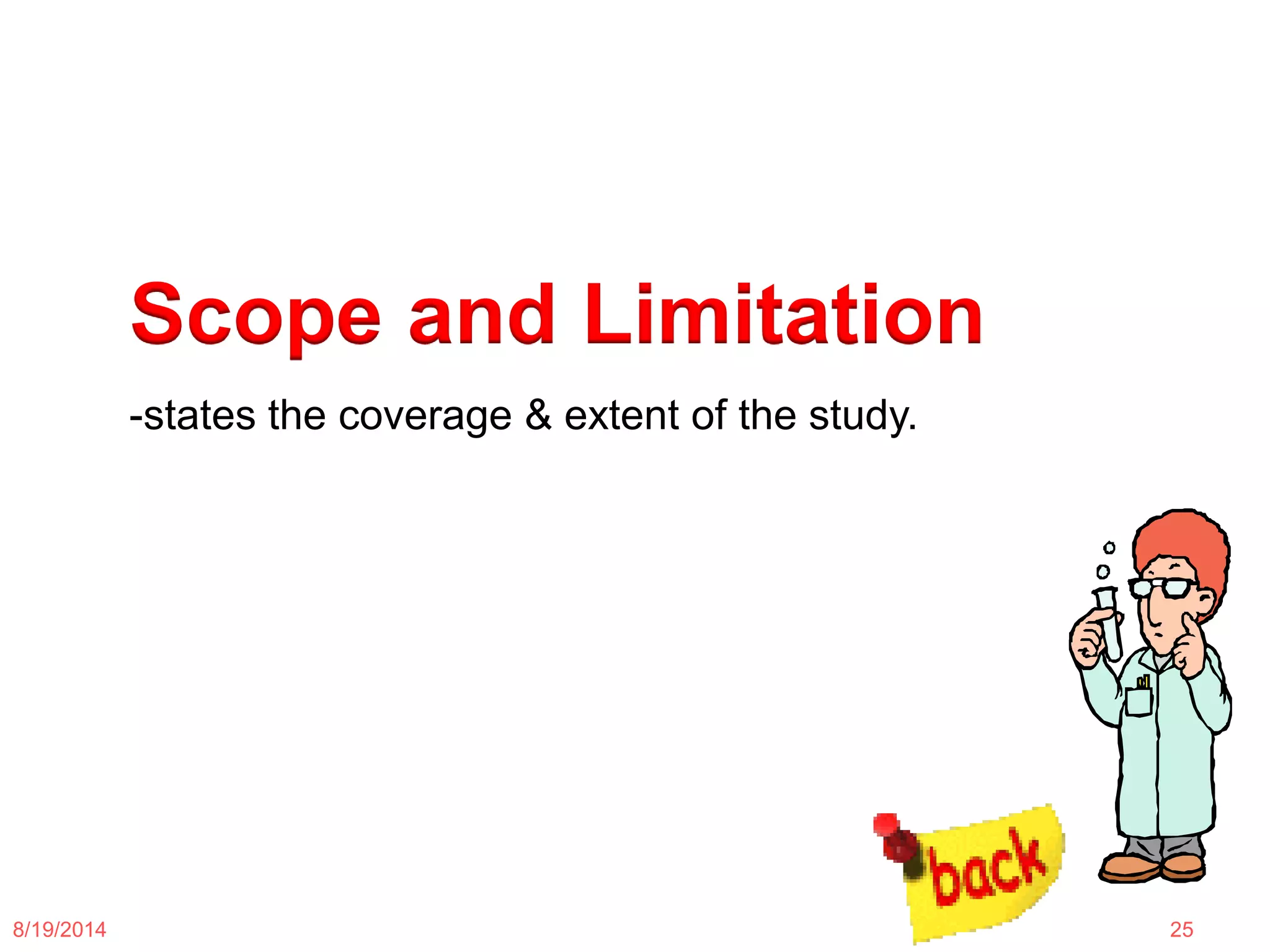
Scope and Limitation
-states the coverage & extent of the study.
8/19/2014 26
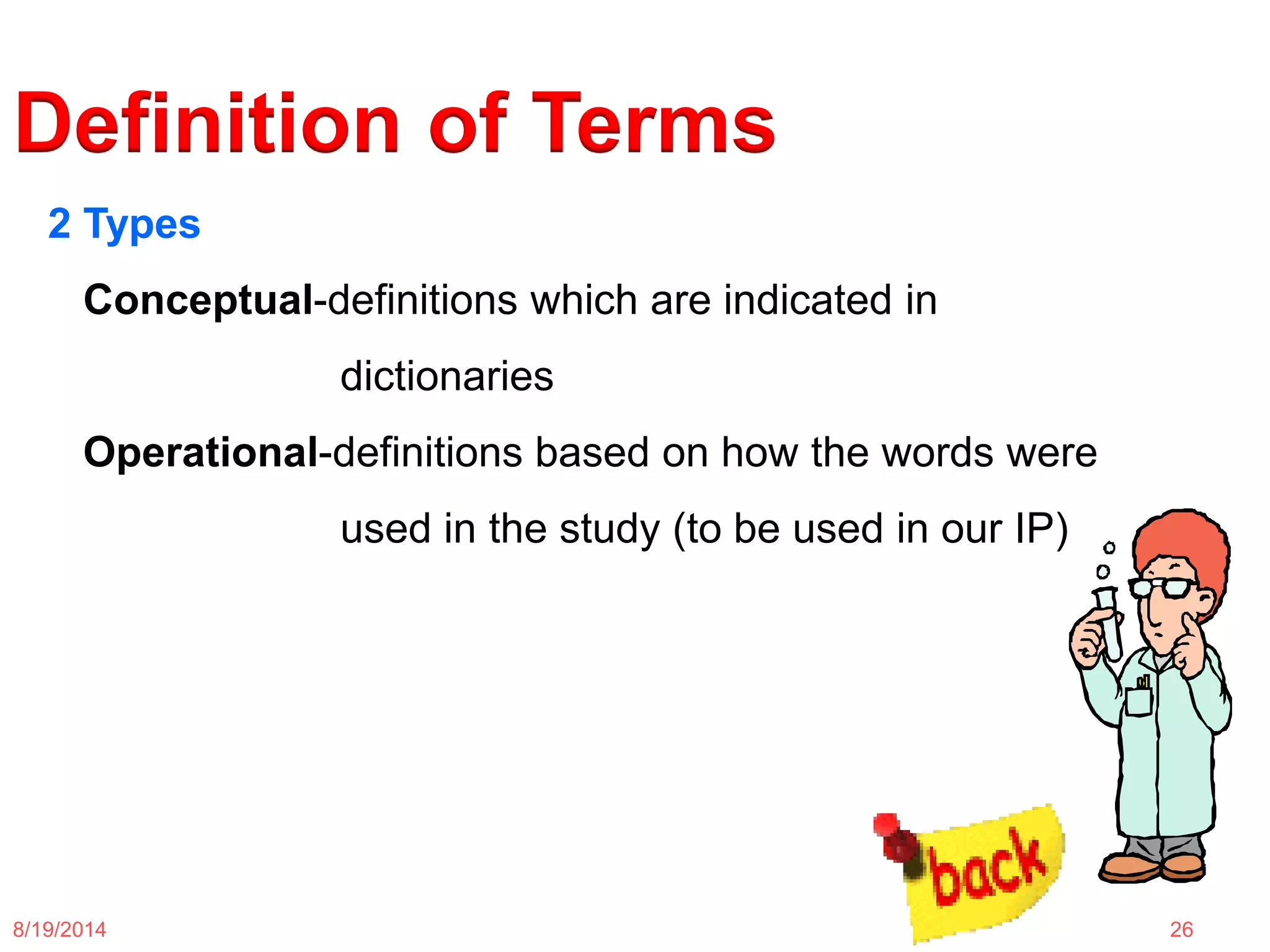
Definition of Terms
2 Types
Conceptual-definitions which are indicated in
dictionaries
Operational-definitions based on how the words were
used in the study (to be used in our IP)
8/19/2014 27
CHAPTER II-Review of Related Literature
-sufficient background information should be presented for
readers to understand & evaluate the results of the present study.
Only the most important studies and theories written on the topic
should be included.
“This contains findings of other studies or
investigations similar as yours.”
8/19/2014 28
CHAPTER III-Methodology -provides enough details so
that a competent worker can repeat the experiments.
Materials/Equipment
-the exact technical specifications, quantities and source of
method of preparation for all materials used should be
given. Specifically built equipment used in the study must
be described and the description accompanied by a
picture.
“What are the things you need in solving your problem?
Procedures
-explain in details the things you did to solve the
problem. The proposal procedure is your guide in
making this portion.
“What are the orderly steps you are going to do to
solve your problem?”
“How are you going to present the data that you will
gather? Will it be through graphs or tables?”
8/19/2014
CHAPTER IV-Results and Discussion
-this maybe divided into sub-sections describing each
set of experiment or observations.
Findings -the data maybe presented in full & discussed
descriptively in the text or these maybe summarized
in tables, pictures & graphs. Tables, pictures & graphs
should make the presentation of the data more
meaningful.
Analysis of Data -the interpretation of the findings are
discussed & the significant features shown in the table
figures or graphs are pointed out.
“This shows the data you have gathered arranged or
presented in tables or graphs. The data must already
speak of the whole thing (general). You must discuss
too the results. What do those data mean?
8/19/2014 30
CHAPTER V-Conclusions
-the general truth implied or illustrated by the results
should be clearly stated. The evidence based on the
results should be summarized for each statement
-this briefly states the immediate answer/findings about
the problem
“This briefly states the immediate answer/findings
about the problem.”
8/19/2014 31
CHAPTER VI- Recommendations
-consists of suggestions on future actions such as a
new direction of research or further experiments
to be performed, practices that might be adapted
or discarded in order to attain certain goals or
objectives
“If others would be doing your project, what would
you advise them?”
8/19/2014 32
Guidelines in Preparing Bibliographies
1. Separate these 3 parts (and any additional items of
information) with periods followed by two spaces.
2. Give the author’s last name first. A second or third author
or the name of an editor
3. After the author is listed in normal order. For more
than 3 authors, list only the first, followed by “et al.”
4. Always include the authors’ name, complete title
of the book and the complete publication
information.
Bibliography-a list of the references used in guiding the
research work and writing and paper.
8/19/2014 33
5. Indicate an editor or compiler by the abbreviation ed. or comp.
or eds. / comps. If there is more than one.
6. In the publication information for books, you may use the
shortened form of publisher’s names. give the name of the city.
Add the state or country only if the city alone would not be
familiar to the readers.
7. In publication dates, for periodicals, abbreviate the names of
all months except May, June and July. Put the dates in
parentheses for periodicals with continuous pagination.
8. Include page numbers for a periodical article.
A work that is part of an anthology or collection,
or an introduction, preface, foreword or after word
do not use p or pp.
8/19/2014 34
8/19/2014 35
8/19/2014 36
References:
http://www.geocities.com/egf94/2ndlongtest/ip.html
http://www.freesciencefairproject.com/requirements.htm
 http://www.dost.gov.ph
Research Methods (Revised Edition)by Consuelo Sevilla et. Al.
Rex Publishing House

Science investigatory project

  • 1.
  • 2.
    - an investigationabout a scientific problem (question) - a problem-solving process using the scientific method
  • 3.
  • 4.
    Stimulate interest inScience Provide educational opportunities Share what you have learned to discuss a certain topic. Application of concepts learned Uses scientific method 8/19/2014 4
  • 5.
  • 6.
    8/19/2014 6 Parts ofa Scientific Research Paper Title Page Abstract Acknowledgment Table of Contents CHAPTER I-INTRODUCTION A. Background of the Study B. Statement of the Problem C. Hypothesis D. Significance of the Study E. Scope and Limitation F. Definition of Terms CHAPTER II- REVIEW OF RELATED LITERATURE CHAPTER III-METHODOLOGY A. Materials B. Procedures CHAPTER IV-RESULTS AND DISCUSSION A. Findings B. Analysis of Data CHAPTER V- CONCLUSION CHAPTER VI-RECOMMENDATION Bibliography
  • 7.
  • 8.
  • 9.
  • 10.
    8/19/2014 10 accurate rules ingrammar, correct spelling & correct punctuation. I, MY, ME & MINE PAST
  • 11.
    8/19/2014 11 PHASE I: THE PROPOSAL (20 points) The proposal is a detailed written plan of how the project will be done. It is like designing an experiment. Since it is yet to be done, the future tense of the verb is used. PHASE II: THE INVESTIGATION (20 points) As soon as your proposal is approved you can now start investigating. Your procedure will be your guide. Keep track of all your observations and data by placing them on a table. Document also your works by photographs, videos, etc.
  • 12.
    8/19/2014 12 PHASE III.THE OUTPUT (60 points) After conducting the investigation you are now ready to organize your gathered data and present your findings. The output has three levels: 1. THE WRITTEN REPORT (20 points) A recall of all the things you did to solve your problem. The mode of the verb is in the past tense. 2. THE EXHIBIT (20 points) It is a showcase of your IP mounted on a board. It must attract viewers so that they may get interested to your IP. 3. THE ORAL DEFENSE (20 points) You will present your work to a panel of judges and they will ask you questions about your project.
  • 13.
    8/19/2014 13 TASKS TARGET DATE TEACHER’S DEADLINE 1.Submission of Problem and Title Aug. 16 2. Submission of Chapter 1 Oct 15 3. Submission of Chapter 2 Oct 31 4. Submission of Chapter 3 Nov 19 5. Investigation Period ASAP 6. Submission of Chapter 4 Dec 3 7. Submission of Chapters 5&6 Dec 14 8. Abstract, Table of Contents, Acknowledgement, Bibliography Jan 7 9. Oral Defense Jan 14- Feb 8 Feb 18 Final Paper Feb 25-28 Exhibit
  • 14.
    8/19/2014 14 Ethics Statement… Scientificfraud and misconduct are not condoned at any level of research or competition. Plagiarism, use or presentation of other researcher's work as one's own forgery of approval signature and fabrication or falsification of data will not be tolerated. Fraudulent projects will fail to qualify for GRADUATION.
  • 15.
  • 16.
    8/19/2014 16 Title -it ispatterned from the question, however it must contain only the essential words -title of the project must be brief, simple and catchy. It must contain the following information: Name of the school (including address) Title of the Investigatory Project (UPPER CASE, bold, centered) Name of the researcher (last name, first name, middle initial) Year and Section Date of Submission Name of the teacher
  • 17.
    8/19/2014 17 Abstract -should consistof short, concise descriptions of the problem & its solution. It must be one page only, single-spaced (with a maximum of 250 words), typewritten in Times New Roman style; font size 11. Sometimes judges do not have time to study all the details of your work, they only read the abstract, thus it’s called the SHOW WINDOW of your project. It must also state the following: Purpose, Procedure used, Results, Conclusion
  • 18.
    8/19/2014 18 Acknowledgement -contains thenames of people & agencies that helped in the conduct of the work described.
  • 19.
    8/19/2014 19 Table ofContents -lists the different parts of the whole report with the corresponding page number of each part. The wording & grammar of the chapter titles, heading & title of tables & figures should be consistent.
  • 20.
    8/19/2014 20 CHAPTER I- Introduction -informs the reader of the problem under study. It shows the nature of scope and the problem, its historical & theoretical background & a review of literature relevant to the problem. Writing the Introduction 1. State clearly and concisely as possible the objectives of the research paper. These objectives may be preceded by few statements introducing the subjects. 2. Keep the introduction brief, proportional to the length of the body. For example, the Introduction of a ten-page paper should be no longer than a page.
  • 21.
    8/19/2014 21 Background ofthe Study -states the rationale of the study. It explains briefly why the investigator chose this study to work on. Rationale or the underlying principle should answer the following questions: How did you arrive at that kind of problem Why do you like to investigate that kind of problem where in fact there are hundreds of problems out there?
  • 22.
    8/19/2014 22 Statement ofthe Problem -it is stated as a question/scientific inquiry -the nature & scope of the problem should be presented with clarity What are the characteristics of a good problem? It should be of great interest to you. It should have practical value to you. It should not be over researched.  It should be within your experience. It can be finished within an allotted time. It should not carry legal or moral impediments.
  • 23.
    8/19/2014 23 Hypothesis-tentative explanation 3Types  Null  Alternative  If and Then (to be used in our IP)
  • 24.
    8/19/2014 24 Significance ofthe Study -the importance of the study is explained in this part
  • 25.
    8/19/2014 25 Scope andLimitation -states the coverage & extent of the study.
  • 26.
    8/19/2014 26 Definition ofTerms 2 Types Conceptual-definitions which are indicated in dictionaries Operational-definitions based on how the words were used in the study (to be used in our IP)
  • 27.
    8/19/2014 27 CHAPTER II-Reviewof Related Literature -sufficient background information should be presented for readers to understand & evaluate the results of the present study. Only the most important studies and theories written on the topic should be included. “This contains findings of other studies or investigations similar as yours.”
  • 28.
    8/19/2014 28 CHAPTER III-Methodology-provides enough details so that a competent worker can repeat the experiments. Materials/Equipment -the exact technical specifications, quantities and source of method of preparation for all materials used should be given. Specifically built equipment used in the study must be described and the description accompanied by a picture. “What are the things you need in solving your problem? Procedures -explain in details the things you did to solve the problem. The proposal procedure is your guide in making this portion. “What are the orderly steps you are going to do to solve your problem?” “How are you going to present the data that you will gather? Will it be through graphs or tables?”
  • 29.
    8/19/2014 CHAPTER IV-Results andDiscussion -this maybe divided into sub-sections describing each set of experiment or observations. Findings -the data maybe presented in full & discussed descriptively in the text or these maybe summarized in tables, pictures & graphs. Tables, pictures & graphs should make the presentation of the data more meaningful. Analysis of Data -the interpretation of the findings are discussed & the significant features shown in the table figures or graphs are pointed out. “This shows the data you have gathered arranged or presented in tables or graphs. The data must already speak of the whole thing (general). You must discuss too the results. What do those data mean?
  • 30.
    8/19/2014 30 CHAPTER V-Conclusions -thegeneral truth implied or illustrated by the results should be clearly stated. The evidence based on the results should be summarized for each statement -this briefly states the immediate answer/findings about the problem “This briefly states the immediate answer/findings about the problem.”
  • 31.
    8/19/2014 31 CHAPTER VI-Recommendations -consists of suggestions on future actions such as a new direction of research or further experiments to be performed, practices that might be adapted or discarded in order to attain certain goals or objectives “If others would be doing your project, what would you advise them?”
  • 32.
    8/19/2014 32 Guidelines inPreparing Bibliographies 1. Separate these 3 parts (and any additional items of information) with periods followed by two spaces. 2. Give the author’s last name first. A second or third author or the name of an editor 3. After the author is listed in normal order. For more than 3 authors, list only the first, followed by “et al.” 4. Always include the authors’ name, complete title of the book and the complete publication information. Bibliography-a list of the references used in guiding the research work and writing and paper.
  • 33.
    8/19/2014 33 5. Indicatean editor or compiler by the abbreviation ed. or comp. or eds. / comps. If there is more than one. 6. In the publication information for books, you may use the shortened form of publisher’s names. give the name of the city. Add the state or country only if the city alone would not be familiar to the readers. 7. In publication dates, for periodicals, abbreviate the names of all months except May, June and July. Put the dates in parentheses for periodicals with continuous pagination. 8. Include page numbers for a periodical article. A work that is part of an anthology or collection, or an introduction, preface, foreword or after word do not use p or pp.
  • 34.
  • 35.
  • 36.