




THE THESIS WRITING
WHAT IS A THESIS?
 A proposal stated or put forward for consideration, especially one
to be discussed and proved or to be maintained against objections:
He vigorously defended his thesis on the causes of war.
 A subject for a composition or essay.
 A dissertation on a particular subject in which one has done
original research, as one presented by a candidate for a diploma or
degree.
PARTS OF A THESIS
Initial Pages
• Title Page
• Approval Sheet
• Abstract
• Acknowledgment
• Dedication
• Table of Contents
• List of Tables
• List of Figures
TITLE PAGE
The following information needs to be on the title page:
 The title (and possibly the subtitle) of your thesis
 First name and surname of the author(s)
 Whether it is a ‘Bachelor’s thesis’ or a ‘Master’s thesis’
 Faculty and department
 Place and date of completion
APPROVAL SHEET
 This is to prove that the authors have passed the requirements
needed for the thesis.
 This is signed by the thesis/adviser, panel and the Dean.
 This also states the grade obtained by the author/s.
ABSTRACT
 An abstract presents a brief summary of your thesis.
 The aim of the abstract is to briefly provide the reader with the
most important information from the entire text.
 An abstract never contains new information.
 This summary is no longer than 2 pages of A4.
ACKNOWLEDGMENT
 This is a page focused on expressing gratitude to organizations,
agencies or individuals who, in one way or another, have aided the
researchers in finishing the thesis.
DEDICATION
 This is the page for dedicating the thesis to certain people or
groups who have inspired the researchers while doing the thesis.
TABLE OF CONTENTS
 The table of contents is essentially a topic outline of the thesis.
 It is compiled by listing the headings in the thesis down to
whichever level you choose.
LIST OF TABLES / LIST OF FIGURES
 Include a list of figures (illustrations) and a list of tables if you
have one or more items in these categories.
 Use a separate page for each list.
 List the number, caption, and page number of every figure and
table in the body of the thesis.
TITLE OF CHAPTERS
1. Problem and Its Background
2. Review of Related Literature and Studies
3. Methodology of the Study
4. Presentation, Analysis and Interpretation of Data
5. Summary, Conclusions and Recommendations
CHAPTER I
Introduction and Background of The Study
INTRODUCTION
 The first chapter of your thesis is your introduction.
 This is where you provide an introduction to the topic of your
thesis: you give the context in terms of content of the research
project.
SIGNIFICANCE OF THE STUDY
 The significance of the study will mainly focus on the question
“Who will benefit from the study?”.
 This section will state the contribution of your study and the
usefulness of your study in the society.
STATEMENT OF THE PROBLEM
 The problem must be reflected to your title or the readers must
know your problem by just simply reading your topic.
 The problem must not be answerable by yes or no and must be
arranged in the flow of your documentation or study.
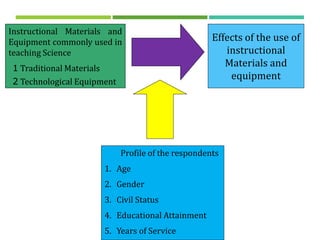
CONCEPTUAL FRAMEWORK
 A conceptual framework elaborates the research problem in relation to relevant
literature. This section may summarize the major (dependent and independent)
variables in your research. The framework may be summarized in a schematic
diagram that presents the major variables and their hypothesized relationships.
It should also cover the following:
 Existing research and its relevance for your topic
 Key ideas or constructs in your approach
 Identify and discuss the variables related to the problem.
 Conceptualized relationships between variables
 Independent variables (presumed cause)
 Dependent variables (presumed effect)
 Intervening variables (other variables that influence the effect of the
independent variable)
Instructional Materials and
Equipment commonly used in
teaching Science
1 Traditional Materials
2 Technological Equipment
Effects of the use of
instructional
Materials and
equipment
Profile of the respondents
1. Age
2. Gender
3. Civil Status
4. Educational Attainment
5. Years of Service
SCOPE AND DELIMITATION
 The scope is mainly the coverage of your study and the
Delimitation is the limitation of your study or topic.
DEFINITION OF TERMS
 The definition of terms must be arranged in alphabetically. It must
be also stated if you used your definition of terms in technically or
operationally.
CHAPTER II
Review of Related Literature and Studies
RELATED LITERATURE
 In this part you must get your data and information from any books,
magazines, and news papers. You must label your published material
with local or foreign.
1. Must be also organized to cover specific problems.
2. Must take all the evidences about the problem with the author’s
experiences.
3. As much as possible, get the latest published materials. Avoid old
published materials.
4. It must be related to your topic. If not, do not get it.
5. On the last part of this part you must have a statement how this old
published material helps the researcher in their current study and
relate it to your study.
CHAPTER III
Methodology of the Study
RESEARCH DESIGN
 The appropriate research design should be specified and
described.
POPULATION AND SAMPLES
 Describe the population of interest and the sampling of subjects
used in the study.
RESEARCH INSTRUMENT
 Describe the instrument and what it will measure.
 State qualifications of informants if used in the study.
VALIDATION PROCEDURE
 Discuss how the validity and the reliability will be established.
Specify the level of reliability (probability).
DATA GATHERING PROCEDURE
 Describe how instrument will be administered.
DATA PROCESSING PROCEDURE AND
STATISTICAL TREATMENT OF DATA
 Describe the processing and treatment of data
CHAPTER VI
Presentation, Analysis and Interpretation of
Data
PRESENTATION OF DATA
 Present the findings of the study in the order of the specific
problem as stated in the statement of the Problem.
 Present the data in these forms:
 Tabular
 Textual
 Graphical (optional)
ANALYSIS OF DATA
 Data may be analyzed quantitatively or qualitatively depending on
the level of measurement and the number of dimensions and
variables of the study.
 Analyze in depth to give meaning to the data presented in the
table. Avoid table reading.
 State statistical descriptions in declarative sentences, e.g. in the
studies involving:
INTERPRETATION OF DATA
 Establish interconnection between and among data
 Check for indicators whether hypothesis/es is/are supported or
not by findings.
 Link the present findings with the previous literature.
 Use parallel observations with contemporary events to give
credence presented in the introduction.
CHAPTER V
Summary of Findings, Conclusions
and
Recommendations
SUMMARY OF FINDINGS
 This describes the problem, research design, and the findings
(answer to the questions raised). The recommended format is the
paragraph form instead of the enumeration form.
 For each of the problems, present:
 The salient findings,
 The results of the hypothesis tested
CONCLUSIONS
 These are brief, generalized statements in answer to the general
and each of the specific sub-problems.
 These contain generalized in relation to the population. These are
general inferences applicable to a wider and similar population.
 Flexibility is considered in making of conclusions. It is not a must
to state conclusions on a one-to-one correspondence with the
problems and the findings as all variables can be subsume in one
paragraph.
 Conclusions may be used as generalizations from a micro to a
macro-level or vice versa (ZOOM LENS approach).
RECOMMENDATIONS
 They should be based on the findings and conclusion of the study.
 Recommendations may be specific or general or both. They may
include suggestions for further studies.
 They should be in non-technical language.
 They should be feasible, workable, flexible, doable, adaptable.
REFERENCES
 http://dictionary.reference.com/browse/thesis
 http://www.jpsimbulan.net/thesis-writing-guide/how-to-write-a-thesis/
 Slide Shear
Thank You

12 rm the thesis writing

  • 1.
  • 2.
    WHAT IS ATHESIS?  A proposal stated or put forward for consideration, especially one to be discussed and proved or to be maintained against objections: He vigorously defended his thesis on the causes of war.  A subject for a composition or essay.  A dissertation on a particular subject in which one has done original research, as one presented by a candidate for a diploma or degree.
  • 3.
    PARTS OF ATHESIS Initial Pages • Title Page • Approval Sheet • Abstract • Acknowledgment • Dedication • Table of Contents • List of Tables • List of Figures
  • 4.
    TITLE PAGE The followinginformation needs to be on the title page:  The title (and possibly the subtitle) of your thesis  First name and surname of the author(s)  Whether it is a ‘Bachelor’s thesis’ or a ‘Master’s thesis’  Faculty and department  Place and date of completion
  • 5.
    APPROVAL SHEET  Thisis to prove that the authors have passed the requirements needed for the thesis.  This is signed by the thesis/adviser, panel and the Dean.  This also states the grade obtained by the author/s.
  • 6.
    ABSTRACT  An abstractpresents a brief summary of your thesis.  The aim of the abstract is to briefly provide the reader with the most important information from the entire text.  An abstract never contains new information.  This summary is no longer than 2 pages of A4.
  • 7.
    ACKNOWLEDGMENT  This isa page focused on expressing gratitude to organizations, agencies or individuals who, in one way or another, have aided the researchers in finishing the thesis.
  • 8.
    DEDICATION  This isthe page for dedicating the thesis to certain people or groups who have inspired the researchers while doing the thesis.
  • 9.
    TABLE OF CONTENTS The table of contents is essentially a topic outline of the thesis.  It is compiled by listing the headings in the thesis down to whichever level you choose.
  • 10.
    LIST OF TABLES/ LIST OF FIGURES  Include a list of figures (illustrations) and a list of tables if you have one or more items in these categories.  Use a separate page for each list.  List the number, caption, and page number of every figure and table in the body of the thesis.
  • 11.
    TITLE OF CHAPTERS 1.Problem and Its Background 2. Review of Related Literature and Studies 3. Methodology of the Study 4. Presentation, Analysis and Interpretation of Data 5. Summary, Conclusions and Recommendations
  • 12.
    CHAPTER I Introduction andBackground of The Study
  • 13.
    INTRODUCTION  The firstchapter of your thesis is your introduction.  This is where you provide an introduction to the topic of your thesis: you give the context in terms of content of the research project.
  • 14.
    SIGNIFICANCE OF THESTUDY  The significance of the study will mainly focus on the question “Who will benefit from the study?”.  This section will state the contribution of your study and the usefulness of your study in the society.
  • 15.
    STATEMENT OF THEPROBLEM  The problem must be reflected to your title or the readers must know your problem by just simply reading your topic.  The problem must not be answerable by yes or no and must be arranged in the flow of your documentation or study.
  • 16.
    CONCEPTUAL FRAMEWORK  Aconceptual framework elaborates the research problem in relation to relevant literature. This section may summarize the major (dependent and independent) variables in your research. The framework may be summarized in a schematic diagram that presents the major variables and their hypothesized relationships. It should also cover the following:  Existing research and its relevance for your topic  Key ideas or constructs in your approach  Identify and discuss the variables related to the problem.  Conceptualized relationships between variables  Independent variables (presumed cause)  Dependent variables (presumed effect)  Intervening variables (other variables that influence the effect of the independent variable)
  • 17.
    Instructional Materials and Equipmentcommonly used in teaching Science 1 Traditional Materials 2 Technological Equipment Effects of the use of instructional Materials and equipment Profile of the respondents 1. Age 2. Gender 3. Civil Status 4. Educational Attainment 5. Years of Service
  • 18.
    SCOPE AND DELIMITATION The scope is mainly the coverage of your study and the Delimitation is the limitation of your study or topic.
  • 19.
    DEFINITION OF TERMS The definition of terms must be arranged in alphabetically. It must be also stated if you used your definition of terms in technically or operationally.
  • 20.
    CHAPTER II Review ofRelated Literature and Studies
  • 21.
    RELATED LITERATURE  Inthis part you must get your data and information from any books, magazines, and news papers. You must label your published material with local or foreign. 1. Must be also organized to cover specific problems. 2. Must take all the evidences about the problem with the author’s experiences. 3. As much as possible, get the latest published materials. Avoid old published materials. 4. It must be related to your topic. If not, do not get it. 5. On the last part of this part you must have a statement how this old published material helps the researcher in their current study and relate it to your study.
  • 22.
  • 23.
    RESEARCH DESIGN  Theappropriate research design should be specified and described.
  • 24.
    POPULATION AND SAMPLES Describe the population of interest and the sampling of subjects used in the study.
  • 25.
    RESEARCH INSTRUMENT  Describethe instrument and what it will measure.  State qualifications of informants if used in the study.
  • 26.
    VALIDATION PROCEDURE  Discusshow the validity and the reliability will be established. Specify the level of reliability (probability).
  • 27.
    DATA GATHERING PROCEDURE Describe how instrument will be administered.
  • 28.
    DATA PROCESSING PROCEDUREAND STATISTICAL TREATMENT OF DATA  Describe the processing and treatment of data
  • 29.
    CHAPTER VI Presentation, Analysisand Interpretation of Data
  • 30.
    PRESENTATION OF DATA Present the findings of the study in the order of the specific problem as stated in the statement of the Problem.  Present the data in these forms:  Tabular  Textual  Graphical (optional)
  • 31.
    ANALYSIS OF DATA Data may be analyzed quantitatively or qualitatively depending on the level of measurement and the number of dimensions and variables of the study.  Analyze in depth to give meaning to the data presented in the table. Avoid table reading.  State statistical descriptions in declarative sentences, e.g. in the studies involving:
  • 32.
    INTERPRETATION OF DATA Establish interconnection between and among data  Check for indicators whether hypothesis/es is/are supported or not by findings.  Link the present findings with the previous literature.  Use parallel observations with contemporary events to give credence presented in the introduction.
  • 33.
    CHAPTER V Summary ofFindings, Conclusions and Recommendations
  • 34.
    SUMMARY OF FINDINGS This describes the problem, research design, and the findings (answer to the questions raised). The recommended format is the paragraph form instead of the enumeration form.  For each of the problems, present:  The salient findings,  The results of the hypothesis tested
  • 35.
    CONCLUSIONS  These arebrief, generalized statements in answer to the general and each of the specific sub-problems.  These contain generalized in relation to the population. These are general inferences applicable to a wider and similar population.  Flexibility is considered in making of conclusions. It is not a must to state conclusions on a one-to-one correspondence with the problems and the findings as all variables can be subsume in one paragraph.  Conclusions may be used as generalizations from a micro to a macro-level or vice versa (ZOOM LENS approach).
  • 36.
    RECOMMENDATIONS  They shouldbe based on the findings and conclusion of the study.  Recommendations may be specific or general or both. They may include suggestions for further studies.  They should be in non-technical language.  They should be feasible, workable, flexible, doable, adaptable.
  • 37.
  • 38.