1
Essentials in Thesis Writing
Department of Physics, University of Colombo
Prof. Upul Sonnadara
Initially Prepared for the 4th Year Students Research Seminar
2
 A thesis is an academic paper that serves to
provide the reader with a great deal of
information about a specific topic.
 Conducting a substantial amount of research on
a selected problem for a certain period of time
leads to a thesis.
 A thesis contributes to enhancing the existing
knowledge leading to research publications.
Overview
3
 Title Page
 Declaration
 Abstract
 Acknowledgments
 Table of Contents
 List of Figures
 List of Tables
Structure of a Thesis
 Chapter 1: Introduction
 Chapter 2: Literature
Review
 Chapter 3: Methodology
 Chapter 4: Results
 Chapter 5: Discussion
 Chapter 6: Conclusions
 References
 Annexures
4
 Title of the thesis, Name of author, Declaration
(Degree and Institution), Date
 Advice: Do not pick very long titles!
 An investigation of the knowledge of simple mathematics of G.C.E.
(A/L) science students with the aim of producing a text book on
mathematics specially dedicated to A/L science students
 Spectroscopic Observations of Novae V1065 CENTAURI and V1280
SCORPII using 45 cm Cassergrain Telescope at Arthur C Clarke
Institute, Sri Lanka
Title Page
5
Neural Network Model for Rainfall Forecasting
by
Akila D. Kumarasiri
A dissertation submitted in partial fulfillment of the requirements for the
Bachelor of Science Special Degree in Engineering Physics
of the
University of Colombo, Sri Lanka
June 2005
Title Page …
6
 An abstract is a short summary of the research work.
Abstract simply provide information to the reader to
learn quickly about the research.
 Abstracts must include sufficient information to
explain to the readers the significance of the
research, major findings and implications.
 A good abstract is concise, readable, and
quantitative. Length of abstracts should be less than
400 words (one page) organized within few
paragraphs.
Abstract
7
Abstract – A virtual robot in an obstacle filled virtual world was
simulated to determine the feasibility and the efficiency of using
optical flow based algorithms in robot navigation. VRML 97 was used
to create the virtual world and the robot. Simulink was used to
implement the algorithms and the optical flow calculations. The view
seen by the robot was captured through a virtual camera and by
calculating the optical flow using the video stream, the direction and
the speed of the robot was determined. This information was sent
back to the virtual world to update the position and the view seen by
the robot in each time step. With the results obtained through this
work it was concluded that it is possible to use VRML and Simulink
effectively to simulate and implement optical flow based algorithms
in robot navigation.
Abstract …
8
 Do not refer in the abstract, the information that is
not given in the thesis.
 Abstract should stand on its own. Avoid including
references to other literature and tables or figures or
equations in the thesis.
 Be explicit.
 Avoid using “I” or “We”.
 Avoid using trade names, acronyms, abbreviations,
or symbols.
 In science, results should be quantified.
Abstract …
9
 Do not acknowledge everyone you have come across.
 Acknowledge the advisor/supervisor first and give
due credit.
 Acknowledge those who made a reasonable
contribution in conducting the research work.
 Sometimes, individuals may simply help your work
and encourage.
 You may acknowledge those who technically,
intellectually and financially helped the research
work.
Acknowledgements
10
 First decide whether the Literature Review is a part
of the Introduction or not.
 Introduction should provide a short overview to the
subject. Under literature review, related background
studies leading your problem should be included.
Scope of the thesis should be given at the end of the
introduction.
 At the beginning, try to include something
interesting to motivate the reader to read your
thesis.
 Proper acknowledgement to the previous work with
adequate references are essential for a thesis.
 Scope of the work could be brief which may end with
a “road map” to the thesis.
Introduction
11
Literature Review
Literature review could be the most annoying,
frustrating and time consuming yet essential and
rewarding part of any proposal, research study,
thesis or a research paper.
Own example:
I have on my desk drafts of a few research papers
written, but not yet published because I am
reluctant to sit down and complete the literature
review to justify the study.
12
Literature Review …
Literature review is an important part of any research
study.
 To know about the research area
 To identify the historical development of concepts
 To identify gaps in the literature
 To avoid reinventing the wheel and making mistakes
 To identify data sources and methodologies used by
others in the past
 To generates ideas that you have not thought about
 To better understand the project and limitations
2
x2
x2
x2
x
2
x
2
x
13
Literature Review …
When choosing material, it is important to ask:
 What should I read?
 What have others done?
 Is there anything left for me to do?
 How do I know this has not been done?
 When should I start to write?
 How do I start writing?
14
Literature Review …
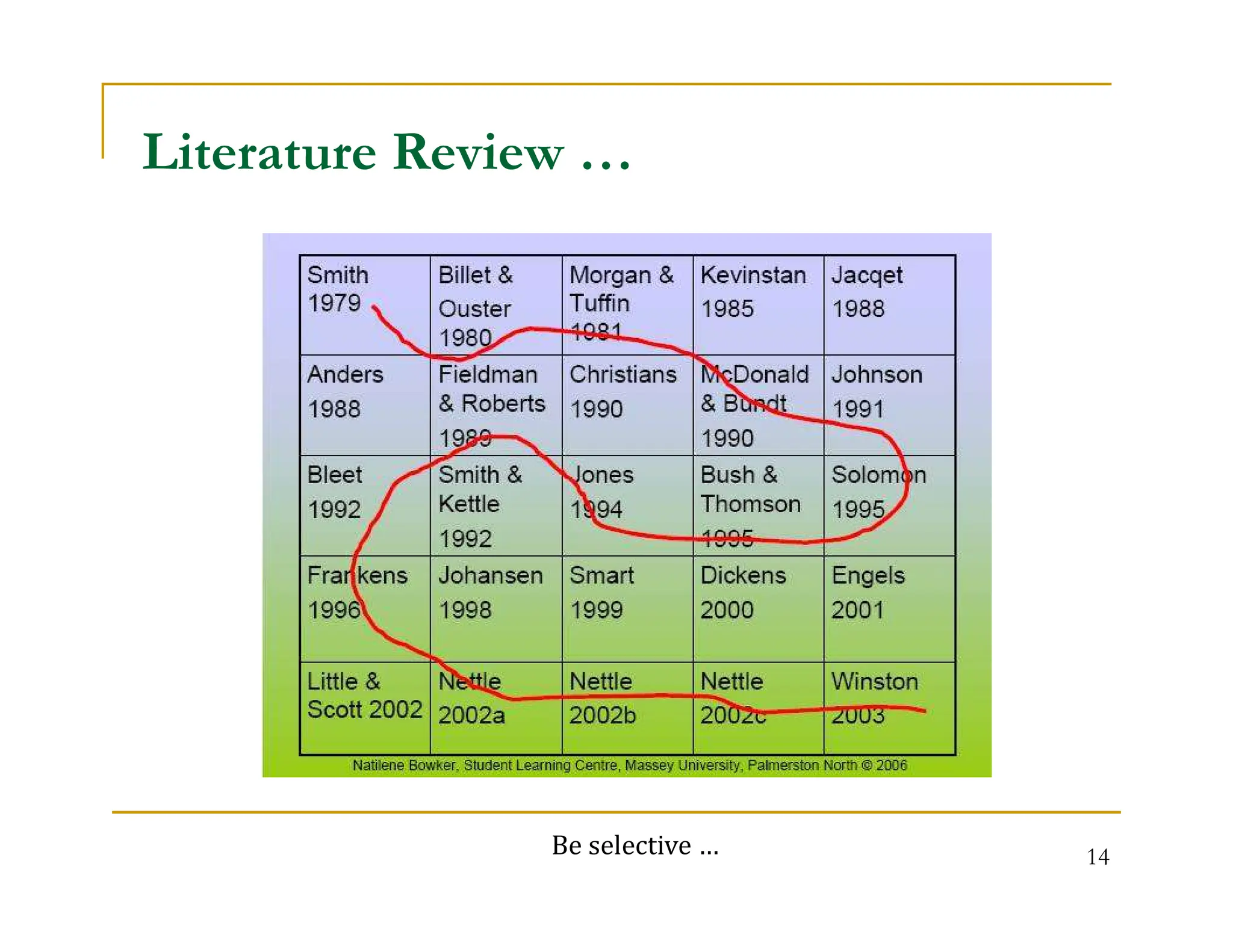
Be selective …
15
 To plagiarize means: to use another person’s idea or
a part of their work and pretend that it is your own.
 In other words: stealing ideas or words. One can
argue that there are no original ideas left and that
everybody uses someone else’s words at some point.
 But merely using other people’s words in itself is not
plagiarism. It is only when you leave out the source
and take credit it becomes plagiarism.
 Do not copy sections of text from other sources directly into your
thesis
 Do not copy figures, diagrams and tables from other sources without
acknowledging
Plagiarism
16
 Detailed information to allow the reader to assess
the reliability of your results.
 Information needed to repeat your experiment by
other researches.
 Data, Materials, equipment and procedure.
 Calculations, techniques and calibration.
 Limitations, assumptions, and range of validity.
 Statistical methods, analysis techniques etc.
Methodology
17
 The results are actual statements of observations,
including statistics, tables and graphs.
 This section focus on data tables and figures.
 Report negative as well as positive results.
 Present sufficient details so that others cannot draw
different opinions and arrive at their own
conclusions.
 Use SI units (m, s, kg, etc.) throughout the thesis.
 Break up your results into logical segments by using
subheadings.
Results and Discussion
18
Try to develop paragraphs focusing on:
 What are the major patterns in the observations?
 What are the likely causes underlying these
patterns resulting predictions?
 Is there agreement or disagreement with previous
work?
 Include the evidence or line of reasoning
supporting each interpretation.
 What is the significance of the present result?
Results and Discussion …
19
Conclusions
 Refer back to the problem, and describe the
conclusions that you reached from carrying out the
investigation, summarize new observations, new
interpretations, and new insights that have resulted
from the work.
 What is the strongest and most important statement
that you can make from your observations?
 Include the broader implications of your results.
 Include recommendations and future directions.
20
Annexures
 Reference data/materials not easily available
 Tables (where more than 1-2 pages).
 Calculations (where more than 1-2 pages).
 Screen capture of software programs, publications
arising from your work, etc.
 List of equipment used in the experiment or details
of complicated procedures.
Figures and tables, including captions, should be embedded in the
text and not in an appendix, unless they are not critical to your
argument.
21
 Tables should have captions above tables.
 Figures should have captions below figures. Axes
should be marked clearly with units.
 Caption should be concise but should have enough
details to understand the table/figure without reading
the text.
 Do not include floating figures, tables, pictures, etc
 Do not include figures/tables on pages that are far
away from the place in text where the references are
made.
 Do not list any references that are not cited in the text.
General rules
22
Writing the Thesis
 Review other dissertations before you begin to write.
 Let the table of contents help you improve your
manuscript.
 Begin writing the sections you know the best.
 Use bogus names/places in early drafts until you
finalize details.
 Use rough drawings of graphics/tables for early
drafts.
 Make your writing clear and unambiguous.
 Introduce tables/figures in the text, present the
table/figure and then describe it.
Thank you.

Essentias in thesis writing by professor Upul sonnadara

  • 1.
    1 Essentials in ThesisWriting Department of Physics, University of Colombo Prof. Upul Sonnadara Initially Prepared for the 4th Year Students Research Seminar
  • 2.
    2  A thesisis an academic paper that serves to provide the reader with a great deal of information about a specific topic.  Conducting a substantial amount of research on a selected problem for a certain period of time leads to a thesis.  A thesis contributes to enhancing the existing knowledge leading to research publications. Overview
  • 3.
    3  Title Page Declaration  Abstract  Acknowledgments  Table of Contents  List of Figures  List of Tables Structure of a Thesis  Chapter 1: Introduction  Chapter 2: Literature Review  Chapter 3: Methodology  Chapter 4: Results  Chapter 5: Discussion  Chapter 6: Conclusions  References  Annexures
  • 4.
    4  Title ofthe thesis, Name of author, Declaration (Degree and Institution), Date  Advice: Do not pick very long titles!  An investigation of the knowledge of simple mathematics of G.C.E. (A/L) science students with the aim of producing a text book on mathematics specially dedicated to A/L science students  Spectroscopic Observations of Novae V1065 CENTAURI and V1280 SCORPII using 45 cm Cassergrain Telescope at Arthur C Clarke Institute, Sri Lanka Title Page
  • 5.
    5 Neural Network Modelfor Rainfall Forecasting by Akila D. Kumarasiri A dissertation submitted in partial fulfillment of the requirements for the Bachelor of Science Special Degree in Engineering Physics of the University of Colombo, Sri Lanka June 2005 Title Page …
  • 6.
    6  An abstractis a short summary of the research work. Abstract simply provide information to the reader to learn quickly about the research.  Abstracts must include sufficient information to explain to the readers the significance of the research, major findings and implications.  A good abstract is concise, readable, and quantitative. Length of abstracts should be less than 400 words (one page) organized within few paragraphs. Abstract
  • 7.
    7 Abstract – Avirtual robot in an obstacle filled virtual world was simulated to determine the feasibility and the efficiency of using optical flow based algorithms in robot navigation. VRML 97 was used to create the virtual world and the robot. Simulink was used to implement the algorithms and the optical flow calculations. The view seen by the robot was captured through a virtual camera and by calculating the optical flow using the video stream, the direction and the speed of the robot was determined. This information was sent back to the virtual world to update the position and the view seen by the robot in each time step. With the results obtained through this work it was concluded that it is possible to use VRML and Simulink effectively to simulate and implement optical flow based algorithms in robot navigation. Abstract …
  • 8.
    8  Do notrefer in the abstract, the information that is not given in the thesis.  Abstract should stand on its own. Avoid including references to other literature and tables or figures or equations in the thesis.  Be explicit.  Avoid using “I” or “We”.  Avoid using trade names, acronyms, abbreviations, or symbols.  In science, results should be quantified. Abstract …
  • 9.
    9  Do notacknowledge everyone you have come across.  Acknowledge the advisor/supervisor first and give due credit.  Acknowledge those who made a reasonable contribution in conducting the research work.  Sometimes, individuals may simply help your work and encourage.  You may acknowledge those who technically, intellectually and financially helped the research work. Acknowledgements
  • 10.
    10  First decidewhether the Literature Review is a part of the Introduction or not.  Introduction should provide a short overview to the subject. Under literature review, related background studies leading your problem should be included. Scope of the thesis should be given at the end of the introduction.  At the beginning, try to include something interesting to motivate the reader to read your thesis.  Proper acknowledgement to the previous work with adequate references are essential for a thesis.  Scope of the work could be brief which may end with a “road map” to the thesis. Introduction
  • 11.
    11 Literature Review Literature reviewcould be the most annoying, frustrating and time consuming yet essential and rewarding part of any proposal, research study, thesis or a research paper. Own example: I have on my desk drafts of a few research papers written, but not yet published because I am reluctant to sit down and complete the literature review to justify the study.
  • 12.
    12 Literature Review … Literaturereview is an important part of any research study.  To know about the research area  To identify the historical development of concepts  To identify gaps in the literature  To avoid reinventing the wheel and making mistakes  To identify data sources and methodologies used by others in the past  To generates ideas that you have not thought about  To better understand the project and limitations 2 x2 x2 x2 x 2 x 2 x
  • 13.
    13 Literature Review … Whenchoosing material, it is important to ask:  What should I read?  What have others done?  Is there anything left for me to do?  How do I know this has not been done?  When should I start to write?  How do I start writing?
  • 14.
  • 15.
    15  To plagiarizemeans: to use another person’s idea or a part of their work and pretend that it is your own.  In other words: stealing ideas or words. One can argue that there are no original ideas left and that everybody uses someone else’s words at some point.  But merely using other people’s words in itself is not plagiarism. It is only when you leave out the source and take credit it becomes plagiarism.  Do not copy sections of text from other sources directly into your thesis  Do not copy figures, diagrams and tables from other sources without acknowledging Plagiarism
  • 16.
    16  Detailed informationto allow the reader to assess the reliability of your results.  Information needed to repeat your experiment by other researches.  Data, Materials, equipment and procedure.  Calculations, techniques and calibration.  Limitations, assumptions, and range of validity.  Statistical methods, analysis techniques etc. Methodology
  • 17.
    17  The resultsare actual statements of observations, including statistics, tables and graphs.  This section focus on data tables and figures.  Report negative as well as positive results.  Present sufficient details so that others cannot draw different opinions and arrive at their own conclusions.  Use SI units (m, s, kg, etc.) throughout the thesis.  Break up your results into logical segments by using subheadings. Results and Discussion
  • 18.
    18 Try to developparagraphs focusing on:  What are the major patterns in the observations?  What are the likely causes underlying these patterns resulting predictions?  Is there agreement or disagreement with previous work?  Include the evidence or line of reasoning supporting each interpretation.  What is the significance of the present result? Results and Discussion …
  • 19.
    19 Conclusions  Refer backto the problem, and describe the conclusions that you reached from carrying out the investigation, summarize new observations, new interpretations, and new insights that have resulted from the work.  What is the strongest and most important statement that you can make from your observations?  Include the broader implications of your results.  Include recommendations and future directions.
  • 20.
    20 Annexures  Reference data/materialsnot easily available  Tables (where more than 1-2 pages).  Calculations (where more than 1-2 pages).  Screen capture of software programs, publications arising from your work, etc.  List of equipment used in the experiment or details of complicated procedures. Figures and tables, including captions, should be embedded in the text and not in an appendix, unless they are not critical to your argument.
  • 21.
    21  Tables shouldhave captions above tables.  Figures should have captions below figures. Axes should be marked clearly with units.  Caption should be concise but should have enough details to understand the table/figure without reading the text.  Do not include floating figures, tables, pictures, etc  Do not include figures/tables on pages that are far away from the place in text where the references are made.  Do not list any references that are not cited in the text. General rules
  • 22.
    22 Writing the Thesis Review other dissertations before you begin to write.  Let the table of contents help you improve your manuscript.  Begin writing the sections you know the best.  Use bogus names/places in early drafts until you finalize details.  Use rough drawings of graphics/tables for early drafts.  Make your writing clear and unambiguous.  Introduce tables/figures in the text, present the table/figure and then describe it. Thank you.