BSc Mathematics
Project Guidelines
for Final year
students 2019-
2022
Based on the First Degree Programme in
MATHEMATICS under Choice Based Credit
and Semester System SYLLABUS for 2018
admission onwards
Course Code: MM 1646
CourseTitle: Project
Credit : 4
Instructional hours per week: 1
Minimum 40 pages
In LaTEX
To complete the undergraduate programme, the
students should undertake a project and prepare
and submit a project report on a topic of their choice
in the subject mathematics or allied subjects.
The work on the project should start in the
beginning of the 5th semester itself, and should end
towards the middle of the 6th semester.
3
TEXTS AND REFERENCETEXTS
Text 1
Daniel Holtom, Elizabeth Fisher.
Enjoy Writing Your Science Thesis or
Dissertation – A step by step guide to
planning and writing dissertations and
theses for undergraduate and graduate
science students, Imperial College
Press.
Ref. 1 – Kathleen McMillan, Jonathan
Weyers. How to write Dissertations &
Project Reports, Pearson Education
Limited
Ref. 2 – Peg Boyle Single. Demystifying
dissertation writing : a streamlined
process from choice of topic to final
text, Stylus Publishing, Virginia
4
Quick overview
• The structure of Dissertation, -
• creating a plan for the Dissertation,
• planning the results section,
• planning the introduction,
• planning and writing the abstract,
• composing the title,
• figures, tables, and appendices,
• references, citations
• making good presentations,
• handling resources like notebooks, library, computers etc.,
• preparing an interim report.
5
Project preparation –
From selecting the topic to
presenting the final report
Deciding onYourTitle
8
TheTitle ofYourThesis or Dissertation
• A short self-explanatory title is best. If it is too short the reader will not be able to tell what the thesis is about. If the
title is too long the reader will have lost interest by the time they finish reading it.
• If you are lacking inspiration then try rewriting your aims. It is best to avoid redundant phrases such as ‘A study of …’,
or ‘An investigation of ...’.
• Choose a title that is focused and best reflects your Results
9
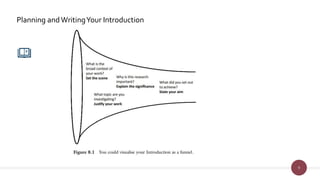
Planning andWritingYour Introduction
10
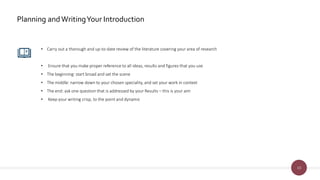
Planning andWritingYour Introduction
• Carry out a thorough and up-to-date review of the literature covering your area of research
• Ensure that you make proper reference to all ideas, results and figures that you use
• The beginning: start broad and set the scene
• The middle: narrow down to your chosen speciality, and set your work in context
• The end: ask one question that is addressed by your Results – this is your aim
• Keep your writing crisp, to the point and dynamic
11
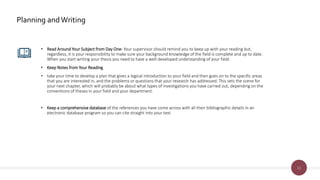
Planning andWriting
• Read Around Your Subject from Day One- Your supervisor should remind you to keep up with your reading but,
regardless, it is your responsibility to make sure your background knowledge of the field is complete and up to date.
When you start writing your thesis you need to have a well-developed understanding of your field.
• Keep Notes from Your Reading
• take your time to develop a plan that gives a logical introduction to your field and then goes on to the specific areas
that you are interested in, and the problems or questions that your research has addressed. This sets the scene for
your next chapter, which will probably be about what types of investigations you have carried out, depending on the
conventions of theses in your field and your department.
• Keep a comprehensive database of the references you have come across with all their bibliographic details in an
electronic database program so you can cite straight into your text
12
• Plan your Results by: clarifying your aims arranging your results to support your aims
• Arrange your Results logically and move from one result to the next related result
• Write multiple Results chapters arranged around different subject areas of your project if appropriate
• Make use of tables, figures and appendices to summarise your data
• Keep your style crisp and to the point; give facts not opinions
• A bullet point (or tabular) summary of each Results chapter can be helpful.
Planning andWritingYour Results
The Other Bits
You will need to include all or some of the following sections, and although there are usually no
rules about the order in which they are presented, the layout below is often used:
• Title page
• Abstract
• Acknowledgements/Dedication
• Table of Contents (including Appendices)
• List of Figures
• List of Tables
• List of Abbreviations
• Main text of the thesis including
• References
• Glossary
• Appendices
• Published Papers
13
Figures andTables
• Decide which figures and tables you need to include when you write your thesis plan
• Prepare a draft of each figure and table
• Annotate figures and write a short title and legend
• Label each axis of a graph and add units and scale
• Make sure that all labels, scales, legends and annotations are readable
• Always present your ‘normal’ or ‘control’ data first on a histogram or in a complex figure
• With multiple figures for the same samples, present the samples in the same order and standardize as much
as possible throughout the thesis or dissertation
• Make all your figures and tables as simple and clear as possible.
• Use color thoughtfully
14
LAYOUT
Aim to produce a document that is stylistically consistent throughout, looks well
organised, and is pleasing to read
• Fonts and Line Spacing
• line spacing
• Margins, headers and footers
• Inserting page numbers
• Aligning to margins
• Titles and Headings
15
Mathematical Equations
Longer equations should be written as display equations
taking up a whole line
Use italics for mathematical symbols such as x and y – both in
the text and also in display equations
Note, however, that numbers (0, 1, 3.14159) and
mathematical functions such as sin, cos, log and exp should
not be in italics
Use Greek letters (α, β, γ) where appropriate • Display
equations should be centred and numbered if you want to
refer back to them later on.
The appearance of equations in your thesis makes a
significant difference to the first impression the reader gets
when they open it up. It pays to make sure that the
equations are presented well. Even though preparing the first
few is time-consuming, it soon gets easier because you
become more efficient at using the software and also
because you can save time by copying and pasting from
equations you have already written
16
Procedures for final draft
Proofreading,
Printing,
Binding and Submission,
oral examinations,
preparing for viva,
Taking the Dissertation to the Viva
17
CITATIONS AND REFERENCES
Any piece of scientific writing, whether it is a journal article that
presents important new results or a first-year essay, has to be
properly referenced because the reader must be able to check the
original sources of any statements you have made.
• Build your own electronic library – use a reference database
program
• Start now! YES RIGHT NOW
• Add citations to your text as you write
• When you have the final version of your thesis, run your eyes
over the Bibliography, and just check that all your references are
up to date, and fully listed with their correct authors, title,
journal, volume number and pages. Also check the Bibliography
has a consistent format
• For journal articles enter authors, year, title, journal name with
correct abbreviation, volume number, page numbers, according
to the conventions of your field
• Use a consistent style for citations and references
• For books enter all authors, year, title, editors (if there are any),
publisher and the town or city in which they are based
18
THANKYOU
KUCKOO B
race2025@gmail.com
https://www.linkedin.com/in/kuckoo-b-63b83391/

B sc mathematics project guidelines for final year students

  • 1.
    BSc Mathematics Project Guidelines forFinal year students 2019- 2022 Based on the First Degree Programme in MATHEMATICS under Choice Based Credit and Semester System SYLLABUS for 2018 admission onwards
  • 2.
    Course Code: MM1646 CourseTitle: Project Credit : 4 Instructional hours per week: 1 Minimum 40 pages In LaTEX
  • 3.
    To complete theundergraduate programme, the students should undertake a project and prepare and submit a project report on a topic of their choice in the subject mathematics or allied subjects. The work on the project should start in the beginning of the 5th semester itself, and should end towards the middle of the 6th semester. 3
  • 4.
    TEXTS AND REFERENCETEXTS Text1 Daniel Holtom, Elizabeth Fisher. Enjoy Writing Your Science Thesis or Dissertation – A step by step guide to planning and writing dissertations and theses for undergraduate and graduate science students, Imperial College Press. Ref. 1 – Kathleen McMillan, Jonathan Weyers. How to write Dissertations & Project Reports, Pearson Education Limited Ref. 2 – Peg Boyle Single. Demystifying dissertation writing : a streamlined process from choice of topic to final text, Stylus Publishing, Virginia 4
  • 5.
    Quick overview • Thestructure of Dissertation, - • creating a plan for the Dissertation, • planning the results section, • planning the introduction, • planning and writing the abstract, • composing the title, • figures, tables, and appendices, • references, citations • making good presentations, • handling resources like notebooks, library, computers etc., • preparing an interim report. 5
  • 6.
    Project preparation – Fromselecting the topic to presenting the final report
  • 7.
  • 8.
    8 TheTitle ofYourThesis orDissertation • A short self-explanatory title is best. If it is too short the reader will not be able to tell what the thesis is about. If the title is too long the reader will have lost interest by the time they finish reading it. • If you are lacking inspiration then try rewriting your aims. It is best to avoid redundant phrases such as ‘A study of …’, or ‘An investigation of ...’. • Choose a title that is focused and best reflects your Results
  • 9.
  • 10.
    10 Planning andWritingYour Introduction •Carry out a thorough and up-to-date review of the literature covering your area of research • Ensure that you make proper reference to all ideas, results and figures that you use • The beginning: start broad and set the scene • The middle: narrow down to your chosen speciality, and set your work in context • The end: ask one question that is addressed by your Results – this is your aim • Keep your writing crisp, to the point and dynamic
  • 11.
    11 Planning andWriting • ReadAround Your Subject from Day One- Your supervisor should remind you to keep up with your reading but, regardless, it is your responsibility to make sure your background knowledge of the field is complete and up to date. When you start writing your thesis you need to have a well-developed understanding of your field. • Keep Notes from Your Reading • take your time to develop a plan that gives a logical introduction to your field and then goes on to the specific areas that you are interested in, and the problems or questions that your research has addressed. This sets the scene for your next chapter, which will probably be about what types of investigations you have carried out, depending on the conventions of theses in your field and your department. • Keep a comprehensive database of the references you have come across with all their bibliographic details in an electronic database program so you can cite straight into your text
  • 12.
    12 • Plan yourResults by: clarifying your aims arranging your results to support your aims • Arrange your Results logically and move from one result to the next related result • Write multiple Results chapters arranged around different subject areas of your project if appropriate • Make use of tables, figures and appendices to summarise your data • Keep your style crisp and to the point; give facts not opinions • A bullet point (or tabular) summary of each Results chapter can be helpful. Planning andWritingYour Results
  • 13.
    The Other Bits Youwill need to include all or some of the following sections, and although there are usually no rules about the order in which they are presented, the layout below is often used: • Title page • Abstract • Acknowledgements/Dedication • Table of Contents (including Appendices) • List of Figures • List of Tables • List of Abbreviations • Main text of the thesis including • References • Glossary • Appendices • Published Papers 13
  • 14.
    Figures andTables • Decidewhich figures and tables you need to include when you write your thesis plan • Prepare a draft of each figure and table • Annotate figures and write a short title and legend • Label each axis of a graph and add units and scale • Make sure that all labels, scales, legends and annotations are readable • Always present your ‘normal’ or ‘control’ data first on a histogram or in a complex figure • With multiple figures for the same samples, present the samples in the same order and standardize as much as possible throughout the thesis or dissertation • Make all your figures and tables as simple and clear as possible. • Use color thoughtfully 14
  • 15.
    LAYOUT Aim to producea document that is stylistically consistent throughout, looks well organised, and is pleasing to read • Fonts and Line Spacing • line spacing • Margins, headers and footers • Inserting page numbers • Aligning to margins • Titles and Headings 15
  • 16.
    Mathematical Equations Longer equationsshould be written as display equations taking up a whole line Use italics for mathematical symbols such as x and y – both in the text and also in display equations Note, however, that numbers (0, 1, 3.14159) and mathematical functions such as sin, cos, log and exp should not be in italics Use Greek letters (α, β, γ) where appropriate • Display equations should be centred and numbered if you want to refer back to them later on. The appearance of equations in your thesis makes a significant difference to the first impression the reader gets when they open it up. It pays to make sure that the equations are presented well. Even though preparing the first few is time-consuming, it soon gets easier because you become more efficient at using the software and also because you can save time by copying and pasting from equations you have already written 16
  • 17.
    Procedures for finaldraft Proofreading, Printing, Binding and Submission, oral examinations, preparing for viva, Taking the Dissertation to the Viva 17
  • 18.
    CITATIONS AND REFERENCES Anypiece of scientific writing, whether it is a journal article that presents important new results or a first-year essay, has to be properly referenced because the reader must be able to check the original sources of any statements you have made. • Build your own electronic library – use a reference database program • Start now! YES RIGHT NOW • Add citations to your text as you write • When you have the final version of your thesis, run your eyes over the Bibliography, and just check that all your references are up to date, and fully listed with their correct authors, title, journal, volume number and pages. Also check the Bibliography has a consistent format • For journal articles enter authors, year, title, journal name with correct abbreviation, volume number, page numbers, according to the conventions of your field • Use a consistent style for citations and references • For books enter all authors, year, title, editors (if there are any), publisher and the town or city in which they are based 18
  • 19.