• “A report is a statement of the result of an
investigation or of any matter on which
definite information is required.”
• (Oxford English
Dictionary)
Objectives
• Understand the purposes of a report.
• Plan a report.
• Understand the structure of a report.
• Collect information for yourreport.
• Organize your information.
• Use an appropriate style of writing.
• Present dataeffectively.
• Understand howto lay out your
information in an appropriateway.
Types of Report Writing
• During your time at university you may be
asked to write different types of report.
• Laboratory reports.
• Technical reports.
• Reports of a work placement or industrial
visit.
• Reports of a field trip or field work.
• Mainly two types of report :
(a)Thesis: A long essay involving personal
research , written as part of a university
Doctorate degree.
(b) Dissertation: A long essay, especially one
• written for a university degree or diploma.
GENERAL INSTRUCTIONS
• The length of the Thesis should preferably be
restricted to 250 printed pages.
• If the Thesis is declared eligible for award of
the PhD degree, two hardbound
copies of the Thesis have to be submitted to
the Academic Division within one
month of the viva-voce examination, after
incorporating the corrections suggested
by the examiners.
LAYOUT AND FORMAT
• Font
The Thesis should be written in English. It must be
typewritten on A4 size paper (21 cm x 29.7 cm) in a clear
and legible font (e.g., Times New Roman 12). As far as
possible, use the same font for the entire thesis but, if
necessary, different fonts may be
used within Tables, Figures, and Appendices. The Thesis has
to be printed single-sided.
Double-spacing should be used in the Abstract and text of
the Thesis. Single spacing should be used in long Tables,
block quotations separated from the text, footnotes, and
bibliographical entries. Paragraphs should be indented, or
an empty line left between paragraphs.
Chapter and Page Layout
• Begin each Chapter on a new page.
Pages should be numbered at the bottom in
the centre, using Arabic numerals (1, 2, 3)
beginning with 1 on the first page of the
Introduction and continuing consecutively to
the
end of the manuscript including References.
• The preliminary pages are numbered in
lower-case Roman numerals, beginning with
the declaration page.
• Margins
A margin of at least 4.0 cm must be left at the
top and left side of each page and a margin
of at least 2.5 cm on the right and bottom.
The last letter or character in the longest line
on the page determines the margin.
Captions and numbering (Tables and
Figures)
• Each Table should carry a number and a title clearly
describing the data presented.
Similarly each Figure / Illustration should carry a number
and caption that clearly describes the nature of data
presented. The caption should be at the bottom of the
Figure.
Number them consecutively throughout, in the order in
which they are placed in the text.
The Figures, Graphs, Tables should be embedded in the text
of the thesis, immediately after the first mention of it in the
text, on the same page if there is room, or on the
following page.
Appropriate use of headings and
subheadings
• Headings should be distinguished from the
surrounding text by a larger font size, a
different font, bolding, italics, or a
combination of these. All headings of the
same level should use the same style, and
headings at lower levels should be less
prominent than those at higher levels.
 Chapter Title (Times New Roman 16 point -Bold Small caps)
 Heading for section (Times New Roman 14 point - Bold
Italic)
 Heading for sub-section (Times New Roman 12 point - Bold)
 Heading for part of subsection- (Times New Roman 12
point- Bold Italic)
 All headings should be left aligned, except chapter
headings, which may be centered.
 The headings and subheadings can be numbered, if
necessary
FORMAT OF THESIS
• The manuscript consists of three main parts:
The Preliminaries, The Text, and The
Annexure. It is to be arranged in the following
sequence:
The Preliminaries
 Cover Page
 Title Page
 Declarations by Student
 Certificate by Research Guide
 Preface
 Acknowledgements
 Table of Contents
 List of Figures, Tables or Illustrations
 List of Abbreviations (optional)
 Abstract/ Executive summary
The Text
1. Introduction
2. Company Profile/ …….Sector in India
3. Literature Review
4. Research Methodology
5. Data Analysis & Interpretation
6. Findings &Discussion
7. Conclusion
Bibliography
Appendix / Annexure
STRUCTURE OF THE PRELIMINARY
PARTS
• OUTER COVER The outer cover should carry
the following details:
The full title of the thesis
The candidate’s name
Thesis - Year
Institute’s Emblem
Name of the Institute
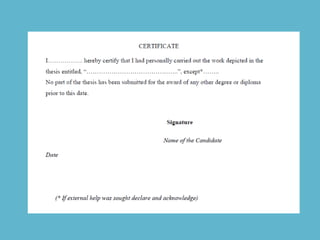
• DECLARATION OF AUTHORSHIP
(Certificate by student)
• CERTIFICATE BY THE RESEARCH GUIDE
ACKNOWLEDGEMENTS
• The acknowledgement of the thesis is written
in gratitude to all those who were
instrumental in bringing the thesis to fruition.
The language used should be formal.
Acknowledge those who have assisted
technically (including materials, supplies),
intellectually (assistance, advice) and
financially (for example, funding agency
institutional support, travel grants)
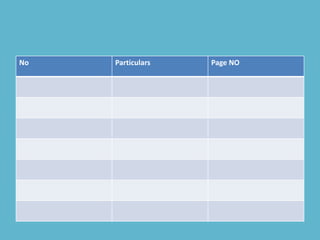
• TABLE OF CONTENTS
The thesis must have a table of contents page
listing chapter headings, section headings
and sub-headings as well as appendices and
their corresponding page number, as
illustrated below. Indent subheadings as
shown below
No Particulars Page NO
SYNOPSIS
• The synopsis is a summary of the contents of the thesis. The synopsis is
submitted prior
to the submission of the thesis and will carry a cover page
It should be concise, and comprehensive, and should have the following
details: The background and objectives, hypothesis, methods, major
findings and significance/
implication of the findings
The results can include quantitative data. Citations are generally not
included in the synopsis.
• The synopsis should not include internal headings, diagrams or other
illustrations. Like the text, it must be double-spaced.
The length of the Synopsis should not exceed 6 pages.
Chp 1 - Introduction
Although this is the first piece of writing the reader
comes to, it is often best to leave its preparation to
last as, until then, you will not be absolutely sure what
you are introducing.
• Background of study
• Statement of the problem
• Research Question
• Objective of study
• Limitations
• Company Profile
Chp 2 - Literature Review, Or
ContextOf The
Study
The purpose of this chapter is to show that you are aware of
where your own piece of research fits into the overall context
of research in your field. To do this you need to:
• describe the current state of research in your defined area;
• consider whether there are any closely related areas that
you also need to refer to;
• identify a gap where you argue that further research is
needed; and
• explain how you plan to attend to that particular research
gap.
Conti…
This can lead logically into a clear statement of the research
question(s) or problem(s) you will be addressing.
In addition to the research context, there may be other
relevant contexts to present for example:
• theoretical context;
• methodological context;
• practice context; and
• political context.
Chp3 -
Methodology
Methodology Checklist
Does the methodology (or research method )
section
• Plain when, where, and how the research was
done?
• Include subsections or informative headings as
appropriate (e.g., evaluation criteria)?
• Mention which method/tools were use to collect
data
Purposeof
Methodology
The method section answers these two main
questions:
1. How was the data collected or generated?
2.How was it analyzed? In other words, it shows
your reader how you obtained your results. But
why do you need to explain how you obtained
your results?
• Research process
– Research Theoretical Framework
– Research question and Hypothesis
• Sample Size
• Sampling Method
– Selection of the Sample
– Collection Procedure
• Research questionnaire design and
description
• Data Analysis methods
Data Analysis
• Descriptive statistics
• Demographics
• Hypothesis testing
– T – Test- One pair sample test, Independent
sample test
– F- Test, Z- Test
– Chi Square test, Manwitnney Test,
• Different Analysis
– Factor Analysis
– Cluster Analysis
– Correlation Analysis
– Regression Analysis
– Dicreminent Analysis
Result / Discussion
• If you've organized, displayed and analyzed
your data, it's time to write it up, and the
place for this is the results section.
• The key to a great results section is in
describing your results - you need to tell
your readers exactly what you found out.
This is where you document what was
observed or discovered. It is not the place
for discussion.
Discussion
• This section has four purposes, it should:
• Interpret and explain your results
• Answer your research question
• Justify your approach
• Critically evaluate your study
Recommendation
• These can take two forms:
recommendations for further study, or
recommendations for change, or both.
Each recommendation should trace
directly to a conclusion.
Conclusion
• Start with a few sentences that summarize the
most important results and conclude by giving
the strongest and most important statement that
highlights the outcome of the study. The
conclusion should provide answers or solutions
to the questions or problems raised in the
introduction. The argumentation of the thesis
should be summarized briefly, and if appropriate,
elaborate on how the research findings
• and results will contribute to the field in
general and what sort of broader implications
these may have. Suggestions may be made for
further research where appropriate, but
this is not a requirement
References/ Bibliography
• Whenever you cite information (this
includes graphics) from another source,
you must credit the source in your
References. Always check with your
instructor to determine which reference
style to use.
• All publications cited in the thesis should be
presented in a list of references following the
text. Students are advised to restrict the total
number of references to 200.
• Illustrative examples of entries in a Bibliography
or list of References are given below:
Example:
Gopinath B, Radhakrishnan K, Sarma PS,
Jayachandran D, Alexander A (2000) A
questionnaire survey about doctor-patient
communication, compliance and locus of
control among South Indian people with epilepsy.
Epilepsy Res 39: 73-82.
• Chapter in a Book
Wenzel HJ, Schwartzkroin PA (2006)
Morphologic approaches to the
characterization of
epilepsy models. In: Pitkanen A, Schwartzkroin
PA, Moshe SL (eds) Models of seizures
and epilepsy, Elsevier Academic Press, San
Diego, pp. 629-652.
• Book
Example:
Pechenik JA (1987) A short guide to writing
about biology. Harper Collins Publishers,
New York.
• Book in a series
Bhattacharjee M (1998) Notes of infinite
permutation groups, Lecture notes in
mathematics
no.1698, Springer, New York.
• Encyclopedia articles
Varley DH, Immelman RFM (1972)
Libraries.Standard Encyclopaedia of Southern
Africa, vol.6, p.618-619
• Thesis/dissertation
Smithers RHN (1997) The mammals of
Botswana. DSc thesis. University of Pretoria.
• Conference proceedings
Bourassa S (1999) ‘Effects of child care on
young children’, Proceedings of the third
annual
meeting of the International Society for Child
Psychology, International Society for Child
Psychology, Atlanta, Georgia, pp. 44-6.
Citations from Internet
• The following elements in sequence must be
considered: Author (if known), Date of
publication/last updated, Title of article or
document on website Type of medium
[Online], Available from (website), Access date
in brackets
• Harris P (2005) Reaching the top of the
mountain. [Online]. Oxford University Press:
Oxford. Available:
http://www.netLibrary.com/openbook/09345
6/html
[Accessed 8 January 2008]
• Useful tips for referencing. [Online]. Available:
http://www.referencetips.org.za
[Accessed 5 November 2008].
• Lawrence JJ (2005) Cholera epidemics in
central Africa. The Times, 26 June 2005.
[Online]. Available: <http:://thetimes.com>
[Accessed 27 June 2005]
• Patents
Author(s) of patent – surname and initials Year of
issue, Title of patent- italicised,
Number of patent including country of issue
• Cookson AH (1985) Particle trap for compressed
gas insulated transmission systems, US
Patent 4554399.
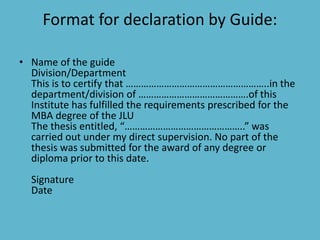
Format for declaration by Guide:
• Name of the guide
Division/Department
This is to certify that ………………………………………………..in the
department/division of …………………………………….of this
Institute has fulfilled the requirements prescribed for the
MBA degree of the JLU
The thesis entitled, “………………………………………..” was
carried out under my direct supervision. No part of the
thesis was submitted for the award of any degree or
diploma prior to this date.
Signature
Date
Research report

Research report

  • 2.
    • “A reportis a statement of the result of an investigation or of any matter on which definite information is required.” • (Oxford English Dictionary)
  • 3.
    Objectives • Understand thepurposes of a report. • Plan a report. • Understand the structure of a report. • Collect information for yourreport. • Organize your information. • Use an appropriate style of writing. • Present dataeffectively. • Understand howto lay out your information in an appropriateway.
  • 4.
    Types of ReportWriting • During your time at university you may be asked to write different types of report. • Laboratory reports. • Technical reports. • Reports of a work placement or industrial visit. • Reports of a field trip or field work.
  • 5.
    • Mainly twotypes of report : (a)Thesis: A long essay involving personal research , written as part of a university Doctorate degree. (b) Dissertation: A long essay, especially one • written for a university degree or diploma.
  • 6.
    GENERAL INSTRUCTIONS • Thelength of the Thesis should preferably be restricted to 250 printed pages.
  • 7.
    • If theThesis is declared eligible for award of the PhD degree, two hardbound copies of the Thesis have to be submitted to the Academic Division within one month of the viva-voce examination, after incorporating the corrections suggested by the examiners.
  • 8.
    LAYOUT AND FORMAT •Font The Thesis should be written in English. It must be typewritten on A4 size paper (21 cm x 29.7 cm) in a clear and legible font (e.g., Times New Roman 12). As far as possible, use the same font for the entire thesis but, if necessary, different fonts may be used within Tables, Figures, and Appendices. The Thesis has to be printed single-sided. Double-spacing should be used in the Abstract and text of the Thesis. Single spacing should be used in long Tables, block quotations separated from the text, footnotes, and bibliographical entries. Paragraphs should be indented, or an empty line left between paragraphs.
  • 9.
    Chapter and PageLayout • Begin each Chapter on a new page. Pages should be numbered at the bottom in the centre, using Arabic numerals (1, 2, 3) beginning with 1 on the first page of the Introduction and continuing consecutively to the end of the manuscript including References.
  • 10.
    • The preliminarypages are numbered in lower-case Roman numerals, beginning with the declaration page.
  • 11.
    • Margins A marginof at least 4.0 cm must be left at the top and left side of each page and a margin of at least 2.5 cm on the right and bottom. The last letter or character in the longest line on the page determines the margin.
  • 12.
    Captions and numbering(Tables and Figures) • Each Table should carry a number and a title clearly describing the data presented. Similarly each Figure / Illustration should carry a number and caption that clearly describes the nature of data presented. The caption should be at the bottom of the Figure. Number them consecutively throughout, in the order in which they are placed in the text. The Figures, Graphs, Tables should be embedded in the text of the thesis, immediately after the first mention of it in the text, on the same page if there is room, or on the following page.
  • 13.
    Appropriate use ofheadings and subheadings • Headings should be distinguished from the surrounding text by a larger font size, a different font, bolding, italics, or a combination of these. All headings of the same level should use the same style, and headings at lower levels should be less prominent than those at higher levels.
  • 14.
     Chapter Title(Times New Roman 16 point -Bold Small caps)  Heading for section (Times New Roman 14 point - Bold Italic)  Heading for sub-section (Times New Roman 12 point - Bold)  Heading for part of subsection- (Times New Roman 12 point- Bold Italic)  All headings should be left aligned, except chapter headings, which may be centered.  The headings and subheadings can be numbered, if necessary
  • 15.
    FORMAT OF THESIS •The manuscript consists of three main parts: The Preliminaries, The Text, and The Annexure. It is to be arranged in the following sequence:
  • 16.
    The Preliminaries  CoverPage  Title Page  Declarations by Student  Certificate by Research Guide  Preface  Acknowledgements  Table of Contents  List of Figures, Tables or Illustrations  List of Abbreviations (optional)  Abstract/ Executive summary
  • 17.
    The Text 1. Introduction 2.Company Profile/ …….Sector in India 3. Literature Review 4. Research Methodology 5. Data Analysis & Interpretation 6. Findings &Discussion 7. Conclusion Bibliography Appendix / Annexure
  • 18.
    STRUCTURE OF THEPRELIMINARY PARTS • OUTER COVER The outer cover should carry the following details: The full title of the thesis The candidate’s name Thesis - Year Institute’s Emblem Name of the Institute
  • 19.
    • DECLARATION OFAUTHORSHIP (Certificate by student) • CERTIFICATE BY THE RESEARCH GUIDE
  • 20.
    ACKNOWLEDGEMENTS • The acknowledgementof the thesis is written in gratitude to all those who were instrumental in bringing the thesis to fruition. The language used should be formal. Acknowledge those who have assisted technically (including materials, supplies), intellectually (assistance, advice) and financially (for example, funding agency institutional support, travel grants)
  • 21.
    • TABLE OFCONTENTS The thesis must have a table of contents page listing chapter headings, section headings and sub-headings as well as appendices and their corresponding page number, as illustrated below. Indent subheadings as shown below
  • 22.
  • 23.
    SYNOPSIS • The synopsisis a summary of the contents of the thesis. The synopsis is submitted prior to the submission of the thesis and will carry a cover page It should be concise, and comprehensive, and should have the following details: The background and objectives, hypothesis, methods, major findings and significance/ implication of the findings The results can include quantitative data. Citations are generally not included in the synopsis. • The synopsis should not include internal headings, diagrams or other illustrations. Like the text, it must be double-spaced. The length of the Synopsis should not exceed 6 pages.
  • 24.
    Chp 1 -Introduction Although this is the first piece of writing the reader comes to, it is often best to leave its preparation to last as, until then, you will not be absolutely sure what you are introducing. • Background of study • Statement of the problem • Research Question • Objective of study • Limitations • Company Profile
  • 25.
    Chp 2 -Literature Review, Or ContextOf The Study The purpose of this chapter is to show that you are aware of where your own piece of research fits into the overall context of research in your field. To do this you need to: • describe the current state of research in your defined area; • consider whether there are any closely related areas that you also need to refer to; • identify a gap where you argue that further research is needed; and • explain how you plan to attend to that particular research gap.
  • 26.
    Conti… This can leadlogically into a clear statement of the research question(s) or problem(s) you will be addressing. In addition to the research context, there may be other relevant contexts to present for example: • theoretical context; • methodological context; • practice context; and • political context.
  • 27.
    Chp3 - Methodology Methodology Checklist Doesthe methodology (or research method ) section • Plain when, where, and how the research was done? • Include subsections or informative headings as appropriate (e.g., evaluation criteria)? • Mention which method/tools were use to collect data
  • 28.
    Purposeof Methodology The method sectionanswers these two main questions: 1. How was the data collected or generated? 2.How was it analyzed? In other words, it shows your reader how you obtained your results. But why do you need to explain how you obtained your results?
  • 29.
    • Research process –Research Theoretical Framework – Research question and Hypothesis • Sample Size • Sampling Method – Selection of the Sample – Collection Procedure • Research questionnaire design and description • Data Analysis methods
  • 30.
    Data Analysis • Descriptivestatistics • Demographics • Hypothesis testing – T – Test- One pair sample test, Independent sample test – F- Test, Z- Test – Chi Square test, Manwitnney Test,
  • 31.
    • Different Analysis –Factor Analysis – Cluster Analysis – Correlation Analysis – Regression Analysis – Dicreminent Analysis
  • 32.
    Result / Discussion •If you've organized, displayed and analyzed your data, it's time to write it up, and the place for this is the results section. • The key to a great results section is in describing your results - you need to tell your readers exactly what you found out. This is where you document what was observed or discovered. It is not the place for discussion.
  • 33.
    Discussion • This sectionhas four purposes, it should: • Interpret and explain your results • Answer your research question • Justify your approach • Critically evaluate your study
  • 34.
    Recommendation • These cantake two forms: recommendations for further study, or recommendations for change, or both. Each recommendation should trace directly to a conclusion.
  • 35.
    Conclusion • Start witha few sentences that summarize the most important results and conclude by giving the strongest and most important statement that highlights the outcome of the study. The conclusion should provide answers or solutions to the questions or problems raised in the introduction. The argumentation of the thesis should be summarized briefly, and if appropriate, elaborate on how the research findings
  • 36.
    • and resultswill contribute to the field in general and what sort of broader implications these may have. Suggestions may be made for further research where appropriate, but this is not a requirement
  • 37.
    References/ Bibliography • Wheneveryou cite information (this includes graphics) from another source, you must credit the source in your References. Always check with your instructor to determine which reference style to use.
  • 38.
    • All publicationscited in the thesis should be presented in a list of references following the text. Students are advised to restrict the total number of references to 200.
  • 39.
    • Illustrative examplesof entries in a Bibliography or list of References are given below: Example: Gopinath B, Radhakrishnan K, Sarma PS, Jayachandran D, Alexander A (2000) A questionnaire survey about doctor-patient communication, compliance and locus of control among South Indian people with epilepsy. Epilepsy Res 39: 73-82.
  • 40.
    • Chapter ina Book Wenzel HJ, Schwartzkroin PA (2006) Morphologic approaches to the characterization of epilepsy models. In: Pitkanen A, Schwartzkroin PA, Moshe SL (eds) Models of seizures and epilepsy, Elsevier Academic Press, San Diego, pp. 629-652.
  • 41.
    • Book Example: Pechenik JA(1987) A short guide to writing about biology. Harper Collins Publishers, New York.
  • 42.
    • Book ina series Bhattacharjee M (1998) Notes of infinite permutation groups, Lecture notes in mathematics no.1698, Springer, New York.
  • 43.
    • Encyclopedia articles VarleyDH, Immelman RFM (1972) Libraries.Standard Encyclopaedia of Southern Africa, vol.6, p.618-619
  • 44.
    • Thesis/dissertation Smithers RHN(1997) The mammals of Botswana. DSc thesis. University of Pretoria.
  • 45.
    • Conference proceedings BourassaS (1999) ‘Effects of child care on young children’, Proceedings of the third annual meeting of the International Society for Child Psychology, International Society for Child Psychology, Atlanta, Georgia, pp. 44-6.
  • 46.
    Citations from Internet •The following elements in sequence must be considered: Author (if known), Date of publication/last updated, Title of article or document on website Type of medium [Online], Available from (website), Access date in brackets
  • 47.
    • Harris P(2005) Reaching the top of the mountain. [Online]. Oxford University Press: Oxford. Available: http://www.netLibrary.com/openbook/09345 6/html [Accessed 8 January 2008]
  • 48.
    • Useful tipsfor referencing. [Online]. Available: http://www.referencetips.org.za [Accessed 5 November 2008].
  • 49.
    • Lawrence JJ(2005) Cholera epidemics in central Africa. The Times, 26 June 2005. [Online]. Available: <http:://thetimes.com> [Accessed 27 June 2005]
  • 50.
    • Patents Author(s) ofpatent – surname and initials Year of issue, Title of patent- italicised, Number of patent including country of issue • Cookson AH (1985) Particle trap for compressed gas insulated transmission systems, US Patent 4554399.
  • 53.
    Format for declarationby Guide: • Name of the guide Division/Department This is to certify that ………………………………………………..in the department/division of …………………………………….of this Institute has fulfilled the requirements prescribed for the MBA degree of the JLU The thesis entitled, “………………………………………..” was carried out under my direct supervision. No part of the thesis was submitted for the award of any degree or diploma prior to this date. Signature Date