HOW TO WRITE A BETTER
THESIS
F a i z a n A k r a m
P h a r m - D ( 4 t h P r o f )
D e p a r t m e n t o f P h a r m a c y
T h e I s l a m i a U n i v e r s i t y o f
B a h a w a l p u r .
Chapter # 09
SIMPLY DEFINED, A THESIS IS AN
EXTENDED ARGUMENT.
Attributes of a Successful Thesis;
 The thesis demonstrates authority in the candidate’s field and shows
evidence of command of knowledge in relevant fields.
 It shows that the candidate has a thorough grasp of the appropriate
methodological techniques and an awareness of their limitations.
 It makes a distinct contribution to knowledge.
 Its contribution to knowledge rests on originality of approach and/or
interpretation of the findings and, in some cases, the discovery of new
facts.
 It demonstrates an ability to communicate research findings effectively in
the professional arena and in an international context.
 It is a careful, rigorous and sustained piece of work demonstrating that a
research ‘apprenticeship’ is complete and the holder is admitted to the
community of scholars in the discipline.
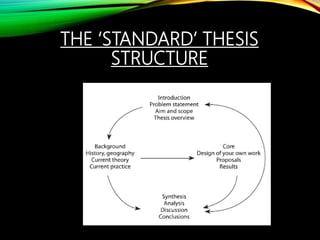
THE ‘STANDARD’ THESIS
STRUCTURE
INTRODUCTION
The introduction explains what the thesis is about: the
problem that the thesis is concerned with, the aims and
scope, and the thesis structure. In some disciplines it includes
an overview of the findings. An introduction is typically
written for a wider readership than the bulk of the thesis, and
may use illustrative examples to help underpin the reader’s
understanding of what you are trying to achieve.
BACKGROUND
• The background is the knowledge required before a reader
can understand your research: relevant history, context,
current knowledge, theory and practice, and other
researchers’ views. In the background, your purpose is to
position your study in the context of what has gone before,
what is currently taking place, and how research in the area
is conducted. It might contain a historical review.
CORE
• The core concerns your own work: your propositions or
hypotheses, innovations, experimental designs, surveys and
reviews, results, analysis, and so on. (This is sometimes
called the contribution, though in a strong thesis the
background too forms part of the contribution, as other
researchers may value your interpretation and analysis of
past work as much as they value the ‘new’ work presented
in the core.) The core can easily form the bulk of the thesis
and consist of several chapters.
SYNTHESIS
The synthesis draws together your contribution to the topic. It
will usually contain a discussion in which you critically
examine your own results in the light of the previous state of
the subject as outlined in the background, and make
judgments as to what has been learnt in your work; the
discussion may be a separate chapter, or may be integrated
with the detailed work in the core. Finally, it is where you
summarise the discussion and evaluation to produce
conclusions. These should respond directly to the aim of the
work as stated in the introduction.
STARTING YOUR THESIS
 Write early, and write often. Keep your research in parallel with your writing so
they grow in parallel. Begin to develop your thesis as part of the process of
initiating your research.
 If you do delay writing until after you have done your own work—although this
is not the safest way to produce a strong thesis!—make sure that you are
writing to the structure advocated above.
 Start with confidence. Make an outline for introductory chapter, then put it aside
while you work on other parts of your study. Come back from time to time to
revise your aim and scope so that they align with the changes you make as you
go along.
 Let your writing drive your development of a literature review. Make sure that it
is structured and critical. Use a rich mix of strategies for exploring the literature,
including online academic tools, traditional libraries, and non-academic
resources such as Wikipedia.
 In the early stages, your research questions may develop or change. This is a
good thing.
WRITING STRATEGIES
 Remember that it is your writing that will be examined. Other tasks may not be
productive unless they lead to material for your thesis. Be aware of the tension
between creating and critical thinking, and consciously exploit it to help you
develop a strong thesis.
 There are many excuses for not writing. Most are a form of procrastination.
 Make plans, and stick to them. Audit yourself and seek to understand and
resolve reasons for lack of progress. When you find an effective writing habit,
use it.
 Make good use of your supervisor; think of her or him as a resource as well as a
mentor.
THE INTRODUCTORY CHAPTER
• The Introductory chapter should consist of five brief elements;
1. Context of the Study
2. Problem Statement
3. Aim and Scope
4. Significance of the Study
5. Overview of the Study
Revising your introduction, aligning your conclusion:
 To avoid making promises to the examiner that you can’t keep or
that you do not later address, regularly review your introductory
chapter and revise it accordingly.
 Consider starting your conclusion chapter on the same day that
you begin your introduction, and, each time you work on one,
work on the other, thus keeping them in alignment.
ESTABLISHING YOUR CONTRIBUTION
Positioning your work:
1. Draw on the conclusions of the background chapters to identify
your research hypotheses or research questions.
2. Understand where your work lies on the dimensions that are
appropriate to your discipline: theoretical or applied, study or
case study, and so on. Use this understanding to inform your
explanation of your intended contribution.
3. Positioning requires justification. For example, if you decide on a
case-study approach, explain why, and justify your choice of
specific case to study; if a long description of the case is
needed, note that you will do this in a separate following
chapter.
CONT.…
Method:
1. Discuss the range of research methods that could be used to test your
hypotheses or answer your questions, and choose the most appropriate. Don’t
forget to justify your choice, even if it is standard for your discipline.
2. Experimental validation requires an experimental design. Expect to have to
explain it in detail, and also to justify it. Make appropriate choices of
measurement or assessment mechanisms.
3. ‘Method’ and ‘methodology’ are not the same thing. ‘Method’ refers to specific
techniques and ‘methodology’ refers to the stance you are taking as the
researcher.
4. If only one method is to be used, describe the research instruments to be used
in implementing it. If more than one method is to be used it is usually better to
defer the descriptions of research instruments to the particular chapters where
you implement the methods and obtain results.
5. If you have not already described your detailed research procedure in the
‘Research Design’ chapter you should describe it first before you go on to
report any research results.
CONT.…
Organization:
1. Design a narrative flow that takes the reader painlessly through the central
part of your thesis—the part that consists of the new ideas that you are
arguing for (and is thus the most unfamiliar).
2. Be alert to the different narrative structures used in different kinds of thesis.
3. Ensure that at all stages you have a clear understanding of the argument you
intend to use for linking of question, data, analysis, and outcome.
OUTCOMES AND RESULTS
Research results:
1. Data comes from sources and experiments described in earlier chapters.
Only include data that is derived from a process that you have described,
that is, the reader must understand where your data comes from. Describe
the data fully.
2. Have clear criteria for inclusion and exclusion of data and results. These
should be independent of what the data shows, that is, it is not acceptable
to only include data that confirms your hypotheses!
3. Make sure you have used the right kind of analysis mechanism for your
data. For example, tools or approaches for large data sets may be
unsuitable for sparse or irregular data.
4. Understand your variables.
5. Build a clear argument from data to knowledge. As you build this
argument, be aware that interpretation of the results may lead you back to
the data collection process.
OUTCOMES AND RESULTS
Presentation:
1. Do not include raw, undigested data in the body of your thesis. Put
it in an appendix, or better, back in your filing cabinet.
2. Display your results in an informative, appropriate way, either
through charts, tables, diagrams, or carefully constructed
arguments. In doing so, make sure that the presentation makes it
possible for the reader to see whether your hypotheses have been
tested or your questions answered.
3. Be open about shortcomings or limitations of your data or results.
4. Figures should be reasonably self-contained.
5. Use examples from elsewhere to guide your design of illustrations.
Don’t be content with word-processor defaults, which often look
unprofessional, and use the right tool for the task.
THE DISCUSSION AND
INTERPRETATION
Structuring your discussion:
1. The task of the discussion chapter is to enable you to reach
your conclusions. Drawing up a tentative list of conclusions will
help you identify an appropriate structure.
2. Begin by writing down all the things you know now that you
didn’t know when you started the project. Rearranging this list
will give you the titles of the main sections of your discussion.
Checking the thesis structure:
1. Before you start writing material in each of these sections, check
your thesis structure by stringing together introductions and
conclusions for all the chapters.
2. Check that the tentatively structured thesis responds to the aim
and scope you set yourself in your introductory chapter.
THE DISCUSSION AND
INTERPRETATION
Write with authority:
1. Make sure that your exposition of new theory or ideas places
your thesis within the context of the field you are working in.
This will require that you not only draw on your own results, but
that you view these against existing thinking as expounded in
your background chapters.
2. Acknowledge any limitations on your findings. Theoretical
results may need validation before their suitability in practice is
known, for example. Shortcomings or uncertainties should also
be acknowledged.
3. If the thesis involves a case study, check that you have dealt
with the problem of generalizability, or issues of transference,
for your findings to similar situations.
CONCLUSIONS
Connecting discussion and conclusions:
1. Your conclusions are what your discussion chapter has
been arguing for.
2. You could write the conclusions to your whole study as
the last section of a chapter called ‘Discussion and
Conclusions’, but it is usually preferable to have a
separate ‘Conclusions’ chapter.
3. If they form a separate chapter there should be no
conclusions to the discussion chapter, and you should
inform the reader of this in the discussion.
CONCLUSIONS
Rules about conclusions:
1. You should draw your conclusions solely from the
discussion chapter.
2. There should be little further discussion in the conclusions
chapter.
3. The conclusions should respond to the aim stated in the
first chapter.
4. Summaries are not conclusions.
5. Conclusions should be crisp and concise.
6. The conclusions can be used to briefly explore the
implications of your findings.
BEFORE YOU SUBMIT…
From first draft to second draft:
1. Check the structure of the thesis as a whole.
2. Read it through in detail yourself. Check the logic flow.
Look for gaps in the logic, repetitions, things in the wrong
order. Fix these up to the best of your ability.
3. Then (and only then) ask your supervisor to do the same.
If possible, find a friend whose opinions you can rely on
but who is unfamiliar with your topic to do the same. Fix
up the problems they identify.
BEFORE YOU SUBMIT…
Checking the details:
1. You now must check to ensure that you have done
everything properly. Depending on how systematic you
have been earlier, this task may take several weeks. Allow
time for it in your thesis completion schedule.
2. Be professional. Do not use material that is not your own
without proper citation, and be aware of ethical concerns
that lie at the core of academic research.
BEYOND THE THESIS…
Publishing:
1. Make sure that the good work you are doing in your project gets
published.
2. The only way to ensure this is to have a dissemination plan. The plan
should be geared to publishing while you are still working on your
project.
3. Regularly give research seminars. Doing so gives you feedback on
your project, and will also form the basis for conference papers and
papers in learned journals.
4. Research papers have a different set of rules and conventions from
theses. To publish papers, you need to address a different readership
using these different conventions.
5. Papers written on the basis of work done as part of your project
should in general be written jointly with your supervisor and possibly
other colleagues too. You need to do this in a way that respects the
input of both parties.
CHARACTERISTICS OF A HIGH
QUALITY THESIS
 The title clearly reflects the focus and the argument.
 A significant and substantial problem has been selected for investigation.
 There is an early statement of the project aims.
 The project presents a considerable advance on existing knowledge.
 The thesis demonstrates a systematic pursuit of a consistent line of
inquiry.
 It is well-planned and executed, with each section clearly building on the
last (that is, there is a coherent and unifying macro-level structure).
 There is clear signposting and linking between paragraphs, sections, and
chapters. It consistently (but not repetitively) reminds the reader of the
purpose, argument, or overall thrust of the thesis.
 The literature review is critical and evaluative, and sets forth an argument
for why and how the study should be conducted.
 The research design is appropriate and allows the questions to be
answered.
 There is a meticulous account of the procedure.
 A rich variety of evidence is employed to develop a balanced argument.
 Advanced analytical skills are used to demonstrate a deep understanding
of the problem; a clear chain of evidence is laid down.
 The discussion is disciplined and not excessively speculative.
 Conclusions are well drawn and convincing (they relate the outcomes
back to the research aims); clear and strong knowledge claims are made
about the exact contributions of the thesis.
 Key concepts or variables are clearly defined and consistently used
throughout.
 Written expression is elegant, precise, and economical.
 There is evidence of systematic proofreading and error correction.
CONT…
CHARACTERISTICS OF A POOR
THESIS
 Objectives and protocol of the study are not stated.
 The research questions are either not significant or are self-evident (no risk of a
successful outcome).
 The principal purpose or argument of the thesis is difficult to discern.
 No clear delimitations to the study.
 Overly simplistic comments and generalizations.
 The scope of the thesis is overly ambitious.
 Grasp of the literature has serious limitations (the student is unaware of major
relevant works, or uses older works that are no longer authoritative or never were
authoritative).
 The description of the literature is serial rather than interpretative (with scant
critical analysis or argument emerging).
 Theoretical perspectives or conceptual frameworks are left implicit; the rationale
for a particular theoretical approach is missing or undeveloped.
 Shows no awareness of the alignment or compatibilities of particular theoretical
and methodological approaches.
 The overview of theory is broad and lacks depth or persuasiveness (especially
noted by a reliance on undergraduate texts without reference to primary authors).
 The description of the sample selection strategy is inadequate (inclusion and
exclusion criteria not stated).
 The arguments are intrinsically weak.
 Large slabs of (qualitative) data are used to present a point when smaller excerpts
with richer or deeper analyses are needed.
 No demonstrated understanding of appropriate statistical analyses and
interpretation, or insufficient detail on how the data analysis was undertaken.
CONT.…
CONT.…
 Triangulation often claimed but rarely delivered.
 Contains sweeping, unfounded conclusions that have little or no
basis in evidence.
 Definitions of key terms are either omitted or imprecise.
 Contains poor photos, confusing diagrams, and inadequately
labelled tables.
 Contains poor written expression that detracts from the
candidate’s argument.
 Littered with spelling and typographical errors; has incorrect or
inconsistent referencing.
 The text is unnecessarily long and wordy. Material is repeated.
 Lack of critical self-evaluation of the research.
How to write better thesis

How to write better thesis

  • 2.
    HOW TO WRITEA BETTER THESIS F a i z a n A k r a m P h a r m - D ( 4 t h P r o f ) D e p a r t m e n t o f P h a r m a c y T h e I s l a m i a U n i v e r s i t y o f B a h a w a l p u r . Chapter # 09
  • 3.
    SIMPLY DEFINED, ATHESIS IS AN EXTENDED ARGUMENT. Attributes of a Successful Thesis;  The thesis demonstrates authority in the candidate’s field and shows evidence of command of knowledge in relevant fields.  It shows that the candidate has a thorough grasp of the appropriate methodological techniques and an awareness of their limitations.  It makes a distinct contribution to knowledge.  Its contribution to knowledge rests on originality of approach and/or interpretation of the findings and, in some cases, the discovery of new facts.  It demonstrates an ability to communicate research findings effectively in the professional arena and in an international context.  It is a careful, rigorous and sustained piece of work demonstrating that a research ‘apprenticeship’ is complete and the holder is admitted to the community of scholars in the discipline.
  • 4.
  • 5.
    INTRODUCTION The introduction explainswhat the thesis is about: the problem that the thesis is concerned with, the aims and scope, and the thesis structure. In some disciplines it includes an overview of the findings. An introduction is typically written for a wider readership than the bulk of the thesis, and may use illustrative examples to help underpin the reader’s understanding of what you are trying to achieve.
  • 6.
    BACKGROUND • The backgroundis the knowledge required before a reader can understand your research: relevant history, context, current knowledge, theory and practice, and other researchers’ views. In the background, your purpose is to position your study in the context of what has gone before, what is currently taking place, and how research in the area is conducted. It might contain a historical review.
  • 7.
    CORE • The coreconcerns your own work: your propositions or hypotheses, innovations, experimental designs, surveys and reviews, results, analysis, and so on. (This is sometimes called the contribution, though in a strong thesis the background too forms part of the contribution, as other researchers may value your interpretation and analysis of past work as much as they value the ‘new’ work presented in the core.) The core can easily form the bulk of the thesis and consist of several chapters.
  • 8.
    SYNTHESIS The synthesis drawstogether your contribution to the topic. It will usually contain a discussion in which you critically examine your own results in the light of the previous state of the subject as outlined in the background, and make judgments as to what has been learnt in your work; the discussion may be a separate chapter, or may be integrated with the detailed work in the core. Finally, it is where you summarise the discussion and evaluation to produce conclusions. These should respond directly to the aim of the work as stated in the introduction.
  • 9.
    STARTING YOUR THESIS Write early, and write often. Keep your research in parallel with your writing so they grow in parallel. Begin to develop your thesis as part of the process of initiating your research.  If you do delay writing until after you have done your own work—although this is not the safest way to produce a strong thesis!—make sure that you are writing to the structure advocated above.  Start with confidence. Make an outline for introductory chapter, then put it aside while you work on other parts of your study. Come back from time to time to revise your aim and scope so that they align with the changes you make as you go along.  Let your writing drive your development of a literature review. Make sure that it is structured and critical. Use a rich mix of strategies for exploring the literature, including online academic tools, traditional libraries, and non-academic resources such as Wikipedia.  In the early stages, your research questions may develop or change. This is a good thing.
  • 10.
    WRITING STRATEGIES  Rememberthat it is your writing that will be examined. Other tasks may not be productive unless they lead to material for your thesis. Be aware of the tension between creating and critical thinking, and consciously exploit it to help you develop a strong thesis.  There are many excuses for not writing. Most are a form of procrastination.  Make plans, and stick to them. Audit yourself and seek to understand and resolve reasons for lack of progress. When you find an effective writing habit, use it.  Make good use of your supervisor; think of her or him as a resource as well as a mentor.
  • 11.
    THE INTRODUCTORY CHAPTER •The Introductory chapter should consist of five brief elements; 1. Context of the Study 2. Problem Statement 3. Aim and Scope 4. Significance of the Study 5. Overview of the Study Revising your introduction, aligning your conclusion:  To avoid making promises to the examiner that you can’t keep or that you do not later address, regularly review your introductory chapter and revise it accordingly.  Consider starting your conclusion chapter on the same day that you begin your introduction, and, each time you work on one, work on the other, thus keeping them in alignment.
  • 12.
    ESTABLISHING YOUR CONTRIBUTION Positioningyour work: 1. Draw on the conclusions of the background chapters to identify your research hypotheses or research questions. 2. Understand where your work lies on the dimensions that are appropriate to your discipline: theoretical or applied, study or case study, and so on. Use this understanding to inform your explanation of your intended contribution. 3. Positioning requires justification. For example, if you decide on a case-study approach, explain why, and justify your choice of specific case to study; if a long description of the case is needed, note that you will do this in a separate following chapter.
  • 13.
    CONT.… Method: 1. Discuss therange of research methods that could be used to test your hypotheses or answer your questions, and choose the most appropriate. Don’t forget to justify your choice, even if it is standard for your discipline. 2. Experimental validation requires an experimental design. Expect to have to explain it in detail, and also to justify it. Make appropriate choices of measurement or assessment mechanisms. 3. ‘Method’ and ‘methodology’ are not the same thing. ‘Method’ refers to specific techniques and ‘methodology’ refers to the stance you are taking as the researcher. 4. If only one method is to be used, describe the research instruments to be used in implementing it. If more than one method is to be used it is usually better to defer the descriptions of research instruments to the particular chapters where you implement the methods and obtain results. 5. If you have not already described your detailed research procedure in the ‘Research Design’ chapter you should describe it first before you go on to report any research results.
  • 14.
    CONT.… Organization: 1. Design anarrative flow that takes the reader painlessly through the central part of your thesis—the part that consists of the new ideas that you are arguing for (and is thus the most unfamiliar). 2. Be alert to the different narrative structures used in different kinds of thesis. 3. Ensure that at all stages you have a clear understanding of the argument you intend to use for linking of question, data, analysis, and outcome.
  • 15.
    OUTCOMES AND RESULTS Researchresults: 1. Data comes from sources and experiments described in earlier chapters. Only include data that is derived from a process that you have described, that is, the reader must understand where your data comes from. Describe the data fully. 2. Have clear criteria for inclusion and exclusion of data and results. These should be independent of what the data shows, that is, it is not acceptable to only include data that confirms your hypotheses! 3. Make sure you have used the right kind of analysis mechanism for your data. For example, tools or approaches for large data sets may be unsuitable for sparse or irregular data. 4. Understand your variables. 5. Build a clear argument from data to knowledge. As you build this argument, be aware that interpretation of the results may lead you back to the data collection process.
  • 16.
    OUTCOMES AND RESULTS Presentation: 1.Do not include raw, undigested data in the body of your thesis. Put it in an appendix, or better, back in your filing cabinet. 2. Display your results in an informative, appropriate way, either through charts, tables, diagrams, or carefully constructed arguments. In doing so, make sure that the presentation makes it possible for the reader to see whether your hypotheses have been tested or your questions answered. 3. Be open about shortcomings or limitations of your data or results. 4. Figures should be reasonably self-contained. 5. Use examples from elsewhere to guide your design of illustrations. Don’t be content with word-processor defaults, which often look unprofessional, and use the right tool for the task.
  • 17.
    THE DISCUSSION AND INTERPRETATION Structuringyour discussion: 1. The task of the discussion chapter is to enable you to reach your conclusions. Drawing up a tentative list of conclusions will help you identify an appropriate structure. 2. Begin by writing down all the things you know now that you didn’t know when you started the project. Rearranging this list will give you the titles of the main sections of your discussion. Checking the thesis structure: 1. Before you start writing material in each of these sections, check your thesis structure by stringing together introductions and conclusions for all the chapters. 2. Check that the tentatively structured thesis responds to the aim and scope you set yourself in your introductory chapter.
  • 18.
    THE DISCUSSION AND INTERPRETATION Writewith authority: 1. Make sure that your exposition of new theory or ideas places your thesis within the context of the field you are working in. This will require that you not only draw on your own results, but that you view these against existing thinking as expounded in your background chapters. 2. Acknowledge any limitations on your findings. Theoretical results may need validation before their suitability in practice is known, for example. Shortcomings or uncertainties should also be acknowledged. 3. If the thesis involves a case study, check that you have dealt with the problem of generalizability, or issues of transference, for your findings to similar situations.
  • 19.
    CONCLUSIONS Connecting discussion andconclusions: 1. Your conclusions are what your discussion chapter has been arguing for. 2. You could write the conclusions to your whole study as the last section of a chapter called ‘Discussion and Conclusions’, but it is usually preferable to have a separate ‘Conclusions’ chapter. 3. If they form a separate chapter there should be no conclusions to the discussion chapter, and you should inform the reader of this in the discussion.
  • 20.
    CONCLUSIONS Rules about conclusions: 1.You should draw your conclusions solely from the discussion chapter. 2. There should be little further discussion in the conclusions chapter. 3. The conclusions should respond to the aim stated in the first chapter. 4. Summaries are not conclusions. 5. Conclusions should be crisp and concise. 6. The conclusions can be used to briefly explore the implications of your findings.
  • 21.
    BEFORE YOU SUBMIT… Fromfirst draft to second draft: 1. Check the structure of the thesis as a whole. 2. Read it through in detail yourself. Check the logic flow. Look for gaps in the logic, repetitions, things in the wrong order. Fix these up to the best of your ability. 3. Then (and only then) ask your supervisor to do the same. If possible, find a friend whose opinions you can rely on but who is unfamiliar with your topic to do the same. Fix up the problems they identify.
  • 22.
    BEFORE YOU SUBMIT… Checkingthe details: 1. You now must check to ensure that you have done everything properly. Depending on how systematic you have been earlier, this task may take several weeks. Allow time for it in your thesis completion schedule. 2. Be professional. Do not use material that is not your own without proper citation, and be aware of ethical concerns that lie at the core of academic research.
  • 23.
    BEYOND THE THESIS… Publishing: 1.Make sure that the good work you are doing in your project gets published. 2. The only way to ensure this is to have a dissemination plan. The plan should be geared to publishing while you are still working on your project. 3. Regularly give research seminars. Doing so gives you feedback on your project, and will also form the basis for conference papers and papers in learned journals. 4. Research papers have a different set of rules and conventions from theses. To publish papers, you need to address a different readership using these different conventions. 5. Papers written on the basis of work done as part of your project should in general be written jointly with your supervisor and possibly other colleagues too. You need to do this in a way that respects the input of both parties.
  • 24.
    CHARACTERISTICS OF AHIGH QUALITY THESIS  The title clearly reflects the focus and the argument.  A significant and substantial problem has been selected for investigation.  There is an early statement of the project aims.  The project presents a considerable advance on existing knowledge.  The thesis demonstrates a systematic pursuit of a consistent line of inquiry.  It is well-planned and executed, with each section clearly building on the last (that is, there is a coherent and unifying macro-level structure).  There is clear signposting and linking between paragraphs, sections, and chapters. It consistently (but not repetitively) reminds the reader of the purpose, argument, or overall thrust of the thesis.  The literature review is critical and evaluative, and sets forth an argument for why and how the study should be conducted.
  • 25.
     The researchdesign is appropriate and allows the questions to be answered.  There is a meticulous account of the procedure.  A rich variety of evidence is employed to develop a balanced argument.  Advanced analytical skills are used to demonstrate a deep understanding of the problem; a clear chain of evidence is laid down.  The discussion is disciplined and not excessively speculative.  Conclusions are well drawn and convincing (they relate the outcomes back to the research aims); clear and strong knowledge claims are made about the exact contributions of the thesis.  Key concepts or variables are clearly defined and consistently used throughout.  Written expression is elegant, precise, and economical.  There is evidence of systematic proofreading and error correction. CONT…
  • 26.
    CHARACTERISTICS OF APOOR THESIS  Objectives and protocol of the study are not stated.  The research questions are either not significant or are self-evident (no risk of a successful outcome).  The principal purpose or argument of the thesis is difficult to discern.  No clear delimitations to the study.  Overly simplistic comments and generalizations.  The scope of the thesis is overly ambitious.  Grasp of the literature has serious limitations (the student is unaware of major relevant works, or uses older works that are no longer authoritative or never were authoritative).  The description of the literature is serial rather than interpretative (with scant critical analysis or argument emerging).
  • 27.
     Theoretical perspectivesor conceptual frameworks are left implicit; the rationale for a particular theoretical approach is missing or undeveloped.  Shows no awareness of the alignment or compatibilities of particular theoretical and methodological approaches.  The overview of theory is broad and lacks depth or persuasiveness (especially noted by a reliance on undergraduate texts without reference to primary authors).  The description of the sample selection strategy is inadequate (inclusion and exclusion criteria not stated).  The arguments are intrinsically weak.  Large slabs of (qualitative) data are used to present a point when smaller excerpts with richer or deeper analyses are needed.  No demonstrated understanding of appropriate statistical analyses and interpretation, or insufficient detail on how the data analysis was undertaken. CONT.…
  • 28.
    CONT.…  Triangulation oftenclaimed but rarely delivered.  Contains sweeping, unfounded conclusions that have little or no basis in evidence.  Definitions of key terms are either omitted or imprecise.  Contains poor photos, confusing diagrams, and inadequately labelled tables.  Contains poor written expression that detracts from the candidate’s argument.  Littered with spelling and typographical errors; has incorrect or inconsistent referencing.  The text is unnecessarily long and wordy. Material is repeated.  Lack of critical self-evaluation of the research.