PHYSICS – Forces 1
LEARNING
OBJECTIVES
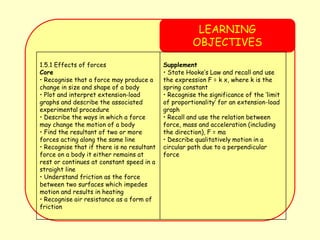
1.5.1 Effects of forces
Core
• Recognise that a force may produce a
change in size and shape of a body
• Plot and interpret extension-load
graphs and describe the associated
experimental procedure
• Describe the ways in which a force
may change the motion of a body
• Find the resultant of two or more
forces acting along the same line
• Recognise that if there is no resultant
force on a body it either remains at
rest or continues at constant speed in a
straight line
• Understand friction as the force
between two surfaces which impedes
motion and results in heating
• Recognise air resistance as a form of
friction
Supplement
• State Hooke’s Law and recall and use
the expression F = k x, where k is the
spring constant
• Recognise the significance of the ‘limit
of proportionality’ for an extension-load
graph
• Recall and use the relation between
force, mass and acceleration (including
the direction), F = ma
• Describe qualitatively motion in a
circular path due to a perpendicular
force
LEARNING
OBJECTIVES
1.5.1 Effects of forces
Core
• Recognise that a force may produce a
change in size and shape of a body
• Plot and interpret extension-load
graphs and describe the associated
experimental procedure
• Describe the ways in which a force
may change the motion of a body
• Find the resultant of two or more
forces acting along the same line
• Recognise that if there is no resultant
force on a body it either remains at
rest or continues at constant speed in a
straight line
• Understand friction as the force
between two surfaces which impedes
motion and results in heating
• Recognise air resistance as a form of
friction
Supplement
• State Hooke’s Law and recall and use
the expression F = k x, where k is the
spring constant
• Recognise the significance of the ‘limit
of proportionality’ for an extension-load
graph
• Recall and use the relation between
force, mass and acceleration (including
the direction), F = ma
• Describe qualitatively motion in a
circular path due to a perpendicular
force
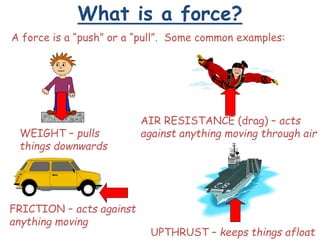
What is a force?
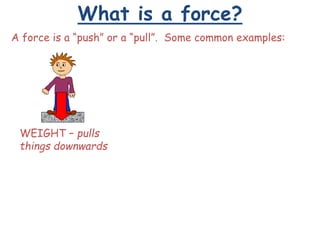
A force is a “push” or a “pull”. Some common examples:
WEIGHT – pulls
things downwards
What is a force?
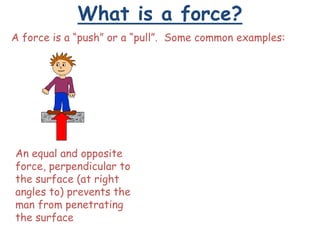
A force is a “push” or a “pull”. Some common examples:
An equal and opposite
force, perpendicular to
the surface (at right
angles to) prevents the
man from penetrating
the surface
What is a force?
A force is a “push” or a “pull”. Some common examples:
WEIGHT – pulls
things downwards
AIR RESISTANCE (drag) – acts
against anything moving through air
UPTHRUST – keeps things afloat
FRICTION – acts against
anything moving
Forces are vector quantities
because they have both size
and direction.
Forces are vector quantities
because they have both size
and direction.
SI units
Forces are measured in
newtons (N)
Forces are vector quantities
because they have both size
and direction.
SI units
Forces are measured in
newtons (N)
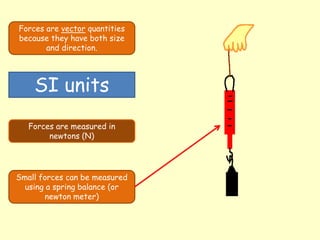
Small forces can be measured
using a spring balance (or
newton meter)
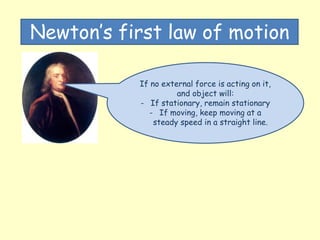
Newton’s first law of motion
If no external force is acting on it,
and object will:
- If stationary, remain stationary
- If moving, keep moving at a
steady speed in a straight line.
Newton’s first law of motion
If no external force is acting on it,
and object will:
- If stationary, remain stationary
- If moving, keep moving at a
steady speed in a straight line.
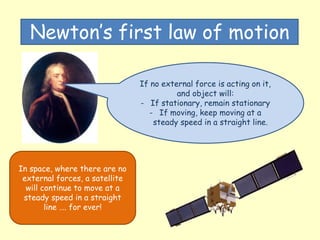
In space, where there are no
external forces, a satellite
will continue to move at a
steady speed in a straight
line …. for ever!
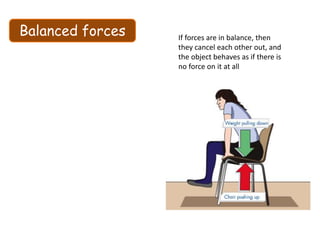
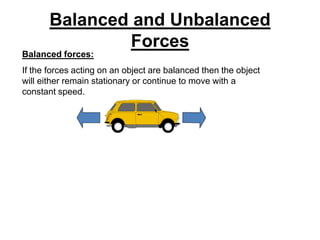
Balanced forces If forces are in balance, then
they cancel each other out, and
the object behaves as if there is
no force on it at all
Balanced forces If forces are in balance, then
they cancel each other out, and
the object behaves as if there is
no force on it at all
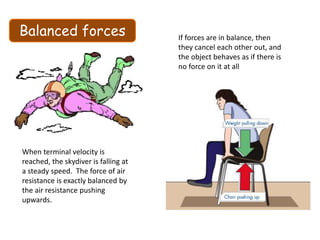
When terminal velocity is
reached, the skydiver is falling at
a steady speed. The force of air
resistance is exactly balanced by
the air resistance pushing
upwards.
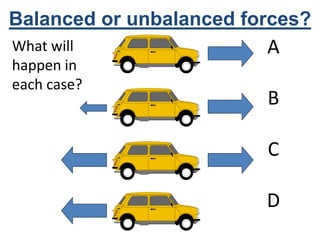
Balanced or unbalanced forces?
What will
happen in
each case?
A
B
C
D
Balanced and Unbalanced
Forces
Balanced forces:
If the forces acting on an object are balanced then the object
will either remain stationary or continue to move with a
constant speed.
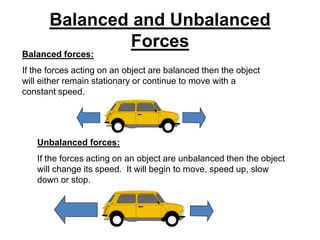
Balanced and Unbalanced
Forces
Balanced forces:
If the forces acting on an object are balanced then the object
will either remain stationary or continue to move with a
constant speed.
Unbalanced forces:
If the forces acting on an object are unbalanced then the object
will change its speed. It will begin to move, speed up, slow
down or stop.
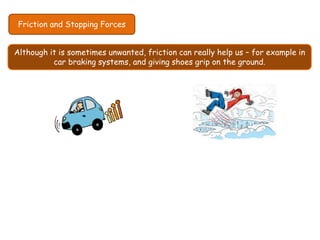
Friction and Stopping Forces
Although it is sometimes unwanted, friction can really help us – for example in
car braking systems, and giving shoes grip on the ground.
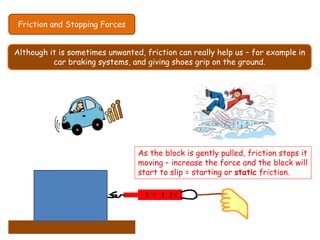
Friction and Stopping Forces
Although it is sometimes unwanted, friction can really help us – for example in
car braking systems, and giving shoes grip on the ground.
As the block is gently pulled, friction stops it
moving – increase the force and the block will
start to slip = starting or static friction.
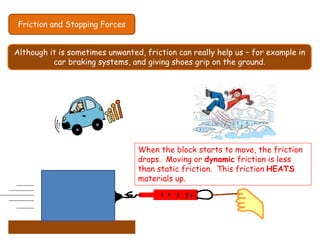
Friction and Stopping Forces
Although it is sometimes unwanted, friction can really help us – for example in
car braking systems, and giving shoes grip on the ground.
When the block starts to move, the friction
drops. Moving or dynamic friction is less
than static friction. This friction HEATS
materials up.
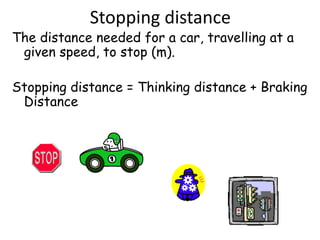
Stopping distance
The distance needed for a car, travelling at a
given speed, to stop (m).
Stopping distance = Thinking distance + Braking
Distance
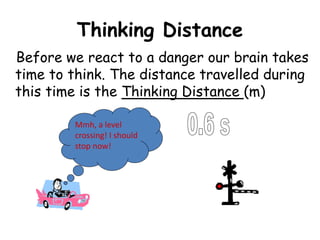
Thinking Distance
Before we react to a danger our brain takes
time to think. The distance travelled during
this time is the Thinking Distance (m)
Mmh, a level
crossing! I should
stop now!
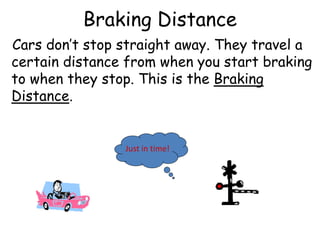
Just in time!
Braking Distance
Cars don’t stop straight away. They travel a
certain distance from when you start braking
to when they stop. This is the Braking
Distance.
LEARNING
OBJECTIVES
1.5.1 Effects of forces
Core
• Recognise that a force may produce a
change in size and shape of a body
• Plot and interpret extension-load
graphs and describe the associated
experimental procedure
• Describe the ways in which a force
may change the motion of a body
• Find the resultant of two or more
forces acting along the same line
• Recognise that if there is no resultant
force on a body it either remains at
rest or continues at constant speed in a
straight line
• Understand friction as the force
between two surfaces which impedes
motion and results in heating
• Recognise air resistance as a form of
friction
Supplement
• State Hooke’s Law and recall and use
the expression F = k x, where k is the
spring constant
• Recognise the significance of the ‘limit
of proportionality’ for an extension-load
graph
• Recall and use the relation between
force, mass and acceleration (including
the direction), F = ma
• Describe qualitatively motion in a
circular path due to a perpendicular
force
Hooke’s Law and forces acting
on a stretched spring.
Hooke’s Law and forces acting
on a stretched spring.
Robert Hooke
was born in 1635
and he devised
an equation
describing
elasticity.
Hooke’s Law and forces acting
on a stretched spring.
Robert Hooke was
born in 1635 and the
1660’s he devised an
equation describing
elasticity.
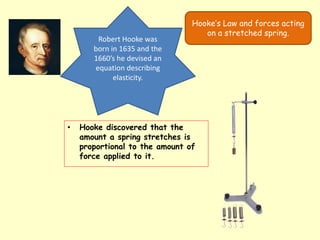
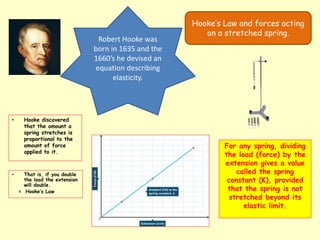
• Hooke discovered that the
amount a spring stretches is
proportional to the amount of
force applied to it.
Hooke’s Law and forces acting
on a stretched spring.
Robert Hooke was
born in 1635 and the
1660’s he devised an
equation describing
elasticity.
• Hooke discovered that the
amount a spring stretches is
proportional to the amount of
force applied to it.
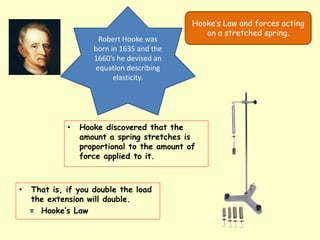
• That is, if you double the load
the extension will double.
= Hooke’s Law
Hooke’s Law and forces acting
on a stretched spring.
Robert Hooke was
born in 1635 and the
1660’s he devised an
equation describing
elasticity.
• Hooke discovered
that the amount a
spring stretches is
proportional to the
amount of force
applied to it.
• That is, if you double
the load the extension
will double.
= Hooke’s Law
Hooke’s Law and forces acting
on a stretched spring.
Robert Hooke was
born in 1635 and the
1660’s he devised an
equation describing
elasticity.
• Hooke discovered
that the amount a
spring stretches is
proportional to the
amount of force
applied to it.
• That is, if you double
the load the extension
will double.
= Hooke’s Law
For any spring, dividing
the load (force) by the
extension gives a value
called the spring
constant (K), provided
that the spring is not
stretched beyond its
elastic limit.
Hooke’s Law and forces acting
on a stretched spring.
Robert Hooke was
born in 1635 and the
1660’s he devised an
equation describing
elasticity.
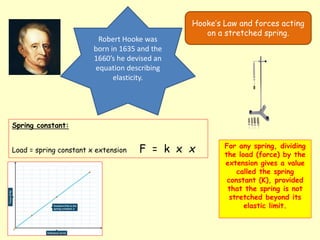
Spring constant:
Load = spring constant x extension F = k x x For any spring, dividing
the load (force) by the
extension gives a value
called the spring
constant (K), provided
that the spring is not
stretched beyond its
elastic limit.
Hooke’s Law and forces acting
on a stretched spring.
Robert Hooke was
born in 1635 and the
1660’s he devised an
equation describing
elasticity.
Spring constant:
Load = spring constant x extension F = k x x For any spring, dividing
the load (force) by the
extension gives a value
called the spring
constant (K), provided
that the spring is not
stretched beyond its
elastic limit.
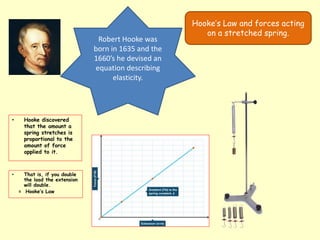
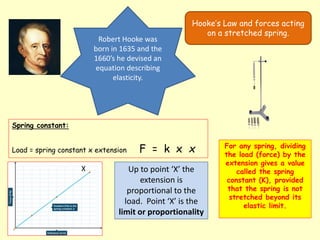
X Up to point ‘X’ the
extension is
proportional to the
load. Point ‘X’ is the
limit or proportionality
Hooke’s Law and forces acting
on a stretched spring.
Robert Hooke was
born in 1635 and the
1660’s he devised an
equation describing
elasticity.
For any spring, dividing
the load (force) by the
extension gives a value
called the spring
constant (K), provided
that the spring is not
stretched beyond its
elastic limit.
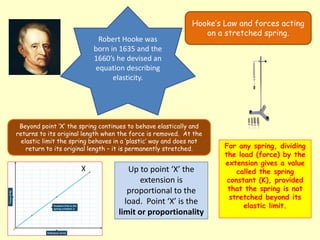
X Up to point ‘X’ the
extension is
proportional to the
load. Point ‘X’ is the
limit or proportionality
Beyond point ‘X’ the spring continues to behave elastically and
returns to its original length when the force is removed. At the
elastic limit the spring behaves in a ‘plastic’ way and does not
return to its original length – it is permanently stretched.
LEARNING
OBJECTIVES
1.5.1 Effects of forces
Core
• Recognise that a force may produce a
change in size and shape of a body
• Plot and interpret extension-load
graphs and describe the associated
experimental procedure
• Describe the ways in which a force
may change the motion of a body
• Find the resultant of two or more
forces acting along the same line
• Recognise that if there is no resultant
force on a body it either remains at
rest or continues at constant speed in a
straight line
• Understand friction as the force
between two surfaces which impedes
motion and results in heating
• Recognise air resistance as a form of
friction
Supplement
• State Hooke’s Law and recall and use
the expression F = k x, where k is the
spring constant
• Recognise the significance of the ‘limit
of proportionality’ for an extension-load
graph
• Recall and use the relation between
force, mass and acceleration (including
the direction), F = ma
• Describe qualitatively motion in a
circular path due to a perpendicular
force
Force, mass
and
acceleration
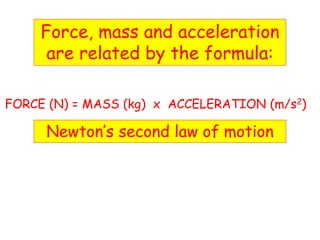
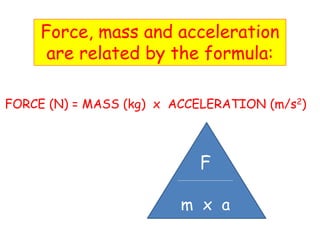
Force, mass and acceleration
are related by the formula:
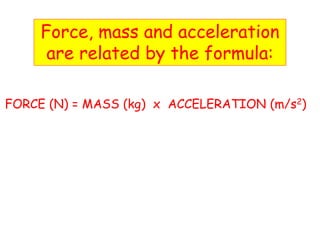
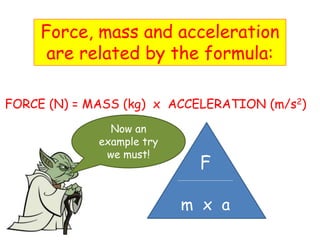
Force, mass and acceleration
are related by the formula:
FORCE (N) = MASS (kg) x ACCELERATION (m/s2)
Force, mass and acceleration
are related by the formula:
FORCE (N) = MASS (kg) x ACCELERATION (m/s2)
Newton’s second law of motion
Force, mass and acceleration
are related by the formula:
FORCE (N) = MASS (kg) x ACCELERATION (m/s2)
F
m x a
Force, mass and acceleration
are related by the formula:
FORCE (N) = MASS (kg) x ACCELERATION (m/s2)
F
m x a
Now an
example try
we must!
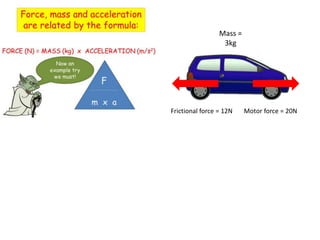
Frictional force = 12N Motor force = 20N
Mass =
3kg
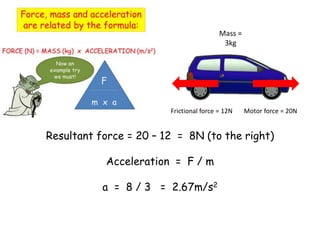
Frictional force = 12N Motor force = 20N
Mass =
3kg
Resultant force = 20 – 12 = 8N (to the right)
Acceleration = F / m
a = 8 / 3 = 2.67m/s2
LEARNING
OBJECTIVES
1.5.1 Effects of forces
Core
• Recognise that a force may produce a
change in size and shape of a body
• Plot and interpret extension-load
graphs and describe the associated
experimental procedure
• Describe the ways in which a force
may change the motion of a body
• Find the resultant of two or more
forces acting along the same line
• Recognise that if there is no resultant
force on a body it either remains at
rest or continues at constant speed in a
straight line
• Understand friction as the force
between two surfaces which impedes
motion and results in heating
• Recognise air resistance as a form of
friction
Supplement
• State Hooke’s Law and recall and use
the expression F = k x, where k is the
spring constant
• Recognise the significance of the ‘limit
of proportionality’ for an extension-load
graph
• Recall and use the relation between
force, mass and acceleration (including
the direction), F = ma
• Describe qualitatively motion in a
circular path due to a perpendicular
force
PHYSICS – Forces 1
Physics 1.5 - Forces 1 (1).pptx

Physics 1.5 - Forces 1 (1).pptx

  • 1.
  • 2.
    LEARNING OBJECTIVES 1.5.1 Effects offorces Core • Recognise that a force may produce a change in size and shape of a body • Plot and interpret extension-load graphs and describe the associated experimental procedure • Describe the ways in which a force may change the motion of a body • Find the resultant of two or more forces acting along the same line • Recognise that if there is no resultant force on a body it either remains at rest or continues at constant speed in a straight line • Understand friction as the force between two surfaces which impedes motion and results in heating • Recognise air resistance as a form of friction Supplement • State Hooke’s Law and recall and use the expression F = k x, where k is the spring constant • Recognise the significance of the ‘limit of proportionality’ for an extension-load graph • Recall and use the relation between force, mass and acceleration (including the direction), F = ma • Describe qualitatively motion in a circular path due to a perpendicular force
  • 3.
    LEARNING OBJECTIVES 1.5.1 Effects offorces Core • Recognise that a force may produce a change in size and shape of a body • Plot and interpret extension-load graphs and describe the associated experimental procedure • Describe the ways in which a force may change the motion of a body • Find the resultant of two or more forces acting along the same line • Recognise that if there is no resultant force on a body it either remains at rest or continues at constant speed in a straight line • Understand friction as the force between two surfaces which impedes motion and results in heating • Recognise air resistance as a form of friction Supplement • State Hooke’s Law and recall and use the expression F = k x, where k is the spring constant • Recognise the significance of the ‘limit of proportionality’ for an extension-load graph • Recall and use the relation between force, mass and acceleration (including the direction), F = ma • Describe qualitatively motion in a circular path due to a perpendicular force
  • 4.
    What is aforce? A force is a “push” or a “pull”. Some common examples: WEIGHT – pulls things downwards
  • 5.
    What is aforce? A force is a “push” or a “pull”. Some common examples: An equal and opposite force, perpendicular to the surface (at right angles to) prevents the man from penetrating the surface
  • 6.
    What is aforce? A force is a “push” or a “pull”. Some common examples: WEIGHT – pulls things downwards AIR RESISTANCE (drag) – acts against anything moving through air UPTHRUST – keeps things afloat FRICTION – acts against anything moving
  • 7.
    Forces are vectorquantities because they have both size and direction.
  • 8.
    Forces are vectorquantities because they have both size and direction. SI units Forces are measured in newtons (N)
  • 9.
    Forces are vectorquantities because they have both size and direction. SI units Forces are measured in newtons (N) Small forces can be measured using a spring balance (or newton meter)
  • 10.
    Newton’s first lawof motion If no external force is acting on it, and object will: - If stationary, remain stationary - If moving, keep moving at a steady speed in a straight line.
  • 11.
    Newton’s first lawof motion If no external force is acting on it, and object will: - If stationary, remain stationary - If moving, keep moving at a steady speed in a straight line. In space, where there are no external forces, a satellite will continue to move at a steady speed in a straight line …. for ever!
  • 12.
    Balanced forces Ifforces are in balance, then they cancel each other out, and the object behaves as if there is no force on it at all
  • 13.
    Balanced forces Ifforces are in balance, then they cancel each other out, and the object behaves as if there is no force on it at all When terminal velocity is reached, the skydiver is falling at a steady speed. The force of air resistance is exactly balanced by the air resistance pushing upwards.
  • 14.
    Balanced or unbalancedforces? What will happen in each case? A B C D
  • 15.
    Balanced and Unbalanced Forces Balancedforces: If the forces acting on an object are balanced then the object will either remain stationary or continue to move with a constant speed.
  • 16.
    Balanced and Unbalanced Forces Balancedforces: If the forces acting on an object are balanced then the object will either remain stationary or continue to move with a constant speed. Unbalanced forces: If the forces acting on an object are unbalanced then the object will change its speed. It will begin to move, speed up, slow down or stop.
  • 17.
  • 18.
    Friction and StoppingForces Although it is sometimes unwanted, friction can really help us – for example in car braking systems, and giving shoes grip on the ground.
  • 19.
    Friction and StoppingForces Although it is sometimes unwanted, friction can really help us – for example in car braking systems, and giving shoes grip on the ground. As the block is gently pulled, friction stops it moving – increase the force and the block will start to slip = starting or static friction.
  • 20.
    Friction and StoppingForces Although it is sometimes unwanted, friction can really help us – for example in car braking systems, and giving shoes grip on the ground. When the block starts to move, the friction drops. Moving or dynamic friction is less than static friction. This friction HEATS materials up.
  • 21.
    Stopping distance The distanceneeded for a car, travelling at a given speed, to stop (m). Stopping distance = Thinking distance + Braking Distance
  • 22.
    Thinking Distance Before wereact to a danger our brain takes time to think. The distance travelled during this time is the Thinking Distance (m) Mmh, a level crossing! I should stop now!
  • 23.
    Just in time! BrakingDistance Cars don’t stop straight away. They travel a certain distance from when you start braking to when they stop. This is the Braking Distance.
  • 24.
    LEARNING OBJECTIVES 1.5.1 Effects offorces Core • Recognise that a force may produce a change in size and shape of a body • Plot and interpret extension-load graphs and describe the associated experimental procedure • Describe the ways in which a force may change the motion of a body • Find the resultant of two or more forces acting along the same line • Recognise that if there is no resultant force on a body it either remains at rest or continues at constant speed in a straight line • Understand friction as the force between two surfaces which impedes motion and results in heating • Recognise air resistance as a form of friction Supplement • State Hooke’s Law and recall and use the expression F = k x, where k is the spring constant • Recognise the significance of the ‘limit of proportionality’ for an extension-load graph • Recall and use the relation between force, mass and acceleration (including the direction), F = ma • Describe qualitatively motion in a circular path due to a perpendicular force
  • 25.
    Hooke’s Law andforces acting on a stretched spring.
  • 26.
    Hooke’s Law andforces acting on a stretched spring. Robert Hooke was born in 1635 and he devised an equation describing elasticity.
  • 27.
    Hooke’s Law andforces acting on a stretched spring. Robert Hooke was born in 1635 and the 1660’s he devised an equation describing elasticity. • Hooke discovered that the amount a spring stretches is proportional to the amount of force applied to it.
  • 28.
    Hooke’s Law andforces acting on a stretched spring. Robert Hooke was born in 1635 and the 1660’s he devised an equation describing elasticity. • Hooke discovered that the amount a spring stretches is proportional to the amount of force applied to it. • That is, if you double the load the extension will double. = Hooke’s Law
  • 29.
    Hooke’s Law andforces acting on a stretched spring. Robert Hooke was born in 1635 and the 1660’s he devised an equation describing elasticity. • Hooke discovered that the amount a spring stretches is proportional to the amount of force applied to it. • That is, if you double the load the extension will double. = Hooke’s Law
  • 30.
    Hooke’s Law andforces acting on a stretched spring. Robert Hooke was born in 1635 and the 1660’s he devised an equation describing elasticity. • Hooke discovered that the amount a spring stretches is proportional to the amount of force applied to it. • That is, if you double the load the extension will double. = Hooke’s Law For any spring, dividing the load (force) by the extension gives a value called the spring constant (K), provided that the spring is not stretched beyond its elastic limit.
  • 31.
    Hooke’s Law andforces acting on a stretched spring. Robert Hooke was born in 1635 and the 1660’s he devised an equation describing elasticity. Spring constant: Load = spring constant x extension F = k x x For any spring, dividing the load (force) by the extension gives a value called the spring constant (K), provided that the spring is not stretched beyond its elastic limit.
  • 32.
    Hooke’s Law andforces acting on a stretched spring. Robert Hooke was born in 1635 and the 1660’s he devised an equation describing elasticity. Spring constant: Load = spring constant x extension F = k x x For any spring, dividing the load (force) by the extension gives a value called the spring constant (K), provided that the spring is not stretched beyond its elastic limit. X Up to point ‘X’ the extension is proportional to the load. Point ‘X’ is the limit or proportionality
  • 33.
    Hooke’s Law andforces acting on a stretched spring. Robert Hooke was born in 1635 and the 1660’s he devised an equation describing elasticity. For any spring, dividing the load (force) by the extension gives a value called the spring constant (K), provided that the spring is not stretched beyond its elastic limit. X Up to point ‘X’ the extension is proportional to the load. Point ‘X’ is the limit or proportionality Beyond point ‘X’ the spring continues to behave elastically and returns to its original length when the force is removed. At the elastic limit the spring behaves in a ‘plastic’ way and does not return to its original length – it is permanently stretched.
  • 34.
    LEARNING OBJECTIVES 1.5.1 Effects offorces Core • Recognise that a force may produce a change in size and shape of a body • Plot and interpret extension-load graphs and describe the associated experimental procedure • Describe the ways in which a force may change the motion of a body • Find the resultant of two or more forces acting along the same line • Recognise that if there is no resultant force on a body it either remains at rest or continues at constant speed in a straight line • Understand friction as the force between two surfaces which impedes motion and results in heating • Recognise air resistance as a form of friction Supplement • State Hooke’s Law and recall and use the expression F = k x, where k is the spring constant • Recognise the significance of the ‘limit of proportionality’ for an extension-load graph • Recall and use the relation between force, mass and acceleration (including the direction), F = ma • Describe qualitatively motion in a circular path due to a perpendicular force
  • 35.
  • 36.
    Force, mass andacceleration are related by the formula:
  • 37.
    Force, mass andacceleration are related by the formula: FORCE (N) = MASS (kg) x ACCELERATION (m/s2)
  • 38.
    Force, mass andacceleration are related by the formula: FORCE (N) = MASS (kg) x ACCELERATION (m/s2) Newton’s second law of motion
  • 39.
    Force, mass andacceleration are related by the formula: FORCE (N) = MASS (kg) x ACCELERATION (m/s2) F m x a
  • 40.
    Force, mass andacceleration are related by the formula: FORCE (N) = MASS (kg) x ACCELERATION (m/s2) F m x a Now an example try we must!
  • 41.
    Frictional force =12N Motor force = 20N Mass = 3kg
  • 42.
    Frictional force =12N Motor force = 20N Mass = 3kg Resultant force = 20 – 12 = 8N (to the right) Acceleration = F / m a = 8 / 3 = 2.67m/s2
  • 43.
    LEARNING OBJECTIVES 1.5.1 Effects offorces Core • Recognise that a force may produce a change in size and shape of a body • Plot and interpret extension-load graphs and describe the associated experimental procedure • Describe the ways in which a force may change the motion of a body • Find the resultant of two or more forces acting along the same line • Recognise that if there is no resultant force on a body it either remains at rest or continues at constant speed in a straight line • Understand friction as the force between two surfaces which impedes motion and results in heating • Recognise air resistance as a form of friction Supplement • State Hooke’s Law and recall and use the expression F = k x, where k is the spring constant • Recognise the significance of the ‘limit of proportionality’ for an extension-load graph • Recall and use the relation between force, mass and acceleration (including the direction), F = ma • Describe qualitatively motion in a circular path due to a perpendicular force
  • 44.