

2.2.3.
 Modulus of Elasticity and Strength


11/20/99      Author: Tomas U. Ganiron Jr   1
The Modulus of the elasticity is the ratio of
       stress to corresponding strain below the
                   proportional limit.

   • For granites and limestone the modulus of
   elasticity in compression is in the range
   2,000,000 – 7,000,000 psi.
   • Sandstone has lower value modulus, which
   may range from 1,000,000 – 5,000,000 psi.
   • The modulus of elasticity of concrete
   increases with increase in the modulus of
   aggregate used in its manufacture.
      • Creep and shrinkage of concrete are also
      affected by the modulus of elasticity of the
      aggregate
11/20/99               Author: Tomas U. Ganiron Jr    2
Compressive strengths of aggregates
           depend on the compressive strengths of
           original rocks.


           The strength of an aggregate affects the
           strength of the building material made with
           it when the two strength values are close
           to each other.


11/20/99                 Author: Tomas U. Ganiron Jr     3
GRADATION

       The particle size or grain-size distribution, of an
       aggregate is one of the most influential aggregate
       characteristics in determining how it will perform as a
       pavement material. Gradation helps determine almost
       every important property including stiffness, stability,
       durability, permeability, workability, fatigue resistance,
       frictional resistance and resistance to moisture
       damage . Gradation helps determine durability,
       porosity, workability, cement and water requirements,
       strength, and shrinkage.

11/20/99                   Author: Tomas U. Ganiron Jr              4
The process that determine the
 GRADING     particle-size distribution of a
             representative sample of the
             aggregate.


  BLENDING   The process of combining
             aggregates of various size to
             obtain a specified gradation


11/20/99          Author: Tomas U. Ganiron Jr   5
Typical Gradations

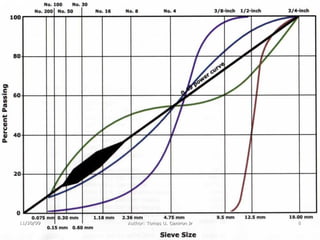
              Dense or well-graded. Refers to a gradation
           that is near maximum density. The most common
           HMA mix designs


               Gap graded. Refers to a gradation that
           contains only a small percentage of aggregate
           particles in the mid-size range. The curve is flat
           in the mid-size range. These mixes can be
           prone to segregation during placement.


11/20/99                     Author: Tomas U. Ganiron Jr        6
Open graded. Refers to a gradation that
       contains only a small percentage of aggregate
       particles in the small range. This results in more
       air voids because there are not enough small
       particles to fill in the voids between the larger
       particles. The curve is flat and near-zero in the
       small-size range.


          Uniformly graded. Refers to a gradation
       that contains most of the particles in a very
       narrow size range. In essence, all the particles
       are the same size. The curve is steep and only
       occupies the narrow size range specified.

11/20/99                  Author: Tomas U. Ganiron Jr       7
11/20/99   Author: Tomas U. Ganiron Jr   8
Other Gradation Terms
•Fine aggregate (sometimes just referred to as
"fines"). Defined as natural or crushed sand passing the
No. 10 sieve and mineral particles passing the No. 200
sieve.
•Coarse aggregate. Hard, durable particles or fragments
of stone, gravel or slag retained on the No. 10 sieve.
•Fine gradation. A gradation that, when plotted on the
0.45 power gradation graph, falls mostly above the 0.45
power maximum density line.
•Coarse gradation. A gradation that, when plotted on the
0.45 power gradation graph, falls mostly below the 0.45
power maximum density line. The term generally applies
to dense graded aggregate.
•Mineral filler. Defined as a finely divided mineral product
at least 65 percent of which will pass through a No. 200
sieve.
11/20/99                 Author: Tomas U. Ganiron Jr           9
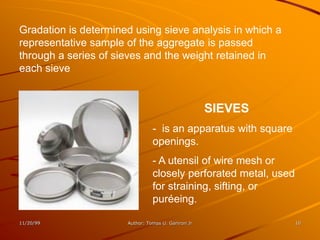
Gradation is determined using sieve analysis in which a
representative sample of the aggregate is passed
through a series of sieves and the weight retained in
each sieve


                                                    SIEVES
                                - is an apparatus with square
                                openings.
                                - A utensil of wire mesh or
                                closely perforated metal, used
                                for straining, sifting, or
                                puréeing.

11/20/99              Author: Tomas U. Ganiron Jr                10
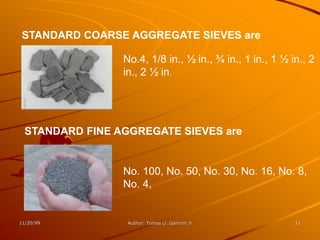
STANDARD COARSE AGGREGATE SIEVES are

                 No.4, 1/8 in., ½ in., ¾ in., 1 in., 1 ½ in., 2
                 in., 2 ½ in.


  STANDARD FINE AGGREGATE SIEVES are


                 No. 100, No. 50, No. 30, No. 16, No. 8,
                 No. 4,


11/20/99          Author: Tomas U. Ganiron Jr             11
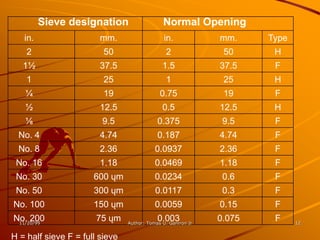
Sieve designation                    Normal Opening
   in.                  mm.                    in.            mm.     Type
    2                    50                     2              50      H
   1½                   37.5                  1.5             37.5     F
    1                    25                     1              25      H
   ¼                     19                  0.75              19      F
   ½                    12.5                  0.5             12.5     H
   ⅛                    9.5                 0.375              9.5     F
 No. 4                  4.74                0.187             4.74     F
 No. 8                  2.36               0.0937             2.36     F
 No. 16                 1.18               0.0469             1.18     F
 No. 30               600 ųm               0.0234              0.6     F
 No. 50               300 ųm               0.0117              0.3     F
No. 100               150 ųm               0.0059             0.15     F
No. 200
 11/20/99
                       75 ųm                0.003
                                Author: Tomas U. Ganiron Jr
                                                              0.075    F     12


H = half sieve F = full sieve
Other Properties
      Other important aggregate
      physical properties are:
  •Toughness and abrasion resistance. Aggregates
  should be hard and tough enough to resist crushing,
  degradation and disintegration from activities such
  as manufacturing stockpiling, production, placing and
  compaction
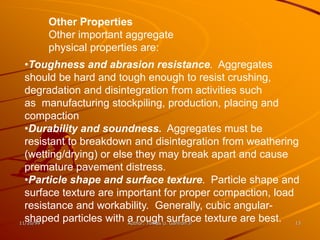
  •Durability and soundness. Aggregates must be
  resistant to breakdown and disintegration from weathering
  (wetting/drying) or else they may break apart and cause
  premature pavement distress.
  •Particle shape and surface texture. Particle shape and
  surface texture are important for proper compaction, load
  resistance and workability. Generally, cubic angular-
  shaped particles with a roughU.surface texture are best. 13
11/20/99                 Author: Tomas Ganiron Jr
•Cleanliness and deleterious materials. Aggregates
    must be relatively clean when used in HMA. Vegetation,
    soft particles, clay lumps, excess dust and vegetable
    matter may affect performance by quickly degrading,
    which causes a loss of structural support and/or
    prevents binder-aggregate bonding.
    •Specific gravity. Aggregate specific gravity is useful
    in making weight-volume conversions and in calculating
    the void content in compacted HMA (Roberts et al.,
    1996).


11/20/99                Author: Tomas U. Ganiron Jr           14
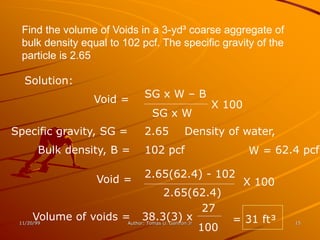
Find the volume of Voids in a 3-yd³ coarse aggregate of
  bulk density equal to 102 pcf. The specific gravity of the
  particle is 2.65

  Solution:
                                 SG x W – B
                    Void =                         X 100
                                   SG x W
Specific gravity, SG =           2.65       Density of water,
     Bulk density, B =           102 pcf                   W = 62.4 pcf

                                 2.65(62.4) - 102
                     Void =                                X 100
                                     2.65(62.4)
                                                    27
      Volume of voids = 38.3(3) x
 11/20/99                                                = 31 ft³   15
                                                   100
                       Author: Tomas U. Ganiron Jr

Modulus of Elasticity and Strength

  • 1.
    2.2.3. Modulus ofElasticity and Strength 11/20/99 Author: Tomas U. Ganiron Jr 1
  • 2.
    The Modulus ofthe elasticity is the ratio of stress to corresponding strain below the proportional limit. • For granites and limestone the modulus of elasticity in compression is in the range 2,000,000 – 7,000,000 psi. • Sandstone has lower value modulus, which may range from 1,000,000 – 5,000,000 psi. • The modulus of elasticity of concrete increases with increase in the modulus of aggregate used in its manufacture. • Creep and shrinkage of concrete are also affected by the modulus of elasticity of the aggregate 11/20/99 Author: Tomas U. Ganiron Jr 2
  • 3.
    Compressive strengths ofaggregates depend on the compressive strengths of original rocks. The strength of an aggregate affects the strength of the building material made with it when the two strength values are close to each other. 11/20/99 Author: Tomas U. Ganiron Jr 3
  • 4.
    GRADATION The particle size or grain-size distribution, of an aggregate is one of the most influential aggregate characteristics in determining how it will perform as a pavement material. Gradation helps determine almost every important property including stiffness, stability, durability, permeability, workability, fatigue resistance, frictional resistance and resistance to moisture damage . Gradation helps determine durability, porosity, workability, cement and water requirements, strength, and shrinkage. 11/20/99 Author: Tomas U. Ganiron Jr 4
  • 5.
    The process thatdetermine the GRADING particle-size distribution of a representative sample of the aggregate. BLENDING The process of combining aggregates of various size to obtain a specified gradation 11/20/99 Author: Tomas U. Ganiron Jr 5
  • 6.
    Typical Gradations Dense or well-graded. Refers to a gradation that is near maximum density. The most common HMA mix designs Gap graded. Refers to a gradation that contains only a small percentage of aggregate particles in the mid-size range. The curve is flat in the mid-size range. These mixes can be prone to segregation during placement. 11/20/99 Author: Tomas U. Ganiron Jr 6
  • 7.
    Open graded. Refersto a gradation that contains only a small percentage of aggregate particles in the small range. This results in more air voids because there are not enough small particles to fill in the voids between the larger particles. The curve is flat and near-zero in the small-size range. Uniformly graded. Refers to a gradation that contains most of the particles in a very narrow size range. In essence, all the particles are the same size. The curve is steep and only occupies the narrow size range specified. 11/20/99 Author: Tomas U. Ganiron Jr 7
  • 8.
    11/20/99 Author: Tomas U. Ganiron Jr 8
  • 9.
    Other Gradation Terms •Fineaggregate (sometimes just referred to as "fines"). Defined as natural or crushed sand passing the No. 10 sieve and mineral particles passing the No. 200 sieve. •Coarse aggregate. Hard, durable particles or fragments of stone, gravel or slag retained on the No. 10 sieve. •Fine gradation. A gradation that, when plotted on the 0.45 power gradation graph, falls mostly above the 0.45 power maximum density line. •Coarse gradation. A gradation that, when plotted on the 0.45 power gradation graph, falls mostly below the 0.45 power maximum density line. The term generally applies to dense graded aggregate. •Mineral filler. Defined as a finely divided mineral product at least 65 percent of which will pass through a No. 200 sieve. 11/20/99 Author: Tomas U. Ganiron Jr 9
  • 10.
    Gradation is determinedusing sieve analysis in which a representative sample of the aggregate is passed through a series of sieves and the weight retained in each sieve SIEVES - is an apparatus with square openings. - A utensil of wire mesh or closely perforated metal, used for straining, sifting, or puréeing. 11/20/99 Author: Tomas U. Ganiron Jr 10
  • 11.
    STANDARD COARSE AGGREGATESIEVES are No.4, 1/8 in., ½ in., ¾ in., 1 in., 1 ½ in., 2 in., 2 ½ in. STANDARD FINE AGGREGATE SIEVES are No. 100, No. 50, No. 30, No. 16, No. 8, No. 4, 11/20/99 Author: Tomas U. Ganiron Jr 11
  • 12.
    Sieve designation Normal Opening in. mm. in. mm. Type 2 50 2 50 H 1½ 37.5 1.5 37.5 F 1 25 1 25 H ¼ 19 0.75 19 F ½ 12.5 0.5 12.5 H ⅛ 9.5 0.375 9.5 F No. 4 4.74 0.187 4.74 F No. 8 2.36 0.0937 2.36 F No. 16 1.18 0.0469 1.18 F No. 30 600 ųm 0.0234 0.6 F No. 50 300 ųm 0.0117 0.3 F No. 100 150 ųm 0.0059 0.15 F No. 200 11/20/99 75 ųm 0.003 Author: Tomas U. Ganiron Jr 0.075 F 12 H = half sieve F = full sieve
  • 13.
    Other Properties Other important aggregate physical properties are: •Toughness and abrasion resistance. Aggregates should be hard and tough enough to resist crushing, degradation and disintegration from activities such as manufacturing stockpiling, production, placing and compaction •Durability and soundness. Aggregates must be resistant to breakdown and disintegration from weathering (wetting/drying) or else they may break apart and cause premature pavement distress. •Particle shape and surface texture. Particle shape and surface texture are important for proper compaction, load resistance and workability. Generally, cubic angular- shaped particles with a roughU.surface texture are best. 13 11/20/99 Author: Tomas Ganiron Jr
  • 14.
    •Cleanliness and deleteriousmaterials. Aggregates must be relatively clean when used in HMA. Vegetation, soft particles, clay lumps, excess dust and vegetable matter may affect performance by quickly degrading, which causes a loss of structural support and/or prevents binder-aggregate bonding. •Specific gravity. Aggregate specific gravity is useful in making weight-volume conversions and in calculating the void content in compacted HMA (Roberts et al., 1996). 11/20/99 Author: Tomas U. Ganiron Jr 14
  • 15.
    Find the volumeof Voids in a 3-yd³ coarse aggregate of bulk density equal to 102 pcf. The specific gravity of the particle is 2.65 Solution: SG x W – B Void = X 100 SG x W Specific gravity, SG = 2.65 Density of water, Bulk density, B = 102 pcf W = 62.4 pcf 2.65(62.4) - 102 Void = X 100 2.65(62.4) 27 Volume of voids = 38.3(3) x 11/20/99 = 31 ft³ 15 100 Author: Tomas U. Ganiron Jr