PHYSICS
ELASTIC FORCE. HOOKE’S LAW. SPRINGS
Teacher: Telman Askeraliyev, MSc, Italy
HOOKE’S LAW
In the 1600s, a scientist called Robert Hooke discovered a law for
elastic materials.
Hooke's achievements were extraordinary - he made the first
powerful microscope and wrote the first scientific best-seller,
Micrographia.
He even coined the word ‘Cell’.
ELASTIC BEHAVIOUR
If a material returns to its original size and shape when you remove
the forces stretching or deforming it (reversible deformation), we
say that the material is demonstrating elastic behaviour.
EXAMPLE
PLASTIC BEHAVIOUR
A plastic (or inelastic) material is one that stays deformed after you
have taken the force away. If deformation remains (irreversible
deformation) after the forces are removed then it is a sign of
plastic behaviour.
If you apply too big a force a material will lose its elasticity.
Hooke discovered that the amount a spring stretches is
proportional to the amount of force applied to it. This means if
you double the force its extension will double, if you triple the
force the extension will triple and so on.
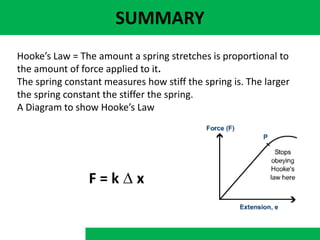
The elastic limit can be seen on the graph.
This is where it stops obeying Hookes law.
FORMULA
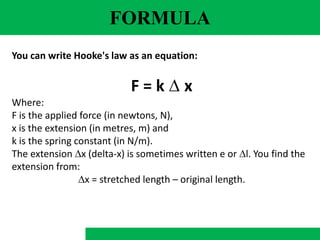
You can write Hooke's law as an equation:
F = k ∆ x
Where:
F is the applied force (in newtons, N),
x is the extension (in metres, m) and
k is the spring constant (in N/m).
The extension ∆x (delta-x) is sometimes written e or ∆l. You find the
extension from:
∆x = stretched length – original length.
HOOK’S LAW
Fs = kx
STRETCHING VS ELONGATION
stretching or elongation: compression:
More F  more ____________ or __________________.
x = 0
x = 0
Fs
x
Fs
x
stretch compression
HOOK’S LAW
Hooke's Law is often written: Fs = -kx
This is because it also describes the force that the
_______________ exerts on an ___________ that is attached
to it. The negative sign indicates that the direction of
the spring force is always _____________ to the
displacement of the object
spring itself object
opposite
HOOK’S LAW
stretched
spring:
compressed
spring:
undisturbed
spring
______________
position, Fs = __
equilibrium
-x
+x
Fs
Fs
x = 0
0
Fs ___ 0
Fs ___ 0
>
<
APPLICATION
Elastic behaviour is very
important in car safety, as
car seatbelts are made
from elastic materials.
However, after a crash they
must be replaced as they
will go past their elastic
limit.
ELASTIC POTENTIAL ENERGY
You can use the graph of Hooke’s Law to determine the
quantity of potential energy stored in the spring.
Calculate the area under the force vs position graph
EP = ½ kx2
SPRING CONSTANT
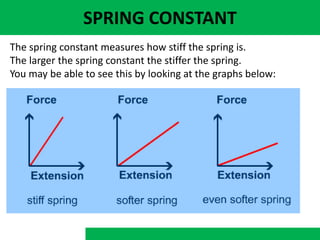
The spring constant measures how stiff the spring is.
The larger the spring constant the stiffer the spring.
You may be able to see this by looking at the graphs below:
SPRING CONSTANT
k is measured in units of newtons per metre (Nm-1).
APPLICATION
Why have seat belts that are elastic?
Why not just have very rigid seatbelts that would keep you firmly
in place?
The reason for this, is that it would be very dangerous and cause
large injuries. This is because it would slow your body down too
quickly. The quicker a collision, the bigger the force that is
produced.
SUMMARY
Hooke’s Law = The amount a spring stretches is proportional to
the amount of force applied to it.
The spring constant measures how stiff the spring is. The larger
the spring constant the stiffer the spring.
A Diagram to show Hooke’s Law
F = k ∆ x
QUIZ - 1
A weight of 8.7 N is attached to a spring that has a spring constant
of 190 N/m. How much will the spring stretch?
QUIZ - 2
Fs
x
direct
Ex: A force of 5.0 N
causes t0.015 m.
How far will it stretch
if the force is 10 N?
he spring to
stretch
2 (0.015 m)
= 0.030 m
5
10
.015 ?
What quantity does the slope represent?
QUIZ - 3
Fs
x
spring
A
spring
B
Ex. Comparing
two springs that
stretch different
amounts.
xB
Applying the same
force F to both springs
Which spring stretches more?
Which is stiffer?
xA
QUIZ - 4
A spring is 0.38m long. When it is pulled by a force of 2.0 N, it
stretches to 0.42 m. What is the spring constant? Assume the
spring behaves elastically.
THANK YOU!

Physics hook w14-l27

  • 1.
    PHYSICS ELASTIC FORCE. HOOKE’SLAW. SPRINGS Teacher: Telman Askeraliyev, MSc, Italy
  • 2.
    HOOKE’S LAW In the1600s, a scientist called Robert Hooke discovered a law for elastic materials. Hooke's achievements were extraordinary - he made the first powerful microscope and wrote the first scientific best-seller, Micrographia. He even coined the word ‘Cell’.
  • 3.
    ELASTIC BEHAVIOUR If amaterial returns to its original size and shape when you remove the forces stretching or deforming it (reversible deformation), we say that the material is demonstrating elastic behaviour.
  • 4.
  • 5.
    PLASTIC BEHAVIOUR A plastic(or inelastic) material is one that stays deformed after you have taken the force away. If deformation remains (irreversible deformation) after the forces are removed then it is a sign of plastic behaviour. If you apply too big a force a material will lose its elasticity. Hooke discovered that the amount a spring stretches is proportional to the amount of force applied to it. This means if you double the force its extension will double, if you triple the force the extension will triple and so on.
  • 10.
    The elastic limitcan be seen on the graph. This is where it stops obeying Hookes law.
  • 12.
    FORMULA You can writeHooke's law as an equation: F = k ∆ x Where: F is the applied force (in newtons, N), x is the extension (in metres, m) and k is the spring constant (in N/m). The extension ∆x (delta-x) is sometimes written e or ∆l. You find the extension from: ∆x = stretched length – original length.
  • 13.
  • 14.
    STRETCHING VS ELONGATION stretchingor elongation: compression: More F  more ____________ or __________________. x = 0 x = 0 Fs x Fs x stretch compression
  • 15.
    HOOK’S LAW Hooke's Lawis often written: Fs = -kx This is because it also describes the force that the _______________ exerts on an ___________ that is attached to it. The negative sign indicates that the direction of the spring force is always _____________ to the displacement of the object spring itself object opposite
  • 16.
  • 17.
    APPLICATION Elastic behaviour isvery important in car safety, as car seatbelts are made from elastic materials. However, after a crash they must be replaced as they will go past their elastic limit.
  • 18.
    ELASTIC POTENTIAL ENERGY Youcan use the graph of Hooke’s Law to determine the quantity of potential energy stored in the spring. Calculate the area under the force vs position graph EP = ½ kx2
  • 19.
    SPRING CONSTANT The springconstant measures how stiff the spring is. The larger the spring constant the stiffer the spring. You may be able to see this by looking at the graphs below:
  • 20.
    SPRING CONSTANT k ismeasured in units of newtons per metre (Nm-1).
  • 21.
    APPLICATION Why have seatbelts that are elastic? Why not just have very rigid seatbelts that would keep you firmly in place? The reason for this, is that it would be very dangerous and cause large injuries. This is because it would slow your body down too quickly. The quicker a collision, the bigger the force that is produced.
  • 22.
    SUMMARY Hooke’s Law =The amount a spring stretches is proportional to the amount of force applied to it. The spring constant measures how stiff the spring is. The larger the spring constant the stiffer the spring. A Diagram to show Hooke’s Law F = k ∆ x
  • 23.
    QUIZ - 1 Aweight of 8.7 N is attached to a spring that has a spring constant of 190 N/m. How much will the spring stretch?
  • 24.
    QUIZ - 2 Fs x direct Ex:A force of 5.0 N causes t0.015 m. How far will it stretch if the force is 10 N? he spring to stretch 2 (0.015 m) = 0.030 m 5 10 .015 ? What quantity does the slope represent?
  • 25.
    QUIZ - 3 Fs x spring A spring B Ex.Comparing two springs that stretch different amounts. xB Applying the same force F to both springs Which spring stretches more? Which is stiffer? xA
  • 26.
    QUIZ - 4 Aspring is 0.38m long. When it is pulled by a force of 2.0 N, it stretches to 0.42 m. What is the spring constant? Assume the spring behaves elastically.
  • 27.

Editor's Notes

  • #7 If you measure how a spring stretches (extends its length) as you apply increasing force and plot extension (x) against force (F); the graph will be a straight line.
  • #11 Elastic limit can be seen on the graph. Anything before the limit and the spring will behave elastically. This is where the graph stops being a straight line. If you stretch the spring beyond this point it will not return to its original size or shape.