The Metric System
What is it? Metric system :  standard system of measurement used by all scientists. Scientists use metric units to measure: length volume mass weight density temperature
The method of converting measurement in one unit to measurements in another unit is known as  dimensional analysis . Conversion factor :  a fraction that always equals 1.
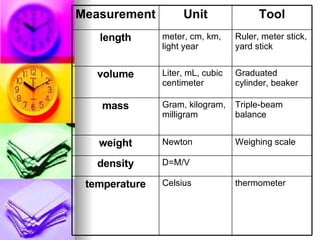
thermometer Celsius temperature D=M/V density Weighing scale Newton weight Triple-beam balance Gram, kilogram, milligram mass Graduated cylinder, beaker Liter, mL, cubic centimeter volume Ruler, meter stick, yard stick meter, cm, km, light year length Tool Unit Measurement
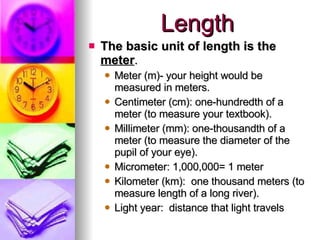
Length The basic unit of length is the  meter . Meter (m)- your height would be measured in meters.  Centimeter (cm): one-hundredth of a meter (to measure your textbook). Millimeter (mm): one-thousandth of a meter (to measure the diameter of the pupil of your eye). Micrometer: 1,000,000= 1 meter Kilometer (km):  one thousand meters (to measure length of a long river). Light year:  distance that light travels
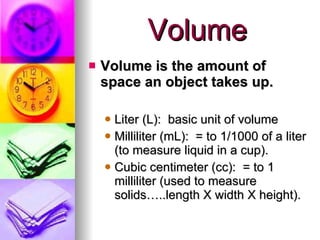
Volume Volume is the amount of space an object takes up. Liter (L):  basic unit of volume Milliliter (mL):  = to 1/1000 of a liter (to measure liquid in a cup). Cubic centimeter (cc):  = to 1 milliliter (used to measure solids…..length X width X height).
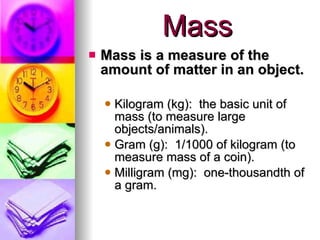
Mass Mass is a measure of the amount of matter in an object. Kilogram (kg):  the basic unit of mass (to measure large objects/animals). Gram (g):  1/1000 of kilogram (to measure mass of a coin). Milligram (mg):  one-thousandth of a gram.
Weight Weight is a measure of the attraction between two objects due to gravity. Newton (N):  the basic unit of weight (your weight in outer space).
Density The relationship between mass & volume. D=M/V Suppose a substance has a mass of 10 grams and a volume of 10 milliliters.  What is the density of the substance?
Temperature Temperature is measured on the Celsius scale only. To convert Celsius ( C°) to Fahrenheit  (F °): Multiply by 9 Divide by 5 Add 32  To convert Fahrenheit (F °) to Celsius (C°): Subtract 32 Multiply by 5 Divide by 9

Metric System

  • 1.
  • 2.
    What is it?Metric system : standard system of measurement used by all scientists. Scientists use metric units to measure: length volume mass weight density temperature
  • 3.
    The method ofconverting measurement in one unit to measurements in another unit is known as dimensional analysis . Conversion factor : a fraction that always equals 1.
  • 4.
    thermometer Celsius temperatureD=M/V density Weighing scale Newton weight Triple-beam balance Gram, kilogram, milligram mass Graduated cylinder, beaker Liter, mL, cubic centimeter volume Ruler, meter stick, yard stick meter, cm, km, light year length Tool Unit Measurement
  • 5.
    Length The basicunit of length is the meter . Meter (m)- your height would be measured in meters. Centimeter (cm): one-hundredth of a meter (to measure your textbook). Millimeter (mm): one-thousandth of a meter (to measure the diameter of the pupil of your eye). Micrometer: 1,000,000= 1 meter Kilometer (km): one thousand meters (to measure length of a long river). Light year: distance that light travels
  • 6.
    Volume Volume isthe amount of space an object takes up. Liter (L): basic unit of volume Milliliter (mL): = to 1/1000 of a liter (to measure liquid in a cup). Cubic centimeter (cc): = to 1 milliliter (used to measure solids…..length X width X height).
  • 7.
    Mass Mass isa measure of the amount of matter in an object. Kilogram (kg): the basic unit of mass (to measure large objects/animals). Gram (g): 1/1000 of kilogram (to measure mass of a coin). Milligram (mg): one-thousandth of a gram.
  • 8.
    Weight Weight isa measure of the attraction between two objects due to gravity. Newton (N): the basic unit of weight (your weight in outer space).
  • 9.
    Density The relationshipbetween mass & volume. D=M/V Suppose a substance has a mass of 10 grams and a volume of 10 milliliters. What is the density of the substance?
  • 10.
    Temperature Temperature ismeasured on the Celsius scale only. To convert Celsius ( C°) to Fahrenheit (F °): Multiply by 9 Divide by 5 Add 32 To convert Fahrenheit (F °) to Celsius (C°): Subtract 32 Multiply by 5 Divide by 9