Electrostatic induction
• Whenever a charged rod is touched by
another conductor, charges start to flow from
charged rod to the conductor.
• charging without actual contact is called
electrostatic induction
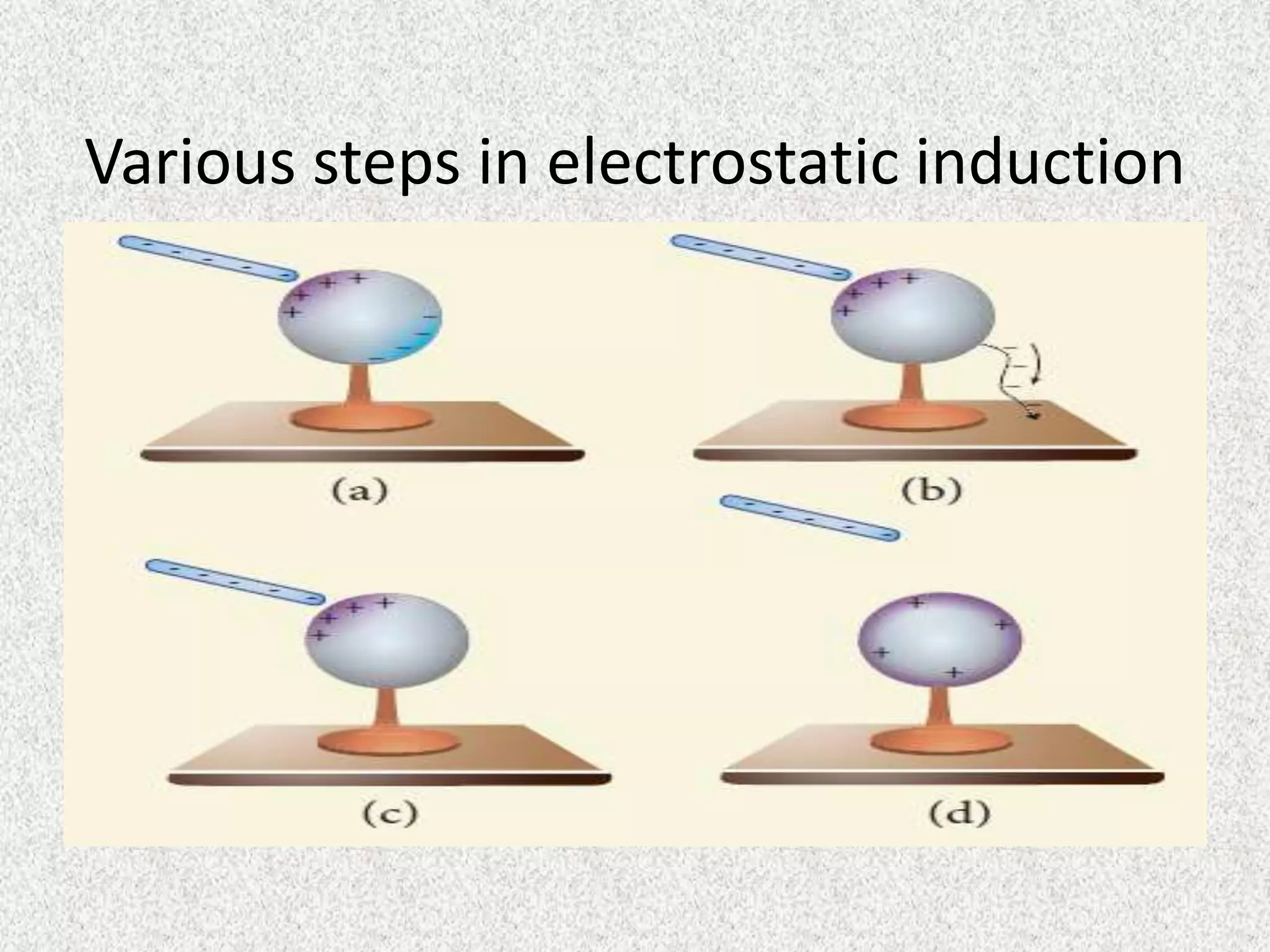
• (i) Consider an uncharged (neutral) conducting
sphere at rest on an insulating stand. Suppose
a negatively charged rod is brought near the
conductor without touching it
• The negative charge of the rod repels the
electrons in the conductor to the opposite
side. As a result, positive charges are induced
near the region of the charged rod while
negative charges on the farther side.
• Before introducing the charged rod, the free
electrons were distributed uniformly on the
surface of the conductor and the net charge is
zero.
• Once the charged rod is brought near the
conductor, the distribution is no longer
uniform with more electrons located on the
farther side of the rod and positive charges
are located closer to the rod. But the total
charge is zero
• (ii) Now the conducting sphere is connected to
the ground through a conducting wire. This is
called grounding.
• Since the ground can always receive any
amount of electrons, grounding removes the
electron from the conducting sphere.
• Note that positive charges will not flow to the
ground because they are attracted by the
negative charges of the rod
• (iii) When the grounding wire is removed from
the conductor, the positive charges remain near
the charged rod
• (iv) Now the charged rod is taken away from the
conductor. As soon as the charged rod is
removed, the positive charge gets distributed
uniformly on the surface of the conductor . By
this process, the neutral conducting sphere
becomes positively charged
Various steps in electrostatic induction
• For an arbitrary shaped conductor, the
intermediate steps and conclusion are the
same except the final step.
• The distribution of positive charges is not
uniform for arbitrarily-shaped conductors
• If the conductor has no net charge, then its
motion is the same as usual projectile
motion of a mass m
• In addition to downward gravitational
force, the charge also will experience a
downward uniform electrostatic force.
• It is important here to note that the
acceleration depends on the mass of the
object.
• Galileo’s conclusion that all objects fall at
the same rate towards the Earth is true
only in a uniform gravitational field.
• When a uniform electric field is included,
the acceleration of a charged object
depends on both mass and charge
Dielectrics or insulators
• A dielectric is a non-conducting material and has
no free electrons.
• The electrons in a dielectric are bound within the
atoms. Ebonite, glass and mica are some
examples of dielectrics.
• When an external electric field is applied, the
electrons are not free to move anywhere but they
are realigned in a specific way.
• A dielectric is made up of either polar molecules
or non-polar molecules
Non-polar molecules
• A non-polar molecule is one in which centers
of positive and negative charges coincide.
• As a result, it has no permanent dipole
moment.
• Examples of non-polar molecules are
hydrogen (H2), oxygen (O2), and carbon
dioxide (CO2) etc
• When an external electric field is applied, the
centers of positive and negative charges are
separated by a small distance which induces
dipole moment in the direction of the external
electric field.
• Then the dielectric is said to be polarized by
an external electric field.
Non polar molecules without
external field
With the external field
Polar molecules
• In polar molecules, the centers of the positive
and negative charges are separated even in
the absence of an external electric field.
• They have a permanent dipole moment.
• Due to thermal motion, the direction of each
dipole moment is oriented randomly
• Hence the net dipole moment is zero in the
absence of an external electric field. Examples
of polar molecules are H2O, N2O, HCl, NH3.
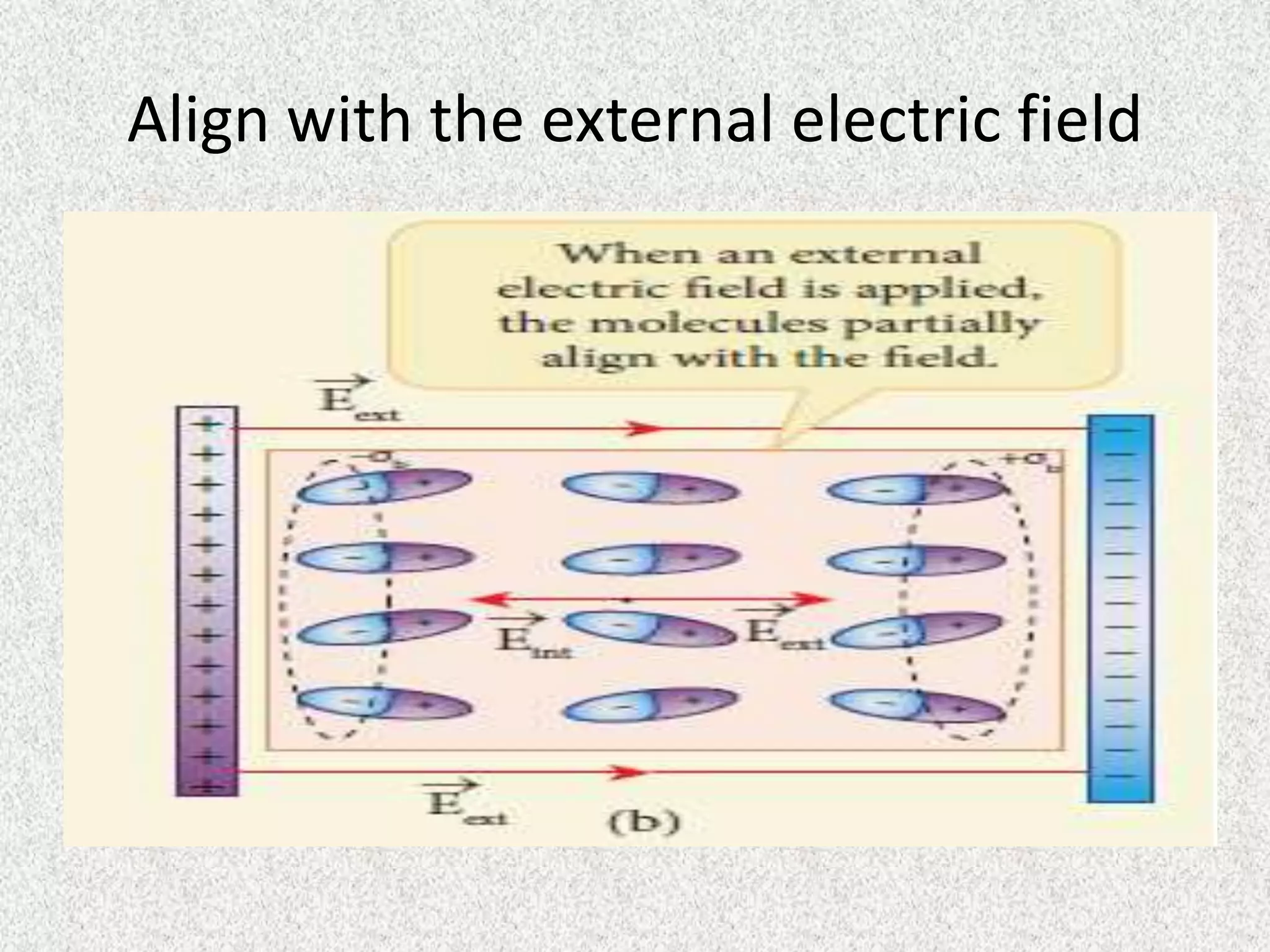
• When an external electric field is applied, the
dipoles inside the polar molecule tend to align
in the direction of the electric field.
• Hence a net dipole moment is induced in it.
Then the dielectric is said to be polarized by
an external electric field
Randomly oriented polar molecules
Align with the external electric field
.
Polarisation
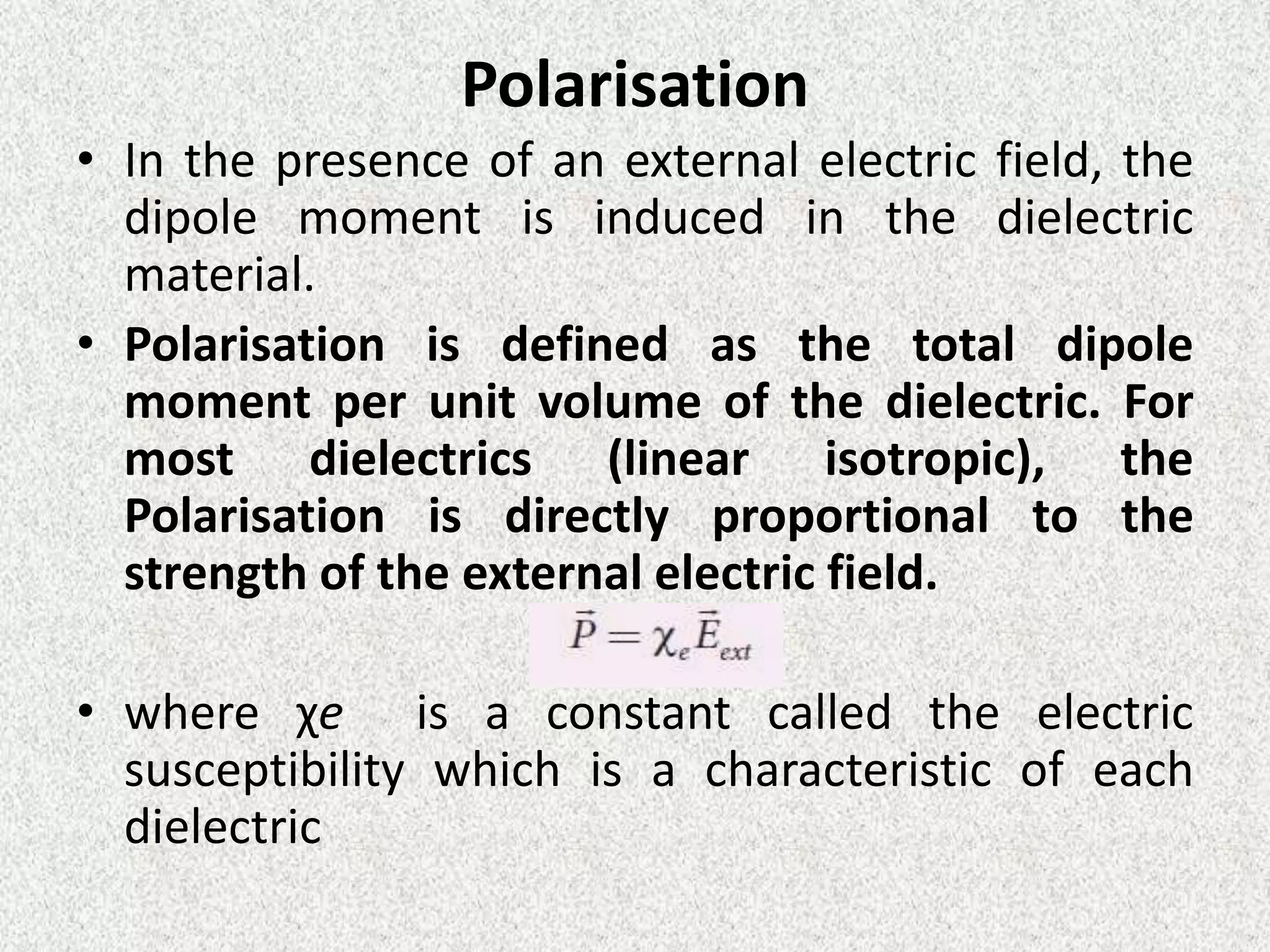
• In the presence of an external electric field, the
dipole moment is induced in the dielectric
material.
• Polarisation is defined as the total dipole
moment per unit volume of the dielectric. For
most dielectrics (linear isotropic), the
Polarisation is directly proportional to the
strength of the external electric field.
• where χe is a constant called the electric
susceptibility which is a characteristic of each
dielectric
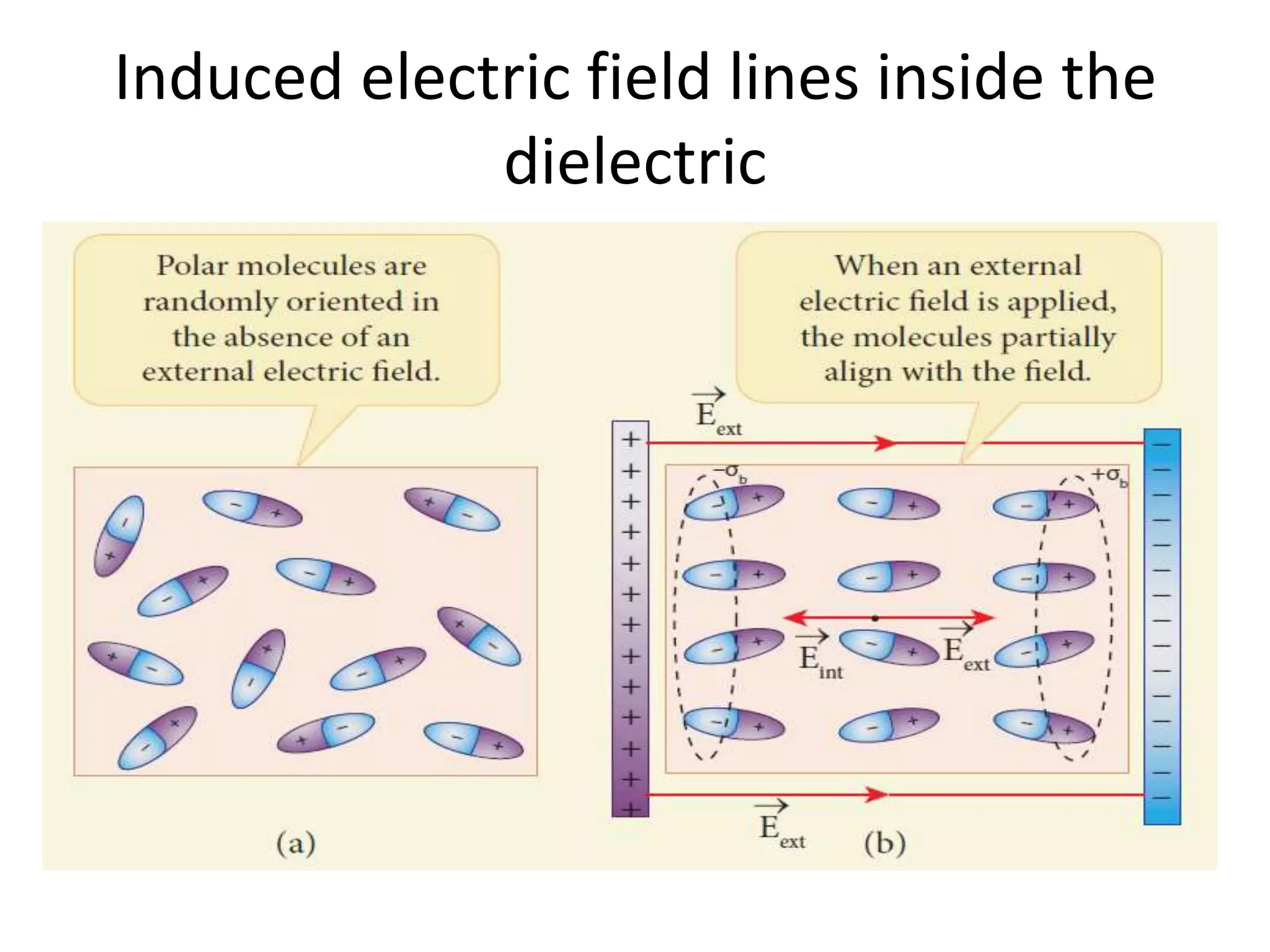
Induced Electric field inside the
dielectric
• When an external electric field is applied on a
conductor, the charges are aligned in such a
way that an internal electric field is created
which cancels the external electric field.
• But in the case of a dielectric, which has no
free electrons, the external electric field only
realigns the charges so that an internal
electric field is produced
• The magnitude of the internal electric field is
smaller than that of external electric field.
Therefore the net electric field inside the
dielectric is not zero but is parallel to an
external electric field with magnitude less
than that of the external electric field.
• For example, let us consider a rectangular
dielectric slab placed between two oppositely
charged plates (capacitor)
• The uniform electric field between the plates acts
as an external electric field E ext which polarizes
the dielectric placed between plates.
• The positive charges are induced on one side
surface and negative charges are induced on the
other side of surface.
• But inside the dielectric, the net charge is zero
even in a small volume.
• So the dielectric in the external field is equivalent
to two oppositely charged sheets with the surface
charge densities +σb and –σb.
• These charges are called bound charges. They are
not free to move like free electrons in conductors
Induced electric field lines inside the
dielectric
Balloon sticks to the wall
Polarisation of wall due to the
electric field created by the balloon
• The charged balloon after rubbing sticks onto
a wall. The reason is that the negatively
charged balloon is brought near the wall, it
polarizes opposite charges on the surface of
the wall, which attracts the balloon
Dielectric strength
• When the external electric field applied to a
dielectric is very large, it tears the atoms apart so
that the bound charges become free charges.
Then the dielectric starts to conduct electricity.
This is called dielectric breakdown.
• The maximum electric field the dielectric can
withstand before it breakdowns is called
dielectric strength.
• For example, the dielectric strength of air is 3 ×
106 V m-1. If the applied electric field increases
beyond this, a spark is produced in the air.
ELECTROSTATIC INDUCTION

ELECTROSTATIC INDUCTION

  • 1.
  • 2.
    Electrostatic induction • Whenevera charged rod is touched by another conductor, charges start to flow from charged rod to the conductor. • charging without actual contact is called electrostatic induction
  • 3.
    • (i) Consideran uncharged (neutral) conducting sphere at rest on an insulating stand. Suppose a negatively charged rod is brought near the conductor without touching it • The negative charge of the rod repels the electrons in the conductor to the opposite side. As a result, positive charges are induced near the region of the charged rod while negative charges on the farther side.
  • 4.
    • Before introducingthe charged rod, the free electrons were distributed uniformly on the surface of the conductor and the net charge is zero. • Once the charged rod is brought near the conductor, the distribution is no longer uniform with more electrons located on the farther side of the rod and positive charges are located closer to the rod. But the total charge is zero
  • 5.
    • (ii) Nowthe conducting sphere is connected to the ground through a conducting wire. This is called grounding. • Since the ground can always receive any amount of electrons, grounding removes the electron from the conducting sphere. • Note that positive charges will not flow to the ground because they are attracted by the negative charges of the rod
  • 6.
    • (iii) Whenthe grounding wire is removed from the conductor, the positive charges remain near the charged rod • (iv) Now the charged rod is taken away from the conductor. As soon as the charged rod is removed, the positive charge gets distributed uniformly on the surface of the conductor . By this process, the neutral conducting sphere becomes positively charged
  • 7.
    Various steps inelectrostatic induction
  • 8.
    • For anarbitrary shaped conductor, the intermediate steps and conclusion are the same except the final step. • The distribution of positive charges is not uniform for arbitrarily-shaped conductors
  • 11.
    • If theconductor has no net charge, then its motion is the same as usual projectile motion of a mass m • In addition to downward gravitational force, the charge also will experience a downward uniform electrostatic force.
  • 13.
    • It isimportant here to note that the acceleration depends on the mass of the object. • Galileo’s conclusion that all objects fall at the same rate towards the Earth is true only in a uniform gravitational field. • When a uniform electric field is included, the acceleration of a charged object depends on both mass and charge
  • 18.
    Dielectrics or insulators •A dielectric is a non-conducting material and has no free electrons. • The electrons in a dielectric are bound within the atoms. Ebonite, glass and mica are some examples of dielectrics. • When an external electric field is applied, the electrons are not free to move anywhere but they are realigned in a specific way. • A dielectric is made up of either polar molecules or non-polar molecules
  • 19.
    Non-polar molecules • Anon-polar molecule is one in which centers of positive and negative charges coincide. • As a result, it has no permanent dipole moment. • Examples of non-polar molecules are hydrogen (H2), oxygen (O2), and carbon dioxide (CO2) etc
  • 20.
    • When anexternal electric field is applied, the centers of positive and negative charges are separated by a small distance which induces dipole moment in the direction of the external electric field. • Then the dielectric is said to be polarized by an external electric field.
  • 21.
    Non polar moleculeswithout external field
  • 22.
  • 23.
    Polar molecules • Inpolar molecules, the centers of the positive and negative charges are separated even in the absence of an external electric field. • They have a permanent dipole moment. • Due to thermal motion, the direction of each dipole moment is oriented randomly • Hence the net dipole moment is zero in the absence of an external electric field. Examples of polar molecules are H2O, N2O, HCl, NH3.
  • 24.
    • When anexternal electric field is applied, the dipoles inside the polar molecule tend to align in the direction of the electric field. • Hence a net dipole moment is induced in it. Then the dielectric is said to be polarized by an external electric field
  • 25.
  • 26.
    Align with theexternal electric field .
  • 27.
    Polarisation • In thepresence of an external electric field, the dipole moment is induced in the dielectric material. • Polarisation is defined as the total dipole moment per unit volume of the dielectric. For most dielectrics (linear isotropic), the Polarisation is directly proportional to the strength of the external electric field. • where χe is a constant called the electric susceptibility which is a characteristic of each dielectric
  • 28.
    Induced Electric fieldinside the dielectric • When an external electric field is applied on a conductor, the charges are aligned in such a way that an internal electric field is created which cancels the external electric field. • But in the case of a dielectric, which has no free electrons, the external electric field only realigns the charges so that an internal electric field is produced
  • 29.
    • The magnitudeof the internal electric field is smaller than that of external electric field. Therefore the net electric field inside the dielectric is not zero but is parallel to an external electric field with magnitude less than that of the external electric field. • For example, let us consider a rectangular dielectric slab placed between two oppositely charged plates (capacitor)
  • 30.
    • The uniformelectric field between the plates acts as an external electric field E ext which polarizes the dielectric placed between plates. • The positive charges are induced on one side surface and negative charges are induced on the other side of surface. • But inside the dielectric, the net charge is zero even in a small volume. • So the dielectric in the external field is equivalent to two oppositely charged sheets with the surface charge densities +σb and –σb. • These charges are called bound charges. They are not free to move like free electrons in conductors
  • 31.
    Induced electric fieldlines inside the dielectric
  • 32.
  • 33.
    Polarisation of walldue to the electric field created by the balloon
  • 34.
    • The chargedballoon after rubbing sticks onto a wall. The reason is that the negatively charged balloon is brought near the wall, it polarizes opposite charges on the surface of the wall, which attracts the balloon
  • 35.
    Dielectric strength • Whenthe external electric field applied to a dielectric is very large, it tears the atoms apart so that the bound charges become free charges. Then the dielectric starts to conduct electricity. This is called dielectric breakdown. • The maximum electric field the dielectric can withstand before it breakdowns is called dielectric strength. • For example, the dielectric strength of air is 3 × 10⁶ V m-1. If the applied electric field increases beyond this, a spark is produced in the air.