ELASTIC CONSTANTS IN
ISOTROPIC MATERIALS
1.Elasticity Modulus (E)
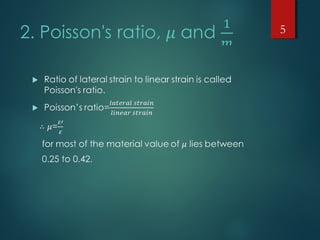
2. Poisson’s Ratio (ν)
3. Shear Modulus (G)
4. Bulk Modulus (K)
1
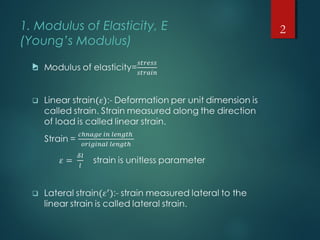
1. Modulus of Elasticity, E
(Young’s Modulus)
2
3
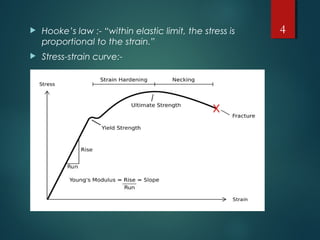
4 Hooke’s law :- “within elastic limit, the stress is
proportional to the strain.”
 Stress-strain curve:-
5
Shear Modulus, G 7
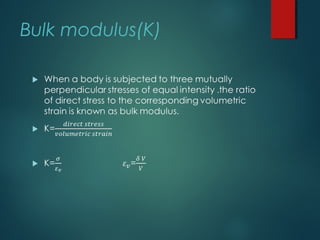
Bulk modulus(K)
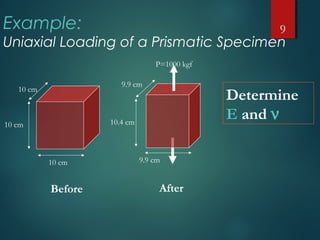
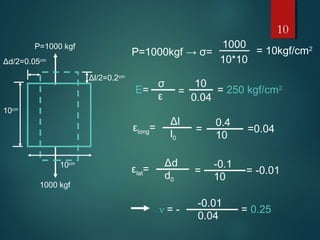
Example:
Uniaxial Loading of a Prismatic Specimen
AfterBefore
10 cm
10 cm
10 cm
10.4 cm
9.9 cm
9.9 cm
Determine
E and ν
P=1000 kgf
9
10cm
10cm
Δl/2=0.2cm
Δd/2=0.05cm
1000 kgf
P=1000 kgf
P=1000kgf → σ=
10*10
1000
= 10kgf/cm2
E=
σ
ε =
10
0.04
= 250 kgf/cm2
εlong=
Δl
l0
= =0.04
0.4
10
εlat=
Δd
d0
= = -0.01
-0.1
10
ν = -
-0.01
0.04
= 0.25
10
RELATION B/W K & E
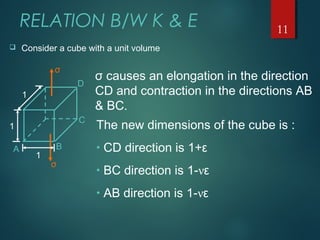
 Consider a cube with a unit volume
σ
1
1
1
σ
D
C
BA
σ causes an elongation in the direction
CD and contraction in the directions AB
& BC.
The new dimensions of the cube is :
• CD direction is 1+ε
• BC direction is 1-νε
• AB direction is 1-νε
11
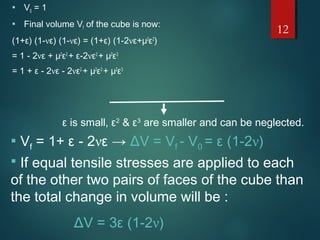
 V0 = 1
 Final volume Vf of the cube is now:
(1+ε) (1-νε) (1-νε) = (1+ε) (1-2νε+μ2
ε2
)
= 1 - 2νε + μ2
ε2
+ ε-2νε2
+ μ2
ε3
= 1 + ε - 2νε - 2νε2
+ μ2
ε2
+ μ2
ε3
ε is small, ε2
& ε3
are smaller and can be neglected.
 Vf = 1+ ε - 2νε → ΔV = Vf - V0 = ε (1-2ν)
 If equal tensile stresses are applied to each
of the other two pairs of faces of the cube than
the total change in volume will be :
ΔV = 3ε (1-2ν)
12
σ
σ
σ
σ
σ
σ
Ξ + +
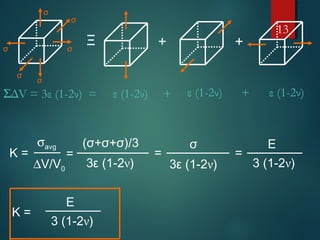
K =
(σ+σ+σ)/3 σ
=
3ε (1-2ν)
=
3ε (1-2ν)
E
3 (1-2ν)
K =
E
3 (1-2ν)
ΣΔV = 3ε (1-2ν) = ε (1-2ν) ε (1-2ν) ε (1-2ν)+ +
=
σavg
∆V/V0
13
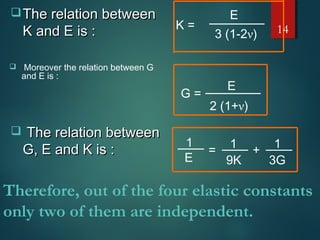
 Moreover the relation between G
and E is :
G =
E
2 (1+ν)
 The relation betweenThe relation between
G, E and K is :G, E and K is :
E
1 1
=
1
+
9K 3G
K =
E
3 (1-2ν)
 The relation betweenThe relation between
K and E is :K and E is :
Therefore, out of the four elastic constants
only two of them are independent.
14
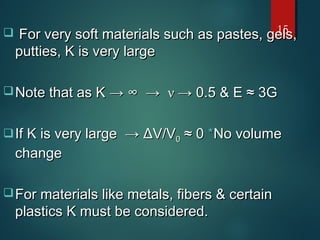
 For very soft materials such as pastes, gels,For very soft materials such as pastes, gels,
putties, K is very largeputties, K is very large
 Note that as KNote that as K → ∞ →→ ∞ → νν →→ 0.5 & E ≈ 3G0.5 & E ≈ 3G
If K is very large →If K is very large → ΔΔV/VV/V00 ≈ 0≈ 0 **No volumeNo volume
changechange
 For materials like metals, fibers & certainFor materials like metals, fibers & certain
plastics K must be considered.plastics K must be considered.
15
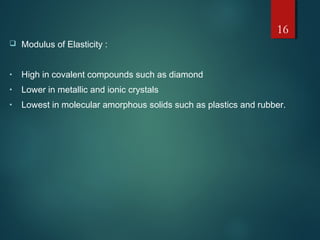
 Modulus of Elasticity :
• High in covalent compounds such as diamond
• Lower in metallic and ionic crystals
• Lowest in molecular amorphous solids such as plastics and rubber.
16
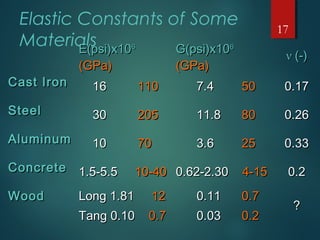
Elastic Constants of Some
MaterialsE(psi)x10E(psi)x1066
(GPa)(GPa)
G(psi)x10G(psi)x1066
(GPa)(GPa)
νν (-)(-)
Cast IronCast Iron 1616 110110 7.47.4 5050 0.170.17
SteelSteel 3030 205205 11.811.8 8080 0.260.26
AluminumAluminum 1010 7070 3.63.6 2525 0.330.33
ConcreteConcrete 1.5-5.51.5-5.5 10-4010-40 0.62-2.300.62-2.30 4-154-15 0.20.2
WoodWood Long 1.81Long 1.81 1212
Tang 0.10Tang 0.10 0.70.7
0.110.11 0.70.7
0.030.03 0.20.2
??
17
Thank You
18

elastic constants

  • 1.
    ELASTIC CONSTANTS IN ISOTROPICMATERIALS 1.Elasticity Modulus (E) 2. Poisson’s Ratio (ν) 3. Shear Modulus (G) 4. Bulk Modulus (K) 1
  • 2.
    1. Modulus ofElasticity, E (Young’s Modulus) 2
  • 3.
  • 4.
    4 Hooke’s law:- “within elastic limit, the stress is proportional to the strain.”  Stress-strain curve:-
  • 5.
  • 7.
  • 8.
  • 9.
    Example: Uniaxial Loading ofa Prismatic Specimen AfterBefore 10 cm 10 cm 10 cm 10.4 cm 9.9 cm 9.9 cm Determine E and ν P=1000 kgf 9
  • 10.
    10cm 10cm Δl/2=0.2cm Δd/2=0.05cm 1000 kgf P=1000 kgf P=1000kgf→ σ= 10*10 1000 = 10kgf/cm2 E= σ ε = 10 0.04 = 250 kgf/cm2 εlong= Δl l0 = =0.04 0.4 10 εlat= Δd d0 = = -0.01 -0.1 10 ν = - -0.01 0.04 = 0.25 10
  • 11.
    RELATION B/W K& E  Consider a cube with a unit volume σ 1 1 1 σ D C BA σ causes an elongation in the direction CD and contraction in the directions AB & BC. The new dimensions of the cube is : • CD direction is 1+ε • BC direction is 1-νε • AB direction is 1-νε 11
  • 12.
     V0 =1  Final volume Vf of the cube is now: (1+ε) (1-νε) (1-νε) = (1+ε) (1-2νε+μ2 ε2 ) = 1 - 2νε + μ2 ε2 + ε-2νε2 + μ2 ε3 = 1 + ε - 2νε - 2νε2 + μ2 ε2 + μ2 ε3 ε is small, ε2 & ε3 are smaller and can be neglected.  Vf = 1+ ε - 2νε → ΔV = Vf - V0 = ε (1-2ν)  If equal tensile stresses are applied to each of the other two pairs of faces of the cube than the total change in volume will be : ΔV = 3ε (1-2ν) 12
  • 13.
    σ σ σ σ σ σ Ξ + + K= (σ+σ+σ)/3 σ = 3ε (1-2ν) = 3ε (1-2ν) E 3 (1-2ν) K = E 3 (1-2ν) ΣΔV = 3ε (1-2ν) = ε (1-2ν) ε (1-2ν) ε (1-2ν)+ + = σavg ∆V/V0 13
  • 14.
     Moreover therelation between G and E is : G = E 2 (1+ν)  The relation betweenThe relation between G, E and K is :G, E and K is : E 1 1 = 1 + 9K 3G K = E 3 (1-2ν)  The relation betweenThe relation between K and E is :K and E is : Therefore, out of the four elastic constants only two of them are independent. 14
  • 15.
     For verysoft materials such as pastes, gels,For very soft materials such as pastes, gels, putties, K is very largeputties, K is very large  Note that as KNote that as K → ∞ →→ ∞ → νν →→ 0.5 & E ≈ 3G0.5 & E ≈ 3G If K is very large →If K is very large → ΔΔV/VV/V00 ≈ 0≈ 0 **No volumeNo volume changechange  For materials like metals, fibers & certainFor materials like metals, fibers & certain plastics K must be considered.plastics K must be considered. 15
  • 16.
     Modulus ofElasticity : • High in covalent compounds such as diamond • Lower in metallic and ionic crystals • Lowest in molecular amorphous solids such as plastics and rubber. 16
  • 17.
    Elastic Constants ofSome MaterialsE(psi)x10E(psi)x1066 (GPa)(GPa) G(psi)x10G(psi)x1066 (GPa)(GPa) νν (-)(-) Cast IronCast Iron 1616 110110 7.47.4 5050 0.170.17 SteelSteel 3030 205205 11.811.8 8080 0.260.26 AluminumAluminum 1010 7070 3.63.6 2525 0.330.33 ConcreteConcrete 1.5-5.51.5-5.5 10-4010-40 0.62-2.300.62-2.30 4-154-15 0.20.2 WoodWood Long 1.81Long 1.81 1212 Tang 0.10Tang 0.10 0.70.7 0.110.11 0.70.7 0.030.03 0.20.2 ?? 17
  • 18.