Pascal’s Law
Index
• Acknowledgment
• Pascal’s Law
• Pascal’ Formula
• Variation of Pascal’ Law
• Using Pascal’s Law
• Applications
• Hydraulic Lift
• Hydraulic Brake
• Hydraulic Jack
• Hydraulic Pump
Acknowledgement
I would like to express my special thanks of
gratitude to my teacher who gave
me the golden opportunity to do this
wonderful project on the topic Pascal’s Law,
which also helped me in doing a lot of
Research and I came to know about so many
new things I am really thankful to them.
Secondly I would also like to thank my parents
and friends who helped me a lot in finalizing
this project within the limited time frame.
Pascal’s Law
• In the 1600's, the French scientist Blaise Pascal
discovered a fact now known as Pascal's Law.
• Pascal's Principle is used to quantitatively relate
the pressure at two points in
an incompressible, static fluid. It states that pressure is
transmitted, undiminished, in a closed static fluid.
• Through the application of Pascal's Principle, a static
liquid can be utilized to generate a large
output force using a much smaller input force, yielding
important devices such as hydraulic presses.
4
Pascal’s Laws State
that
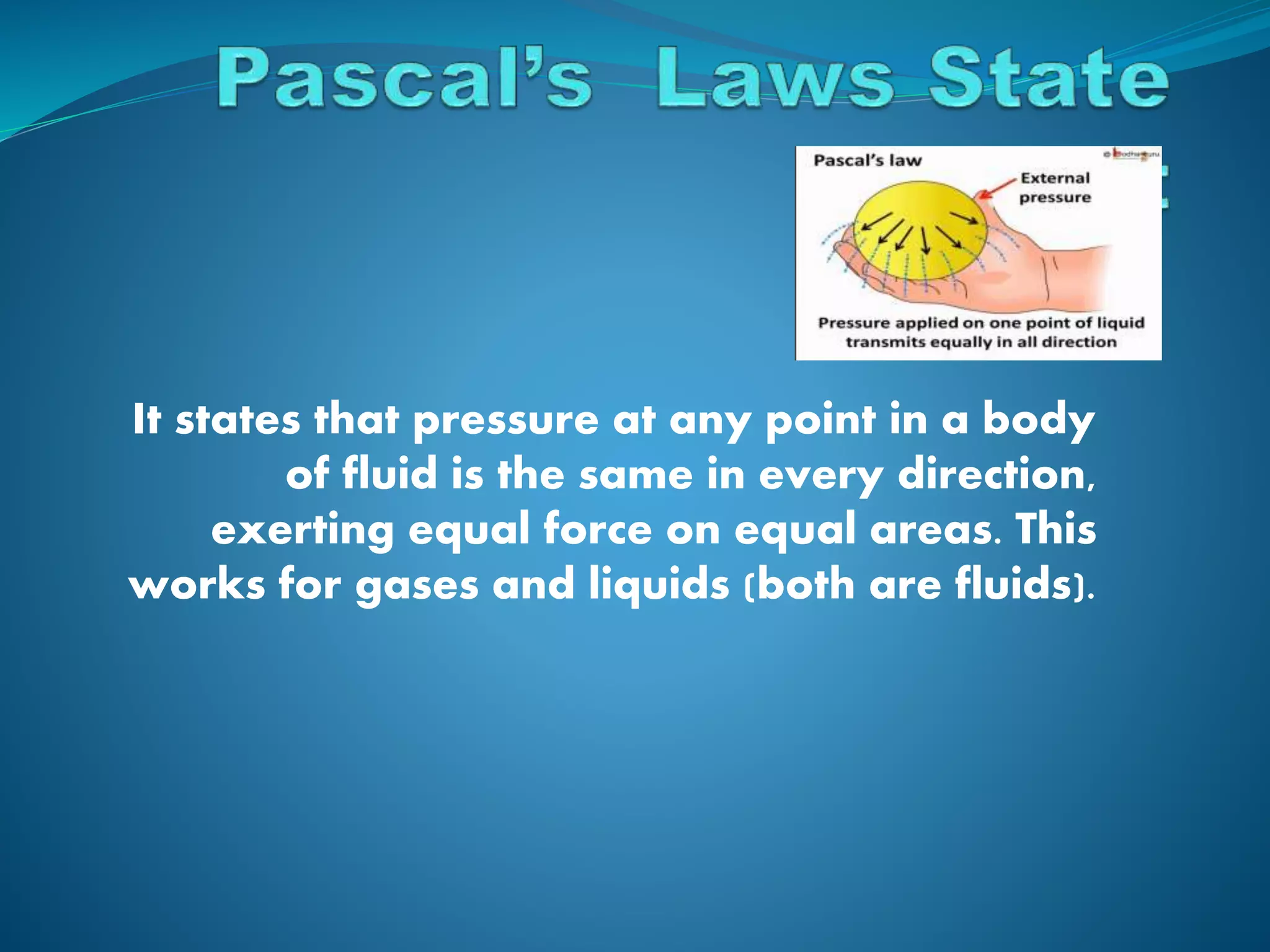
It states that pressure at any point
in a body of fluid is the same in
every direction, exerting equal force
on equal areas. This works for gases
and liquids (both are fluids).
Pascal’s Formula
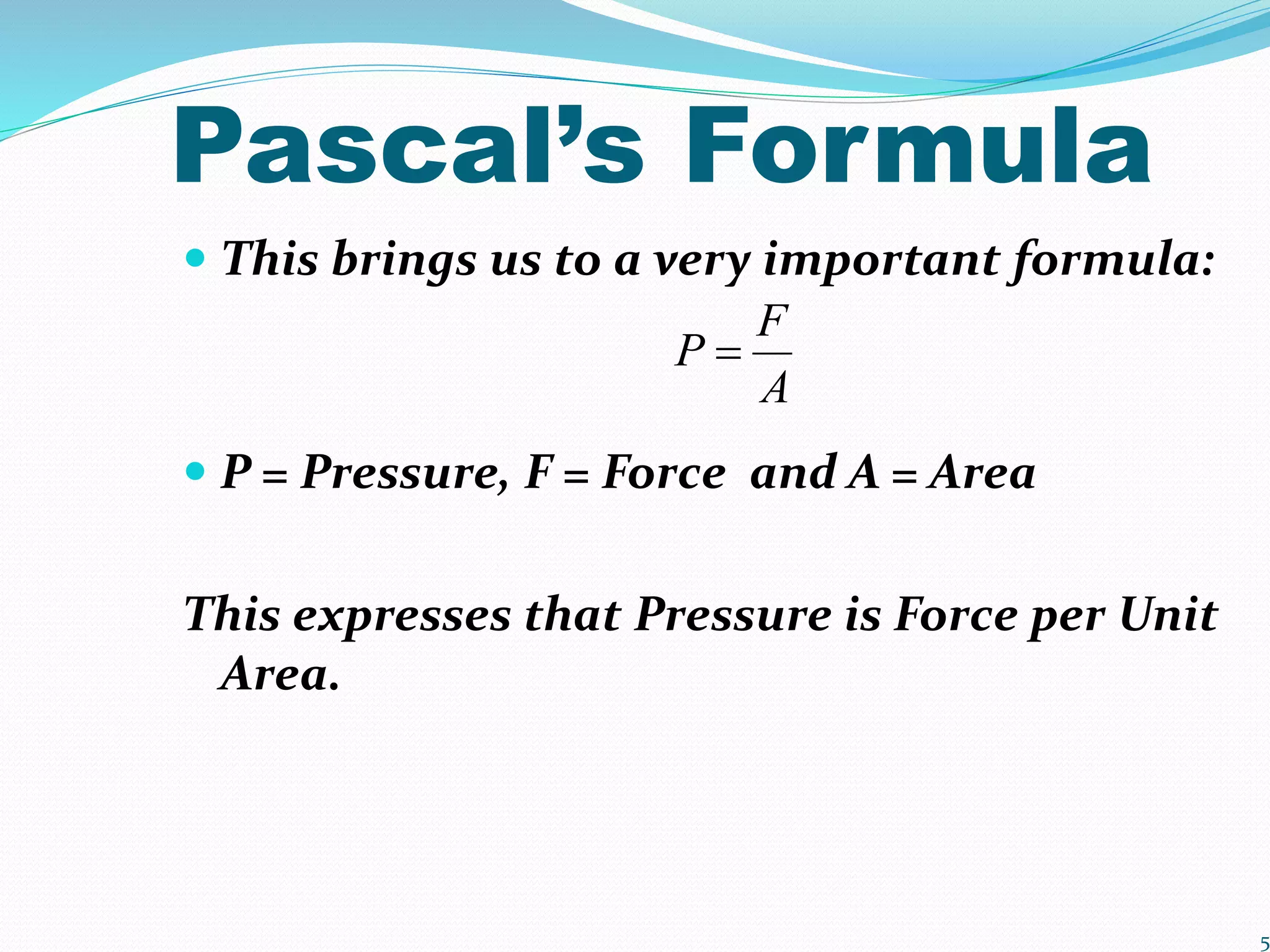
• This brings us to a very important formula:
• P = Pressure, F = Force and A = Area
This expresses that Pressure is Force per Unit Area.
A
F
P 
6
Variations of Pascal’s
Law
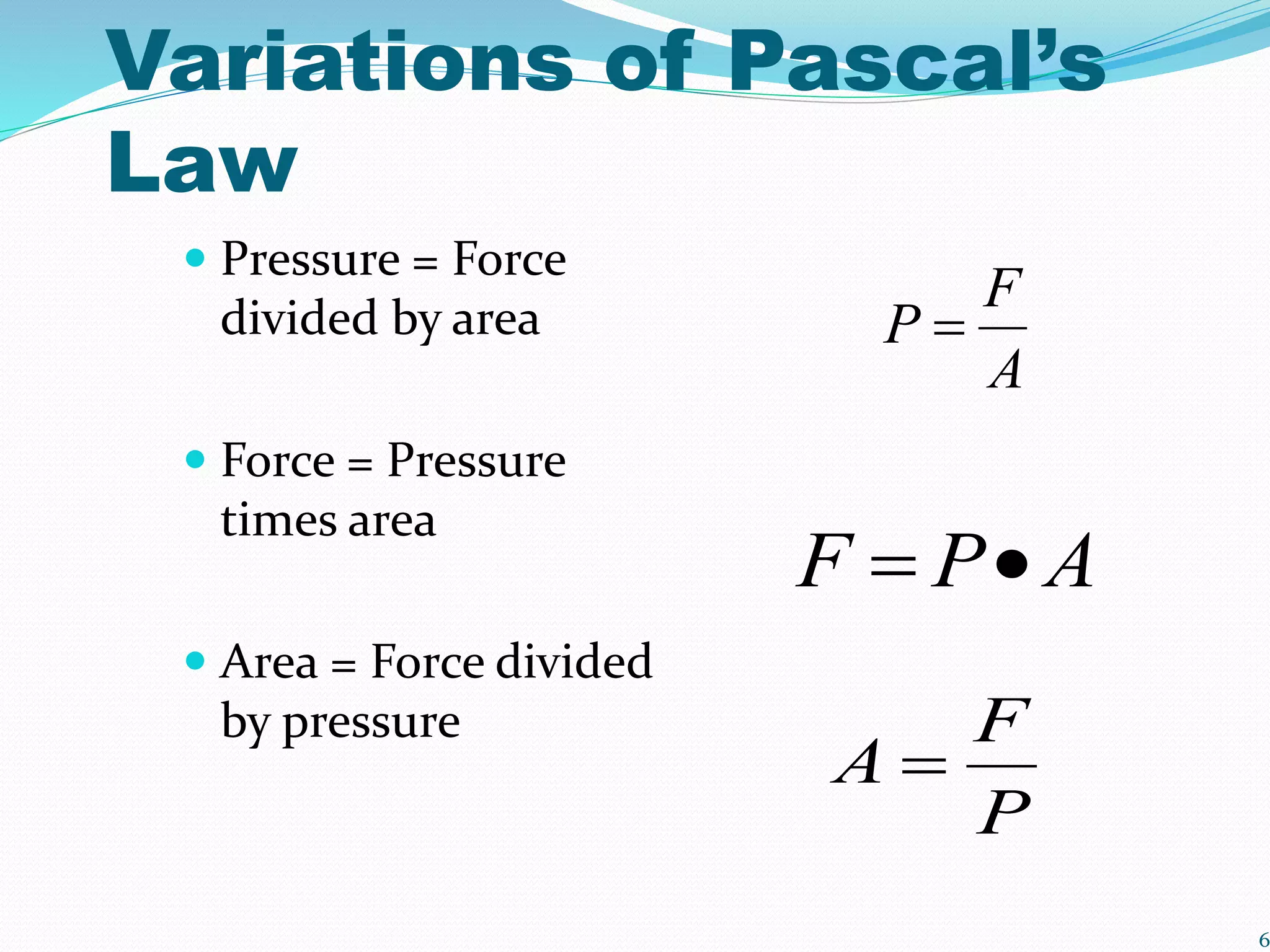
• Pressure = Force
divided by area
• Force = Pressure times
area
• Area = Force divided
by pressure
A
F
P 
APF 
7
P
F
A 
8
F
P A
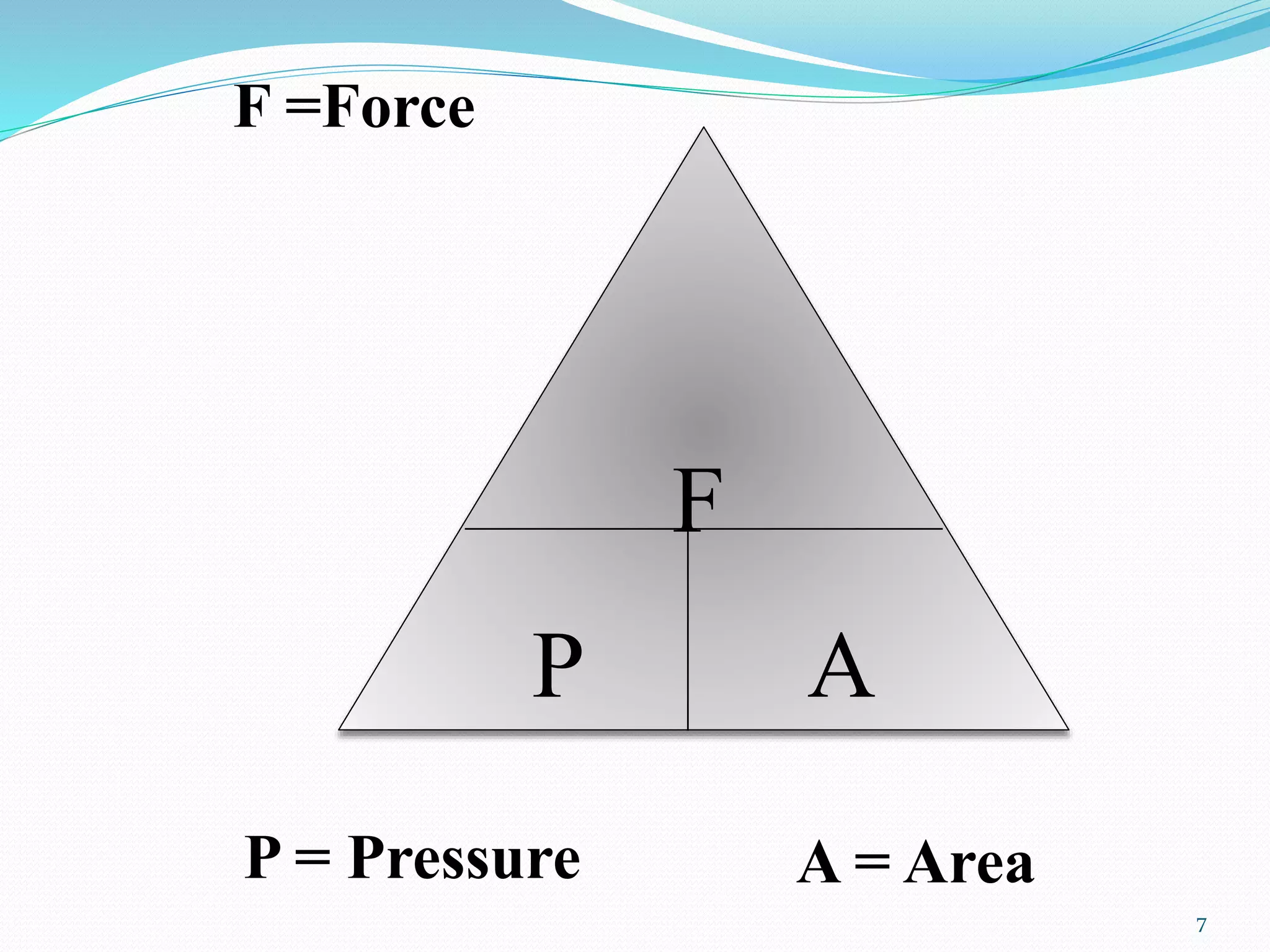
F =Force
P = Pressure A = Area
Have you used formulas
like Pascal’s Law? Where
are they used?
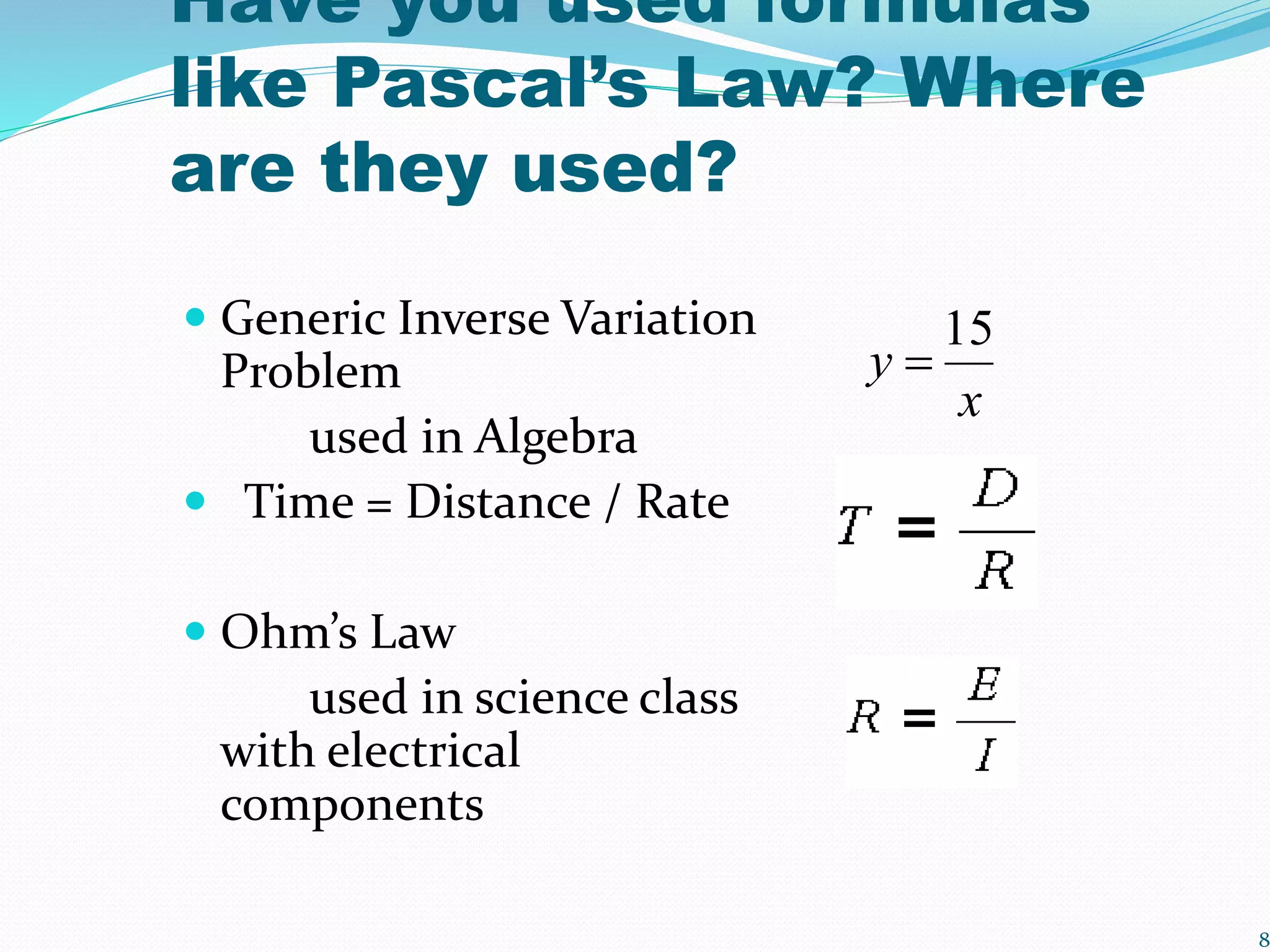
• Generic Inverse Variation
Problem
used in Algebra
• Time = Distance / Rate
• Ohm’s Law
used in science class
with electrical
components
x
y
15

9
Using Pascal’s Law
10
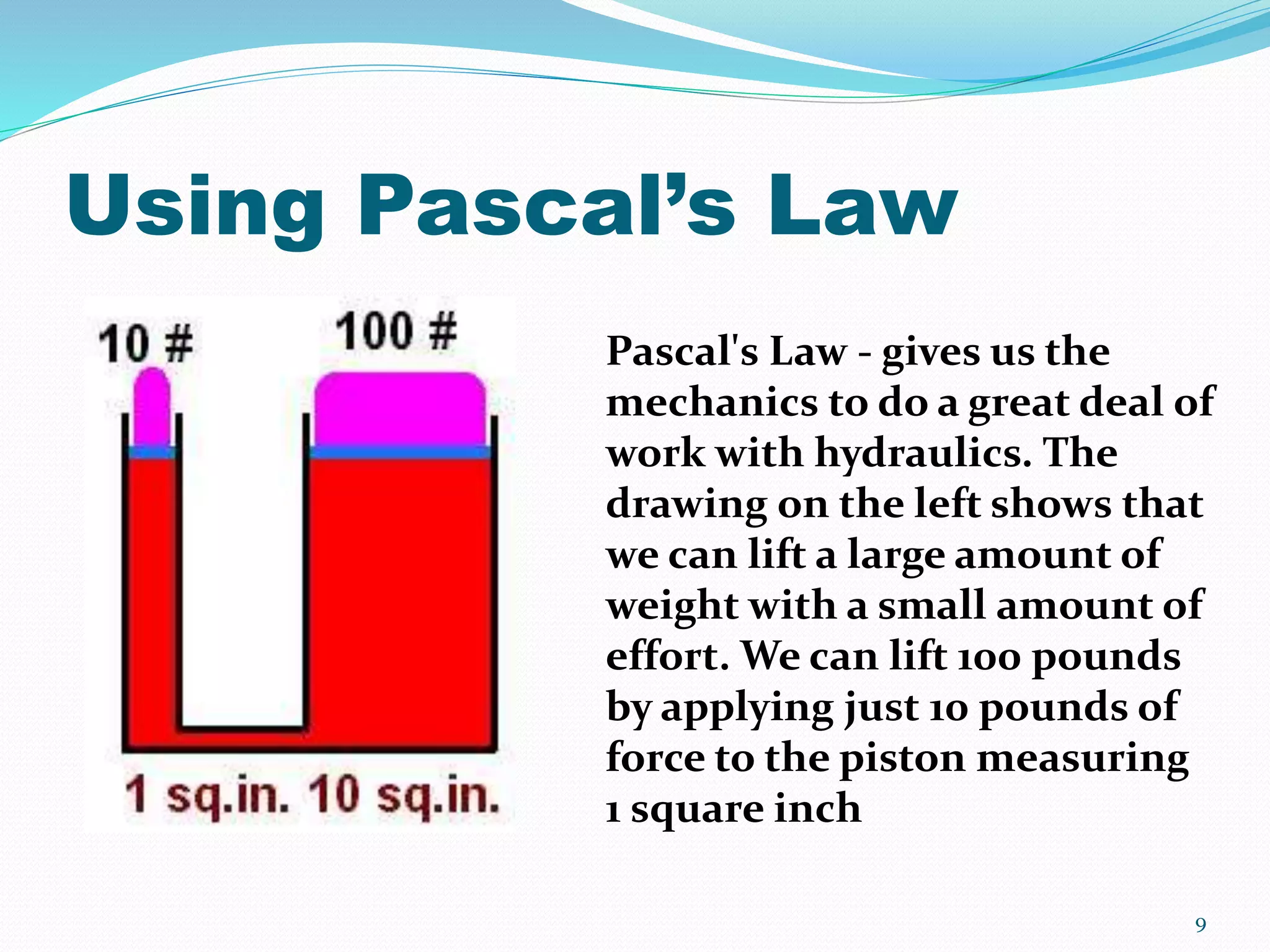
Pascal's Law - gives us the
mechanics to do a great deal of
work with hydraulics. The drawing
on the left shows that we can lift a
large amount of weight with a
small amount of effort. We can lift
100 pounds by applying just 10
pounds of force to the piston
measuring 1 square inch
Applications of Pascal's
law
• Hydraulic lift
• Hydraulic Jacks
• Hydraulic Brakes
• Hydraulic Pumps
Hydraulic lift
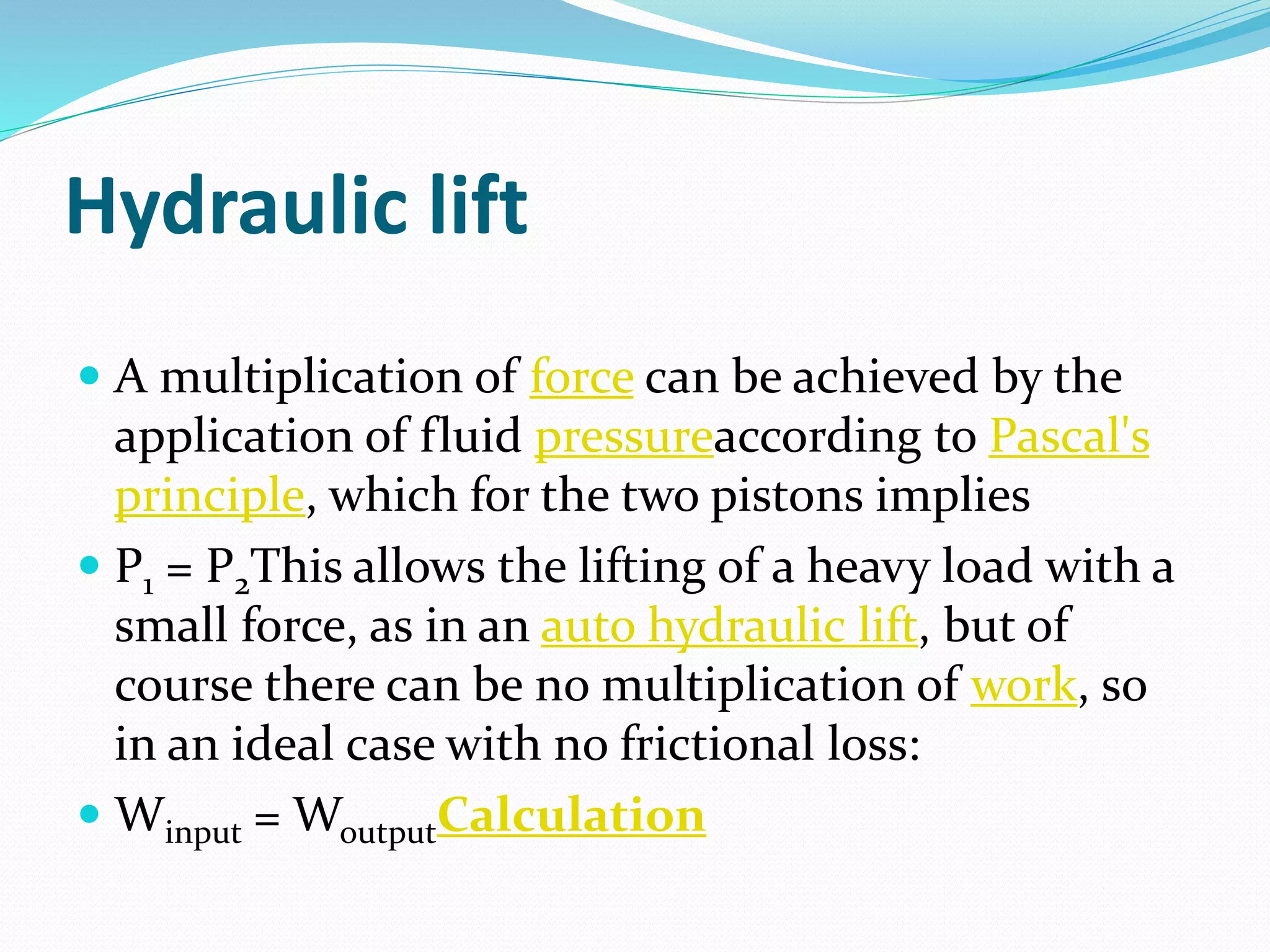
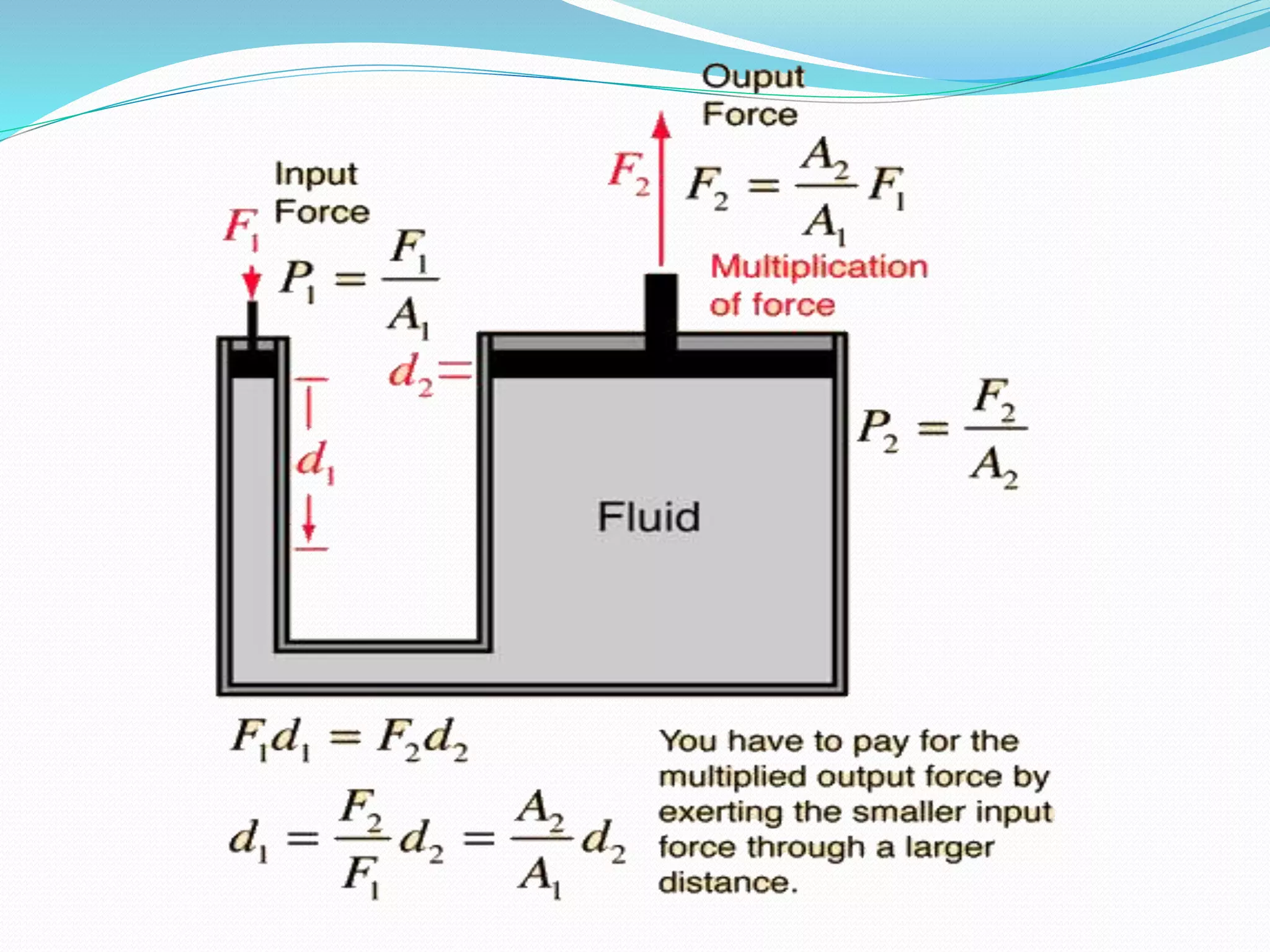
• A multiplication of force can be achieved by the
application of fluid pressureaccording to Pascal's
principle, which for the two pistons implies
• P1 = P2This allows the lifting of a heavy load with a
small force, as in an auto hydraulic lift, but of course
there can be no multiplication of work, so in an ideal
case with no frictional loss:
• Winput = WoutputCalculation
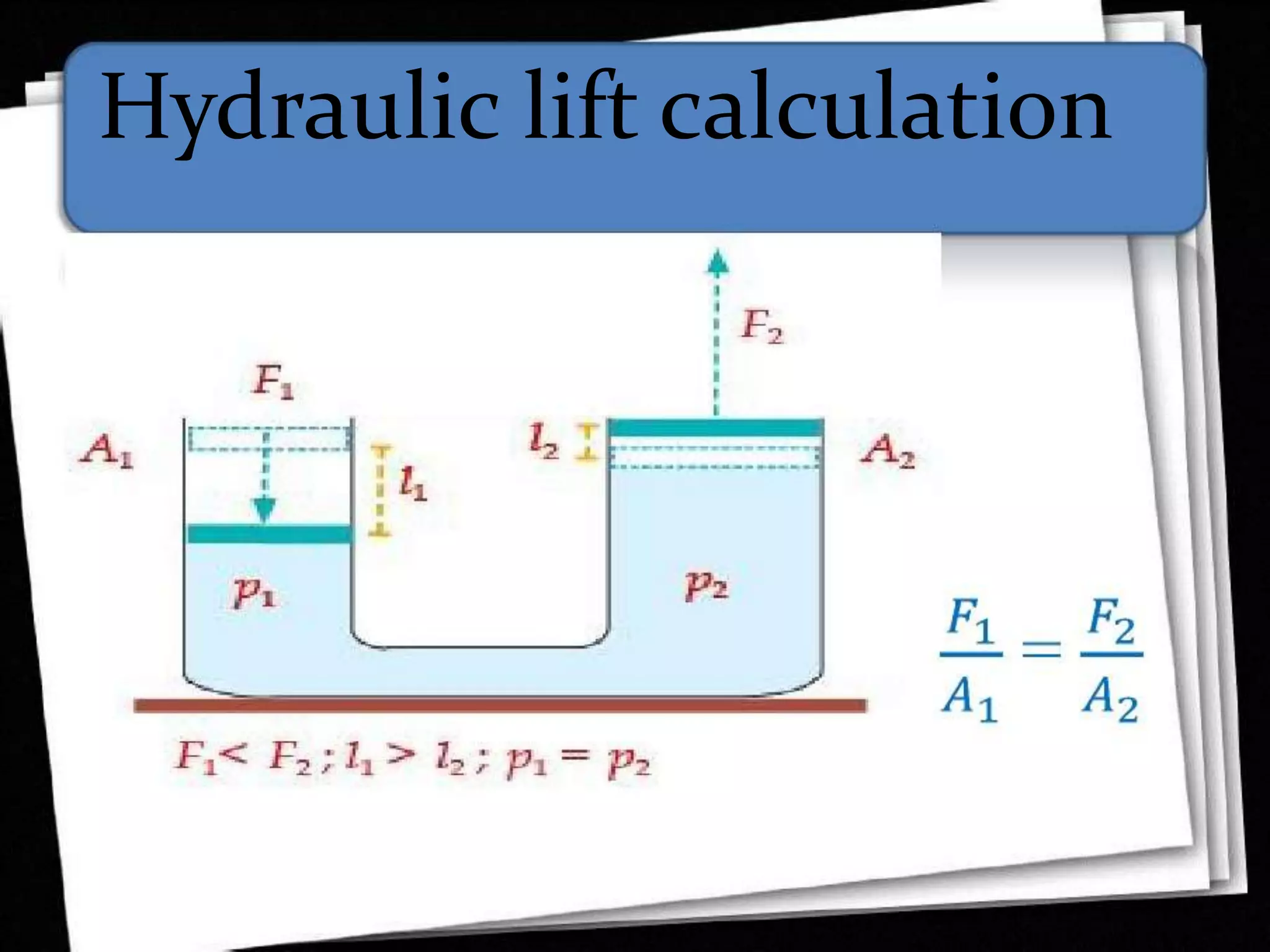
Hydraulic lift calculation
Automobile Hydraulic lift
Hydraulic brake
The hydraulic brake is an arrangement
of braking mechanism which uses brake fluid,
typically containing ethylene glycol, to transfer
pressure from the controlling mechanism to
the braking mechanism. When brakes are
applied suddenly in a moving vehicle, there is
every chance of the vehicle to skid because
the wheels are not retarded uniformly. In
order to avoid this danger of skidding when
the brakes are applied, the brake mechanism
must be such that each wheel is equally and
simultaneously retarded. A hydraulic brake
serves this purpose. It works on the principle
of Pascal’s law.
Hydraulic Brake
Hydraulic Jack
Hydraulic Pump
Hydraulic pumps are used in hydraulic drive systems and
can be hydrostatic or hydrodynamic. A hydraulic pump
is a mechanical source of power that converts
mechanical power into hydraulic energy (hydrostatic
energy i.e. flow, pressure). It generates flow with
enough power to overcome pressure induced by the
load at the pump outlet. When a hydraulic pump
operates, it creates a vacuum at the pump inlet, which
forces liquid from the reservoir into the inlet line to the
pump and by mechanical action delivers this liquid to
the pump outlet and forces it into the hydraulic
system.
Hydraulic Pump
THANK
YOU!!

Pascals law

  • 1.
  • 2.
    Index • Acknowledgment • Pascal’sLaw • Pascal’ Formula • Variation of Pascal’ Law • Using Pascal’s Law • Applications • Hydraulic Lift • Hydraulic Brake • Hydraulic Jack • Hydraulic Pump
  • 3.
    Acknowledgement I would liketo express my special thanks of gratitude to my teacher who gave me the golden opportunity to do this wonderful project on the topic Pascal’s Law, which also helped me in doing a lot of Research and I came to know about so many new things I am really thankful to them. Secondly I would also like to thank my parents and friends who helped me a lot in finalizing this project within the limited time frame.
  • 4.
    Pascal’s Law • Inthe 1600's, the French scientist Blaise Pascal discovered a fact now known as Pascal's Law. • Pascal's Principle is used to quantitatively relate the pressure at two points in an incompressible, static fluid. It states that pressure is transmitted, undiminished, in a closed static fluid. • Through the application of Pascal's Principle, a static liquid can be utilized to generate a large output force using a much smaller input force, yielding important devices such as hydraulic presses. 4
  • 5.
    Pascal’s Laws State that Itstates that pressure at any point in a body of fluid is the same in every direction, exerting equal force on equal areas. This works for gases and liquids (both are fluids).
  • 6.
    Pascal’s Formula • Thisbrings us to a very important formula: • P = Pressure, F = Force and A = Area This expresses that Pressure is Force per Unit Area. A F P  6
  • 7.
    Variations of Pascal’s Law •Pressure = Force divided by area • Force = Pressure times area • Area = Force divided by pressure A F P  APF  7 P F A 
  • 8.
    8 F P A F =Force P= Pressure A = Area
  • 9.
    Have you usedformulas like Pascal’s Law? Where are they used? • Generic Inverse Variation Problem used in Algebra • Time = Distance / Rate • Ohm’s Law used in science class with electrical components x y 15  9
  • 10.
    Using Pascal’s Law 10 Pascal'sLaw - gives us the mechanics to do a great deal of work with hydraulics. The drawing on the left shows that we can lift a large amount of weight with a small amount of effort. We can lift 100 pounds by applying just 10 pounds of force to the piston measuring 1 square inch
  • 11.
    Applications of Pascal's law •Hydraulic lift • Hydraulic Jacks • Hydraulic Brakes • Hydraulic Pumps
  • 12.
    Hydraulic lift • Amultiplication of force can be achieved by the application of fluid pressureaccording to Pascal's principle, which for the two pistons implies • P1 = P2This allows the lifting of a heavy load with a small force, as in an auto hydraulic lift, but of course there can be no multiplication of work, so in an ideal case with no frictional loss: • Winput = WoutputCalculation
  • 13.
  • 16.
  • 17.
    Hydraulic brake The hydraulicbrake is an arrangement of braking mechanism which uses brake fluid, typically containing ethylene glycol, to transfer pressure from the controlling mechanism to the braking mechanism. When brakes are applied suddenly in a moving vehicle, there is every chance of the vehicle to skid because the wheels are not retarded uniformly. In order to avoid this danger of skidding when the brakes are applied, the brake mechanism must be such that each wheel is equally and simultaneously retarded. A hydraulic brake serves this purpose. It works on the principle of Pascal’s law.
  • 18.
  • 19.
  • 20.
    Hydraulic Pump Hydraulic pumpsare used in hydraulic drive systems and can be hydrostatic or hydrodynamic. A hydraulic pump is a mechanical source of power that converts mechanical power into hydraulic energy (hydrostatic energy i.e. flow, pressure). It generates flow with enough power to overcome pressure induced by the load at the pump outlet. When a hydraulic pump operates, it creates a vacuum at the pump inlet, which forces liquid from the reservoir into the inlet line to the pump and by mechanical action delivers this liquid to the pump outlet and forces it into the hydraulic system.
  • 21.
  • 22.