1
PARTICIPANTS NAME 
 SATYAM SINGH (11SETME252) 
 SAYANTAN DAS (11SETEM480) 
 VIBHAS KUMAR (11SETME165) 
 SUMIT RAJ (11SETME363) 
 VISHAL BASNET (11SETME411)
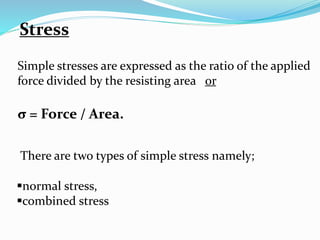
Stress 
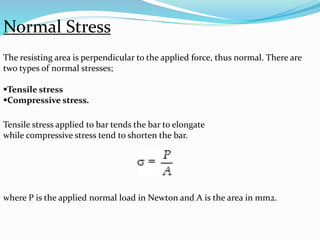
Simple stresses are expressed as the ratio of the applied 
force divided by the resisting area or 
σ = Force / Area. 
There are two types of simple stress namely; 
normal stress, 
combined stress
Normal Stress 
The resisting area is perpendicular to the applied force, thus normal. There are 
two types of normal stresses; 
Tensile stress 
Compressive stress. 
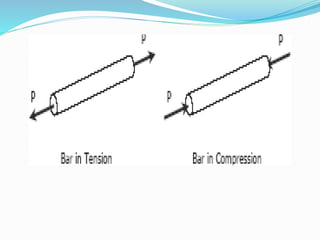
Tensile stress applied to bar tends the bar to elongate 
while compressive stress tend to shorten the bar. 
where P is the applied normal load in Newton and A is the area in mm2.
Combined Stress 
In combined stress there are two types of stress 
 Shear stress 
Tortional stress
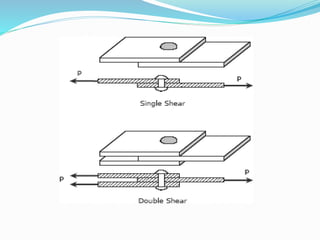
Shear Stress 
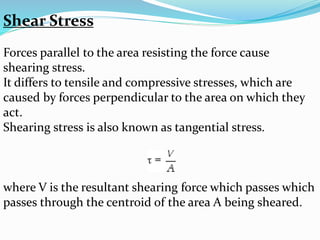
Forces parallel to the area resisting the force cause 
shearing stress. 
It differs to tensile and compressive stresses, which are 
caused by forces perpendicular to the area on which they 
act. 
Shearing stress is also known as tangential stress. 
where V is the resultant shearing force which passes which 
passes through the centroid of the area A being sheared.
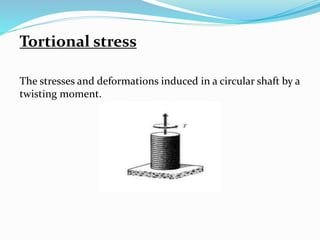
Tortional stress 
The stresses and deformations induced in a circular shaft by a 
twisting moment.
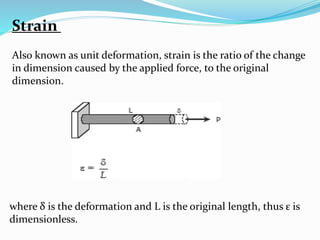
Strain 
Also known as unit deformation, strain is the ratio of the change 
in dimension caused by the applied force, to the original 
dimension. 
where δ is the deformation and L is the original length, thus ε is 
dimensionless.
Types of strain: 
Tensile strain 
Compressive strain 
Shear strain 
Volumetric strain
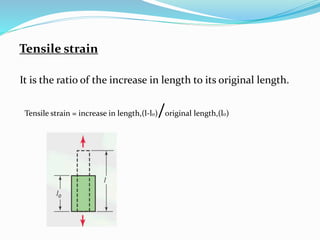
Tensile strain 
It is the ratio of the increase in length to its original length. 
Tensile strain = increase in length,(l-l0)/original length,(l0)
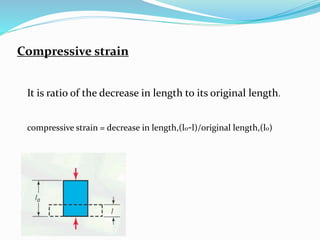
Compressive strain 
It is ratio of the decrease in length to its original length. 
compressive strain = decrease in length,(l0-l)/original length,(l0)
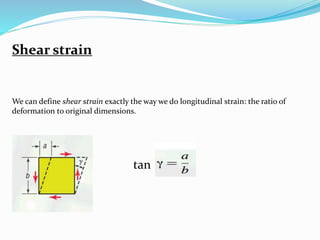
Shear strain 
We can define shear strain exactly the way we do longitudinal strain: the ratio of 
deformation to original dimensions. 
tan
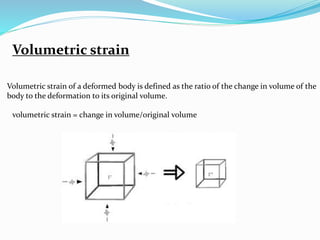
Volumetric strain 
Volumetric strain of a deformed body is defined as the ratio of the change in volume of the 
body to the deformation to its original volume. 
volumetric strain = change in volume/original volume
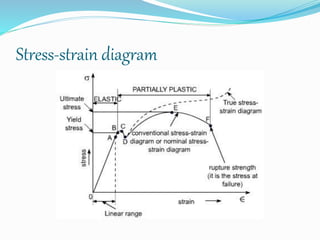
Stress-strain diagram
The curve starts from the origin ‘O’ showing thereby that there 
is no initial stress or strain in the test specimen. 
Up to point ‘A’ Hooke’s law is obeyed and stress is proportional 
to strain therefore ‘OA’ is straight line and point ‘A’ is called 
the proportionality limit stress. 
The portion between ‘AB’ is not a straight line, but up to point 
‘B’, the material remains elastic.
The point ‘B’ is called the elastic limit point and the stress 
corresponding to that is called the elastic limit stress. 
Beyond the point ‘B’, the material goes to plastic stage until the 
upper yield point ‘C’ is reached. 
At this point the cross-sectional area of the material starts 
decreasing and the stress decreases to a lower value to a point ‘D’, 
called the lower yield point. 
Corresponding to point ‘C’, the stress is known as upper yield 
point stress.
At point ‘D’ the specimen elongates by a considerable amount 
without any increase in stress and up to point ‘E’. 
The portion ‘DE’ is called the yielding of the material at 
constant stress. 
From point ‘E’ onwards , the strain hardening phenomena 
becomes pre-dominant and the strength of the material 
increases thereby requiring more stress for deformation, 
until point ‘F’ is reached.
Point ‘F’ is called the ultimate point and the stress 
corresponding to this point is called the ultimate stress. 
It is the maximum stress to which the material can be 
subjected in a simple tensile test. 
At point ‘F’ the necking of the material begins and the cross-sectional 
area starts decreasing at a rapid rate. 
Due to this local necking the stress in the material goes on 
decreasing inspite of the fact that actual stress intensity goes 
on increasing.
Ultimately the specimen breaks at point ‘G’, known as the 
breaking point, and the corresponding stress is called the 
normal breaking stress bared up to original area of cross-section.
Thanks for your kind attention….

types of stress and strain

  • 1.
  • 3.
    PARTICIPANTS NAME SATYAM SINGH (11SETME252)  SAYANTAN DAS (11SETEM480)  VIBHAS KUMAR (11SETME165)  SUMIT RAJ (11SETME363)  VISHAL BASNET (11SETME411)
  • 4.
    Stress Simple stressesare expressed as the ratio of the applied force divided by the resisting area or σ = Force / Area. There are two types of simple stress namely; normal stress, combined stress
  • 5.
    Normal Stress Theresisting area is perpendicular to the applied force, thus normal. There are two types of normal stresses; Tensile stress Compressive stress. Tensile stress applied to bar tends the bar to elongate while compressive stress tend to shorten the bar. where P is the applied normal load in Newton and A is the area in mm2.
  • 7.
    Combined Stress Incombined stress there are two types of stress  Shear stress Tortional stress
  • 8.
    Shear Stress Forcesparallel to the area resisting the force cause shearing stress. It differs to tensile and compressive stresses, which are caused by forces perpendicular to the area on which they act. Shearing stress is also known as tangential stress. where V is the resultant shearing force which passes which passes through the centroid of the area A being sheared.
  • 10.
    Tortional stress Thestresses and deformations induced in a circular shaft by a twisting moment.
  • 11.
    Strain Also knownas unit deformation, strain is the ratio of the change in dimension caused by the applied force, to the original dimension. where δ is the deformation and L is the original length, thus ε is dimensionless.
  • 12.
    Types of strain: Tensile strain Compressive strain Shear strain Volumetric strain
  • 13.
    Tensile strain Itis the ratio of the increase in length to its original length. Tensile strain = increase in length,(l-l0)/original length,(l0)
  • 14.
    Compressive strain Itis ratio of the decrease in length to its original length. compressive strain = decrease in length,(l0-l)/original length,(l0)
  • 15.
    Shear strain Wecan define shear strain exactly the way we do longitudinal strain: the ratio of deformation to original dimensions. tan
  • 16.
    Volumetric strain Volumetricstrain of a deformed body is defined as the ratio of the change in volume of the body to the deformation to its original volume. volumetric strain = change in volume/original volume
  • 17.
  • 18.
    The curve startsfrom the origin ‘O’ showing thereby that there is no initial stress or strain in the test specimen. Up to point ‘A’ Hooke’s law is obeyed and stress is proportional to strain therefore ‘OA’ is straight line and point ‘A’ is called the proportionality limit stress. The portion between ‘AB’ is not a straight line, but up to point ‘B’, the material remains elastic.
  • 19.
    The point ‘B’is called the elastic limit point and the stress corresponding to that is called the elastic limit stress. Beyond the point ‘B’, the material goes to plastic stage until the upper yield point ‘C’ is reached. At this point the cross-sectional area of the material starts decreasing and the stress decreases to a lower value to a point ‘D’, called the lower yield point. Corresponding to point ‘C’, the stress is known as upper yield point stress.
  • 20.
    At point ‘D’the specimen elongates by a considerable amount without any increase in stress and up to point ‘E’. The portion ‘DE’ is called the yielding of the material at constant stress. From point ‘E’ onwards , the strain hardening phenomena becomes pre-dominant and the strength of the material increases thereby requiring more stress for deformation, until point ‘F’ is reached.
  • 21.
    Point ‘F’ iscalled the ultimate point and the stress corresponding to this point is called the ultimate stress. It is the maximum stress to which the material can be subjected in a simple tensile test. At point ‘F’ the necking of the material begins and the cross-sectional area starts decreasing at a rapid rate. Due to this local necking the stress in the material goes on decreasing inspite of the fact that actual stress intensity goes on increasing.
  • 22.
    Ultimately the specimenbreaks at point ‘G’, known as the breaking point, and the corresponding stress is called the normal breaking stress bared up to original area of cross-section.
  • 23.
    Thanks for yourkind attention….