STRESS AND STRAIN
RELATIONS
UNIT I
DIRECT OR NORMAL STRESS
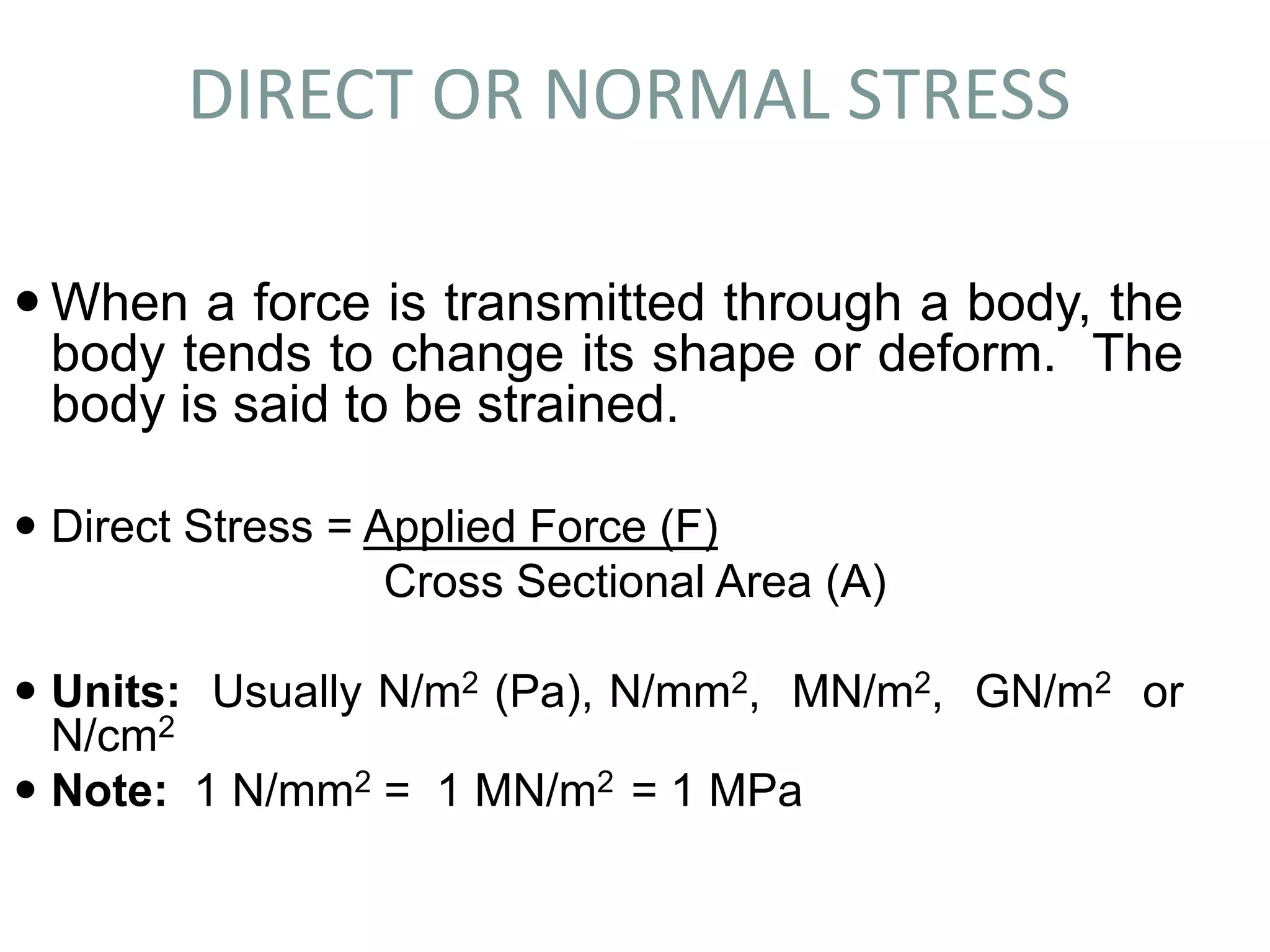
 When a force is transmitted through a body, the
body tends to change its shape or deform. The
body is said to be strained.
 Direct Stress = Applied Force (F)
Cross Sectional Area (A)
 Units: Usually N/m2 (Pa), N/mm2, MN/m2, GN/m2 or
N/cm2
 Note: 1 N/mm2 = 1 MN/m2 = 1 MPa
Direct Stress Contd.
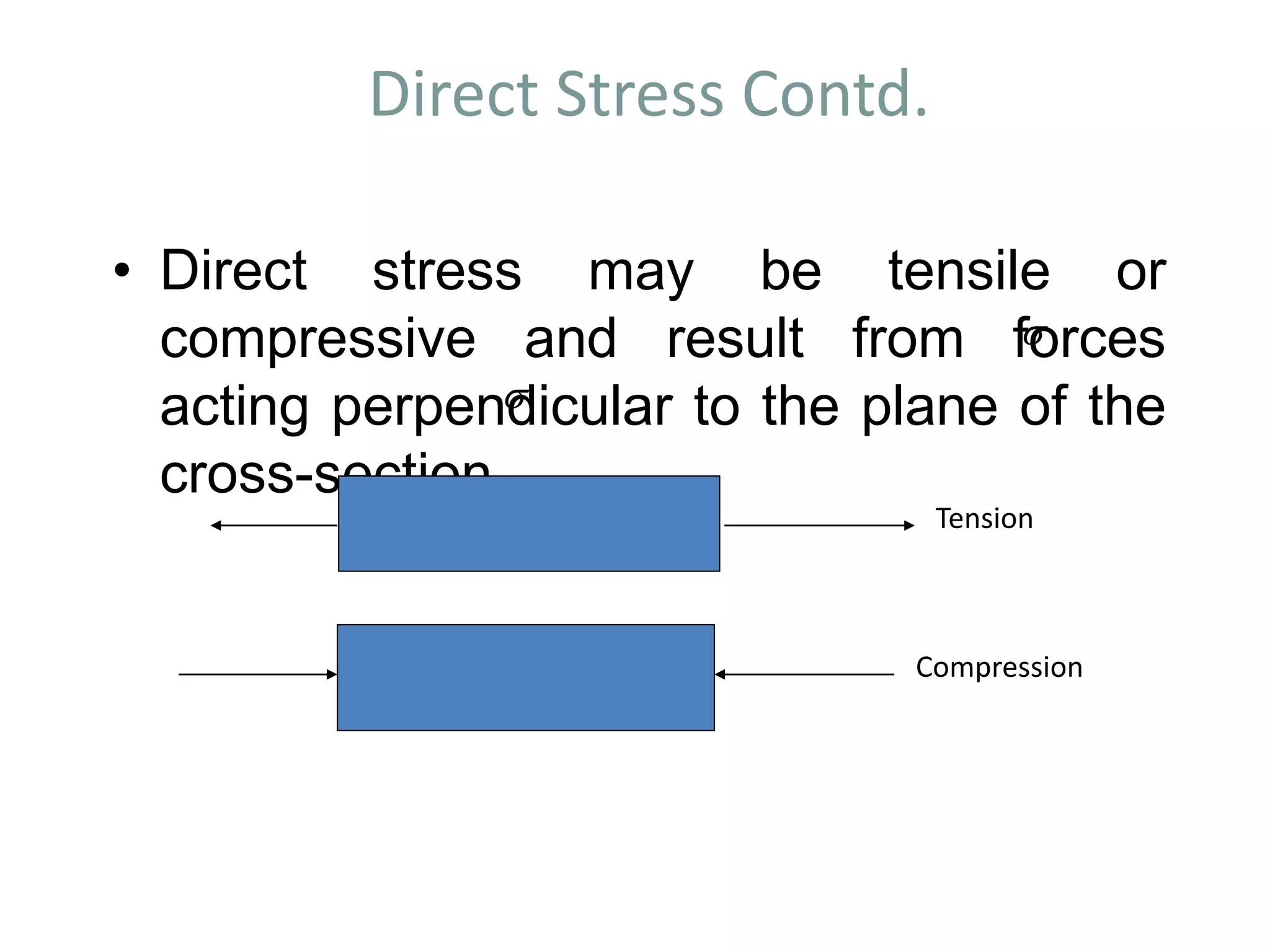
• Direct stress may be tensile or
compressive and result from forces
acting perpendicular to the plane of the
cross-section


Tension
Compression
Direct or Normal Strain
• When loads are applied to a body, some deformation will occur
resulting to a change in dimension.
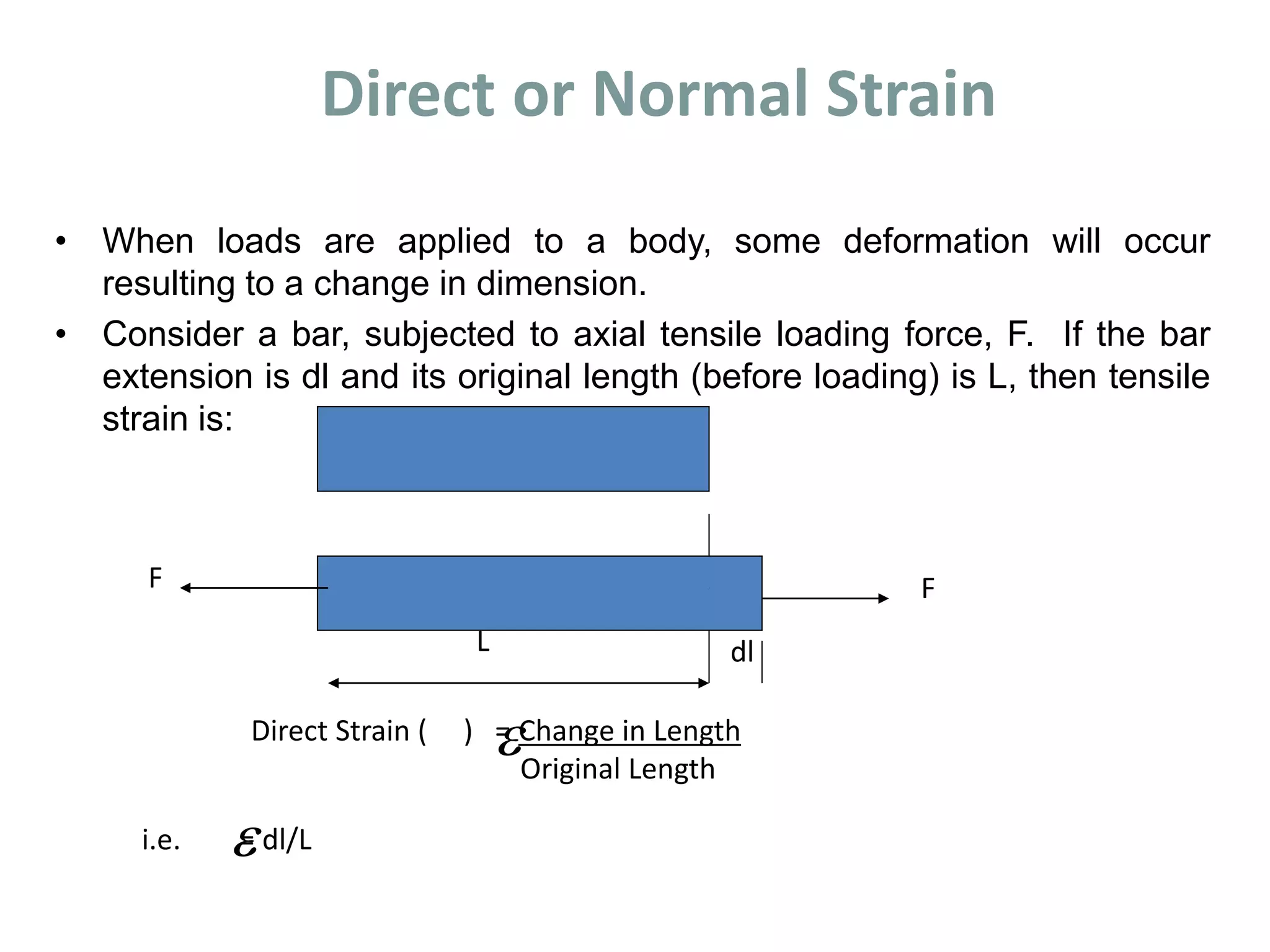
• Consider a bar, subjected to axial tensile loading force, F. If the bar
extension is dl and its original length (before loading) is L, then tensile
strain is:
dl
FF
L


Direct Strain ( ) = Change in Length
Original Length
i.e. = dl/L
Direct or Normal Strain Contd.
• As strain is a ratio of lengths, it is dimensionless.
• Similarly, for compression by amount, dl:
Compressive strain = - dl/L
• Note: Strain is positive for an increase in dimension
and negative for a reduction in dimension.
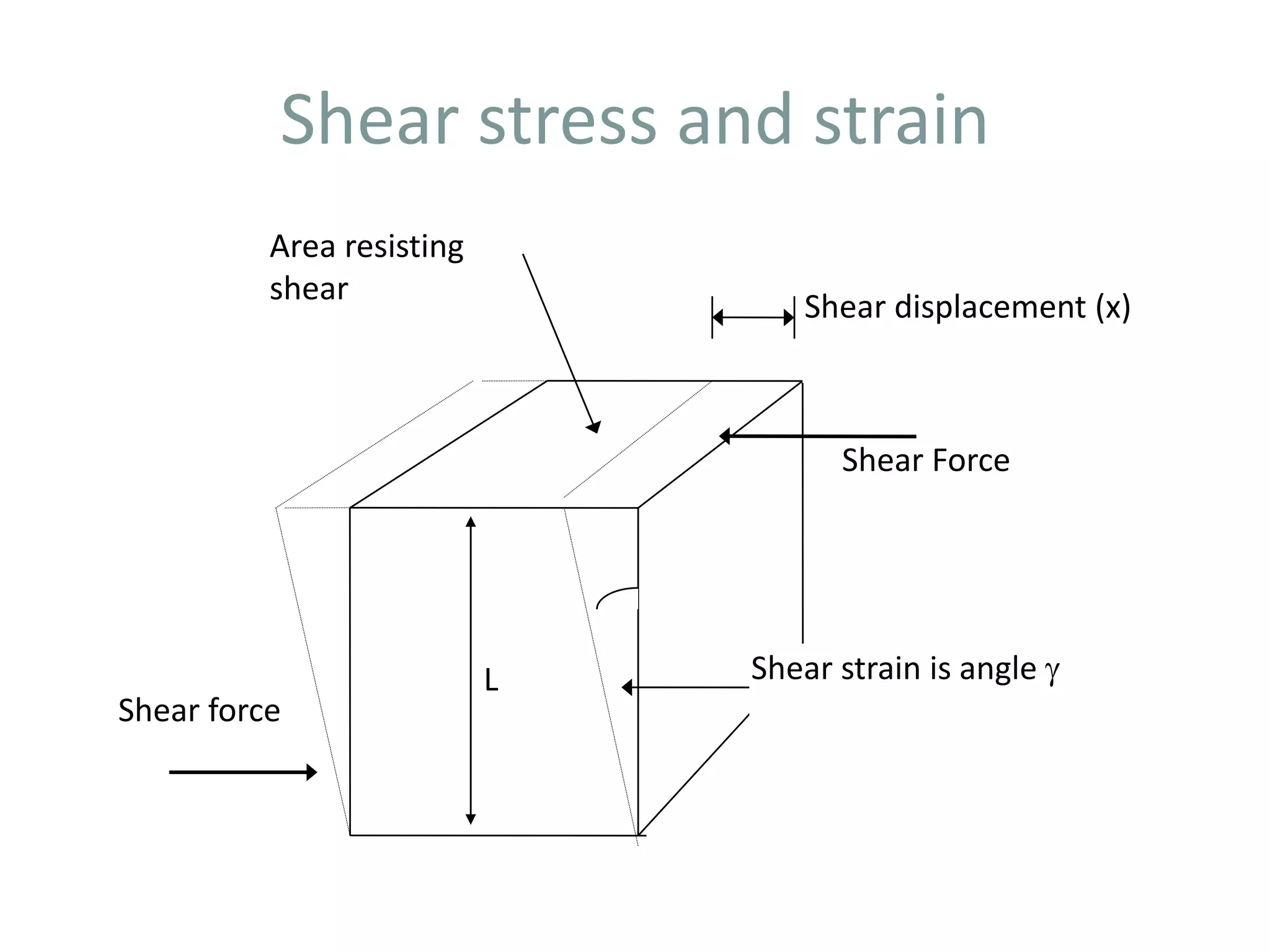
Shear Stress and Shear Strain
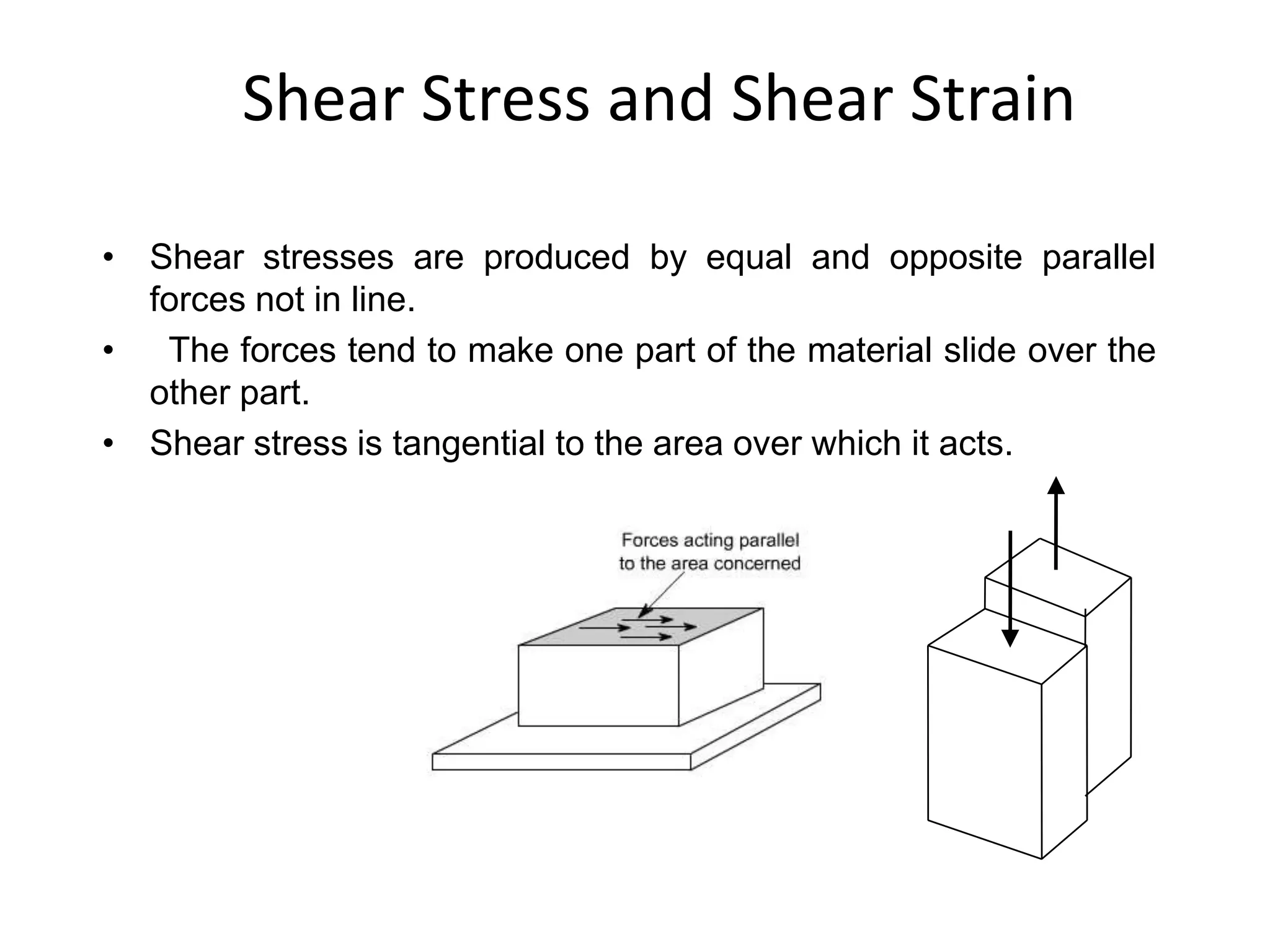
• Shear stresses are produced by equal and opposite parallel
forces not in line.
• The forces tend to make one part of the material slide over the
other part.
• Shear stress is tangential to the area over which it acts.
Ultimate Strength
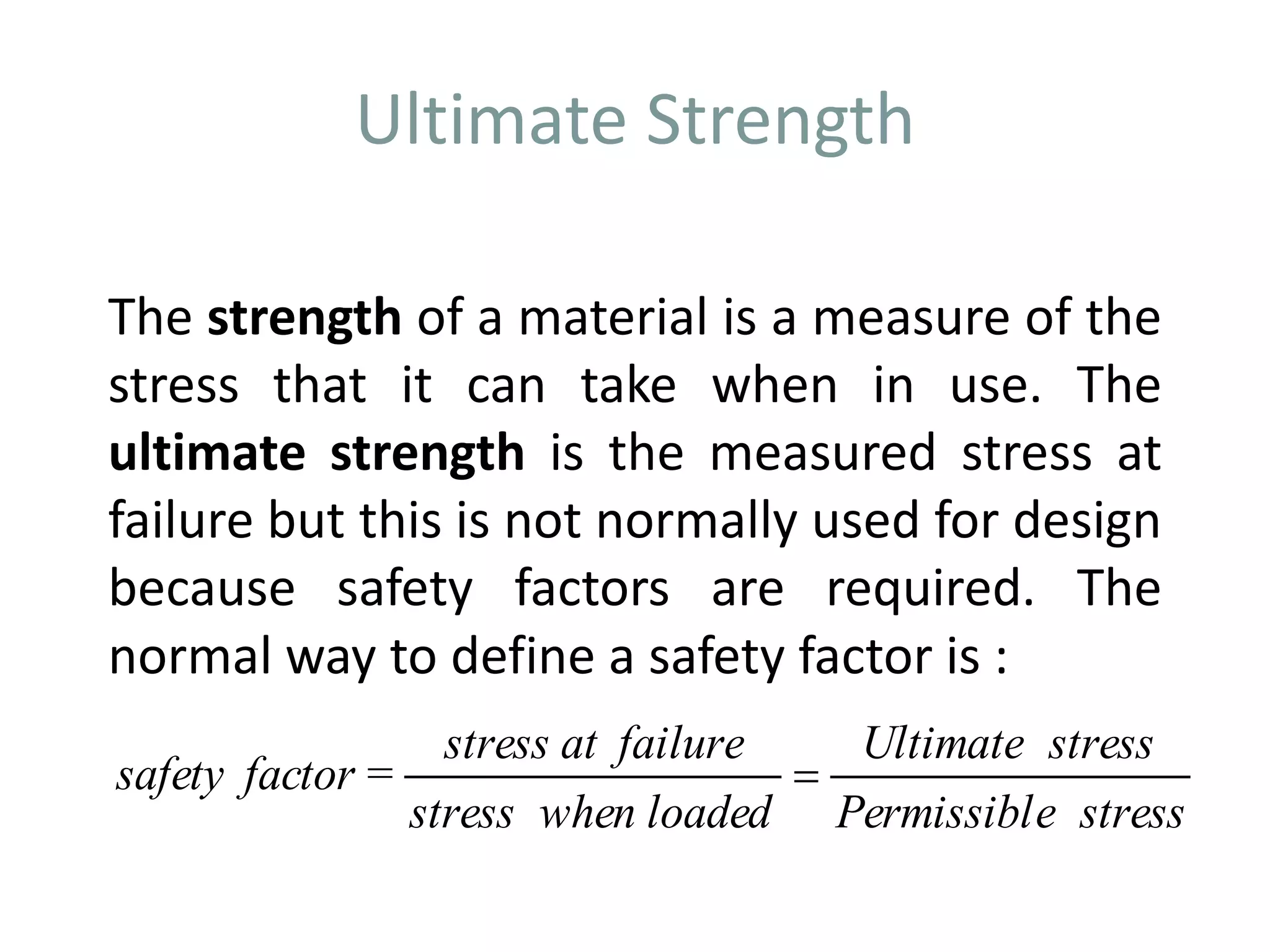
The strength of a material is a measure of the
stress that it can take when in use. The
ultimate strength is the measured stress at
failure but this is not normally used for design
because safety factors are required. The
normal way to define a safety factor is :
stressePermissibl
stressUltimate
loadedwhenstress
failureatstress
=factorsafety 
Strain
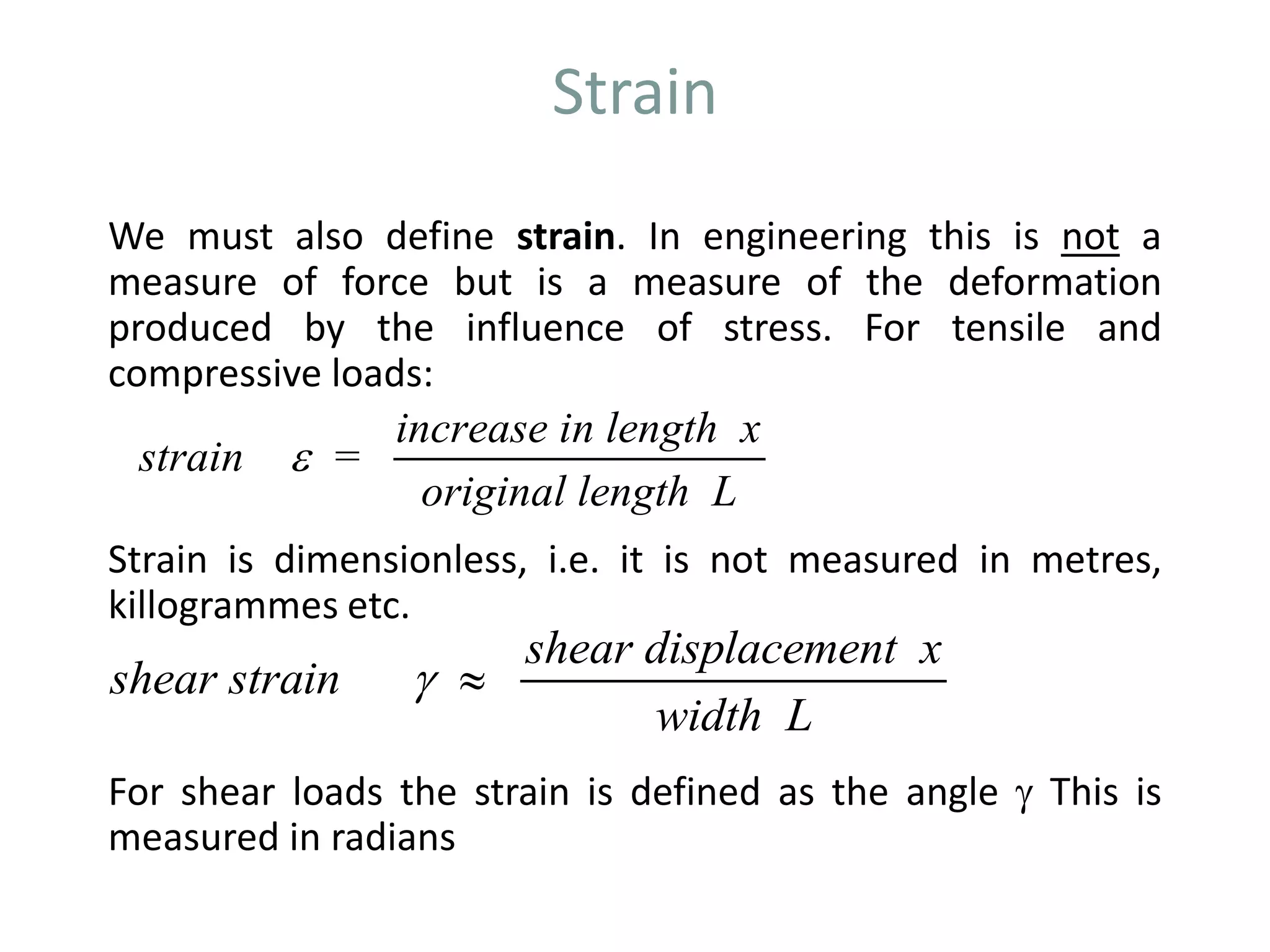
We must also define strain. In engineering this is not a
measure of force but is a measure of the deformation
produced by the influence of stress. For tensile and
compressive loads:
Strain is dimensionless, i.e. it is not measured in metres,
killogrammes etc.
For shear loads the strain is defined as the angle  This is
measured in radians
strain =
increase in length x
original length L

shear strain
shear displacement x
width L
 
Shear stress and strain
Shear force
Shear Force
Area resisting
shear
Shear displacement (x)
Shear strain is angle L
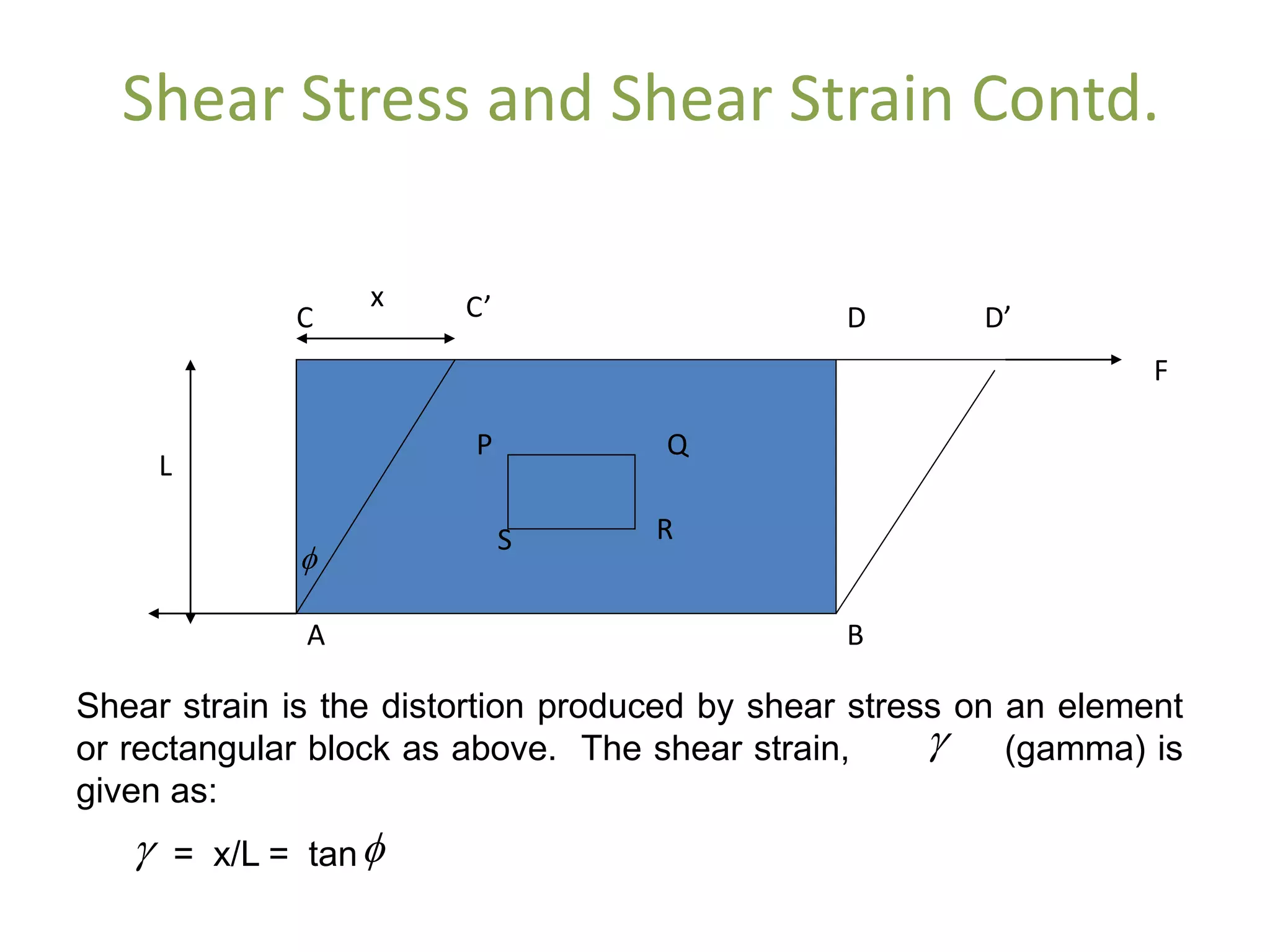
Shear Stress and Shear Strain Contd.
P Q
S R
F
D D’
A B
C C’
L
x

Shear strain is the distortion produced by shear stress on an element
or rectangular block as above. The shear strain, (gamma) is
given as:
= x/L = tan 

Shear Stress and Shear Strain
Concluded
• For small ,
• Shear strain then becomes the change in
the right angle.
• It is dimensionless and is measured in
radians.
  
Elastic and Plastic deformation
Stress
Strain
Stress
Strain
Permanent
Deformation
Elastic deformation Plastic deformation
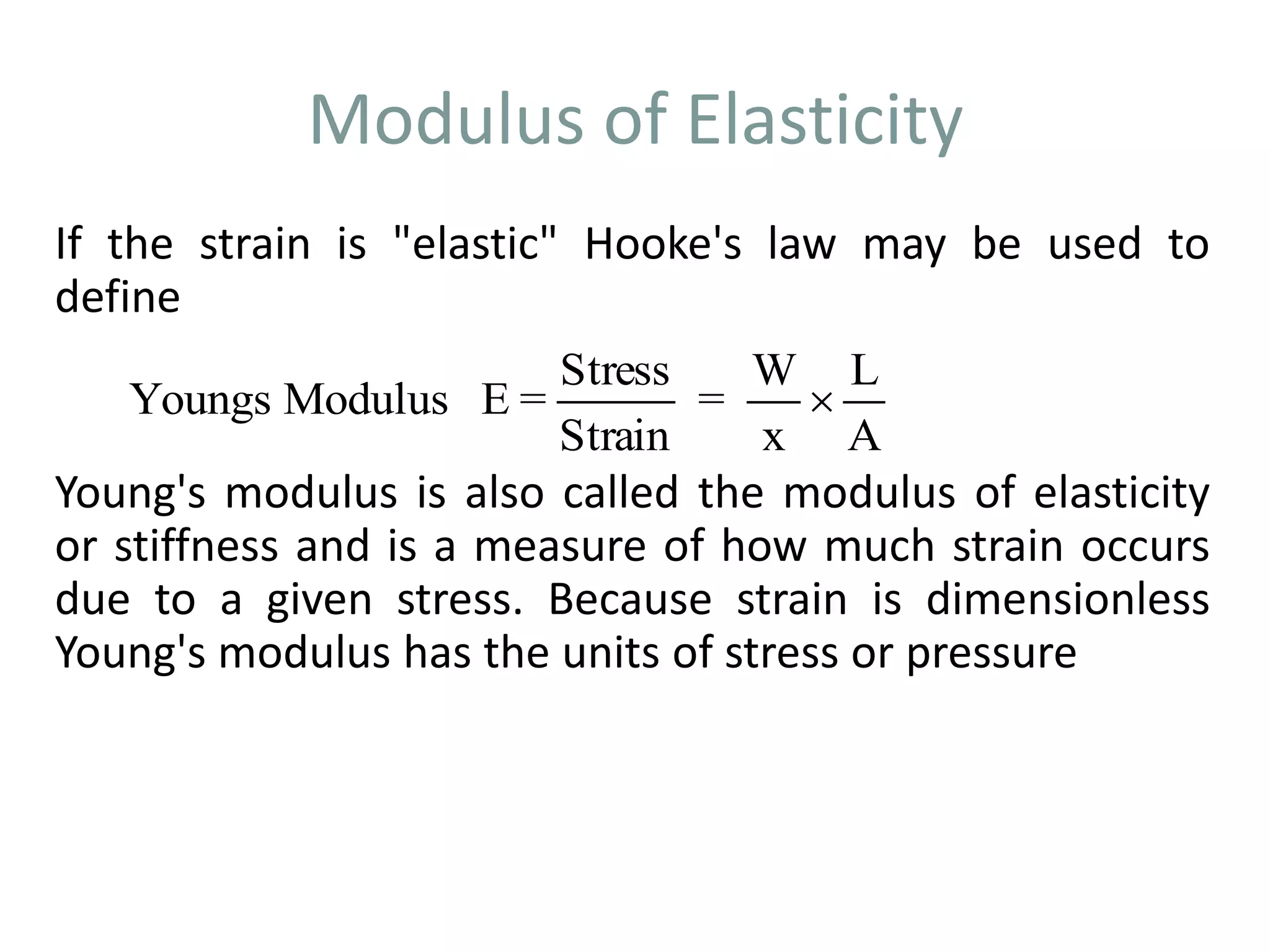
Modulus of Elasticity
If the strain is "elastic" Hooke's law may be used to
define
Young's modulus is also called the modulus of elasticity
or stiffness and is a measure of how much strain occurs
due to a given stress. Because strain is dimensionless
Young's modulus has the units of stress or pressure
A
L
x
W
=
Strain
Stress
=EModulusYoungs 
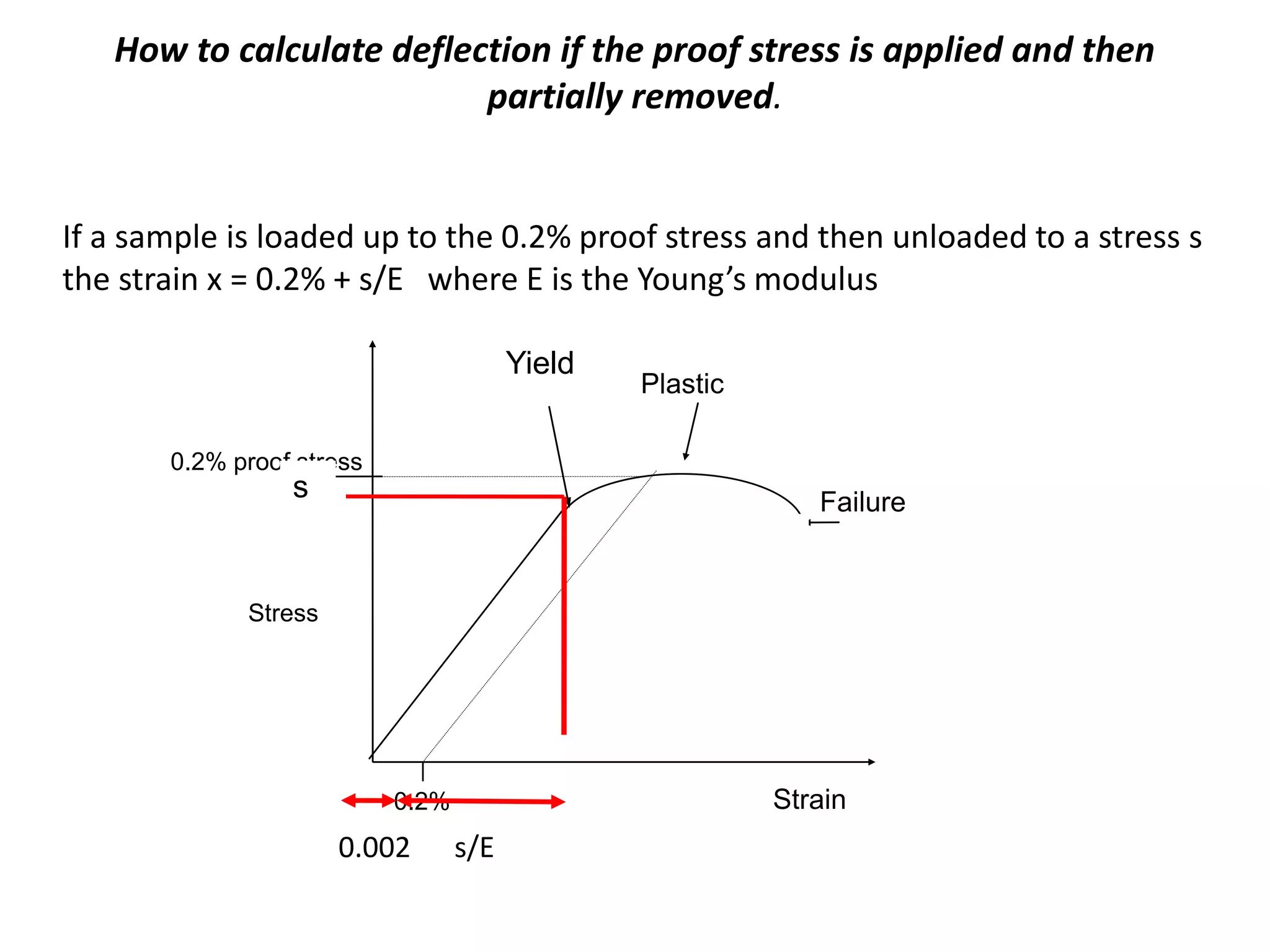
How to calculate deflection if the proof stress is applied and then
partially removed.
Yield
0.2% proof stress
Stress
Strain0.2%
Plastic
Failure
s
0.002 s/E
If a sample is loaded up to the 0.2% proof stress and then unloaded to a stress s
the strain x = 0.2% + s/E where E is the Young’s modulus
Volumetric Strain
• Hydrostatic stress refers to tensile or
compressive stress in all dimensions
within or external to a body.
• Hydrostatic stress results in change in
volume of the material.
• Consider a cube with sides x, y, z. Let
dx, dy, and dz represent increase in
length in all directions.
• i.e. new volume = (x + dx) (y + dy) (z +
dz)
Volumetric Strain Contd.
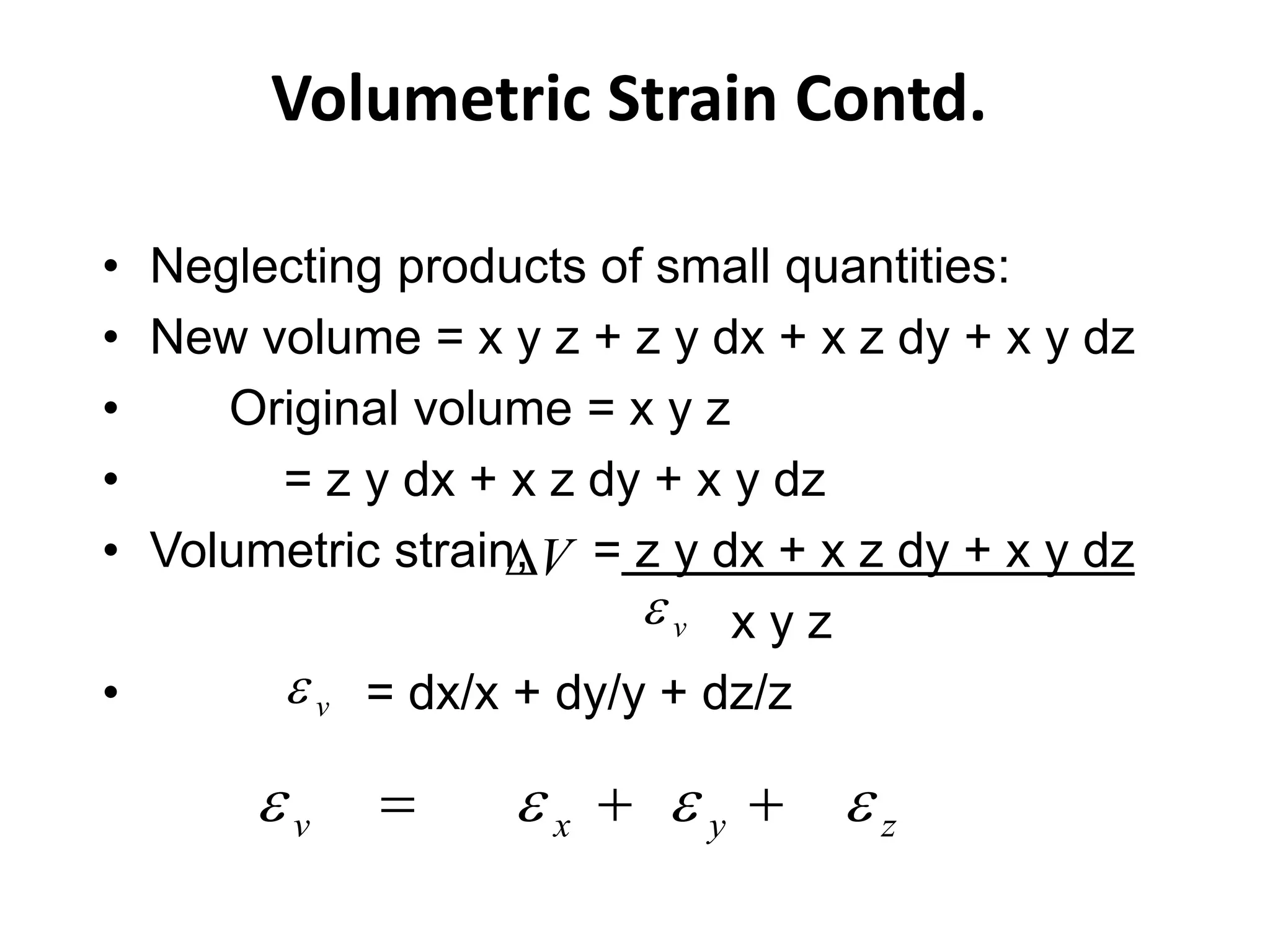
• Neglecting products of small quantities:
• New volume = x y z + z y dx + x z dy + x y dz
• Original volume = x y z
• = z y dx + x z dy + x y dz
• Volumetric strain, = z y dx + x z dy + x y dz
x y z
• = dx/x + dy/y + dz/z
V
 v
 v
   v x y z  
Elasticity and Hooke’s Law
• All solid materials deform when they are
stressed, and as stress is increased,
deformation also increases.
• If a material returns to its original size and
shape on removal of load causing
deformation, it is said to be elastic.
• If the stress is steadily increased, a point is
reached when, after the removal of load, not
all the induced strain is removed.
• This is called the elastic limit.
Hooke’s Law
• States that providing the limit of proportionality of
a material is not exceeded, the stress is directly
proportional to the strain produced.
• If a graph of stress and strain is plotted as load is
gradually applied, the first portion of the graph will
be a straight line.
• The slope of this line is the constant of
proportionality called modulus of Elasticity, E or
Young’s Modulus.
• It is a measure of the stiffness of a material.
Hooke’s Law
• States that providing the limit of proportionality of
a material is not exceeded, the stress is directly
proportional to the strain produced.
• If a graph of stress and strain is plotted as load is
gradually applied, the first portion of the graph will
be a straight line.
• The slope of this line is the constant of
proportionality called modulus of Elasticity, E or
Young’s Modulus.
• It is a measure of the stiffness of a material.
Hooke’s Law
Modulus of Elasticity, E =
Direct stress
Direct strain



Also: For Shear stress: Modulus of rigidity or shear modulus, G =
Shear stress
Shear strain



Also: Volumetric strain, is proportional to hydrostatic stress, within the
elastic range
i.e. : called bulk modulus.
 v

 / v K
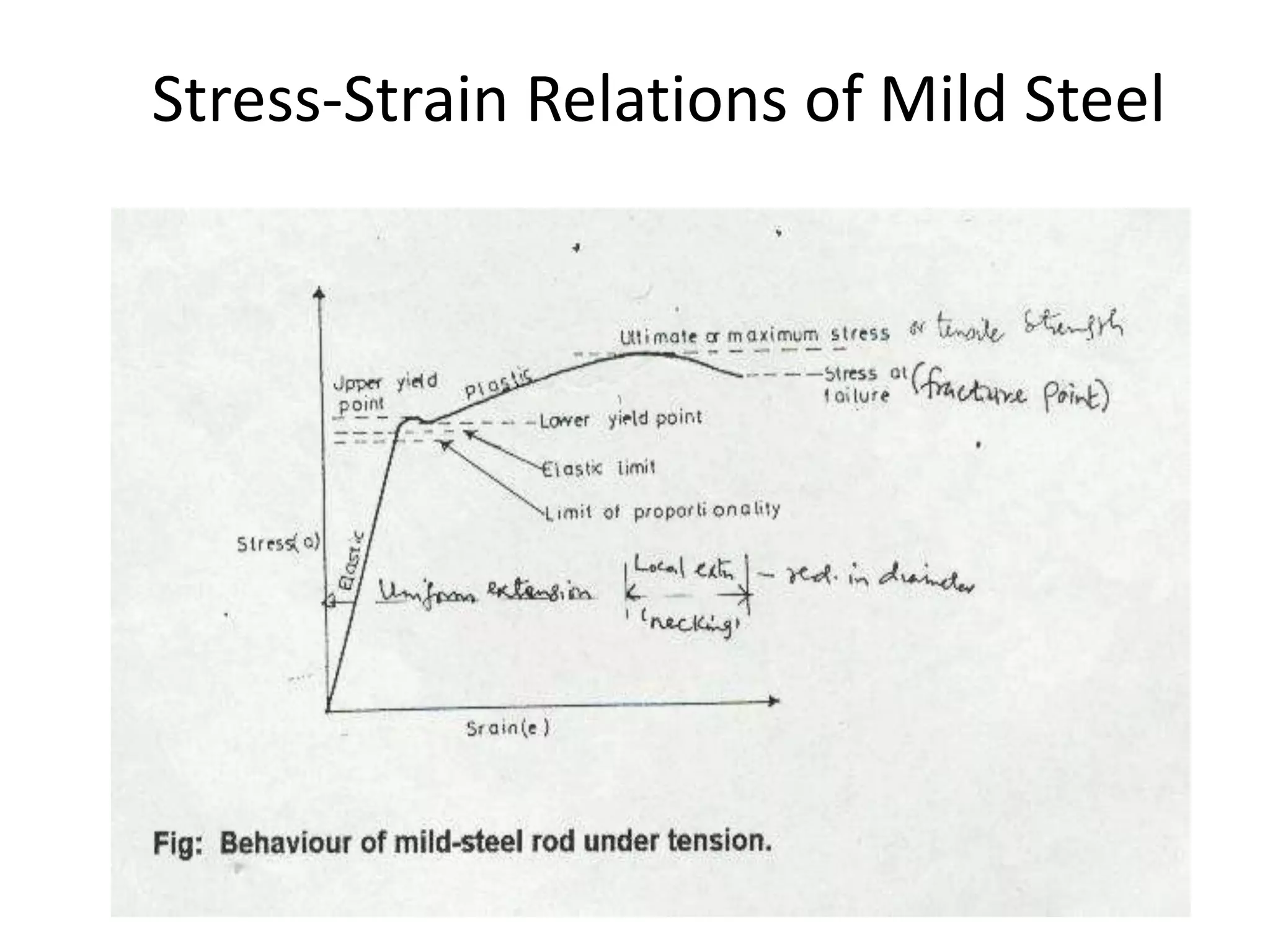
Stress-Strain Relations of Mild Steel
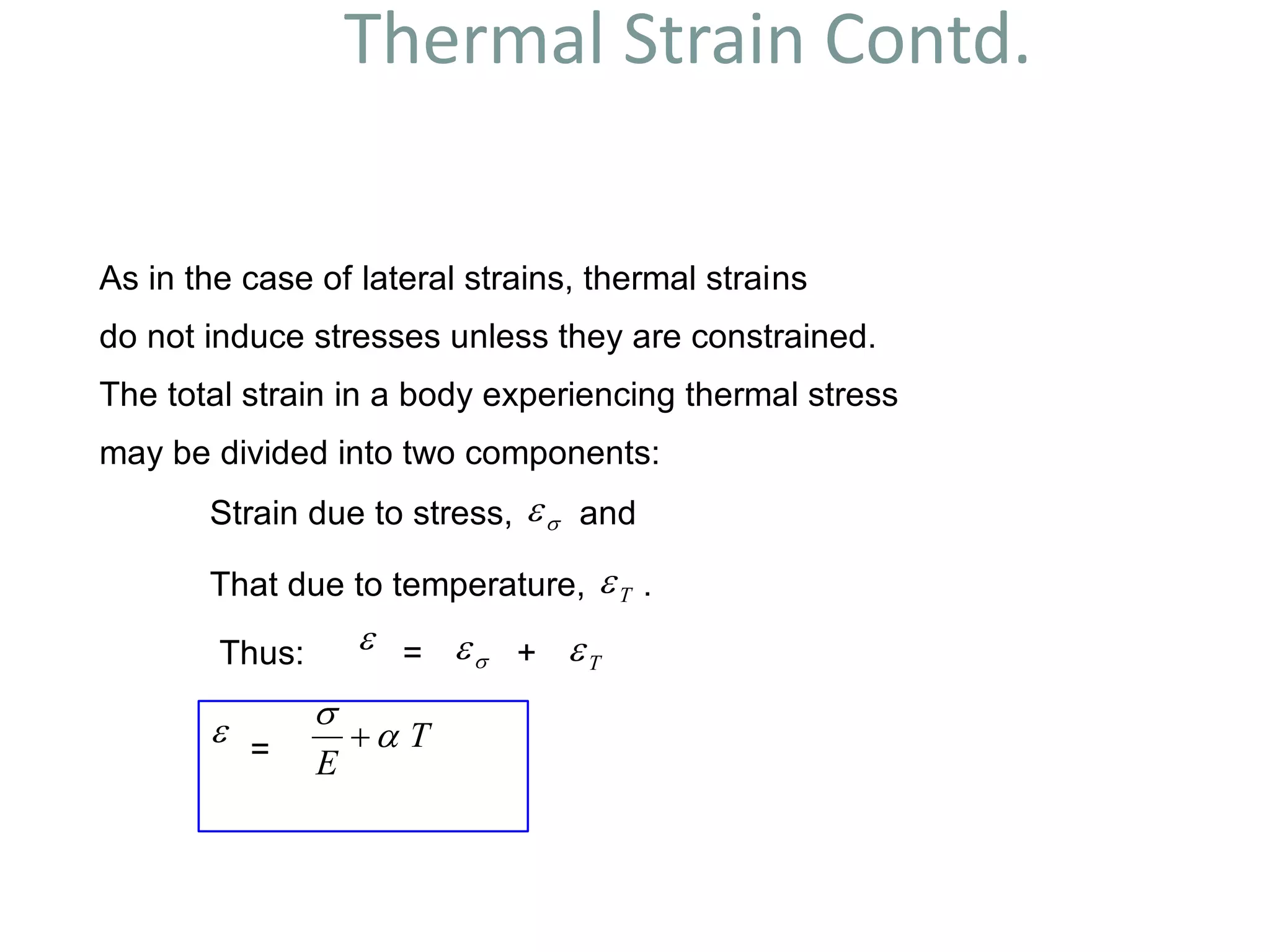
Thermal Strain Contd.
As in the case of lateral strains, thermal strains
do not induce stresses unless they are constrained.
The total strain in a body experiencing thermal stress
may be divided into two components:
Strain due to stress,  and
That due to temperature, T .
Thus:  =  + T
 =


E
T
Relationship between Elastic Modulus (E) and Bulk Modulus, K
It has been shown that :    v x y z  
    
   
   


 


   










x x y z
x y z
x
y z
v x y z
v
v
v
E
For hydrostatic stress
i e
E E
Similarly and are each
E
Volumetric strain
E
E
Bulk Modulus K
Volumetric or hydrostatic stress
Volumetric strain
i e E K and K
E
  
  
   

   
 
 
 
  

1
1
2 1 2
1 2
3
1 2
3
1 2
3 1 2
3 1 2
( )
,
. .
,
,
. .
Compound Bars
A compound bar is one comprising two or more parallel elements, of different materials,
which are fixed together at their end. The compound bar may be loaded in tension or
compression.
1 2
F F
2
Section through a typical compound bar consisting of a circular bar (1) surrounded by a
tube (2)
Temperature stresses in compound bars
1  1
2  2
L
(a) L 1 T
1
L 2 T
2 {b}
FL
A E1 1
F 1 F
F 2 F
(c)
FL
A E2 2
Temperature Stresses Contd.
Free expansions in bars (1) and (2) are L T and L T 1 2 respectively.
Due to end fixing force, F: the decrease in length of bar (1) is
FL
A E1 1
and the increase in length of (2) is
FL
A E2 2
.
At Equilibrium:
L T
FL
A E
L T
FL
A E
i e F
A E A E
T
i e A
A E A E
E E A A
T
T A E E
A E A E
T A E E
A E A E
 
 
  

 

 
1
1 1
2
2 2
1 1 2 2
1 2
1 1
2 2 1 1
1 2 1 2
1 2
1
1 2 2 1 2
1 1 2 2
2
1 2 1 1 2
1 1 2 2
1 1
  
  
L
NM O
QP 






. . [ ] ( )
. . ( )
( )
( )
Note: As a result of Force, F, bar (1) will be in compression while (2) will be in tension.
1 1
2 2
L
(a) L1 T
1
L2 T
2 {b}
FL
A E1 1
F 1 F
F 2 F
(c)
FL
A E2 2

Som ppt

  • 1.
  • 2.
    DIRECT OR NORMALSTRESS  When a force is transmitted through a body, the body tends to change its shape or deform. The body is said to be strained.  Direct Stress = Applied Force (F) Cross Sectional Area (A)  Units: Usually N/m2 (Pa), N/mm2, MN/m2, GN/m2 or N/cm2  Note: 1 N/mm2 = 1 MN/m2 = 1 MPa
  • 3.
    Direct Stress Contd. •Direct stress may be tensile or compressive and result from forces acting perpendicular to the plane of the cross-section   Tension Compression
  • 4.
    Direct or NormalStrain • When loads are applied to a body, some deformation will occur resulting to a change in dimension. • Consider a bar, subjected to axial tensile loading force, F. If the bar extension is dl and its original length (before loading) is L, then tensile strain is: dl FF L   Direct Strain ( ) = Change in Length Original Length i.e. = dl/L
  • 5.
    Direct or NormalStrain Contd. • As strain is a ratio of lengths, it is dimensionless. • Similarly, for compression by amount, dl: Compressive strain = - dl/L • Note: Strain is positive for an increase in dimension and negative for a reduction in dimension.
  • 6.
    Shear Stress andShear Strain • Shear stresses are produced by equal and opposite parallel forces not in line. • The forces tend to make one part of the material slide over the other part. • Shear stress is tangential to the area over which it acts.
  • 7.
    Ultimate Strength The strengthof a material is a measure of the stress that it can take when in use. The ultimate strength is the measured stress at failure but this is not normally used for design because safety factors are required. The normal way to define a safety factor is : stressePermissibl stressUltimate loadedwhenstress failureatstress =factorsafety 
  • 8.
    Strain We must alsodefine strain. In engineering this is not a measure of force but is a measure of the deformation produced by the influence of stress. For tensile and compressive loads: Strain is dimensionless, i.e. it is not measured in metres, killogrammes etc. For shear loads the strain is defined as the angle  This is measured in radians strain = increase in length x original length L  shear strain shear displacement x width L  
  • 9.
    Shear stress andstrain Shear force Shear Force Area resisting shear Shear displacement (x) Shear strain is angle L
  • 10.
    Shear Stress andShear Strain Contd. P Q S R F D D’ A B C C’ L x  Shear strain is the distortion produced by shear stress on an element or rectangular block as above. The shear strain, (gamma) is given as: = x/L = tan  
  • 11.
    Shear Stress andShear Strain Concluded • For small , • Shear strain then becomes the change in the right angle. • It is dimensionless and is measured in radians.   
  • 12.
    Elastic and Plasticdeformation Stress Strain Stress Strain Permanent Deformation Elastic deformation Plastic deformation
  • 13.
    Modulus of Elasticity Ifthe strain is "elastic" Hooke's law may be used to define Young's modulus is also called the modulus of elasticity or stiffness and is a measure of how much strain occurs due to a given stress. Because strain is dimensionless Young's modulus has the units of stress or pressure A L x W = Strain Stress =EModulusYoungs 
  • 14.
    How to calculatedeflection if the proof stress is applied and then partially removed. Yield 0.2% proof stress Stress Strain0.2% Plastic Failure s 0.002 s/E If a sample is loaded up to the 0.2% proof stress and then unloaded to a stress s the strain x = 0.2% + s/E where E is the Young’s modulus
  • 15.
    Volumetric Strain • Hydrostaticstress refers to tensile or compressive stress in all dimensions within or external to a body. • Hydrostatic stress results in change in volume of the material. • Consider a cube with sides x, y, z. Let dx, dy, and dz represent increase in length in all directions. • i.e. new volume = (x + dx) (y + dy) (z + dz)
  • 16.
    Volumetric Strain Contd. •Neglecting products of small quantities: • New volume = x y z + z y dx + x z dy + x y dz • Original volume = x y z • = z y dx + x z dy + x y dz • Volumetric strain, = z y dx + x z dy + x y dz x y z • = dx/x + dy/y + dz/z V  v  v    v x y z  
  • 17.
    Elasticity and Hooke’sLaw • All solid materials deform when they are stressed, and as stress is increased, deformation also increases. • If a material returns to its original size and shape on removal of load causing deformation, it is said to be elastic. • If the stress is steadily increased, a point is reached when, after the removal of load, not all the induced strain is removed. • This is called the elastic limit.
  • 18.
    Hooke’s Law • Statesthat providing the limit of proportionality of a material is not exceeded, the stress is directly proportional to the strain produced. • If a graph of stress and strain is plotted as load is gradually applied, the first portion of the graph will be a straight line. • The slope of this line is the constant of proportionality called modulus of Elasticity, E or Young’s Modulus. • It is a measure of the stiffness of a material.
  • 19.
    Hooke’s Law • Statesthat providing the limit of proportionality of a material is not exceeded, the stress is directly proportional to the strain produced. • If a graph of stress and strain is plotted as load is gradually applied, the first portion of the graph will be a straight line. • The slope of this line is the constant of proportionality called modulus of Elasticity, E or Young’s Modulus. • It is a measure of the stiffness of a material.
  • 20.
    Hooke’s Law Modulus ofElasticity, E = Direct stress Direct strain    Also: For Shear stress: Modulus of rigidity or shear modulus, G = Shear stress Shear strain    Also: Volumetric strain, is proportional to hydrostatic stress, within the elastic range i.e. : called bulk modulus.  v   / v K
  • 21.
  • 22.
    Thermal Strain Contd. Asin the case of lateral strains, thermal strains do not induce stresses unless they are constrained. The total strain in a body experiencing thermal stress may be divided into two components: Strain due to stress,  and That due to temperature, T . Thus:  =  + T  =   E T
  • 23.
    Relationship between ElasticModulus (E) and Bulk Modulus, K It has been shown that :    v x y z                                    x x y z x y z x y z v x y z v v v E For hydrostatic stress i e E E Similarly and are each E Volumetric strain E E Bulk Modulus K Volumetric or hydrostatic stress Volumetric strain i e E K and K E                          1 1 2 1 2 1 2 3 1 2 3 1 2 3 1 2 3 1 2 ( ) , . . , , . .
  • 24.
    Compound Bars A compoundbar is one comprising two or more parallel elements, of different materials, which are fixed together at their end. The compound bar may be loaded in tension or compression. 1 2 F F 2 Section through a typical compound bar consisting of a circular bar (1) surrounded by a tube (2)
  • 25.
    Temperature stresses incompound bars 1  1 2  2 L (a) L 1 T 1 L 2 T 2 {b} FL A E1 1 F 1 F F 2 F (c) FL A E2 2
  • 26.
    Temperature Stresses Contd. Freeexpansions in bars (1) and (2) are L T and L T 1 2 respectively. Due to end fixing force, F: the decrease in length of bar (1) is FL A E1 1 and the increase in length of (2) is FL A E2 2 . At Equilibrium: L T FL A E L T FL A E i e F A E A E T i e A A E A E E E A A T T A E E A E A E T A E E A E A E              1 1 1 2 2 2 1 1 2 2 1 2 1 1 2 2 1 1 1 2 1 2 1 2 1 1 2 2 1 2 1 1 2 2 2 1 2 1 1 2 1 1 2 2 1 1       L NM O QP        . . [ ] ( ) . . ( ) ( ) ( ) Note: As a result of Force, F, bar (1) will be in compression while (2) will be in tension. 1 1 2 2 L (a) L1 T 1 L2 T 2 {b} FL A E1 1 F 1 F F 2 F (c) FL A E2 2