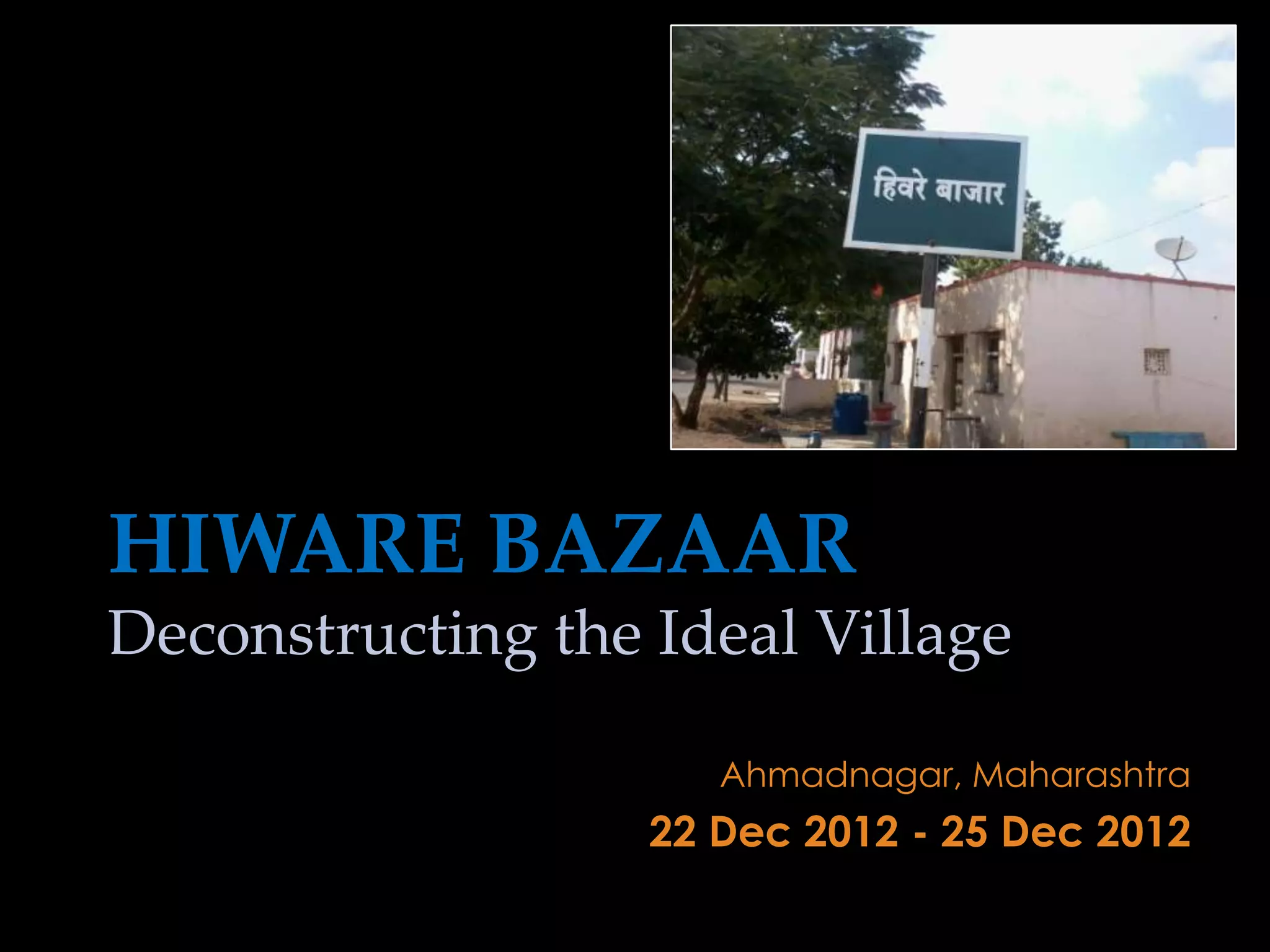
HIWARE BAZAAR
Deconstructing the Ideal Village

                      Ahmadnagar, Maharashtra
                   22 Dec 2012 - 25 Dec 2012
Model village of Maharashtra

A self-learning exercise to experience and understand
the reality of this model of development

Methods – participative observation, specific enquiry
based construction of context, village walks, etc.


   All views are mine and any factual errors are unintentional, and entirely my mistake
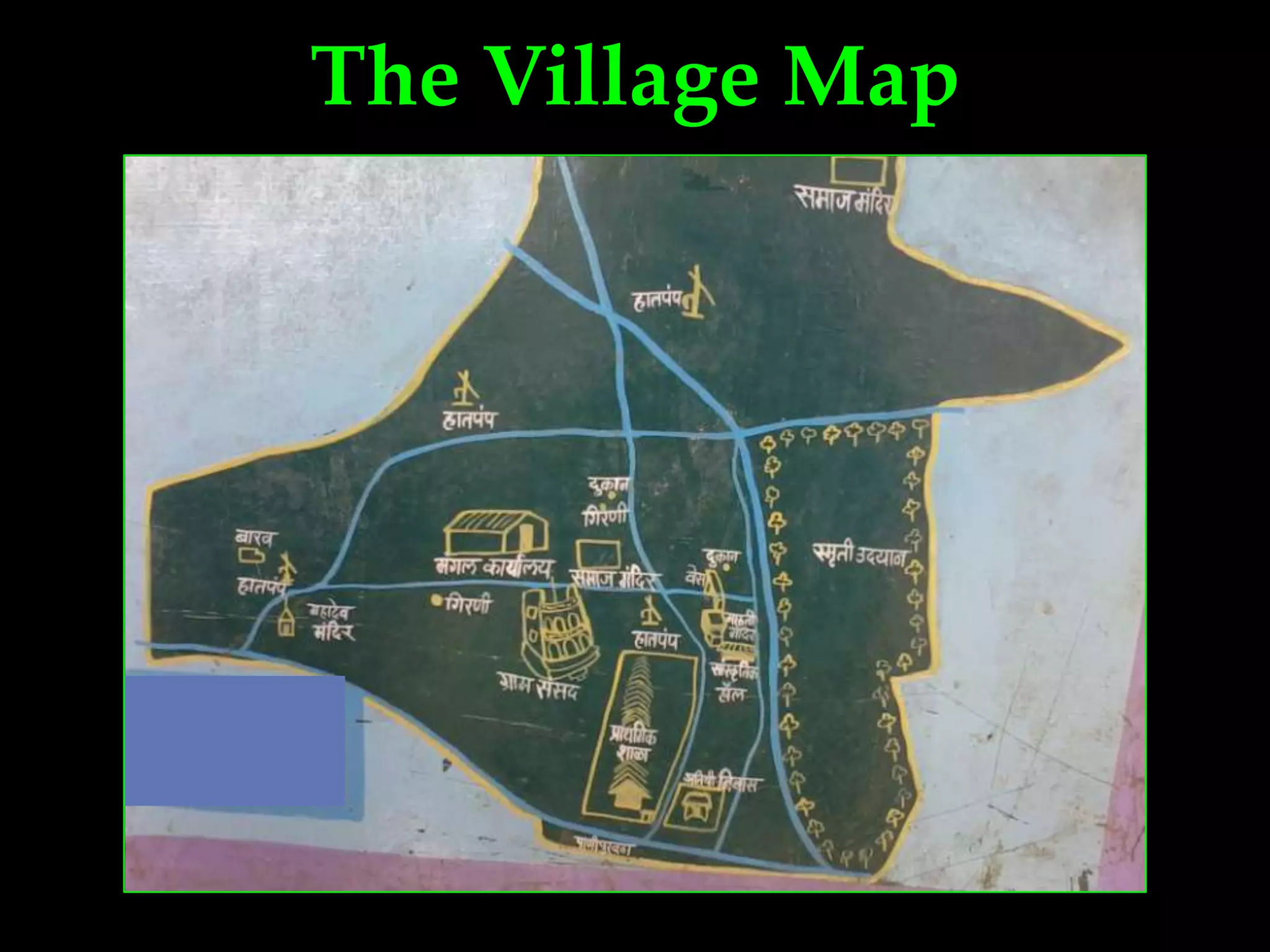
The Village Map
History
•   Migration due to unemployment and livelihood distress

•   Alcoholism and collapse of education and healthcare

•   Faction-ridden society with fights on issues of land
    encroachment, water issues, etc.                      Conversation with people
                                                          of the neighbouring
•   Lack of solidarity and respect                        villages reveal that they
                                                          are envious and proud of
                                                          Hiware Bazaar and
Geography                                                 identify these things as
                                                          the stumbling blocks in
                                                          their path of progress
•   Around 1000 hectares at the foothills of Sahyadris

•   Total rainfall 199 mm (2011-12), Water scarce region,
    Ground water exploitation

•   Agriculture rain fed

•   Limited water retention- (a) Geological structure does not
    allow for water permeability (b) Degradation of forests
The State Of Affairs NOW

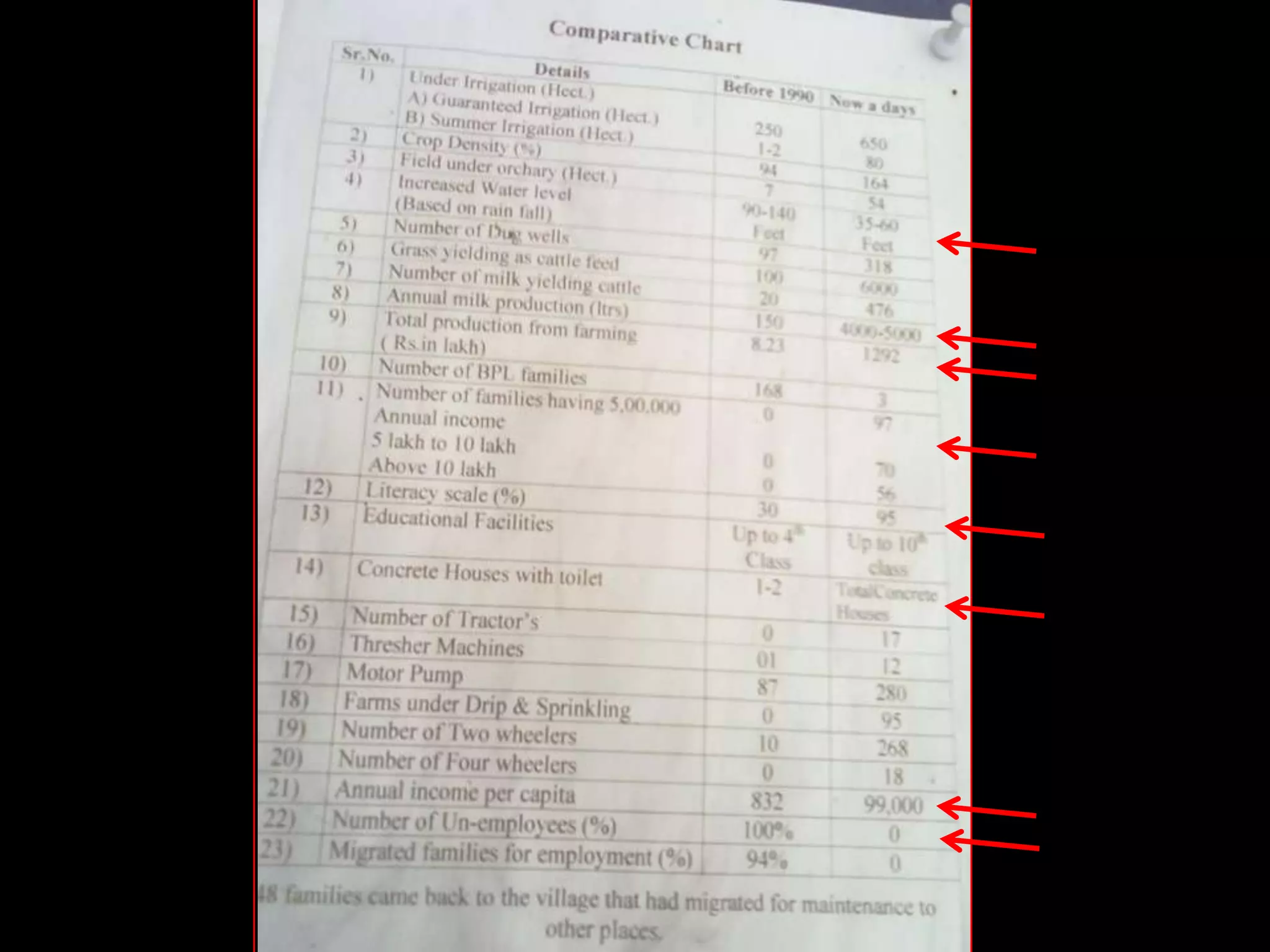
•   Full access to safe drinking water, sanitation, very high literacy, school
    education upto X std.

•   Increase in irrigated area + ground water

•   Sustainable prosperous agriculture + Dairy economy very prosperous
    due to high quality of grass


•   Effective public institutions, high physical development, participatory
    governance and prosperous.
The Transition To Progress…
Governance


•   Experiential Learning: Initially a demonstration was carried out to the villages
    about the failed projects in neighbouring villages about the mis-management of
    resources
•   Gram Sabha: meetings every month at least, and more on need-basis, all voices
    are duly regarded, not a noble dictator; as told by the Sarpanch to us- a simple
    majority is not used; until a vast majority, esp. the parties involved agree, the
    proposed initiative is not taken up - Eg. the land re-measurement task was
    pending from 1997-2004 due to enormous resistance.
•   People power: The people prioritise their development projects, contribute free
    labour through shramdaan and manage essential natural resources through
    enforcement of norms

•   Transparency & Accountability– expenditure statements accessible to all- was
    brought about to convince the doubters.
Resource Use Management


•   Awareness generation about soil and water conservation
•   Ban on private bore wells (except two for drinking water), community hand
    pumps installed at several places. Open wells used for water access
•   Ban on water-intensive crops like sugarcane and banana. Half acre
    sugarcane permitted for fodder purpose, but only through usage of drip
    irrigation
•   Measurement of groundwater levels by school children

•   Collection and Management of a monthly water tax – Rs 60/month (2012)- on
    individual connections

•   Committees to monitor forest conservation, cleanliness, wildlife protection

•   Decisions on crop planning and water budgeting taken in Gram Sansad
    meetings

     o Based on the rainfall in a given year, the village decides for using kharif,
        rabi or summer crops.

     o Drip Irrigation is encouraged
•   Mostly bio-gas used, Chulhas less used to preserve biomass, LPGs not as
    prevalent, but exists.

•   Some decisions were enforced in a staggered manner to not affect the poor

     o Tree cutting ban incrementally increased starting from forest land.

          • An instance of gaming the system- People started misusing the
            temporary stay on Babul tree cutting. Many were cut as a result. A Pune-
            based consultant was hired and the trees were injected at the
            root, giving more gum resin output. This is how trees were saved.

     o Grazing restrictions also incremental in nature.

          • Open grazing in rotational basis

          • One head load of grass a day from common lands for Rs. 100 per year.
            Fee exempt for poor/landless families, cut through sickle to preserve
            roots.
Watershed Development Initiative
Before the watershed development, rainwater was flowing without percolation and
retention. This was due to no time available for the water to seep into the soil. This process
may be accelerated due to loss of green cover and forest degradation.

The watershed development programme in Hiware Bazaar started in 1992.

The set of measures they undertook were-
•   Reforestation of the hilly forest land
•   Building trenches along contours
•   Shallow dams off stone or cement
•   Aquifer blast - because the run off water was flowing to the neighbouring pond, creating
    cracks for groundwater to flow through

Low earthen barriers and small ponds were constructed for additional surface water storage

Financing was achieved through the various govt schemes
     o Joint Forestry Management Programme with the Forest Dept. on forest land
     o Adarsh Gaon Yojana of the Maharashtra Govt on non-forest land

Yashwant Krishi Gram and Watershed Development Trust –NGOs, managed the money and
offered technical assistance– the Sarpanch being a part of this NGO

Shramdaan provided free labour
Some Misc. Details

Land value increased due to productivity.. Sale of land to outsiders
was banned, and landless were given first priority to purchase land.
Active credit access for land and livestock by the gram sabha and
the sarpanch.

A visit to a particular dalit settlement displayed a good sense of well-
being and belonginess. Seemed contended, secured and well
integrated with the village. Physical development - concrete road,
pakka houses, water, toilets, water tank nearby.

Part of school land was initially a liquor shop. All liquor shops were shut
down. The school building was renovated and expanded through
villagers self contribution, utilising govt funds and through shramdaan.
Farming is a primary occupation. Common crops grown-
Jawar, Corn, Pomogranate, Tomato, Brinjal, Onion, Dhaniya, Sitafal, etc
. Mechanised farming and drip irrigation is also variedly used. With rise
in income due to agricultural prosperity, investment in water storage
and in assets like cattle has increased

Community feeling is a striking feature. Animosities perceived to be
absent during our conversations with numerous individuals with differing
social standing.

A water tank near the Dalit settlements and a mosque for the only
Muslim household are powerful symbols of inclusiveness and integration

Due to better governance and optimal resource use management, all
public institutions like public distribution system, public health care, etc.
seems to be functioning well, much to the satisfaction of the villagers.
Sarpanch’s Crucial Decisions

•   Tapping into govt scheme funds (one of the first being Indira Awaas
    Yojana) through his ‘social-cultural capital’ for sanctioning grants.

•   Primary thrust on education and later water-management (imp
    resource in dryland regions and where agriculture is the mainstay)

•   Participatory governance, uniting community (through fostering of
    values and education), transparency and accountability, following
    norms, Shramdaan.

•   Community driven with active assistance to the poor. Land sale ban
    to outsiders helped in the landless buying land – equitable growth
Luck Factors
•   Less population (around thousand) and a vastly homogeneous
    one – 80% Marathas. Consensus building and decision making for
    resource sharing becomes faster and easier.

•   Far away from a major city. Not counting Ahmednagar. Helps
    reducing aspirations of the city life. Bad transport connectivity.

•   Leadership: Had Popatrao Pawar – an affluent, educated city
    folk who was persuaded to return and lead the panchayat to
    head it and show the future direction. Humble, Dedicated and
    Farsighted guy.

•   Geography: Being near the foothills of the Sahaydris, easier to
    trace water flowing patterns, thus watershed programme was
    slightly easier to implement
Future Prospects
• Agricultural prosperity is unlikely to let the villagers shift
  occupations.

• Preservation   of   norms   and   commons    is   a   continuous
  challenge

• Urbanised, mechanised aspirational city life in the nearby may
  bring about changes

• Although all efforts are community driven, it binds only at the
  face of a respected leadership. Leadership transition may
  have profound unintended changes.
What Hiware Bazaar SHOULD BE PROUD OF?

• Strategic interventions esp. watershed management
  = agriculturally sustainable >> PROSPERITY
• Correspondingly renewal of public institutions +
  participative, accountable governance = IDEAL
  VILLAGE

What Hiware Bazaar SHOULD NOT CONFUSE itself as?

• NOT SELF SUFFICIENT in the fullest sense- either alone,
  or even a part of associated units of villages, towns
  or cities.
• DEPENDENT on other places for all essential,
  manufactured and service goods.
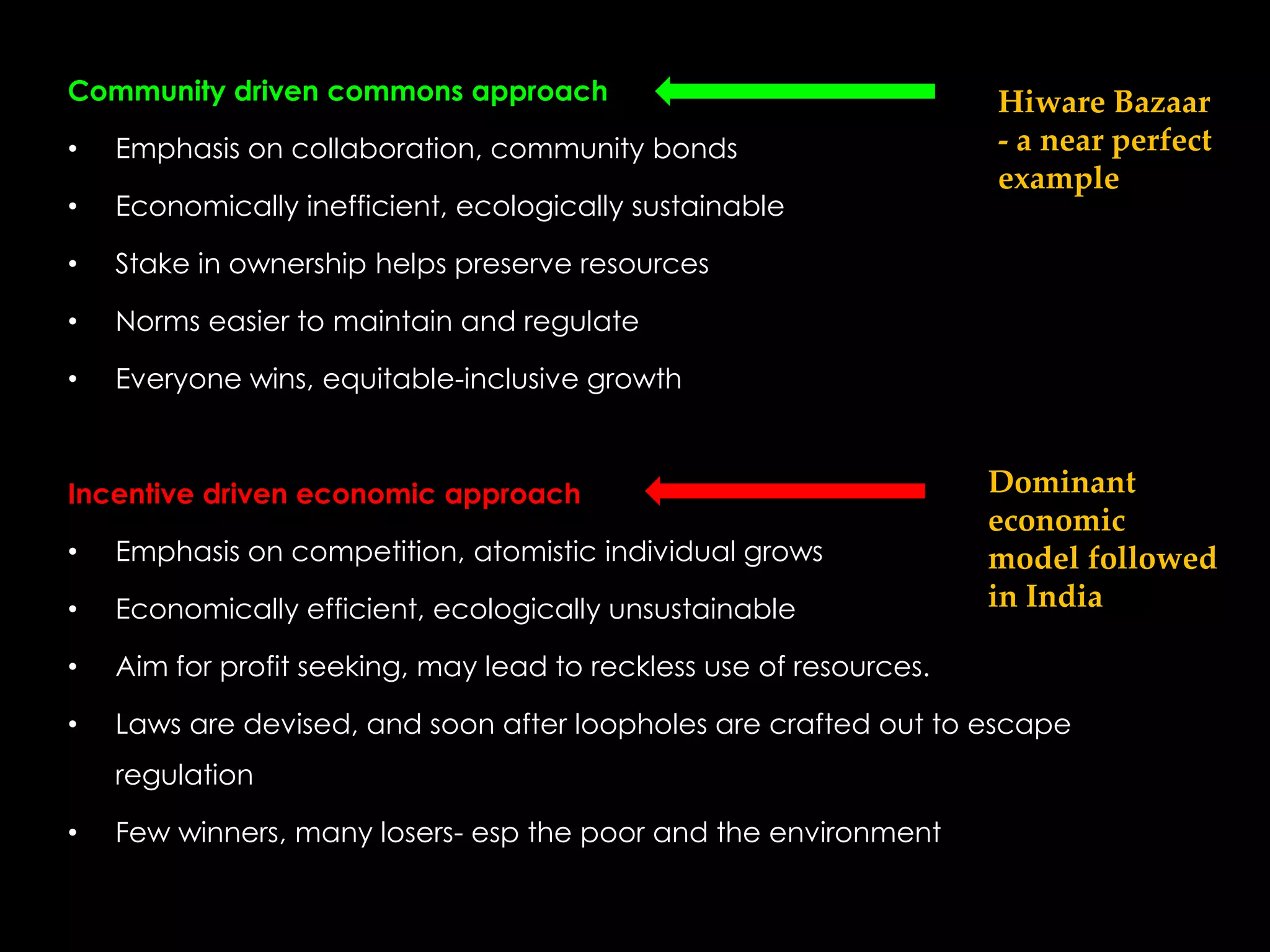
Community driven commons approach                                    Hiware Bazaar
•   Emphasis on collaboration, community bonds                       - a near perfect
                                                                     example
•   Economically inefficient, ecologically sustainable

•   Stake in ownership helps preserve resources

•   Norms easier to maintain and regulate

•   Everyone wins, equitable-inclusive growth


Incentive driven economic approach                                   Dominant
                                                                     economic
•   Emphasis on competition, atomistic individual grows              model followed
•   Economically efficient, ecologically unsustainable               in India

•   Aim for profit seeking, may lead to reckless use of resources.

•   Laws are devised, and soon after loopholes are crafted out to escape
    regulation

•   Few winners, many losers- esp the poor and the environment
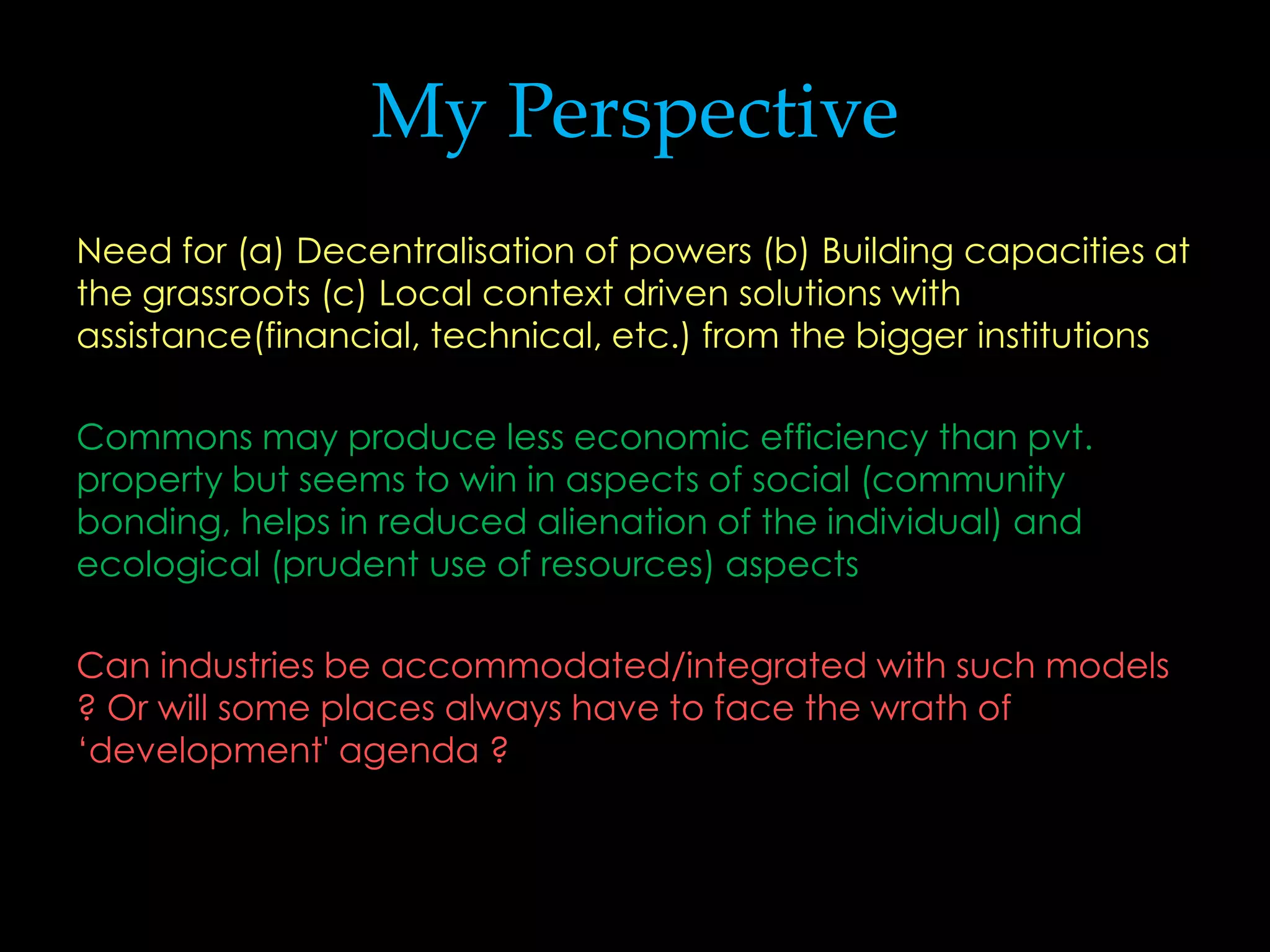
My Perspective
Need for (a) Decentralisation of powers (b) Building capacities at
the grassroots (c) Local context driven solutions with
assistance(financial, technical, etc.) from the bigger institutions

Commons may produce less economic efficiency than pvt.
property but seems to win in aspects of social (community
bonding, helps in reduced alienation of the individual) and
ecological (prudent use of resources) aspects

Can industries be accommodated/integrated with such models
? Or will some places always have to face the wrath of
‘development' agenda ?

Hiware Bazaar

  • 1.
    HIWARE BAZAAR Deconstructing theIdeal Village Ahmadnagar, Maharashtra 22 Dec 2012 - 25 Dec 2012
  • 2.
    Model village ofMaharashtra A self-learning exercise to experience and understand the reality of this model of development Methods – participative observation, specific enquiry based construction of context, village walks, etc. All views are mine and any factual errors are unintentional, and entirely my mistake
  • 3.
  • 4.
    History • Migration due to unemployment and livelihood distress • Alcoholism and collapse of education and healthcare • Faction-ridden society with fights on issues of land encroachment, water issues, etc. Conversation with people of the neighbouring • Lack of solidarity and respect villages reveal that they are envious and proud of Hiware Bazaar and Geography identify these things as the stumbling blocks in their path of progress • Around 1000 hectares at the foothills of Sahyadris • Total rainfall 199 mm (2011-12), Water scarce region, Ground water exploitation • Agriculture rain fed • Limited water retention- (a) Geological structure does not allow for water permeability (b) Degradation of forests
  • 5.
    The State OfAffairs NOW • Full access to safe drinking water, sanitation, very high literacy, school education upto X std. • Increase in irrigated area + ground water • Sustainable prosperous agriculture + Dairy economy very prosperous due to high quality of grass • Effective public institutions, high physical development, participatory governance and prosperous.
  • 7.
    The Transition ToProgress… Governance • Experiential Learning: Initially a demonstration was carried out to the villages about the failed projects in neighbouring villages about the mis-management of resources • Gram Sabha: meetings every month at least, and more on need-basis, all voices are duly regarded, not a noble dictator; as told by the Sarpanch to us- a simple majority is not used; until a vast majority, esp. the parties involved agree, the proposed initiative is not taken up - Eg. the land re-measurement task was pending from 1997-2004 due to enormous resistance. • People power: The people prioritise their development projects, contribute free labour through shramdaan and manage essential natural resources through enforcement of norms • Transparency & Accountability– expenditure statements accessible to all- was brought about to convince the doubters.
  • 8.
    Resource Use Management • Awareness generation about soil and water conservation • Ban on private bore wells (except two for drinking water), community hand pumps installed at several places. Open wells used for water access • Ban on water-intensive crops like sugarcane and banana. Half acre sugarcane permitted for fodder purpose, but only through usage of drip irrigation • Measurement of groundwater levels by school children • Collection and Management of a monthly water tax – Rs 60/month (2012)- on individual connections • Committees to monitor forest conservation, cleanliness, wildlife protection • Decisions on crop planning and water budgeting taken in Gram Sansad meetings o Based on the rainfall in a given year, the village decides for using kharif, rabi or summer crops. o Drip Irrigation is encouraged
  • 9.
    Mostly bio-gas used, Chulhas less used to preserve biomass, LPGs not as prevalent, but exists. • Some decisions were enforced in a staggered manner to not affect the poor o Tree cutting ban incrementally increased starting from forest land. • An instance of gaming the system- People started misusing the temporary stay on Babul tree cutting. Many were cut as a result. A Pune- based consultant was hired and the trees were injected at the root, giving more gum resin output. This is how trees were saved. o Grazing restrictions also incremental in nature. • Open grazing in rotational basis • One head load of grass a day from common lands for Rs. 100 per year. Fee exempt for poor/landless families, cut through sickle to preserve roots.
  • 10.
    Watershed Development Initiative Beforethe watershed development, rainwater was flowing without percolation and retention. This was due to no time available for the water to seep into the soil. This process may be accelerated due to loss of green cover and forest degradation. The watershed development programme in Hiware Bazaar started in 1992. The set of measures they undertook were- • Reforestation of the hilly forest land • Building trenches along contours • Shallow dams off stone or cement • Aquifer blast - because the run off water was flowing to the neighbouring pond, creating cracks for groundwater to flow through Low earthen barriers and small ponds were constructed for additional surface water storage Financing was achieved through the various govt schemes o Joint Forestry Management Programme with the Forest Dept. on forest land o Adarsh Gaon Yojana of the Maharashtra Govt on non-forest land Yashwant Krishi Gram and Watershed Development Trust –NGOs, managed the money and offered technical assistance– the Sarpanch being a part of this NGO Shramdaan provided free labour
  • 11.
    Some Misc. Details Landvalue increased due to productivity.. Sale of land to outsiders was banned, and landless were given first priority to purchase land. Active credit access for land and livestock by the gram sabha and the sarpanch. A visit to a particular dalit settlement displayed a good sense of well- being and belonginess. Seemed contended, secured and well integrated with the village. Physical development - concrete road, pakka houses, water, toilets, water tank nearby. Part of school land was initially a liquor shop. All liquor shops were shut down. The school building was renovated and expanded through villagers self contribution, utilising govt funds and through shramdaan.
  • 12.
    Farming is aprimary occupation. Common crops grown- Jawar, Corn, Pomogranate, Tomato, Brinjal, Onion, Dhaniya, Sitafal, etc . Mechanised farming and drip irrigation is also variedly used. With rise in income due to agricultural prosperity, investment in water storage and in assets like cattle has increased Community feeling is a striking feature. Animosities perceived to be absent during our conversations with numerous individuals with differing social standing. A water tank near the Dalit settlements and a mosque for the only Muslim household are powerful symbols of inclusiveness and integration Due to better governance and optimal resource use management, all public institutions like public distribution system, public health care, etc. seems to be functioning well, much to the satisfaction of the villagers.
  • 13.
    Sarpanch’s Crucial Decisions • Tapping into govt scheme funds (one of the first being Indira Awaas Yojana) through his ‘social-cultural capital’ for sanctioning grants. • Primary thrust on education and later water-management (imp resource in dryland regions and where agriculture is the mainstay) • Participatory governance, uniting community (through fostering of values and education), transparency and accountability, following norms, Shramdaan. • Community driven with active assistance to the poor. Land sale ban to outsiders helped in the landless buying land – equitable growth
  • 14.
    Luck Factors • Less population (around thousand) and a vastly homogeneous one – 80% Marathas. Consensus building and decision making for resource sharing becomes faster and easier. • Far away from a major city. Not counting Ahmednagar. Helps reducing aspirations of the city life. Bad transport connectivity. • Leadership: Had Popatrao Pawar – an affluent, educated city folk who was persuaded to return and lead the panchayat to head it and show the future direction. Humble, Dedicated and Farsighted guy. • Geography: Being near the foothills of the Sahaydris, easier to trace water flowing patterns, thus watershed programme was slightly easier to implement
  • 15.
    Future Prospects • Agriculturalprosperity is unlikely to let the villagers shift occupations. • Preservation of norms and commons is a continuous challenge • Urbanised, mechanised aspirational city life in the nearby may bring about changes • Although all efforts are community driven, it binds only at the face of a respected leadership. Leadership transition may have profound unintended changes.
  • 16.
    What Hiware BazaarSHOULD BE PROUD OF? • Strategic interventions esp. watershed management = agriculturally sustainable >> PROSPERITY • Correspondingly renewal of public institutions + participative, accountable governance = IDEAL VILLAGE What Hiware Bazaar SHOULD NOT CONFUSE itself as? • NOT SELF SUFFICIENT in the fullest sense- either alone, or even a part of associated units of villages, towns or cities. • DEPENDENT on other places for all essential, manufactured and service goods.
  • 17.
    Community driven commonsapproach Hiware Bazaar • Emphasis on collaboration, community bonds - a near perfect example • Economically inefficient, ecologically sustainable • Stake in ownership helps preserve resources • Norms easier to maintain and regulate • Everyone wins, equitable-inclusive growth Incentive driven economic approach Dominant economic • Emphasis on competition, atomistic individual grows model followed • Economically efficient, ecologically unsustainable in India • Aim for profit seeking, may lead to reckless use of resources. • Laws are devised, and soon after loopholes are crafted out to escape regulation • Few winners, many losers- esp the poor and the environment
  • 18.
    My Perspective Need for(a) Decentralisation of powers (b) Building capacities at the grassroots (c) Local context driven solutions with assistance(financial, technical, etc.) from the bigger institutions Commons may produce less economic efficiency than pvt. property but seems to win in aspects of social (community bonding, helps in reduced alienation of the individual) and ecological (prudent use of resources) aspects Can industries be accommodated/integrated with such models ? Or will some places always have to face the wrath of ‘development' agenda ?