Water Management in Developing Country
A Case Study of a Watershed Development Program
                         in
             the State of Bihar, India


  A.N.College,Patna
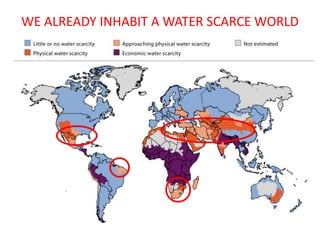
WE ALREADY INHABIT A WATER SCARCE WORLD
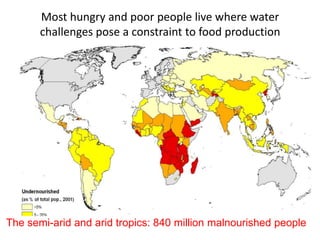
Most hungry and poor people live where water
       challenges pose a constraint to food production


The semi-arid and arid tropics: 840 million malnourished people
Traditional Water Management

  A Practical Solution to Water Scarcity
          Which Works in Bihar
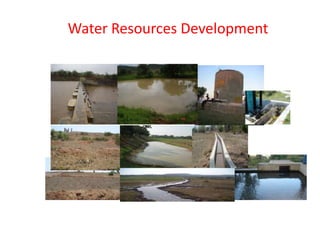
Water Resources Development
Different Approaches
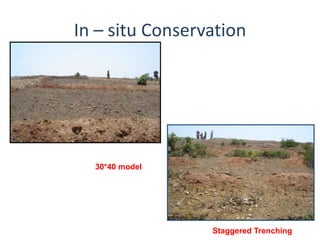
In – situ Conservation


  30*40 model


                 Staggered Trenching
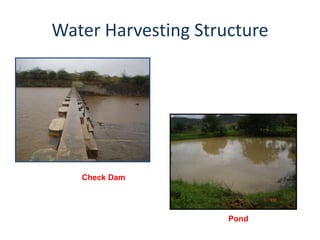
Water Harvesting Structure


   Check Dam


                     Pond
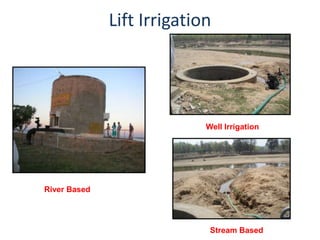
Lift Irrigation


                            Well Irrigation


River Based


                             Stream Based
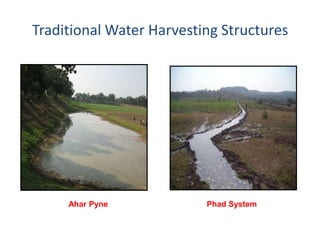
Traditional Water Harvesting Structures


     Ahar Pyne            Phad System
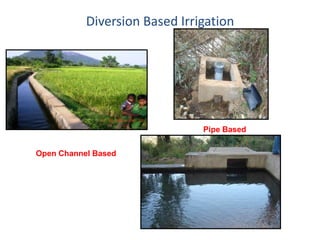
Diversion Based Irrigation


                               Pipe Based


Open Channel Based
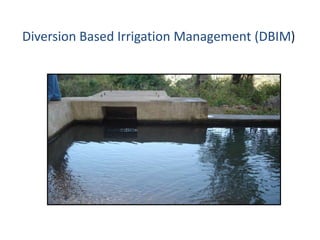
Diversion Based Irrigation Management (DBIM)
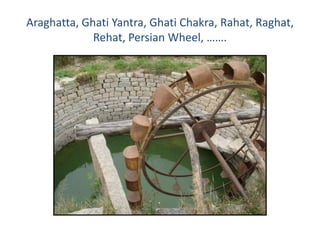
Araghatta, Ghati Yantra, Ghati Chakra, Rahat, Raghat,
             Rehat, Persian Wheel, …….
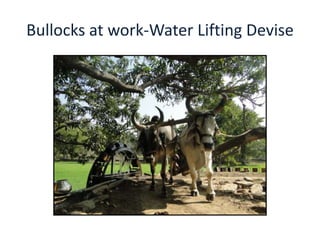
Bullocks at work-Water Lifting Devise
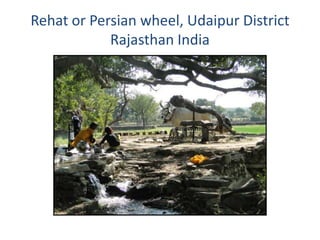
Rehat or Persian wheel, Udaipur District
            Rajasthan India
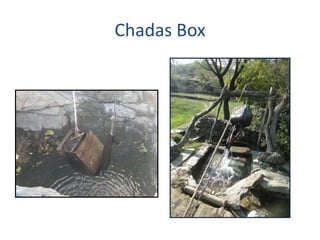
Chadas Box
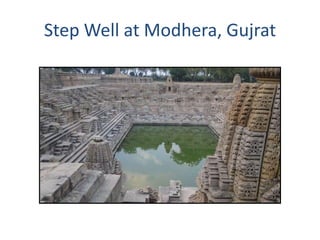
Step Well at Modhera, Gujrat
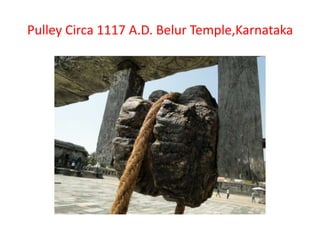
Pulley Circa 1117 A.D. Belur Temple,Karnataka
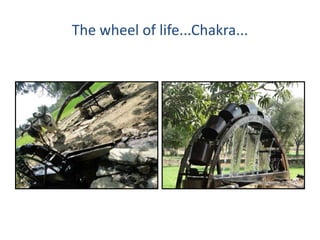
The wheel of life...Chakra...
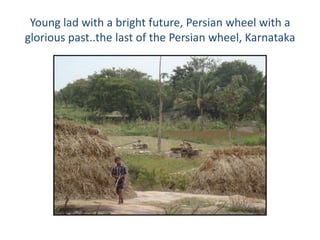
Young lad with a bright future, Persian wheel with a
glorious past..the last of the Persian wheel, Karnataka
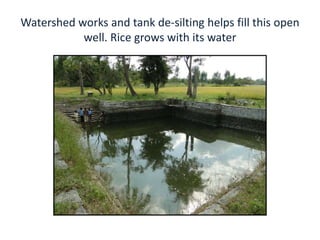
Watershed works and tank de-silting helps fill this open
           well. Rice grows with its water
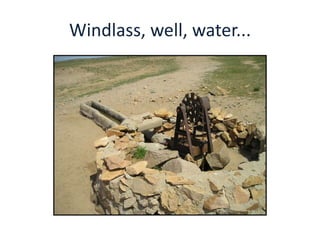
Windlass, well, water...
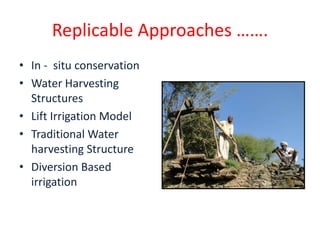
Replicable Approaches …….
• In - situ conservation
• Water Harvesting
  Structures
• Lift Irrigation Model
• Traditional Water
  harvesting Structure
• Diversion Based
  irrigation
OUR WATER MANAGEMENT INITIATIVE AT
    CHANAN (Banka District),BIHAR
Introduction
• The background – lack of
  proper Water Management
  practices in areas of
  moderate rainfall of east-
  central India
• Lack of proper utilization of
  monsoon rainwater – Low
  agricultural productivity –
  subsistence agriculture
  propagating poverty
• Development approaches-
  top-down vs. bottom-up
  approaches
• Growing importance of
  participatory approach in
  developing economies.
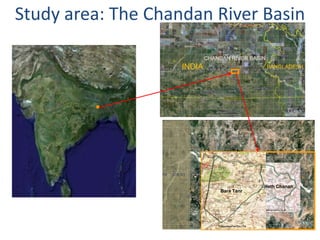
Study area: The Chandan River Basin

                            CHANDAN RIVER BASIN
                    INDIA                         BANGLADESH


                                              Heth Chanan
                                 Bara Tanr
SOCIO-CULTURAL ASPECTS
• The total population is approx. 5250 persons,
  & total no. of households are 920.
• The literacy rate is 28.7%. The female literacy
  rate is only 14%.
• The number of women in the 16-60 years age
  group is 1478.
• Cultural transition required
Economic aspects
• Categorization of the area’s population as
  mainly “below poverty line” (BPL).
• Low agricultural lead and low income
  generation for farmers attributed to uneven
  rainfall distribution, absence of water
  harvesting structures, and soil and water
  conservation methods.
• Out-migration of working male population
  was a serious problem
Integrated Watershed management- a holistic
             development initiative

• A micro-level development initiative was
   launched in Bihar in 2007 through public
   private partnership and participatory
   approach for a sustainable rural economy.
• Positive outcomes within short span of time
 - Sustained Agricultural productivity.
  - Economic diversification following
   agricultural surplus, halting of out migration,
   gender equity.
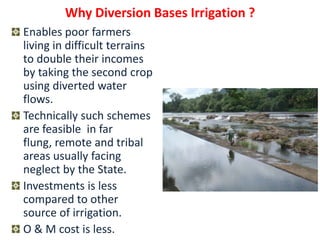
Why Diversion Bases Irrigation ?
Enables poor farmers
living in difficult terrains
to double their incomes
by taking the second crop
using diverted water
flows.
Technically such schemes
are feasible in far
flung, remote and tribal
areas usually facing
neglect by the State.
Investments is less
compared to other
source of irrigation.
O & M cost is less.
Methodology
• Obtaining data on physical and social parameters of the
  study areas
• Inputs from maps , GPS and GIS database- detailed study of
  topographical maps that helped to decide upon soil and
  water conservation methods.
• Interviews with stakeholders to obtain feedback on
  development strategies followed.
• Community organization and participation with stress on
  gender representation.
• EIA study to gauge the sustainability of this project.
• To present a holistic model of rural development in India
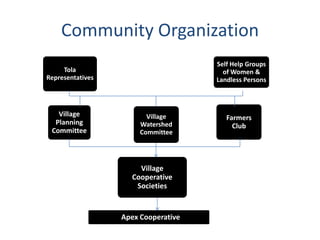
Community Organization
                                     Self Help Groups
     Tola                              of Women &
Representatives                      Landless Persons


   Village               Village        Farmers
  Planning             Watershed          Club
 Committee             Committee


                      Village
                    Cooperative
                     Societies


                  Apex Cooperative
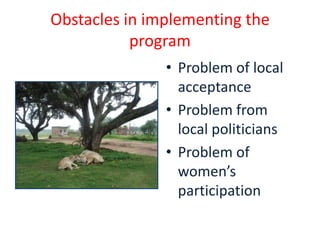
Obstacles in implementing the
           program
               • Problem of local
                 acceptance
               • Problem from
                 local politicians
               • Problem of
                 women’s
                 participation
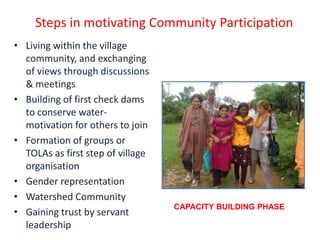
Steps in motivating Community Participation
• Living within the village
  community, and exchanging
  of views through discussions
  & meetings
• Building of first check dams
  to conserve water-
  motivation for others to join
• Formation of groups or
  TOLAs as first step of village
  organisation
• Gender representation
• Watershed Community
                                   CAPACITY BUILDING PHASE
• Gaining trust by servant
  leadership
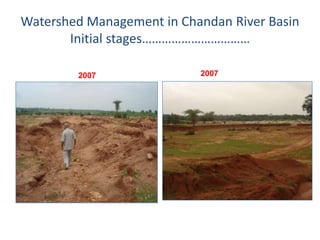
Watershed Management in Chandan River Basin
       Initial stages……………………………

        2007               2007
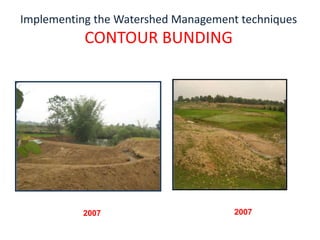
Implementing the Watershed Management techniques
           CONTOUR BUNDING


          2007
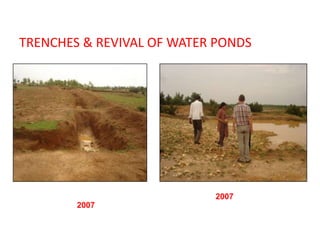
TRENCHES & REVIVAL OF WATER PONDS
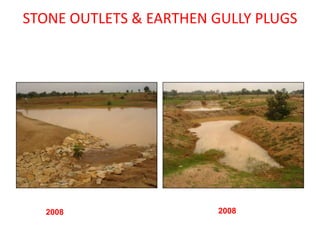
STONE OUTLETS & EARTHEN GULLY PLUGS


  2008
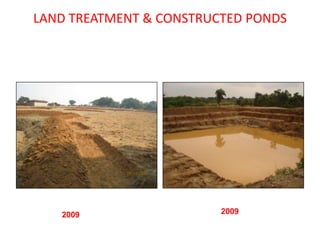
LAND TREATMENT & CONSTRUCTED PONDS


   2009
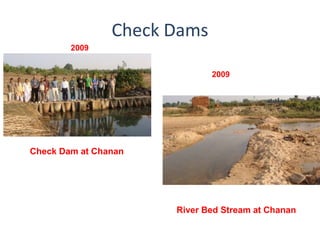
Check Dams


Check Dam at Chanan


                      River Bed Stream at Chanan
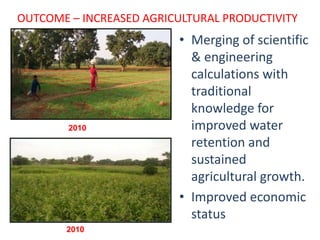
OUTCOME – INCREASED AGRICULTURAL PRODUCTIVITY
                          • Merging of scientific
                            & engineering
                            calculations with
                            traditional
                            knowledge for
                            improved water
                            retention and
                            sustained
                            agricultural growth.
                          • Improved economic
                            status
       2010
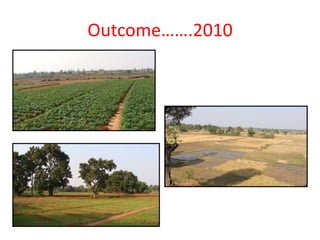
Outcome…….2010
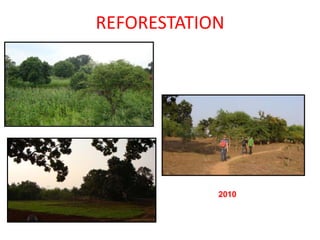
REFORESTATION
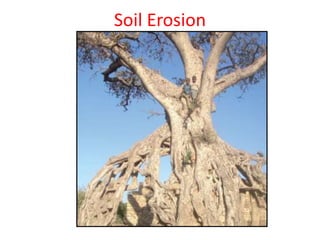
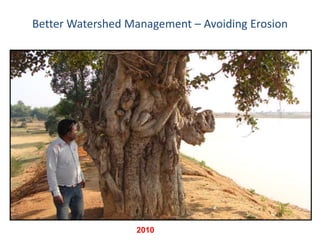
Soil Erosion
Better Watershed Management – Avoiding Erosion


                  2010
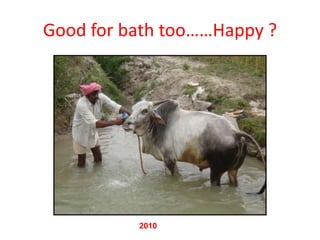
Good for bath too……Happy ?


          2010
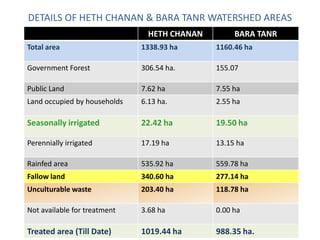
DETAILS OF HETH CHANAN & BARA TANR WATERSHED AREAS
                                HETH CHANAN        BARA TANR
Total area                    1338.93 ha      1160.46 ha

Government Forest             306.54 ha.      155.07

Public Land                   7.62 ha         7.55 ha
Land occupied by households   6.13 ha.        2.55 ha

Seasonally irrigated          22.42 ha        19.50 ha

Perennially irrigated         17.19 ha        13.15 ha

Rainfed area                  535.92 ha       559.78 ha
Fallow land                   340.60 ha       277.14 ha
Unculturable waste            203.40 ha       118.78 ha

Not available for treatment   3.68 ha         0.00 ha

Treated area (Till Date)      1019.44 ha      988.35 ha.
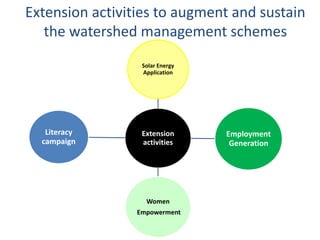
Extension activities to augment and sustain
   the watershed management schemes
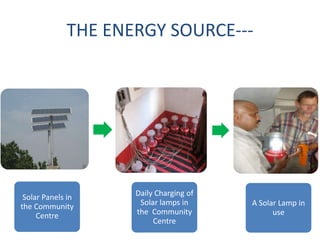
                  Solar Energy
                  Application


   Literacy       Extension      Employment
  campaign        activities      Generation


                   Women
                 Empowerment
THE ENERGY SOURCE---


 Solar Panels in    Daily Charging of
the Community        Solar lamps in     A Solar Lamp in
     Centre         the Community             use
                         Centre
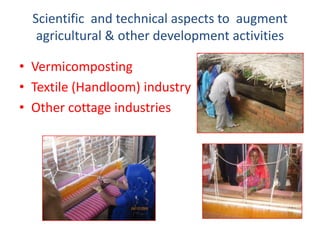
Scientific and technical aspects to augment
   agricultural & other development activities

• Vermicomposting
• Textile (Handloom) industry
• Other cottage industries
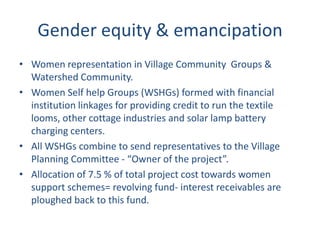
Gender equity & emancipation
• Women representation in Village Community Groups &
  Watershed Community.
• Women Self help Groups (WSHGs) formed with financial
  institution linkages for providing credit to run the textile
  looms, other cottage industries and solar lamp battery
  charging centers.
• All WSHGs combine to send representatives to the Village
  Planning Committee - “Owner of the project”.
• Allocation of 7.5 % of total project cost towards women
  support schemes= revolving fund- interest receivables are
  ploughed back to this fund.
Utilization of Local Inputs
• Traditional knowledge base
• Local resources
• Formation of VWC, VPC & Farmers’ Club for
  transfer of technologies, quality control of
  agro-industrial products, marketing of
  produce and coordination with banks.
• Creation of local demand-supply networks, &
  then linking them with district, state and
  national network.
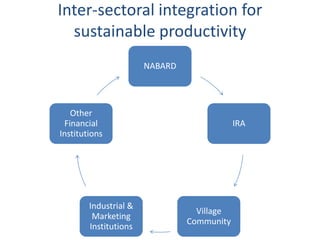
Inter-sectoral integration for
  sustainable productivity
                       NABARD


   Other
 Financial                                  IRA
Institutions


        Industrial &
                                  Village
         Marketing
                                Community
        Institutions
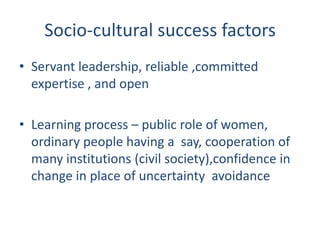
Socio-cultural success factors
• Servant leadership, reliable ,committed
  expertise , and open

• Learning process – public role of women,
  ordinary people having a say, cooperation of
  many institutions (civil society),confidence in
  change in place of uncertainty avoidance
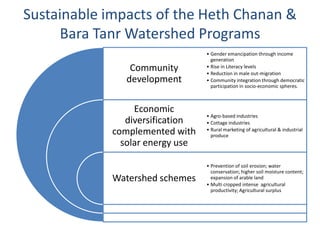
Sustainable impacts of the Heth Chanan &
      Bara Tanr Watershed Programs
                                  • Gender emancipation through income
                                    generation
                 Community        • Rise in Literacy levels
                                  • Reduction in male out-migration
                development       • Community integration through democratic
                                    participation in socio-economic spheres.


                  Economic
                                  • Agro-based industries
                diversification   • Cottage industries
             complemented with    • Rural marketing of agricultural & industrial
                                    produce
               solar energy use

                                  • Prevention of soil erosion; water
                                    conservation; higher soil moisture content;
             Watershed schemes      expansion of arable land
                                  • Multi cropped intense agricultural
                                    productivity; Agricultural surplus
Water is precious – Conserve it
Acknowledgements
National Bank for Agriculture and Development
    (NABARD), Patna Regional Office, India.


 Indian Rural Association (IRA), Banka , Bihar,
                     India.
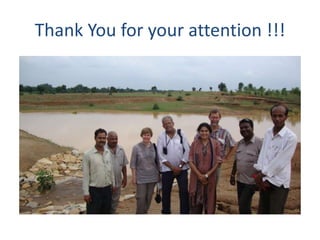
Thank You for your attention !!!

Water management in developing country

  • 1.
    Water Management inDeveloping Country A Case Study of a Watershed Development Program in the State of Bihar, India A.N.College,Patna
  • 2.
    WE ALREADY INHABITA WATER SCARCE WORLD
  • 3.
    Most hungry andpoor people live where water challenges pose a constraint to food production The semi-arid and arid tropics: 840 million malnourished people
  • 4.
    Traditional Water Management A Practical Solution to Water Scarcity Which Works in Bihar
  • 5.
  • 6.
  • 7.
    In – situConservation 30*40 model Staggered Trenching
  • 8.
  • 9.
    Lift Irrigation Well Irrigation River Based Stream Based
  • 10.
    Traditional Water HarvestingStructures Ahar Pyne Phad System
  • 11.
    Diversion Based Irrigation Pipe Based Open Channel Based
  • 12.
    Diversion Based IrrigationManagement (DBIM)
  • 13.
    Araghatta, Ghati Yantra,Ghati Chakra, Rahat, Raghat, Rehat, Persian Wheel, …….
  • 14.
    Bullocks at work-WaterLifting Devise
  • 15.
    Rehat or Persianwheel, Udaipur District Rajasthan India
  • 16.
  • 17.
    Step Well atModhera, Gujrat
  • 18.
    Pulley Circa 1117A.D. Belur Temple,Karnataka
  • 19.
    The wheel oflife...Chakra...
  • 20.
    Young lad witha bright future, Persian wheel with a glorious past..the last of the Persian wheel, Karnataka
  • 21.
    Watershed works andtank de-silting helps fill this open well. Rice grows with its water
  • 22.
  • 23.
    Replicable Approaches ……. •In - situ conservation • Water Harvesting Structures • Lift Irrigation Model • Traditional Water harvesting Structure • Diversion Based irrigation
  • 24.
    OUR WATER MANAGEMENTINITIATIVE AT CHANAN (Banka District),BIHAR
  • 25.
    Introduction • The background– lack of proper Water Management practices in areas of moderate rainfall of east- central India • Lack of proper utilization of monsoon rainwater – Low agricultural productivity – subsistence agriculture propagating poverty • Development approaches- top-down vs. bottom-up approaches • Growing importance of participatory approach in developing economies.
  • 26.
    Study area: TheChandan River Basin CHANDAN RIVER BASIN INDIA BANGLADESH Heth Chanan Bara Tanr
  • 27.
    SOCIO-CULTURAL ASPECTS • Thetotal population is approx. 5250 persons, & total no. of households are 920. • The literacy rate is 28.7%. The female literacy rate is only 14%. • The number of women in the 16-60 years age group is 1478. • Cultural transition required
  • 28.
    Economic aspects • Categorizationof the area’s population as mainly “below poverty line” (BPL). • Low agricultural lead and low income generation for farmers attributed to uneven rainfall distribution, absence of water harvesting structures, and soil and water conservation methods. • Out-migration of working male population was a serious problem
  • 29.
    Integrated Watershed management-a holistic development initiative • A micro-level development initiative was launched in Bihar in 2007 through public private partnership and participatory approach for a sustainable rural economy. • Positive outcomes within short span of time - Sustained Agricultural productivity. - Economic diversification following agricultural surplus, halting of out migration, gender equity.
  • 30.
    Why Diversion BasesIrrigation ? Enables poor farmers living in difficult terrains to double their incomes by taking the second crop using diverted water flows. Technically such schemes are feasible in far flung, remote and tribal areas usually facing neglect by the State. Investments is less compared to other source of irrigation. O & M cost is less.
  • 31.
    Methodology • Obtaining dataon physical and social parameters of the study areas • Inputs from maps , GPS and GIS database- detailed study of topographical maps that helped to decide upon soil and water conservation methods. • Interviews with stakeholders to obtain feedback on development strategies followed. • Community organization and participation with stress on gender representation. • EIA study to gauge the sustainability of this project. • To present a holistic model of rural development in India
  • 32.
    Community Organization Self Help Groups Tola of Women & Representatives Landless Persons Village Village Farmers Planning Watershed Club Committee Committee Village Cooperative Societies Apex Cooperative
  • 33.
    Obstacles in implementingthe program • Problem of local acceptance • Problem from local politicians • Problem of women’s participation
  • 34.
    Steps in motivatingCommunity Participation • Living within the village community, and exchanging of views through discussions & meetings • Building of first check dams to conserve water- motivation for others to join • Formation of groups or TOLAs as first step of village organisation • Gender representation • Watershed Community CAPACITY BUILDING PHASE • Gaining trust by servant leadership
  • 35.
    Watershed Management inChandan River Basin Initial stages…………………………… 2007 2007
  • 36.
    Implementing the WatershedManagement techniques CONTOUR BUNDING 2007
  • 37.
    TRENCHES & REVIVALOF WATER PONDS
  • 38.
    STONE OUTLETS &EARTHEN GULLY PLUGS 2008
  • 39.
    LAND TREATMENT &CONSTRUCTED PONDS 2009
  • 40.
    Check Dams Check Damat Chanan River Bed Stream at Chanan
  • 41.
    OUTCOME – INCREASEDAGRICULTURAL PRODUCTIVITY • Merging of scientific & engineering calculations with traditional knowledge for improved water retention and sustained agricultural growth. • Improved economic status 2010
  • 42.
  • 43.
  • 44.
  • 45.
    Better Watershed Management– Avoiding Erosion 2010
  • 46.
    Good for bathtoo……Happy ? 2010
  • 47.
    DETAILS OF HETHCHANAN & BARA TANR WATERSHED AREAS HETH CHANAN BARA TANR Total area 1338.93 ha 1160.46 ha Government Forest 306.54 ha. 155.07 Public Land 7.62 ha 7.55 ha Land occupied by households 6.13 ha. 2.55 ha Seasonally irrigated 22.42 ha 19.50 ha Perennially irrigated 17.19 ha 13.15 ha Rainfed area 535.92 ha 559.78 ha Fallow land 340.60 ha 277.14 ha Unculturable waste 203.40 ha 118.78 ha Not available for treatment 3.68 ha 0.00 ha Treated area (Till Date) 1019.44 ha 988.35 ha.
  • 48.
    Extension activities toaugment and sustain the watershed management schemes Solar Energy Application Literacy Extension Employment campaign activities Generation Women Empowerment
  • 49.
    THE ENERGY SOURCE--- Solar Panels in Daily Charging of the Community Solar lamps in A Solar Lamp in Centre the Community use Centre
  • 50.
    Scientific and technicalaspects to augment agricultural & other development activities • Vermicomposting • Textile (Handloom) industry • Other cottage industries
  • 51.
    Gender equity &emancipation • Women representation in Village Community Groups & Watershed Community. • Women Self help Groups (WSHGs) formed with financial institution linkages for providing credit to run the textile looms, other cottage industries and solar lamp battery charging centers. • All WSHGs combine to send representatives to the Village Planning Committee - “Owner of the project”. • Allocation of 7.5 % of total project cost towards women support schemes= revolving fund- interest receivables are ploughed back to this fund.
  • 52.
    Utilization of LocalInputs • Traditional knowledge base • Local resources • Formation of VWC, VPC & Farmers’ Club for transfer of technologies, quality control of agro-industrial products, marketing of produce and coordination with banks. • Creation of local demand-supply networks, & then linking them with district, state and national network.
  • 53.
    Inter-sectoral integration for sustainable productivity NABARD Other Financial IRA Institutions Industrial & Village Marketing Community Institutions
  • 54.
    Socio-cultural success factors •Servant leadership, reliable ,committed expertise , and open • Learning process – public role of women, ordinary people having a say, cooperation of many institutions (civil society),confidence in change in place of uncertainty avoidance
  • 55.
    Sustainable impacts ofthe Heth Chanan & Bara Tanr Watershed Programs • Gender emancipation through income generation Community • Rise in Literacy levels • Reduction in male out-migration development • Community integration through democratic participation in socio-economic spheres. Economic • Agro-based industries diversification • Cottage industries complemented with • Rural marketing of agricultural & industrial produce solar energy use • Prevention of soil erosion; water conservation; higher soil moisture content; Watershed schemes expansion of arable land • Multi cropped intense agricultural productivity; Agricultural surplus
  • 56.
    Water is precious– Conserve it
  • 57.
    Acknowledgements National Bank forAgriculture and Development (NABARD), Patna Regional Office, India. Indian Rural Association (IRA), Banka , Bihar, India.
  • 58.
    Thank You foryour attention !!!