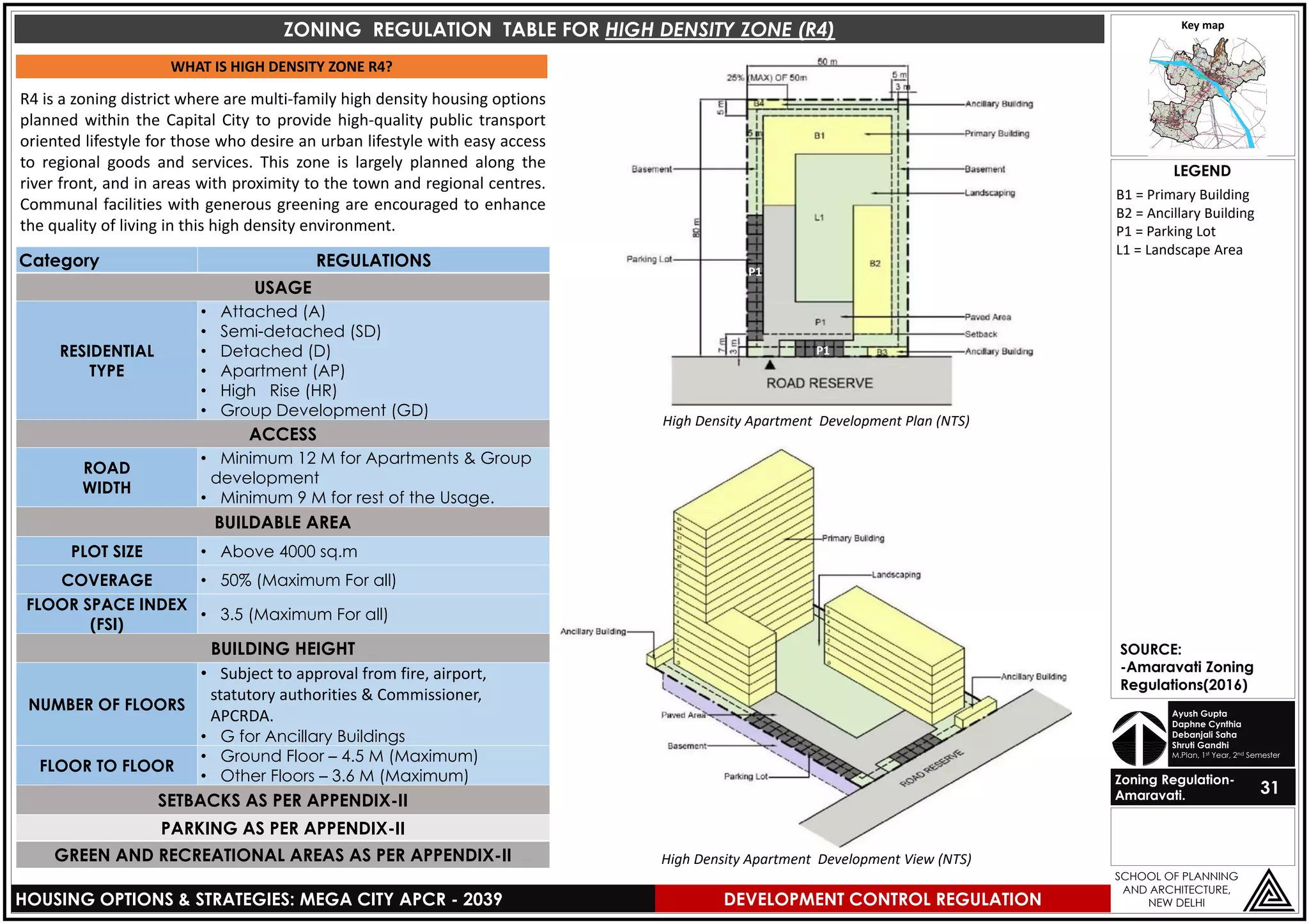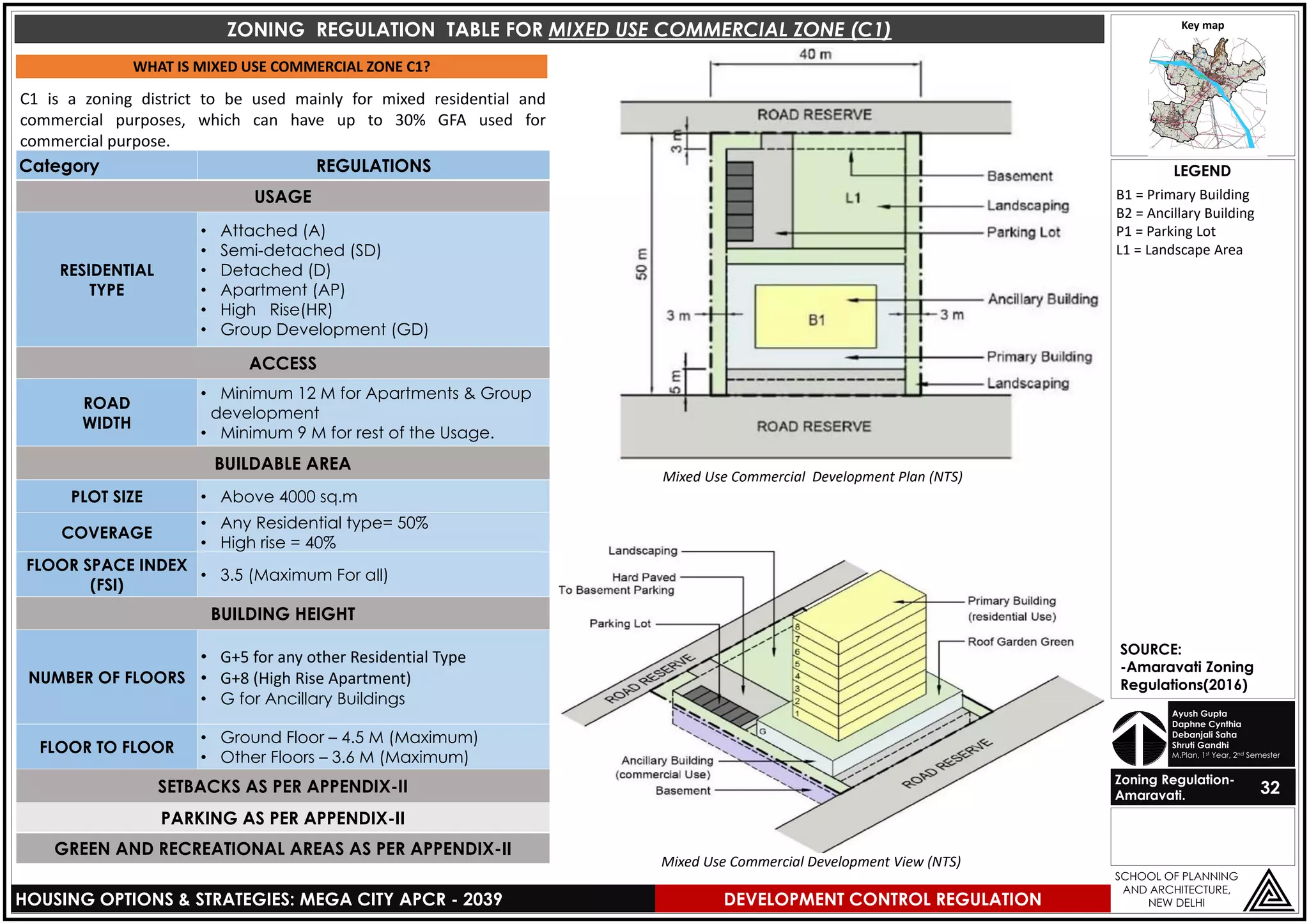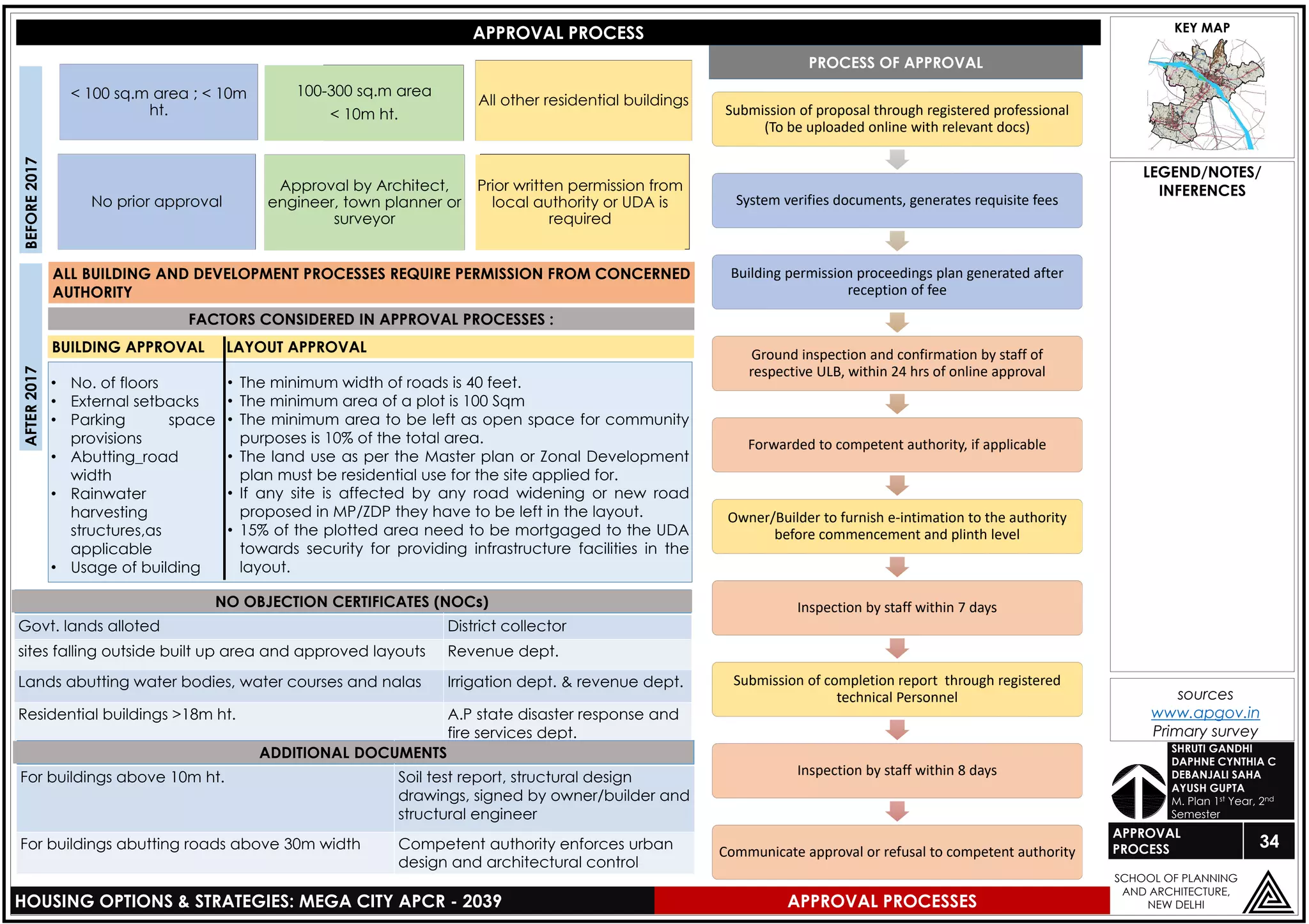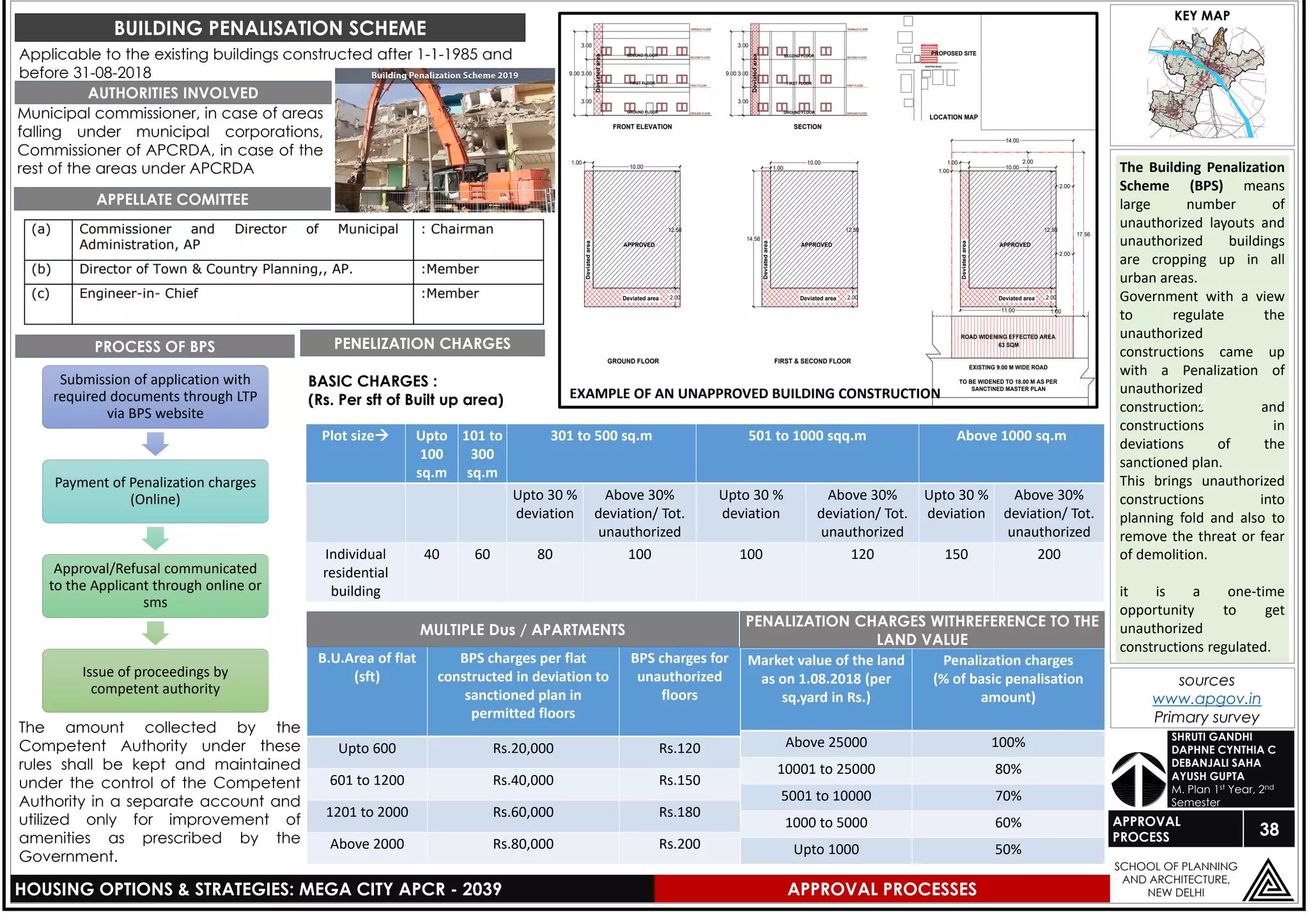
01
LEGEND/NOTES/
INFERENCES
z
HOUSING OPTIONS & STRATEGIES: MEGA CITY APCR - 2039
SCHOOL OF PLANNING
AND ARCHITECTURE,
NEW DELHI
TIMELINE
KEY MAP
DEBANJALI SAHA
AYUSH GUPTA
DAPHNE C
SHRUTI GANDHI
M. Plan 1st Year, 2nd Semester
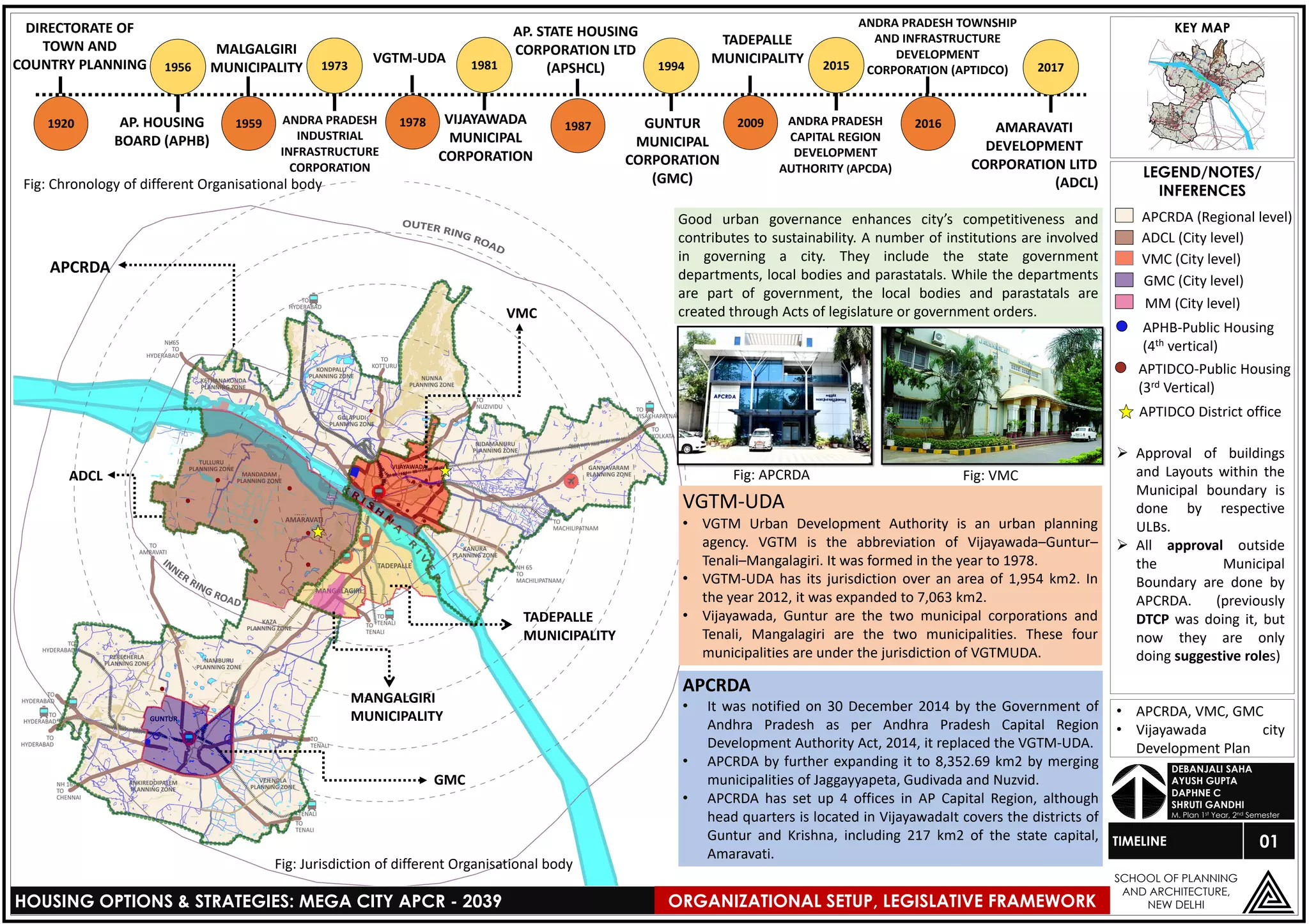
VGTM-UDA
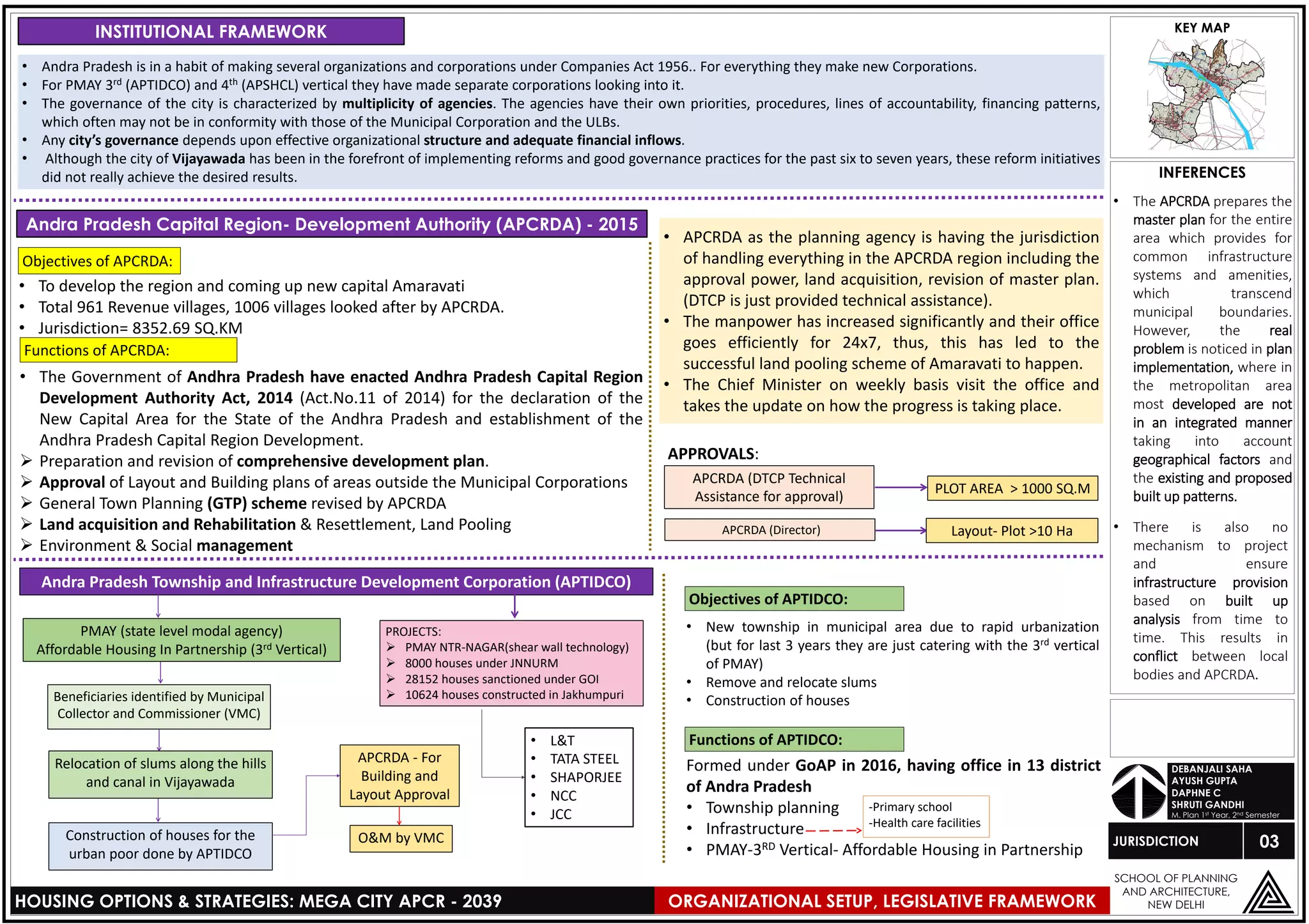
• VGTM Urban Development Authority is an urban planning
agency. VGTM is the abbreviation of Vijayawada–Guntur–
Tenali–Mangalagiri. It was formed in the year to 1978.
• VGTM-UDA has its jurisdiction over an area of 1,954 km2. In
the year 2012, it was expanded to 7,063 km2.
• Vijayawada, Guntur are the two municipal corporations and
Tenali, Mangalagiri are the two municipalities. These four
municipalities are under the jurisdiction of VGTMUDA.
APCRDA
• It was notified on 30 December 2014 by the Government of
Andhra Pradesh as per Andhra Pradesh Capital Region
Development Authority Act, 2014, it replaced the VGTM-UDA.
• APCRDA by further expanding it to 8,352.69 km2 by merging
municipalities of Jaggayyapeta, Gudivada and Nuzvid.
• APCRDA has set up 4 offices in AP Capital Region, although
head quarters is located in VijayawadaIt covers the districts of
Guntur and Krishna, including 217 km2 of the state capital,
Amaravati.
1920 VIJAYAWADA
MUNICIPAL
CORPORATION
GUNTUR
MUNICIPAL
CORPORATION
(GMC)
MALGALGIRI
MUNICIPALITY
TADEPALLE
MUNICIPALITY
1956
1959
1973
1987
1981 2017
2016AP. HOUSING
BOARD (APHB)
AP. STATE HOUSING
CORPORATION LTD
(APSHCL)
DIRECTORATE OF
TOWN AND
COUNTRY PLANNING
ANDRA PRADESH
CAPITAL REGION
DEVELOPMENT
AUTHORITY (APCDA)
ANDRA PRADESH TOWNSHIP
AND INFRASTRUCTURE
DEVELOPMENT
CORPORATION (APTIDCO)
ANDRA PRADESH
INDUSTRIAL
INFRASTRUCTURE
CORPORATION
AMARAVATI
DEVELOPMENT
CORPORATION LITD
(ADCL)
 Approval of buildings
and Layouts within the
Municipal boundary is
done by respective
ULBs.
 All approval outside
the Municipal
Boundary are done by
APCRDA. (previously
DTCP was doing it, but
now they are only
doing suggestive roles)
• APCRDA, VMC, GMC
• Vijayawada city
Development Plan
APCRDA (Regional level)
ADCL (City level)
VMC (City level)
GMC (City level)
MM (City level)
APHB-Public Housing
(4th vertical)
APTIDCO-Public Housing
(3rd Vertical)
Good urban governance enhances city’s competitiveness and
contributes to sustainability. A number of institutions are involved
in governing a city. They include the state government
departments, local bodies and parastatals. While the departments
are part of government, the local bodies and parastatals are
created through Acts of legislature or government orders.
Fig: APCRDA Fig: VMC
ORGANIZATIONAL SETUP, LEGISLATIVE FRAMEWORK
Fig: Jurisdiction of different Organisational body
MANGALGIRI
MUNICIPALITY
APCRDA
GMC
TADEPALLE
MUNICIPALITY
VMC
ADCL
APTIDCO District office
1978
VGTM-UDA
1994
2009
2015
Fig: Chronology of different Organisational body
02
LEGEND
z
HOUSING OPTIONS & STRATEGIES: MEGA CITY APCR - 2039
SCHOOL OF PLANNING
AND ARCHITECTURE,
NEW DELHI
ORGANIZATIONAL
SETUP
KEY MAP
DEBANJALI SAHA
AYUSH GUPTA
DAPHNE C
SHRUTI GANDHI
M. Plan 1st Year, 2nd Semester
Ministry of
Housing
and Urban AffairsAPPRAISAL
AGENCIES
GOVERNMENT
OF INDIA
PLAN
PREPARATION
AND
IMPLEMENTATION
MONITORING
AGENCIES
• REFORMS
• PROJECTS
Andra
Pradesh
Industrial
Infrastructure
Corporation
(APIIC) (1973)
• Look into
Master
Plan
• CLU
Director of
Planning
• Trunk
Infrastructure
• Green
Master plan
and Blue
Master Plan
Director of
Development
& promotion
Andra Pradesh
Township and
Infrastructure
Development
Corporation
(APTIDCO) (2016)
Amaravati
Development
Corporation
Limited
(ADCL)
Approval of :
• Layout (21days)
• Building
(15days)
GOVERNMENT OF ANDRA PRADESH
• Affordable housing in
Partnership (3rd Vertical of
PMAY)
• Infrastructure
• Integrated Township planning
with all income groups (walk to
work concept) [presently not
functioning]
Directorate of
Town and
Country Planning
(DTCP)-1920
• Conducted survey
and finds out the
housing shortage of
all classes
(Bhavanipuram
Project, Vijayawada)
• Provide houses along
with the other
facilities (presently
not functioning)
• Provides
PMAY
Beneficiary
Led
Construction
(4th Vertical)
• NTR-Rural
Housing
HUDCO
Zilla Panchayat
District collector
BENIFICIARYSELECTION,
OPERATION&MAINTEINANCE
Block Samiti
Janpad Panchayat
DISTRICT LEVEL
Commissioner
Establishment Engineering Estate Town
Planning
Revenue
Property Tax
VIJAYAWADA MUNICIPAL
CORPORATION
GUNTUR MUNICIPAL
CORPORATION
TADEPALLI
MUNICIPALITY
MANGALGIRI
MUNICIPALITY
CITY LEVELAdministration
Section
• Vacancies
• Appointments
• Pay
• Allowances
• Audit report
Revenue
Section
• Demand, collection,
Balance.
• Land acquisition.
• Land conversion
• Regularization of
encroachments
Election
section
• Integrated development
of small and medium
towns
• Slum area development
Census
section
Census subjects
(excluding Demographic
Profile)
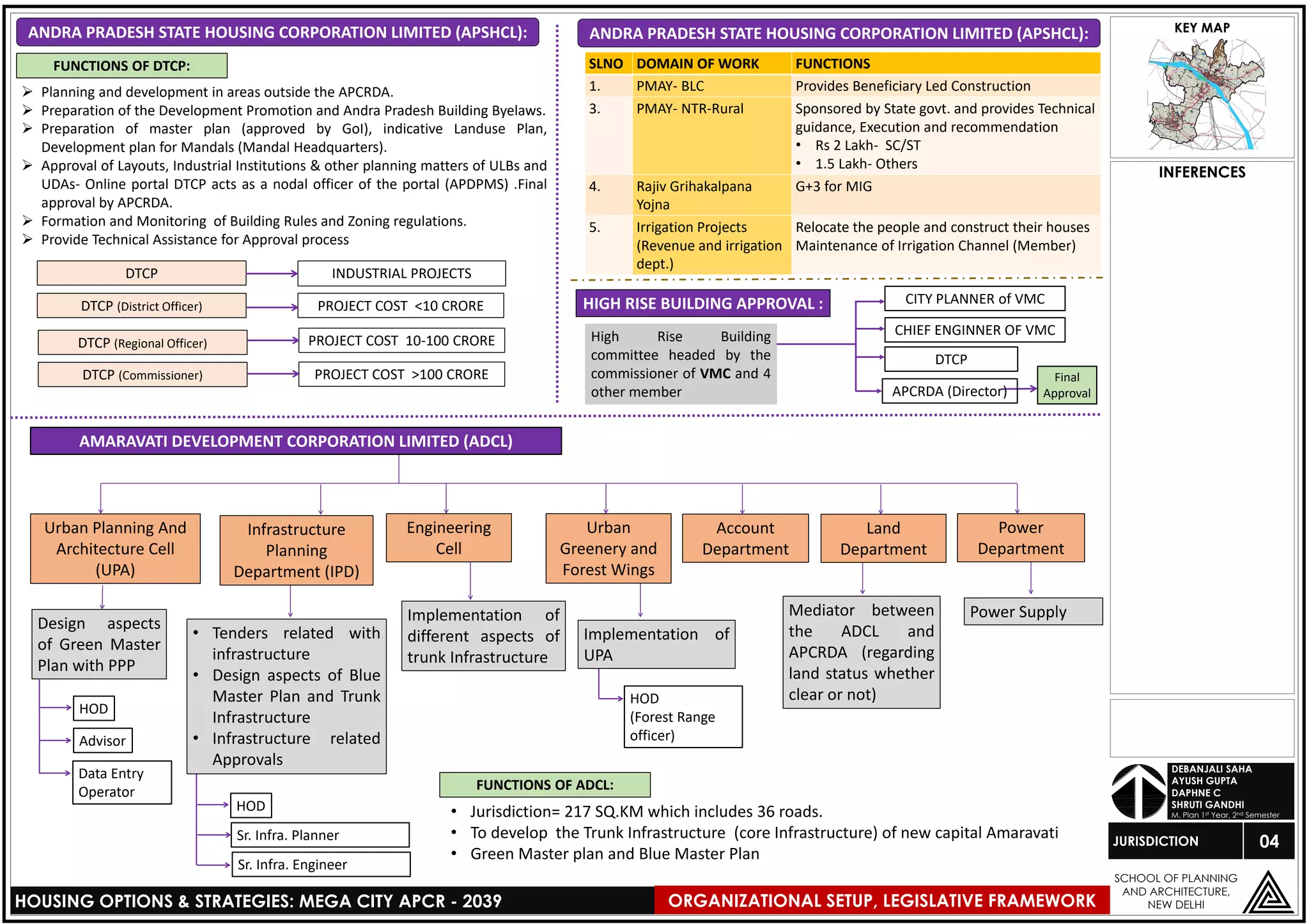
• A number of
institutions are
involved in the
governance of
Vijayawada city,
Guntur, Mangalgiri,
Tadepalli and the
surrounding peri-
urban areas that
constitute the Urban
Agglomeration.
• Some of them were
established through
Acts of legislature and
others are part of
state’s governance
framework.
ORGANIZATIONAL SETUP, LEGISLATIVE FRAMEWORK
THREE-TIERSYSTEM
APCRDA, DTCP, VMC,
APTIDCO- offices.
• The Municipal Acts list the functions under two categories, namely,
“obligatory functions” and “discretionary functions”.
• The functional domain was expanded in 1994 as per the 12th Schedule
of the 74th Constitution Amendment Act.
• In Andhra Pradesh, the Municipalities and Corporation Acts provide for a
majority of the functions listed in the 12th Schedule of the constitution.
Policy Directly linked.
Technical Support
and Advice
Project Proposal Flow
Municipal Administration & Urban
Development Department
AP. Housing
Board (1956)
AP. State
Housing
Corporation Ltd.
(1987)
Andra Pradesh Capital
Region Development
Authority (APCRDA)
2015
• Nodal agency
for online
approval
• Technical
assistance
and support
CENTRAL LEVEL STATE LEVEL
REGIONAL
LEVEL
Municipal
section
FOR CONSTRUCTION
INFERENCES
03
INFERENCES
z
HOUSING OPTIONS & STRATEGIES: MEGA CITY APCR - 2039
SCHOOL OF PLANNING
AND ARCHITECTURE,
NEW DELHI
JURISDICTION
KEY MAP
DEBANJALI SAHA
AYUSH GUPTA
DAPHNE C
SHRUTI GANDHI
M. Plan 1st Year, 2nd Semester
Objectives of APTIDCO:
• New township in municipal area due to rapid urbanization
(but for last 3 years they are just catering with the 3rd vertical
of PMAY)
• Remove and relocate slums
• Construction of houses
Functions of APTIDCO:
Formed under GoAP in 2016, having office in 13 district
of Andra Pradesh
• Township planning
• Infrastructure
• PMAY-3RD Vertical- Affordable Housing in Partnership
-Primary school
-Health care facilities
ORGANIZATIONAL SETUP, LEGISLATIVE FRAMEWORK
INSTITUTIONAL FRAMEWORK
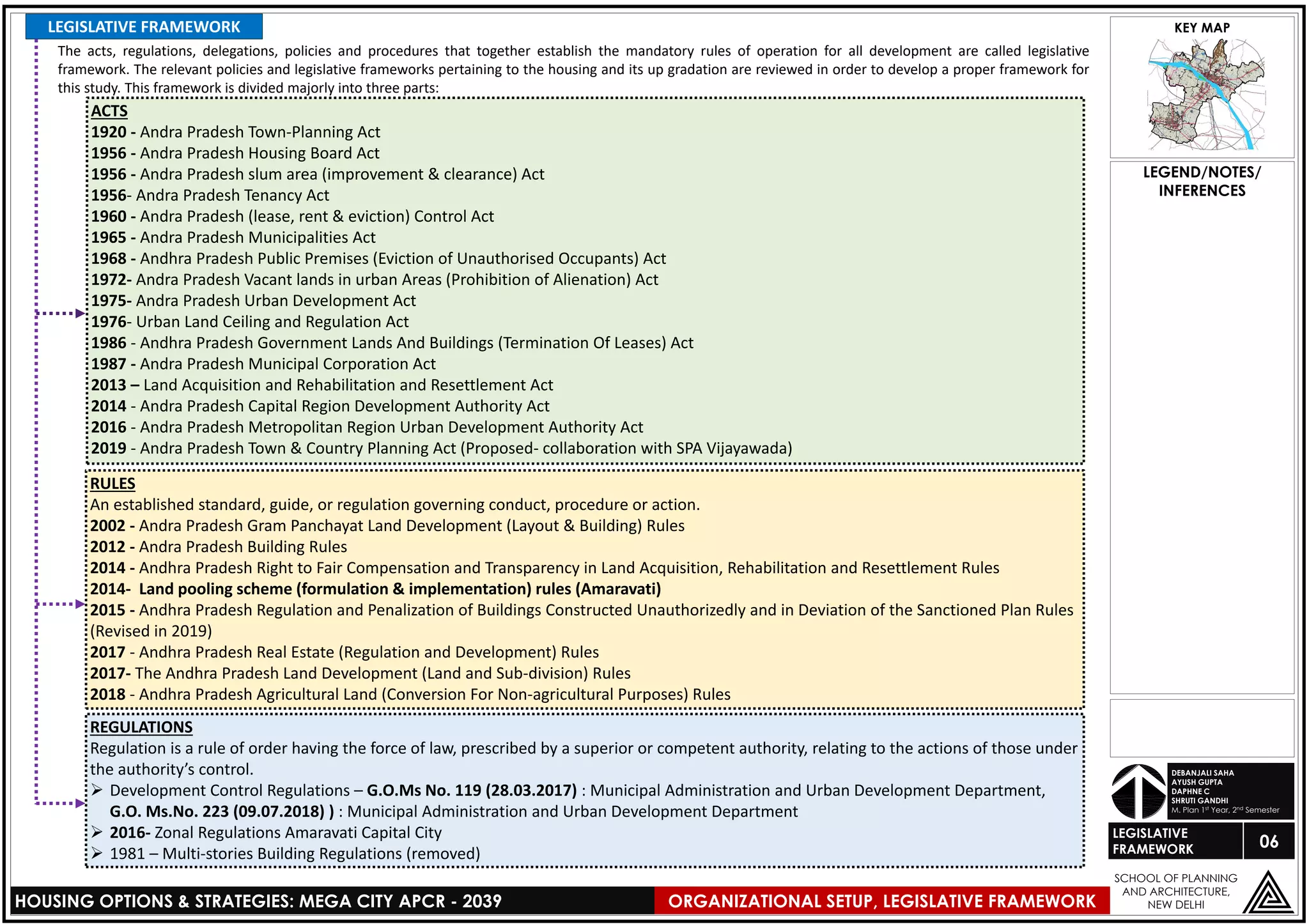
• Andra Pradesh is in a habit of making several organizations and corporations under Companies Act 1956.. For everything they make new Corporations.
• For PMAY 3rd (APTIDCO) and 4th (APSHCL) vertical they have made separate corporations looking into it.
• The governance of the city is characterized by multiplicity of agencies. The agencies have their own priorities, procedures, lines of accountability, financing patterns,
which often may not be in conformity with those of the Municipal Corporation and the ULBs.
• Any city’s governance depends upon effective organizational structure and adequate financial inflows.
• Although the city of Vijayawada has been in the forefront of implementing reforms and good governance practices for the past six to seven years, these reform initiatives
did not really achieve the desired results.
• The Government of Andhra Pradesh have enacted Andhra Pradesh Capital Region
Development Authority Act, 2014 (Act.No.11 of 2014) for the declaration of the
New Capital Area for the State of the Andhra Pradesh and establishment of the
Andhra Pradesh Capital Region Development.
 Preparation and revision of comprehensive development plan.
 Approval of Layout and Building plans of areas outside the Municipal Corporations
 General Town Planning (GTP) scheme revised by APCRDA
 Land acquisition and Rehabilitation & Resettlement, Land Pooling
 Environment & Social management
Andra Pradesh Capital Region- Development Authority (APCRDA) - 2015
Functions of APCRDA:
Objectives of APCRDA:
• To develop the region and coming up new capital Amaravati
• Total 961 Revenue villages, 1006 villages looked after by APCRDA.
• Jurisdiction= 8352.69 SQ.KM
Andra Pradesh Township and Infrastructure Development Corporation (APTIDCO)
APCRDA - For
Building and
Layout Approval
PROJECTS:
 PMAY NTR-NAGAR(shear wall technology)
 8000 houses under JNNURM
 28152 houses sanctioned under GOI
 10624 houses constructed in Jakhumpuri
O&M by VMC
PMAY (state level modal agency)
Affordable Housing In Partnership (3rd Vertical)
Relocation of slums along the hills
and canal in Vijayawada
Beneficiaries identified by Municipal
Collector and Commissioner (VMC)
Construction of houses for the
urban poor done by APTIDCO
APCRDA (DTCP Technical
Assistance for approval)
PLOT AREA > 1000 SQ.M
APCRDA (Director) Layout- Plot >10 Ha
APPROVALS:
• APCRDA as the planning agency is having the jurisdiction
of handling everything in the APCRDA region including the
approval power, land acquisition, revision of master plan.
(DTCP is just provided technical assistance).
• The manpower has increased significantly and their office
goes efficiently for 24x7, thus, this has led to the
successful land pooling scheme of Amaravati to happen.
• The Chief Minister on weekly basis visit the office and
takes the update on how the progress is taking place.
• L&T
• TATA STEEL
• SHAPORJEE
• NCC
• JCC
• There is also no
mechanism to project
and ensure
infrastructure provision
based on built up
analysis from time to
time. This results in
conflict between local
bodies and APCRDA.
• The APCRDA prepares the
master plan for the entire
area which provides for
common infrastructure
systems and amenities,
which transcend
municipal boundaries.
However, the real
problem is noticed in plan
implementation, where in
the metropolitan area
most developed are not
in an integrated manner
taking into account
geographical factors and
the existing and proposed
built up patterns.
04
INFERENCES
z
HOUSING OPTIONS & STRATEGIES: MEGA CITY APCR - 2039
SCHOOL OF PLANNING
AND ARCHITECTURE,
NEW DELHI
JURISDICTION
KEY MAP
DEBANJALI SAHA
AYUSH GUPTA
DAPHNE C
SHRUTI GANDHI
M. Plan 1st Year, 2nd Semester
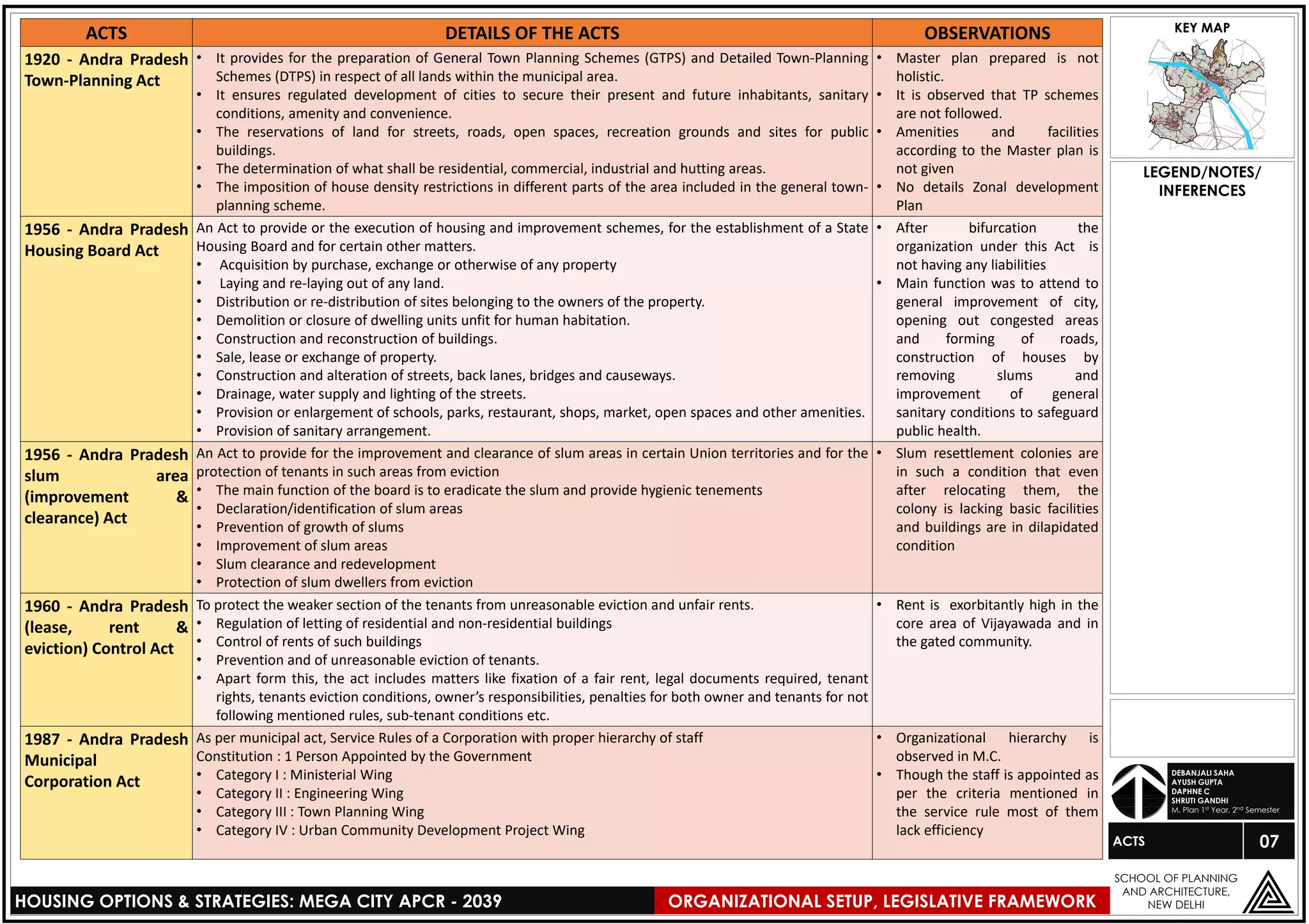
FUNCTIONS OF DTCP:
 Planning and development in areas outside the APCRDA.
 Preparation of the Development Promotion and Andra Pradesh Building Byelaws.
 Preparation of master plan (approved by GoI), indicative Landuse Plan,
Development plan for Mandals (Mandal Headquarters).
 Approval of Layouts, Industrial Institutions & other planning matters of ULBs and
UDAs- Online portal DTCP acts as a nodal officer of the portal (APDPMS) .Final
approval by APCRDA.
 Formation and Monitoring of Building Rules and Zoning regulations.
 Provide Technical Assistance for Approval process
AMARAVATI DEVELOPMENT CORPORATION LIMITED (ADCL)
Urban Planning And
Architecture Cell
(UPA)
Account
Department
Land
Department
Power
Department
Design aspects
of Green Master
Plan with PPP
• Tenders related with
infrastructure
• Design aspects of Blue
Master Plan and Trunk
Infrastructure
• Infrastructure related
Approvals
Implementation of
different aspects of
trunk Infrastructure
Implementation of
UPA
Urban
Greenery and
Forest Wings
Infrastructure
Planning
Department (IPD)
Engineering
Cell
Mediator between
the ADCL and
APCRDA (regarding
land status whether
clear or not)
Power Supply
HOD
Advisor
Data Entry
Operator
HOD
(Forest Range
officer)
Sr. Infra. Planner
Sr. Infra. Engineer
HOD • Jurisdiction= 217 SQ.KM which includes 36 roads.
• To develop the Trunk Infrastructure (core Infrastructure) of new capital Amaravati
• Green Master plan and Blue Master Plan
ANDRA PRADESH STATE HOUSING CORPORATION LIMITED (APSHCL):
SLNO DOMAIN OF WORK FUNCTIONS
1. PMAY- BLC Provides Beneficiary Led Construction
3. PMAY- NTR-Rural Sponsored by State govt. and provides Technical
guidance, Execution and recommendation
• Rs 2 Lakh- SC/ST
• 1.5 Lakh- Others
4. Rajiv Grihakalpana
Yojna
G+3 for MIG
5. Irrigation Projects
(Revenue and irrigation
dept.)
Relocate the people and construct their houses
Maintenance of Irrigation Channel (Member)
ANDRA PRADESH STATE HOUSING CORPORATION LIMITED (APSHCL):
DTCP INDUSTRIAL PROJECTS
DTCP (District Officer)
DTCP (Regional Officer)
DTCP (Commissioner)
PROJECT COST <10 CRORE
PROJECT COST 10-100 CRORE
PROJECT COST >100 CRORE
HIGH RISE BUILDING APPROVAL :
High Rise Building
committee headed by the
commissioner of VMC and 4
other member
CHIEF ENGINNER OF VMC
CITY PLANNER of VMC
DTCP
Final
Approval
FUNCTIONS OF ADCL:
APCRDA (Director)
ORGANIZATIONAL SETUP, LEGISLATIVE FRAMEWORK
4. If doesn’t
moves, then
removal done by
Police Power under
Law. 05
LEGEND/NOTES/
INFERENCES
z
HOUSING OPTIONS & STRATEGIES: MEGA CITY APCR - 2039
SCHOOL OF PLANNING
AND ARCHITECTURE,
NEW DELHI
JURISDICTION
KEY MAP
DEBANJALI SAHA
AYUSH GUPTA
DAPHNE C
SHRUTI GANDHI
M. Plan 1st Year, 2nd Semester
VIJAYAWADA MUNICIPAL CORPORATION :
Commissioner
ACP II
ACP I
Building Inspectors
(Initial Officer)
PLOT SIZE APPROVED BY:
• <200 SQ.M Building Inspector
• 200-500 SQ.M City Planner
• >500 SQ.M Commissioner
Town Planning Section
Jurisdiction: 61.88 SQ.KM
The Vijayawada, Guntur, Tadepalle and Mangalagiri Metropolitan Area consists the areas under the Municipal Corporation of Vijayawada and Guntur
and other municipalities viz. Tadepalli (2nd grade) and Mangalagiri (2nd grade) and several other gram panchayats and villages. It is governed/
administered by Andra Pradesh Capital Region Development Authority (APCRDA).
Deputy
Commissioner
Engineering Section
Plot >200 sq.m. = DTCP
Plot <200 sq.m. = GMC
(Commissioner)
Municipal
Commissioner
Supdt. Engineer
Director of Economics and
Statistic (Socio economic
Profile)
District Collector appoints different people
for the collection of data
(Eg. Govt. Employees)
District Mandal
(Assi. Statistical Engineer)
[update data in the district
handbook every year]
GUNTUR MUNICIPAL CORPORATION (GMC)
1. negotiation with the Slum
union leader, political persons
(MLA, Ward members)– Done by
the Commissioner or Collector.
FOR SLUMS RESETTLEMENT IN AND AROUND VMC:
3. After 3-4 days the
settlement is removed
and free food, shelter,
water and vehicles are
provided till they shift to
the new resettlement
colony.
5. If doesn’t
moves, then
removal done
by Police Power
under Law.
PLOT AREA BENIFICIARY CONTRIBUTION BANK LOAN BHK
300 SQ. FT. Rs 500 2.65 lakhs 1 bhk
365 SQ. FT. Rs 50,000 3.15 lakhs 1 bhk
420 SQ.FT. Rs 1 Lakh 3.65 lakhs 2 bhk
For SLUMS:
Guntur
Municipal
Corporation
Government
of Andra
Pradesh
Beneficiary
selected by the
District level
Committee
Approval by
APCRDA
Allotment of Building
according to lottery system
conducted by NIC
APTIDCO for
Construction
AFFORDABLE HOUSING (3rd vertical):
BENIFICIARY LEAD CONSTRCUCTION (4th Vertical):
1.5 LAKHS Government of India
1.5 LAKHS Government of Andra Pradesh
3LAKHS
PLOT AREA < 1000 SQ.M
VMC (DTCP Technical
Assistance)
Layout- Plot <10 Ha
VMC
(DTCP Technical Assistance for
approval)
2. Two-Three meetings
are conducted and factors
like employment facility,
vocational training
program etc. are issued.
Slum DepartmentEngineeringCommissioner
• All approvals/sanctions of buildings and
layout within the municipal boundary is
done by VMC.
• Choosing of beneficiary for different
schemes
• Operation and maintenance of public
housing and infrastructure
•There is a lack of
coordination between
urban local bodies and
parastatals in areas such as
inter-municipal, inter-
district and inter-state
roads etc.
• It is necessary to have
two pronged
approaches for the
reforms, the first
creating a front end,
the next strengthening
the back end to
effectively cater to the
front end.
• On reality, what is
happening in the case
of Vijayawada is that
front end systems have
been created but the
back end systems have
not been effectively
upgraded/ geared up
to meet the influx of
the kind of
information/
complaints that came
through the same.
• The result is improper
functioning of the
system as a whole
ORGANIZATIONAL SETUP, LEGISLATIVE FRAMEWORK
06
LEGEND/NOTES/
INFERENCES
z
HOUSING OPTIONS & STRATEGIES: MEGA CITY APCR - 2039
SCHOOL OF PLANNING
AND ARCHITECTURE,
NEW DELHI
LEGISLATIVE
FRAMEWORK
KEY MAP
DEBANJALI SAHA
AYUSH GUPTA
DAPHNE C
SHRUTI GANDHI
M. Plan 1st Year, 2nd Semester
ORGANIZATIONAL SETUP, LEGISLATIVE FRAMEWORK
ACTS
1920 - Andra Pradesh Town-Planning Act
1956 - Andra Pradesh Housing Board Act
1956 - Andra Pradesh slum area (improvement & clearance) Act
1956- Andra Pradesh Tenancy Act
1960 - Andra Pradesh (lease, rent & eviction) Control Act
1965 - Andra Pradesh Municipalities Act
1968 - Andhra Pradesh Public Premises (Eviction of Unauthorised Occupants) Act
1972- Andra Pradesh Vacant lands in urban Areas (Prohibition of Alienation) Act
1975- Andra Pradesh Urban Development Act
1976- Urban Land Ceiling and Regulation Act
1986 - Andhra Pradesh Government Lands And Buildings (Termination Of Leases) Act
1987 - Andra Pradesh Municipal Corporation Act
2013 – Land Acquisition and Rehabilitation and Resettlement Act
2014 - Andra Pradesh Capital Region Development Authority Act
2016 - Andra Pradesh Metropolitan Region Urban Development Authority Act
2019 - Andra Pradesh Town & Country Planning Act (Proposed- collaboration with SPA Vijayawada)
LEGISLATIVE FRAMEWORK
The acts, regulations, delegations, policies and procedures that together establish the mandatory rules of operation for all development are called legislative
framework. The relevant policies and legislative frameworks pertaining to the housing and its up gradation are reviewed in order to develop a proper framework for
this study. This framework is divided majorly into three parts:
RULES
An established standard, guide, or regulation governing conduct, procedure or action.
2002 - Andra Pradesh Gram Panchayat Land Development (Layout & Building) Rules
2012 - Andra Pradesh Building Rules
2014 - Andhra Pradesh Right to Fair Compensation and Transparency in Land Acquisition, Rehabilitation and Resettlement Rules
2014- Land pooling scheme (formulation & implementation) rules (Amaravati)
2015 - Andhra Pradesh Regulation and Penalization of Buildings Constructed Unauthorizedly and in Deviation of the Sanctioned Plan Rules
(Revised in 2019)
2017 - Andhra Pradesh Real Estate (Regulation and Development) Rules
2017- The Andhra Pradesh Land Development (Land and Sub-division) Rules
2018 - Andhra Pradesh Agricultural Land (Conversion For Non-agricultural Purposes) Rules
REGULATIONS
Regulation is a rule of order having the force of law, prescribed by a superior or competent authority, relating to the actions of those under
the authority’s control.
 Development Control Regulations – G.O.Ms No. 119 (28.03.2017) : Municipal Administration and Urban Development Department,
G.O. Ms.No. 223 (09.07.2018) ) : Municipal Administration and Urban Development Department
 2016- Zonal Regulations Amaravati Capital City
 1981 – Multi-stories Building Regulations (removed)
07
LEGEND/NOTES/
INFERENCES
z
HOUSING OPTIONS & STRATEGIES: MEGA CITY APCR - 2039
SCHOOL OF PLANNING
AND ARCHITECTURE,
NEW DELHI
ACTS
KEY MAP
DEBANJALI SAHA
AYUSH GUPTA
DAPHNE C
SHRUTI GANDHI
M. Plan 1st Year, 2nd Semester
ORGANIZATIONAL SETUP, LEGISLATIVE FRAMEWORK
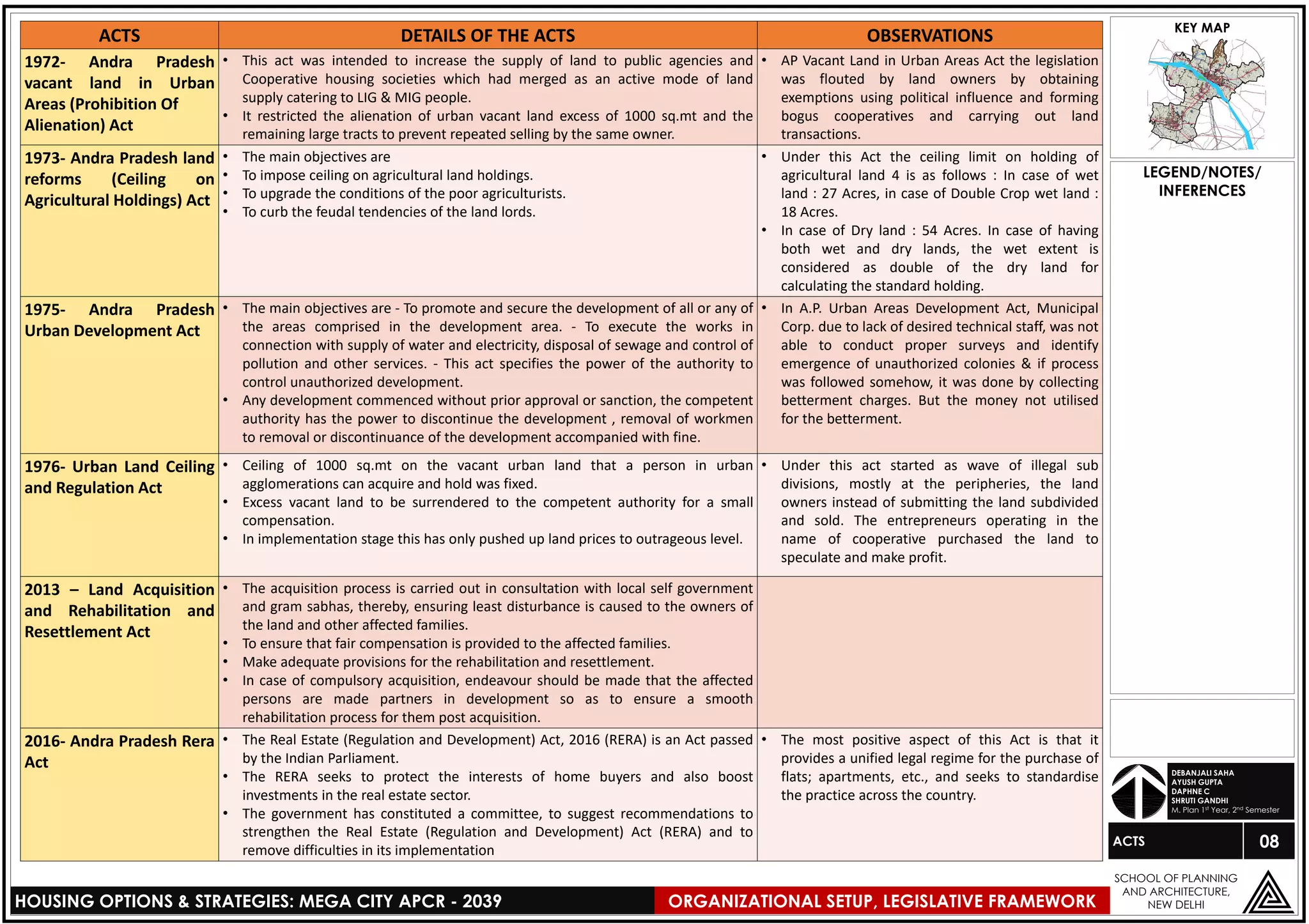
ACTS DETAILS OF THE ACTS OBSERVATIONS
1920 - Andra Pradesh
Town-Planning Act
• It provides for the preparation of General Town Planning Schemes (GTPS) and Detailed Town-Planning
Schemes (DTPS) in respect of all lands within the municipal area.
• It ensures regulated development of cities to secure their present and future inhabitants, sanitary
conditions, amenity and convenience.
• The reservations of land for streets, roads, open spaces, recreation grounds and sites for public
buildings.
• The determination of what shall be residential, commercial, industrial and hutting areas.
• The imposition of house density restrictions in different parts of the area included in the general town-
planning scheme.
• Master plan prepared is not
holistic.
• It is observed that TP schemes
are not followed.
• Amenities and facilities
according to the Master plan is
not given
• No details Zonal development
Plan
1956 - Andra Pradesh
Housing Board Act
An Act to provide or the execution of housing and improvement schemes, for the establishment of a State
Housing Board and for certain other matters.
• Acquisition by purchase, exchange or otherwise of any property
• Laying and re-laying out of any land.
• Distribution or re-distribution of sites belonging to the owners of the property.
• Demolition or closure of dwelling units unfit for human habitation.
• Construction and reconstruction of buildings.
• Sale, lease or exchange of property.
• Construction and alteration of streets, back lanes, bridges and causeways.
• Drainage, water supply and lighting of the streets.
• Provision or enlargement of schools, parks, restaurant, shops, market, open spaces and other amenities.
• Provision of sanitary arrangement.
• After bifurcation the
organization under this Act is
not having any liabilities
• Main function was to attend to
general improvement of city,
opening out congested areas
and forming of roads,
construction of houses by
removing slums and
improvement of general
sanitary conditions to safeguard
public health.
1956 - Andra Pradesh
slum area
(improvement &
clearance) Act
An Act to provide for the improvement and clearance of slum areas in certain Union territories and for the
protection of tenants in such areas from eviction
• The main function of the board is to eradicate the slum and provide hygienic tenements
• Declaration/identification of slum areas
• Prevention of growth of slums
• Improvement of slum areas
• Slum clearance and redevelopment
• Protection of slum dwellers from eviction
• Slum resettlement colonies are
in such a condition that even
after relocating them, the
colony is lacking basic facilities
and buildings are in dilapidated
condition
1960 - Andra Pradesh
(lease, rent &
eviction) Control Act
To protect the weaker section of the tenants from unreasonable eviction and unfair rents.
• Regulation of letting of residential and non-residential buildings
• Control of rents of such buildings
• Prevention and of unreasonable eviction of tenants.
• Apart form this, the act includes matters like fixation of a fair rent, legal documents required, tenant
rights, tenants eviction conditions, owner’s responsibilities, penalties for both owner and tenants for not
following mentioned rules, sub-tenant conditions etc.
• Rent is exorbitantly high in the
core area of Vijayawada and in
the gated community.
1987 - Andra Pradesh
Municipal
Corporation Act
As per municipal act, Service Rules of a Corporation with proper hierarchy of staff
Constitution : 1 Person Appointed by the Government
• Category I : Ministerial Wing
• Category II : Engineering Wing
• Category III : Town Planning Wing
• Category IV : Urban Community Development Project Wing
• Organizational hierarchy is
observed in M.C.
• Though the staff is appointed as
per the criteria mentioned in
the service rule most of them
lack efficiency
08
LEGEND/NOTES/
INFERENCES
z
HOUSING OPTIONS & STRATEGIES: MEGA CITY APCR - 2039
SCHOOL OF PLANNING
AND ARCHITECTURE,
NEW DELHI
ACTS
KEY MAP
DEBANJALI SAHA
AYUSH GUPTA
DAPHNE C
SHRUTI GANDHI
M. Plan 1st Year, 2nd Semester
ORGANIZATIONAL SETUP, LEGISLATIVE FRAMEWORK
ACTS DETAILS OF THE ACTS OBSERVATIONS
1972- Andra Pradesh
vacant land in Urban
Areas (Prohibition Of
Alienation) Act
• This act was intended to increase the supply of land to public agencies and
Cooperative housing societies which had merged as an active mode of land
supply catering to LIG & MIG people.
• It restricted the alienation of urban vacant land excess of 1000 sq.mt and the
remaining large tracts to prevent repeated selling by the same owner.
• AP Vacant Land in Urban Areas Act the legislation
was flouted by land owners by obtaining
exemptions using political influence and forming
bogus cooperatives and carrying out land
transactions.
1973- Andra Pradesh land
reforms (Ceiling on
Agricultural Holdings) Act
• The main objectives are
• To impose ceiling on agricultural land holdings.
• To upgrade the conditions of the poor agriculturists.
• To curb the feudal tendencies of the land lords.
• Under this Act the ceiling limit on holding of
agricultural land 4 is as follows : In case of wet
land : 27 Acres, in case of Double Crop wet land :
18 Acres.
• In case of Dry land : 54 Acres. In case of having
both wet and dry lands, the wet extent is
considered as double of the dry land for
calculating the standard holding.
1975- Andra Pradesh
Urban Development Act
• The main objectives are - To promote and secure the development of all or any of
the areas comprised in the development area. - To execute the works in
connection with supply of water and electricity, disposal of sewage and control of
pollution and other services. - This act specifies the power of the authority to
control unauthorized development.
• Any development commenced without prior approval or sanction, the competent
authority has the power to discontinue the development , removal of workmen
to removal or discontinuance of the development accompanied with fine.
• In A.P. Urban Areas Development Act, Municipal
Corp. due to lack of desired technical staff, was not
able to conduct proper surveys and identify
emergence of unauthorized colonies & if process
was followed somehow, it was done by collecting
betterment charges. But the money not utilised
for the betterment.
1976- Urban Land Ceiling
and Regulation Act
• Ceiling of 1000 sq.mt on the vacant urban land that a person in urban
agglomerations can acquire and hold was fixed.
• Excess vacant land to be surrendered to the competent authority for a small
compensation.
• In implementation stage this has only pushed up land prices to outrageous level.
• Under this act started as wave of illegal sub
divisions, mostly at the peripheries, the land
owners instead of submitting the land subdivided
and sold. The entrepreneurs operating in the
name of cooperative purchased the land to
speculate and make profit.
2013 – Land Acquisition
and Rehabilitation and
Resettlement Act
• The acquisition process is carried out in consultation with local self government
and gram sabhas, thereby, ensuring least disturbance is caused to the owners of
the land and other affected families.
• To ensure that fair compensation is provided to the affected families.
• Make adequate provisions for the rehabilitation and resettlement.
• In case of compulsory acquisition, endeavour should be made that the affected
persons are made partners in development so as to ensure a smooth
rehabilitation process for them post acquisition.
2016- Andra Pradesh Rera
Act
• The Real Estate (Regulation and Development) Act, 2016 (RERA) is an Act passed
by the Indian Parliament.
• The RERA seeks to protect the interests of home buyers and also boost
investments in the real estate sector.
• The government has constituted a committee, to suggest recommendations to
strengthen the Real Estate (Regulation and Development) Act (RERA) and to
remove difficulties in its implementation
• The most positive aspect of this Act is that it
provides a unified legal regime for the purchase of
flats; apartments, etc., and seeks to standardise
the practice across the country.
INTRODUCTION
LEGEND/NOTES/
INFERENCES
Ayush Gupta
Daphne Cynthia
Debanjali Saha
Shruti Gandhi
M.Plan, 1st Year, 2nd Semester
z
HOUSING OPTIONS & STRATEGIES: MEGA CITY APCR - 2039
SCHOOL OF PLANNING
AND ARCHITECTURE,
NEW DELHI
INTRODUCTION
Key map
DEVELOPMENT CONTROL REGULATIONS
09
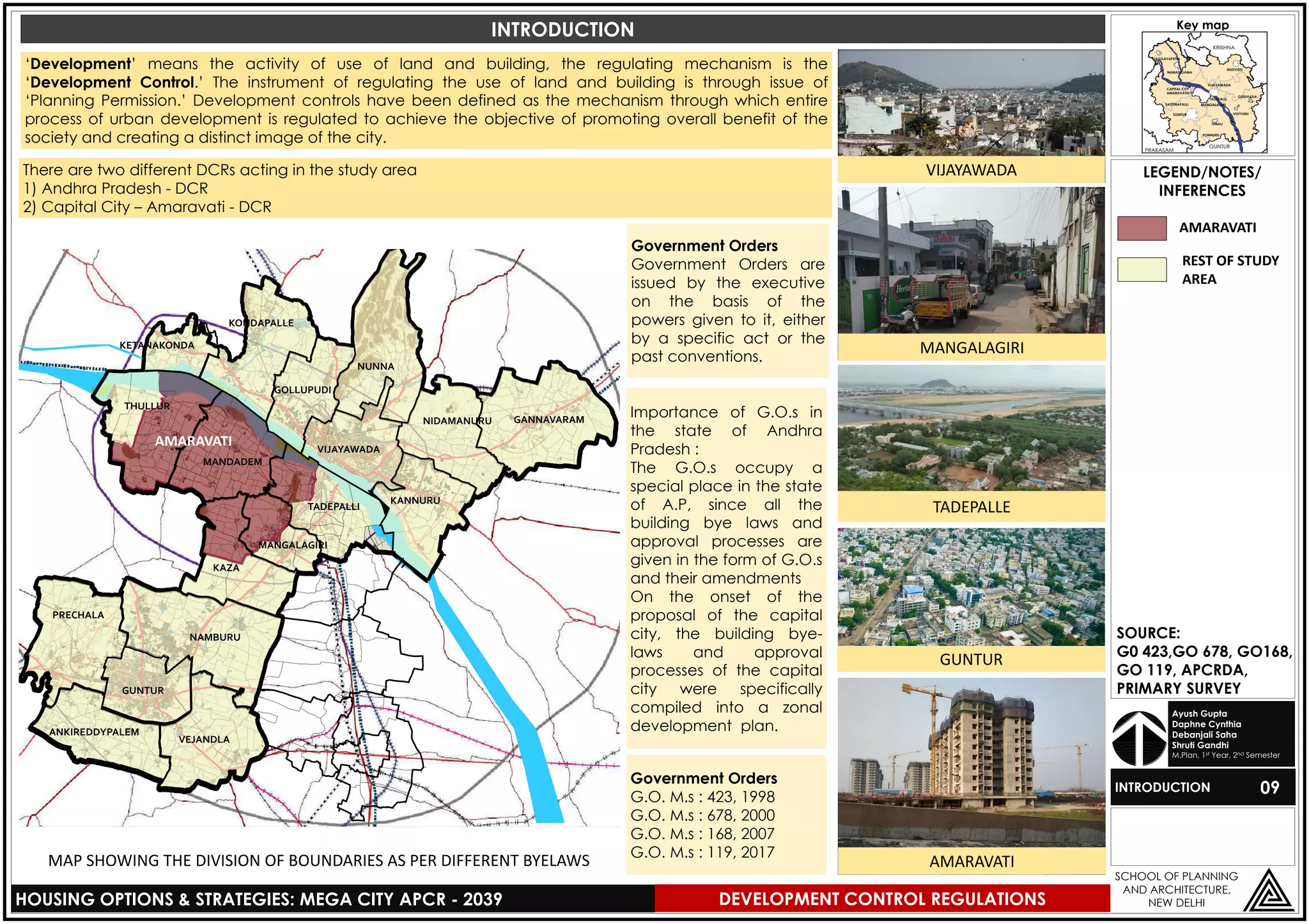
‘Development’ means the activity of use of land and building, the regulating mechanism is the
‘Development Control.’ The instrument of regulating the use of land and building is through issue of
‘Planning Permission.’ Development controls have been defined as the mechanism through which entire
process of urban development is regulated to achieve the objective of promoting overall benefit of the
society and creating a distinct image of the city.
AMARAVATI
REST OF STUDY
AREA
There are two different DCRs acting in the study area
1) Andhra Pradesh - DCR
2) Capital City – Amaravati - DCR
VIJAYAWADA
MANGALAGIRI
TADEPALLE
GUNTUR
AMARAVATI
AMARAVATI
Government Orders
Government Orders are
issued by the executive
on the basis of the
powers given to it, either
by a specific act or the
past conventions.
Importance of G.O.s in
the state of Andhra
Pradesh :
The G.O.s occupy a
special place in the state
of A.P, since all the
building bye laws and
approval processes are
given in the form of G.O.s
and their amendments
On the onset of the
proposal of the capital
city, the building bye-
laws and approval
processes of the capital
city were specifically
compiled into a zonal
development plan.
Government Orders
G.O. M.s : 423, 1998
G.O. M.s : 678, 2000
G.O. M.s : 168, 2007
G.O. M.s : 119, 2017
MAP SHOWING THE DIVISION OF BOUNDARIES AS PER DIFFERENT BYELAWS
SOURCE:
G0 423,GO 678, GO168,
GO 119, APCRDA,
PRIMARY SURVEY
HOUSING STRATEGY APPROVAL PROCESS
SCHOOL OF PLANNING
AND ARCHITECTURE,
NEW DELHI
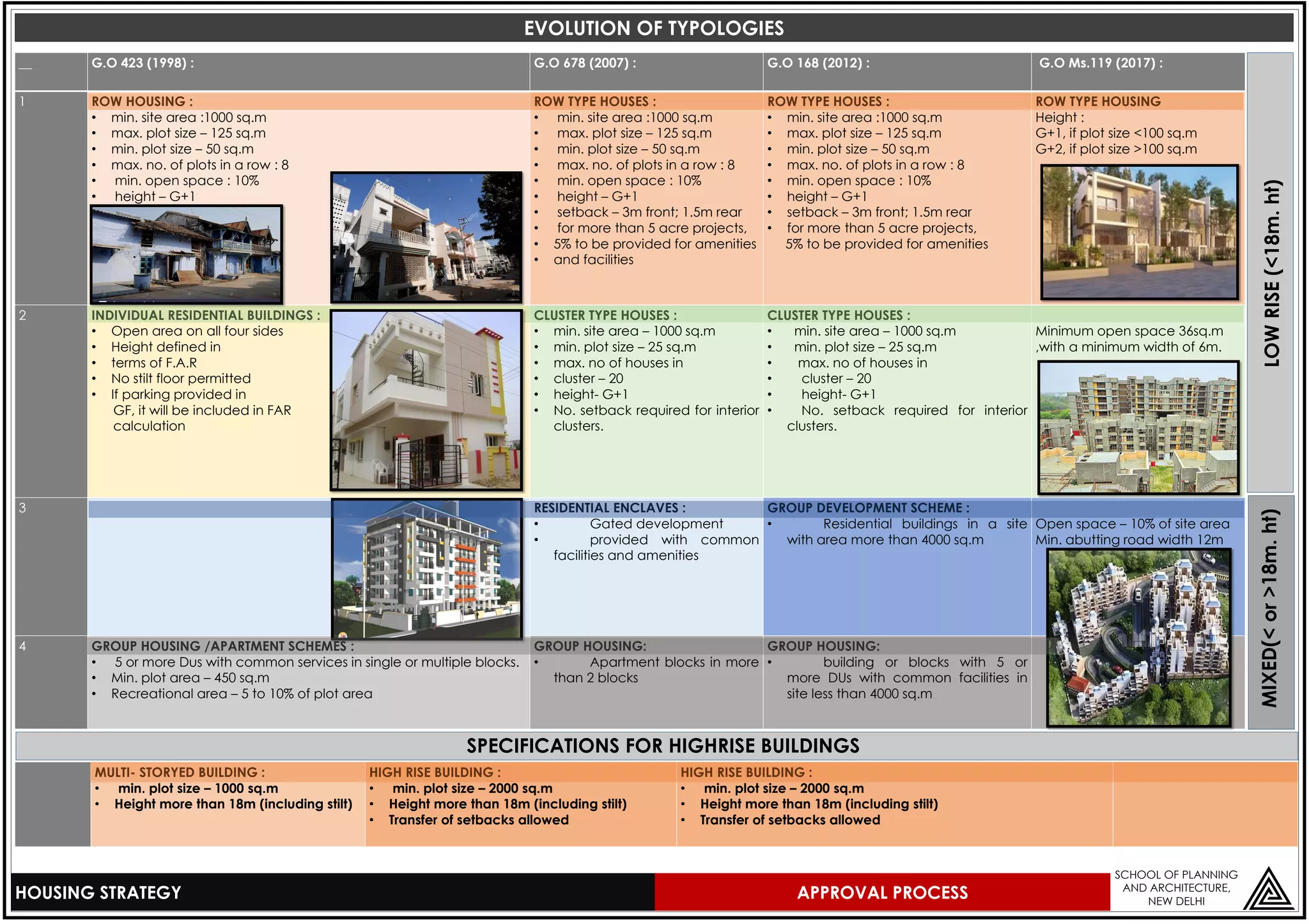
EVOLUTION OF TYPOLOGIES
__ G.O 423 (1998) : G.O 678 (2007) : G.O 168 (2012) : G.O Ms.119 (2017) :
1 ROW HOUSING :
• min. site area :1000 sq.m
• max. plot size – 125 sq.m
• min. plot size – 50 sq.m
• max. no. of plots in a row : 8
• min. open space : 10%
• height – G+1
ROW TYPE HOUSES :
• min. site area :1000 sq.m
• max. plot size – 125 sq.m
• min. plot size – 50 sq.m
• max. no. of plots in a row : 8
• min. open space : 10%
• height – G+1
• setback – 3m front; 1.5m rear
• for more than 5 acre projects,
• 5% to be provided for amenities
• and facilities
ROW TYPE HOUSES :
• min. site area :1000 sq.m
• max. plot size – 125 sq.m
• min. plot size – 50 sq.m
• max. no. of plots in a row : 8
• min. open space : 10%
• height – G+1
• setback – 3m front; 1.5m rear
• for more than 5 acre projects,
5% to be provided for amenities
ROW TYPE HOUSING
Height :
G+1, if plot size <100 sq.m
G+2, if plot size >100 sq.m
2 INDIVIDUAL RESIDENTIAL BUILDINGS :
• Open area on all four sides
• Height defined in
• terms of F.A.R
• No stilt floor permitted
• If parking provided in
GF, it will be included in FAR
calculation
CLUSTER TYPE HOUSES :
• min. site area – 1000 sq.m
• min. plot size – 25 sq.m
• max. no of houses in
• cluster – 20
• height- G+1
• No. setback required for interior
clusters.
CLUSTER TYPE HOUSES :
• min. site area – 1000 sq.m
• min. plot size – 25 sq.m
• max. no of houses in
• cluster – 20
• height- G+1
• No. setback required for interior
clusters.
Minimum open space 36sq.m
,with a minimum width of 6m.
3 RESIDENTIAL ENCLAVES :
• Gated development
• provided with common
facilities and amenities
GROUP DEVELOPMENT SCHEME :
• Residential buildings in a site
with area more than 4000 sq.m
Open space – 10% of site area
Min. abutting road width 12m
4 GROUP HOUSING /APARTMENT SCHEMES :
• 5 or more Dus with common services in single or multiple blocks.
• Min. plot area – 450 sq.m
• Recreational area – 5 to 10% of plot area
GROUP HOUSING:
• Apartment blocks in more
than 2 blocks
GROUP HOUSING:
• building or blocks with 5 or
more DUs with common facilities in
site less than 4000 sq.m
LOWRISE(<18m.ht)MIXED(<or>18m.ht)
MULTI- STORYED BUILDING :
• min. plot size – 1000 sq.m
• Height more than 18m (including stilt)
HIGH RISE BUILDING :
• min. plot size – 2000 sq.m
• Height more than 18m (including stilt)
• Transfer of setbacks allowed
HIGH RISE BUILDING :
• min. plot size – 2000 sq.m
• Height more than 18m (including stilt)
• Transfer of setbacks allowed
SPECIFICATIONS FOR HIGHRISE BUILDINGS
DAPHNE CYNTHIA C
DEBANJALI SAHA
SHRUTI GANDHI
AYUSH GUPTA
M.Plan, 1st Year, 2nd Semester
z
HOUSING STRATEGY APPROVAL PROCESS
SCHOOL OF PLANNING
AND ARCHITECTURE,
NEW DELHI
G.O. Ms.no. 423 (1998) G.O.Ms.no : 541 (2000) G.O.Ms.no : 678 (2007) G.O.Ms.no. : 168 (2012) G.O.Ms.no. : 119 (2017)
Approval
process
Building Permit procedure (no
mention of layouts)
Approval process for
layouts
SELECT COMMITTEE for review
Setbacks and
road widths
Site and building requirements _F.A.R • Min. plot sizes abutting specific road
widths
• Min approach road specified
• F.A.R removed
Min. road width
increased to 9m, in
congested areas
Setbacks_based on plot size and
building height
Setbacks based on building height
Open space % of recreational areas
Specified
Open space criteria for buildings above
10m ht.
(5%)
Parking Parking requirements_w.r.t no. of DUs Parking as a percentage of B.U.A
Fees Security deposit • Building permit/ licence fees- 2% of
building permit fee, collected as initial
fee, upto a max. of Rs.10,000
• This fees is forfeited in case of rejection.
• Special fees for sites abutting major
roads
• City level infrastructure impact fee for
buildings above 15m
Highrise Criteria for “MULTISTORY BUILING” Terminology changed to “HIGHRISE”
“SKYSCRAPPER ZONE” – buildings
between 18-36m ht.-not permitted
HIGH RISE BUILDING
COMMITTEE constituted
Structural
safety
• Structural safety measures
incorporated
Soil test and geo-technical
investigative report to be
submitted for buildings>10m ht.
TDR Introduction of TDR –(100% for road
widening cases)
T.D.R increased to 200%
for road widening cases
T.D.R increased to 400% in case of road
widening(in amendment of 2018)
Special
norms
Restriction of building activity introduced
NOCs from various departments required
Access conditions on highways ,
Ringroads, etc.
Incentives for owners leaving
more setbacks/installing
rainwater harvesting
facilities,etc.
Environmental
clearance from SEIAA
mandated
• Rules regarding provion of helipad in
high rises
• Provisions for differently abled, elderly
and children introduced
• Green building and sustainability
provisions
• Rainwater harvesting made compulsory
• Provisions for EWS and LIG categories
included
HISTORY OF GOs
12
LEGEND/NOTES/
INFERENCES
Ayush Gupta
Daphne Cynthia
Debanjali Saha
Shruti Gandhi
M.Plan, 1st Year, 2nd Semester
z
HOUSING OPTIONS & STRATEGIES: MEGA CITY APCR - 2039 DEVELOPMENT CONTROL REGULATION
SCHOOL OF PLANNING
AND ARCHITECTURE,
NEW DELHI
INTRODUCTION TO
TYPOLOGIES
Key map
INTRODUCTION TO TYPOLOGIES
SOURCE:
G0 423(1998) Practised
in Vijaywada,ZDP 2007.
& Andhra Pradesh
Building Rules 2017
(GO 119), (GO 223)
High Rise Building means a building with 18 meters and above
(including stilt floor) in height. However, chimneys, cooling
towers, boiler rooms/ lift machine rooms, cold storage and
other non-working areas in case of industrial buildings and
water tanks and architectural features in respect of other
buildings may be permitted as a non-High rise Building.
Row Houses
Row Buildings means a row of houses with only front, rear and
interior open spaces.
NON-HIGH RISE (Below 18m)
Detached building
Includes a building with walls and roofs independent of any
other building and with open spaces on all sides within the same
plot.
HIGH RISE (18m and above)
GROUP DEVELOPMENT SCHEME (Non – High Rise & High Rise)
‘Group Development Scheme’ is reckoned as development of
Buildings for any use in a Campus or Site of 4000sq.m and above
in area and could be row houses, semi-detached, detached
Houses, Apartment blocks or High-Rise buildings or mix or
combination of the above.
Cluster housing
Cluster housing refers to a development in which houses are
situated in groups/clusters close to each other with larger areas
of open space within the development form
• The FSI component has been removed from the Andhra Pradesh building regulations since 2007.
• The present framework of AP-Byelaws is based on the following three major parameters-
a) Road Width b) Plot Size c) Setback
• Maximum height and setbacks are stipulated as per the abutting road width for the plot sizes.
• Also there is no variation with respect to the use of land or building activity on a certain plot which means the regulations
are even for residential and commercial typology of buildings.
• Stilt Floor meant for parking is excluded from the
permissible height. Height of stilt floor shall not be less
than 2.5m
• In case of parking floors where mechanical system and
lift are provided, height of such parking floor shall not be
less than 4.5m.
• Parking floors in High rise buildings are excluded from
calculation of height of building.
MINIMUM ABUTTING EXISTING ROAD WIDTH REQUIRED
LEGEND/NOTES/
INFERENCES
Ayush Gupta
Daphne Cynthia
Debanjali Saha
Shruti Gandhi
M.Plan, 1st Year, 2nd Semester
z
HOUSING OPTIONS & STRATEGIES: MEGA CITY APCR - 2039
SCHOOL OF PLANNING
AND ARCHITECTURE,
NEW DELHI
ABUTTING ROAD
WIDTH
Key map
DEVELOPMENT CONTROL REGULATION
SOURCE:
Andhra Pradesh
Building Rules 2017
(GO 119), (GO 223)
13
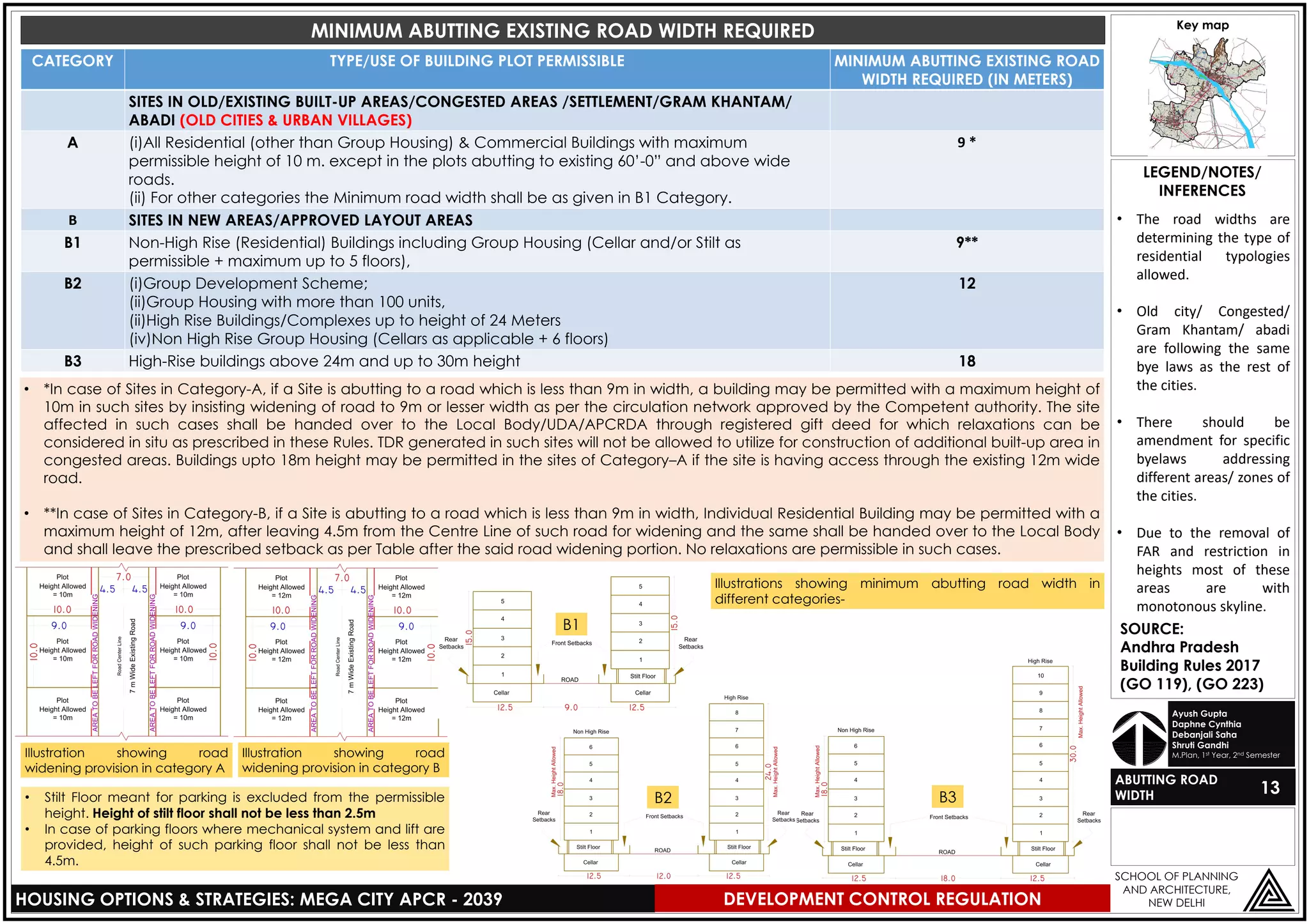
CATEGORY TYPE/USE OF BUILDING PLOT PERMISSIBLE MINIMUM ABUTTING EXISTING ROAD
WIDTH REQUIRED (IN METERS)
SITES IN OLD/EXISTING BUILT-UP AREAS/CONGESTED AREAS /SETTLEMENT/GRAM KHANTAM/
ABADI (OLD CITIES & URBAN VILLAGES)
A (i)All Residential (other than Group Housing) & Commercial Buildings with maximum
permissible height of 10 m. except in the plots abutting to existing 60’-0” and above wide
roads.
(ii) For other categories the Minimum road width shall be as given in B1 Category.
9 *
B SITES IN NEW AREAS/APPROVED LAYOUT AREAS
B1 Non-High Rise (Residential) Buildings including Group Housing (Cellar and/or Stilt as
permissible + maximum up to 5 floors),
9**
B2 (i)Group Development Scheme;
(ii)Group Housing with more than 100 units,
(ii)High Rise Buildings/Complexes up to height of 24 Meters
(iv)Non High Rise Group Housing (Cellars as applicable + 6 floors)
12
B3 High-Rise buildings above 24m and up to 30m height 18
• *In case of Sites in Category-A, if a Site is abutting to a road which is less than 9m in width, a building may be permitted with a maximum height of
10m in such sites by insisting widening of road to 9m or lesser width as per the circulation network approved by the Competent authority. The site
affected in such cases shall be handed over to the Local Body/UDA/APCRDA through registered gift deed for which relaxations can be
considered in situ as prescribed in these Rules. TDR generated in such sites will not be allowed to utilize for construction of additional built-up area in
congested areas. Buildings upto 18m height may be permitted in the sites of Category–A if the site is having access through the existing 12m wide
road.
• **In case of Sites in Category-B, if a Site is abutting to a road which is less than 9m in width, Individual Residential Building may be permitted with a
maximum height of 12m, after leaving 4.5m from the Centre Line of such road for widening and the same shall be handed over to the Local Body
and shall leave the prescribed setback as per Table after the said road widening portion. No relaxations are permissible in such cases.
• The road widths are
determining the type of
residential typologies
allowed.
• Old city/ Congested/
Gram Khantam/ abadi
are following the same
bye laws as the rest of
the cities.
• There should be
amendment for specific
byelaws addressing
different areas/ zones of
the cities.
• Due to the removal of
FAR and restriction in
heights most of these
areas are with
monotonous skyline.
• Stilt Floor meant for parking is excluded from the permissible
height. Height of stilt floor shall not be less than 2.5m
• In case of parking floors where mechanical system and lift are
provided, height of such parking floor shall not be less than
4.5m.
Illustration showing road
widening provision in category A
Illustration showing road
widening provision in category B
Illustrations showing minimum abutting road width in
different categories-
B1
B2 B3
14
LEGEND/NOTES/
INFERENCES
Ayush Gupta
Daphne Cynthia
Debanjali Saha
Shruti Gandhi
M.Plan, 1st Year, 2nd Semester
z
HOUSING OPTIONS & STRATEGIES: MEGA CITY APCR - 2039 DEVELOPMENT CONTROL REGULATION
SCHOOL OF PLANNING
AND ARCHITECTURE,
NEW DELHI
NON-HIGH RISE
Key map
INDIVIDUAL RESIDENTIAL BUILDINGS
Plot Size in Sq m
Setbacks in M
Front Rear Sides
Upto 50
50 to 75
75 to 100
100 to 150
150 to 200
200 to 300
0.75
1.00
1.25
1.50
2.00
3.00
---
1.00
1.00
2.00
2.00
2.00
---
0.50
0.50
1.00
1.25
1.50
Plot area in Sq m Maximum Permissible Coverage
A) Below 500
B) 500 to 2000
C) 2000 &
above
As per Min building setbacks
50%
1000 sq m or 40% of the Plot area
whichever is higher
Road
width
(M)
Front
(M)
Rear
(M)
Sides (M)
Upto 12
Road
12-18
Road
Above 18
Road
3.00
4.00
6.00
3.00
3.00
3.00
A) 1/4th of plot width with 1.5
m on one side.
OR
B) Where 1/4th of side setback
is more than 6.0 M minimum
of 3.0 M on each side.
For plot size above 300 sq.m. & building height of 10m
For plot size upto 300 sq.m. & building height of 10m
Maximum plot coverage
Plot Size in Sq m
Setbacks For
building height
12.0 m
or Stilt +
3 Floors
12.0 to
18.0 m
i.e. Stilt +
5 floors.
Upto 1000
Above
1000 –2000
Above 2000
3.00 m
4.00 m
5.00 m
4.00 m
5.00 m
6.00 m
GROUP HOUSING/
APARTMENT
ROW HOUSING
NON-HIGH RISE DEVELOPMENT
G0. 423 (1998)
SOURCE:
G0 423(1998) Practised
in Vijaywada,ZDP 2007.
& Andhra Pradesh
Building Rules 2017
(GO 119), (GO 223)
G0. 119 (2017)
• As compared to
regulations of 1998 with
multiple tables with
different statements in
2017 a consolidated
table comprised of all
regulations was
introduced to increase
the ease of
understanding amongst
the practitioners and
common people.
• For all the regulations
like setbacks,
permissible height,
parking provision etc
one has to refer to one
consolidated table-
“Minimum Setbacks and
Permissible Height
Regulation Table”.
From the plot size, building heights are determined.
While setbacks are determined from building heights and road widths.
Indirectly plot size is also determining setbacks.
**Buildings of height above 15m and below 18m in Sl.Nos.9, 10 and 11 above,
shall be permitted only if such plots abut minimum 12m wide roads only.
15
LEGEND/NOTES/
INFERENCES
Ayush Gupta
Daphne Cynthia
Debanjali Saha
Shruti Gandhi
M.Plan, 1st Year, 2nd Semester
z
HOUSING OPTIONS & STRATEGIES: MEGA CITY APCR - 2039 DEVELOPMENT CONTROL REGULATION
SCHOOL OF PLANNING
AND ARCHITECTURE,
NEW DELHI
NON-HIGH RISE
Key map
NON-HIGH RISE DEVELOPMENT
ROW TYPE HOUSING
SOURCE:
Andhra Pradesh
Building Rules 2017
(GO 119), (GO 223)
1) Row Houses shall abut internal roads only.
2) Minimum site area shall be not less than 1000sq.m.
3) Minimum size of individual plot shall be 50sq.m.
4) Maximum plot size shall be 125sq.m.
5) Number of plots in a row shall not be more than 8.
6) Separation between two blocks shall not be less
than 6 m which may be an open space or an
alley/pedestrian plaza.
7) Only internal staircase is allowed.
8) Minimum width of internal roads: 9m.
9) Internal cul-de-sac road 6m with maximum length
50m is allowed.
10) Minimum open space: 10 % of site area.
11) Height permissible:
12) Minimum setbacks: Front 3m; Rear 1.5m.
13) The setbacks in a row can be interchangeable.
14) In case of very large projects more than 5 acres,
common amenities and facilities like shopping
center, community hall/club house etc. are required
to be provided in minimum 5 % of the site area.
Plot area in Sq m Permissible Height
A) Upto 100
B) Above 100
G+1 or 7m
G+2 or 10m
CLUSTER HOUSING
1) Minimum site area shall be not less than
1000sq.m.
2) Minimum Plot size 25sq.m with maximum
number of 20 houses in a cluster.
3) Minimum size of cluster open space 36sq.m with
a minimum width of 6m.
4) Height permissible 2 floors or 6m.
5) Minimum access road 9m.
6) Internal access may be through pedestrian paths
of 6m.
7) Minimum space between two clusters shall be
6m which may be utilised as pathway / alley.
8) Building setbacks: No setbacks are needed for
interior clusters as the lighting and ventilation is
either from the central open space of cluster and
the surrounding pedestrian pathway / access
road of the cluster. However, interior courtyards
may be provided for larger plots and building
areas to facilitate lighting and ventilation.
9) In case of very large projects more than 5 acres,
common amenities and facilities like shopping
center, community hall/club house etc. are
required to be provided in minimum 5 % of the
site area.
GROUP DEVELOPMENT SCHEMES
1) The min. site/plot area shall be 4000sq.m.
2) The minimum abutting existing road width shall
be 12m and black topped.
3) Group Development Schemes shall be
considered where the site is developed
together with construction of building and all
amenities and facilities and not disposed as
open plots.
4) Provision of a Landscaping plan including rain
water harvesting / water recycling details shall
be accompanied with the application.
5) Minimum of 10% of site area shall be
earmarked for organized open space and be
utilized as greenery and shall be provided over
and above the mandatory setbacks at suitable
location accessible to entire community to the
satisfaction of the competent authority. Such
open space shall be open to sky and shall not
be over cellar floors.
6) The Building setbacks & open space between
two blocks shall be as per the type of housing &
requirements given as per Table & Points
mentioned for Non-High rise and High Rise.
7) A thorough public access road of 12m width
with 2-lane black-topped is to be developed
within the applicant’s site on any one side at
the periphery. This condition would not apply if
there is an existing abutting peripheral road on
any side.
8) Road requirements:
a) 9m to 18m for main internal approach roads;
b) 9m for other internal roads and also for looped
roads.
c) 8m for cul-de-sacs roads (with a minimum
radius 9m.) between 50-100m length.
9) All roads and open spaces mentioned in this
Rule shall be handed over to local body at free of
cost through a registered gift deed before issue of
occupancy certificate.
For Plot upto 100 sq.m For Plot Above 100 sq.m
Tentative Plan of Row Housing Tentative Plan of Cluster Housing
• In Row Type Housing
introduction of an extra
floor in 2017 for Plots
sizes above 100 sq.m.
• No separate mention of
road width in 1998
whereas in 2017
separate mention of
abutting road and
minimum width 9m is
mentioned.
• In 2017 Group
Development Scheme
replaced the Group
Housing typology
(1998). And a new
typology named Cluster
Housing was introduced
in 2007.
16
LEGEND/NOTES/
INFERENCES
Ayush Gupta
Daphne Cynthia
Debanjali Saha
Shruti Gandhi
M.Plan, 1st Year, 2nd Semester
z
HOUSING OPTIONS & STRATEGIES: MEGA CITY APCR - 2039 DEVELOPMENT CONTROL REGULATION SCHOOL OF PLANNING AND
ARCHITECTURE, NEW DELHI
NON-HIGH RISE
Key map
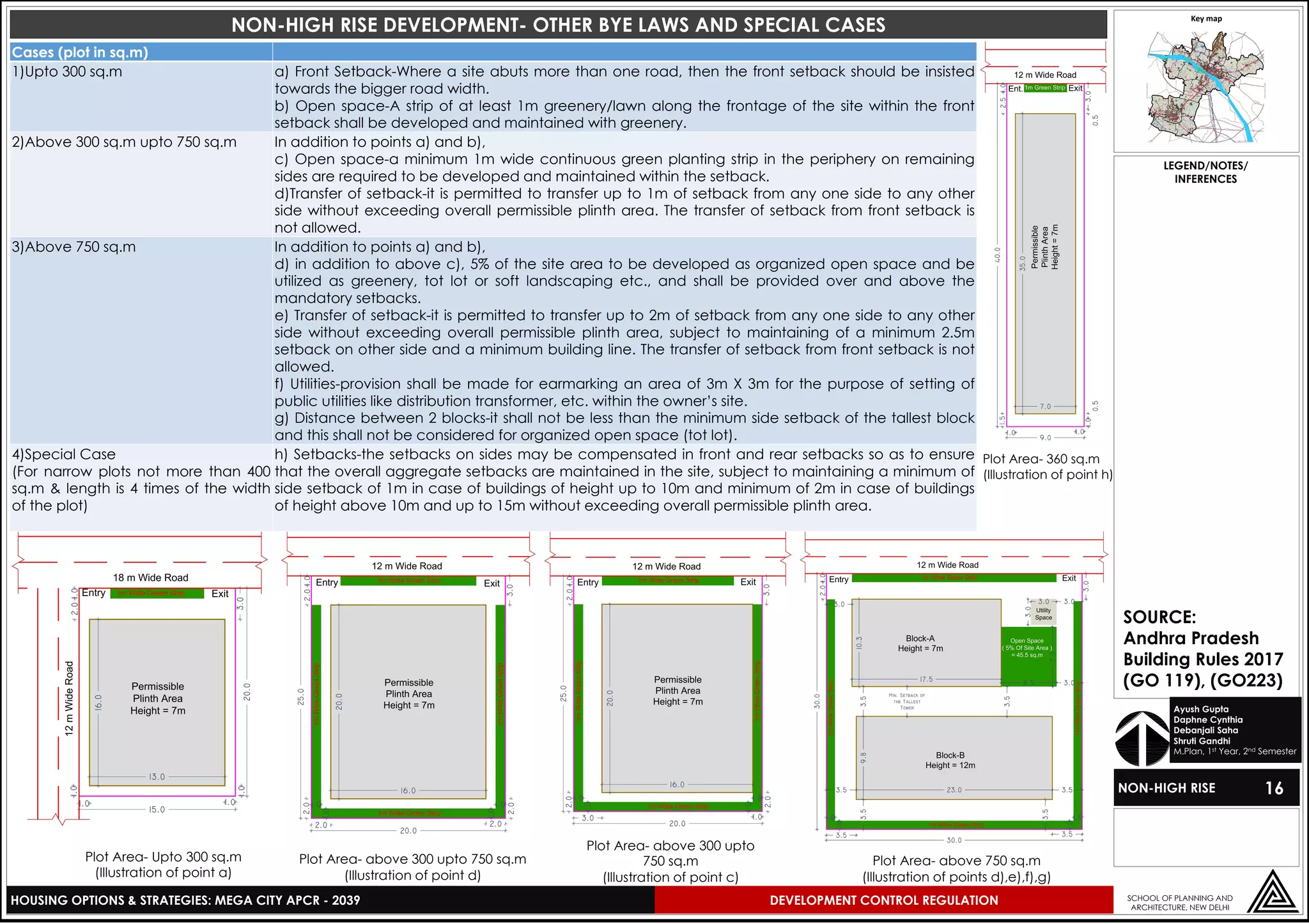
NON-HIGH RISE DEVELOPMENT- OTHER BYE LAWS AND SPECIAL CASES
SOURCE:
Andhra Pradesh
Building Rules 2017
(GO 119), (GO223)
Plot Area- Upto 300 sq.m
(Illustration of point a)
Plot Area- above 300 upto
750 sq.m
(Illustration of point c)
Plot Area- above 300 upto 750 sq.m
(Illustration of point d)
Plot Area- above 750 sq.m
(Illustration of points d),e),f),g)
Plot Area- 360 sq.m
(Illustration of point h)
Cases (plot in sq.m)
1)Upto 300 sq.m a) Front Setback-Where a site abuts more than one road, then the front setback should be insisted
towards the bigger road width.
b) Open space-A strip of at least 1m greenery/lawn along the frontage of the site within the front
setback shall be developed and maintained with greenery.
2)Above 300 sq.m upto 750 sq.m In addition to points a) and b),
c) Open space-a minimum 1m wide continuous green planting strip in the periphery on remaining
sides are required to be developed and maintained within the setback.
d)Transfer of setback-it is permitted to transfer up to 1m of setback from any one side to any other
side without exceeding overall permissible plinth area. The transfer of setback from front setback is
not allowed.
3)Above 750 sq.m In addition to points a) and b),
d) in addition to above c), 5% of the site area to be developed as organized open space and be
utilized as greenery, tot lot or soft landscaping etc., and shall be provided over and above the
mandatory setbacks.
e) Transfer of setback-it is permitted to transfer up to 2m of setback from any one side to any other
side without exceeding overall permissible plinth area, subject to maintaining of a minimum 2.5m
setback on other side and a minimum building line. The transfer of setback from front setback is not
allowed.
f) Utilities-provision shall be made for earmarking an area of 3m X 3m for the purpose of setting of
public utilities like distribution transformer, etc. within the owner’s site.
g) Distance between 2 blocks-it shall not be less than the minimum side setback of the tallest block
and this shall not be considered for organized open space (tot lot).
4)Special Case
(For narrow plots not more than 400
sq.m & length is 4 times of the width
of the plot)
h) Setbacks-the setbacks on sides may be compensated in front and rear setbacks so as to ensure
that the overall aggregate setbacks are maintained in the site, subject to maintaining a minimum of
side setback of 1m in case of buildings of height up to 10m and minimum of 2m in case of buildings
of height above 10m and up to 15m without exceeding overall permissible plinth area.
Category Sides (M) Remark
Plot Size 900 sq.mt Given
Road Width 12m Given
B/W Blocks 3.5 m Min. side setback of block -B
Front Setback 3m Only applicable of Block-A
Side Setback
(Block-A)
3m Required
Side Setback
(Block-B)
3.5m Required
Height (P) 7m – Block-A
12m- Block-B
Permissible
Green Strip 1m wide all around Plot size above 750 sq.mt
Open Space 45.5 sq.mt 5% of the Plot Area
Built-up Area
(Block-A)
10.3x17.5x2=360.5
sq.mt
Plinth X Floors(Allowed)
Built-up Area
(Block-B)
9.8x23x4=901.6 sq.mt Plinth X Floors(Allowed)
Parking Block-A 72.1 sq.mt 20% of the Built-up Area
Parking Block-B 180.32 sq.mt 20% of the Built-up Area
Common
Amenities
NA Plot less than 5 acres
Utility Space 3m X 3m Plot Size above 750 sq.mt
17
LEGEND/NOTES/
INFERENCES
Ayush Gupta
Daphne Cynthia
Debanjali Saha
Shruti Gandhi
M.Plan, 1st Year, 2nd Semester
z
HOUSING OPTIONS & STRATEGIES: MEGA CITY APCR - 2039
SCHOOL OF PLANNING
AND ARCHITECTURE,
NEW DELHI
NON-HIGH RISE
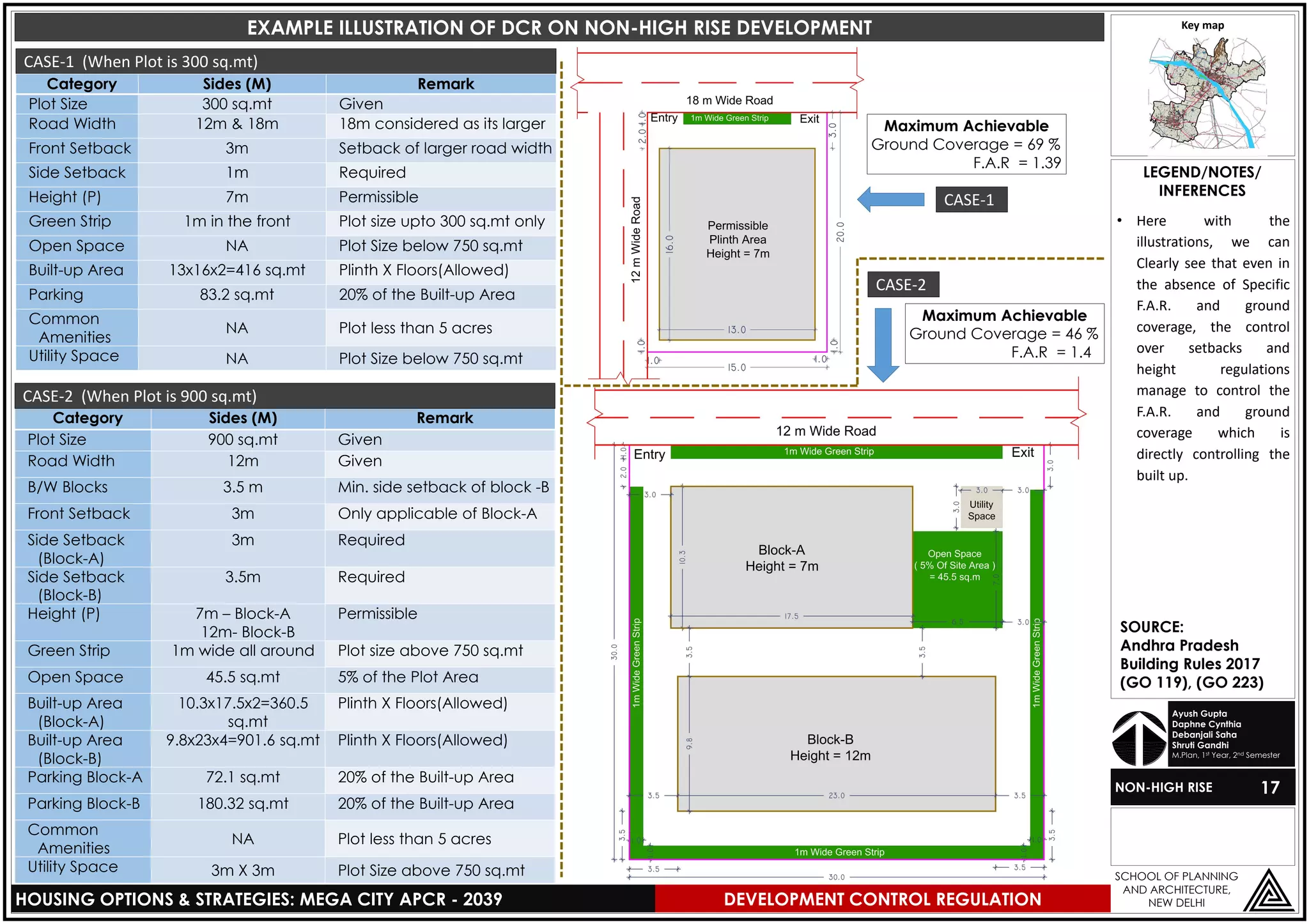
Key mapEXAMPLE ILLUSTRATION OF DCR ON NON-HIGH RISE DEVELOPMENT
Maximum Achievable
Ground Coverage = 69 %
F.A.R = 1.39
CASE-1 (When Plot is 300 sq.mt)
Category Sides (M) Remark
Plot Size 300 sq.mt Given
Road Width 12m & 18m 18m considered as its larger
Front Setback 3m Setback of larger road width
Side Setback 1m Required
Height (P) 7m Permissible
Green Strip 1m in the front Plot size upto 300 sq.mt only
Open Space NA Plot Size below 750 sq.mt
Built-up Area 13x16x2=416 sq.mt Plinth X Floors(Allowed)
Parking 83.2 sq.mt 20% of the Built-up Area
Common
Amenities
NA Plot less than 5 acres
Utility Space NA Plot Size below 750 sq.mt
CASE-2 (When Plot is 900 sq.mt)
CASE-1
CASE-2
Maximum Achievable
Ground Coverage = 46 %
F.A.R = 1.4
SOURCE:
Andhra Pradesh
Building Rules 2017
(GO 119), (GO 223)
• Here with the
illustrations, we can
Clearly see that even in
the absence of Specific
F.A.R. and ground
coverage, the control
over setbacks and
height regulations
manage to control the
F.A.R. and ground
coverage which is
directly controlling the
built up.
DEVELOPMENT CONTROL REGULATION
18
LEGEND/NOTES/
INFERENCES
Ayush Gupta
Daphne Cynthia
Debanjali Saha
Shruti Gandhi
M.Plan, 1st Year, 2nd Semester
z
HOUSING OPTIONS & STRATEGIES: MEGA CITY APCR - 2039
SCHOOL OF PLANNING
AND ARCHITECTURE,
NEW DELHI
HIGH RISE
Key map
S.no
Height of Building
in meters
Minimum abutting
road width
(in meters)
All round
Setbacks
(in meters)Above upto
1 18 21 12 7
2 21 24 12 8
3 24 27 18 9
4 27 30 18 10
5 30 35 24 11
6 35 40 24 12
7 40 45 24 13
8 45 50 30 14
9 50 55 30 15
After 55m 0.5m additional setback for every 5m of height shall be insisted
SETBACKS FOR HIGH RISE BUILDINGS
Minimum Plot Area: 2000 sq m.
Access Road: Minimum width of 12 m
Applications:
•There shall be no restriction on the maximum permissible height
of any Multi-storied Buildings subject to multi-storeyed building
regulations and necessary clearance from Fire Services Dept.
And National Airport Authority.
Location & Plot Area:
• Minimum Plot Area: 1000 sq m. & Min. Width of plot-12m
• Access Road: Minimum width of 12 m
Applications:
• Prior Clearance from Airport Authority
• Prior No Objection Certificate (NOC) from the Andhra Pradesh
State Disaster Response & Fire Services Department
[APSDR&FSD]
Location & Plot Area:
•High Rise Buildings/Complexes shall be permissible only in areas
notified by the sanctioning Authority with prior approval from the
competent Authority from time to time.
•High rise Buildings shall not be permissible in congested areas
and in gram kantam areas.
• Minimum Plot Area: 2000 sq m.
• Access Road: Minimum width of 12 m
SOURCE:
G0 423(1998) Practised
in Vijaywada,ZDP 2007.
& Andhra Pradesh
Building Rules 2017
(GO 119), (GO 223)
HIGH RISE BUILDINGS
G0.423(1998)G0.119(2107)
1. Tower and Podium Type Building:
i) Height of the building shall be allowed up to 50m.
ii)For Podium, i.e., Ground plus first floor: all-round setbacks
shall be 7m.
iii) For Tower block: The maximum coverage shall be 50 % of
the Podium Block i.e. setback area shall be at least 50% of
the Podium Block subject to a minimum of 3m on any side.
iv) No projection shall be made into the setback.
v) The fire safety and fire escape measures for the Tower
Block shall be independent of the Podium Block.
2. “Stepped Type” or “Pyramidal Type” Building:
i) Such type of High Rise Building blocks may be allowed for
heights above 30m with the following open space
requirements:
ii)At Ground level: Minimum 9m all round open space for the
first five floors.
iii) At Upper floors: Increase of 2m all round open space or
more, for every 5 upper floors or 15m height or part
thereof, over and above the ground level open space of
minimum 9m.
iv) No projection shall be made into the setback.
SPECIAL TYPE OF HIGH RISE BUILDINGS
• The open space to be left between two blocks shall be
equivalent to the Setback and this shall not be considered
for organized open space (Tot lot).
• In case of high rise buildings up to 30m height, it is
permitted to transfer up to 2m of setback from one side to
the other side, which needs to be uniform at any given
point, subject to maintaining the minimum setback of 7m
on all sides and not exceeding the permissible/allowable
plinth area.
• Buildings abutting major road of 30m and above width shall
be permitted only after providing black-topped service
roads of minimum 7m width with minimum 2 Lane
carriageway within the defined right of way. It will be the
responsibility of the developer/builder/owner to provide
the above service road of the standards fixed by the
Sanctioning Authority at his own cost.
• Parking floors in High rise buildings are excluded from
calculation of height of building.
HIGH RISE DEVELOPMENT
MULTI-STORIED BUILDINGS
• As compared to non-
high rise buildings with
specific setbacks for
front, rear and side
setbacks, high rise
building have common
all round setbacks.
• All round setbacks are
provided to ensure fire
tender movement.
DEVELOPMENT CONTROL REGULATION
19
LEGEND/NOTES/
INFERENCES
Ayush Gupta
Daphne Cynthia
Debanjali Saha
Shruti Gandhi
M.Plan, 1st Year, 2nd Semester
z
HOUSING OPTIONS & STRATEGIES: MEGA CITY APCR - 2039
SCHOOL OF PLANNING
AND ARCHITECTURE,
NEW DELHI
HIGH RISE
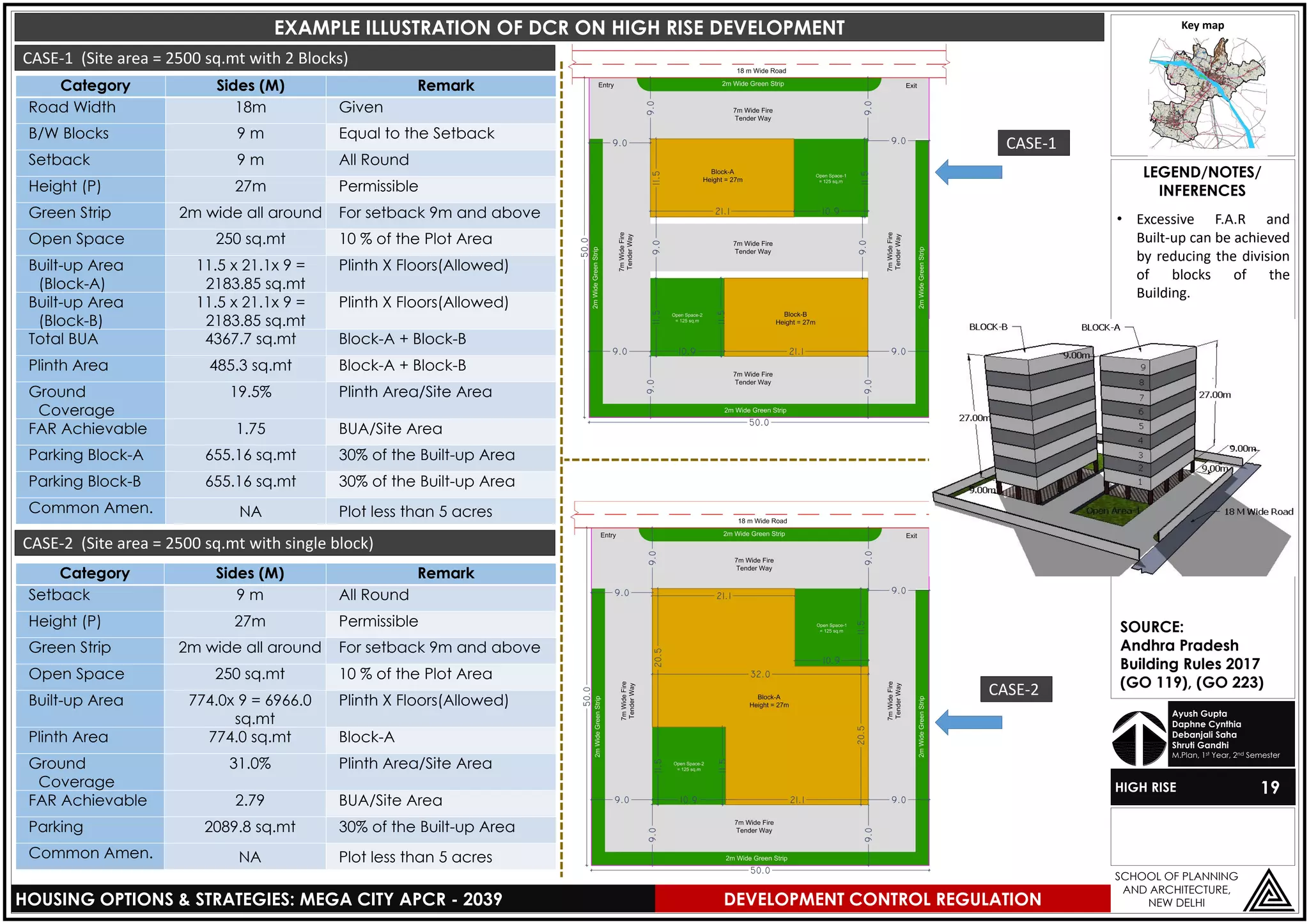
Key mapEXAMPLE ILLUSTRATION OF DCR ON HIGH RISE DEVELOPMENT
Category Sides (M) Remark
Road Width 18m Given
B/W Blocks 9 m Equal to the Setback
Setback 9 m All Round
Height (P) 27m Permissible
Green Strip 2m wide all around For setback 9m and above
Open Space 250 sq.mt 10 % of the Plot Area
Built-up Area
(Block-A)
11.5 x 21.1x 9 =
2183.85 sq.mt
Plinth X Floors(Allowed)
Built-up Area
(Block-B)
11.5 x 21.1x 9 =
2183.85 sq.mt
Plinth X Floors(Allowed)
Total BUA 4367.7 sq.mt Block-A + Block-B
Plinth Area 485.3 sq.mt Block-A + Block-B
Ground
Coverage
19.5% Plinth Area/Site Area
FAR Achievable 1.75 BUA/Site Area
Parking Block-A 655.16 sq.mt 30% of the Built-up Area
Parking Block-B 655.16 sq.mt 30% of the Built-up Area
Common Amen. NA Plot less than 5 acres
CASE-2 (Site area = 2500 sq.mt with single block)
CASE-1
CASE-2
CASE-1 (Site area = 2500 sq.mt with 2 Blocks)
Category Sides (M) Remark
Setback 9 m All Round
Height (P) 27m Permissible
Green Strip 2m wide all around For setback 9m and above
Open Space 250 sq.mt 10 % of the Plot Area
Built-up Area 774.0x 9 = 6966.0
sq.mt
Plinth X Floors(Allowed)
Plinth Area 774.0 sq.mt Block-A
Ground
Coverage
31.0% Plinth Area/Site Area
FAR Achievable 2.79 BUA/Site Area
Parking 2089.8 sq.mt 30% of the Built-up Area
Common Amen. NA Plot less than 5 acres
SOURCE:
Andhra Pradesh
Building Rules 2017
(GO 119), (GO 223)
• Excessive F.A.R and
Built-up can be achieved
by reducing the division
of blocks of the
Building.
DEVELOPMENT CONTROL REGULATION
HOUSING OPTIONS & STRATEGIES: MEGA CITY APCR - 2039
SCHOOL OF PLANNING
AND ARCHITECTURE,
NEW DELHIDEVELOPMENT CONTROL REGULATION
HIGH RISE DEVELOPMENT
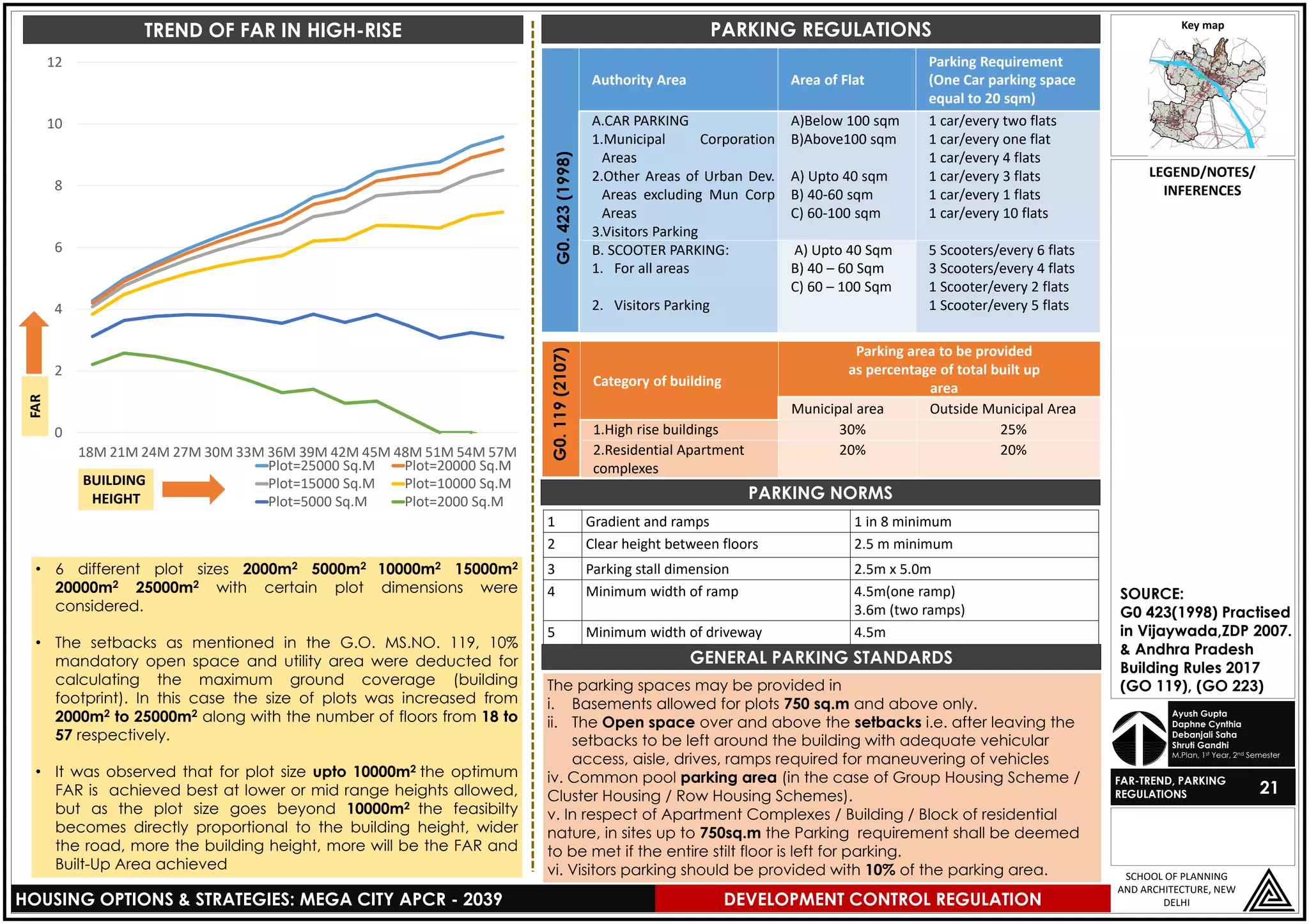
UNDERSTANDING OF FAR TREND IN DIFFERENT HIGHTS, PLOT SIZES AND ROAD WIDTHS
PARKING REGULATIONS
LEGEND/NOTES/
INFERENCES
z
HOUSING OPTIONS & STRATEGIES: MEGA CITY APCR - 2039
SCHOOL OF PLANNING
AND ARCHITECTURE, NEW
DELHI
Key map
Authority Area Area of Flat
Parking Requirement
(One Car parking space
equal to 20 sqm)
A.CAR PARKING
1.Municipal Corporation
Areas
2.Other Areas of Urban Dev.
Areas excluding Mun Corp
Areas
3.Visitors Parking
A)Below 100 sqm
B)Above100 sqm
A) Upto 40 sqm
B) 40-60 sqm
C) 60-100 sqm
1 car/every two flats
1 car/every one flat
1 car/every 4 flats
1 car/every 3 flats
1 car/every 1 flats
1 car/every 10 flats
B. SCOOTER PARKING:
1. For all areas
2. Visitors Parking
A) Upto 40 Sqm
B) 40 – 60 Sqm
C) 60 – 100 Sqm
5 Scooters/every 6 flats
3 Scooters/every 4 flats
1 Scooter/every 2 flats
1 Scooter/every 5 flats
Category of building
Parking area to be provided
as percentage of total built up
area
Municipal area Outside Municipal Area
1.High rise buildings 30% 25%
2.Residential Apartment
complexes
20% 20%
G0.423(1998)G0.119(2107)
The parking spaces may be provided in
i. Basements allowed for plots 750 sq.m and above only.
ii. The Open space over and above the setbacks i.e. after leaving the
setbacks to be left around the building with adequate vehicular
access, aisle, drives, ramps required for maneuvering of vehicles
iv. Common pool parking area (in the case of Group Housing Scheme /
Cluster Housing / Row Housing Schemes).
v. In respect of Apartment Complexes / Building / Block of residential
nature, in sites up to 750sq.m the Parking requirement shall be deemed
to be met if the entire stilt floor is left for parking.
vi. Visitors parking should be provided with 10% of the parking area.
1 Gradient and ramps 1 in 8 minimum
2 Clear height between floors 2.5 m minimum
3 Parking stall dimension 2.5m x 5.0m
4 Minimum width of ramp 4.5m(one ramp)
3.6m (two ramps)
5 Minimum width of driveway 4.5m
GENERAL PARKING STANDARDS
PARKING NORMS
SOURCE:
G0 423(1998) Practised
in Vijaywada,ZDP 2007.
& Andhra Pradesh
Building Rules 2017
(GO 119), (GO 223)
21
Ayush Gupta
Daphne Cynthia
Debanjali Saha
Shruti Gandhi
M.Plan, 1st Year, 2nd Semester
FAR-TREND, PARKING
REGULATIONS
TREND OF FAR IN HIGH-RISE
0
2
4
6
8
10
12
18M 21M 24M 27M 30M 33M 36M 39M 42M 45M 48M 51M 54M 57M
Plot=25000 Sq.M Plot=20000 Sq.M
Plot=15000 Sq.M Plot=10000 Sq.M
Plot=5000 Sq.M Plot=2000 Sq.M
DEVELOPMENT CONTROL REGULATION
BUILDING
HEIGHT
FAR
• 6 different plot sizes 2000m2 5000m2 10000m2 15000m2
20000m2 25000m2 with certain plot dimensions were
considered.
• The setbacks as mentioned in the G.O. MS.NO. 119, 10%
mandatory open space and utility area were deducted for
calculating the maximum ground coverage (building
footprint). In this case the size of plots was increased from
2000m2 to 25000m2 along with the number of floors from 18 to
57 respectively.
• It was observed that for plot size upto 10000m2 the optimum
FAR is achieved best at lower or mid range heights allowed,
but as the plot size goes beyond 10000m2 the feasibilty
becomes directly proportional to the building height, wider
the road, more the building height, more will be the FAR and
Built-Up Area achieved
GREEN BUILDING
22
LEGEND/NOTES/
INFERENCES
Ayush Gupta
Daphne Cynthia
Debanjali Saha
Shruti Gandhi
M.Plan, 1st Year, 2nd Semester
z
HOUSING OPTIONS & STRATEGIES: MEGA CITY APCR - 2039
SCHOOL OF PLANNING
AND ARCHITECTURE,
NEW DELHI
OPEN SPACES,
GREEN BUILDING
Key map
A green building is “one which uses less water, optimizes energy
efficiency, conserves natural resources, generates less waste and
provides healthier spaces for occupants, as compared to a
conventional building.” - IGBC
Plot
Category
Sub
category
Applicable
plot area
(Sq. m.)
Provisions for Residential
A B C D
I Below 300 Nil
II A 300-500 (1). Water Conservation and
Management
(a) Rain Water Harvesting
(by Recharge)
(2). Solar Energy Utilization
(b) Installation of Solar
Assisted Water Heating
Systems (Optional)
(4). Waste Management
B 500-1000 1) Water Conservation
and Management
Reduction of Hardscape
(3). Energy Efficiency
(c) Lighting of common areas
by Solar Energy/LED devices
(4) Waste Management
(a) Segregation of Waste
C 1000-3000 1) Water Conservation
and Management
Waste Water Recycle and
Reuse
Solar Energy Utilization
(a)Installation of Solar
Photovoltaic Panels
Energy Efficiency
(b) Energy Efficiency in
HVAC systems
III A Above 3000 Water Conservation and
Management
Low Water Consumption
Energy Efficiency Low Energy
Consumption Lighting Fixtures
SOURCE:
Andhra Pradesh
Building Rules 2017
(GO 119), (GO 223)
Row housing
Minimum Open Space (Park) 10% in plots
200 sq.m. & above.
Individual residential
building
Nothing specified about open spaces
Group housing/
apartment scheme
Recreational Open Space (Tot-Lot)
A) Plot upto 2000 sq .m. - 5% of plot area.
B) Plots above 2000 sq. m - 10% of plot
area.
• A strip of at least 1m greenery/lawn to be provided within setback along
frontage.
• For Plots above 300sq.m, a minimum 1m wide continuous green planting
strip in the periphery on remaining sides are required to be developed and
maintained within the setback.
• For above 750sq.m, in addition to above two points, 5% of the site area to
be developed as organized open space and be utilized as greenery, tot lot
or soft landscaping etc., and shall be provided over and above the
mandatory setbacks.
• Such organized open space could be in more than one location and shall
be of a minimum width of 3m with a minimum area of 15sq.m at each
location.
• If the strip of greenery/lawn and the organized open space (tot lot) are not
maintained, 10% of additional Property Tax every year shall be imposed
• The space between 2 blocks shall not be less than the minimum side
setback of the tallest block and this shall not be considered for organized
open space (tot lot).
G0.423(1998)
1. Row housing Minimum open space: 10 % of site area.
2. Individual residential
building
Minimum size of cluster open space
36sq.m with a minimum width of 6m.
3. Group housing/
apartment scheme
Minimum of 10% of site area shall be
provided for organized open space
G0.119(2107)
HIGH RISE BUILDINGS
OPEN SPACES
NON- HIGH RISE BUILDINGS
• Where the lighting and ventilation of a building is through the means of a chowk or inner
courtyard or interior open space/duct, such open space shall be open to sky and area of at
least 25sq.m and no side shall be less than 3m.
• This space shall be at least 10% of total site area at ground level open to sky and shall be a
minimum width of 4.5m. This may be provided in one or more pockets with minimum area
of 50sq.m at each location.
• A minimum of 2m wide green planting strip in the periphery on all sides within the setbacks
(All round open spaces) where setback is 9m and above are required to be developed and
maintained.
DEVELOPMENT CONTROL REGULATION
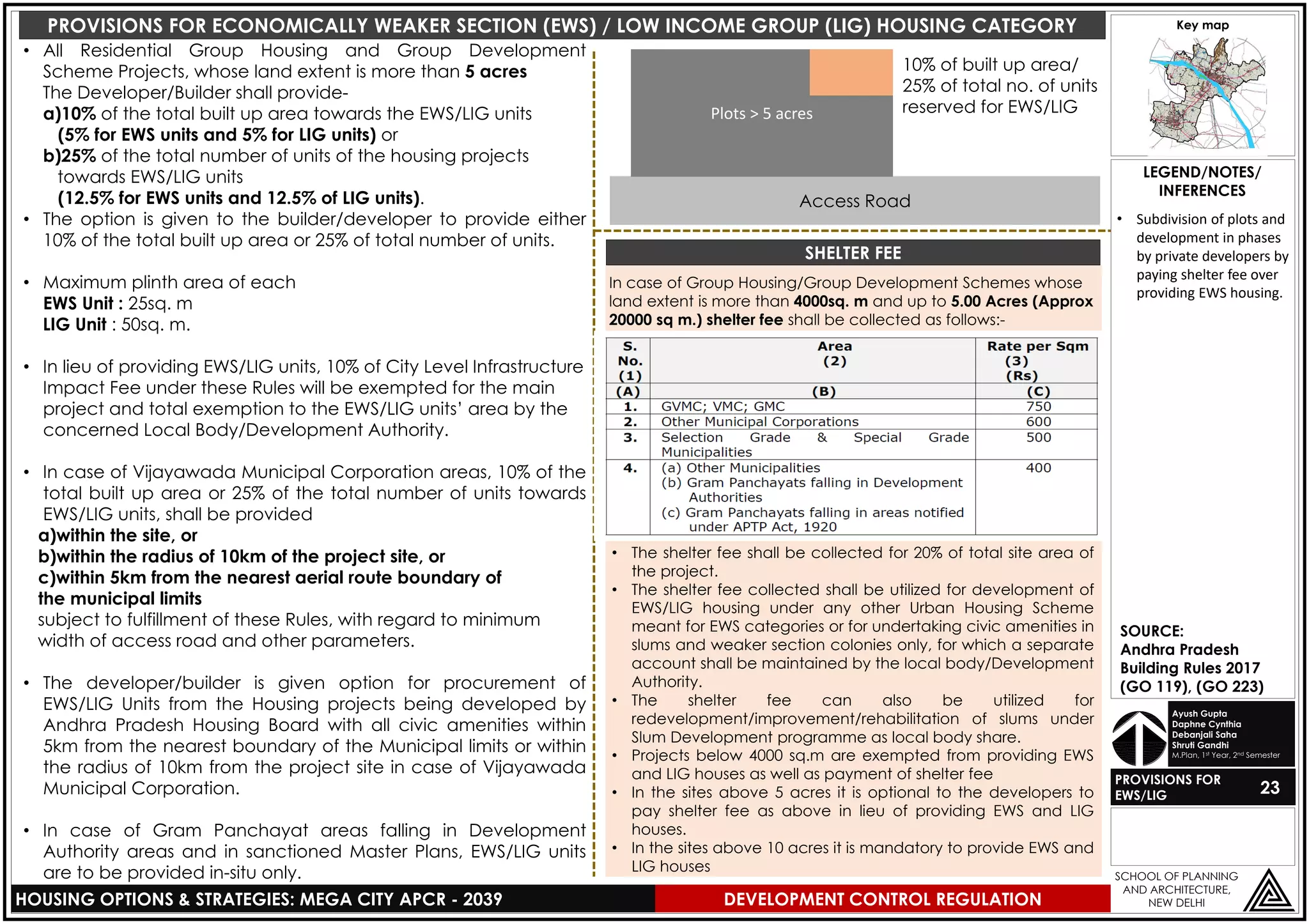
• The shelter fee shall be collected for 20% of total site area of
the project.
• The shelter fee collected shall be utilized for development of
EWS/LIG housing under any other Urban Housing Scheme
meant for EWS categories or for undertaking civic amenities in
slums and weaker section colonies only, for which a separate
account shall be maintained by the local body/Development
Authority.
• The shelter fee can also be utilized for
redevelopment/improvement/rehabilitation of slums under
Slum Development programme as local body share.
• Projects below 4000 sq.m are exempted from providing EWS
and LIG houses as well as payment of shelter fee
• In the sites above 5 acres it is optional to the developers to
pay shelter fee as above in lieu of providing EWS and LIG
houses.
• In the sites above 10 acres it is mandatory to provide EWS and
LIG houses
23
LEGEND/NOTES/
INFERENCES
Ayush Gupta
Daphne Cynthia
Debanjali Saha
Shruti Gandhi
M.Plan, 1st Year, 2nd Semester
z
HOUSING OPTIONS & STRATEGIES: MEGA CITY APCR - 2039
SCHOOL OF PLANNING
AND ARCHITECTURE,
NEW DELHI
PROVISIONS FOR
EWS/LIG
Key map
SOURCE:
Andhra Pradesh
Building Rules 2017
(GO 119), (GO 223)
• All Residential Group Housing and Group Development
Scheme Projects, whose land extent is more than 5 acres
The Developer/Builder shall provide-
a)10% of the total built up area towards the EWS/LIG units
(5% for EWS units and 5% for LIG units) or
b)25% of the total number of units of the housing projects
towards EWS/LIG units
(12.5% for EWS units and 12.5% of LIG units).
• The option is given to the builder/developer to provide either
10% of the total built up area or 25% of total number of units.
• Maximum plinth area of each
EWS Unit : 25sq. m
LIG Unit : 50sq. m.
• In lieu of providing EWS/LIG units, 10% of City Level Infrastructure
Impact Fee under these Rules will be exempted for the main
project and total exemption to the EWS/LIG units’ area by the
concerned Local Body/Development Authority.
• In case of Vijayawada Municipal Corporation areas, 10% of the
total built up area or 25% of the total number of units towards
EWS/LIG units, shall be provided
a)within the site, or
b)within the radius of 10km of the project site, or
c)within 5km from the nearest aerial route boundary of
the municipal limits
subject to fulfillment of these Rules, with regard to minimum
width of access road and other parameters.
• The developer/builder is given option for procurement of
EWS/LIG Units from the Housing projects being developed by
Andhra Pradesh Housing Board with all civic amenities within
5km from the nearest boundary of the Municipal limits or within
the radius of 10km from the project site in case of Vijayawada
Municipal Corporation.
• In case of Gram Panchayat areas falling in Development
Authority areas and in sanctioned Master Plans, EWS/LIG units
are to be provided in-situ only.
PROVISIONS FOR ECONOMICALLY WEAKER SECTION (EWS) / LOW INCOME GROUP (LIG) HOUSING CATEGORY
In case of Group Housing/Group Development Schemes whose
land extent is more than 4000sq. m and up to 5.00 Acres (Approx
20000 sq m.) shelter fee shall be collected as follows:-
Access Road
Plots > 5 acres
10% of built up area/
25% of total no. of units
reserved for EWS/LIG
SHELTER FEE
• Subdivision of plots and
development in phases
by private developers by
paying shelter fee over
providing EWS housing.
DEVELOPMENT CONTROL REGULATION
When part of land owned by an individual has to be acquired by the govt. for
community purposes such as road widening,etc. the owner has an option of
choosing to utilize a specific built up area of land elsewhere, (relative to the area
of plot he is giving up), instead of monetary compensation. Equivalent built
up area in
additional floor
Allowed
concessions in
setbacks
Adjustment in
Landvalue
towards building
permit fee and
charges
Adjustment of
City Level
Infrastructure
Impact fee
towards the value
of the land
surrendered
• The extent of concessions given shall be such
that the total built up area after concession shall
not exceed the sum of built up area allowed (as
proposed) on total area without road widening
and built up area equivalent to surrendered
area.
• TDR can either be sold or can be utilized by the
same owner depending on convenience.
• TDR shall not be applicable in larger projects i.e.
in Group Development Schemes of more than 5
Acs. in extent.
In case of High Rise Buildings the concessions in
setbacks, other than the front setback would be
considered subject to maintaining minimum clear
setback of 7m on the sides and rear side and such
minimum set-back area shall be clear without any
obstructions to facilitate movement of fire fighting
vehicles or their effective operation
TYPES OF TDR
ROAD TDR
400%
CONSERVATION
TDR
200%
HERITAGE
TDR
200%
PROJECTS >
4000 sq.m
Only in peripheral
or access roads,
which are in
excess of the
minimum
requirement of
30%
SHRUTI GANDHI
DAPHNE CYNTHIA C
DEBANJALI SAHA
AYUSH GUPTA
M. Plan 1st Year, 2nd
Semester
z
HOUSING OPTIONS & STRATEGIES: MEGA CITY APCR - 2039 APPROVAL PROCESSES
SCHOOL OF PLANNING
AND ARCHITECTURE,
NEW DELHI
TDR
KEY MAP
TDR(TRANSFERRABLE DEVELOPMENT RIGHTS)
24Additional cellar unit permission
for units between 500-750 sq.m
Min. rear and side Setbacks for concession
Min. Front Setbacks for concession
sources
www.apgov.in
Primary survey
ADVANTAGES :
• a perfect urban development tool as it facilitates the development of suburban locations.
DISADVANTAGES :
• Developers use it as a tool to maximize the saleable area in a few prime locations. This excessive construction has resulted in
congestion in the suburbs, haphazard and unplanned development, and intense pressure on infrastructure
• it has lead to an increase in the real estate prices. Since the TDR acquisition cost is loaded onto the project cost, the
developers increase the final pricing of the project.
In order to curb
the loopholes and
shooting of real
estate prices, the
Government
should have some
mechanism to
keep a check on
the quantum of
TDR available in
the market and
the trading price.
TDR programs depend on a careful
balance between sending and receiving
areas; the demand and the price
landowners are willing to pay to increase
the density of development in the receiving
area needs to balance with the willingness
of landowners in the sending areas to sell
their development rights and at an
appropriate cost.
SHRUTI GANDHI
DAPHNE CYNTHIA C
DEBANJALI SAHA
AYUSH GUPTA
M. Plan 1st Year, 2nd
Semester
z
HOUSING OPTIONS & STRATEGIES: MEGA CITY APCR - 2039 APPROVAL PROCESSES
SCHOOL OF PLANNING
AND ARCHITECTURE,
NEW DELHI
TDR
KEY MAP
TDR(TRANSFERRABLE DEVELOPMENT RIGHTS)
25
SENDING ZONES
RECEIVING ZONES
sources
www.apgov.in
Primary survey
26
LEGEND
Ayush Gupta
Daphne Cynthia
Debanjali Saha
Shruti Gandhi
M.Plan, 1st Year, 2nd Semester
z
HOUSING OPTIONS & STRATEGIES: MEGA CITY APCR - 2039
SCHOOL OF PLANNING
AND ARCHITECTURE,
NEW DELHI
ZONES DISTRIBUTION IN
AMARAVATI
Key map
AMARAVATI MASTER PLAN AND ZONES DISTRIBUTION
SOURCE:
-Amaravati Concept
Handbook(2017),
-Amaravati Zoning
Regulations(2016)
SCALE:
RESIDENTIAL TYPOLOGIES
INDIVIDUAL HOUSE
(LANDED UNITS)
 DETACHED
 SEMI-DETACHED
 DORMITORY
 FARM HOUSE
 ROW HOUSING
 GUEST HOUSE
 HOSTEL
 PROFESSIONAL’S
RESIDENCE
 APARTMENT
 GROUP
DEVELOPMENT
 SERVICE
APARTMENT
 UTILITY STAFF
HOUSING
 WORKERS’S
QUARTERS
MULTIPLE HOUSING
UNIT
R1
SUB - DISTRICTS
PERMITTING RESIDENTIAL
USE
VILLAGE PLANNING
ZONE
R2 LOW DENSITY ZONE
R3
MEDIUM TO HIGH
DENSITY ZONE
R4 HIGH DENSITY ZONE
C1
MIXED USE
COMMERCIAL ZONE
TOTAL ZONES – 6
SUB – DISTRICTS - 21
Village
Planning
Zone
25%
Low Density
0.5%
Medium to
High Density
Zone
73%
High Density
1.5%
PERCENTAGE OF RESIDENTIAL ZONE IN THE
MASTER PLAN = 32.02%
MASTERPLAN OF
AMARAVATI
DEVELOPMENT CONTROL REGULATION
27
LEGEND
Ayush Gupta
Daphne Cynthia
Debanjali Saha
Shruti Gandhi
M.Plan, 1st Year, 2nd Semester
z
HOUSING OPTIONS & STRATEGIES: MEGA CITY APCR - 2039
SCHOOL OF PLANNING
AND ARCHITECTURE,
NEW DELHI
Zoning Regulation-
Amaravati.
Key map
ZONING REGULATION MATRIX (APPENDIX-II)
SOURCE:
-Amaravati Zoning
Regulations(2016)
PLOT RANGE
Category PLOT SIZE (Above-Upto)
100 100 to 300 sq.m
300 Above 300 upto 500 sq.m
500 Above 500 upto 2000 sq.m
2000 Above 2000 upto 4000 sq.m
4000 Above 4000 sq.m
PARKING REQUIREMENTS
Category PLOT SIZE (Above-Upto)
Residence 1 Stall per Dwelling Unit
Service Apt. 1 Stall per Apartment
Visitors Only for Apartments and
Group Development.
(1 per 10 Dwelling Units)
Category PLOT SIZE (Above-Upto)
Base-
ment
• Allowed above 500 sq.m Plot
• Ventilation not less than 2.5%
of the Basement Floor Area.
10% can be used as Utilities (AC
plant room, Generator Room,
Sewage Treatment Plant,
Electrical Installation and
Laundry Room
Ramp
3.6 m wide (for One-way)
5.4 m wide (for Two-way)
Drive-
way
2.8 m wide (for One-way)
4.5 m wide (for Two-way)
Height
Normal = 2.65 M (Maximum)
Mechanical = 4.5 M (Maximum)
PARKING AND DRIVE-WAY REGULATIONS FOR APARTMENTS/GROUP DEVELOPMENT HAVING 100 UNITS
AND ABOVE
1) Minimum 3% of Built-Up Area upto maximum of 2000sq.m shall be
planned and developed for common amenities like Convenient Shopping,
Community Hall, Club House, Creche, Gymnasium.
2) Common amenities block shall not be the part of Residential Plots,
However in case of single block, amenities can be provided in the same
block.
3) Minimum 10% of the Plot area/Site area shall be provided for Tot-
lot/Open spaces, where 50% of the Tot-lot shall be at one place.
4) Provision of Solar water heater and Solar Lighting should be made in
these kind of development.
Y = YES/MANDATORY
N = NO/NOT MANDATORY
TP = TYPOLOGY
A = ATTACHED
D = DETACHED
SD = SEMI-DETACHED
AL = ANCILARY
AP = APARTMENT
HR = HIGH RISE
GD = GROUP DEVELOPMENT
AN = ANY
1 STALL = A PARKING SPACE ( 5M x 2.5M )
C = CONTINUOUS
Subject to approval from fire,
airport, statutory authorities &
Commissioner, APCRDA.
Provisions for EWS/LIG Housing shall be followed where proposed
site area for residential project is 4000 sq.m and above by
reserving 10% bua or 25% od DU’s or Shelter fee
• To control the density of
a particular area, the
residential zone has
been divided into 5
Zoning Districts.
• On the basis of the
zoning districts, the
densities are controlled
with the help of
setbacks, FAR and
Ground Coverage.
INFERENCE
DEVELOPMENT CONTROL REGULATION
There are 3 types of TDR followed in the capital city. The road
widening cases obtain 200% TDR, while the heritage and
conservation cases are given 100% TDR
28
LEGEND
ZONING REGULATION TABLE FOR VILLAGE PLANNING ZONE (R1)
SOURCE:
-Amaravati Zoning
Regulations(2016)
Category REGULATIONS
USAGE
RESIDENTIAL
TYPE
• Attached (A)
• Semi-detached (SD)
• Detached (D)
• Apartment (AP)
• Group Development (GD)
ACCESS
ROAD
WIDTH
• Minimum 12 M for Apartments & Group
development
• Minimum 9 M for rest of the Usage.
BUILDABLE AREA
PLOT SIZE
• Attached = 100 sq.m
• Semi-detached = 100 sq.m
• Detached = 100 sq.m
• Apartment = Above 300 sq.m
• Group Development = Above 4000 sq.m
COVERAGE
• Group Development = 50%
• Apartment Above 500 sq.m = 50%
• Rest all kind of Residential Type = 60%
FLOOR SPACE INDEX
(FSI)
1.4 for all kind of Residential Type
BUILDING HEIGHT
NUMBER OF FLOORS
• G+3 for below 300 sq.m
• G+4 for 300 sq.m and above
• G for Ancillary Buildings
FLOOR TO FLOOR
• Ground Floor – 4.5 M (Maximum)
• Other Floors – 3.6 M (Maximum)
SETBACKS AS PER APPENDIX-II
PARKING AS PER APPENDIX-II
GREEN AND RECREATIONAL AREAS AS PER APPENDIX-II
WHAT IS VILLAGE PLANNING ZONE R1?
Ayush Gupta
Daphne Cynthia
Debanjali Saha
Shruti Gandhi
M.Plan, 1st Year, 2nd Semester
z
HOUSING OPTIONS & STRATEGIES: MEGA CITY APCR - 2039
SCHOOL OF PLANNING
AND ARCHITECTURE,
NEW DELHI
Zoning Regulation-
Amaravati.
Key map
Detached Development
Plan (NTS)
Semi-Detached Development
Plan (NTS)
Detached Development
View (NTS)
Attached Development Plan (NTS)
P1 P1 P1
P1 P1 P1 P1 P1 P1 P1 P1
It is a zoning district offering low rise developments within the existing
villages. The R1 Zone is intended to offer low rise housing as part of the
farming community and complementary public facilities as needed. The
purpose is to create good community areas within the villages falling
within the capital city.
B1 = Primary Building
B2 = Ancillary Building
P1 = Parking Lot
L1 = Landscape Area
Attached Development
View (NTS)
• F.A.R was introduced
in order to control the
development of
Amravati, since it is a
Greenfield
development. At an
Initial level, there is a
need to control
densities and
development, but there
is a provision of
removal of FAR in the
later stage.
INFERENCE
DEVELOPMENT CONTROL REGULATION
29
LEGEND
Ayush Gupta
Daphne Cynthia
Debanjali Saha
Shruti Gandhi
M.Plan, 1st Year, 2nd Semester
z
HOUSING OPTIONS & STRATEGIES: MEGA CITY APCR - 2039
SCHOOL OF PLANNING
AND ARCHITECTURE,
NEW DELHI
Zoning Regulation-
Amaravati.
Key map
ZONING REGULATION TABLE FOR LOW DENSITY ZONE (R2)
SOURCE:
-Amaravati Zoning
Regulations(2016)
Category REGULATIONS
USAGE
RESIDENTIAL
TYPE
• Attached (A)
• Semi-detached (SD)
• Detached (D)
• Apartment (AP)
ACCESS
ROAD
WIDTH
• Minimum 12 M for Apartments
• Minimum 9 M for rest of the Usage.
BUILDABLE AREA
PLOT SIZE
• Attached = 250 sq.m
• Semi-detached = 250 sq.m
• Detached = 450 sq.m
• Apartment = 500 sq.m
COVERAGE
• Apartment Above 500 sq.m = 40%
• Rest all kind of Residential Type =50%
FLOOR SPACE INDEX
(FSI)
• 1.2 for apartment (AP)
• 1.0 for rest all kind of Residential Type
BUILDING HEIGHT
NUMBER OF FLOORS
• G+4 for Apartment (AP)
• G+2 for rest all kind of residential type
• G for Ancillary Buildings
FLOOR TO FLOOR
• Ground Floor – 4.5 M (Maximum)
• Other Floors – 3.6 M (Maximum)
SETBACKS AS PER APPENDIX-II
PARKING AS PER APPENDIX-II
GREEN AND RECREATIONAL AREAS AS PER APPENDIX-II
WHAT IS LOW DENSITY ZONE R2?
The R2 is a zoning district established to develop low density premium
residential developments. The Zone allows development of detached,
semi detached, attached houses and apartments. This zone is in
proximity to the ceremonial axis.
B1 = Primary Building
B2 = Ancillary Building
P1 = Parking Lot
L1 = Landscape Area
Detached Development
Plan (NTS)
Semi-Detached
Development Plan (NTS)
Detached Development
View (NTS)
Attached Development Plan (NTS)
Attached Development
View (NTS)
Semi-Detached
Development View (NTS)
Apartment
Development Plan (NTS)
Apartment Development
View (NTS)
P1
P1 P1
P1 P1P1
P1 P1
P1 P1 P1P1 P1
P1
P1
P1
P1
P1
DEVELOPMENT CONTROL REGULATION
30
LEGEND
Ayush Gupta
Daphne Cynthia
Debanjali Saha
Shruti Gandhi
M.Plan, 1st Year, 2nd Semester
z
HOUSING OPTIONS & STRATEGIES: MEGA CITY APCR - 2039
SCHOOL OF PLANNING
AND ARCHITECTURE,
NEW DELHI
Zoning Regulation-
Amaravati.
Key map
ZONING REGULATION TABLE FOR MEDIUM TO HIGH DENSITY ZONE (R3)
SOURCE:
-Amaravati Zoning
Regulations(2016)
Category REGULATIONS
USAGE
RESIDENTIAL
TYPE
• Attached (A)
• Semi-detached (SD)
• Detached (D)
• Apartment (AP) & Apartment High
Rise(AP_HR)
• Group Development (GD)
ACCESS
ROAD
WIDTH
• Minimum 12 M for Apartments & Group
development
• Minimum 9 M for rest of the Usage.
BUILDABLE AREA
PLOT SIZE
• Attached = 100 sq.m
• Semi-detached = 100 sq.m
• Detached = 100 sq.m
• Apartment = Above 300 sq.m
• Apartment High Rise =Above 2000 sq.m
• Group Development = Above 4000 sq.m
COVERAGE
• Group Development = 50%
• Apartment Above 2000 sq.m = 50%
• Rest all kind of Residential Type = 60%
FLOOR SPACE INDEX
(FSI)
• 2.4 for Group Development
• 2.4 for High Density Apartment
(above 4000 sq.m)
• 2.0 for Medium Density Apartment (from
500 sq.m upto 4000 sq.m)
• 1.75 for rest all kind of Residential Type
BUILDING HEIGHT
NUMBER OF FLOORS
• G+3 for upto 300 sq.m
• G+5 for upto 2000 sq.m
• G+11(Apartment High Rise & Group
Development)
• G for Ancillary Buildings
FLOOR TO FLOOR
• Ground Floor – 4.5 M (Maximum)
• Other Floors – 3.6 M (Maximum)
SETBACKS AS PER APPENDIX-II
PARKING AS PER APPENDIX-II
GREEN AND RECREATIONAL AREAS AS PER APPENDIX-II
WHAT IS MEDIUM TO HIGH DENSITY ZONE R3?
B1 = Primary Building
B2 = Ancillary Building
P1 = Parking Lot
L1 = Landscape Area
Attached Development Plan (NTS) Attached Development View (NTS)
Medium Density Apartment
Development Plan (NTS)
R3 is a zoning district established to allow medium to high density
residential developments across the city, and create well planned
medium to high density housing complexes with ample open spaces. All
the returnable residential land for farmers falls under this zone.
High Density Apartment Development Plan (NTS)
Medium Density Apartment
Development View (NTS)
High Density Apartment
Development View (NTS)
P1 P1P1 P1 P1 P1P1 P1
P1
P1
P1
P1
P1
DEVELOPMENT CONTROL REGULATION
31
LEGEND
Ayush Gupta
Daphne Cynthia
Debanjali Saha
Shruti Gandhi
M.Plan, 1st Year, 2nd Semester
z
HOUSING OPTIONS & STRATEGIES: MEGA CITY APCR - 2039
SCHOOL OF PLANNING
AND ARCHITECTURE,
NEW DELHI
Zoning Regulation-
Amaravati.
Key map
ZONING REGULATION TABLE FOR HIGH DENSITY ZONE (R4)
SOURCE:
-Amaravati Zoning
Regulations(2016)
Category REGULATIONS
USAGE
RESIDENTIAL
TYPE
• Attached (A)
• Semi-detached (SD)
• Detached (D)
• Apartment (AP)
• High Rise (HR)
• Group Development (GD)
ACCESS
ROAD
WIDTH
• Minimum 12 M for Apartments & Group
development
• Minimum 9 M for rest of the Usage.
BUILDABLE AREA
PLOT SIZE • Above 4000 sq.m
COVERAGE • 50% (Maximum For all)
FLOOR SPACE INDEX
(FSI)
• 3.5 (Maximum For all)
BUILDING HEIGHT
NUMBER OF FLOORS
• Subject to approval from fire, airport,
statutory authorities & Commissioner,
APCRDA.
• G for Ancillary Buildings
FLOOR TO FLOOR
• Ground Floor – 4.5 M (Maximum)
• Other Floors – 3.6 M (Maximum)
SETBACKS AS PER APPENDIX-II
PARKING AS PER APPENDIX-II
GREEN AND RECREATIONAL AREAS AS PER APPENDIX-II
WHAT IS HIGH DENSITY ZONE R4?
R4 is a zoning district where are multi-family high density housing options
planned within the Capital City to provide high-quality public transport
oriented lifestyle for those who desire an urban lifestyle with easy access
to regional goods and services. This zone is largely planned along the
river front, and in areas with proximity to the town and regional centres.
Communal facilities with generous greening are encouraged to enhance
the quality of living in this high density environment.
B1 = Primary Building
B2 = Ancillary Building
P1 = Parking Lot
L1 = Landscape Area
High Density Apartment Development Plan (NTS)
High Density Apartment Development View (NTS)
P1
P1
DEVELOPMENT CONTROL REGULATION
32
LEGEND
Ayush Gupta
Daphne Cynthia
Debanjali Saha
Shruti Gandhi
M.Plan, 1st Year, 2nd Semester
z
HOUSING OPTIONS & STRATEGIES: MEGA CITY APCR - 2039
SCHOOL OF PLANNING
AND ARCHITECTURE,
NEW DELHI
Zoning Regulation-
Amaravati.
Key map
ZONING REGULATION TABLE FOR MIXED USE COMMERCIAL ZONE (C1)
SOURCE:
-Amaravati Zoning
Regulations(2016)
WHAT IS MIXED USE COMMERCIAL ZONE C1?
C1 is a zoning district to be used mainly for mixed residential and
commercial purposes, which can have up to 30% GFA used for
commercial purpose.
B1 = Primary Building
B2 = Ancillary Building
P1 = Parking Lot
L1 = Landscape Area
Category REGULATIONS
USAGE
RESIDENTIAL
TYPE
• Attached (A)
• Semi-detached (SD)
• Detached (D)
• Apartment (AP)
• High Rise(HR)
• Group Development (GD)
ACCESS
ROAD
WIDTH
• Minimum 12 M for Apartments & Group
development
• Minimum 9 M for rest of the Usage.
BUILDABLE AREA
PLOT SIZE • Above 4000 sq.m
COVERAGE
• Any Residential type= 50%
• High rise = 40%
FLOOR SPACE INDEX
(FSI)
• 3.5 (Maximum For all)
BUILDING HEIGHT
NUMBER OF FLOORS
• G+5 for any other Residential Type
• G+8 (High Rise Apartment)
• G for Ancillary Buildings
FLOOR TO FLOOR
• Ground Floor – 4.5 M (Maximum)
• Other Floors – 3.6 M (Maximum)
SETBACKS AS PER APPENDIX-II
PARKING AS PER APPENDIX-II
GREEN AND RECREATIONAL AREAS AS PER APPENDIX-II
Mixed Use Commercial Development Plan (NTS)
Mixed Use Commercial Development View (NTS)
DEVELOPMENT CONTROL REGULATION
33
LEGEND
Ayush Gupta
Daphne Cynthia
Debanjali Saha
Shruti Gandhi
M.Plan, 1st Year, 2nd Semester
z
HOUSING OPTIONS & STRATEGIES: MEGA CITY APCR - 2039
SCHOOL OF PLANNING
AND ARCHITECTURE,
NEW DELHI
Zoning Regulation-
Amaravati.
Key map
DENSITY CALCULATIONS FOR DIFFERENT RESIDENTIAL ZONES
SOURCE:
-Amaravati Zoning
Regulations(2016)
DEVELOPMENT CONTROL REGULATION
Residential Zone (Village Zone R1)
Area (In Ha) 1736.89
Area (In Sq.m) 17368900
Building
Typology
Maximum
FSI
Maximum
No.of Floors
Attached (A) 1.40 G+3
Semi-detached
(SD) 1.40
G+3
Detached (D) 1.40 G+3
Apartment (AP)
1.40
G+4
Group
Development
(GD) 1.40
G+4
Residential Zone (Low Density R2)
Area (In Ha) 42.63
Area (In Sq.m) 426300
Building
Typology
Maximum
FSI
Maximum No.of
Floors
Attached (A) 1.00 G+2
Semi-detached
(SD) 1.00
G+2
Detached (D) 1.00 G+2
Apartment (AP) 1.20 G+4
Residential Zone (Medium to High Density R3)
Area (In Ha) 5057.94
Area (In Sq.m) 50579400
Building
Typology
Maximum
FSI
Maximum
No.of Floors
Attached (A) 1.75 G+3
Semi-detached
(SD) 1.75
G+3
Detached (D) 1.75 G+3
Apartment (AP) 1.75 G+5
Apartment_Mediu
m Density
(AP1_HR)
2.00 G+11
Apartment_High
Density (AP2_HR)
2.40 G+11
Group
Development (GD) 2.40
G+11
Residential Zone (High Density R4)
Area (In Ha) 113.71
Area (In Sq.m) 1137100
Building
Typology
Maximum FSI
Maximum
No.of Floors
Any>4000 sq.m
3.50
Continuous
Case I Case II
Building Typology
(A, SD, D)
Building Typology
(A, SD,
D)
Plot Area (In
Sq.m)
100
Plot Area (In
Sq.m)
300
No.of Plots 173689 No.of Plots 57896
Considering HH
size 4
Considering HH
size 4
Total No.of
Persons 694756
Total No.of
Persons 231585
Density (PPH) 400 Density (PPH) 133
Case III Case IV
Building Typology (AP) Building Typology (GD)
Plot Area (In Sq.m) 300 Plot Area (In Sq.m) 4000
No.of Plots 57896 No.of Plots 4342
FAR 1.40 FAR 1.40
BUA (In Sq.m) 420 BUA (In Sq.m) 5600
Considering Area of 1
flat (2BHK) (In Sq.m)
83.60
Considering Area of 1
flat (2BHK) (In Sq.m)
83.60
No.of DU's Per plot 5 No.of DU's Per plot 67
Considering HH size 4 Considering HH size 4
Total No.of Persons 1157927 Total No.of Persons 1163716
Density (PPH) 667 Density (PPH) 670
Case I Case II
Building Typology (A, SD) Building Typology (D)
Plot Area (In
Sq.m)
250 Plot Area (In
Sq.m)
450
No.of Plots 1705.2 No.of Plots 947
Considering HH
size 4
Considering HH
size 4
Total No.of
Persons 6820.8
Total No.of
Persons 3789
Density (PPH) 160 Density (PPH) 89
Case III
Building Typology (AP)
Plot Area (In Sq.m) 500
No.of Plots 853
FAR 1.20
BUA (In Sq.m) 600
Considering Area of 1 flat (2BHK) (In Sq.m) 83.60
No.of DU's Per plot 7
Considering HH size 4
Total No.of Persons 24477
Density (PPH) 574
Case I Case II
Building Typology
(A, SD, D)
Building Typology
(A, SD,
D)
Plot Area (In
Sq.m)
100
Plot Area (In Sq.m)
300
No.of Plots 505794 No.of Plots 168598
Considering HH
size 4
Considering HH
size 4
Total No.of
Persons 2023176 Total No.of Persons 674392
Density (PPH) 400 Density (PPH) 133
Case III Case IV
Building Typology (AP) Building Typology (AP1_HR)
Plot Area (In Sq.m) 300 Plot Area (In Sq.m) 2000
No.of Plots 168598 No.of Plots 25290
FAR 1.75 FAR 2.00
BUA (In Sq.m) 525 BUA (In Sq.m) 4000
Considering Area of 1
flat (2BHK) (In Sq.m)
83.60
Considering Area of
1 flat (2BHK) (In
Sq.m)
83.60
No.of DU's Per plot 5 No.of DU's Per plot 47
Considering HH size 4 Considering HH size 4
Total No.of Persons 3371960 Total No.of Persons 4754464
Density (PPH) 667 Density (PPH) 940
Case V
Building Typology (AP2_HR, GD)
Plot Area (In Sq.m) 4000
No.of Plots 12645
FAR 2.40
BUA (In Sq.m) 9600
Considering Area of 1 flat (2BHK) (In Sq.m) 83.60
No.of DU's Per plot 114
Considering HH size 4
Total No.of Persons 5766052
Density (PPH) 1140
Case I
Building Typology (Any>4000 sq.m)
Plot Area (In Sq.m) 4000
No.of Plots 284
FAR 3.50
BUA (In Sq.m) 14000
Considering Area of 1 flat (2BHK) (In
Sq.m)
83.60
No.of DU's Per plot 167
Considering HH size 4
Total No.of Persons 189896
Density (PPH) 1670
TP = TYPOLOGY
A = ATTACHED
D = DETACHED
SD = SEMI-DETACHED
AL = ANCILARY
AP = APARTMENT
HR = HIGH RISE
GD = GROUP DEVELOPMENT
INFERENCES
• R1 ZONE:
Density varies from a
minimum of 133 PPH to
670 PPH
• R2 ZONE:
Density varies from a
minimum of 89 PPH to
574 PPH.
• R3 ZONE:
Density varies from a
minimum of 133 PPH to
1140 PPH
• R4 ZONE:
This zone allows a
maximum density of
1670 PPH
< 100 sq.m area ; < 10m
ht.
100-300 sq.m area
< 10m ht.
All other residential buildings
No prior approval
Approval by Architect,
engineer, town planner or
surveyor
Prior written permission from
local authority or UDA is
required
BEFORE2017AFTER2017
ALL BUILDING AND DEVELOPMENT PROCESSES REQUIRE PERMISSION FROM CONCERNED
AUTHORITY
Submission of proposal through registered professional
(To be uploaded online with relevant docs)
System verifies documents, generates requisite fees
Building permission proceedings plan generated after
reception of fee
Ground inspection and confirmation by staff of
respective ULB, within 24 hrs of online approval
Forwarded to competent authority, if applicable
Owner/Builder to furnish e-intimation to the authority
before commencement and plinth level
Inspection by staff within 7 days
Submission of completion report through registered
technical Personnel
Inspection by staff within 8 days
Communicate approval or refusal to competent authority
• No. of floors
• External setbacks
• Parking space
provisions
• Abutting_road
width
• Rainwater
harvesting
structures,as
applicable
• Usage of building
• The minimum width of roads is 40 feet.
• The minimum area of a plot is 100 Sqm
• The minimum area to be left as open space for community
purposes is 10% of the total area.
• The land use as per the Master plan or Zonal Development
plan must be residential use for the site applied for.
• If any site is affected by any road widening or new road
proposed in MP/ZDP they have to be left in the layout.
• 15% of the plotted area need to be mortgaged to the UDA
towards security for providing infrastructure facilities in the
layout.
34
LEGEND/NOTES/
INFERENCES
SHRUTI GANDHI
DAPHNE CYNTHIA C
DEBANJALI SAHA
AYUSH GUPTA
M. Plan 1st Year, 2nd
Semester
z
HOUSING OPTIONS & STRATEGIES: MEGA CITY APCR - 2039 APPROVAL PROCESSES
SCHOOL OF PLANNING
AND ARCHITECTURE,
NEW DELHI
APPROVAL
PROCESS
KEY MAP
APPROVAL PROCESS
sources
www.apgov.in
Primary survey
FACTORS CONSIDERED IN APPROVAL PROCESSES :
BUILDING APPROVAL LAYOUT APPROVAL
NOC REQUIRED FOR : FROM :
Govt. lands alloted District collector
sites falling outside built up area and approved layouts Revenue dept.
Lands abutting water bodies, water courses and nalas Irrigation dept. & revenue dept.
Residential buildings >18m ht. A.P state disaster response and
fire services dept.
ADDITIONAL DOCUMENTS :
For buildings above 10m ht. Soil test report, structural design
drawings, signed by owner/builder and
structural engineer
For buildings abutting roads above 30m width Competent authority enforces urban
design and architectural control
PROCESS OF APPROVAL
NO OBJECTION CERTIFICATES (NOCs)
ADDITIONAL DOCUMENTS
RESTRICTIONS ON BUILDINGS
Railways 30m distance between railway boundary and
building
State Environmental Impact
Assessment Authority
Covering an area > 50ha and
or built up area >1,50,000sq.m
Defence Authority Sites within 500m radius
Oil/Gas authority Within vicinity of the same, compliance from
respective authorities is required
Airport authority of India
Heritage monuments No construction within 100m of protected
monuments, 100-200m-NOC required.
35
SHRUTI GANDHI
DAPHNE CYNTHIA C
DEBANJALI SAHA
AYUSH GUPTA
M. Plan 1st Year, 2nd
Semester
z
HOUSING OPTIONS & STRATEGIES: MEGA CITY APCR - 2039 APPROVAL PROCESS
SCHOOL OF PLANNING
AND ARCHITECTURE,
NEW DELHI
APPROVAL
PROCESS
KEY MAP
RESTRICTIONS AND FEES
BUILDING /LAYOUT PERMITFEE & CHARGE
CONVERSION CHARGES AREA Rs.
a) RESIDENTIAL USE 1 Sq.m site area 15
b) OTHER USES 1 Sq.m site area 20
LAYOUT APPROVAL Per Hectare or part of 25000
SITE APPROVAL 1 Sq.m of site area 20
Open space contribution charges 14% Prevailing Landvalue
BETTERMENT CHARGES
a) Residential 1 Sq.m site area 125
b) Non- Residential 1 Sq.m site area 150
EXTERNAL BETTERMENT CHARGES 30% of betterment
charges
BUILDING PERMIT FEE
Residential Buildings
<200sq.m plot area 1 sq.m built up area 15
200 – 500 sq.m plot area 1 sq.m built up area 30
>500 sq.m plot area 1 sq.m built up area 75
Highrise buildings 1 sq.m built up area 100
DEVELOPMENT CHARGES
• 2% of Building Permit Fee along with the Building Application subject to a
maximum of Rs. 10,000/- as initial fees.
• The balance building permit together with other fees and charges is
levied and collected before the issue of permission / sanction.
• In case of rejection of the application, the initial fees would be forfeited
ENCROACHMENT FEE
Licences area Rate per
anum
construction of Building with in street
alignment or Building line
1 Sq.m 250
any door, gate bar of ground floor window
to open outward upon any street
1 Rmt 500
to put up Varandha, Eves weather frames,
Balconies, Sunshades and the like over the
street
1 Sq.m 250
to construct any step or drain covering
necessary to access to the premises
1 Sq.m 250
temporary erection of pandals and other
structures in a street or public place (per
week)
10
Sq.m
100
INITIAL FEES
RESTRICTIONS ON BUILDINGS
BUILDING / LAYOUT PERMIT FEE
ENCROACHMENT FEES
30M BUFFER FROM
RAILWAY LINES
AREA COVERED
UNDER AIRPORT NOC
sources
www.apgov.in
Primary survey
CITY LEVEL INFRASTRUCTURE IMPACT FEES
AREAS
6th floor to 9th
floor
10th floor to 17th
floor
Above 17th floor
Municipal
corporations
500 1000 2000
Municipalities 250 400 800
Rural
municipalities/
Gram panchayats
200 300 500
(In Rs. Per sq.ft)
36
INFERENCES
SHRUTI GANDHI
DAPHNE CYNTHIA C
DEBANJALI SAHA
AYUSH GUPTA
M. Plan 1st Year, 2nd
Semester
z
HOUSING OPTIONS & STRATEGIES: MEGA CITY APCR - 2039 APPROVAL PROCESS
SCHOOL OF PLANNING
AND ARCHITECTURE,
NEW DELHI
APPROVAL
PROCESS
KEY MAP
NOCs and RESTRICTIONS
Levy of Special Fees and Other Provisions for Certain Areas
For sites around major transit routes, either existing or proposed
SHELTER FEE
no. of days (from date of sanction) Fees
a) > 6 months NIL
b) 6 months – 1 year 50% of building permit fee
c) > 1 year Fresh building permit fee
RESUBMISSION OF REVISED PLANS
ISSUE OF CERTIFIED COPIES OF SANCTIONED PLANS
Approved Building plan Sanctioned layout plan
i)upto 500 Sq.m of permitted
floor area
Upto 1 hectare of site
area
500
ii)Every additional 100 Sq.m Every additional 1 hectare 100
AUTHORITES :
COMMISSIONER
CHIEF CITY
PLANNER
EXECUTIVE
COMMITTEE
APPROVALS
DECISIONS ON
VARIANCES
Application by Applicant to the Commissioner with application fees
Issue of DPO(Development Permit
Order) by the Commissioner
Intimation of commencement by
owner within 1 year of
commencement
Completion certificate to be
issued by the owner
Occupancy certificate to be
issued by the commissioner
Rejection to be declared
Exemption from development permission fee
EWS and LIG housing schemes
slum clearance and redevelopment schemes
under-taken by public agencies or subsidized by
State Government with carpet area of a
tenement of not more than 50 sq.m
FIRE SAFETY NOC
For all high rise buildings, the site should be inspected by the Andhra Pradesh
State Disasters Response & Fire Services Department and clearance should be
given. Occupancy certificate is given only after fire safety NOC is obtained
DEVELOPMENTS PRIOR TO
BYE LAWS :
Any construction prior to
the commencement of
these byelaws is deemed
sanctioned.
Unauthorized construction
Any unauthorized construction or deviation from
the approved plans shall be deemed
unsanctioned and appropriate action shall be
taken
The enforcement
authority to ensure
maintenance of the
building/ layout as per
the bye-laws
Has the power to
remove any deviation
in construction or
maintenance
In case of all high rise
buildings, periodic
inspection to be done
to ensure adherence
to sanctioned plan.
Any person building
without prior approval
will be subject to
imprisonment of 3
years or fine upto 10%
of the value of land.
APPROVAL PROCESS IN THE CAPITAL CITY
CITY LEVEL INFRASTRUCTURE IMPACT FEES (Rs. Per sq.ft)
RESUBMISSION OF REVISED PLANS
DEVELOPMENTS PRIOR TO BYE-
LAWS
EXEMPTION FROM DEVELOPMENT PERMISSION FEE
UNAUTHORIZED CONSTRUCTION
NOCs – FIRE SAFETY DEPARTMENT
MUNICIPAL CORPORATIONS
MUNICIPALITIES
CENSUS TOWNS
OUTGROWTHS
sources
www.apgov.in
Primary survey
AUTHORITIES
GRAM PANCHAYAT
CHANGE OF LANDUSE (CLU)
G.Os :
G.O MS no. 387
G.O M.S no. 378
G.O M.S no. 95
G.O M.S no.439
EXECUTIVE COMITEE
1. Principal Secretary to
Government, MA & UD
Department - Chairman
2. Director, Town and Country
Planning, Andhra
Pradesh - Member
3. Officer on Special Duty, MA
& UD Department
- Member
• Change of Landuse shall be discouraged upto 5
years.
• All CLU cases shall be examined with reference to
surrounding landuses and should not affect the
integrity of the neighbouring landuses
• Pollution creating activities shall be considered only
after public hearing in a gram/ward sabha held with
:
local residents/land owners and
AP pollution Control Board
CRITERIA :
Inorder for a CLU to be approved, it must be shown that :
DEVELOPMENT IMPACT ASSESSMENT :
the request must be accompanied by a formal
analysis which includes :
• how the proposal differs from the plan how it
meets one of the criteria
• how the plan and its elements would need
to be changed to allow for the proposal
Preparation of
I)remarks submitted by the local
body
Ii)development impact
assessment
Examination and approval by
EXECUTIVE COMMITEE
CALLING FOR
OBJECTIONS/SUGGESTIONS by
publishing in two leading local
newspapers
(given time period : 15 days)
Examination of objections /
suggestions
Approval of CLU by EXECUTIVE
COMMITEE
Gazette notification published
Incorporation of approved CLU
proposal in the relevant statutory
Mater plans/Zonal plans
CADASTRAL CORRECTIONS :
Since the master plan and the zonal plans are
prepared at diffent scales and through different
platforms, there is a chance of anomalies
between the various plans. These are called
cadastral corrections.
Application by public to correct
anomalies
Planning team of APCRDA ; BASE DATA –
FMB and village map and latest geo
referenced map as available with
APCRDA
GIS team of APCRDA ;- Prepares revised
map/plan and compares with the
original, showing the difference in
landuse
Masterplan
has omitted
any approved
layouts or
buildings
The proposal
will further
another
important
aspect of the
Masterplan
Larger interest of
the public
Large scale
employment
generation
Economic
development of
the area
Request made
by
government
departments
SHRUTI GANDHI
DAPHNE CYNTHIA C
DEBANJALI SAHA
AYUSH GUPTA
M. Plan 1st Year, 2nd
Semester
z
HOUSING OPTIONS & STRATEGIES: MEGA CITY APCR - 2039 APPROVAL PROCESSES
SCHOOL OF PLANNING
AND ARCHITECTURE,
NEW DELHI
APPROVAL
PROCESS
KEY MAP
37
AUTHORITIES INVOLVED IN CLU PROCESS OF CLU
CRITERIA FOR APPLICATION OF CLU
CADASTRAL CORRESTIONS
0
20
40
60
80
100
120
140
160
Resi Comm Ind Misc
REC Agri Resi
ANALYSIS :
AMENDMENTS TO MASTER PLAN :
On occasion that the authority finds that the
community supports an initiative that is not in
conformance with the master plan, it is
necessary to amend the master plan in a
consistent manner to reflect the will of the
community.
• Surveys state that
in the past 5
years, more than
40% deviation
from the
proposed
landuse has
been observed
iin the
Vijayawada and
Guntur regions
• This shows that
despite the
norms being
strict, the
enforcement is
not effective,
since the final
deision is
objective to the 3
members of the
committee.
ANALYSIS OF CLU CHARGES
AMENDMENTS TO MASTER PLAN
DEVELOPMENT IMPACT ASSESSMENT
sources
www.apgov.in
Primary survey
Applicable to the existing buildings constructed after 1-1-1985 and
before 31-08-2018
BUILDING PENALISATION SCHEME
APELLATE COMMITEE:
The amount collected by the
Competent Authority under these
rules shall be kept and maintained
under the control of the Competent
Authority in a separate account and
utilized only for improvement of
amenities as prescribed by the
Government.
PENALIZATION CHARGES :
BASIC CHARGES :
(Rs. Per sft of Built up area)
Plot size Upto
100
sq.m
101 to
300
sq.m
301 to 500 sq.m 501 to 1000 sqq.m Above 1000 sq.m
Upto 30 %
deviation
Above 30%
deviation/ Tot.
unauthorized
Upto 30 %
deviation
Above 30%
deviation/ Tot.
unauthorized
Upto 30 %
deviation
Above 30%
deviation/ Tot.
unauthorized
Individual
residential
building
40 60 80 100 100 120 150 200
B.U.Area of flat
(sft)
BPS charges per flat
constructed in deviation to
sanctioned plan in
permitted floors
BPS charges for
unauthorized
floors
Upto 600 Rs.20,000 Rs.120
601 to 1200 Rs.40,000 Rs.150
1201 to 2000 Rs.60,000 Rs.180
Above 2000 Rs.80,000 Rs.200
Market value of the land
as on 1.08.2018 (per
sq.yard in Rs.)
Penalization charges
(% of basic penalisation
amount)
Above 25000 100%
10001 to 25000 80%
5001 to 10000 70%
1000 to 5000 60%
Upto 1000 50%
Submission of application with
required documents through LTP
via BPS website
Payment of Penalization charges
(Online)
Approval/Refusal communicated
to the Applicant through online or
sms
Issue of proceedings by
competent authority
AUTHORITY :
Municipal commissioner, in case of areas
falling under municipal corporations,
Commissioner of APCRDA, in case of the
rest of the areas under APCRDA
EXAMPLE OF AN UNAPPROVED BUILDING CONSTRUCTION
The Building Penalization
Scheme (BPS) means
large number of
unauthorized layouts and
unauthorized buildings
are cropping up in all
urban areas.
Government with a view
to regulate the
unauthorized
constructions came up
with a Penalization of
unauthorized
constructions and
constructions in
deviations of the
sanctioned plan.
This brings unauthorized
constructions into
planning fold and also to
remove the threat or fear
of demolition.
it is a one-time
opportunity to get
unauthorized
constructions regulated.
SHRUTI GANDHI
DAPHNE CYNTHIA C
DEBANJALI SAHA
AYUSH GUPTA
M. Plan 1st Year, 2nd
Semester
z
HOUSING OPTIONS & STRATEGIES: MEGA CITY APCR - 2039 APPROVAL PROCESSES
SCHOOL OF PLANNING
AND ARCHITECTURE,
NEW DELHI
APPROVAL
PROCESS
KEY MAP
38
AUTHORITIES INVOLVED
APPELLATE COMITTEE
PENELIZATION CHARGES
MULTIPLE Dus / APARTMENTS
PENALIZATION CHARGES WITHREFERENCE TO THE
LAND VALUE
PROCESS OF BPS
sources
www.apgov.in
Primary survey
• The application shall be compulsorily filed within ninety
days from the date of Notification of the BPS (04 Jan 2019)
• If the owner/individual fails to apply, he is liable for
enforcement and the building may be subject to demolition
• Certificate from licenced structural engineer is required
• Clearance from State fire service and disaster response
department to be acquired for residential buildings that are
above 18m.
• Clearance from Airport authority, if applicable
• The Owner / Applicant shall pay an initial amount of Rs.
10,000 along with application and shall pay the balance
penal charges and other required documents within 90
days from the date of application submitted, failing which
application deemed to be rejected.
• Buildings constructed prior to 31-12-1997 are eligible for
reduction of 25% on penalization charges.
• In case of residential buildings falling in slums already
identified / notified by the ULBs, only 50% of penalization
charges shall be levied.
BPS not valid for :
Penalization of unauthorized constructions shall not be
considered in the following cases and in cases where
public interest and public safety are likely to be adversely
affected :
• Encroachment on Government land or property
belonging to Public undertakings, Andhra Pradesh
Housing Board, Andhra Pradesh Industrial Infrastructure
Corporation, Urban Development Authority,
Metropolitan Development Authority, Capital Region
Development Authority, Local body, Endowments, Wakf
Board, etc.
• Land for which the applicant has no title
• Surplus land declared under Urban Land Ceiling act
• Buildings affected under alignment of any proposed
road under Master Plan
• Tank bed and Sikham lands, River Course / Drain / Vagu
any Water body ;
EXEMPTION:
Huts, semi-permanent and RCC residential buildings up to two storeys
(G+1) in sites up to 100 sq m are exempted from operation of these
rules.
• Prohibited buildings under the Coastal Regulation Zone and
such other environmentally restricted zones as prescribed in
respective regulations;
• Layout/Master Plan open spaces/Areas earmarked for
Recreation Use
• Buildings that are not in conformity with land use approved
in Master Plan/Zonal Development Plan / Zoning Regulations.
• Sites under legal litigation/ disputes regarding ownership of
the site / building;
• Area earmarked for parking as per sanctioned plan;
• Buildings falling in ‘Capital City Area’ of Capital Region
Development Authority Area.
• Under any circumstances the building / floors constructed
after cutoff date 31.08.2018 are not eligible for penalization. If
any Licensed Technical Personnel (LTP) / applicant submits
such buildings for penalization, he will be black listed without
any notice.
APPEAL :
If an applicant is not satisfied by the order passed by the competent
authority, he can apply for an appeal to the appealate committee,
within 30 days.
ADVANTAGES :
 the constructed building will get formal orders of regulation
which will remove the uncertainty and threat of demolition and
will get the occupancy certificate which is mandatory as per
Municipal Laws.
 To bring all the unauthorized constructions into planning fold and
to regulate the development in urban areas.
 To provide an opportunity to the owners of the buildings to
regulate their unauthorized constructions and deviations made
to the sanctioned plan.
 To provide relief to several persons who have purchased
buildings without any knowledge about the building regulations.
SHRUTI GANDHI
DAPHNE CYNTHIA C
DEBANJALI SAHA
AYUSH GUPTA
M. Plan 1st Year, 2nd
Semester
z
HOUSING OPTIONS & STRATEGIES: MEGA CITY APCR - 2039 APPROVAL PROCESSES
SCHOOL OF PLANNING
AND ARCHITECTURE,
NEW DELHI
APPROVAL
PROCESS
KEY MAP
BUILDING PENALISATION SCHEME (BPS)
39
sources
www.apgov.in
Primary survey
Ayush Gupta
Daphne Cynthia
Debanjali Saha
Shruti Gandhi
M.Plan, 1st Year, 2nd Semester
z
SCHOOL OF PLANNING
AND ARCHITECTURE,
NEW DELHI
Key map
PROBLEMS ISSUES POTENTIALS
Absence of specific byelaws and density for
different zones/areas (Old city/congested areas
have the same byelaws as compared to the rest
of the city)
1. Increase in congestion
2. Load on infrastructure
3. Increase in unauthorized construction due to norms
that become unrealistic in certain parts of the region .
Separate byelaws and specific density
norms for various areas need to be
introduced.
Lack of detailed ZDPs at the local level 1. No planned open spaces in neighbourhood level,
decreasing the built open-ratio.
2. Uncontrolled spatial/locational change in land use.
(Causing environmental degradation)
3. Absence of Neighbourhood level infrastructure
facilities.
4. On Street parking causing congestion
1. Formation of detailed development
plan at neighbourhood level.
2. Inclusion of URDPFI’s guidelines for
social infrastructure.
3. Amendment for Land Policies.
Absence of EWS/LIG housing in Private sector Subdivision of plots and development in phases by
developers by paying shelter fee over providing EWS
housing .
Amendment in the A.P. Building Bye-laws
for provision of EWS/LIG housing category
Violation of Bye-laws
a) Open space/green strip Lack of Maintenance or removal of provided green strips
or open spaces after inspection and provision of OC and
CC
Taxation charges and penalties for improper maintenance
are not duly collected
Timely inspection after issue of
Occupation and completion certificates
b)setbacks Extension of balconies/plinth area into the minimum
setback area
c) Building height Construction of extra floors by misuse of
penalisation/regularisation scheme
Amendment in the bye-laws
Misuse of TDR 1. Purchase price of TDR increasing the primary cost of
Du’s.
2. No ceiling on TDR in the receiving areas irrespective of
the congestion factor
1. Limits on selling price of TDR
2. Restriction of the number of floors
constructed considering the holding
capacity of the surrounding area.
Building Penalization Charges are much lower
than approval charges
1. Increase in unplanned development due to easy
availability of regularisation
1. Appropriate increase in Building
Penalization charge
40
ISSUES AND
POTENTIALS
ORGANIZATIONAL SETUP, LEGISLATIVE FRAMEWORK,DCR,APPROVAL
PROCESSHOUSING OPTIONS & STRATEGIES: MEGA CITY APCR - 2039
ISSUES & POTENTIALS
41
LEGEND/NOTES/
INFERENCES
z
HOUSING OPTIONS & STRATEGIES: MEGA CITY APCR - 2039
SCHOOL OF PLANNING
AND ARCHITECTURE,
NEW DELHI
ISSUE-POTENTIALS
KEY MAP
DEBANJALI SAHA
AYUSH GUPTA
DAPHNE C
SHRUTI GANDHI
M. Plan 1st Year, 2nd Semester
PROBLEMS ISSUES POTENTIAL
CITY LEVEL • APHB • Inefficiency of technical staff – poor record
maintenance.
• Delay in construction because of insufficient
funds
• Lack of inter-Departmental
Coordination
Creating gap between the demand and supply Betterment in reforms can be done to the areas of
e-governance and better citizen interface.
SUB-
SYSTEM
PUBLIC
HOUSING
• APTIDCO • APTIDCO only catering with Public housing in
APCRDA region, and not outside APCRDA.
• PPP model can come up to built Public housing
outside APCRDA region
• APHB • Main agenda of the board – provision of LIG
houses has not been followed.
• Lack of proper maintenance of the building
structures in APHB colony.
• APHB should take responsibility for
maintenance/renovation of the houses with
effective monitoring.
• No strict initiative/rules to
stop illegal houses.
• Builders get to construct an extra floor just with
the help of regularization scheme and penalty.
• Timely inspection and monitoring required
after occupation and completion certificate.
• No provision of adequate access roads leading to
the building. Thus violating the bye-laws
UNAUTHORIZED
COLONY
• Lack of policy in fringe areas. • Growth of informal subsystem coming up in the
fringe or peripheral areas.
• Need of a policy in the peripheral development
and control.
• Minimum plot size of 100 SQ.M
is not followed
• Not affordable for all people to maintain the
minimum plot size in a layout as per norms to
100 SQ.M
• Reduce standard for the min plot size of
100SQ.M in bye-laws so that it can be
affordable by the people.
• Lacks in documentation • No data regarding how much is the growth and
transformation of the unauthorized colony.
• GIS based technology can be adapted for
approval and sanctioning. It can also be linked
with all other development to know the
growth and transformation.
SLUMS &
SQATTERS
• Only 2 out of 15 shelter homes
are constructed by VMC.
• VMC not using the shelter fee submitted by the
developers, because of no land availability.
• Financial aid is there but VMC should earmark
area for setting up shelter homes.
URBAN VILLAGE • Dumping of waste in canals
and open spaces.
• Causes environmental issues and polluting the
canals.
• Strict rule should be made by ULBs and fine
should be taken for dumping waste.
OLD CITY • No specific bye-laws for
congested and abadi areas
• Degradation in the basic quality of life • A section can be made in the DCR dealing with
such areas, to control the density and
accommodate more plots and people
EMPLOYEERS
HOUSING
• Lacks in providing and
maintenance of employers
housing by different institutions
• Most houses are in Dilapidated condition • Separate organization can be set up looking
after affordable employers housing for
different organizations, within the city core.
ORGANIZATIONAL SETUP, LEGISLATIVE FRAMEWORK,DCR,APPROVAL
PROCESS
ISSUES & POTENTIALS

Vijayawada- Organizational setup and Development control regulations

  • 1.
    01 LEGEND/NOTES/ INFERENCES z HOUSING OPTIONS &STRATEGIES: MEGA CITY APCR - 2039 SCHOOL OF PLANNING AND ARCHITECTURE, NEW DELHI TIMELINE KEY MAP DEBANJALI SAHA AYUSH GUPTA DAPHNE C SHRUTI GANDHI M. Plan 1st Year, 2nd Semester VGTM-UDA • VGTM Urban Development Authority is an urban planning agency. VGTM is the abbreviation of Vijayawada–Guntur– Tenali–Mangalagiri. It was formed in the year to 1978. • VGTM-UDA has its jurisdiction over an area of 1,954 km2. In the year 2012, it was expanded to 7,063 km2. • Vijayawada, Guntur are the two municipal corporations and Tenali, Mangalagiri are the two municipalities. These four municipalities are under the jurisdiction of VGTMUDA. APCRDA • It was notified on 30 December 2014 by the Government of Andhra Pradesh as per Andhra Pradesh Capital Region Development Authority Act, 2014, it replaced the VGTM-UDA. • APCRDA by further expanding it to 8,352.69 km2 by merging municipalities of Jaggayyapeta, Gudivada and Nuzvid. • APCRDA has set up 4 offices in AP Capital Region, although head quarters is located in VijayawadaIt covers the districts of Guntur and Krishna, including 217 km2 of the state capital, Amaravati. 1920 VIJAYAWADA MUNICIPAL CORPORATION GUNTUR MUNICIPAL CORPORATION (GMC) MALGALGIRI MUNICIPALITY TADEPALLE MUNICIPALITY 1956 1959 1973 1987 1981 2017 2016AP. HOUSING BOARD (APHB) AP. STATE HOUSING CORPORATION LTD (APSHCL) DIRECTORATE OF TOWN AND COUNTRY PLANNING ANDRA PRADESH CAPITAL REGION DEVELOPMENT AUTHORITY (APCDA) ANDRA PRADESH TOWNSHIP AND INFRASTRUCTURE DEVELOPMENT CORPORATION (APTIDCO) ANDRA PRADESH INDUSTRIAL INFRASTRUCTURE CORPORATION AMARAVATI DEVELOPMENT CORPORATION LITD (ADCL)  Approval of buildings and Layouts within the Municipal boundary is done by respective ULBs.  All approval outside the Municipal Boundary are done by APCRDA. (previously DTCP was doing it, but now they are only doing suggestive roles) • APCRDA, VMC, GMC • Vijayawada city Development Plan APCRDA (Regional level) ADCL (City level) VMC (City level) GMC (City level) MM (City level) APHB-Public Housing (4th vertical) APTIDCO-Public Housing (3rd Vertical) Good urban governance enhances city’s competitiveness and contributes to sustainability. A number of institutions are involved in governing a city. They include the state government departments, local bodies and parastatals. While the departments are part of government, the local bodies and parastatals are created through Acts of legislature or government orders. Fig: APCRDA Fig: VMC ORGANIZATIONAL SETUP, LEGISLATIVE FRAMEWORK Fig: Jurisdiction of different Organisational body MANGALGIRI MUNICIPALITY APCRDA GMC TADEPALLE MUNICIPALITY VMC ADCL APTIDCO District office 1978 VGTM-UDA 1994 2009 2015 Fig: Chronology of different Organisational body
  • 2.
    02 LEGEND z HOUSING OPTIONS &STRATEGIES: MEGA CITY APCR - 2039 SCHOOL OF PLANNING AND ARCHITECTURE, NEW DELHI ORGANIZATIONAL SETUP KEY MAP DEBANJALI SAHA AYUSH GUPTA DAPHNE C SHRUTI GANDHI M. Plan 1st Year, 2nd Semester Ministry of Housing and Urban AffairsAPPRAISAL AGENCIES GOVERNMENT OF INDIA PLAN PREPARATION AND IMPLEMENTATION MONITORING AGENCIES • REFORMS • PROJECTS Andra Pradesh Industrial Infrastructure Corporation (APIIC) (1973) • Look into Master Plan • CLU Director of Planning • Trunk Infrastructure • Green Master plan and Blue Master Plan Director of Development & promotion Andra Pradesh Township and Infrastructure Development Corporation (APTIDCO) (2016) Amaravati Development Corporation Limited (ADCL) Approval of : • Layout (21days) • Building (15days) GOVERNMENT OF ANDRA PRADESH • Affordable housing in Partnership (3rd Vertical of PMAY) • Infrastructure • Integrated Township planning with all income groups (walk to work concept) [presently not functioning] Directorate of Town and Country Planning (DTCP)-1920 • Conducted survey and finds out the housing shortage of all classes (Bhavanipuram Project, Vijayawada) • Provide houses along with the other facilities (presently not functioning) • Provides PMAY Beneficiary Led Construction (4th Vertical) • NTR-Rural Housing HUDCO Zilla Panchayat District collector BENIFICIARYSELECTION, OPERATION&MAINTEINANCE Block Samiti Janpad Panchayat DISTRICT LEVEL Commissioner Establishment Engineering Estate Town Planning Revenue Property Tax VIJAYAWADA MUNICIPAL CORPORATION GUNTUR MUNICIPAL CORPORATION TADEPALLI MUNICIPALITY MANGALGIRI MUNICIPALITY CITY LEVELAdministration Section • Vacancies • Appointments • Pay • Allowances • Audit report Revenue Section • Demand, collection, Balance. • Land acquisition. • Land conversion • Regularization of encroachments Election section • Integrated development of small and medium towns • Slum area development Census section Census subjects (excluding Demographic Profile) • A number of institutions are involved in the governance of Vijayawada city, Guntur, Mangalgiri, Tadepalli and the surrounding peri- urban areas that constitute the Urban Agglomeration. • Some of them were established through Acts of legislature and others are part of state’s governance framework. ORGANIZATIONAL SETUP, LEGISLATIVE FRAMEWORK THREE-TIERSYSTEM APCRDA, DTCP, VMC, APTIDCO- offices. • The Municipal Acts list the functions under two categories, namely, “obligatory functions” and “discretionary functions”. • The functional domain was expanded in 1994 as per the 12th Schedule of the 74th Constitution Amendment Act. • In Andhra Pradesh, the Municipalities and Corporation Acts provide for a majority of the functions listed in the 12th Schedule of the constitution. Policy Directly linked. Technical Support and Advice Project Proposal Flow Municipal Administration & Urban Development Department AP. Housing Board (1956) AP. State Housing Corporation Ltd. (1987) Andra Pradesh Capital Region Development Authority (APCRDA) 2015 • Nodal agency for online approval • Technical assistance and support CENTRAL LEVEL STATE LEVEL REGIONAL LEVEL Municipal section FOR CONSTRUCTION INFERENCES
  • 3.
    03 INFERENCES z HOUSING OPTIONS &STRATEGIES: MEGA CITY APCR - 2039 SCHOOL OF PLANNING AND ARCHITECTURE, NEW DELHI JURISDICTION KEY MAP DEBANJALI SAHA AYUSH GUPTA DAPHNE C SHRUTI GANDHI M. Plan 1st Year, 2nd Semester Objectives of APTIDCO: • New township in municipal area due to rapid urbanization (but for last 3 years they are just catering with the 3rd vertical of PMAY) • Remove and relocate slums • Construction of houses Functions of APTIDCO: Formed under GoAP in 2016, having office in 13 district of Andra Pradesh • Township planning • Infrastructure • PMAY-3RD Vertical- Affordable Housing in Partnership -Primary school -Health care facilities ORGANIZATIONAL SETUP, LEGISLATIVE FRAMEWORK INSTITUTIONAL FRAMEWORK • Andra Pradesh is in a habit of making several organizations and corporations under Companies Act 1956.. For everything they make new Corporations. • For PMAY 3rd (APTIDCO) and 4th (APSHCL) vertical they have made separate corporations looking into it. • The governance of the city is characterized by multiplicity of agencies. The agencies have their own priorities, procedures, lines of accountability, financing patterns, which often may not be in conformity with those of the Municipal Corporation and the ULBs. • Any city’s governance depends upon effective organizational structure and adequate financial inflows. • Although the city of Vijayawada has been in the forefront of implementing reforms and good governance practices for the past six to seven years, these reform initiatives did not really achieve the desired results. • The Government of Andhra Pradesh have enacted Andhra Pradesh Capital Region Development Authority Act, 2014 (Act.No.11 of 2014) for the declaration of the New Capital Area for the State of the Andhra Pradesh and establishment of the Andhra Pradesh Capital Region Development.  Preparation and revision of comprehensive development plan.  Approval of Layout and Building plans of areas outside the Municipal Corporations  General Town Planning (GTP) scheme revised by APCRDA  Land acquisition and Rehabilitation & Resettlement, Land Pooling  Environment & Social management Andra Pradesh Capital Region- Development Authority (APCRDA) - 2015 Functions of APCRDA: Objectives of APCRDA: • To develop the region and coming up new capital Amaravati • Total 961 Revenue villages, 1006 villages looked after by APCRDA. • Jurisdiction= 8352.69 SQ.KM Andra Pradesh Township and Infrastructure Development Corporation (APTIDCO) APCRDA - For Building and Layout Approval PROJECTS:  PMAY NTR-NAGAR(shear wall technology)  8000 houses under JNNURM  28152 houses sanctioned under GOI  10624 houses constructed in Jakhumpuri O&M by VMC PMAY (state level modal agency) Affordable Housing In Partnership (3rd Vertical) Relocation of slums along the hills and canal in Vijayawada Beneficiaries identified by Municipal Collector and Commissioner (VMC) Construction of houses for the urban poor done by APTIDCO APCRDA (DTCP Technical Assistance for approval) PLOT AREA > 1000 SQ.M APCRDA (Director) Layout- Plot >10 Ha APPROVALS: • APCRDA as the planning agency is having the jurisdiction of handling everything in the APCRDA region including the approval power, land acquisition, revision of master plan. (DTCP is just provided technical assistance). • The manpower has increased significantly and their office goes efficiently for 24x7, thus, this has led to the successful land pooling scheme of Amaravati to happen. • The Chief Minister on weekly basis visit the office and takes the update on how the progress is taking place. • L&T • TATA STEEL • SHAPORJEE • NCC • JCC • There is also no mechanism to project and ensure infrastructure provision based on built up analysis from time to time. This results in conflict between local bodies and APCRDA. • The APCRDA prepares the master plan for the entire area which provides for common infrastructure systems and amenities, which transcend municipal boundaries. However, the real problem is noticed in plan implementation, where in the metropolitan area most developed are not in an integrated manner taking into account geographical factors and the existing and proposed built up patterns.
  • 4.
    04 INFERENCES z HOUSING OPTIONS &STRATEGIES: MEGA CITY APCR - 2039 SCHOOL OF PLANNING AND ARCHITECTURE, NEW DELHI JURISDICTION KEY MAP DEBANJALI SAHA AYUSH GUPTA DAPHNE C SHRUTI GANDHI M. Plan 1st Year, 2nd Semester FUNCTIONS OF DTCP:  Planning and development in areas outside the APCRDA.  Preparation of the Development Promotion and Andra Pradesh Building Byelaws.  Preparation of master plan (approved by GoI), indicative Landuse Plan, Development plan for Mandals (Mandal Headquarters).  Approval of Layouts, Industrial Institutions & other planning matters of ULBs and UDAs- Online portal DTCP acts as a nodal officer of the portal (APDPMS) .Final approval by APCRDA.  Formation and Monitoring of Building Rules and Zoning regulations.  Provide Technical Assistance for Approval process AMARAVATI DEVELOPMENT CORPORATION LIMITED (ADCL) Urban Planning And Architecture Cell (UPA) Account Department Land Department Power Department Design aspects of Green Master Plan with PPP • Tenders related with infrastructure • Design aspects of Blue Master Plan and Trunk Infrastructure • Infrastructure related Approvals Implementation of different aspects of trunk Infrastructure Implementation of UPA Urban Greenery and Forest Wings Infrastructure Planning Department (IPD) Engineering Cell Mediator between the ADCL and APCRDA (regarding land status whether clear or not) Power Supply HOD Advisor Data Entry Operator HOD (Forest Range officer) Sr. Infra. Planner Sr. Infra. Engineer HOD • Jurisdiction= 217 SQ.KM which includes 36 roads. • To develop the Trunk Infrastructure (core Infrastructure) of new capital Amaravati • Green Master plan and Blue Master Plan ANDRA PRADESH STATE HOUSING CORPORATION LIMITED (APSHCL): SLNO DOMAIN OF WORK FUNCTIONS 1. PMAY- BLC Provides Beneficiary Led Construction 3. PMAY- NTR-Rural Sponsored by State govt. and provides Technical guidance, Execution and recommendation • Rs 2 Lakh- SC/ST • 1.5 Lakh- Others 4. Rajiv Grihakalpana Yojna G+3 for MIG 5. Irrigation Projects (Revenue and irrigation dept.) Relocate the people and construct their houses Maintenance of Irrigation Channel (Member) ANDRA PRADESH STATE HOUSING CORPORATION LIMITED (APSHCL): DTCP INDUSTRIAL PROJECTS DTCP (District Officer) DTCP (Regional Officer) DTCP (Commissioner) PROJECT COST <10 CRORE PROJECT COST 10-100 CRORE PROJECT COST >100 CRORE HIGH RISE BUILDING APPROVAL : High Rise Building committee headed by the commissioner of VMC and 4 other member CHIEF ENGINNER OF VMC CITY PLANNER of VMC DTCP Final Approval FUNCTIONS OF ADCL: APCRDA (Director) ORGANIZATIONAL SETUP, LEGISLATIVE FRAMEWORK
  • 5.
    4. If doesn’t moves,then removal done by Police Power under Law. 05 LEGEND/NOTES/ INFERENCES z HOUSING OPTIONS & STRATEGIES: MEGA CITY APCR - 2039 SCHOOL OF PLANNING AND ARCHITECTURE, NEW DELHI JURISDICTION KEY MAP DEBANJALI SAHA AYUSH GUPTA DAPHNE C SHRUTI GANDHI M. Plan 1st Year, 2nd Semester VIJAYAWADA MUNICIPAL CORPORATION : Commissioner ACP II ACP I Building Inspectors (Initial Officer) PLOT SIZE APPROVED BY: • <200 SQ.M Building Inspector • 200-500 SQ.M City Planner • >500 SQ.M Commissioner Town Planning Section Jurisdiction: 61.88 SQ.KM The Vijayawada, Guntur, Tadepalle and Mangalagiri Metropolitan Area consists the areas under the Municipal Corporation of Vijayawada and Guntur and other municipalities viz. Tadepalli (2nd grade) and Mangalagiri (2nd grade) and several other gram panchayats and villages. It is governed/ administered by Andra Pradesh Capital Region Development Authority (APCRDA). Deputy Commissioner Engineering Section Plot >200 sq.m. = DTCP Plot <200 sq.m. = GMC (Commissioner) Municipal Commissioner Supdt. Engineer Director of Economics and Statistic (Socio economic Profile) District Collector appoints different people for the collection of data (Eg. Govt. Employees) District Mandal (Assi. Statistical Engineer) [update data in the district handbook every year] GUNTUR MUNICIPAL CORPORATION (GMC) 1. negotiation with the Slum union leader, political persons (MLA, Ward members)– Done by the Commissioner or Collector. FOR SLUMS RESETTLEMENT IN AND AROUND VMC: 3. After 3-4 days the settlement is removed and free food, shelter, water and vehicles are provided till they shift to the new resettlement colony. 5. If doesn’t moves, then removal done by Police Power under Law. PLOT AREA BENIFICIARY CONTRIBUTION BANK LOAN BHK 300 SQ. FT. Rs 500 2.65 lakhs 1 bhk 365 SQ. FT. Rs 50,000 3.15 lakhs 1 bhk 420 SQ.FT. Rs 1 Lakh 3.65 lakhs 2 bhk For SLUMS: Guntur Municipal Corporation Government of Andra Pradesh Beneficiary selected by the District level Committee Approval by APCRDA Allotment of Building according to lottery system conducted by NIC APTIDCO for Construction AFFORDABLE HOUSING (3rd vertical): BENIFICIARY LEAD CONSTRCUCTION (4th Vertical): 1.5 LAKHS Government of India 1.5 LAKHS Government of Andra Pradesh 3LAKHS PLOT AREA < 1000 SQ.M VMC (DTCP Technical Assistance) Layout- Plot <10 Ha VMC (DTCP Technical Assistance for approval) 2. Two-Three meetings are conducted and factors like employment facility, vocational training program etc. are issued. Slum DepartmentEngineeringCommissioner • All approvals/sanctions of buildings and layout within the municipal boundary is done by VMC. • Choosing of beneficiary for different schemes • Operation and maintenance of public housing and infrastructure •There is a lack of coordination between urban local bodies and parastatals in areas such as inter-municipal, inter- district and inter-state roads etc. • It is necessary to have two pronged approaches for the reforms, the first creating a front end, the next strengthening the back end to effectively cater to the front end. • On reality, what is happening in the case of Vijayawada is that front end systems have been created but the back end systems have not been effectively upgraded/ geared up to meet the influx of the kind of information/ complaints that came through the same. • The result is improper functioning of the system as a whole ORGANIZATIONAL SETUP, LEGISLATIVE FRAMEWORK
  • 6.
    06 LEGEND/NOTES/ INFERENCES z HOUSING OPTIONS &STRATEGIES: MEGA CITY APCR - 2039 SCHOOL OF PLANNING AND ARCHITECTURE, NEW DELHI LEGISLATIVE FRAMEWORK KEY MAP DEBANJALI SAHA AYUSH GUPTA DAPHNE C SHRUTI GANDHI M. Plan 1st Year, 2nd Semester ORGANIZATIONAL SETUP, LEGISLATIVE FRAMEWORK ACTS 1920 - Andra Pradesh Town-Planning Act 1956 - Andra Pradesh Housing Board Act 1956 - Andra Pradesh slum area (improvement & clearance) Act 1956- Andra Pradesh Tenancy Act 1960 - Andra Pradesh (lease, rent & eviction) Control Act 1965 - Andra Pradesh Municipalities Act 1968 - Andhra Pradesh Public Premises (Eviction of Unauthorised Occupants) Act 1972- Andra Pradesh Vacant lands in urban Areas (Prohibition of Alienation) Act 1975- Andra Pradesh Urban Development Act 1976- Urban Land Ceiling and Regulation Act 1986 - Andhra Pradesh Government Lands And Buildings (Termination Of Leases) Act 1987 - Andra Pradesh Municipal Corporation Act 2013 – Land Acquisition and Rehabilitation and Resettlement Act 2014 - Andra Pradesh Capital Region Development Authority Act 2016 - Andra Pradesh Metropolitan Region Urban Development Authority Act 2019 - Andra Pradesh Town & Country Planning Act (Proposed- collaboration with SPA Vijayawada) LEGISLATIVE FRAMEWORK The acts, regulations, delegations, policies and procedures that together establish the mandatory rules of operation for all development are called legislative framework. The relevant policies and legislative frameworks pertaining to the housing and its up gradation are reviewed in order to develop a proper framework for this study. This framework is divided majorly into three parts: RULES An established standard, guide, or regulation governing conduct, procedure or action. 2002 - Andra Pradesh Gram Panchayat Land Development (Layout & Building) Rules 2012 - Andra Pradesh Building Rules 2014 - Andhra Pradesh Right to Fair Compensation and Transparency in Land Acquisition, Rehabilitation and Resettlement Rules 2014- Land pooling scheme (formulation & implementation) rules (Amaravati) 2015 - Andhra Pradesh Regulation and Penalization of Buildings Constructed Unauthorizedly and in Deviation of the Sanctioned Plan Rules (Revised in 2019) 2017 - Andhra Pradesh Real Estate (Regulation and Development) Rules 2017- The Andhra Pradesh Land Development (Land and Sub-division) Rules 2018 - Andhra Pradesh Agricultural Land (Conversion For Non-agricultural Purposes) Rules REGULATIONS Regulation is a rule of order having the force of law, prescribed by a superior or competent authority, relating to the actions of those under the authority’s control.  Development Control Regulations – G.O.Ms No. 119 (28.03.2017) : Municipal Administration and Urban Development Department, G.O. Ms.No. 223 (09.07.2018) ) : Municipal Administration and Urban Development Department  2016- Zonal Regulations Amaravati Capital City  1981 – Multi-stories Building Regulations (removed)
  • 7.
    07 LEGEND/NOTES/ INFERENCES z HOUSING OPTIONS &STRATEGIES: MEGA CITY APCR - 2039 SCHOOL OF PLANNING AND ARCHITECTURE, NEW DELHI ACTS KEY MAP DEBANJALI SAHA AYUSH GUPTA DAPHNE C SHRUTI GANDHI M. Plan 1st Year, 2nd Semester ORGANIZATIONAL SETUP, LEGISLATIVE FRAMEWORK ACTS DETAILS OF THE ACTS OBSERVATIONS 1920 - Andra Pradesh Town-Planning Act • It provides for the preparation of General Town Planning Schemes (GTPS) and Detailed Town-Planning Schemes (DTPS) in respect of all lands within the municipal area. • It ensures regulated development of cities to secure their present and future inhabitants, sanitary conditions, amenity and convenience. • The reservations of land for streets, roads, open spaces, recreation grounds and sites for public buildings. • The determination of what shall be residential, commercial, industrial and hutting areas. • The imposition of house density restrictions in different parts of the area included in the general town- planning scheme. • Master plan prepared is not holistic. • It is observed that TP schemes are not followed. • Amenities and facilities according to the Master plan is not given • No details Zonal development Plan 1956 - Andra Pradesh Housing Board Act An Act to provide or the execution of housing and improvement schemes, for the establishment of a State Housing Board and for certain other matters. • Acquisition by purchase, exchange or otherwise of any property • Laying and re-laying out of any land. • Distribution or re-distribution of sites belonging to the owners of the property. • Demolition or closure of dwelling units unfit for human habitation. • Construction and reconstruction of buildings. • Sale, lease or exchange of property. • Construction and alteration of streets, back lanes, bridges and causeways. • Drainage, water supply and lighting of the streets. • Provision or enlargement of schools, parks, restaurant, shops, market, open spaces and other amenities. • Provision of sanitary arrangement. • After bifurcation the organization under this Act is not having any liabilities • Main function was to attend to general improvement of city, opening out congested areas and forming of roads, construction of houses by removing slums and improvement of general sanitary conditions to safeguard public health. 1956 - Andra Pradesh slum area (improvement & clearance) Act An Act to provide for the improvement and clearance of slum areas in certain Union territories and for the protection of tenants in such areas from eviction • The main function of the board is to eradicate the slum and provide hygienic tenements • Declaration/identification of slum areas • Prevention of growth of slums • Improvement of slum areas • Slum clearance and redevelopment • Protection of slum dwellers from eviction • Slum resettlement colonies are in such a condition that even after relocating them, the colony is lacking basic facilities and buildings are in dilapidated condition 1960 - Andra Pradesh (lease, rent & eviction) Control Act To protect the weaker section of the tenants from unreasonable eviction and unfair rents. • Regulation of letting of residential and non-residential buildings • Control of rents of such buildings • Prevention and of unreasonable eviction of tenants. • Apart form this, the act includes matters like fixation of a fair rent, legal documents required, tenant rights, tenants eviction conditions, owner’s responsibilities, penalties for both owner and tenants for not following mentioned rules, sub-tenant conditions etc. • Rent is exorbitantly high in the core area of Vijayawada and in the gated community. 1987 - Andra Pradesh Municipal Corporation Act As per municipal act, Service Rules of a Corporation with proper hierarchy of staff Constitution : 1 Person Appointed by the Government • Category I : Ministerial Wing • Category II : Engineering Wing • Category III : Town Planning Wing • Category IV : Urban Community Development Project Wing • Organizational hierarchy is observed in M.C. • Though the staff is appointed as per the criteria mentioned in the service rule most of them lack efficiency
  • 8.
    08 LEGEND/NOTES/ INFERENCES z HOUSING OPTIONS &STRATEGIES: MEGA CITY APCR - 2039 SCHOOL OF PLANNING AND ARCHITECTURE, NEW DELHI ACTS KEY MAP DEBANJALI SAHA AYUSH GUPTA DAPHNE C SHRUTI GANDHI M. Plan 1st Year, 2nd Semester ORGANIZATIONAL SETUP, LEGISLATIVE FRAMEWORK ACTS DETAILS OF THE ACTS OBSERVATIONS 1972- Andra Pradesh vacant land in Urban Areas (Prohibition Of Alienation) Act • This act was intended to increase the supply of land to public agencies and Cooperative housing societies which had merged as an active mode of land supply catering to LIG & MIG people. • It restricted the alienation of urban vacant land excess of 1000 sq.mt and the remaining large tracts to prevent repeated selling by the same owner. • AP Vacant Land in Urban Areas Act the legislation was flouted by land owners by obtaining exemptions using political influence and forming bogus cooperatives and carrying out land transactions. 1973- Andra Pradesh land reforms (Ceiling on Agricultural Holdings) Act • The main objectives are • To impose ceiling on agricultural land holdings. • To upgrade the conditions of the poor agriculturists. • To curb the feudal tendencies of the land lords. • Under this Act the ceiling limit on holding of agricultural land 4 is as follows : In case of wet land : 27 Acres, in case of Double Crop wet land : 18 Acres. • In case of Dry land : 54 Acres. In case of having both wet and dry lands, the wet extent is considered as double of the dry land for calculating the standard holding. 1975- Andra Pradesh Urban Development Act • The main objectives are - To promote and secure the development of all or any of the areas comprised in the development area. - To execute the works in connection with supply of water and electricity, disposal of sewage and control of pollution and other services. - This act specifies the power of the authority to control unauthorized development. • Any development commenced without prior approval or sanction, the competent authority has the power to discontinue the development , removal of workmen to removal or discontinuance of the development accompanied with fine. • In A.P. Urban Areas Development Act, Municipal Corp. due to lack of desired technical staff, was not able to conduct proper surveys and identify emergence of unauthorized colonies & if process was followed somehow, it was done by collecting betterment charges. But the money not utilised for the betterment. 1976- Urban Land Ceiling and Regulation Act • Ceiling of 1000 sq.mt on the vacant urban land that a person in urban agglomerations can acquire and hold was fixed. • Excess vacant land to be surrendered to the competent authority for a small compensation. • In implementation stage this has only pushed up land prices to outrageous level. • Under this act started as wave of illegal sub divisions, mostly at the peripheries, the land owners instead of submitting the land subdivided and sold. The entrepreneurs operating in the name of cooperative purchased the land to speculate and make profit. 2013 – Land Acquisition and Rehabilitation and Resettlement Act • The acquisition process is carried out in consultation with local self government and gram sabhas, thereby, ensuring least disturbance is caused to the owners of the land and other affected families. • To ensure that fair compensation is provided to the affected families. • Make adequate provisions for the rehabilitation and resettlement. • In case of compulsory acquisition, endeavour should be made that the affected persons are made partners in development so as to ensure a smooth rehabilitation process for them post acquisition. 2016- Andra Pradesh Rera Act • The Real Estate (Regulation and Development) Act, 2016 (RERA) is an Act passed by the Indian Parliament. • The RERA seeks to protect the interests of home buyers and also boost investments in the real estate sector. • The government has constituted a committee, to suggest recommendations to strengthen the Real Estate (Regulation and Development) Act (RERA) and to remove difficulties in its implementation • The most positive aspect of this Act is that it provides a unified legal regime for the purchase of flats; apartments, etc., and seeks to standardise the practice across the country.
  • 9.
    INTRODUCTION LEGEND/NOTES/ INFERENCES Ayush Gupta Daphne Cynthia DebanjaliSaha Shruti Gandhi M.Plan, 1st Year, 2nd Semester z HOUSING OPTIONS & STRATEGIES: MEGA CITY APCR - 2039 SCHOOL OF PLANNING AND ARCHITECTURE, NEW DELHI INTRODUCTION Key map DEVELOPMENT CONTROL REGULATIONS 09 ‘Development’ means the activity of use of land and building, the regulating mechanism is the ‘Development Control.’ The instrument of regulating the use of land and building is through issue of ‘Planning Permission.’ Development controls have been defined as the mechanism through which entire process of urban development is regulated to achieve the objective of promoting overall benefit of the society and creating a distinct image of the city. AMARAVATI REST OF STUDY AREA There are two different DCRs acting in the study area 1) Andhra Pradesh - DCR 2) Capital City – Amaravati - DCR VIJAYAWADA MANGALAGIRI TADEPALLE GUNTUR AMARAVATI AMARAVATI Government Orders Government Orders are issued by the executive on the basis of the powers given to it, either by a specific act or the past conventions. Importance of G.O.s in the state of Andhra Pradesh : The G.O.s occupy a special place in the state of A.P, since all the building bye laws and approval processes are given in the form of G.O.s and their amendments On the onset of the proposal of the capital city, the building bye- laws and approval processes of the capital city were specifically compiled into a zonal development plan. Government Orders G.O. M.s : 423, 1998 G.O. M.s : 678, 2000 G.O. M.s : 168, 2007 G.O. M.s : 119, 2017 MAP SHOWING THE DIVISION OF BOUNDARIES AS PER DIFFERENT BYELAWS SOURCE: G0 423,GO 678, GO168, GO 119, APCRDA, PRIMARY SURVEY
  • 10.
    HOUSING STRATEGY APPROVALPROCESS SCHOOL OF PLANNING AND ARCHITECTURE, NEW DELHI EVOLUTION OF TYPOLOGIES __ G.O 423 (1998) : G.O 678 (2007) : G.O 168 (2012) : G.O Ms.119 (2017) : 1 ROW HOUSING : • min. site area :1000 sq.m • max. plot size – 125 sq.m • min. plot size – 50 sq.m • max. no. of plots in a row : 8 • min. open space : 10% • height – G+1 ROW TYPE HOUSES : • min. site area :1000 sq.m • max. plot size – 125 sq.m • min. plot size – 50 sq.m • max. no. of plots in a row : 8 • min. open space : 10% • height – G+1 • setback – 3m front; 1.5m rear • for more than 5 acre projects, • 5% to be provided for amenities • and facilities ROW TYPE HOUSES : • min. site area :1000 sq.m • max. plot size – 125 sq.m • min. plot size – 50 sq.m • max. no. of plots in a row : 8 • min. open space : 10% • height – G+1 • setback – 3m front; 1.5m rear • for more than 5 acre projects, 5% to be provided for amenities ROW TYPE HOUSING Height : G+1, if plot size <100 sq.m G+2, if plot size >100 sq.m 2 INDIVIDUAL RESIDENTIAL BUILDINGS : • Open area on all four sides • Height defined in • terms of F.A.R • No stilt floor permitted • If parking provided in GF, it will be included in FAR calculation CLUSTER TYPE HOUSES : • min. site area – 1000 sq.m • min. plot size – 25 sq.m • max. no of houses in • cluster – 20 • height- G+1 • No. setback required for interior clusters. CLUSTER TYPE HOUSES : • min. site area – 1000 sq.m • min. plot size – 25 sq.m • max. no of houses in • cluster – 20 • height- G+1 • No. setback required for interior clusters. Minimum open space 36sq.m ,with a minimum width of 6m. 3 RESIDENTIAL ENCLAVES : • Gated development • provided with common facilities and amenities GROUP DEVELOPMENT SCHEME : • Residential buildings in a site with area more than 4000 sq.m Open space – 10% of site area Min. abutting road width 12m 4 GROUP HOUSING /APARTMENT SCHEMES : • 5 or more Dus with common services in single or multiple blocks. • Min. plot area – 450 sq.m • Recreational area – 5 to 10% of plot area GROUP HOUSING: • Apartment blocks in more than 2 blocks GROUP HOUSING: • building or blocks with 5 or more DUs with common facilities in site less than 4000 sq.m LOWRISE(<18m.ht)MIXED(<or>18m.ht) MULTI- STORYED BUILDING : • min. plot size – 1000 sq.m • Height more than 18m (including stilt) HIGH RISE BUILDING : • min. plot size – 2000 sq.m • Height more than 18m (including stilt) • Transfer of setbacks allowed HIGH RISE BUILDING : • min. plot size – 2000 sq.m • Height more than 18m (including stilt) • Transfer of setbacks allowed SPECIFICATIONS FOR HIGHRISE BUILDINGS
  • 11.
    DAPHNE CYNTHIA C DEBANJALISAHA SHRUTI GANDHI AYUSH GUPTA M.Plan, 1st Year, 2nd Semester z HOUSING STRATEGY APPROVAL PROCESS SCHOOL OF PLANNING AND ARCHITECTURE, NEW DELHI G.O. Ms.no. 423 (1998) G.O.Ms.no : 541 (2000) G.O.Ms.no : 678 (2007) G.O.Ms.no. : 168 (2012) G.O.Ms.no. : 119 (2017) Approval process Building Permit procedure (no mention of layouts) Approval process for layouts SELECT COMMITTEE for review Setbacks and road widths Site and building requirements _F.A.R • Min. plot sizes abutting specific road widths • Min approach road specified • F.A.R removed Min. road width increased to 9m, in congested areas Setbacks_based on plot size and building height Setbacks based on building height Open space % of recreational areas Specified Open space criteria for buildings above 10m ht. (5%) Parking Parking requirements_w.r.t no. of DUs Parking as a percentage of B.U.A Fees Security deposit • Building permit/ licence fees- 2% of building permit fee, collected as initial fee, upto a max. of Rs.10,000 • This fees is forfeited in case of rejection. • Special fees for sites abutting major roads • City level infrastructure impact fee for buildings above 15m Highrise Criteria for “MULTISTORY BUILING” Terminology changed to “HIGHRISE” “SKYSCRAPPER ZONE” – buildings between 18-36m ht.-not permitted HIGH RISE BUILDING COMMITTEE constituted Structural safety • Structural safety measures incorporated Soil test and geo-technical investigative report to be submitted for buildings>10m ht. TDR Introduction of TDR –(100% for road widening cases) T.D.R increased to 200% for road widening cases T.D.R increased to 400% in case of road widening(in amendment of 2018) Special norms Restriction of building activity introduced NOCs from various departments required Access conditions on highways , Ringroads, etc. Incentives for owners leaving more setbacks/installing rainwater harvesting facilities,etc. Environmental clearance from SEIAA mandated • Rules regarding provion of helipad in high rises • Provisions for differently abled, elderly and children introduced • Green building and sustainability provisions • Rainwater harvesting made compulsory • Provisions for EWS and LIG categories included HISTORY OF GOs
  • 12.
    12 LEGEND/NOTES/ INFERENCES Ayush Gupta Daphne Cynthia DebanjaliSaha Shruti Gandhi M.Plan, 1st Year, 2nd Semester z HOUSING OPTIONS & STRATEGIES: MEGA CITY APCR - 2039 DEVELOPMENT CONTROL REGULATION SCHOOL OF PLANNING AND ARCHITECTURE, NEW DELHI INTRODUCTION TO TYPOLOGIES Key map INTRODUCTION TO TYPOLOGIES SOURCE: G0 423(1998) Practised in Vijaywada,ZDP 2007. & Andhra Pradesh Building Rules 2017 (GO 119), (GO 223) High Rise Building means a building with 18 meters and above (including stilt floor) in height. However, chimneys, cooling towers, boiler rooms/ lift machine rooms, cold storage and other non-working areas in case of industrial buildings and water tanks and architectural features in respect of other buildings may be permitted as a non-High rise Building. Row Houses Row Buildings means a row of houses with only front, rear and interior open spaces. NON-HIGH RISE (Below 18m) Detached building Includes a building with walls and roofs independent of any other building and with open spaces on all sides within the same plot. HIGH RISE (18m and above) GROUP DEVELOPMENT SCHEME (Non – High Rise & High Rise) ‘Group Development Scheme’ is reckoned as development of Buildings for any use in a Campus or Site of 4000sq.m and above in area and could be row houses, semi-detached, detached Houses, Apartment blocks or High-Rise buildings or mix or combination of the above. Cluster housing Cluster housing refers to a development in which houses are situated in groups/clusters close to each other with larger areas of open space within the development form • The FSI component has been removed from the Andhra Pradesh building regulations since 2007. • The present framework of AP-Byelaws is based on the following three major parameters- a) Road Width b) Plot Size c) Setback • Maximum height and setbacks are stipulated as per the abutting road width for the plot sizes. • Also there is no variation with respect to the use of land or building activity on a certain plot which means the regulations are even for residential and commercial typology of buildings. • Stilt Floor meant for parking is excluded from the permissible height. Height of stilt floor shall not be less than 2.5m • In case of parking floors where mechanical system and lift are provided, height of such parking floor shall not be less than 4.5m. • Parking floors in High rise buildings are excluded from calculation of height of building.
  • 13.
    MINIMUM ABUTTING EXISTINGROAD WIDTH REQUIRED LEGEND/NOTES/ INFERENCES Ayush Gupta Daphne Cynthia Debanjali Saha Shruti Gandhi M.Plan, 1st Year, 2nd Semester z HOUSING OPTIONS & STRATEGIES: MEGA CITY APCR - 2039 SCHOOL OF PLANNING AND ARCHITECTURE, NEW DELHI ABUTTING ROAD WIDTH Key map DEVELOPMENT CONTROL REGULATION SOURCE: Andhra Pradesh Building Rules 2017 (GO 119), (GO 223) 13 CATEGORY TYPE/USE OF BUILDING PLOT PERMISSIBLE MINIMUM ABUTTING EXISTING ROAD WIDTH REQUIRED (IN METERS) SITES IN OLD/EXISTING BUILT-UP AREAS/CONGESTED AREAS /SETTLEMENT/GRAM KHANTAM/ ABADI (OLD CITIES & URBAN VILLAGES) A (i)All Residential (other than Group Housing) & Commercial Buildings with maximum permissible height of 10 m. except in the plots abutting to existing 60’-0” and above wide roads. (ii) For other categories the Minimum road width shall be as given in B1 Category. 9 * B SITES IN NEW AREAS/APPROVED LAYOUT AREAS B1 Non-High Rise (Residential) Buildings including Group Housing (Cellar and/or Stilt as permissible + maximum up to 5 floors), 9** B2 (i)Group Development Scheme; (ii)Group Housing with more than 100 units, (ii)High Rise Buildings/Complexes up to height of 24 Meters (iv)Non High Rise Group Housing (Cellars as applicable + 6 floors) 12 B3 High-Rise buildings above 24m and up to 30m height 18 • *In case of Sites in Category-A, if a Site is abutting to a road which is less than 9m in width, a building may be permitted with a maximum height of 10m in such sites by insisting widening of road to 9m or lesser width as per the circulation network approved by the Competent authority. The site affected in such cases shall be handed over to the Local Body/UDA/APCRDA through registered gift deed for which relaxations can be considered in situ as prescribed in these Rules. TDR generated in such sites will not be allowed to utilize for construction of additional built-up area in congested areas. Buildings upto 18m height may be permitted in the sites of Category–A if the site is having access through the existing 12m wide road. • **In case of Sites in Category-B, if a Site is abutting to a road which is less than 9m in width, Individual Residential Building may be permitted with a maximum height of 12m, after leaving 4.5m from the Centre Line of such road for widening and the same shall be handed over to the Local Body and shall leave the prescribed setback as per Table after the said road widening portion. No relaxations are permissible in such cases. • The road widths are determining the type of residential typologies allowed. • Old city/ Congested/ Gram Khantam/ abadi are following the same bye laws as the rest of the cities. • There should be amendment for specific byelaws addressing different areas/ zones of the cities. • Due to the removal of FAR and restriction in heights most of these areas are with monotonous skyline. • Stilt Floor meant for parking is excluded from the permissible height. Height of stilt floor shall not be less than 2.5m • In case of parking floors where mechanical system and lift are provided, height of such parking floor shall not be less than 4.5m. Illustration showing road widening provision in category A Illustration showing road widening provision in category B Illustrations showing minimum abutting road width in different categories- B1 B2 B3
  • 14.
    14 LEGEND/NOTES/ INFERENCES Ayush Gupta Daphne Cynthia DebanjaliSaha Shruti Gandhi M.Plan, 1st Year, 2nd Semester z HOUSING OPTIONS & STRATEGIES: MEGA CITY APCR - 2039 DEVELOPMENT CONTROL REGULATION SCHOOL OF PLANNING AND ARCHITECTURE, NEW DELHI NON-HIGH RISE Key map INDIVIDUAL RESIDENTIAL BUILDINGS Plot Size in Sq m Setbacks in M Front Rear Sides Upto 50 50 to 75 75 to 100 100 to 150 150 to 200 200 to 300 0.75 1.00 1.25 1.50 2.00 3.00 --- 1.00 1.00 2.00 2.00 2.00 --- 0.50 0.50 1.00 1.25 1.50 Plot area in Sq m Maximum Permissible Coverage A) Below 500 B) 500 to 2000 C) 2000 & above As per Min building setbacks 50% 1000 sq m or 40% of the Plot area whichever is higher Road width (M) Front (M) Rear (M) Sides (M) Upto 12 Road 12-18 Road Above 18 Road 3.00 4.00 6.00 3.00 3.00 3.00 A) 1/4th of plot width with 1.5 m on one side. OR B) Where 1/4th of side setback is more than 6.0 M minimum of 3.0 M on each side. For plot size above 300 sq.m. & building height of 10m For plot size upto 300 sq.m. & building height of 10m Maximum plot coverage Plot Size in Sq m Setbacks For building height 12.0 m or Stilt + 3 Floors 12.0 to 18.0 m i.e. Stilt + 5 floors. Upto 1000 Above 1000 –2000 Above 2000 3.00 m 4.00 m 5.00 m 4.00 m 5.00 m 6.00 m GROUP HOUSING/ APARTMENT ROW HOUSING NON-HIGH RISE DEVELOPMENT G0. 423 (1998) SOURCE: G0 423(1998) Practised in Vijaywada,ZDP 2007. & Andhra Pradesh Building Rules 2017 (GO 119), (GO 223) G0. 119 (2017) • As compared to regulations of 1998 with multiple tables with different statements in 2017 a consolidated table comprised of all regulations was introduced to increase the ease of understanding amongst the practitioners and common people. • For all the regulations like setbacks, permissible height, parking provision etc one has to refer to one consolidated table- “Minimum Setbacks and Permissible Height Regulation Table”. From the plot size, building heights are determined. While setbacks are determined from building heights and road widths. Indirectly plot size is also determining setbacks. **Buildings of height above 15m and below 18m in Sl.Nos.9, 10 and 11 above, shall be permitted only if such plots abut minimum 12m wide roads only.
  • 15.
    15 LEGEND/NOTES/ INFERENCES Ayush Gupta Daphne Cynthia DebanjaliSaha Shruti Gandhi M.Plan, 1st Year, 2nd Semester z HOUSING OPTIONS & STRATEGIES: MEGA CITY APCR - 2039 DEVELOPMENT CONTROL REGULATION SCHOOL OF PLANNING AND ARCHITECTURE, NEW DELHI NON-HIGH RISE Key map NON-HIGH RISE DEVELOPMENT ROW TYPE HOUSING SOURCE: Andhra Pradesh Building Rules 2017 (GO 119), (GO 223) 1) Row Houses shall abut internal roads only. 2) Minimum site area shall be not less than 1000sq.m. 3) Minimum size of individual plot shall be 50sq.m. 4) Maximum plot size shall be 125sq.m. 5) Number of plots in a row shall not be more than 8. 6) Separation between two blocks shall not be less than 6 m which may be an open space or an alley/pedestrian plaza. 7) Only internal staircase is allowed. 8) Minimum width of internal roads: 9m. 9) Internal cul-de-sac road 6m with maximum length 50m is allowed. 10) Minimum open space: 10 % of site area. 11) Height permissible: 12) Minimum setbacks: Front 3m; Rear 1.5m. 13) The setbacks in a row can be interchangeable. 14) In case of very large projects more than 5 acres, common amenities and facilities like shopping center, community hall/club house etc. are required to be provided in minimum 5 % of the site area. Plot area in Sq m Permissible Height A) Upto 100 B) Above 100 G+1 or 7m G+2 or 10m CLUSTER HOUSING 1) Minimum site area shall be not less than 1000sq.m. 2) Minimum Plot size 25sq.m with maximum number of 20 houses in a cluster. 3) Minimum size of cluster open space 36sq.m with a minimum width of 6m. 4) Height permissible 2 floors or 6m. 5) Minimum access road 9m. 6) Internal access may be through pedestrian paths of 6m. 7) Minimum space between two clusters shall be 6m which may be utilised as pathway / alley. 8) Building setbacks: No setbacks are needed for interior clusters as the lighting and ventilation is either from the central open space of cluster and the surrounding pedestrian pathway / access road of the cluster. However, interior courtyards may be provided for larger plots and building areas to facilitate lighting and ventilation. 9) In case of very large projects more than 5 acres, common amenities and facilities like shopping center, community hall/club house etc. are required to be provided in minimum 5 % of the site area. GROUP DEVELOPMENT SCHEMES 1) The min. site/plot area shall be 4000sq.m. 2) The minimum abutting existing road width shall be 12m and black topped. 3) Group Development Schemes shall be considered where the site is developed together with construction of building and all amenities and facilities and not disposed as open plots. 4) Provision of a Landscaping plan including rain water harvesting / water recycling details shall be accompanied with the application. 5) Minimum of 10% of site area shall be earmarked for organized open space and be utilized as greenery and shall be provided over and above the mandatory setbacks at suitable location accessible to entire community to the satisfaction of the competent authority. Such open space shall be open to sky and shall not be over cellar floors. 6) The Building setbacks & open space between two blocks shall be as per the type of housing & requirements given as per Table & Points mentioned for Non-High rise and High Rise. 7) A thorough public access road of 12m width with 2-lane black-topped is to be developed within the applicant’s site on any one side at the periphery. This condition would not apply if there is an existing abutting peripheral road on any side. 8) Road requirements: a) 9m to 18m for main internal approach roads; b) 9m for other internal roads and also for looped roads. c) 8m for cul-de-sacs roads (with a minimum radius 9m.) between 50-100m length. 9) All roads and open spaces mentioned in this Rule shall be handed over to local body at free of cost through a registered gift deed before issue of occupancy certificate. For Plot upto 100 sq.m For Plot Above 100 sq.m Tentative Plan of Row Housing Tentative Plan of Cluster Housing • In Row Type Housing introduction of an extra floor in 2017 for Plots sizes above 100 sq.m. • No separate mention of road width in 1998 whereas in 2017 separate mention of abutting road and minimum width 9m is mentioned. • In 2017 Group Development Scheme replaced the Group Housing typology (1998). And a new typology named Cluster Housing was introduced in 2007.
  • 16.
    16 LEGEND/NOTES/ INFERENCES Ayush Gupta Daphne Cynthia DebanjaliSaha Shruti Gandhi M.Plan, 1st Year, 2nd Semester z HOUSING OPTIONS & STRATEGIES: MEGA CITY APCR - 2039 DEVELOPMENT CONTROL REGULATION SCHOOL OF PLANNING AND ARCHITECTURE, NEW DELHI NON-HIGH RISE Key map NON-HIGH RISE DEVELOPMENT- OTHER BYE LAWS AND SPECIAL CASES SOURCE: Andhra Pradesh Building Rules 2017 (GO 119), (GO223) Plot Area- Upto 300 sq.m (Illustration of point a) Plot Area- above 300 upto 750 sq.m (Illustration of point c) Plot Area- above 300 upto 750 sq.m (Illustration of point d) Plot Area- above 750 sq.m (Illustration of points d),e),f),g) Plot Area- 360 sq.m (Illustration of point h) Cases (plot in sq.m) 1)Upto 300 sq.m a) Front Setback-Where a site abuts more than one road, then the front setback should be insisted towards the bigger road width. b) Open space-A strip of at least 1m greenery/lawn along the frontage of the site within the front setback shall be developed and maintained with greenery. 2)Above 300 sq.m upto 750 sq.m In addition to points a) and b), c) Open space-a minimum 1m wide continuous green planting strip in the periphery on remaining sides are required to be developed and maintained within the setback. d)Transfer of setback-it is permitted to transfer up to 1m of setback from any one side to any other side without exceeding overall permissible plinth area. The transfer of setback from front setback is not allowed. 3)Above 750 sq.m In addition to points a) and b), d) in addition to above c), 5% of the site area to be developed as organized open space and be utilized as greenery, tot lot or soft landscaping etc., and shall be provided over and above the mandatory setbacks. e) Transfer of setback-it is permitted to transfer up to 2m of setback from any one side to any other side without exceeding overall permissible plinth area, subject to maintaining of a minimum 2.5m setback on other side and a minimum building line. The transfer of setback from front setback is not allowed. f) Utilities-provision shall be made for earmarking an area of 3m X 3m for the purpose of setting of public utilities like distribution transformer, etc. within the owner’s site. g) Distance between 2 blocks-it shall not be less than the minimum side setback of the tallest block and this shall not be considered for organized open space (tot lot). 4)Special Case (For narrow plots not more than 400 sq.m & length is 4 times of the width of the plot) h) Setbacks-the setbacks on sides may be compensated in front and rear setbacks so as to ensure that the overall aggregate setbacks are maintained in the site, subject to maintaining a minimum of side setback of 1m in case of buildings of height up to 10m and minimum of 2m in case of buildings of height above 10m and up to 15m without exceeding overall permissible plinth area.
  • 17.
    Category Sides (M)Remark Plot Size 900 sq.mt Given Road Width 12m Given B/W Blocks 3.5 m Min. side setback of block -B Front Setback 3m Only applicable of Block-A Side Setback (Block-A) 3m Required Side Setback (Block-B) 3.5m Required Height (P) 7m – Block-A 12m- Block-B Permissible Green Strip 1m wide all around Plot size above 750 sq.mt Open Space 45.5 sq.mt 5% of the Plot Area Built-up Area (Block-A) 10.3x17.5x2=360.5 sq.mt Plinth X Floors(Allowed) Built-up Area (Block-B) 9.8x23x4=901.6 sq.mt Plinth X Floors(Allowed) Parking Block-A 72.1 sq.mt 20% of the Built-up Area Parking Block-B 180.32 sq.mt 20% of the Built-up Area Common Amenities NA Plot less than 5 acres Utility Space 3m X 3m Plot Size above 750 sq.mt 17 LEGEND/NOTES/ INFERENCES Ayush Gupta Daphne Cynthia Debanjali Saha Shruti Gandhi M.Plan, 1st Year, 2nd Semester z HOUSING OPTIONS & STRATEGIES: MEGA CITY APCR - 2039 SCHOOL OF PLANNING AND ARCHITECTURE, NEW DELHI NON-HIGH RISE Key mapEXAMPLE ILLUSTRATION OF DCR ON NON-HIGH RISE DEVELOPMENT Maximum Achievable Ground Coverage = 69 % F.A.R = 1.39 CASE-1 (When Plot is 300 sq.mt) Category Sides (M) Remark Plot Size 300 sq.mt Given Road Width 12m & 18m 18m considered as its larger Front Setback 3m Setback of larger road width Side Setback 1m Required Height (P) 7m Permissible Green Strip 1m in the front Plot size upto 300 sq.mt only Open Space NA Plot Size below 750 sq.mt Built-up Area 13x16x2=416 sq.mt Plinth X Floors(Allowed) Parking 83.2 sq.mt 20% of the Built-up Area Common Amenities NA Plot less than 5 acres Utility Space NA Plot Size below 750 sq.mt CASE-2 (When Plot is 900 sq.mt) CASE-1 CASE-2 Maximum Achievable Ground Coverage = 46 % F.A.R = 1.4 SOURCE: Andhra Pradesh Building Rules 2017 (GO 119), (GO 223) • Here with the illustrations, we can Clearly see that even in the absence of Specific F.A.R. and ground coverage, the control over setbacks and height regulations manage to control the F.A.R. and ground coverage which is directly controlling the built up. DEVELOPMENT CONTROL REGULATION
  • 18.
    18 LEGEND/NOTES/ INFERENCES Ayush Gupta Daphne Cynthia DebanjaliSaha Shruti Gandhi M.Plan, 1st Year, 2nd Semester z HOUSING OPTIONS & STRATEGIES: MEGA CITY APCR - 2039 SCHOOL OF PLANNING AND ARCHITECTURE, NEW DELHI HIGH RISE Key map S.no Height of Building in meters Minimum abutting road width (in meters) All round Setbacks (in meters)Above upto 1 18 21 12 7 2 21 24 12 8 3 24 27 18 9 4 27 30 18 10 5 30 35 24 11 6 35 40 24 12 7 40 45 24 13 8 45 50 30 14 9 50 55 30 15 After 55m 0.5m additional setback for every 5m of height shall be insisted SETBACKS FOR HIGH RISE BUILDINGS Minimum Plot Area: 2000 sq m. Access Road: Minimum width of 12 m Applications: •There shall be no restriction on the maximum permissible height of any Multi-storied Buildings subject to multi-storeyed building regulations and necessary clearance from Fire Services Dept. And National Airport Authority. Location & Plot Area: • Minimum Plot Area: 1000 sq m. & Min. Width of plot-12m • Access Road: Minimum width of 12 m Applications: • Prior Clearance from Airport Authority • Prior No Objection Certificate (NOC) from the Andhra Pradesh State Disaster Response & Fire Services Department [APSDR&FSD] Location & Plot Area: •High Rise Buildings/Complexes shall be permissible only in areas notified by the sanctioning Authority with prior approval from the competent Authority from time to time. •High rise Buildings shall not be permissible in congested areas and in gram kantam areas. • Minimum Plot Area: 2000 sq m. • Access Road: Minimum width of 12 m SOURCE: G0 423(1998) Practised in Vijaywada,ZDP 2007. & Andhra Pradesh Building Rules 2017 (GO 119), (GO 223) HIGH RISE BUILDINGS G0.423(1998)G0.119(2107) 1. Tower and Podium Type Building: i) Height of the building shall be allowed up to 50m. ii)For Podium, i.e., Ground plus first floor: all-round setbacks shall be 7m. iii) For Tower block: The maximum coverage shall be 50 % of the Podium Block i.e. setback area shall be at least 50% of the Podium Block subject to a minimum of 3m on any side. iv) No projection shall be made into the setback. v) The fire safety and fire escape measures for the Tower Block shall be independent of the Podium Block. 2. “Stepped Type” or “Pyramidal Type” Building: i) Such type of High Rise Building blocks may be allowed for heights above 30m with the following open space requirements: ii)At Ground level: Minimum 9m all round open space for the first five floors. iii) At Upper floors: Increase of 2m all round open space or more, for every 5 upper floors or 15m height or part thereof, over and above the ground level open space of minimum 9m. iv) No projection shall be made into the setback. SPECIAL TYPE OF HIGH RISE BUILDINGS • The open space to be left between two blocks shall be equivalent to the Setback and this shall not be considered for organized open space (Tot lot). • In case of high rise buildings up to 30m height, it is permitted to transfer up to 2m of setback from one side to the other side, which needs to be uniform at any given point, subject to maintaining the minimum setback of 7m on all sides and not exceeding the permissible/allowable plinth area. • Buildings abutting major road of 30m and above width shall be permitted only after providing black-topped service roads of minimum 7m width with minimum 2 Lane carriageway within the defined right of way. It will be the responsibility of the developer/builder/owner to provide the above service road of the standards fixed by the Sanctioning Authority at his own cost. • Parking floors in High rise buildings are excluded from calculation of height of building. HIGH RISE DEVELOPMENT MULTI-STORIED BUILDINGS • As compared to non- high rise buildings with specific setbacks for front, rear and side setbacks, high rise building have common all round setbacks. • All round setbacks are provided to ensure fire tender movement. DEVELOPMENT CONTROL REGULATION
  • 19.
    19 LEGEND/NOTES/ INFERENCES Ayush Gupta Daphne Cynthia DebanjaliSaha Shruti Gandhi M.Plan, 1st Year, 2nd Semester z HOUSING OPTIONS & STRATEGIES: MEGA CITY APCR - 2039 SCHOOL OF PLANNING AND ARCHITECTURE, NEW DELHI HIGH RISE Key mapEXAMPLE ILLUSTRATION OF DCR ON HIGH RISE DEVELOPMENT Category Sides (M) Remark Road Width 18m Given B/W Blocks 9 m Equal to the Setback Setback 9 m All Round Height (P) 27m Permissible Green Strip 2m wide all around For setback 9m and above Open Space 250 sq.mt 10 % of the Plot Area Built-up Area (Block-A) 11.5 x 21.1x 9 = 2183.85 sq.mt Plinth X Floors(Allowed) Built-up Area (Block-B) 11.5 x 21.1x 9 = 2183.85 sq.mt Plinth X Floors(Allowed) Total BUA 4367.7 sq.mt Block-A + Block-B Plinth Area 485.3 sq.mt Block-A + Block-B Ground Coverage 19.5% Plinth Area/Site Area FAR Achievable 1.75 BUA/Site Area Parking Block-A 655.16 sq.mt 30% of the Built-up Area Parking Block-B 655.16 sq.mt 30% of the Built-up Area Common Amen. NA Plot less than 5 acres CASE-2 (Site area = 2500 sq.mt with single block) CASE-1 CASE-2 CASE-1 (Site area = 2500 sq.mt with 2 Blocks) Category Sides (M) Remark Setback 9 m All Round Height (P) 27m Permissible Green Strip 2m wide all around For setback 9m and above Open Space 250 sq.mt 10 % of the Plot Area Built-up Area 774.0x 9 = 6966.0 sq.mt Plinth X Floors(Allowed) Plinth Area 774.0 sq.mt Block-A Ground Coverage 31.0% Plinth Area/Site Area FAR Achievable 2.79 BUA/Site Area Parking 2089.8 sq.mt 30% of the Built-up Area Common Amen. NA Plot less than 5 acres SOURCE: Andhra Pradesh Building Rules 2017 (GO 119), (GO 223) • Excessive F.A.R and Built-up can be achieved by reducing the division of blocks of the Building. DEVELOPMENT CONTROL REGULATION
  • 20.
    HOUSING OPTIONS &STRATEGIES: MEGA CITY APCR - 2039 SCHOOL OF PLANNING AND ARCHITECTURE, NEW DELHIDEVELOPMENT CONTROL REGULATION HIGH RISE DEVELOPMENT UNDERSTANDING OF FAR TREND IN DIFFERENT HIGHTS, PLOT SIZES AND ROAD WIDTHS
  • 21.
    PARKING REGULATIONS LEGEND/NOTES/ INFERENCES z HOUSING OPTIONS& STRATEGIES: MEGA CITY APCR - 2039 SCHOOL OF PLANNING AND ARCHITECTURE, NEW DELHI Key map Authority Area Area of Flat Parking Requirement (One Car parking space equal to 20 sqm) A.CAR PARKING 1.Municipal Corporation Areas 2.Other Areas of Urban Dev. Areas excluding Mun Corp Areas 3.Visitors Parking A)Below 100 sqm B)Above100 sqm A) Upto 40 sqm B) 40-60 sqm C) 60-100 sqm 1 car/every two flats 1 car/every one flat 1 car/every 4 flats 1 car/every 3 flats 1 car/every 1 flats 1 car/every 10 flats B. SCOOTER PARKING: 1. For all areas 2. Visitors Parking A) Upto 40 Sqm B) 40 – 60 Sqm C) 60 – 100 Sqm 5 Scooters/every 6 flats 3 Scooters/every 4 flats 1 Scooter/every 2 flats 1 Scooter/every 5 flats Category of building Parking area to be provided as percentage of total built up area Municipal area Outside Municipal Area 1.High rise buildings 30% 25% 2.Residential Apartment complexes 20% 20% G0.423(1998)G0.119(2107) The parking spaces may be provided in i. Basements allowed for plots 750 sq.m and above only. ii. The Open space over and above the setbacks i.e. after leaving the setbacks to be left around the building with adequate vehicular access, aisle, drives, ramps required for maneuvering of vehicles iv. Common pool parking area (in the case of Group Housing Scheme / Cluster Housing / Row Housing Schemes). v. In respect of Apartment Complexes / Building / Block of residential nature, in sites up to 750sq.m the Parking requirement shall be deemed to be met if the entire stilt floor is left for parking. vi. Visitors parking should be provided with 10% of the parking area. 1 Gradient and ramps 1 in 8 minimum 2 Clear height between floors 2.5 m minimum 3 Parking stall dimension 2.5m x 5.0m 4 Minimum width of ramp 4.5m(one ramp) 3.6m (two ramps) 5 Minimum width of driveway 4.5m GENERAL PARKING STANDARDS PARKING NORMS SOURCE: G0 423(1998) Practised in Vijaywada,ZDP 2007. & Andhra Pradesh Building Rules 2017 (GO 119), (GO 223) 21 Ayush Gupta Daphne Cynthia Debanjali Saha Shruti Gandhi M.Plan, 1st Year, 2nd Semester FAR-TREND, PARKING REGULATIONS TREND OF FAR IN HIGH-RISE 0 2 4 6 8 10 12 18M 21M 24M 27M 30M 33M 36M 39M 42M 45M 48M 51M 54M 57M Plot=25000 Sq.M Plot=20000 Sq.M Plot=15000 Sq.M Plot=10000 Sq.M Plot=5000 Sq.M Plot=2000 Sq.M DEVELOPMENT CONTROL REGULATION BUILDING HEIGHT FAR • 6 different plot sizes 2000m2 5000m2 10000m2 15000m2 20000m2 25000m2 with certain plot dimensions were considered. • The setbacks as mentioned in the G.O. MS.NO. 119, 10% mandatory open space and utility area were deducted for calculating the maximum ground coverage (building footprint). In this case the size of plots was increased from 2000m2 to 25000m2 along with the number of floors from 18 to 57 respectively. • It was observed that for plot size upto 10000m2 the optimum FAR is achieved best at lower or mid range heights allowed, but as the plot size goes beyond 10000m2 the feasibilty becomes directly proportional to the building height, wider the road, more the building height, more will be the FAR and Built-Up Area achieved
  • 22.
    GREEN BUILDING 22 LEGEND/NOTES/ INFERENCES Ayush Gupta DaphneCynthia Debanjali Saha Shruti Gandhi M.Plan, 1st Year, 2nd Semester z HOUSING OPTIONS & STRATEGIES: MEGA CITY APCR - 2039 SCHOOL OF PLANNING AND ARCHITECTURE, NEW DELHI OPEN SPACES, GREEN BUILDING Key map A green building is “one which uses less water, optimizes energy efficiency, conserves natural resources, generates less waste and provides healthier spaces for occupants, as compared to a conventional building.” - IGBC Plot Category Sub category Applicable plot area (Sq. m.) Provisions for Residential A B C D I Below 300 Nil II A 300-500 (1). Water Conservation and Management (a) Rain Water Harvesting (by Recharge) (2). Solar Energy Utilization (b) Installation of Solar Assisted Water Heating Systems (Optional) (4). Waste Management B 500-1000 1) Water Conservation and Management Reduction of Hardscape (3). Energy Efficiency (c) Lighting of common areas by Solar Energy/LED devices (4) Waste Management (a) Segregation of Waste C 1000-3000 1) Water Conservation and Management Waste Water Recycle and Reuse Solar Energy Utilization (a)Installation of Solar Photovoltaic Panels Energy Efficiency (b) Energy Efficiency in HVAC systems III A Above 3000 Water Conservation and Management Low Water Consumption Energy Efficiency Low Energy Consumption Lighting Fixtures SOURCE: Andhra Pradesh Building Rules 2017 (GO 119), (GO 223) Row housing Minimum Open Space (Park) 10% in plots 200 sq.m. & above. Individual residential building Nothing specified about open spaces Group housing/ apartment scheme Recreational Open Space (Tot-Lot) A) Plot upto 2000 sq .m. - 5% of plot area. B) Plots above 2000 sq. m - 10% of plot area. • A strip of at least 1m greenery/lawn to be provided within setback along frontage. • For Plots above 300sq.m, a minimum 1m wide continuous green planting strip in the periphery on remaining sides are required to be developed and maintained within the setback. • For above 750sq.m, in addition to above two points, 5% of the site area to be developed as organized open space and be utilized as greenery, tot lot or soft landscaping etc., and shall be provided over and above the mandatory setbacks. • Such organized open space could be in more than one location and shall be of a minimum width of 3m with a minimum area of 15sq.m at each location. • If the strip of greenery/lawn and the organized open space (tot lot) are not maintained, 10% of additional Property Tax every year shall be imposed • The space between 2 blocks shall not be less than the minimum side setback of the tallest block and this shall not be considered for organized open space (tot lot). G0.423(1998) 1. Row housing Minimum open space: 10 % of site area. 2. Individual residential building Minimum size of cluster open space 36sq.m with a minimum width of 6m. 3. Group housing/ apartment scheme Minimum of 10% of site area shall be provided for organized open space G0.119(2107) HIGH RISE BUILDINGS OPEN SPACES NON- HIGH RISE BUILDINGS • Where the lighting and ventilation of a building is through the means of a chowk or inner courtyard or interior open space/duct, such open space shall be open to sky and area of at least 25sq.m and no side shall be less than 3m. • This space shall be at least 10% of total site area at ground level open to sky and shall be a minimum width of 4.5m. This may be provided in one or more pockets with minimum area of 50sq.m at each location. • A minimum of 2m wide green planting strip in the periphery on all sides within the setbacks (All round open spaces) where setback is 9m and above are required to be developed and maintained. DEVELOPMENT CONTROL REGULATION
  • 23.
    • The shelterfee shall be collected for 20% of total site area of the project. • The shelter fee collected shall be utilized for development of EWS/LIG housing under any other Urban Housing Scheme meant for EWS categories or for undertaking civic amenities in slums and weaker section colonies only, for which a separate account shall be maintained by the local body/Development Authority. • The shelter fee can also be utilized for redevelopment/improvement/rehabilitation of slums under Slum Development programme as local body share. • Projects below 4000 sq.m are exempted from providing EWS and LIG houses as well as payment of shelter fee • In the sites above 5 acres it is optional to the developers to pay shelter fee as above in lieu of providing EWS and LIG houses. • In the sites above 10 acres it is mandatory to provide EWS and LIG houses 23 LEGEND/NOTES/ INFERENCES Ayush Gupta Daphne Cynthia Debanjali Saha Shruti Gandhi M.Plan, 1st Year, 2nd Semester z HOUSING OPTIONS & STRATEGIES: MEGA CITY APCR - 2039 SCHOOL OF PLANNING AND ARCHITECTURE, NEW DELHI PROVISIONS FOR EWS/LIG Key map SOURCE: Andhra Pradesh Building Rules 2017 (GO 119), (GO 223) • All Residential Group Housing and Group Development Scheme Projects, whose land extent is more than 5 acres The Developer/Builder shall provide- a)10% of the total built up area towards the EWS/LIG units (5% for EWS units and 5% for LIG units) or b)25% of the total number of units of the housing projects towards EWS/LIG units (12.5% for EWS units and 12.5% of LIG units). • The option is given to the builder/developer to provide either 10% of the total built up area or 25% of total number of units. • Maximum plinth area of each EWS Unit : 25sq. m LIG Unit : 50sq. m. • In lieu of providing EWS/LIG units, 10% of City Level Infrastructure Impact Fee under these Rules will be exempted for the main project and total exemption to the EWS/LIG units’ area by the concerned Local Body/Development Authority. • In case of Vijayawada Municipal Corporation areas, 10% of the total built up area or 25% of the total number of units towards EWS/LIG units, shall be provided a)within the site, or b)within the radius of 10km of the project site, or c)within 5km from the nearest aerial route boundary of the municipal limits subject to fulfillment of these Rules, with regard to minimum width of access road and other parameters. • The developer/builder is given option for procurement of EWS/LIG Units from the Housing projects being developed by Andhra Pradesh Housing Board with all civic amenities within 5km from the nearest boundary of the Municipal limits or within the radius of 10km from the project site in case of Vijayawada Municipal Corporation. • In case of Gram Panchayat areas falling in Development Authority areas and in sanctioned Master Plans, EWS/LIG units are to be provided in-situ only. PROVISIONS FOR ECONOMICALLY WEAKER SECTION (EWS) / LOW INCOME GROUP (LIG) HOUSING CATEGORY In case of Group Housing/Group Development Schemes whose land extent is more than 4000sq. m and up to 5.00 Acres (Approx 20000 sq m.) shelter fee shall be collected as follows:- Access Road Plots > 5 acres 10% of built up area/ 25% of total no. of units reserved for EWS/LIG SHELTER FEE • Subdivision of plots and development in phases by private developers by paying shelter fee over providing EWS housing. DEVELOPMENT CONTROL REGULATION
  • 24.
    When part ofland owned by an individual has to be acquired by the govt. for community purposes such as road widening,etc. the owner has an option of choosing to utilize a specific built up area of land elsewhere, (relative to the area of plot he is giving up), instead of monetary compensation. Equivalent built up area in additional floor Allowed concessions in setbacks Adjustment in Landvalue towards building permit fee and charges Adjustment of City Level Infrastructure Impact fee towards the value of the land surrendered • The extent of concessions given shall be such that the total built up area after concession shall not exceed the sum of built up area allowed (as proposed) on total area without road widening and built up area equivalent to surrendered area. • TDR can either be sold or can be utilized by the same owner depending on convenience. • TDR shall not be applicable in larger projects i.e. in Group Development Schemes of more than 5 Acs. in extent. In case of High Rise Buildings the concessions in setbacks, other than the front setback would be considered subject to maintaining minimum clear setback of 7m on the sides and rear side and such minimum set-back area shall be clear without any obstructions to facilitate movement of fire fighting vehicles or their effective operation TYPES OF TDR ROAD TDR 400% CONSERVATION TDR 200% HERITAGE TDR 200% PROJECTS > 4000 sq.m Only in peripheral or access roads, which are in excess of the minimum requirement of 30% SHRUTI GANDHI DAPHNE CYNTHIA C DEBANJALI SAHA AYUSH GUPTA M. Plan 1st Year, 2nd Semester z HOUSING OPTIONS & STRATEGIES: MEGA CITY APCR - 2039 APPROVAL PROCESSES SCHOOL OF PLANNING AND ARCHITECTURE, NEW DELHI TDR KEY MAP TDR(TRANSFERRABLE DEVELOPMENT RIGHTS) 24Additional cellar unit permission for units between 500-750 sq.m Min. rear and side Setbacks for concession Min. Front Setbacks for concession sources www.apgov.in Primary survey
  • 25.
    ADVANTAGES : • aperfect urban development tool as it facilitates the development of suburban locations. DISADVANTAGES : • Developers use it as a tool to maximize the saleable area in a few prime locations. This excessive construction has resulted in congestion in the suburbs, haphazard and unplanned development, and intense pressure on infrastructure • it has lead to an increase in the real estate prices. Since the TDR acquisition cost is loaded onto the project cost, the developers increase the final pricing of the project. In order to curb the loopholes and shooting of real estate prices, the Government should have some mechanism to keep a check on the quantum of TDR available in the market and the trading price. TDR programs depend on a careful balance between sending and receiving areas; the demand and the price landowners are willing to pay to increase the density of development in the receiving area needs to balance with the willingness of landowners in the sending areas to sell their development rights and at an appropriate cost. SHRUTI GANDHI DAPHNE CYNTHIA C DEBANJALI SAHA AYUSH GUPTA M. Plan 1st Year, 2nd Semester z HOUSING OPTIONS & STRATEGIES: MEGA CITY APCR - 2039 APPROVAL PROCESSES SCHOOL OF PLANNING AND ARCHITECTURE, NEW DELHI TDR KEY MAP TDR(TRANSFERRABLE DEVELOPMENT RIGHTS) 25 SENDING ZONES RECEIVING ZONES sources www.apgov.in Primary survey
  • 26.
    26 LEGEND Ayush Gupta Daphne Cynthia DebanjaliSaha Shruti Gandhi M.Plan, 1st Year, 2nd Semester z HOUSING OPTIONS & STRATEGIES: MEGA CITY APCR - 2039 SCHOOL OF PLANNING AND ARCHITECTURE, NEW DELHI ZONES DISTRIBUTION IN AMARAVATI Key map AMARAVATI MASTER PLAN AND ZONES DISTRIBUTION SOURCE: -Amaravati Concept Handbook(2017), -Amaravati Zoning Regulations(2016) SCALE: RESIDENTIAL TYPOLOGIES INDIVIDUAL HOUSE (LANDED UNITS)  DETACHED  SEMI-DETACHED  DORMITORY  FARM HOUSE  ROW HOUSING  GUEST HOUSE  HOSTEL  PROFESSIONAL’S RESIDENCE  APARTMENT  GROUP DEVELOPMENT  SERVICE APARTMENT  UTILITY STAFF HOUSING  WORKERS’S QUARTERS MULTIPLE HOUSING UNIT R1 SUB - DISTRICTS PERMITTING RESIDENTIAL USE VILLAGE PLANNING ZONE R2 LOW DENSITY ZONE R3 MEDIUM TO HIGH DENSITY ZONE R4 HIGH DENSITY ZONE C1 MIXED USE COMMERCIAL ZONE TOTAL ZONES – 6 SUB – DISTRICTS - 21 Village Planning Zone 25% Low Density 0.5% Medium to High Density Zone 73% High Density 1.5% PERCENTAGE OF RESIDENTIAL ZONE IN THE MASTER PLAN = 32.02% MASTERPLAN OF AMARAVATI DEVELOPMENT CONTROL REGULATION
  • 27.
    27 LEGEND Ayush Gupta Daphne Cynthia DebanjaliSaha Shruti Gandhi M.Plan, 1st Year, 2nd Semester z HOUSING OPTIONS & STRATEGIES: MEGA CITY APCR - 2039 SCHOOL OF PLANNING AND ARCHITECTURE, NEW DELHI Zoning Regulation- Amaravati. Key map ZONING REGULATION MATRIX (APPENDIX-II) SOURCE: -Amaravati Zoning Regulations(2016) PLOT RANGE Category PLOT SIZE (Above-Upto) 100 100 to 300 sq.m 300 Above 300 upto 500 sq.m 500 Above 500 upto 2000 sq.m 2000 Above 2000 upto 4000 sq.m 4000 Above 4000 sq.m PARKING REQUIREMENTS Category PLOT SIZE (Above-Upto) Residence 1 Stall per Dwelling Unit Service Apt. 1 Stall per Apartment Visitors Only for Apartments and Group Development. (1 per 10 Dwelling Units) Category PLOT SIZE (Above-Upto) Base- ment • Allowed above 500 sq.m Plot • Ventilation not less than 2.5% of the Basement Floor Area. 10% can be used as Utilities (AC plant room, Generator Room, Sewage Treatment Plant, Electrical Installation and Laundry Room Ramp 3.6 m wide (for One-way) 5.4 m wide (for Two-way) Drive- way 2.8 m wide (for One-way) 4.5 m wide (for Two-way) Height Normal = 2.65 M (Maximum) Mechanical = 4.5 M (Maximum) PARKING AND DRIVE-WAY REGULATIONS FOR APARTMENTS/GROUP DEVELOPMENT HAVING 100 UNITS AND ABOVE 1) Minimum 3% of Built-Up Area upto maximum of 2000sq.m shall be planned and developed for common amenities like Convenient Shopping, Community Hall, Club House, Creche, Gymnasium. 2) Common amenities block shall not be the part of Residential Plots, However in case of single block, amenities can be provided in the same block. 3) Minimum 10% of the Plot area/Site area shall be provided for Tot- lot/Open spaces, where 50% of the Tot-lot shall be at one place. 4) Provision of Solar water heater and Solar Lighting should be made in these kind of development. Y = YES/MANDATORY N = NO/NOT MANDATORY TP = TYPOLOGY A = ATTACHED D = DETACHED SD = SEMI-DETACHED AL = ANCILARY AP = APARTMENT HR = HIGH RISE GD = GROUP DEVELOPMENT AN = ANY 1 STALL = A PARKING SPACE ( 5M x 2.5M ) C = CONTINUOUS Subject to approval from fire, airport, statutory authorities & Commissioner, APCRDA. Provisions for EWS/LIG Housing shall be followed where proposed site area for residential project is 4000 sq.m and above by reserving 10% bua or 25% od DU’s or Shelter fee • To control the density of a particular area, the residential zone has been divided into 5 Zoning Districts. • On the basis of the zoning districts, the densities are controlled with the help of setbacks, FAR and Ground Coverage. INFERENCE DEVELOPMENT CONTROL REGULATION There are 3 types of TDR followed in the capital city. The road widening cases obtain 200% TDR, while the heritage and conservation cases are given 100% TDR
  • 28.
    28 LEGEND ZONING REGULATION TABLEFOR VILLAGE PLANNING ZONE (R1) SOURCE: -Amaravati Zoning Regulations(2016) Category REGULATIONS USAGE RESIDENTIAL TYPE • Attached (A) • Semi-detached (SD) • Detached (D) • Apartment (AP) • Group Development (GD) ACCESS ROAD WIDTH • Minimum 12 M for Apartments & Group development • Minimum 9 M for rest of the Usage. BUILDABLE AREA PLOT SIZE • Attached = 100 sq.m • Semi-detached = 100 sq.m • Detached = 100 sq.m • Apartment = Above 300 sq.m • Group Development = Above 4000 sq.m COVERAGE • Group Development = 50% • Apartment Above 500 sq.m = 50% • Rest all kind of Residential Type = 60% FLOOR SPACE INDEX (FSI) 1.4 for all kind of Residential Type BUILDING HEIGHT NUMBER OF FLOORS • G+3 for below 300 sq.m • G+4 for 300 sq.m and above • G for Ancillary Buildings FLOOR TO FLOOR • Ground Floor – 4.5 M (Maximum) • Other Floors – 3.6 M (Maximum) SETBACKS AS PER APPENDIX-II PARKING AS PER APPENDIX-II GREEN AND RECREATIONAL AREAS AS PER APPENDIX-II WHAT IS VILLAGE PLANNING ZONE R1? Ayush Gupta Daphne Cynthia Debanjali Saha Shruti Gandhi M.Plan, 1st Year, 2nd Semester z HOUSING OPTIONS & STRATEGIES: MEGA CITY APCR - 2039 SCHOOL OF PLANNING AND ARCHITECTURE, NEW DELHI Zoning Regulation- Amaravati. Key map Detached Development Plan (NTS) Semi-Detached Development Plan (NTS) Detached Development View (NTS) Attached Development Plan (NTS) P1 P1 P1 P1 P1 P1 P1 P1 P1 P1 P1 It is a zoning district offering low rise developments within the existing villages. The R1 Zone is intended to offer low rise housing as part of the farming community and complementary public facilities as needed. The purpose is to create good community areas within the villages falling within the capital city. B1 = Primary Building B2 = Ancillary Building P1 = Parking Lot L1 = Landscape Area Attached Development View (NTS) • F.A.R was introduced in order to control the development of Amravati, since it is a Greenfield development. At an Initial level, there is a need to control densities and development, but there is a provision of removal of FAR in the later stage. INFERENCE DEVELOPMENT CONTROL REGULATION
  • 29.
    29 LEGEND Ayush Gupta Daphne Cynthia DebanjaliSaha Shruti Gandhi M.Plan, 1st Year, 2nd Semester z HOUSING OPTIONS & STRATEGIES: MEGA CITY APCR - 2039 SCHOOL OF PLANNING AND ARCHITECTURE, NEW DELHI Zoning Regulation- Amaravati. Key map ZONING REGULATION TABLE FOR LOW DENSITY ZONE (R2) SOURCE: -Amaravati Zoning Regulations(2016) Category REGULATIONS USAGE RESIDENTIAL TYPE • Attached (A) • Semi-detached (SD) • Detached (D) • Apartment (AP) ACCESS ROAD WIDTH • Minimum 12 M for Apartments • Minimum 9 M for rest of the Usage. BUILDABLE AREA PLOT SIZE • Attached = 250 sq.m • Semi-detached = 250 sq.m • Detached = 450 sq.m • Apartment = 500 sq.m COVERAGE • Apartment Above 500 sq.m = 40% • Rest all kind of Residential Type =50% FLOOR SPACE INDEX (FSI) • 1.2 for apartment (AP) • 1.0 for rest all kind of Residential Type BUILDING HEIGHT NUMBER OF FLOORS • G+4 for Apartment (AP) • G+2 for rest all kind of residential type • G for Ancillary Buildings FLOOR TO FLOOR • Ground Floor – 4.5 M (Maximum) • Other Floors – 3.6 M (Maximum) SETBACKS AS PER APPENDIX-II PARKING AS PER APPENDIX-II GREEN AND RECREATIONAL AREAS AS PER APPENDIX-II WHAT IS LOW DENSITY ZONE R2? The R2 is a zoning district established to develop low density premium residential developments. The Zone allows development of detached, semi detached, attached houses and apartments. This zone is in proximity to the ceremonial axis. B1 = Primary Building B2 = Ancillary Building P1 = Parking Lot L1 = Landscape Area Detached Development Plan (NTS) Semi-Detached Development Plan (NTS) Detached Development View (NTS) Attached Development Plan (NTS) Attached Development View (NTS) Semi-Detached Development View (NTS) Apartment Development Plan (NTS) Apartment Development View (NTS) P1 P1 P1 P1 P1P1 P1 P1 P1 P1 P1P1 P1 P1 P1 P1 P1 P1 DEVELOPMENT CONTROL REGULATION
  • 30.
    30 LEGEND Ayush Gupta Daphne Cynthia DebanjaliSaha Shruti Gandhi M.Plan, 1st Year, 2nd Semester z HOUSING OPTIONS & STRATEGIES: MEGA CITY APCR - 2039 SCHOOL OF PLANNING AND ARCHITECTURE, NEW DELHI Zoning Regulation- Amaravati. Key map ZONING REGULATION TABLE FOR MEDIUM TO HIGH DENSITY ZONE (R3) SOURCE: -Amaravati Zoning Regulations(2016) Category REGULATIONS USAGE RESIDENTIAL TYPE • Attached (A) • Semi-detached (SD) • Detached (D) • Apartment (AP) & Apartment High Rise(AP_HR) • Group Development (GD) ACCESS ROAD WIDTH • Minimum 12 M for Apartments & Group development • Minimum 9 M for rest of the Usage. BUILDABLE AREA PLOT SIZE • Attached = 100 sq.m • Semi-detached = 100 sq.m • Detached = 100 sq.m • Apartment = Above 300 sq.m • Apartment High Rise =Above 2000 sq.m • Group Development = Above 4000 sq.m COVERAGE • Group Development = 50% • Apartment Above 2000 sq.m = 50% • Rest all kind of Residential Type = 60% FLOOR SPACE INDEX (FSI) • 2.4 for Group Development • 2.4 for High Density Apartment (above 4000 sq.m) • 2.0 for Medium Density Apartment (from 500 sq.m upto 4000 sq.m) • 1.75 for rest all kind of Residential Type BUILDING HEIGHT NUMBER OF FLOORS • G+3 for upto 300 sq.m • G+5 for upto 2000 sq.m • G+11(Apartment High Rise & Group Development) • G for Ancillary Buildings FLOOR TO FLOOR • Ground Floor – 4.5 M (Maximum) • Other Floors – 3.6 M (Maximum) SETBACKS AS PER APPENDIX-II PARKING AS PER APPENDIX-II GREEN AND RECREATIONAL AREAS AS PER APPENDIX-II WHAT IS MEDIUM TO HIGH DENSITY ZONE R3? B1 = Primary Building B2 = Ancillary Building P1 = Parking Lot L1 = Landscape Area Attached Development Plan (NTS) Attached Development View (NTS) Medium Density Apartment Development Plan (NTS) R3 is a zoning district established to allow medium to high density residential developments across the city, and create well planned medium to high density housing complexes with ample open spaces. All the returnable residential land for farmers falls under this zone. High Density Apartment Development Plan (NTS) Medium Density Apartment Development View (NTS) High Density Apartment Development View (NTS) P1 P1P1 P1 P1 P1P1 P1 P1 P1 P1 P1 P1 DEVELOPMENT CONTROL REGULATION
  • 31.
    31 LEGEND Ayush Gupta Daphne Cynthia DebanjaliSaha Shruti Gandhi M.Plan, 1st Year, 2nd Semester z HOUSING OPTIONS & STRATEGIES: MEGA CITY APCR - 2039 SCHOOL OF PLANNING AND ARCHITECTURE, NEW DELHI Zoning Regulation- Amaravati. Key map ZONING REGULATION TABLE FOR HIGH DENSITY ZONE (R4) SOURCE: -Amaravati Zoning Regulations(2016) Category REGULATIONS USAGE RESIDENTIAL TYPE • Attached (A) • Semi-detached (SD) • Detached (D) • Apartment (AP) • High Rise (HR) • Group Development (GD) ACCESS ROAD WIDTH • Minimum 12 M for Apartments & Group development • Minimum 9 M for rest of the Usage. BUILDABLE AREA PLOT SIZE • Above 4000 sq.m COVERAGE • 50% (Maximum For all) FLOOR SPACE INDEX (FSI) • 3.5 (Maximum For all) BUILDING HEIGHT NUMBER OF FLOORS • Subject to approval from fire, airport, statutory authorities & Commissioner, APCRDA. • G for Ancillary Buildings FLOOR TO FLOOR • Ground Floor – 4.5 M (Maximum) • Other Floors – 3.6 M (Maximum) SETBACKS AS PER APPENDIX-II PARKING AS PER APPENDIX-II GREEN AND RECREATIONAL AREAS AS PER APPENDIX-II WHAT IS HIGH DENSITY ZONE R4? R4 is a zoning district where are multi-family high density housing options planned within the Capital City to provide high-quality public transport oriented lifestyle for those who desire an urban lifestyle with easy access to regional goods and services. This zone is largely planned along the river front, and in areas with proximity to the town and regional centres. Communal facilities with generous greening are encouraged to enhance the quality of living in this high density environment. B1 = Primary Building B2 = Ancillary Building P1 = Parking Lot L1 = Landscape Area High Density Apartment Development Plan (NTS) High Density Apartment Development View (NTS) P1 P1 DEVELOPMENT CONTROL REGULATION
  • 32.
    32 LEGEND Ayush Gupta Daphne Cynthia DebanjaliSaha Shruti Gandhi M.Plan, 1st Year, 2nd Semester z HOUSING OPTIONS & STRATEGIES: MEGA CITY APCR - 2039 SCHOOL OF PLANNING AND ARCHITECTURE, NEW DELHI Zoning Regulation- Amaravati. Key map ZONING REGULATION TABLE FOR MIXED USE COMMERCIAL ZONE (C1) SOURCE: -Amaravati Zoning Regulations(2016) WHAT IS MIXED USE COMMERCIAL ZONE C1? C1 is a zoning district to be used mainly for mixed residential and commercial purposes, which can have up to 30% GFA used for commercial purpose. B1 = Primary Building B2 = Ancillary Building P1 = Parking Lot L1 = Landscape Area Category REGULATIONS USAGE RESIDENTIAL TYPE • Attached (A) • Semi-detached (SD) • Detached (D) • Apartment (AP) • High Rise(HR) • Group Development (GD) ACCESS ROAD WIDTH • Minimum 12 M for Apartments & Group development • Minimum 9 M for rest of the Usage. BUILDABLE AREA PLOT SIZE • Above 4000 sq.m COVERAGE • Any Residential type= 50% • High rise = 40% FLOOR SPACE INDEX (FSI) • 3.5 (Maximum For all) BUILDING HEIGHT NUMBER OF FLOORS • G+5 for any other Residential Type • G+8 (High Rise Apartment) • G for Ancillary Buildings FLOOR TO FLOOR • Ground Floor – 4.5 M (Maximum) • Other Floors – 3.6 M (Maximum) SETBACKS AS PER APPENDIX-II PARKING AS PER APPENDIX-II GREEN AND RECREATIONAL AREAS AS PER APPENDIX-II Mixed Use Commercial Development Plan (NTS) Mixed Use Commercial Development View (NTS) DEVELOPMENT CONTROL REGULATION
  • 33.
    33 LEGEND Ayush Gupta Daphne Cynthia DebanjaliSaha Shruti Gandhi M.Plan, 1st Year, 2nd Semester z HOUSING OPTIONS & STRATEGIES: MEGA CITY APCR - 2039 SCHOOL OF PLANNING AND ARCHITECTURE, NEW DELHI Zoning Regulation- Amaravati. Key map DENSITY CALCULATIONS FOR DIFFERENT RESIDENTIAL ZONES SOURCE: -Amaravati Zoning Regulations(2016) DEVELOPMENT CONTROL REGULATION Residential Zone (Village Zone R1) Area (In Ha) 1736.89 Area (In Sq.m) 17368900 Building Typology Maximum FSI Maximum No.of Floors Attached (A) 1.40 G+3 Semi-detached (SD) 1.40 G+3 Detached (D) 1.40 G+3 Apartment (AP) 1.40 G+4 Group Development (GD) 1.40 G+4 Residential Zone (Low Density R2) Area (In Ha) 42.63 Area (In Sq.m) 426300 Building Typology Maximum FSI Maximum No.of Floors Attached (A) 1.00 G+2 Semi-detached (SD) 1.00 G+2 Detached (D) 1.00 G+2 Apartment (AP) 1.20 G+4 Residential Zone (Medium to High Density R3) Area (In Ha) 5057.94 Area (In Sq.m) 50579400 Building Typology Maximum FSI Maximum No.of Floors Attached (A) 1.75 G+3 Semi-detached (SD) 1.75 G+3 Detached (D) 1.75 G+3 Apartment (AP) 1.75 G+5 Apartment_Mediu m Density (AP1_HR) 2.00 G+11 Apartment_High Density (AP2_HR) 2.40 G+11 Group Development (GD) 2.40 G+11 Residential Zone (High Density R4) Area (In Ha) 113.71 Area (In Sq.m) 1137100 Building Typology Maximum FSI Maximum No.of Floors Any>4000 sq.m 3.50 Continuous Case I Case II Building Typology (A, SD, D) Building Typology (A, SD, D) Plot Area (In Sq.m) 100 Plot Area (In Sq.m) 300 No.of Plots 173689 No.of Plots 57896 Considering HH size 4 Considering HH size 4 Total No.of Persons 694756 Total No.of Persons 231585 Density (PPH) 400 Density (PPH) 133 Case III Case IV Building Typology (AP) Building Typology (GD) Plot Area (In Sq.m) 300 Plot Area (In Sq.m) 4000 No.of Plots 57896 No.of Plots 4342 FAR 1.40 FAR 1.40 BUA (In Sq.m) 420 BUA (In Sq.m) 5600 Considering Area of 1 flat (2BHK) (In Sq.m) 83.60 Considering Area of 1 flat (2BHK) (In Sq.m) 83.60 No.of DU's Per plot 5 No.of DU's Per plot 67 Considering HH size 4 Considering HH size 4 Total No.of Persons 1157927 Total No.of Persons 1163716 Density (PPH) 667 Density (PPH) 670 Case I Case II Building Typology (A, SD) Building Typology (D) Plot Area (In Sq.m) 250 Plot Area (In Sq.m) 450 No.of Plots 1705.2 No.of Plots 947 Considering HH size 4 Considering HH size 4 Total No.of Persons 6820.8 Total No.of Persons 3789 Density (PPH) 160 Density (PPH) 89 Case III Building Typology (AP) Plot Area (In Sq.m) 500 No.of Plots 853 FAR 1.20 BUA (In Sq.m) 600 Considering Area of 1 flat (2BHK) (In Sq.m) 83.60 No.of DU's Per plot 7 Considering HH size 4 Total No.of Persons 24477 Density (PPH) 574 Case I Case II Building Typology (A, SD, D) Building Typology (A, SD, D) Plot Area (In Sq.m) 100 Plot Area (In Sq.m) 300 No.of Plots 505794 No.of Plots 168598 Considering HH size 4 Considering HH size 4 Total No.of Persons 2023176 Total No.of Persons 674392 Density (PPH) 400 Density (PPH) 133 Case III Case IV Building Typology (AP) Building Typology (AP1_HR) Plot Area (In Sq.m) 300 Plot Area (In Sq.m) 2000 No.of Plots 168598 No.of Plots 25290 FAR 1.75 FAR 2.00 BUA (In Sq.m) 525 BUA (In Sq.m) 4000 Considering Area of 1 flat (2BHK) (In Sq.m) 83.60 Considering Area of 1 flat (2BHK) (In Sq.m) 83.60 No.of DU's Per plot 5 No.of DU's Per plot 47 Considering HH size 4 Considering HH size 4 Total No.of Persons 3371960 Total No.of Persons 4754464 Density (PPH) 667 Density (PPH) 940 Case V Building Typology (AP2_HR, GD) Plot Area (In Sq.m) 4000 No.of Plots 12645 FAR 2.40 BUA (In Sq.m) 9600 Considering Area of 1 flat (2BHK) (In Sq.m) 83.60 No.of DU's Per plot 114 Considering HH size 4 Total No.of Persons 5766052 Density (PPH) 1140 Case I Building Typology (Any>4000 sq.m) Plot Area (In Sq.m) 4000 No.of Plots 284 FAR 3.50 BUA (In Sq.m) 14000 Considering Area of 1 flat (2BHK) (In Sq.m) 83.60 No.of DU's Per plot 167 Considering HH size 4 Total No.of Persons 189896 Density (PPH) 1670 TP = TYPOLOGY A = ATTACHED D = DETACHED SD = SEMI-DETACHED AL = ANCILARY AP = APARTMENT HR = HIGH RISE GD = GROUP DEVELOPMENT INFERENCES • R1 ZONE: Density varies from a minimum of 133 PPH to 670 PPH • R2 ZONE: Density varies from a minimum of 89 PPH to 574 PPH. • R3 ZONE: Density varies from a minimum of 133 PPH to 1140 PPH • R4 ZONE: This zone allows a maximum density of 1670 PPH
  • 34.
    < 100 sq.marea ; < 10m ht. 100-300 sq.m area < 10m ht. All other residential buildings No prior approval Approval by Architect, engineer, town planner or surveyor Prior written permission from local authority or UDA is required BEFORE2017AFTER2017 ALL BUILDING AND DEVELOPMENT PROCESSES REQUIRE PERMISSION FROM CONCERNED AUTHORITY Submission of proposal through registered professional (To be uploaded online with relevant docs) System verifies documents, generates requisite fees Building permission proceedings plan generated after reception of fee Ground inspection and confirmation by staff of respective ULB, within 24 hrs of online approval Forwarded to competent authority, if applicable Owner/Builder to furnish e-intimation to the authority before commencement and plinth level Inspection by staff within 7 days Submission of completion report through registered technical Personnel Inspection by staff within 8 days Communicate approval or refusal to competent authority • No. of floors • External setbacks • Parking space provisions • Abutting_road width • Rainwater harvesting structures,as applicable • Usage of building • The minimum width of roads is 40 feet. • The minimum area of a plot is 100 Sqm • The minimum area to be left as open space for community purposes is 10% of the total area. • The land use as per the Master plan or Zonal Development plan must be residential use for the site applied for. • If any site is affected by any road widening or new road proposed in MP/ZDP they have to be left in the layout. • 15% of the plotted area need to be mortgaged to the UDA towards security for providing infrastructure facilities in the layout. 34 LEGEND/NOTES/ INFERENCES SHRUTI GANDHI DAPHNE CYNTHIA C DEBANJALI SAHA AYUSH GUPTA M. Plan 1st Year, 2nd Semester z HOUSING OPTIONS & STRATEGIES: MEGA CITY APCR - 2039 APPROVAL PROCESSES SCHOOL OF PLANNING AND ARCHITECTURE, NEW DELHI APPROVAL PROCESS KEY MAP APPROVAL PROCESS sources www.apgov.in Primary survey FACTORS CONSIDERED IN APPROVAL PROCESSES : BUILDING APPROVAL LAYOUT APPROVAL NOC REQUIRED FOR : FROM : Govt. lands alloted District collector sites falling outside built up area and approved layouts Revenue dept. Lands abutting water bodies, water courses and nalas Irrigation dept. & revenue dept. Residential buildings >18m ht. A.P state disaster response and fire services dept. ADDITIONAL DOCUMENTS : For buildings above 10m ht. Soil test report, structural design drawings, signed by owner/builder and structural engineer For buildings abutting roads above 30m width Competent authority enforces urban design and architectural control PROCESS OF APPROVAL NO OBJECTION CERTIFICATES (NOCs) ADDITIONAL DOCUMENTS
  • 35.
    RESTRICTIONS ON BUILDINGS Railways30m distance between railway boundary and building State Environmental Impact Assessment Authority Covering an area > 50ha and or built up area >1,50,000sq.m Defence Authority Sites within 500m radius Oil/Gas authority Within vicinity of the same, compliance from respective authorities is required Airport authority of India Heritage monuments No construction within 100m of protected monuments, 100-200m-NOC required. 35 SHRUTI GANDHI DAPHNE CYNTHIA C DEBANJALI SAHA AYUSH GUPTA M. Plan 1st Year, 2nd Semester z HOUSING OPTIONS & STRATEGIES: MEGA CITY APCR - 2039 APPROVAL PROCESS SCHOOL OF PLANNING AND ARCHITECTURE, NEW DELHI APPROVAL PROCESS KEY MAP RESTRICTIONS AND FEES BUILDING /LAYOUT PERMITFEE & CHARGE CONVERSION CHARGES AREA Rs. a) RESIDENTIAL USE 1 Sq.m site area 15 b) OTHER USES 1 Sq.m site area 20 LAYOUT APPROVAL Per Hectare or part of 25000 SITE APPROVAL 1 Sq.m of site area 20 Open space contribution charges 14% Prevailing Landvalue BETTERMENT CHARGES a) Residential 1 Sq.m site area 125 b) Non- Residential 1 Sq.m site area 150 EXTERNAL BETTERMENT CHARGES 30% of betterment charges BUILDING PERMIT FEE Residential Buildings <200sq.m plot area 1 sq.m built up area 15 200 – 500 sq.m plot area 1 sq.m built up area 30 >500 sq.m plot area 1 sq.m built up area 75 Highrise buildings 1 sq.m built up area 100 DEVELOPMENT CHARGES • 2% of Building Permit Fee along with the Building Application subject to a maximum of Rs. 10,000/- as initial fees. • The balance building permit together with other fees and charges is levied and collected before the issue of permission / sanction. • In case of rejection of the application, the initial fees would be forfeited ENCROACHMENT FEE Licences area Rate per anum construction of Building with in street alignment or Building line 1 Sq.m 250 any door, gate bar of ground floor window to open outward upon any street 1 Rmt 500 to put up Varandha, Eves weather frames, Balconies, Sunshades and the like over the street 1 Sq.m 250 to construct any step or drain covering necessary to access to the premises 1 Sq.m 250 temporary erection of pandals and other structures in a street or public place (per week) 10 Sq.m 100 INITIAL FEES RESTRICTIONS ON BUILDINGS BUILDING / LAYOUT PERMIT FEE ENCROACHMENT FEES 30M BUFFER FROM RAILWAY LINES AREA COVERED UNDER AIRPORT NOC sources www.apgov.in Primary survey
  • 36.
    CITY LEVEL INFRASTRUCTUREIMPACT FEES AREAS 6th floor to 9th floor 10th floor to 17th floor Above 17th floor Municipal corporations 500 1000 2000 Municipalities 250 400 800 Rural municipalities/ Gram panchayats 200 300 500 (In Rs. Per sq.ft) 36 INFERENCES SHRUTI GANDHI DAPHNE CYNTHIA C DEBANJALI SAHA AYUSH GUPTA M. Plan 1st Year, 2nd Semester z HOUSING OPTIONS & STRATEGIES: MEGA CITY APCR - 2039 APPROVAL PROCESS SCHOOL OF PLANNING AND ARCHITECTURE, NEW DELHI APPROVAL PROCESS KEY MAP NOCs and RESTRICTIONS Levy of Special Fees and Other Provisions for Certain Areas For sites around major transit routes, either existing or proposed SHELTER FEE no. of days (from date of sanction) Fees a) > 6 months NIL b) 6 months – 1 year 50% of building permit fee c) > 1 year Fresh building permit fee RESUBMISSION OF REVISED PLANS ISSUE OF CERTIFIED COPIES OF SANCTIONED PLANS Approved Building plan Sanctioned layout plan i)upto 500 Sq.m of permitted floor area Upto 1 hectare of site area 500 ii)Every additional 100 Sq.m Every additional 1 hectare 100 AUTHORITES : COMMISSIONER CHIEF CITY PLANNER EXECUTIVE COMMITTEE APPROVALS DECISIONS ON VARIANCES Application by Applicant to the Commissioner with application fees Issue of DPO(Development Permit Order) by the Commissioner Intimation of commencement by owner within 1 year of commencement Completion certificate to be issued by the owner Occupancy certificate to be issued by the commissioner Rejection to be declared Exemption from development permission fee EWS and LIG housing schemes slum clearance and redevelopment schemes under-taken by public agencies or subsidized by State Government with carpet area of a tenement of not more than 50 sq.m FIRE SAFETY NOC For all high rise buildings, the site should be inspected by the Andhra Pradesh State Disasters Response & Fire Services Department and clearance should be given. Occupancy certificate is given only after fire safety NOC is obtained DEVELOPMENTS PRIOR TO BYE LAWS : Any construction prior to the commencement of these byelaws is deemed sanctioned. Unauthorized construction Any unauthorized construction or deviation from the approved plans shall be deemed unsanctioned and appropriate action shall be taken The enforcement authority to ensure maintenance of the building/ layout as per the bye-laws Has the power to remove any deviation in construction or maintenance In case of all high rise buildings, periodic inspection to be done to ensure adherence to sanctioned plan. Any person building without prior approval will be subject to imprisonment of 3 years or fine upto 10% of the value of land. APPROVAL PROCESS IN THE CAPITAL CITY CITY LEVEL INFRASTRUCTURE IMPACT FEES (Rs. Per sq.ft) RESUBMISSION OF REVISED PLANS DEVELOPMENTS PRIOR TO BYE- LAWS EXEMPTION FROM DEVELOPMENT PERMISSION FEE UNAUTHORIZED CONSTRUCTION NOCs – FIRE SAFETY DEPARTMENT MUNICIPAL CORPORATIONS MUNICIPALITIES CENSUS TOWNS OUTGROWTHS sources www.apgov.in Primary survey AUTHORITIES GRAM PANCHAYAT
  • 37.
    CHANGE OF LANDUSE(CLU) G.Os : G.O MS no. 387 G.O M.S no. 378 G.O M.S no. 95 G.O M.S no.439 EXECUTIVE COMITEE 1. Principal Secretary to Government, MA & UD Department - Chairman 2. Director, Town and Country Planning, Andhra Pradesh - Member 3. Officer on Special Duty, MA & UD Department - Member • Change of Landuse shall be discouraged upto 5 years. • All CLU cases shall be examined with reference to surrounding landuses and should not affect the integrity of the neighbouring landuses • Pollution creating activities shall be considered only after public hearing in a gram/ward sabha held with : local residents/land owners and AP pollution Control Board CRITERIA : Inorder for a CLU to be approved, it must be shown that : DEVELOPMENT IMPACT ASSESSMENT : the request must be accompanied by a formal analysis which includes : • how the proposal differs from the plan how it meets one of the criteria • how the plan and its elements would need to be changed to allow for the proposal Preparation of I)remarks submitted by the local body Ii)development impact assessment Examination and approval by EXECUTIVE COMMITEE CALLING FOR OBJECTIONS/SUGGESTIONS by publishing in two leading local newspapers (given time period : 15 days) Examination of objections / suggestions Approval of CLU by EXECUTIVE COMMITEE Gazette notification published Incorporation of approved CLU proposal in the relevant statutory Mater plans/Zonal plans CADASTRAL CORRECTIONS : Since the master plan and the zonal plans are prepared at diffent scales and through different platforms, there is a chance of anomalies between the various plans. These are called cadastral corrections. Application by public to correct anomalies Planning team of APCRDA ; BASE DATA – FMB and village map and latest geo referenced map as available with APCRDA GIS team of APCRDA ;- Prepares revised map/plan and compares with the original, showing the difference in landuse Masterplan has omitted any approved layouts or buildings The proposal will further another important aspect of the Masterplan Larger interest of the public Large scale employment generation Economic development of the area Request made by government departments SHRUTI GANDHI DAPHNE CYNTHIA C DEBANJALI SAHA AYUSH GUPTA M. Plan 1st Year, 2nd Semester z HOUSING OPTIONS & STRATEGIES: MEGA CITY APCR - 2039 APPROVAL PROCESSES SCHOOL OF PLANNING AND ARCHITECTURE, NEW DELHI APPROVAL PROCESS KEY MAP 37 AUTHORITIES INVOLVED IN CLU PROCESS OF CLU CRITERIA FOR APPLICATION OF CLU CADASTRAL CORRESTIONS 0 20 40 60 80 100 120 140 160 Resi Comm Ind Misc REC Agri Resi ANALYSIS : AMENDMENTS TO MASTER PLAN : On occasion that the authority finds that the community supports an initiative that is not in conformance with the master plan, it is necessary to amend the master plan in a consistent manner to reflect the will of the community. • Surveys state that in the past 5 years, more than 40% deviation from the proposed landuse has been observed iin the Vijayawada and Guntur regions • This shows that despite the norms being strict, the enforcement is not effective, since the final deision is objective to the 3 members of the committee. ANALYSIS OF CLU CHARGES AMENDMENTS TO MASTER PLAN DEVELOPMENT IMPACT ASSESSMENT sources www.apgov.in Primary survey
  • 38.
    Applicable to theexisting buildings constructed after 1-1-1985 and before 31-08-2018 BUILDING PENALISATION SCHEME APELLATE COMMITEE: The amount collected by the Competent Authority under these rules shall be kept and maintained under the control of the Competent Authority in a separate account and utilized only for improvement of amenities as prescribed by the Government. PENALIZATION CHARGES : BASIC CHARGES : (Rs. Per sft of Built up area) Plot size Upto 100 sq.m 101 to 300 sq.m 301 to 500 sq.m 501 to 1000 sqq.m Above 1000 sq.m Upto 30 % deviation Above 30% deviation/ Tot. unauthorized Upto 30 % deviation Above 30% deviation/ Tot. unauthorized Upto 30 % deviation Above 30% deviation/ Tot. unauthorized Individual residential building 40 60 80 100 100 120 150 200 B.U.Area of flat (sft) BPS charges per flat constructed in deviation to sanctioned plan in permitted floors BPS charges for unauthorized floors Upto 600 Rs.20,000 Rs.120 601 to 1200 Rs.40,000 Rs.150 1201 to 2000 Rs.60,000 Rs.180 Above 2000 Rs.80,000 Rs.200 Market value of the land as on 1.08.2018 (per sq.yard in Rs.) Penalization charges (% of basic penalisation amount) Above 25000 100% 10001 to 25000 80% 5001 to 10000 70% 1000 to 5000 60% Upto 1000 50% Submission of application with required documents through LTP via BPS website Payment of Penalization charges (Online) Approval/Refusal communicated to the Applicant through online or sms Issue of proceedings by competent authority AUTHORITY : Municipal commissioner, in case of areas falling under municipal corporations, Commissioner of APCRDA, in case of the rest of the areas under APCRDA EXAMPLE OF AN UNAPPROVED BUILDING CONSTRUCTION The Building Penalization Scheme (BPS) means large number of unauthorized layouts and unauthorized buildings are cropping up in all urban areas. Government with a view to regulate the unauthorized constructions came up with a Penalization of unauthorized constructions and constructions in deviations of the sanctioned plan. This brings unauthorized constructions into planning fold and also to remove the threat or fear of demolition. it is a one-time opportunity to get unauthorized constructions regulated. SHRUTI GANDHI DAPHNE CYNTHIA C DEBANJALI SAHA AYUSH GUPTA M. Plan 1st Year, 2nd Semester z HOUSING OPTIONS & STRATEGIES: MEGA CITY APCR - 2039 APPROVAL PROCESSES SCHOOL OF PLANNING AND ARCHITECTURE, NEW DELHI APPROVAL PROCESS KEY MAP 38 AUTHORITIES INVOLVED APPELLATE COMITTEE PENELIZATION CHARGES MULTIPLE Dus / APARTMENTS PENALIZATION CHARGES WITHREFERENCE TO THE LAND VALUE PROCESS OF BPS sources www.apgov.in Primary survey
  • 39.
    • The applicationshall be compulsorily filed within ninety days from the date of Notification of the BPS (04 Jan 2019) • If the owner/individual fails to apply, he is liable for enforcement and the building may be subject to demolition • Certificate from licenced structural engineer is required • Clearance from State fire service and disaster response department to be acquired for residential buildings that are above 18m. • Clearance from Airport authority, if applicable • The Owner / Applicant shall pay an initial amount of Rs. 10,000 along with application and shall pay the balance penal charges and other required documents within 90 days from the date of application submitted, failing which application deemed to be rejected. • Buildings constructed prior to 31-12-1997 are eligible for reduction of 25% on penalization charges. • In case of residential buildings falling in slums already identified / notified by the ULBs, only 50% of penalization charges shall be levied. BPS not valid for : Penalization of unauthorized constructions shall not be considered in the following cases and in cases where public interest and public safety are likely to be adversely affected : • Encroachment on Government land or property belonging to Public undertakings, Andhra Pradesh Housing Board, Andhra Pradesh Industrial Infrastructure Corporation, Urban Development Authority, Metropolitan Development Authority, Capital Region Development Authority, Local body, Endowments, Wakf Board, etc. • Land for which the applicant has no title • Surplus land declared under Urban Land Ceiling act • Buildings affected under alignment of any proposed road under Master Plan • Tank bed and Sikham lands, River Course / Drain / Vagu any Water body ; EXEMPTION: Huts, semi-permanent and RCC residential buildings up to two storeys (G+1) in sites up to 100 sq m are exempted from operation of these rules. • Prohibited buildings under the Coastal Regulation Zone and such other environmentally restricted zones as prescribed in respective regulations; • Layout/Master Plan open spaces/Areas earmarked for Recreation Use • Buildings that are not in conformity with land use approved in Master Plan/Zonal Development Plan / Zoning Regulations. • Sites under legal litigation/ disputes regarding ownership of the site / building; • Area earmarked for parking as per sanctioned plan; • Buildings falling in ‘Capital City Area’ of Capital Region Development Authority Area. • Under any circumstances the building / floors constructed after cutoff date 31.08.2018 are not eligible for penalization. If any Licensed Technical Personnel (LTP) / applicant submits such buildings for penalization, he will be black listed without any notice. APPEAL : If an applicant is not satisfied by the order passed by the competent authority, he can apply for an appeal to the appealate committee, within 30 days. ADVANTAGES :  the constructed building will get formal orders of regulation which will remove the uncertainty and threat of demolition and will get the occupancy certificate which is mandatory as per Municipal Laws.  To bring all the unauthorized constructions into planning fold and to regulate the development in urban areas.  To provide an opportunity to the owners of the buildings to regulate their unauthorized constructions and deviations made to the sanctioned plan.  To provide relief to several persons who have purchased buildings without any knowledge about the building regulations. SHRUTI GANDHI DAPHNE CYNTHIA C DEBANJALI SAHA AYUSH GUPTA M. Plan 1st Year, 2nd Semester z HOUSING OPTIONS & STRATEGIES: MEGA CITY APCR - 2039 APPROVAL PROCESSES SCHOOL OF PLANNING AND ARCHITECTURE, NEW DELHI APPROVAL PROCESS KEY MAP BUILDING PENALISATION SCHEME (BPS) 39 sources www.apgov.in Primary survey
  • 40.
    Ayush Gupta Daphne Cynthia DebanjaliSaha Shruti Gandhi M.Plan, 1st Year, 2nd Semester z SCHOOL OF PLANNING AND ARCHITECTURE, NEW DELHI Key map PROBLEMS ISSUES POTENTIALS Absence of specific byelaws and density for different zones/areas (Old city/congested areas have the same byelaws as compared to the rest of the city) 1. Increase in congestion 2. Load on infrastructure 3. Increase in unauthorized construction due to norms that become unrealistic in certain parts of the region . Separate byelaws and specific density norms for various areas need to be introduced. Lack of detailed ZDPs at the local level 1. No planned open spaces in neighbourhood level, decreasing the built open-ratio. 2. Uncontrolled spatial/locational change in land use. (Causing environmental degradation) 3. Absence of Neighbourhood level infrastructure facilities. 4. On Street parking causing congestion 1. Formation of detailed development plan at neighbourhood level. 2. Inclusion of URDPFI’s guidelines for social infrastructure. 3. Amendment for Land Policies. Absence of EWS/LIG housing in Private sector Subdivision of plots and development in phases by developers by paying shelter fee over providing EWS housing . Amendment in the A.P. Building Bye-laws for provision of EWS/LIG housing category Violation of Bye-laws a) Open space/green strip Lack of Maintenance or removal of provided green strips or open spaces after inspection and provision of OC and CC Taxation charges and penalties for improper maintenance are not duly collected Timely inspection after issue of Occupation and completion certificates b)setbacks Extension of balconies/plinth area into the minimum setback area c) Building height Construction of extra floors by misuse of penalisation/regularisation scheme Amendment in the bye-laws Misuse of TDR 1. Purchase price of TDR increasing the primary cost of Du’s. 2. No ceiling on TDR in the receiving areas irrespective of the congestion factor 1. Limits on selling price of TDR 2. Restriction of the number of floors constructed considering the holding capacity of the surrounding area. Building Penalization Charges are much lower than approval charges 1. Increase in unplanned development due to easy availability of regularisation 1. Appropriate increase in Building Penalization charge 40 ISSUES AND POTENTIALS ORGANIZATIONAL SETUP, LEGISLATIVE FRAMEWORK,DCR,APPROVAL PROCESSHOUSING OPTIONS & STRATEGIES: MEGA CITY APCR - 2039 ISSUES & POTENTIALS
  • 41.
    41 LEGEND/NOTES/ INFERENCES z HOUSING OPTIONS &STRATEGIES: MEGA CITY APCR - 2039 SCHOOL OF PLANNING AND ARCHITECTURE, NEW DELHI ISSUE-POTENTIALS KEY MAP DEBANJALI SAHA AYUSH GUPTA DAPHNE C SHRUTI GANDHI M. Plan 1st Year, 2nd Semester PROBLEMS ISSUES POTENTIAL CITY LEVEL • APHB • Inefficiency of technical staff – poor record maintenance. • Delay in construction because of insufficient funds • Lack of inter-Departmental Coordination Creating gap between the demand and supply Betterment in reforms can be done to the areas of e-governance and better citizen interface. SUB- SYSTEM PUBLIC HOUSING • APTIDCO • APTIDCO only catering with Public housing in APCRDA region, and not outside APCRDA. • PPP model can come up to built Public housing outside APCRDA region • APHB • Main agenda of the board – provision of LIG houses has not been followed. • Lack of proper maintenance of the building structures in APHB colony. • APHB should take responsibility for maintenance/renovation of the houses with effective monitoring. • No strict initiative/rules to stop illegal houses. • Builders get to construct an extra floor just with the help of regularization scheme and penalty. • Timely inspection and monitoring required after occupation and completion certificate. • No provision of adequate access roads leading to the building. Thus violating the bye-laws UNAUTHORIZED COLONY • Lack of policy in fringe areas. • Growth of informal subsystem coming up in the fringe or peripheral areas. • Need of a policy in the peripheral development and control. • Minimum plot size of 100 SQ.M is not followed • Not affordable for all people to maintain the minimum plot size in a layout as per norms to 100 SQ.M • Reduce standard for the min plot size of 100SQ.M in bye-laws so that it can be affordable by the people. • Lacks in documentation • No data regarding how much is the growth and transformation of the unauthorized colony. • GIS based technology can be adapted for approval and sanctioning. It can also be linked with all other development to know the growth and transformation. SLUMS & SQATTERS • Only 2 out of 15 shelter homes are constructed by VMC. • VMC not using the shelter fee submitted by the developers, because of no land availability. • Financial aid is there but VMC should earmark area for setting up shelter homes. URBAN VILLAGE • Dumping of waste in canals and open spaces. • Causes environmental issues and polluting the canals. • Strict rule should be made by ULBs and fine should be taken for dumping waste. OLD CITY • No specific bye-laws for congested and abadi areas • Degradation in the basic quality of life • A section can be made in the DCR dealing with such areas, to control the density and accommodate more plots and people EMPLOYEERS HOUSING • Lacks in providing and maintenance of employers housing by different institutions • Most houses are in Dilapidated condition • Separate organization can be set up looking after affordable employers housing for different organizations, within the city core. ORGANIZATIONAL SETUP, LEGISLATIVE FRAMEWORK,DCR,APPROVAL PROCESS ISSUES & POTENTIALS