

CASE STUDY
ON
PROJECT
ARAVALI
1
CASE STUDY : PROJECT ARAVALLI


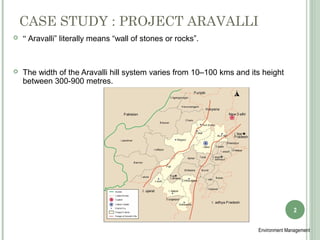
“ Aravalli” literally means “wall of stones or rocks”.



The width of the Aravalli hill system varies from 10–100 kms and its height
between 300-900 metres.

2
Environment Management
REASONS FOR DEFORESTRATION
•Till

about 50 years ago, the Aravalli and adjoining areas
were thickly forested and home to a variety of animals
and birds.
•Subsequently,

large-scale felling of trees as also the
sudden increase in population and livestock led to
significant loss of forest cover.
•Large

areas of forests were cleared for agriculture, and
grazing pressures did not allow the remaining forests to
survive and regenerate.
This, in turn, led to water scarcity, falling water table,
soil erosion and floods and overall degradation of the
environment
•

Environment Management
ARAVALI BEFORE THE PROJECT

Environment Management
PROJECT ARAVALLI


In Haryana, most of the land in the Aravalli region belonged to the
community as a result of certain legislation in the 1930s, subse-quently
amended in 1972. Therefore, in 1990, a project was launched in five districts
of Haryana to restore/regenerate the ecosystem, and a Project Authority was
constituted.



This project cover 10 districts of Rajasthan viz. Alwar, Sikar, Jhunjhunu,
Nagaur, Jaipur (Including Dausa) Pali, Sirohi, Udaipur, Chittorgarh
and Bansware. The total cost of project is Rs. 288.86 crores.



The OECF assisted Aravalli Afforestation Project started in the year 1992
and the financial outlay was of Rs. 176.69 crores (8095 million Yen). The
Project period was five years, i.e. 1992-97. The project period was extended
up to March 2000.

5
Environment Management
PROJECT OBJECTIVES
•To

check desertification and to restore the ecological
status of the Aravallis by intensive reforestation.
•To

meet the fuelwood, tree fodder, grass, timber, fruit and
minor forest products.
•To

check soil erosion and thereby improve infiltration of
water and hydrological balance.
•To

provide employment to the rural / tribal population and
thereby improve their socio-economic condition.
•To

improve the habitat for the animal population in the
wild life sanctuaries

Environment Management
VILLAGE FOREST COMMITTEE
9-13 members were constituted, with the
Sarpanch as chairman and a Forest Dept. official
as member-secretary.
•

•It

was mandatory to have at least 3 local women
and representatives of SC/STs on each VFC, who
were responsible for drawing up plans
for the project.

Environment Management
OPERATIONS


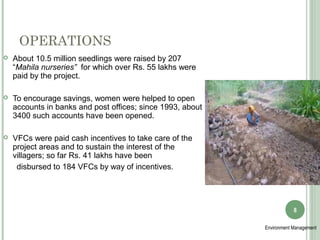
About 10.5 million seedlings were raised by 207
“Mahila nurseries” for which over Rs. 55 lakhs were
paid by the project.



To encourage savings, women were helped to open
accounts in banks and post offices; since 1993, about
3400 such accounts have been opened.



VFCs were paid cash incentives to take care of the
project areas and to sustain the interest of the
villagers; so far Rs. 41 lakhs have been
disbursed to 184 VFCs by way of incentives.

8
Environment Management
STALL FEEDING OF LIVESTOCK


Instead of open grazing, stall feeding of livestock would be followed



Instead of keeping smaller animals like goats and sheep, farmers would
switch to larger animals like buffaloes



To stall-feed the livestock, large quantities of fodder would be required.
Hence different types of grasses and legumes were sown in the open areas
between saplings in the plantation areas.



Initially, grass seeds were procured from the market; later villagers were
encouraged to harvest grass seeds from community lands for purchase by
the project authorities.



Within two years, the fodder availability increased substantially and the
villagers were encouraged to raise the size of their livestock population.
9
Environment Management
FINAL OUTCOME

10
Environment Management
FINAL OUTCOME

PROTECTIVE WALL AT A SITE

BADODIA AREA

Environment Management
THANK
YOU!
Environment Management

Project aravalli

  • 1.
  • 2.
    CASE STUDY :PROJECT ARAVALLI  “ Aravalli” literally means “wall of stones or rocks”.  The width of the Aravalli hill system varies from 10–100 kms and its height between 300-900 metres. 2 Environment Management
  • 3.
    REASONS FOR DEFORESTRATION •Till about50 years ago, the Aravalli and adjoining areas were thickly forested and home to a variety of animals and birds. •Subsequently, large-scale felling of trees as also the sudden increase in population and livestock led to significant loss of forest cover. •Large areas of forests were cleared for agriculture, and grazing pressures did not allow the remaining forests to survive and regenerate. This, in turn, led to water scarcity, falling water table, soil erosion and floods and overall degradation of the environment • Environment Management
  • 4.
    ARAVALI BEFORE THEPROJECT Environment Management
  • 5.
    PROJECT ARAVALLI  In Haryana,most of the land in the Aravalli region belonged to the community as a result of certain legislation in the 1930s, subse-quently amended in 1972. Therefore, in 1990, a project was launched in five districts of Haryana to restore/regenerate the ecosystem, and a Project Authority was constituted.  This project cover 10 districts of Rajasthan viz. Alwar, Sikar, Jhunjhunu, Nagaur, Jaipur (Including Dausa) Pali, Sirohi, Udaipur, Chittorgarh and Bansware. The total cost of project is Rs. 288.86 crores.  The OECF assisted Aravalli Afforestation Project started in the year 1992 and the financial outlay was of Rs. 176.69 crores (8095 million Yen). The Project period was five years, i.e. 1992-97. The project period was extended up to March 2000. 5 Environment Management
  • 6.
    PROJECT OBJECTIVES •To check desertificationand to restore the ecological status of the Aravallis by intensive reforestation. •To meet the fuelwood, tree fodder, grass, timber, fruit and minor forest products. •To check soil erosion and thereby improve infiltration of water and hydrological balance. •To provide employment to the rural / tribal population and thereby improve their socio-economic condition. •To improve the habitat for the animal population in the wild life sanctuaries Environment Management
  • 7.
    VILLAGE FOREST COMMITTEE 9-13members were constituted, with the Sarpanch as chairman and a Forest Dept. official as member-secretary. • •It was mandatory to have at least 3 local women and representatives of SC/STs on each VFC, who were responsible for drawing up plans for the project. Environment Management
  • 8.
    OPERATIONS  About 10.5 millionseedlings were raised by 207 “Mahila nurseries” for which over Rs. 55 lakhs were paid by the project.  To encourage savings, women were helped to open accounts in banks and post offices; since 1993, about 3400 such accounts have been opened.  VFCs were paid cash incentives to take care of the project areas and to sustain the interest of the villagers; so far Rs. 41 lakhs have been disbursed to 184 VFCs by way of incentives. 8 Environment Management
  • 9.
    STALL FEEDING OFLIVESTOCK  Instead of open grazing, stall feeding of livestock would be followed  Instead of keeping smaller animals like goats and sheep, farmers would switch to larger animals like buffaloes  To stall-feed the livestock, large quantities of fodder would be required. Hence different types of grasses and legumes were sown in the open areas between saplings in the plantation areas.  Initially, grass seeds were procured from the market; later villagers were encouraged to harvest grass seeds from community lands for purchase by the project authorities.  Within two years, the fodder availability increased substantially and the villagers were encouraged to raise the size of their livestock population. 9 Environment Management
  • 10.
  • 11.
    FINAL OUTCOME PROTECTIVE WALLAT A SITE BADODIA AREA Environment Management
  • 12.