Welcome
GRAMYA VIKASH MANCHA
               (GVM)
     (A unified platform for
    progressive contemplation)
 Vision: “GVM     envisages a peaceful, prosperous, egalitarian and exploitation free
                               society in every village”
      Mission: GVM         exist to empower the rural community particularly the
underprivileged and women to take control over the social institutions and to improve
their quality of life , thereby create a society where these people can live with dignity
                                         Address
                                  NO. 1 BARDHANARA
                                  P.O: DAKSHINGAON
                                       PIN: 781350
                                  DISTRICT : NALBARI
                                      ASSAM , INDIA
                                PHONE: +91-3624-283740
                                Email: gvm_ngo@sify.com
Historical Context
•   Project title: Promotion of Diversion based Irrigation in Nalbari and Baksa districts of Assam
•   Location: Nalbari and Baksa districts of Assam
•   Other partners: Institutions such as NABARD, Krishi Vigyan Kendra , North Eastern
    Development Financial Corporation Ltd.(NEDFi), Local bank, Krishi Vigyan Kendra,
    Agriculture, Veterinary and Fishery Department, PRI, CSOs
•   Target: 50,000 families from excluded sections of the society
•   Context: The entire area is situated at the plains of the Brahmaputra Valley and numbers of
    tributaries of the mighty river Brahmaputra, which are originated from the foothills of the
    Himalayan Range and have been passing through the area
      – Large network of natural canals, creeks and wetlands are source for irrigation, drinking
         and natural fishing. Almost all farmers and fisherman of both the districts are solely
         dependent upon these natural networks of water bodies
      – But due to problem like recurrent flash flood, deforestation, rapid diversion of main
         tributaries, siltation, sand deposition, breach of embankment etc. etc. most of these
         natural water bodies become worthless, which have been affecting the life and
         livelihood of common people engendering a set of social problems such as increasing
         migration to urban areas, increasing unsafe human trafficking, ethnic conflict,
         increasing social violence, livelihood crisis, increasing drop out of child / adolescent and
         so on
      – First initiative during the year 2007 in Ghogra Canal restoration work (On community
         demand in lieu of relief activities), which gave an encouraging results
Achievements

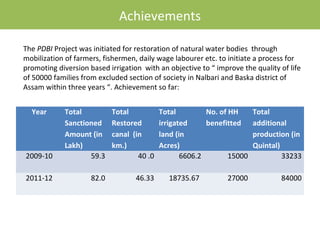
The PDBI Project was initiated for restoration of natural water bodies through
mobilization of farmers, fishermen, daily wage labourer etc. to initiate a process for
promoting diversion based irrigation with an objective to “ improve the quality of life
of 50000 families from excluded section of society in Nalbari and Baska district of
Assam within three years “. Achievement so far:


  Year       Total          Total           Total         No. of HH      Total
             Sanctioned     Restored        irrigated     benefitted     additional
             Amount (in     canal (in       land (in                     production (in
             Lakh)          km.)            Acres)                       Quintal)
2009-10             59.3            40 .0          6606.2        15000            33233

2011-12              82.0          46.33      18735.67          27000            84000
Process Adopted
Strategies adopted:
1) Protect natural water bodies and Reduce vulnerability through community mobilization
2) Socio-economic upliftment through introducing effective use of diversion based irrigation
     system
Process Adopted:
•    Preparation of Participatory Vulnerability Analysis (PVA) report and community action
     plan
•    Restoration of water bodies like canal, creeks and wetland with special focus on DBI
•    For improvement of irrigation for agricultural practices adoption of improvised
     techniques like installation of improvised sluice gate, diversion weir, bandh
•    Formation of Cluster level coordination committee in the clusters for planning, review
     and monitoring of restoration work and other agricultural activities
•    Formation of Jan Suraksha Samiti (Canal Management Committee) for management of
     canals, conflict resolution, regulation of water.
•    Consultation and Networking with NABARD, Krishi Vigyan Kendra, Local nationalized
     Bank, North Eastern Development Finance Corporation Ltd. (NEDFi), Agriculture,
     Veterinary and Fishery Dept. etc.
•    Capacity enhancement of farmers/ fisherman, woman, SHGs and Farmers Club for
     sustainable agricultural practices and use of resources for income generating activities
•    Media sensitization and interaction program
Issues in Implementation
•    Disorganized community and distrust towards development initiatives
•    Encroachment and blockage of water bodies
•    Inter village conflicts is a challenge in the restoration of canal work
•    The politically disturbed situation due to the existence of different power groups
     particularly in Baksa district is a big challenge
•    Disaster and Climate change affecting mostly the poor and marginalized farmers

Strategy to overcome the problems:
•    Community organised, trust building process initiated through PVA, reflection
     and community dialogue
•    Issues related to encroachment, inter village conflicts etc resolved through
     community dialogue led by cluster level coordination committee and Jan
     Suraksha Samiti (Canal Management Committee)
•    Through the help and active participation of the Dong Bandh Committees and
     local development organisation
•    Capacity enhancement of farmers/ fisherman, rural woman through trainings on
     System of Rice Intensification (SRI), water hyacinth based craft, agricultural
     activities such as chilli cultivation, banana plantation and plantation of Pat-doiya
     (Scientific name – Schumannianthus dichotoma)a kind of tree which can reduce
     erosion, siltation and become source of livelihood across water bodies)
Leveraging for DBI
•   Under the PDBI project a number of awareness meeting on MGNREGA were held
    in four cluster of the project area. Just after the meeting held at Kalakuchi more
    than 300 Job Card holder applied for work and got work of dredging of Satirkur
    sub Canal.
•   As a result of consultation with PRI representatives, Panchayat did cleaning work
    of Satirkur sub Canal under MGNREGA.
•   Canal Management Committee (CMC) of Jaha cluster submitted public
    memorandum to DC, Nalbari to make a solution of Baralia bandh problem.
    Fortunately the DC ordered the Circle officer of Pachim Nalbari, Barkshetri Circle
    to do detail survey on the issue and to submit him the report. Process is going on
•   A number of canal dredging works have been planned under MGNREA at
    Pagladiya cluster.
•   In Diring cluster of Baksa a protection wall was constructed by the Panchayat
    (known as the Village Council Development Committee, VCDC) after the
    Installation of the Improvised sluice gate in Balakata Dong (canal) of Narayanpur
    village.
Sustainability

•   The initiative has restored the ecological balance of the area
•   Community involvement, consciousness and motivation increased to
    maintain the balance.
•   A strong network among primary stakeholders established to carry
    forward all process and programmes.
•   Social cohesiveness, awareness and common understanding on the
    entire issues , linkages, causes and effects has been increased sufficiently
    and it become a primary agenda in the society.
Replicability and Scalability

•   Entire process can be replicated to other parts, having similar geographical
    settings.
•   Trust building process with different stakeholders and Initiating community
    dialogue/ debate on key socio-economic issues
•   Adopting Participatory Vulnerability Analysis (PVA) process with primary
    stakeholders focusing primarily on livelihood issues, thereby formulate community
    action plan and ensure active participation of all stakeholders to implement action
    plan
•   Assist bonafied partners in linking with formal development actors to ensure
    support from development scheme/ Act etc
•   Organize interface/ interaction programme with different development actors and
    share action plan/ experiences
•   Strengthen the cohesiveness among primary stakeholders/ form coordination
    committee to implement community action plan
Impact/ Outcome
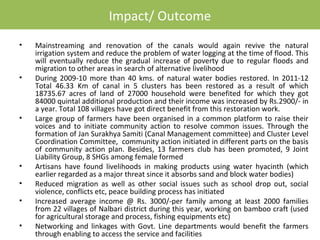
•   Mainstreaming and renovation of the canals would again revive the natural
    irrigation system and reduce the problem of water logging at the time of flood. This
    will eventually reduce the gradual increase of poverty due to regular floods and
    migration to other areas in search of alternative livelihood
•   During 2009-10 more than 40 kms. of natural water bodies restored. In 2011-12
    Total 46.33 Km of canal in 5 clusters has been restored as a result of which
    18735.67 acres of land of 27000 household were benefited for which they got
    84000 quintal additional production and their income was increased by Rs.2900/- in
    a year. Total 108 villages have got direct benefit from this restoration work.
•   Large group of farmers have been organised in a common platform to raise their
    voices and to initiate community action to resolve common issues. Through the
    formation of Jan Surakhya Samiti (Canal Management committee) and Cluster Level
    Coordination Committee, community action initiated in different parts on the basis
    of community action plan. Besides, 13 farmers club has been promoted, 9 Joint
    Liability Group, 8 SHGs among female formed
•   Artisans have found livelihoods in making products using water hyacinth (which
    earlier regarded as a major threat since it absorbs sand and block water bodies)
•   Reduced migration as well as other social issues such as school drop out, social
    violence, conflicts etc, peace building process has initiated
•   Increased average income @ Rs. 3000/-per family among at least 2000 families
    from 22 villages of Nalbari district during this year, working on bamboo craft (used
    for agricultural storage and process, fishing equipments etc)
•   Networking and linkages with Govt. Line departments would benefit the farmers
    through enabling to access the service and facilities
Community dredging the Katuria canal, Sathamou village under Pagaldia
               Cluster based on the PVA action plan
Social and resource mapping and identification of problems during the
                  Participatory Vulnerability Analysis
After 20 years farmers would grow shali paddy after the restoration of
                 Pocha canal in Baralia cluster, Nalbari
Women leading the restoration work of a Dong (canal) from Baganpur
                       to Simlaguri , Baksa
Cleaning of Pocha canal in Baralia cluster , Nalbari district
A newly dredged sub canal (Meghajan) to irrigate paddy field ,
    diverted water from Ghogra Canal in Pagladiya Cluster
A Canal after dredging by the community in Kalakuchi village under Jaha
                                Cluster
Earthen bundh to store and lift water
Farmers using water from canal in Nalbari
Farmers lifting water from canal
Lifting water to field using Pump
The concrete diversion bandh constructed in Uttar Diringapur village of
                 Baksa (Diverted to three direction)
Diversion Bandh (Under construction) at Arampur under Baksa
                          district
Water Control Gate in Pocha Jan linking Baralia
                    river
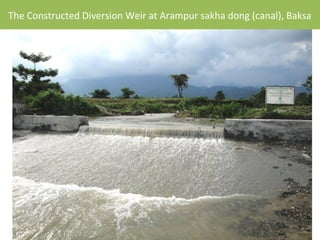
The Constructed Diversion Weir at Arampur sakha dong (canal), Baksa
The Improvised Sluice Gate installed at Balakata Dong (canal),
                 Narayanpur village, Baksa
Capacity building of rural woman through Skill development
        programmes on water hyacinth based craft
Chiili cultivation initiated by woman farmers in groups, Baralia cluster
                                  Nalbari
Farmers initiated chili farming in Baksa
SRI initiated by the farmers of Nalbari district under DBI
Inter cluster networking meeting
Thanks

GVM PDBI Presentation

  • 1.
  • 2.
    GRAMYA VIKASH MANCHA (GVM) (A unified platform for progressive contemplation) Vision: “GVM envisages a peaceful, prosperous, egalitarian and exploitation free society in every village” Mission: GVM exist to empower the rural community particularly the underprivileged and women to take control over the social institutions and to improve their quality of life , thereby create a society where these people can live with dignity Address NO. 1 BARDHANARA P.O: DAKSHINGAON PIN: 781350 DISTRICT : NALBARI ASSAM , INDIA PHONE: +91-3624-283740 Email: gvm_ngo@sify.com
  • 3.
    Historical Context • Project title: Promotion of Diversion based Irrigation in Nalbari and Baksa districts of Assam • Location: Nalbari and Baksa districts of Assam • Other partners: Institutions such as NABARD, Krishi Vigyan Kendra , North Eastern Development Financial Corporation Ltd.(NEDFi), Local bank, Krishi Vigyan Kendra, Agriculture, Veterinary and Fishery Department, PRI, CSOs • Target: 50,000 families from excluded sections of the society • Context: The entire area is situated at the plains of the Brahmaputra Valley and numbers of tributaries of the mighty river Brahmaputra, which are originated from the foothills of the Himalayan Range and have been passing through the area – Large network of natural canals, creeks and wetlands are source for irrigation, drinking and natural fishing. Almost all farmers and fisherman of both the districts are solely dependent upon these natural networks of water bodies – But due to problem like recurrent flash flood, deforestation, rapid diversion of main tributaries, siltation, sand deposition, breach of embankment etc. etc. most of these natural water bodies become worthless, which have been affecting the life and livelihood of common people engendering a set of social problems such as increasing migration to urban areas, increasing unsafe human trafficking, ethnic conflict, increasing social violence, livelihood crisis, increasing drop out of child / adolescent and so on – First initiative during the year 2007 in Ghogra Canal restoration work (On community demand in lieu of relief activities), which gave an encouraging results
  • 4.
    Achievements The PDBI Projectwas initiated for restoration of natural water bodies through mobilization of farmers, fishermen, daily wage labourer etc. to initiate a process for promoting diversion based irrigation with an objective to “ improve the quality of life of 50000 families from excluded section of society in Nalbari and Baska district of Assam within three years “. Achievement so far: Year Total Total Total No. of HH Total Sanctioned Restored irrigated benefitted additional Amount (in canal (in land (in production (in Lakh) km.) Acres) Quintal) 2009-10 59.3 40 .0 6606.2 15000 33233 2011-12 82.0 46.33 18735.67 27000 84000
  • 5.
    Process Adopted Strategies adopted: 1)Protect natural water bodies and Reduce vulnerability through community mobilization 2) Socio-economic upliftment through introducing effective use of diversion based irrigation system Process Adopted: • Preparation of Participatory Vulnerability Analysis (PVA) report and community action plan • Restoration of water bodies like canal, creeks and wetland with special focus on DBI • For improvement of irrigation for agricultural practices adoption of improvised techniques like installation of improvised sluice gate, diversion weir, bandh • Formation of Cluster level coordination committee in the clusters for planning, review and monitoring of restoration work and other agricultural activities • Formation of Jan Suraksha Samiti (Canal Management Committee) for management of canals, conflict resolution, regulation of water. • Consultation and Networking with NABARD, Krishi Vigyan Kendra, Local nationalized Bank, North Eastern Development Finance Corporation Ltd. (NEDFi), Agriculture, Veterinary and Fishery Dept. etc. • Capacity enhancement of farmers/ fisherman, woman, SHGs and Farmers Club for sustainable agricultural practices and use of resources for income generating activities • Media sensitization and interaction program
  • 6.
    Issues in Implementation • Disorganized community and distrust towards development initiatives • Encroachment and blockage of water bodies • Inter village conflicts is a challenge in the restoration of canal work • The politically disturbed situation due to the existence of different power groups particularly in Baksa district is a big challenge • Disaster and Climate change affecting mostly the poor and marginalized farmers Strategy to overcome the problems: • Community organised, trust building process initiated through PVA, reflection and community dialogue • Issues related to encroachment, inter village conflicts etc resolved through community dialogue led by cluster level coordination committee and Jan Suraksha Samiti (Canal Management Committee) • Through the help and active participation of the Dong Bandh Committees and local development organisation • Capacity enhancement of farmers/ fisherman, rural woman through trainings on System of Rice Intensification (SRI), water hyacinth based craft, agricultural activities such as chilli cultivation, banana plantation and plantation of Pat-doiya (Scientific name – Schumannianthus dichotoma)a kind of tree which can reduce erosion, siltation and become source of livelihood across water bodies)
  • 7.
    Leveraging for DBI • Under the PDBI project a number of awareness meeting on MGNREGA were held in four cluster of the project area. Just after the meeting held at Kalakuchi more than 300 Job Card holder applied for work and got work of dredging of Satirkur sub Canal. • As a result of consultation with PRI representatives, Panchayat did cleaning work of Satirkur sub Canal under MGNREGA. • Canal Management Committee (CMC) of Jaha cluster submitted public memorandum to DC, Nalbari to make a solution of Baralia bandh problem. Fortunately the DC ordered the Circle officer of Pachim Nalbari, Barkshetri Circle to do detail survey on the issue and to submit him the report. Process is going on • A number of canal dredging works have been planned under MGNREA at Pagladiya cluster. • In Diring cluster of Baksa a protection wall was constructed by the Panchayat (known as the Village Council Development Committee, VCDC) after the Installation of the Improvised sluice gate in Balakata Dong (canal) of Narayanpur village.
  • 8.
    Sustainability • The initiative has restored the ecological balance of the area • Community involvement, consciousness and motivation increased to maintain the balance. • A strong network among primary stakeholders established to carry forward all process and programmes. • Social cohesiveness, awareness and common understanding on the entire issues , linkages, causes and effects has been increased sufficiently and it become a primary agenda in the society.
  • 9.
    Replicability and Scalability • Entire process can be replicated to other parts, having similar geographical settings. • Trust building process with different stakeholders and Initiating community dialogue/ debate on key socio-economic issues • Adopting Participatory Vulnerability Analysis (PVA) process with primary stakeholders focusing primarily on livelihood issues, thereby formulate community action plan and ensure active participation of all stakeholders to implement action plan • Assist bonafied partners in linking with formal development actors to ensure support from development scheme/ Act etc • Organize interface/ interaction programme with different development actors and share action plan/ experiences • Strengthen the cohesiveness among primary stakeholders/ form coordination committee to implement community action plan
  • 10.
    Impact/ Outcome • Mainstreaming and renovation of the canals would again revive the natural irrigation system and reduce the problem of water logging at the time of flood. This will eventually reduce the gradual increase of poverty due to regular floods and migration to other areas in search of alternative livelihood • During 2009-10 more than 40 kms. of natural water bodies restored. In 2011-12 Total 46.33 Km of canal in 5 clusters has been restored as a result of which 18735.67 acres of land of 27000 household were benefited for which they got 84000 quintal additional production and their income was increased by Rs.2900/- in a year. Total 108 villages have got direct benefit from this restoration work. • Large group of farmers have been organised in a common platform to raise their voices and to initiate community action to resolve common issues. Through the formation of Jan Surakhya Samiti (Canal Management committee) and Cluster Level Coordination Committee, community action initiated in different parts on the basis of community action plan. Besides, 13 farmers club has been promoted, 9 Joint Liability Group, 8 SHGs among female formed • Artisans have found livelihoods in making products using water hyacinth (which earlier regarded as a major threat since it absorbs sand and block water bodies) • Reduced migration as well as other social issues such as school drop out, social violence, conflicts etc, peace building process has initiated • Increased average income @ Rs. 3000/-per family among at least 2000 families from 22 villages of Nalbari district during this year, working on bamboo craft (used for agricultural storage and process, fishing equipments etc) • Networking and linkages with Govt. Line departments would benefit the farmers through enabling to access the service and facilities
  • 11.
    Community dredging theKaturia canal, Sathamou village under Pagaldia Cluster based on the PVA action plan
  • 12.
    Social and resourcemapping and identification of problems during the Participatory Vulnerability Analysis
  • 13.
    After 20 yearsfarmers would grow shali paddy after the restoration of Pocha canal in Baralia cluster, Nalbari
  • 14.
    Women leading therestoration work of a Dong (canal) from Baganpur to Simlaguri , Baksa
  • 15.
    Cleaning of Pochacanal in Baralia cluster , Nalbari district
  • 16.
    A newly dredgedsub canal (Meghajan) to irrigate paddy field , diverted water from Ghogra Canal in Pagladiya Cluster
  • 17.
    A Canal afterdredging by the community in Kalakuchi village under Jaha Cluster
  • 18.
    Earthen bundh tostore and lift water
  • 19.
    Farmers using waterfrom canal in Nalbari
  • 20.
  • 21.
    Lifting water tofield using Pump
  • 22.
    The concrete diversionbandh constructed in Uttar Diringapur village of Baksa (Diverted to three direction)
  • 23.
    Diversion Bandh (Underconstruction) at Arampur under Baksa district
  • 24.
    Water Control Gatein Pocha Jan linking Baralia river
  • 25.
    The Constructed DiversionWeir at Arampur sakha dong (canal), Baksa
  • 26.
    The Improvised SluiceGate installed at Balakata Dong (canal), Narayanpur village, Baksa
  • 27.
    Capacity building ofrural woman through Skill development programmes on water hyacinth based craft
  • 28.
    Chiili cultivation initiatedby woman farmers in groups, Baralia cluster Nalbari
  • 29.
    Farmers initiated chilifarming in Baksa
  • 30.
    SRI initiated bythe farmers of Nalbari district under DBI
  • 31.
  • 32.