UNIT 3

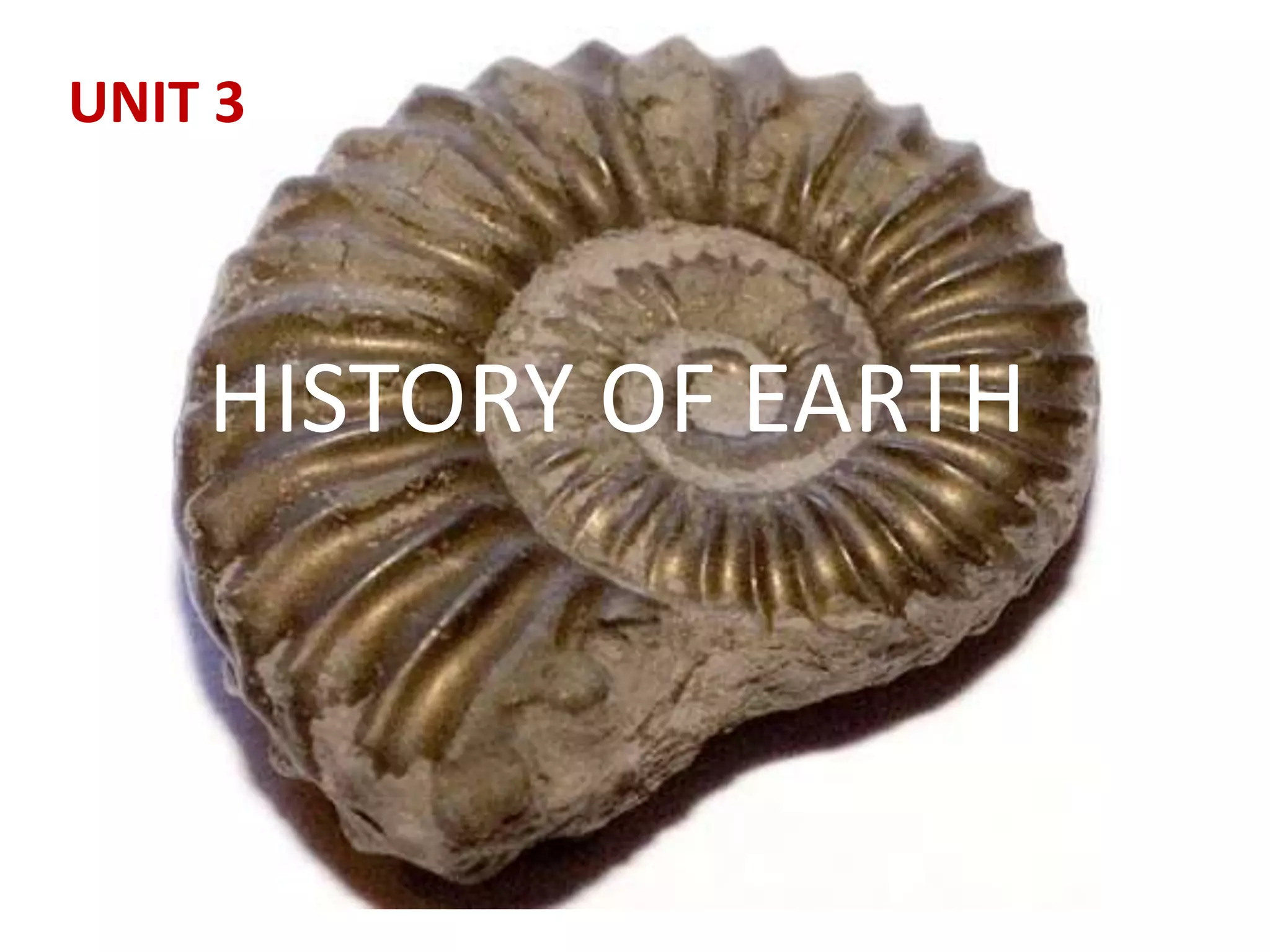
HISTORY OF EARTH
The origin of
the Solar
System
1. Supernova
2. Nebula
3. Temperature rose
due to nuclear
fusion reactions
4. Temperature fall
and materials start
condensing
5. Condensed
fragments collided
and got together
until planets were
formed
THE SOLAR SYSTEM
METHODS OF ABSOLUTE DATING
Absolute dating methods measure the time that
has elapsed since a geologic event happened
(rock formation, deposition of a stratum, the
age of a fossil, etc.).
They are:
SedBiological methods
imentological methods
Radiometric methods
Biological methods
These are based on the analysis of biological rhythms
associated with intervals of time, such as the growth rings of
trees or daily growth bands (striations) on living corals.
Each year, trees develop
two rings: one light ring (in
spring) and one dark ring
(in summer). By doing a
very simple calculation,
we can tell the age of a
tree if we count the
number of rings inside the
tree trunk.
Sedimentological methods
These are based on cyclical sediment deposits, like what
happens with glacial varves, which are sediments that are
deposited at the bottom of glacial lakes, depending on
seasonal changes.
Summer

Winter
Ice
Glacial lake

Thin dark layer of sediments

Only a thin dark layer (consisting of
clays and organic matter) accumulates
when the surface of the lake is frozen
over in winter.
Thick clear layer of
sediments

Glacial varves

A thick clear detrital
layer is deposited into
the lake when the ice
melts in summer.

It is possible to calculate the age of the lake
by counting the varves.
Radiometric methods
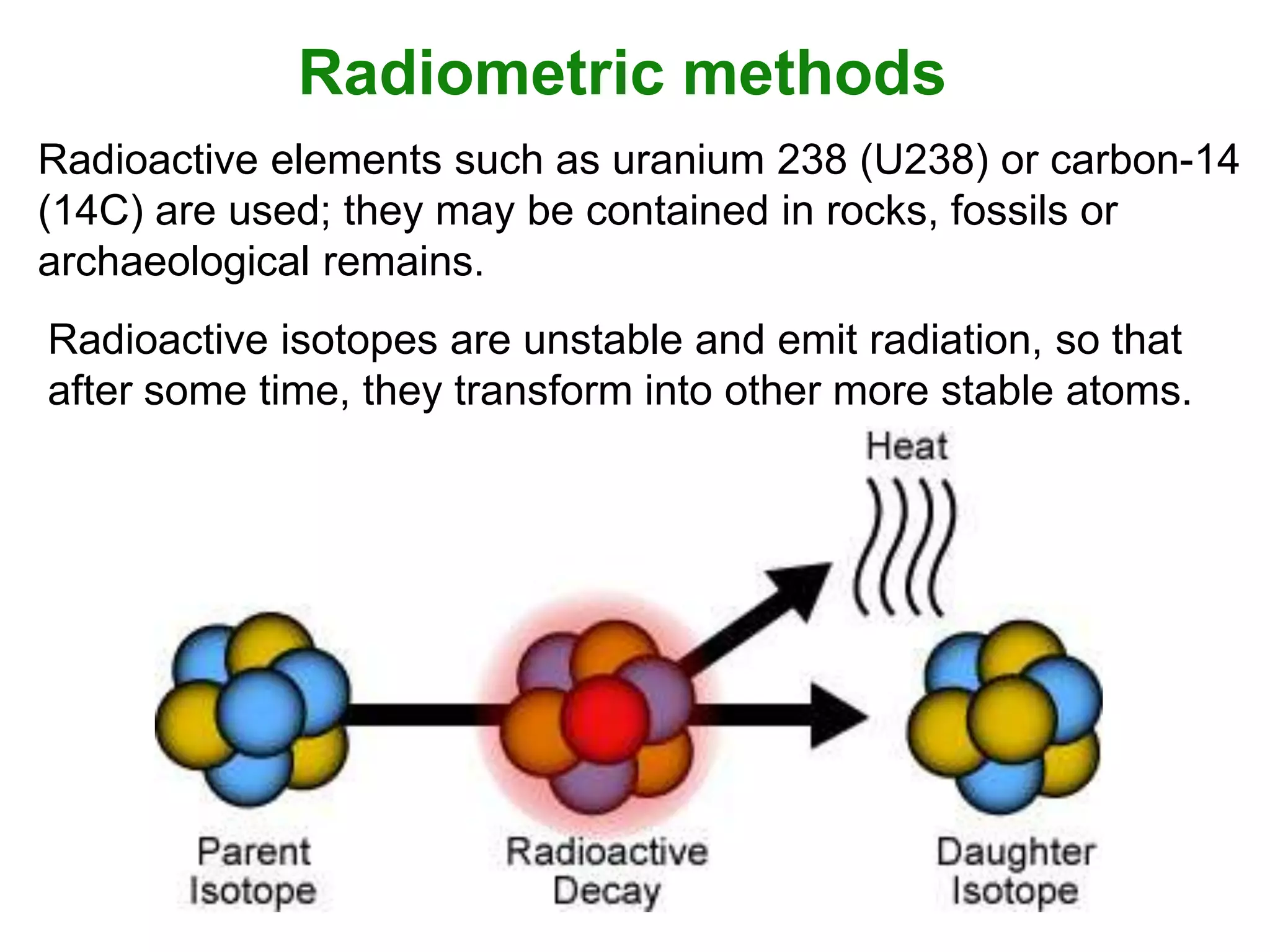
Radioactive elements such as uranium 238 (U238) or carbon-14
(14C) are used; they may be contained in rocks, fossils or
archaeological remains.
Radioactive isotopes are unstable and emit radiation, so that
after some time, they transform into other more stable atoms.
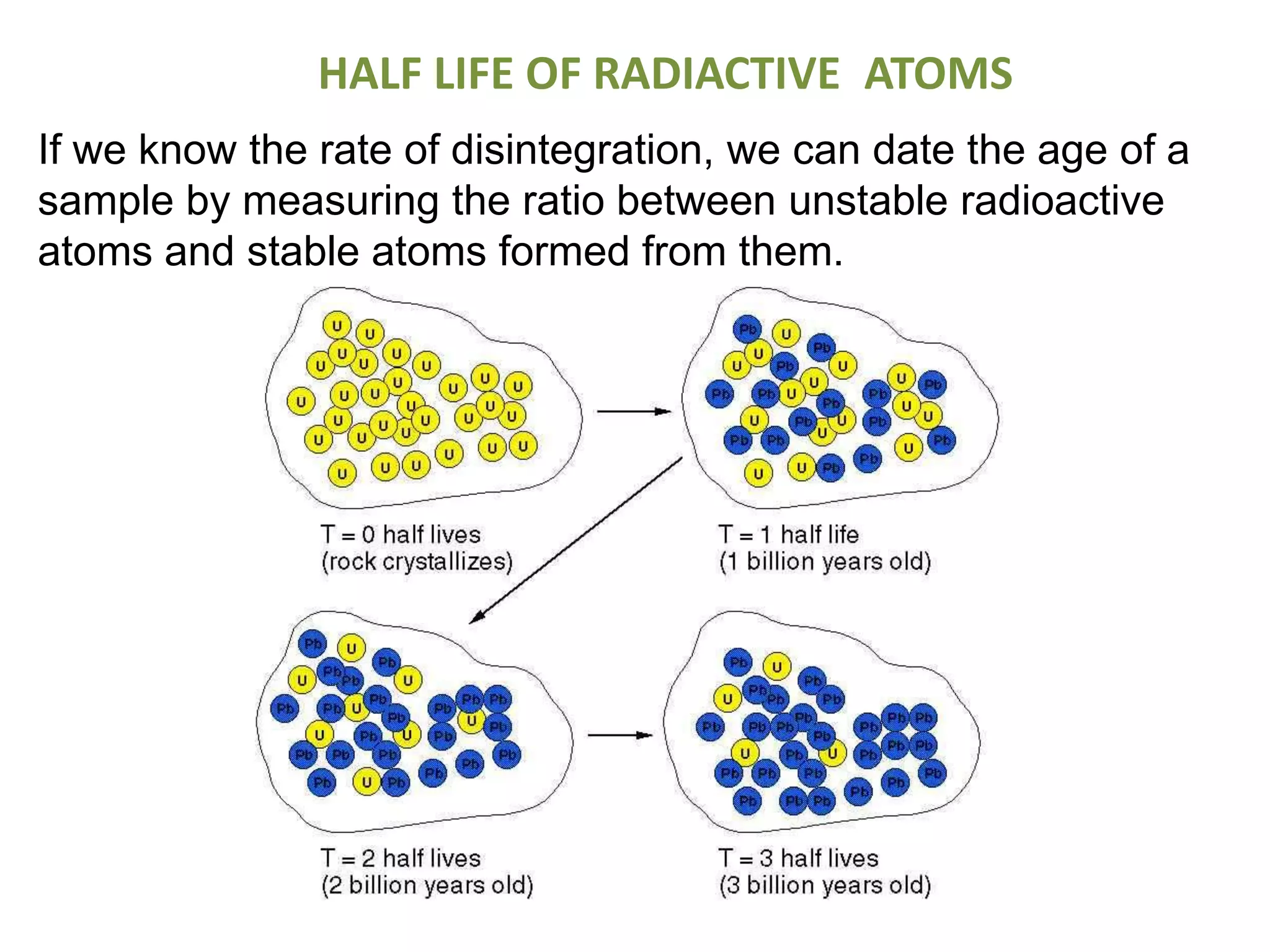
HALF LIFE OF RADIACTIVE ATOMS
If we know the rate of disintegration, we can date the age of a
sample by measuring the ratio between unstable radioactive
atoms and stable atoms formed from them.
METHODS OF RELATIVE DATING
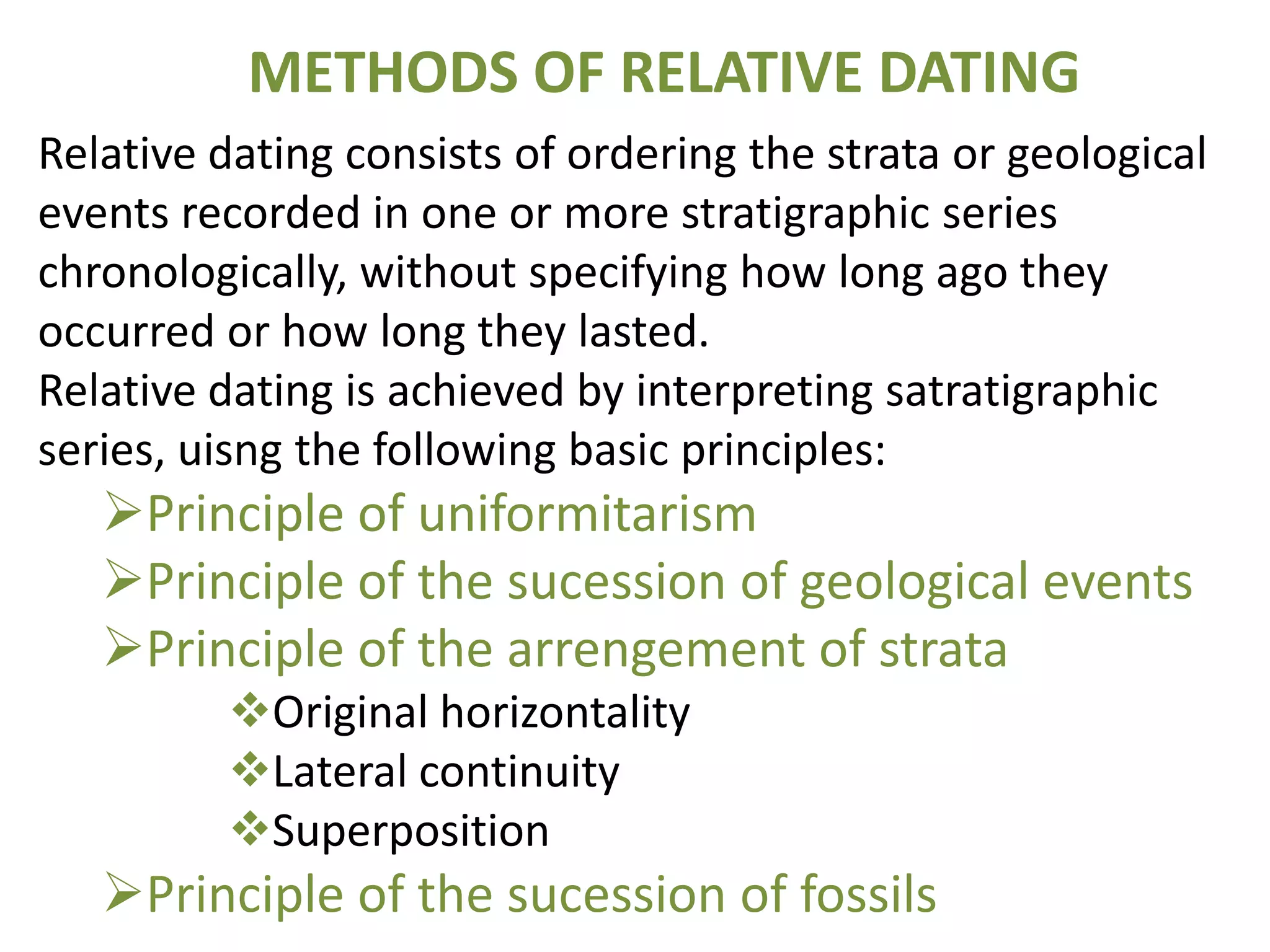
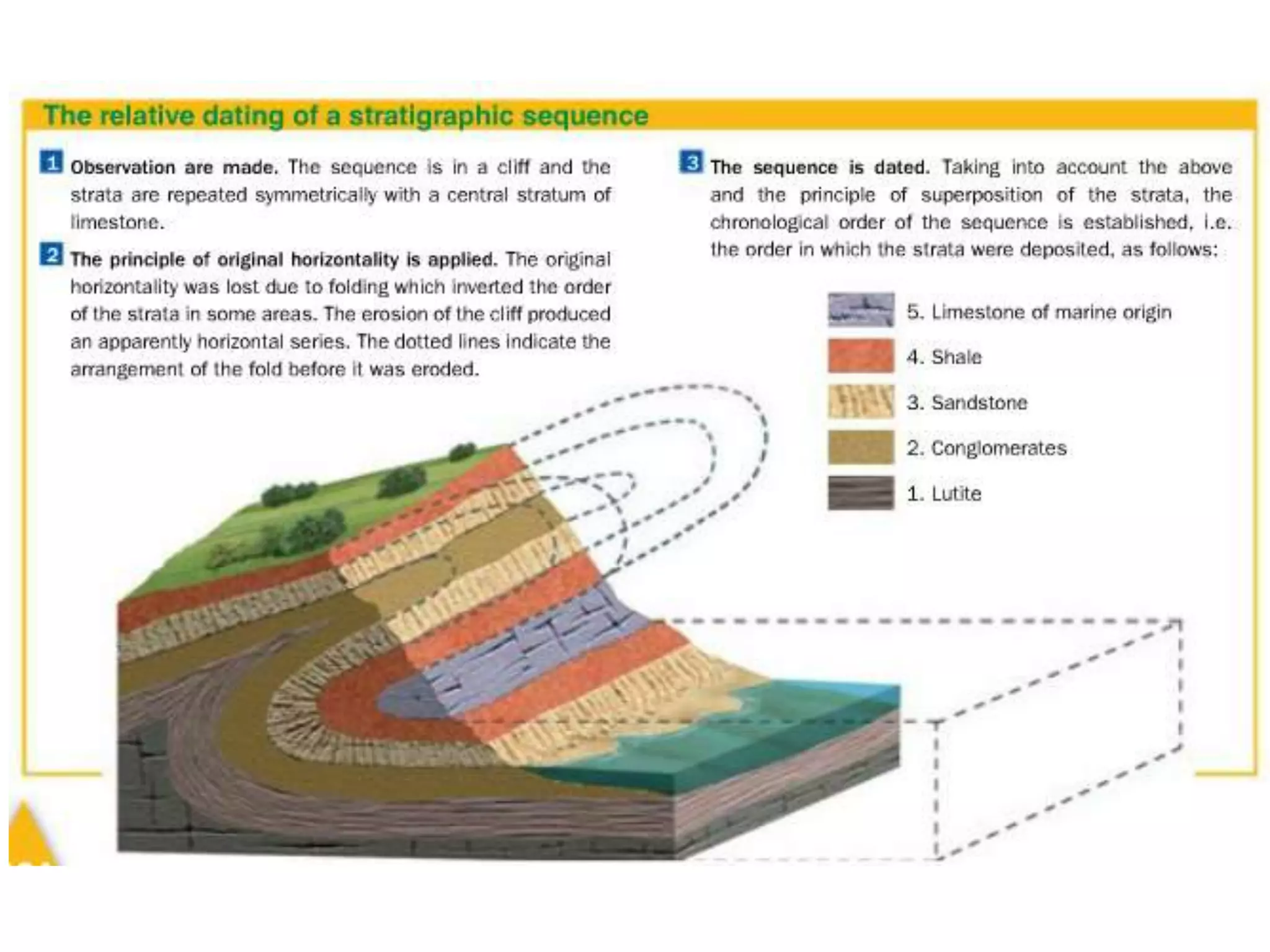
Relative dating consists of ordering the strata or geological
events recorded in one or more stratigraphic series
chronologically, without specifying how long ago they
occurred or how long they lasted.
Relative dating is achieved by interpreting satratigraphic
series, uisng the following basic principles:

Principle of uniformitarism
Principle of the sucession of geological events
Principle of the arrengement of strata
Original horizontality
Lateral continuity
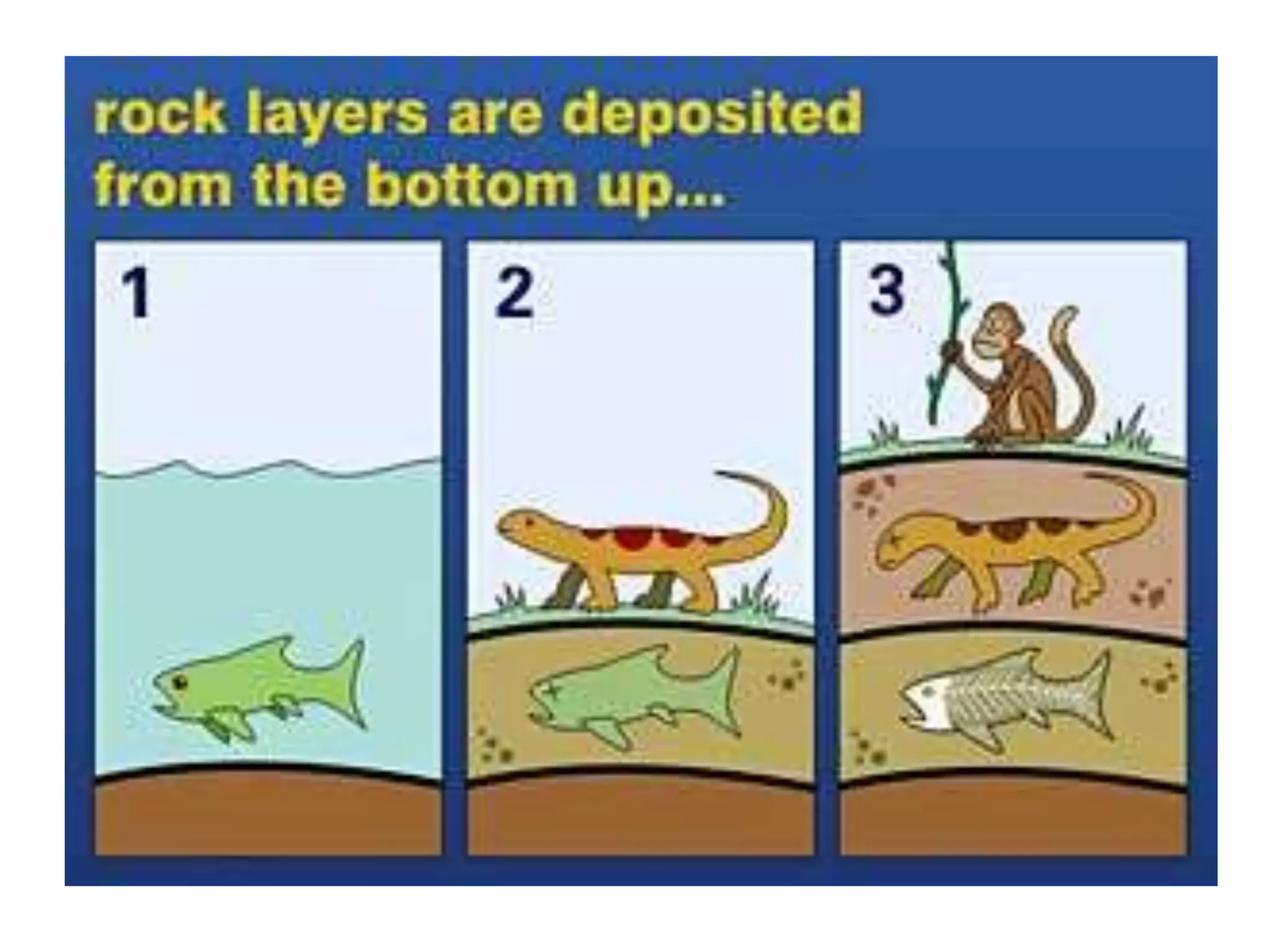
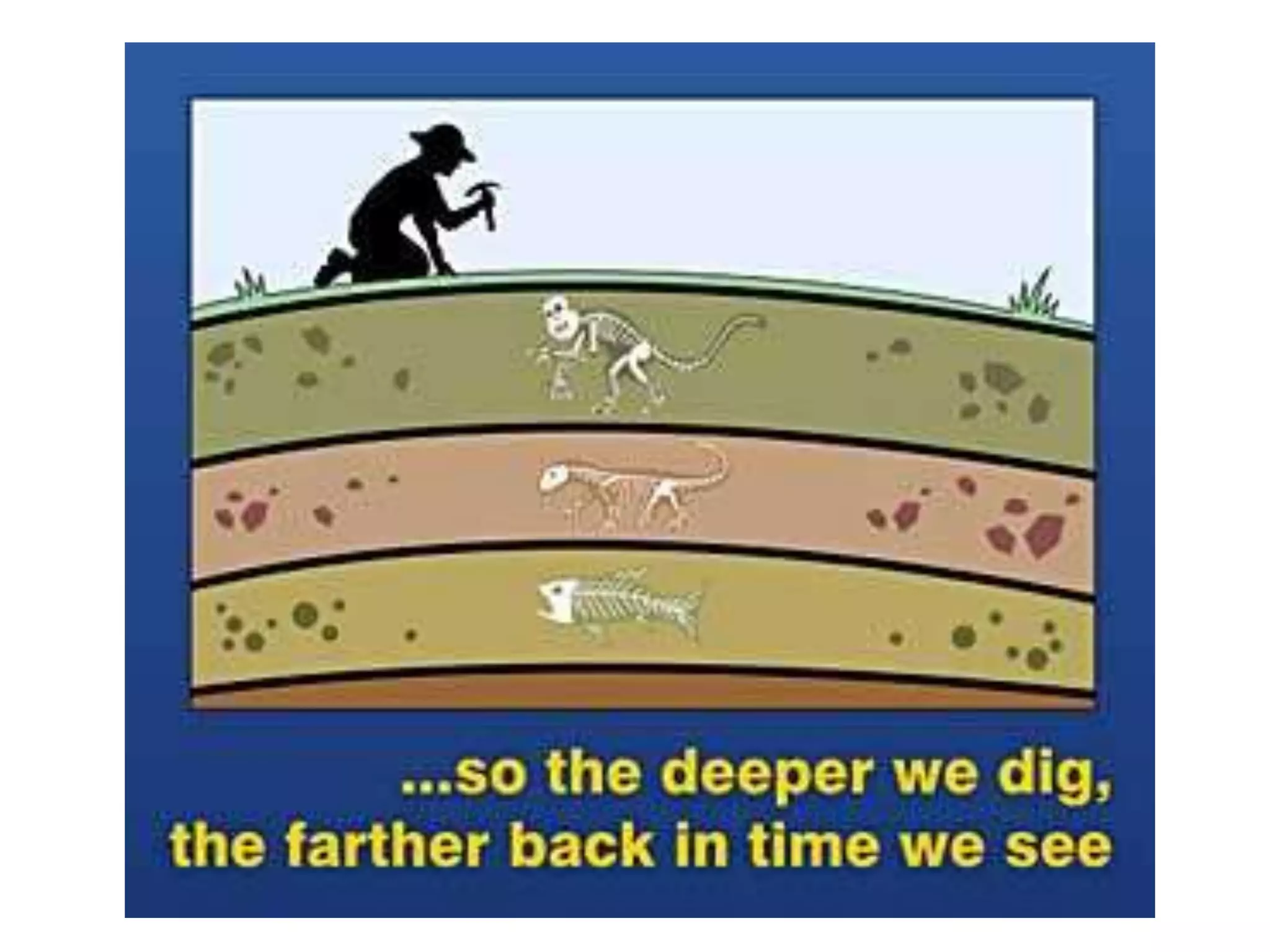
Superposition

Principle of the sucession of fossils
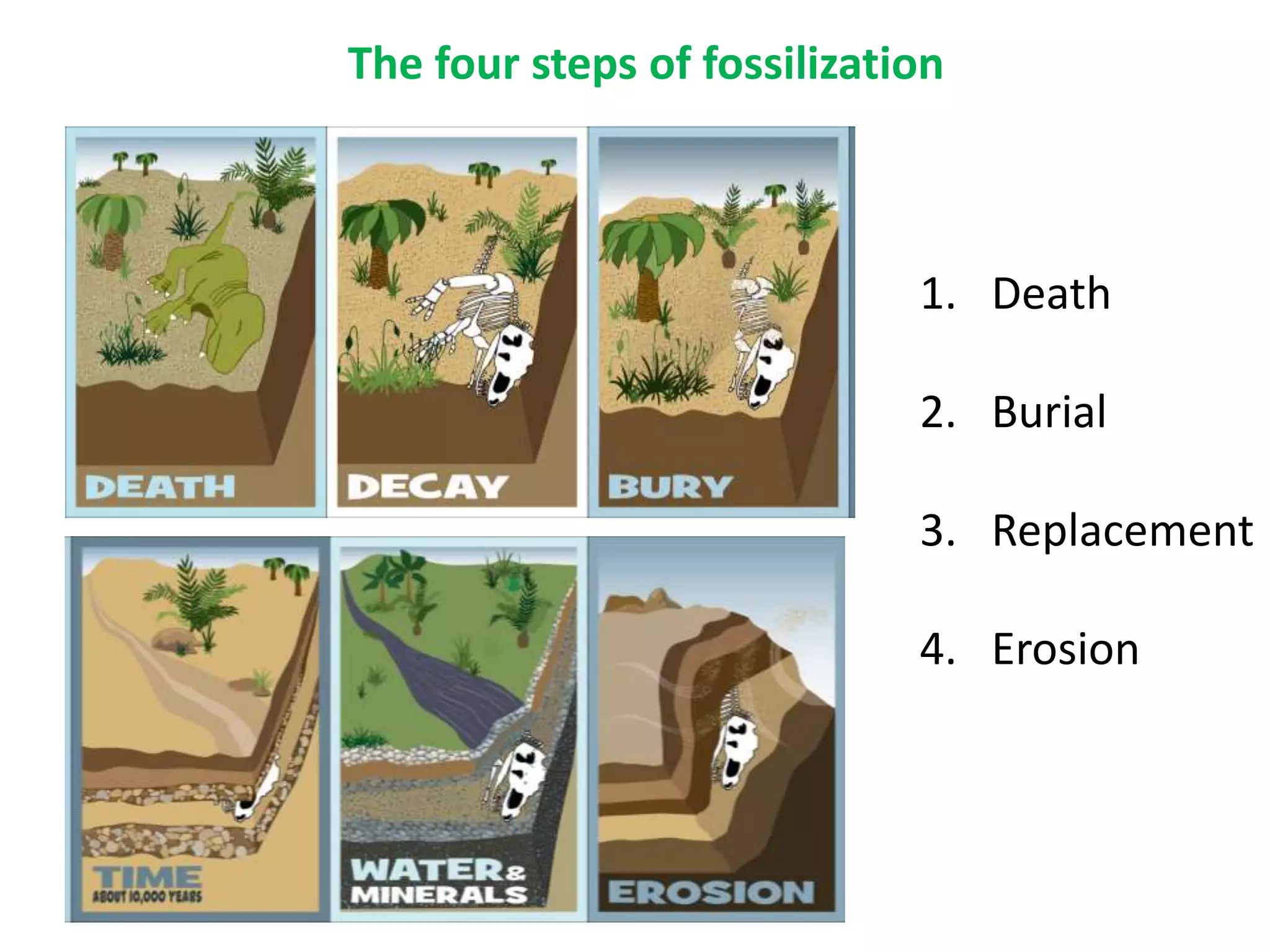
The four steps of fossilization

1. Death

2. Burial
3. Replacement

4. Erosion
INDEX FOSSILS
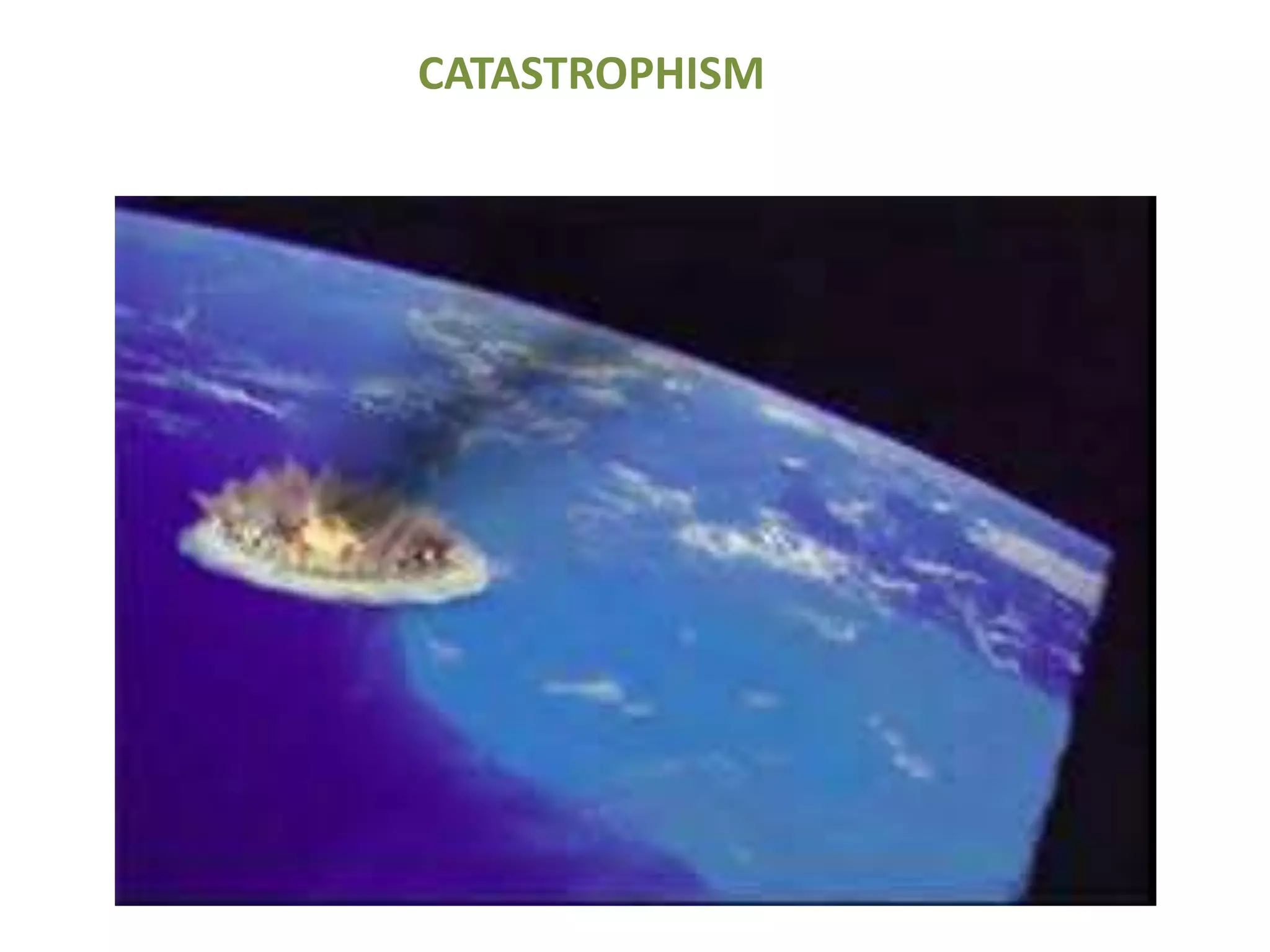
CATASTROPHISM
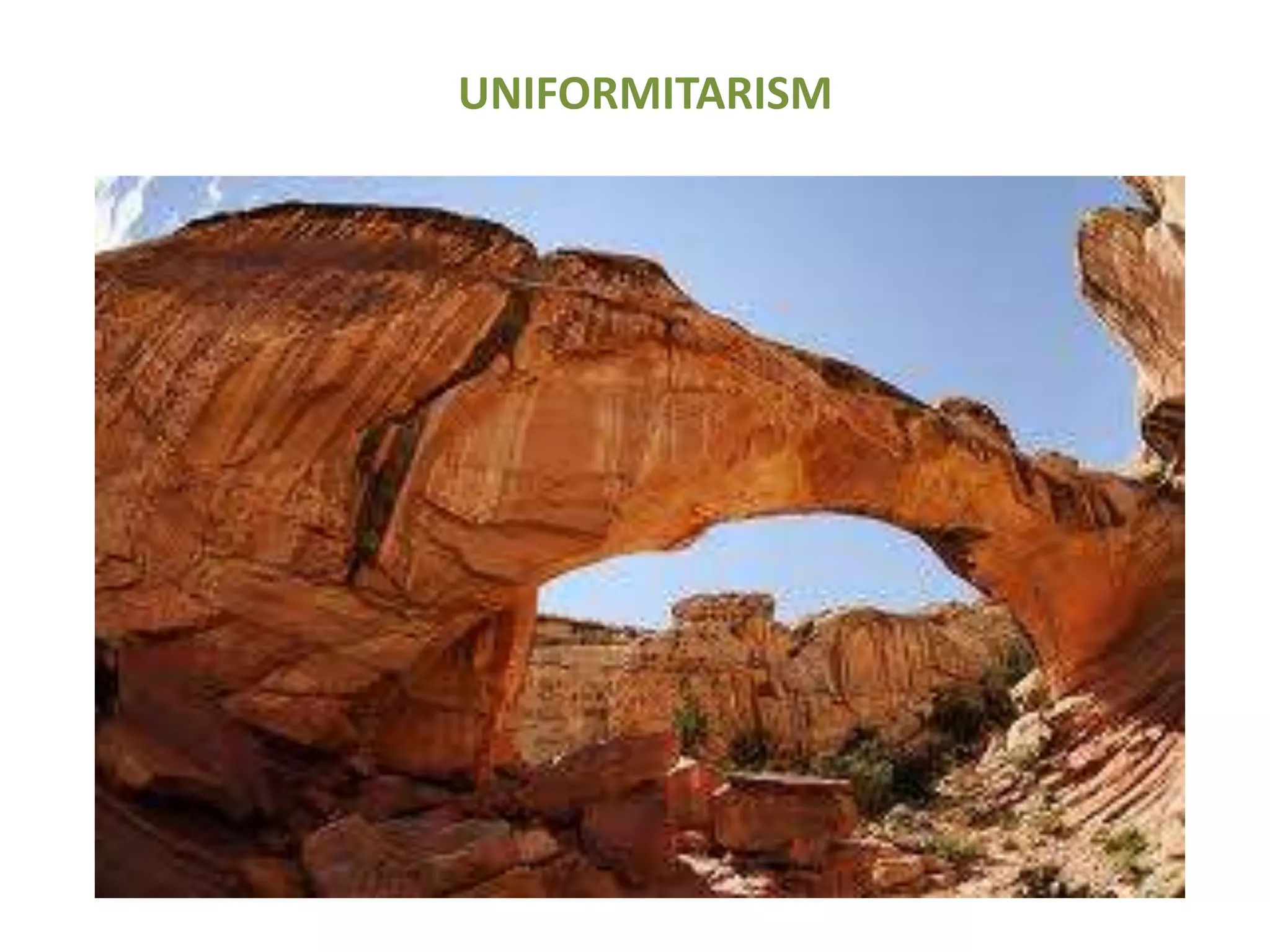
UNIFORMITARISM
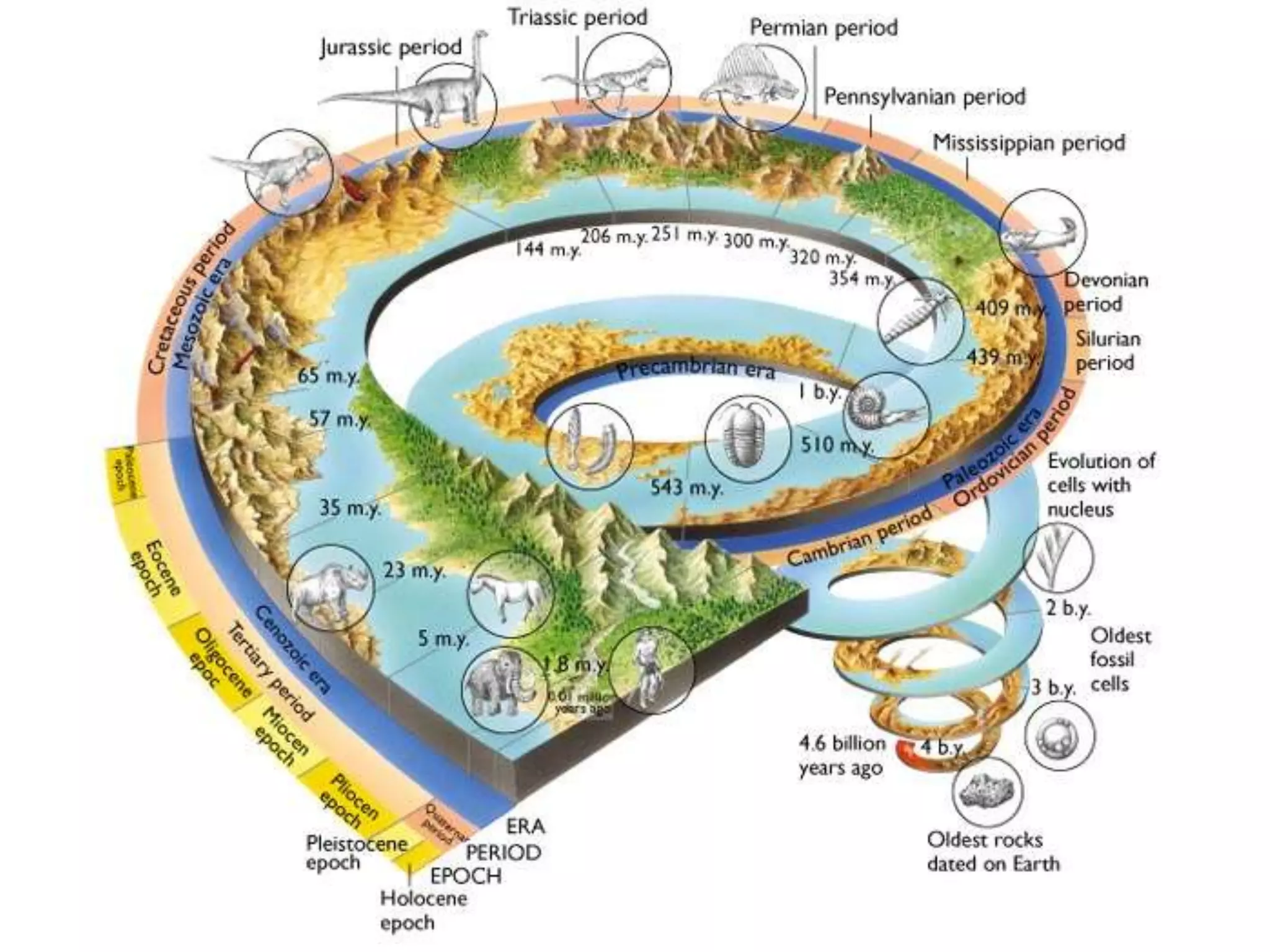
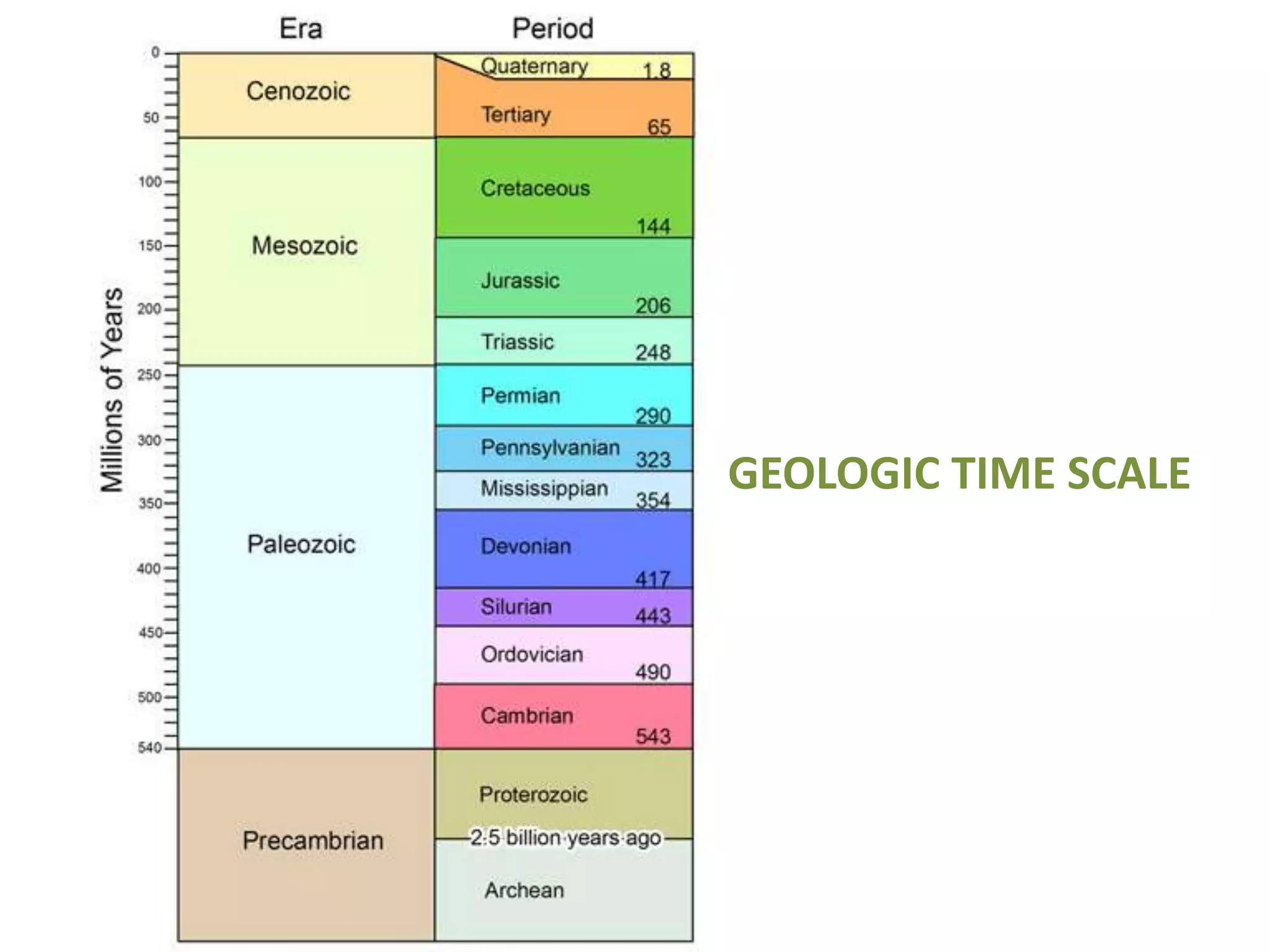
GEOLOGIC TIME SCALE
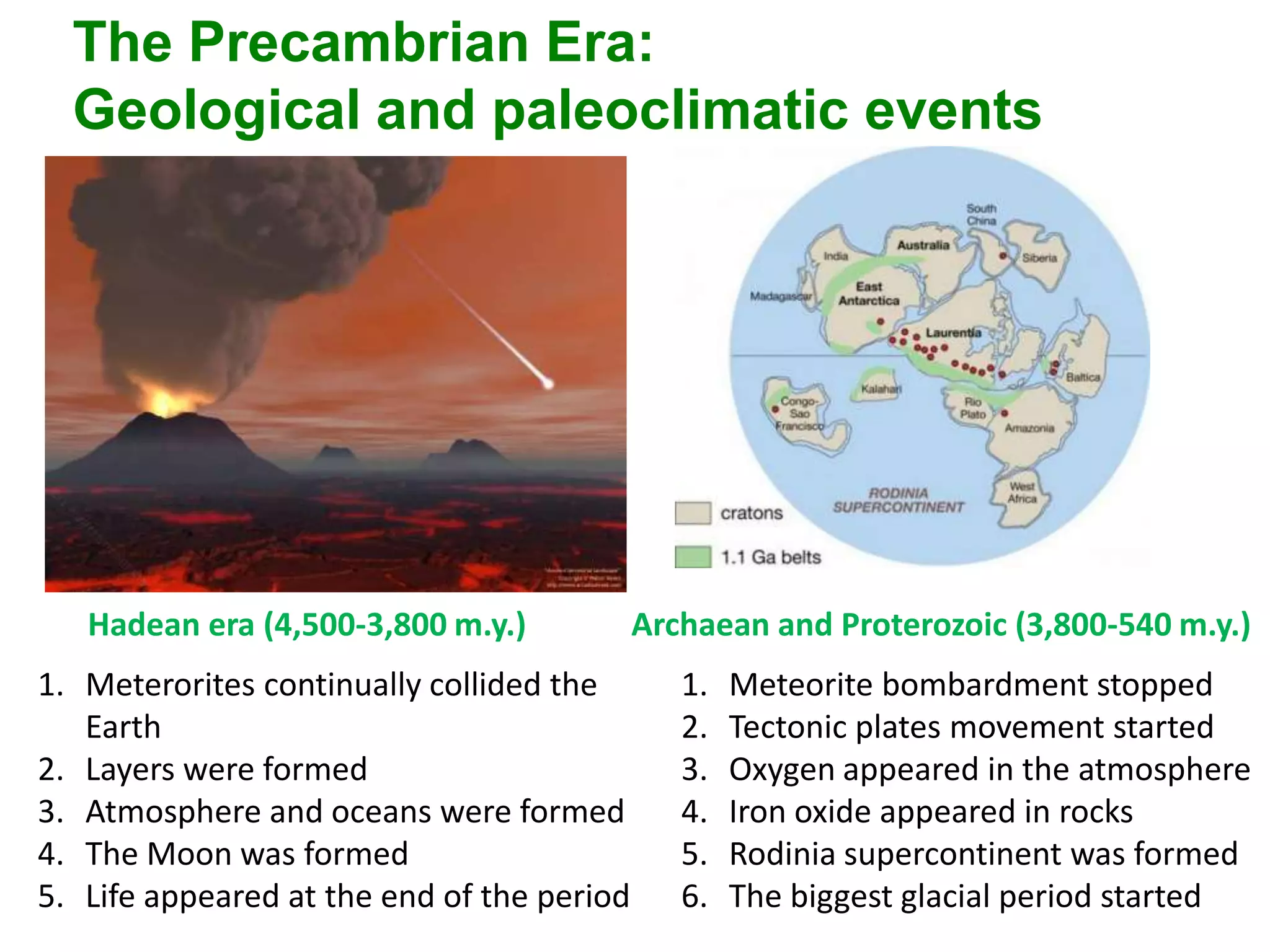
The Precambrian Era:
Geological and paleoclimatic events

Hadean era (4,500-3,800 m.y.)
1. Meterorites continually collided the
Earth
2. Layers were formed
3. Atmosphere and oceans were formed
4. The Moon was formed
5. Life appeared at the end of the period

Archaean and Proterozoic (3,800-540 m.y.)
1.
2.
3.
4.
5.
6.

Meteorite bombardment stopped
Tectonic plates movement started
Oxygen appeared in the atmosphere
Iron oxide appeared in rocks
Rodinia supercontinent was formed
The biggest glacial period started
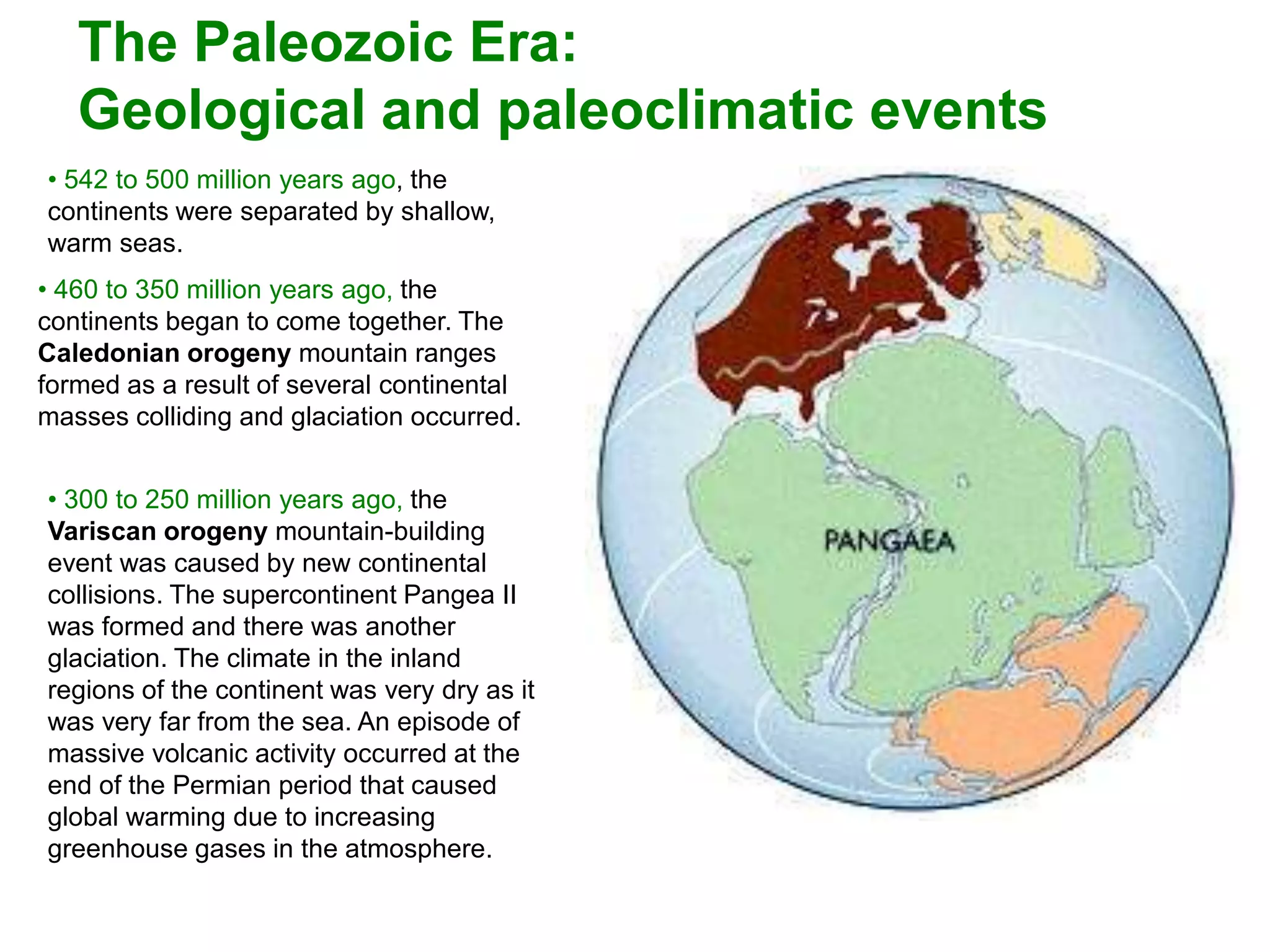
The Paleozoic Era:
Geological and paleoclimatic events
• 542 to 500 million years ago, the
continents were separated by shallow,
warm seas.
• 460 to 350 million years ago, the
continents began to come together. The
Caledonian orogeny mountain ranges
formed as a result of several continental
masses colliding and glaciation occurred.
• 300 to 250 million years ago, the
Variscan orogeny mountain-building
event was caused by new continental
collisions. The supercontinent Pangea II
was formed and there was another
glaciation. The climate in the inland
regions of the continent was very dry as it
was very far from the sea. An episode of
massive volcanic activity occurred at the
end of the Permian period that caused
global warming due to increasing
greenhouse gases in the atmosphere.
The Mesozoic Era:
Geological and paleoclimatic events
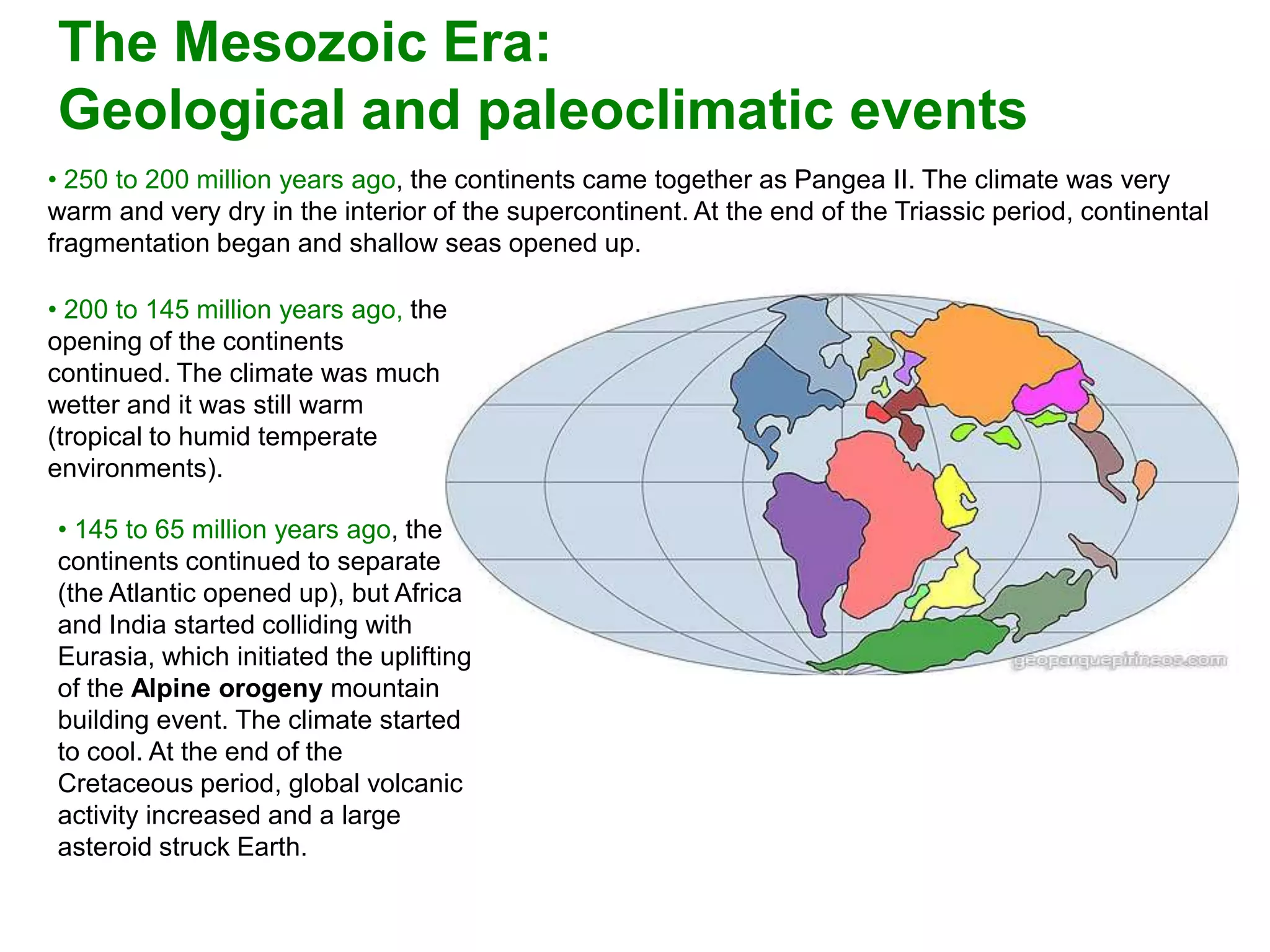
• 250 to 200 million years ago, the continents came together as Pangea II. The climate was very
warm and very dry in the interior of the supercontinent. At the end of the Triassic period, continental
fragmentation began and shallow seas opened up.
• 200 to 145 million years ago, the
opening of the continents
continued. The climate was much
wetter and it was still warm
(tropical to humid temperate
environments).
• 145 to 65 million years ago, the
continents continued to separate
(the Atlantic opened up), but Africa
and India started colliding with
Eurasia, which initiated the uplifting
of the Alpine orogeny mountain
building event. The climate started
to cool. At the end of the
Cretaceous period, global volcanic
activity increased and a large
asteroid struck Earth.
The Cenozic Era:
Geological and paleoclimatic events
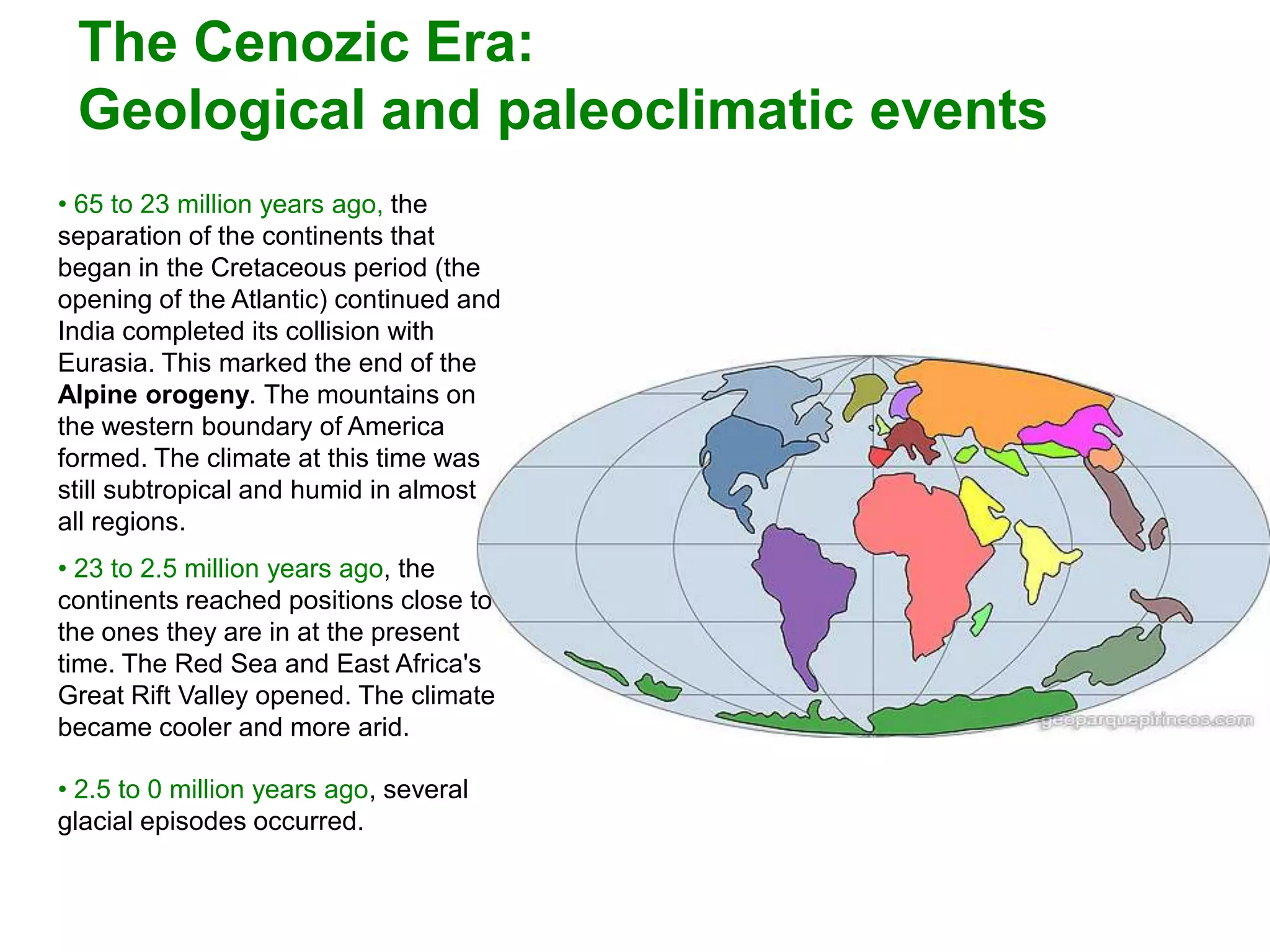
• 65 to 23 million years ago, the
separation of the continents that
began in the Cretaceous period (the
opening of the Atlantic) continued and
India completed its collision with
Eurasia. This marked the end of the
Alpine orogeny. The mountains on
the western boundary of America
formed. The climate at this time was
still subtropical and humid in almost
all regions.
• 23 to 2.5 million years ago, the
continents reached positions close to
the ones they are in at the present
time. The Red Sea and East Africa's
Great Rift Valley opened. The climate
became cooler and more arid.
• 2.5 to 0 million years ago, several
glacial episodes occurred.
The Precambrian Era: Biological events
• 3,800 to 3,500 million years ago, the
earliest life appears on Earth, probably
originating in an aquatic environment.
There are indications of this in the
biochemical clues that appear in rocks
from this time and in the first fossilised
prokaryotes.
• 3,400 million years ago, stromatolites appear.
These are structures produced by the activity
of cyanobacteria. These and other
photoautotroph organisms filled the
atmosphere with oxygen that produced mass
extinction of anaerobic organisms 2,000 million
years ago.
• 1,700 to 1,000 million years ago,
eukaryotes and multicellular organisms
emerge.
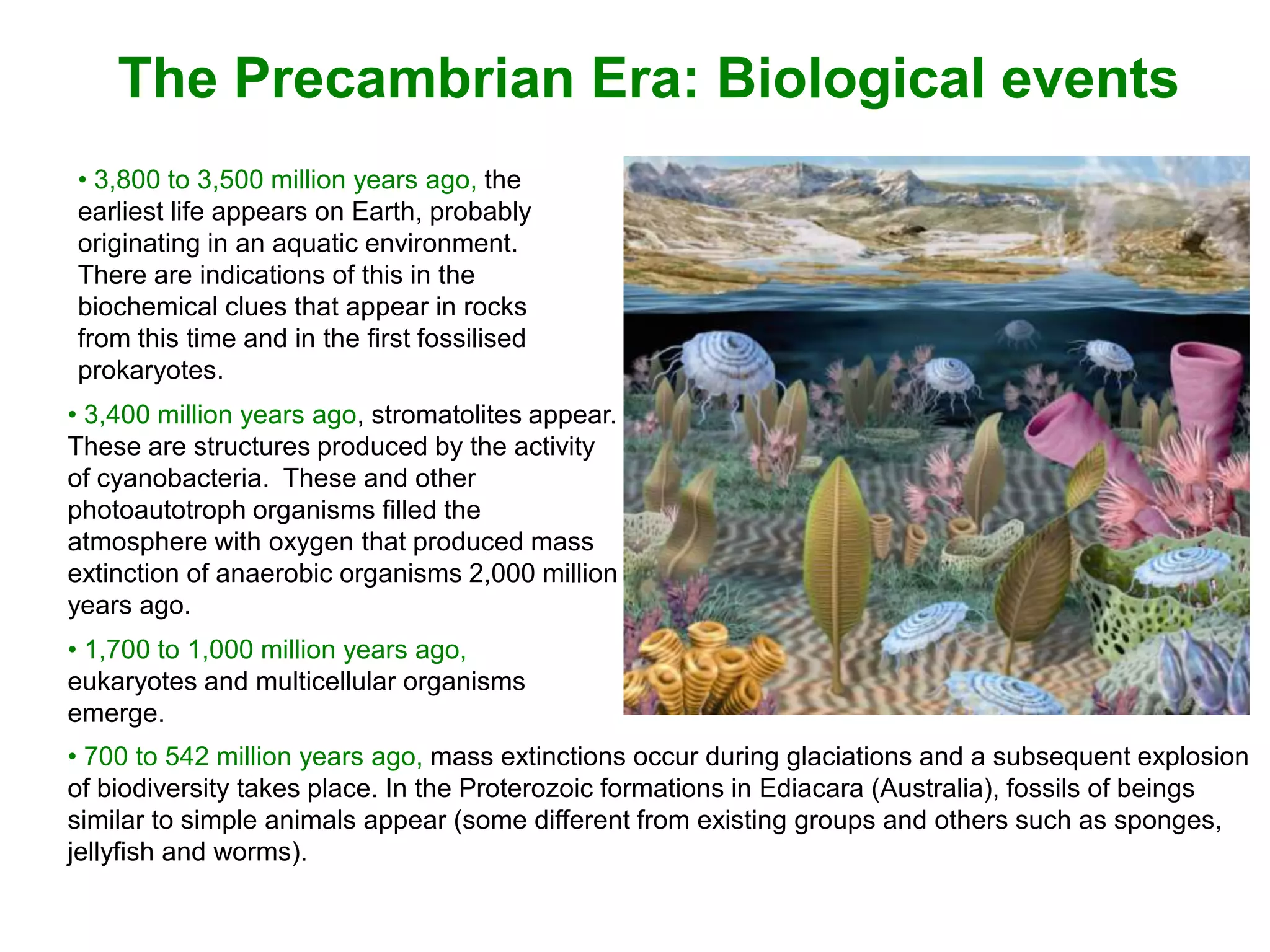
• 700 to 542 million years ago, mass extinctions occur during glaciations and a subsequent explosion
of biodiversity takes place. In the Proterozoic formations in Ediacara (Australia), fossils of beings
similar to simple animals appear (some different from existing groups and others such as sponges,
jellyfish and worms).
Ediacaran fauna
The Paleozoic Era: Biological events
• 542 to 460 million years ago, there was a great explosion of marine life. The majority of
invertebrate groups, including the first chordates, appeared.
• 460 to 400 million years ago, fish
appeared. Marine biodiversity decreased
due to the glaciation at the end of the
Ordovician period, but it recovered later.
New groups of fish started showing up.
The first plants and terrestrial arthropods
emerged.
• 400 to 250 million years ago, there was
a great diversity of fish. Plants without
seeds, and later conifers, flourished in the
terrestrial environment. The first
amphibians and early reptiles started
showing up. The latter proliferated and
diversified, adapting better to arid
conditions. At the end of the era, the
greatest mass extinction in the history of
the Earth occurred (90% of species were
wiped out).
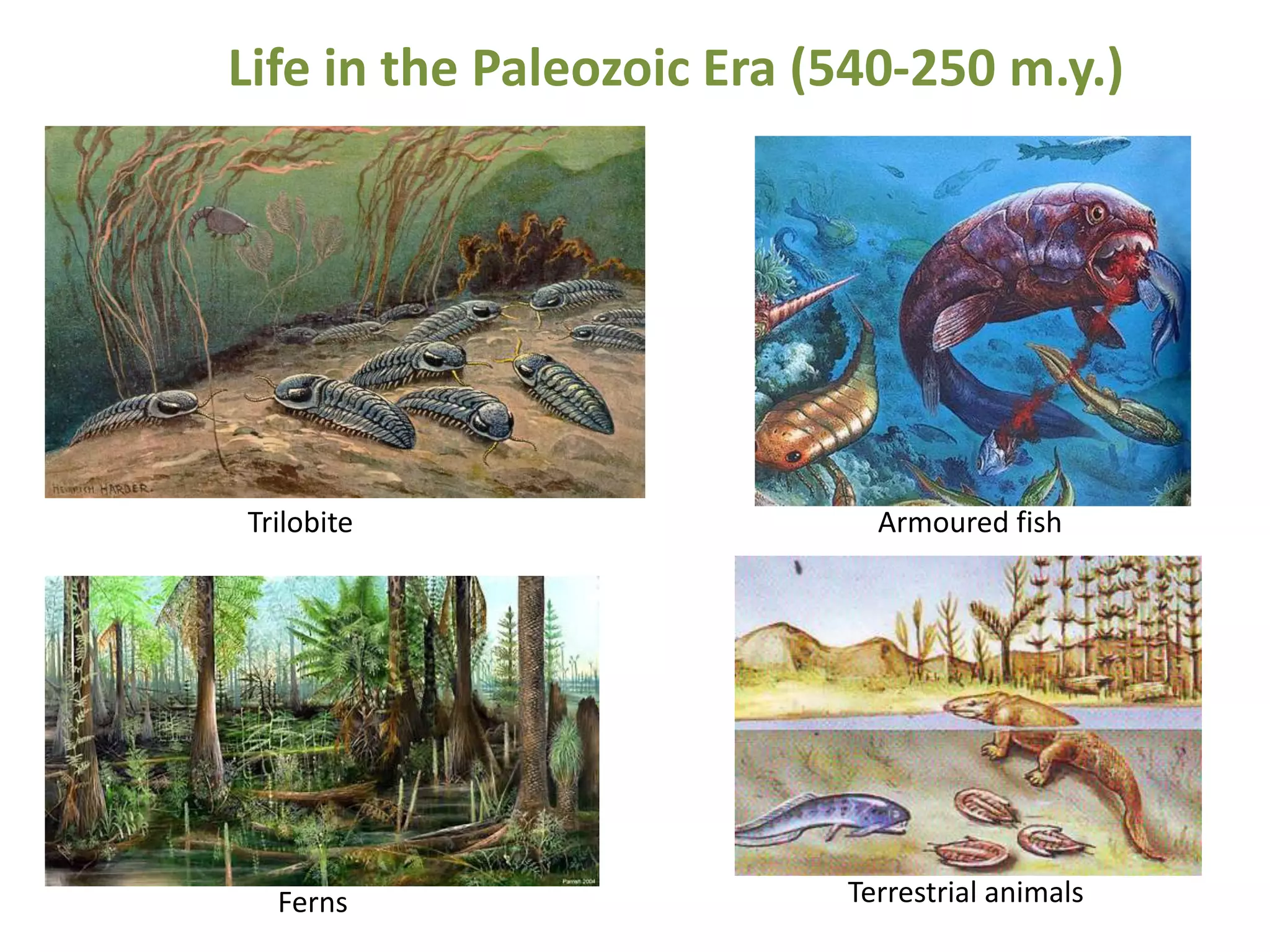
Life in the Paleozoic Era (540-250 m.y.)

Trilobite

Ferns

Armoured fish

Terrestrial animals
The Mesozoic Era: Biological events
• 250 to 200 million years ago, fish and
marine invertebrates recovered from the
Permian extinction. On land, the arid
climate favoured primitive gymnosperms,
insects and reptiles (the latter adapted to all
environments). The first dinosaurs and
early mammals started showing up.

• 200 to 145 million years ago, there was a
great diversity of marine invertebrates.
Fish and marine reptiles dominated the
seas. Conifers dominated the flora and
dinosaurs diversified and reached large
sizes. The first birds appeared.

• 145 to 65 million years ago, there was a great diversity of marine life and dinosaurs. Flowering
plants, pollinating insects and marsupials appeared. The end of the Cretaceous period saw a rapid
mass extinction, especially of many sea creatures, such as the ammonites, and terrestrial creatures
such as dinosaurs.
Life in the Mesozoic Era (250-65 m.y.)
Ammonite

Dinosaurs

Gymnosperms
The Cenozoic Era: Biological events
• 65 to 23 million years ago, the survivors of the extinction in the Cretaceous period, especially
angiosperm plants, mammals and birds, spread and diversified.
• 2.3 to 2.5 million years ago, birds and
mammals diversified widely, and in
many cases, into large sizes. Many of
the existing groups, including the first
anthropoid primates (and hominids at
end of the period), appeared. A
subtropical humid forest flora dominated
in almost all latitudes, although at the
end of this period the shift towards a
progressively cooler and drier climate
modified the fauna and flora.
• 2.5 to 0 million years ago, glaciations
radically altered the flora and caused
the emergence of many modern
groups of plants. There were new
mammal species adapted to colder or
drier climates. Hominids emerged and
the human species appeared.
Life in the Cenozoic Era (65 m.y. – present)

Mammals & birds

Humans

Angiosperms
SUMMARY

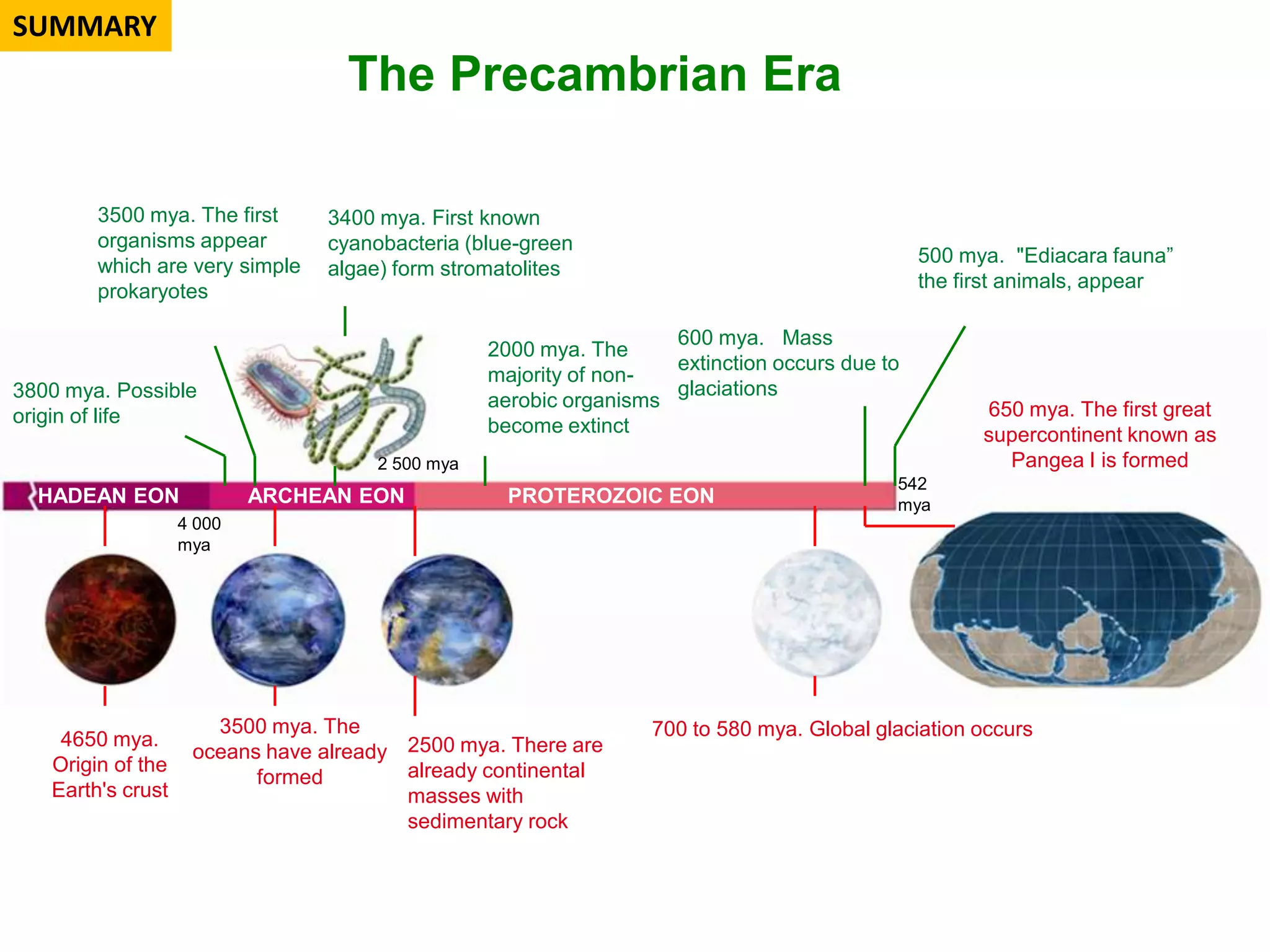
The Precambrian Era
3500 mya. The first
organisms appear
which are very simple
prokaryotes

3400 mya. First known
cyanobacteria (blue-green
algae) form stromatolites

500 mya. "Ediacara fauna”
the first animals, appear

600 mya. Mass
2000 mya. The
extinction occurs due to
majority of nonglaciations
aerobic organisms
become extinct

3800 mya. Possible
origin of life
2 500 mya

HADEAN EON

ARCHEAN EON

PROTEROZOIC EON

650 mya. The first great
supercontinent known as
Pangea I is formed

542
mya

4 000
mya

4650 mya.
Origin of the
Earth's crust

3500 mya. The
oceans have already 2500 mya. There are
already continental
formed
masses with
sedimentary rock

700 to 580 mya. Global glaciation occurs
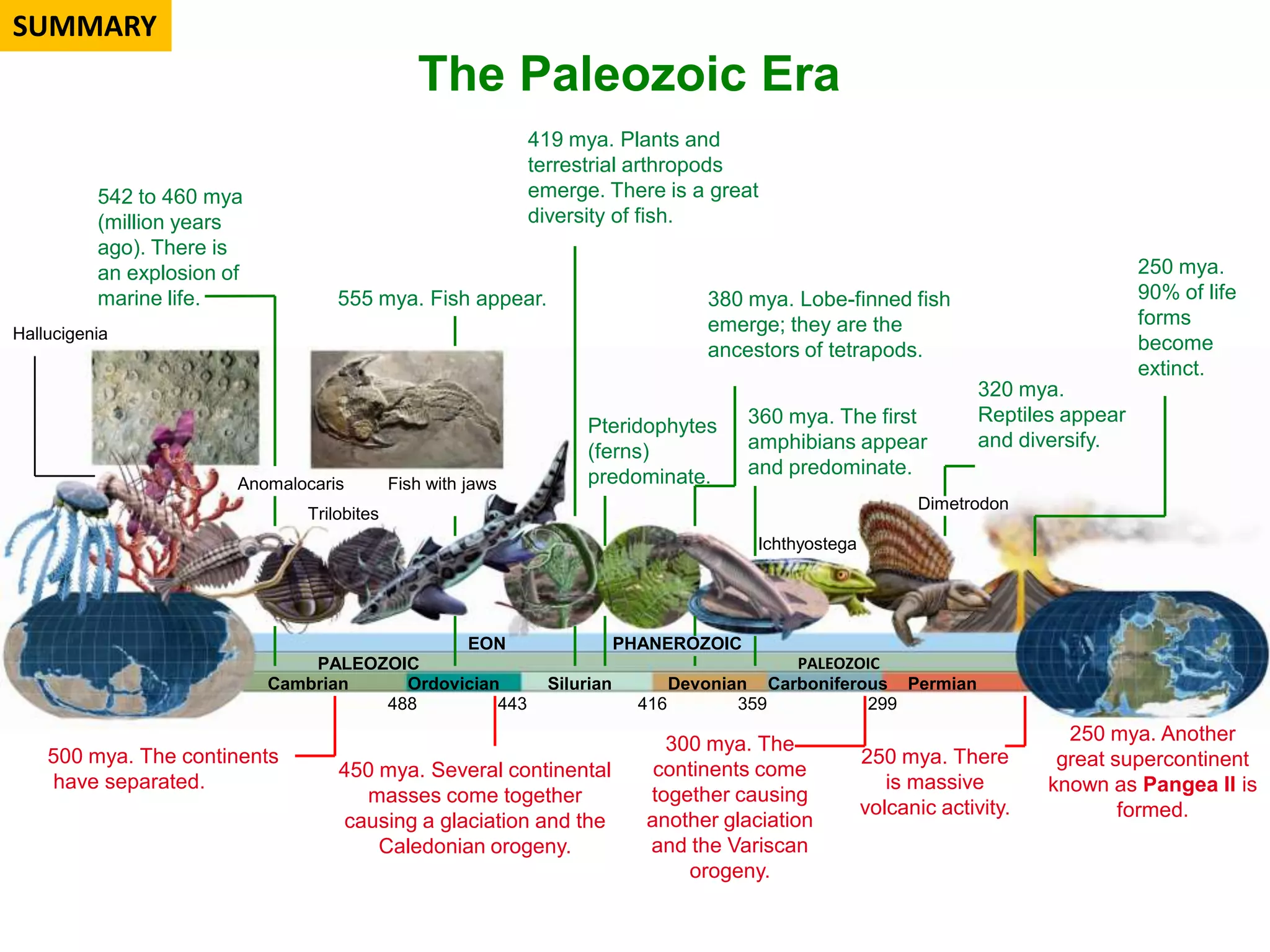
SUMMARY

The Paleozoic Era
419 mya. Plants and
terrestrial arthropods
emerge. There is a great
diversity of fish.

542 to 460 mya
(million years
ago). There is
an explosion of
marine life.

555 mya. Fish appear.

380 mya. Lobe-finned fish
emerge; they are the
ancestors of tetrapods.

Hallucigenia

Anomalocaris

Fish with jaws

250 mya.
90% of life
forms
become
extinct.

Pteridophytes
(ferns)
predominate.

360 mya. The first
amphibians appear
and predominate.

320 mya.
Reptiles appear
and diversify.

Dimetrodon

Trilobites
Ichthyostega

EON
PALEOZOIC
Cambrian
Ordovician
488
443

500 mya. The continents
have separated.

PHANEROZOIC
Silurian

450 mya. Several continental
masses come together
causing a glaciation and the
Caledonian orogeny.

PALEOZOIC
Devonian Carboniferous Permian
416
359
299

300 mya. The
continents come
together causing
another glaciation
and the Variscan
orogeny.

250 mya. There
is massive
volcanic activity.

250 mya. Another
great supercontinent
known as Pangea II is
formed.
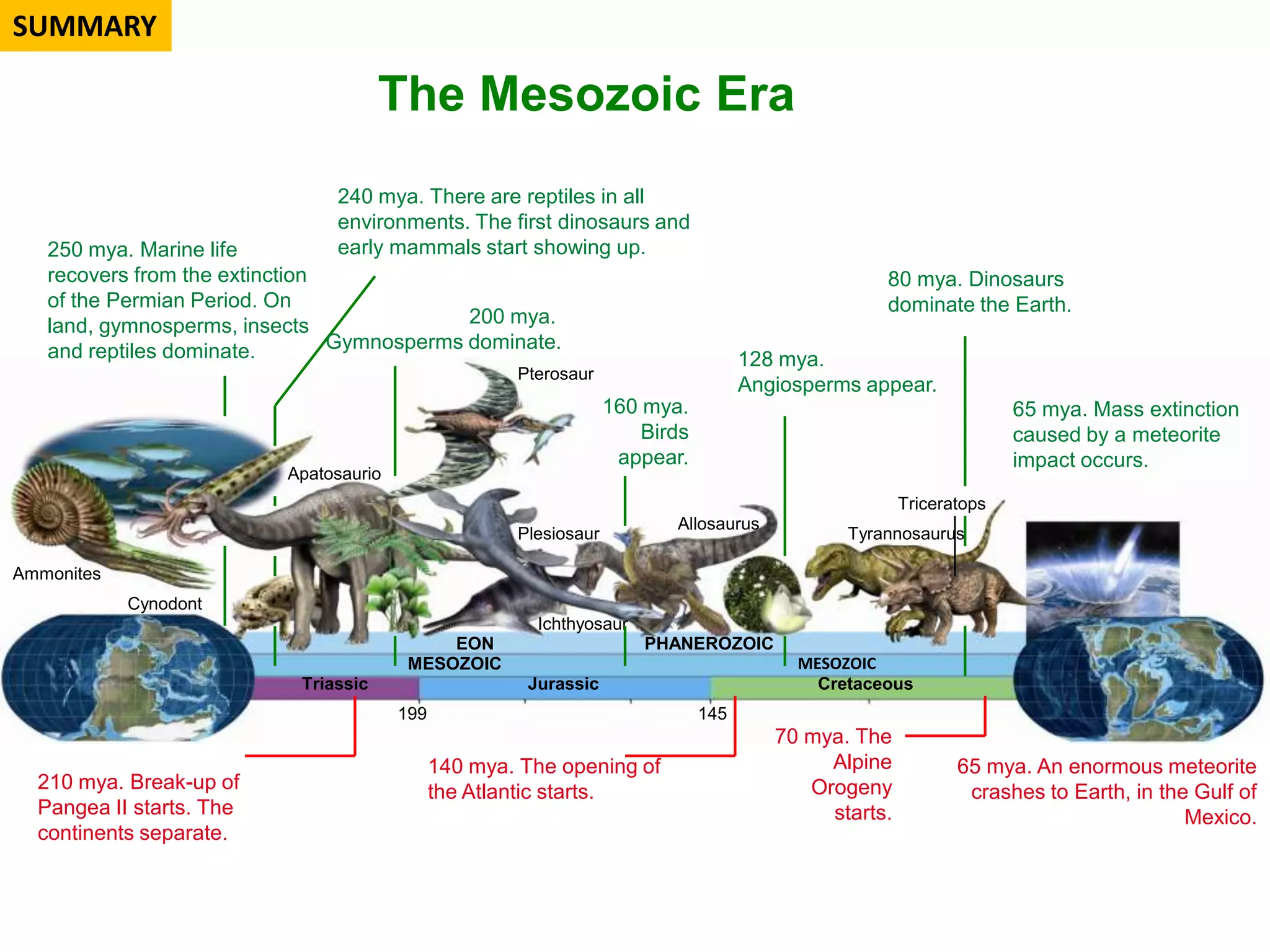
SUMMARY

The Mesozoic Era
240 mya. There are reptiles in all
environments. The first dinosaurs and
early mammals start showing up.

250 mya. Marine life
recovers from the extinction
of the Permian Period. On
200 mya.
land, gymnosperms, insects
Gymnosperms dominate.
and reptiles dominate.

80 mya. Dinosaurs
dominate the Earth.

128 mya.
Angiosperms appear.

Pterosaur

160 mya.
Birds
appear.

Apatosaurio

65 mya. Mass extinction
caused by a meteorite
impact occurs.
Triceratops

Allosaurus

Plesiosaur

Tyrannosaurus

Ammonites
Cynodont
Ichthyosaur
EON
MESOZOIC
Triassic

PHANEROZOIC

199

210 mya. Break-up of
Pangea II starts. The
continents separate.

MESOZOIC
Cretaceous

Jurassic
145

140 mya. The opening of
the Atlantic starts.

70 mya. The
Alpine
Orogeny
starts.

65 mya. An enormous meteorite
crashes to Earth, in the Gulf of
Mexico.
SUMMARY

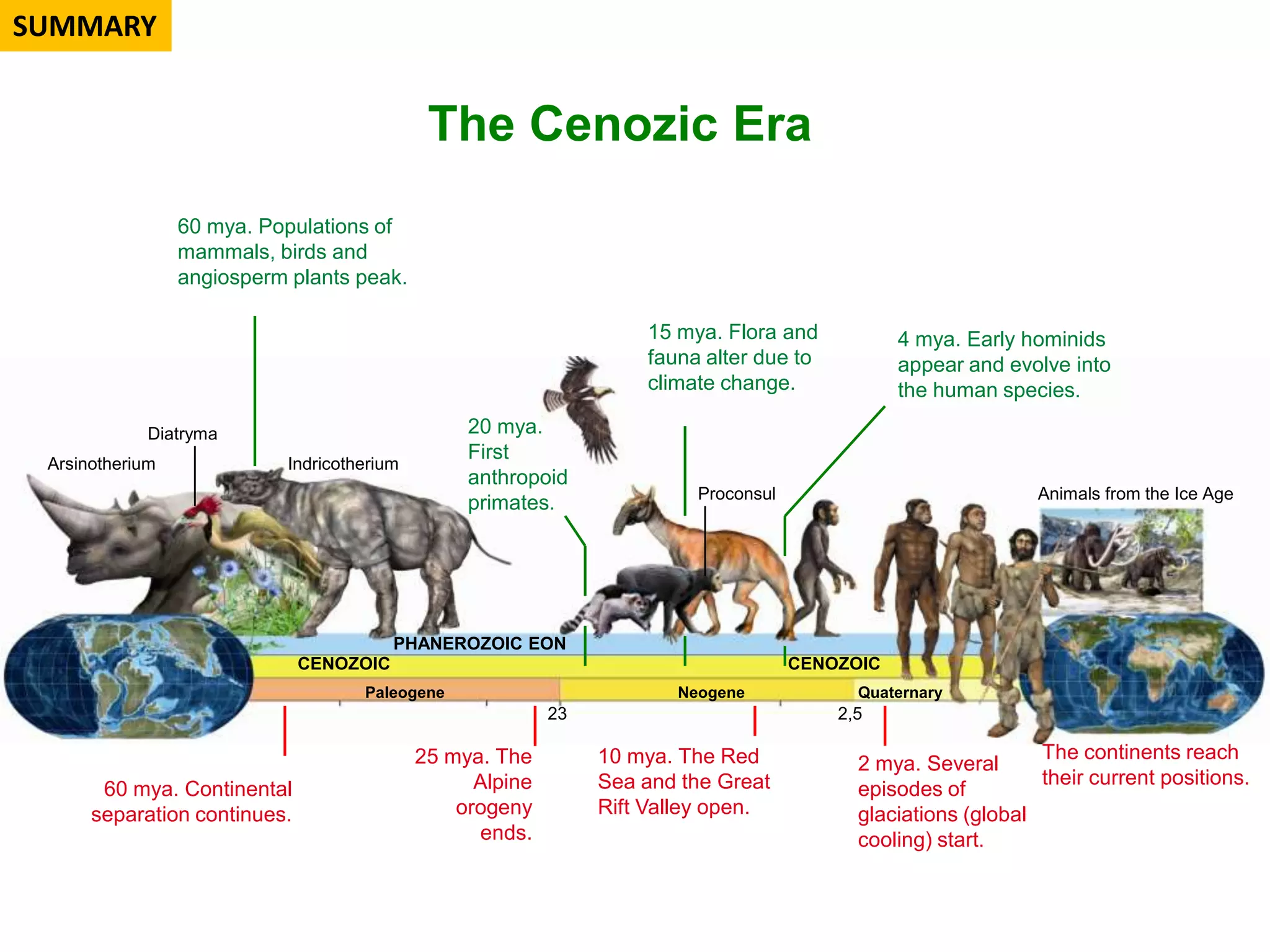
The Cenozic Era
60 mya. Populations of
mammals, birds and
angiosperm plants peak.
15 mya. Flora and
fauna alter due to
climate change.
20 mya.
First
anthropoid
primates.

Diatryma
Arsinotherium

Indricotherium

4 mya. Early hominids
appear and evolve into
the human species.

Proconsul

Animals from the Ice Age

PHANEROZOIC EON
CENOZOIC

CENOZOIC

Paleogene

Neogene

23

60 mya. Continental
separation continues.

25 mya. The
Alpine
orogeny
ends.

Quaternary

2,5

10 mya. The Red
Sea and the Great
Rift Valley open.

The continents reach
2 mya. Several
their current positions.
episodes of
glaciations (global
cooling) start.
REVISING CONCEPTS
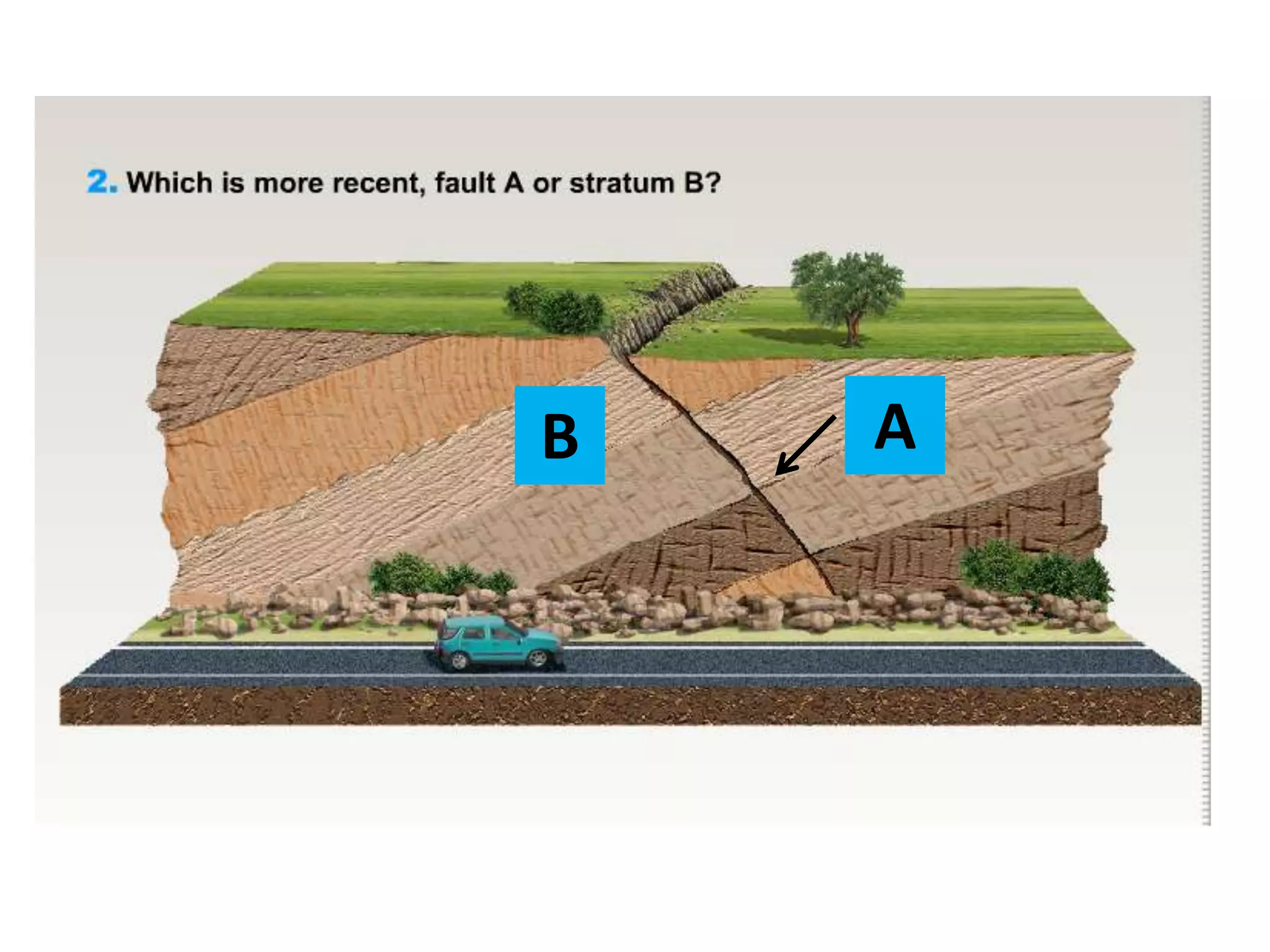
A

B
B

A
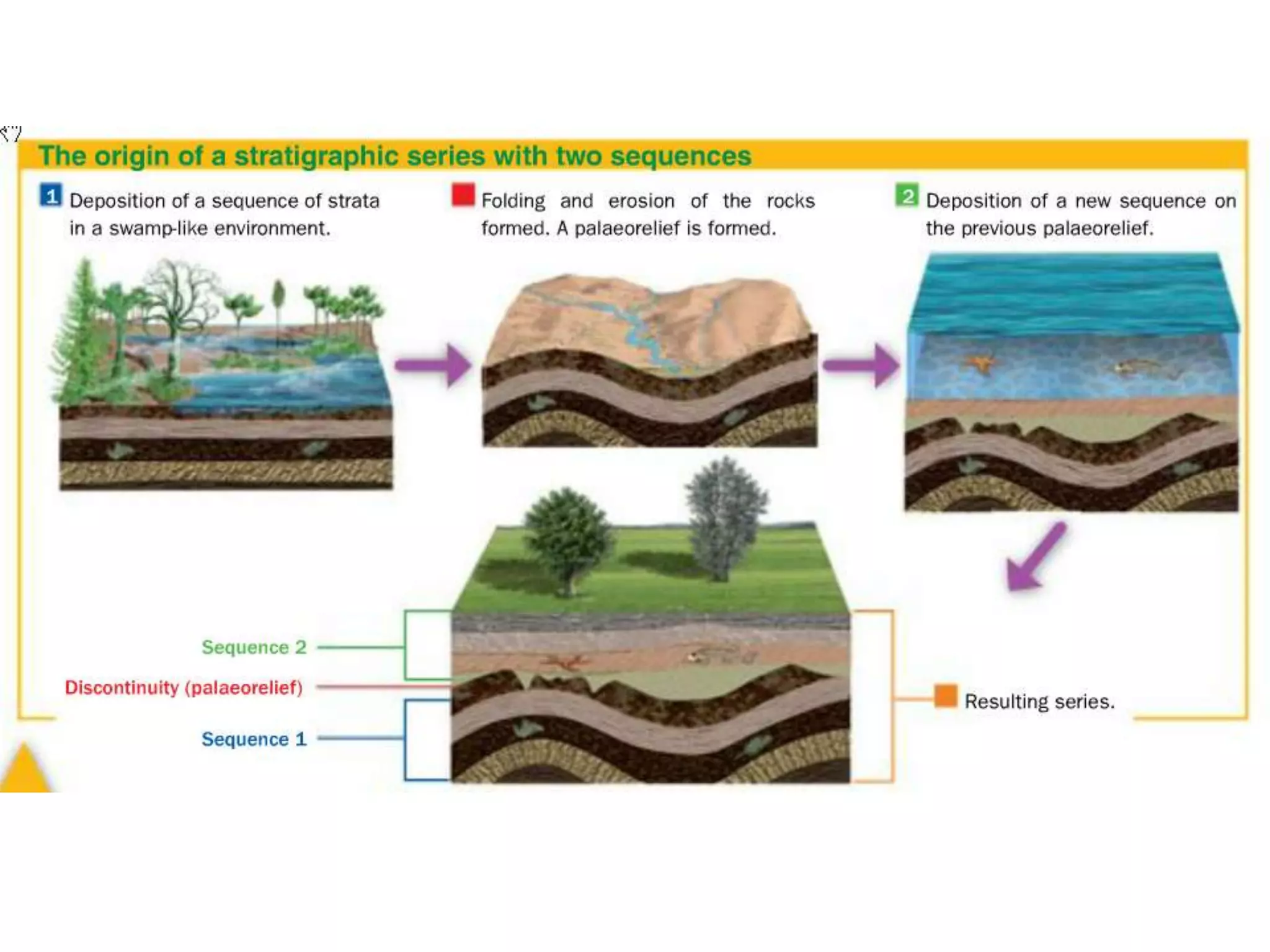
Look at the stratigraphic redord of an area. Indicate the
stratigraphic series and the stratigraphic sequences
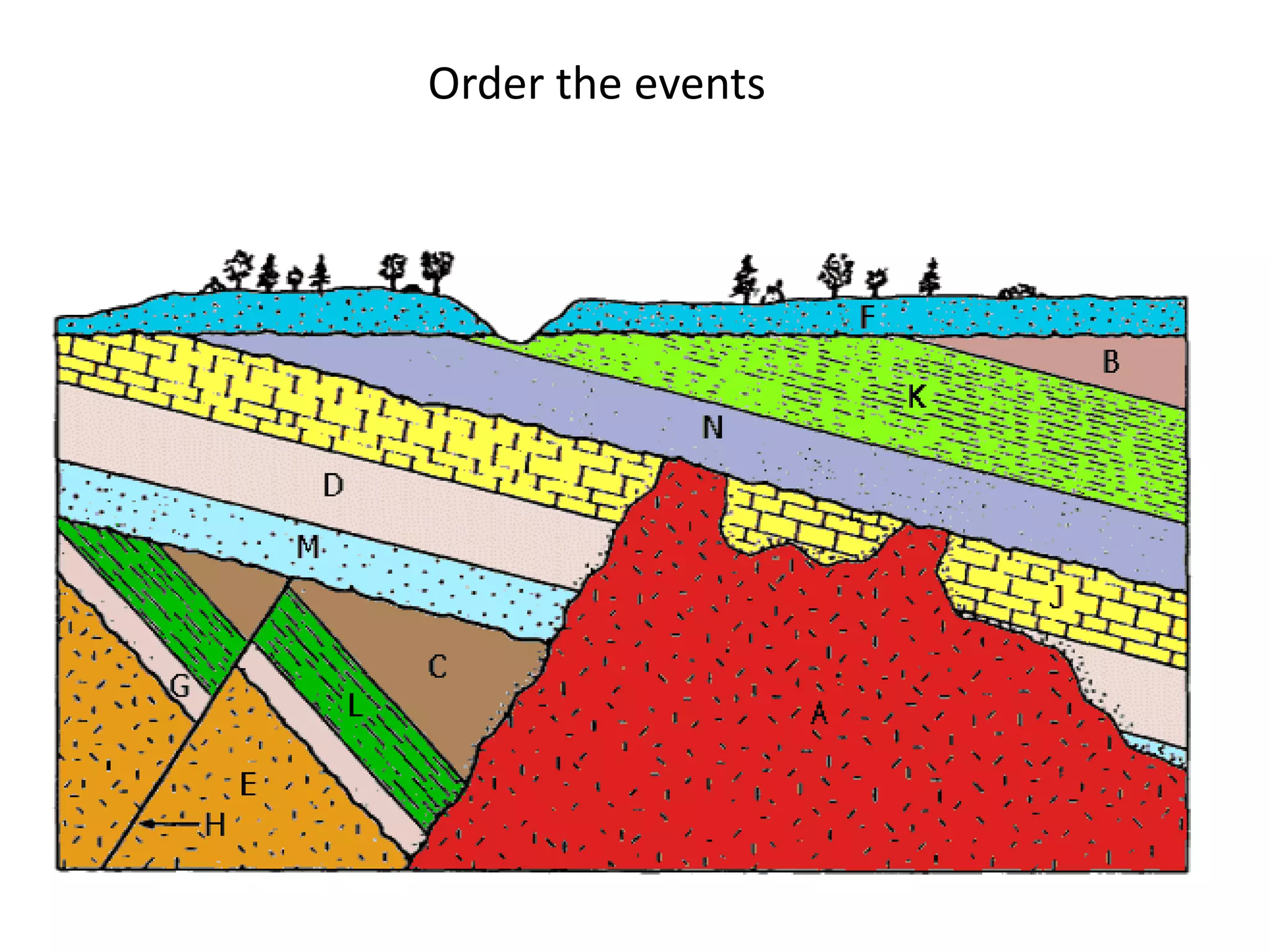
Order the events
History of earth

History of earth

  • 1.
  • 2.
    The origin of theSolar System 1. Supernova 2. Nebula 3. Temperature rose due to nuclear fusion reactions 4. Temperature fall and materials start condensing 5. Condensed fragments collided and got together until planets were formed
  • 3.
  • 4.
    METHODS OF ABSOLUTEDATING Absolute dating methods measure the time that has elapsed since a geologic event happened (rock formation, deposition of a stratum, the age of a fossil, etc.). They are: SedBiological methods imentological methods Radiometric methods
  • 5.
    Biological methods These arebased on the analysis of biological rhythms associated with intervals of time, such as the growth rings of trees or daily growth bands (striations) on living corals. Each year, trees develop two rings: one light ring (in spring) and one dark ring (in summer). By doing a very simple calculation, we can tell the age of a tree if we count the number of rings inside the tree trunk.
  • 6.
    Sedimentological methods These arebased on cyclical sediment deposits, like what happens with glacial varves, which are sediments that are deposited at the bottom of glacial lakes, depending on seasonal changes. Summer Winter Ice Glacial lake Thin dark layer of sediments Only a thin dark layer (consisting of clays and organic matter) accumulates when the surface of the lake is frozen over in winter. Thick clear layer of sediments Glacial varves A thick clear detrital layer is deposited into the lake when the ice melts in summer. It is possible to calculate the age of the lake by counting the varves.
  • 7.
    Radiometric methods Radioactive elementssuch as uranium 238 (U238) or carbon-14 (14C) are used; they may be contained in rocks, fossils or archaeological remains. Radioactive isotopes are unstable and emit radiation, so that after some time, they transform into other more stable atoms.
  • 8.
    HALF LIFE OFRADIACTIVE ATOMS If we know the rate of disintegration, we can date the age of a sample by measuring the ratio between unstable radioactive atoms and stable atoms formed from them.
  • 11.
    METHODS OF RELATIVEDATING Relative dating consists of ordering the strata or geological events recorded in one or more stratigraphic series chronologically, without specifying how long ago they occurred or how long they lasted. Relative dating is achieved by interpreting satratigraphic series, uisng the following basic principles: Principle of uniformitarism Principle of the sucession of geological events Principle of the arrengement of strata Original horizontality Lateral continuity Superposition Principle of the sucession of fossils
  • 18.
    The four stepsof fossilization 1. Death 2. Burial 3. Replacement 4. Erosion
  • 20.
  • 21.
  • 22.
  • 24.
  • 25.
    The Precambrian Era: Geologicaland paleoclimatic events Hadean era (4,500-3,800 m.y.) 1. Meterorites continually collided the Earth 2. Layers were formed 3. Atmosphere and oceans were formed 4. The Moon was formed 5. Life appeared at the end of the period Archaean and Proterozoic (3,800-540 m.y.) 1. 2. 3. 4. 5. 6. Meteorite bombardment stopped Tectonic plates movement started Oxygen appeared in the atmosphere Iron oxide appeared in rocks Rodinia supercontinent was formed The biggest glacial period started
  • 26.
    The Paleozoic Era: Geologicaland paleoclimatic events • 542 to 500 million years ago, the continents were separated by shallow, warm seas. • 460 to 350 million years ago, the continents began to come together. The Caledonian orogeny mountain ranges formed as a result of several continental masses colliding and glaciation occurred. • 300 to 250 million years ago, the Variscan orogeny mountain-building event was caused by new continental collisions. The supercontinent Pangea II was formed and there was another glaciation. The climate in the inland regions of the continent was very dry as it was very far from the sea. An episode of massive volcanic activity occurred at the end of the Permian period that caused global warming due to increasing greenhouse gases in the atmosphere.
  • 27.
    The Mesozoic Era: Geologicaland paleoclimatic events • 250 to 200 million years ago, the continents came together as Pangea II. The climate was very warm and very dry in the interior of the supercontinent. At the end of the Triassic period, continental fragmentation began and shallow seas opened up. • 200 to 145 million years ago, the opening of the continents continued. The climate was much wetter and it was still warm (tropical to humid temperate environments). • 145 to 65 million years ago, the continents continued to separate (the Atlantic opened up), but Africa and India started colliding with Eurasia, which initiated the uplifting of the Alpine orogeny mountain building event. The climate started to cool. At the end of the Cretaceous period, global volcanic activity increased and a large asteroid struck Earth.
  • 28.
    The Cenozic Era: Geologicaland paleoclimatic events • 65 to 23 million years ago, the separation of the continents that began in the Cretaceous period (the opening of the Atlantic) continued and India completed its collision with Eurasia. This marked the end of the Alpine orogeny. The mountains on the western boundary of America formed. The climate at this time was still subtropical and humid in almost all regions. • 23 to 2.5 million years ago, the continents reached positions close to the ones they are in at the present time. The Red Sea and East Africa's Great Rift Valley opened. The climate became cooler and more arid. • 2.5 to 0 million years ago, several glacial episodes occurred.
  • 29.
    The Precambrian Era:Biological events • 3,800 to 3,500 million years ago, the earliest life appears on Earth, probably originating in an aquatic environment. There are indications of this in the biochemical clues that appear in rocks from this time and in the first fossilised prokaryotes. • 3,400 million years ago, stromatolites appear. These are structures produced by the activity of cyanobacteria. These and other photoautotroph organisms filled the atmosphere with oxygen that produced mass extinction of anaerobic organisms 2,000 million years ago. • 1,700 to 1,000 million years ago, eukaryotes and multicellular organisms emerge. • 700 to 542 million years ago, mass extinctions occur during glaciations and a subsequent explosion of biodiversity takes place. In the Proterozoic formations in Ediacara (Australia), fossils of beings similar to simple animals appear (some different from existing groups and others such as sponges, jellyfish and worms).
  • 30.
  • 31.
    The Paleozoic Era:Biological events • 542 to 460 million years ago, there was a great explosion of marine life. The majority of invertebrate groups, including the first chordates, appeared. • 460 to 400 million years ago, fish appeared. Marine biodiversity decreased due to the glaciation at the end of the Ordovician period, but it recovered later. New groups of fish started showing up. The first plants and terrestrial arthropods emerged. • 400 to 250 million years ago, there was a great diversity of fish. Plants without seeds, and later conifers, flourished in the terrestrial environment. The first amphibians and early reptiles started showing up. The latter proliferated and diversified, adapting better to arid conditions. At the end of the era, the greatest mass extinction in the history of the Earth occurred (90% of species were wiped out).
  • 32.
    Life in thePaleozoic Era (540-250 m.y.) Trilobite Ferns Armoured fish Terrestrial animals
  • 33.
    The Mesozoic Era:Biological events • 250 to 200 million years ago, fish and marine invertebrates recovered from the Permian extinction. On land, the arid climate favoured primitive gymnosperms, insects and reptiles (the latter adapted to all environments). The first dinosaurs and early mammals started showing up. • 200 to 145 million years ago, there was a great diversity of marine invertebrates. Fish and marine reptiles dominated the seas. Conifers dominated the flora and dinosaurs diversified and reached large sizes. The first birds appeared. • 145 to 65 million years ago, there was a great diversity of marine life and dinosaurs. Flowering plants, pollinating insects and marsupials appeared. The end of the Cretaceous period saw a rapid mass extinction, especially of many sea creatures, such as the ammonites, and terrestrial creatures such as dinosaurs.
  • 34.
    Life in theMesozoic Era (250-65 m.y.) Ammonite Dinosaurs Gymnosperms
  • 35.
    The Cenozoic Era:Biological events • 65 to 23 million years ago, the survivors of the extinction in the Cretaceous period, especially angiosperm plants, mammals and birds, spread and diversified. • 2.3 to 2.5 million years ago, birds and mammals diversified widely, and in many cases, into large sizes. Many of the existing groups, including the first anthropoid primates (and hominids at end of the period), appeared. A subtropical humid forest flora dominated in almost all latitudes, although at the end of this period the shift towards a progressively cooler and drier climate modified the fauna and flora. • 2.5 to 0 million years ago, glaciations radically altered the flora and caused the emergence of many modern groups of plants. There were new mammal species adapted to colder or drier climates. Hominids emerged and the human species appeared.
  • 36.
    Life in theCenozoic Era (65 m.y. – present) Mammals & birds Humans Angiosperms
  • 37.
    SUMMARY The Precambrian Era 3500mya. The first organisms appear which are very simple prokaryotes 3400 mya. First known cyanobacteria (blue-green algae) form stromatolites 500 mya. "Ediacara fauna” the first animals, appear 600 mya. Mass 2000 mya. The extinction occurs due to majority of nonglaciations aerobic organisms become extinct 3800 mya. Possible origin of life 2 500 mya HADEAN EON ARCHEAN EON PROTEROZOIC EON 650 mya. The first great supercontinent known as Pangea I is formed 542 mya 4 000 mya 4650 mya. Origin of the Earth's crust 3500 mya. The oceans have already 2500 mya. There are already continental formed masses with sedimentary rock 700 to 580 mya. Global glaciation occurs
  • 38.
    SUMMARY The Paleozoic Era 419mya. Plants and terrestrial arthropods emerge. There is a great diversity of fish. 542 to 460 mya (million years ago). There is an explosion of marine life. 555 mya. Fish appear. 380 mya. Lobe-finned fish emerge; they are the ancestors of tetrapods. Hallucigenia Anomalocaris Fish with jaws 250 mya. 90% of life forms become extinct. Pteridophytes (ferns) predominate. 360 mya. The first amphibians appear and predominate. 320 mya. Reptiles appear and diversify. Dimetrodon Trilobites Ichthyostega EON PALEOZOIC Cambrian Ordovician 488 443 500 mya. The continents have separated. PHANEROZOIC Silurian 450 mya. Several continental masses come together causing a glaciation and the Caledonian orogeny. PALEOZOIC Devonian Carboniferous Permian 416 359 299 300 mya. The continents come together causing another glaciation and the Variscan orogeny. 250 mya. There is massive volcanic activity. 250 mya. Another great supercontinent known as Pangea II is formed.
  • 39.
    SUMMARY The Mesozoic Era 240mya. There are reptiles in all environments. The first dinosaurs and early mammals start showing up. 250 mya. Marine life recovers from the extinction of the Permian Period. On 200 mya. land, gymnosperms, insects Gymnosperms dominate. and reptiles dominate. 80 mya. Dinosaurs dominate the Earth. 128 mya. Angiosperms appear. Pterosaur 160 mya. Birds appear. Apatosaurio 65 mya. Mass extinction caused by a meteorite impact occurs. Triceratops Allosaurus Plesiosaur Tyrannosaurus Ammonites Cynodont Ichthyosaur EON MESOZOIC Triassic PHANEROZOIC 199 210 mya. Break-up of Pangea II starts. The continents separate. MESOZOIC Cretaceous Jurassic 145 140 mya. The opening of the Atlantic starts. 70 mya. The Alpine Orogeny starts. 65 mya. An enormous meteorite crashes to Earth, in the Gulf of Mexico.
  • 40.
    SUMMARY The Cenozic Era 60mya. Populations of mammals, birds and angiosperm plants peak. 15 mya. Flora and fauna alter due to climate change. 20 mya. First anthropoid primates. Diatryma Arsinotherium Indricotherium 4 mya. Early hominids appear and evolve into the human species. Proconsul Animals from the Ice Age PHANEROZOIC EON CENOZOIC CENOZOIC Paleogene Neogene 23 60 mya. Continental separation continues. 25 mya. The Alpine orogeny ends. Quaternary 2,5 10 mya. The Red Sea and the Great Rift Valley open. The continents reach 2 mya. Several their current positions. episodes of glaciations (global cooling) start.
  • 41.
  • 42.
  • 43.
  • 45.
    Look at thestratigraphic redord of an area. Indicate the stratigraphic series and the stratigraphic sequences
  • 46.