Praye
r
What is the geologic
time scale?
Describe the various hazards that may
happen in the event of earthquakes, volcanic
eruptions, and landslides
Using hazard maps, identify areas prone to
hazards brought about by earthquakes,
volcanic eruptions, and landslides
Identify human activities that speed up or
trigger landslides
“Draw Me”
Directions. In a piece of paper
draw an erupting volcano. Based
on your drawing, can you name
five geologic hazards posed by an
erupting volcano.
Geological Processes
and Hazards
Geological processes are naturally
occurring events that directly or
indirectly impact the geology of the
Earth. Examples of geological processes
include events such as plate tectonics,
weathering, earthquakes, volcanic
eruptions, mountain formation,
deposition, erosion, droughts, flooding,
and landslides.
Geological processes affect every
human on the Earth all of the time,
but are most noticeable when they
cause loss of life or property.
These threatening processes are
called natural disasters.
-an extreme natural event in the
crust of the earth that poses a
threat to life and property.
-these hazards can cause immense
damage, loss of property, and
sometimes life.
What is a geological hazard?
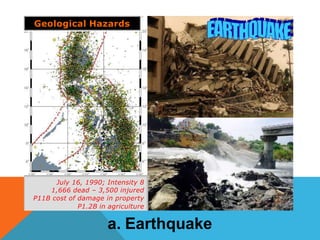
July 16, 1990; Intensity 8
1,666 dead – 3,500 injured
P11B cost of damage in property
P1.2B in agriculture
Geological Hazards
a. Earthquake
a. Earthquake
- An earthquake is a shaking
of the ground caused by sudden
slippage of rock masses below or at
the surface of the earth.
- It is a wave-like movement of
the earth’s surface.
Hazards caused by an
Earthquake
1. Ground Shaking
2. Surface Faulting
3. Landslide
4. Liquefaction
5. Tsunamis
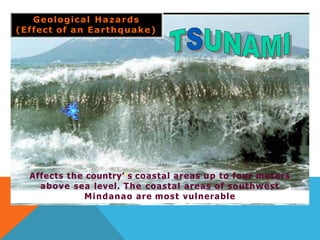
Affects the country’’s coastal areas up to four meters
above sea level. The coastal areas of southwest
Mindanao are most vulnerable
Geological Hazards
(Effect of an Earthquake)
TSUNAMI
- Tsunamis are giant sea
waves generated by under-the
sea earthquakes and volcanic
eruptions.
Not all submarine earthquakes,
however, can cause the occurrenc
e of tsunamis.
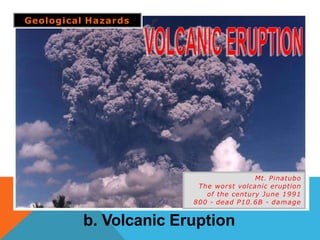
Mt. Pinatubo
The worst volcanic eruption
of the century June 1991
800 - dead P10.6B - damage
Geological Hazards
b. Volcanic Eruption
-occurs when magma is released
from a volcano. Volcanic eruptions
are major natural hazards on Earth.
Volcanic eruptions can have a
devastating effect on people and the
environment.
Hazards caused by Volcanic
Eruption
1. Tephra
2. Pyroclastic Flow
3. Lahar
4. Flood
5. Lava Domes
6. Poisonous Gases
The Philippines has suffered from an
inexhaustible number of deadly
typhoons, earthquakes, volcanic
eruptions and other natural disasters. This
is due to its location along the Ring of
Fire, or typhoon belt – a large Pacific
Ocean region where many of Earth’s
volcanic eruptions and earthquakes
occur.
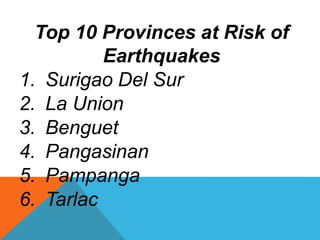
Top 10 Provinces at Risk of
Earthquakes
1. Surigao Del Sur
2. La Union
3. Benguet
4. Pangasinan
5. Pampanga
6. Tarlac
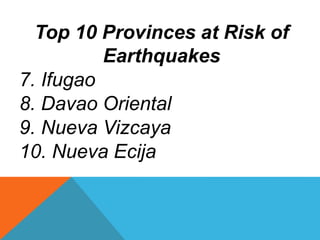
Top 10 Provinces at Risk of
Earthquakes
7. Ifugao
8. Davao Oriental
9. Nueva Vizcaya
10. Nueva Ecija
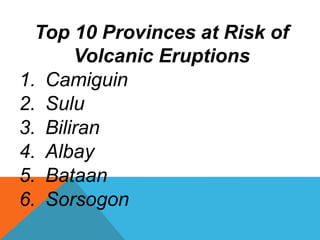
Top 10 Provinces at Risk of
Volcanic Eruptions
1. Camiguin
2. Sulu
3. Biliran
4. Albay
5. Bataan
6. Sorsogon
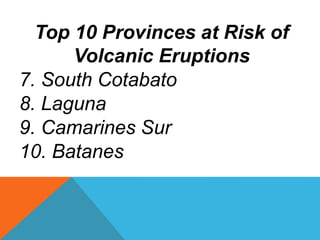
Top 10 Provinces at Risk of
Volcanic Eruptions
7. South Cotabato
8. Laguna
9. Camarines Sur
10. Batanes
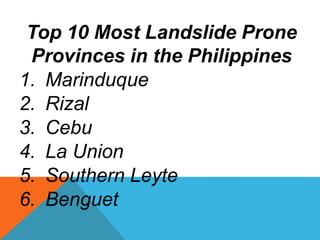
Top 10 Most Landslide Prone
Provinces in the Philippines
1. Marinduque
2. Rizal
3. Cebu
4. La Union
5. Southern Leyte
6. Benguet
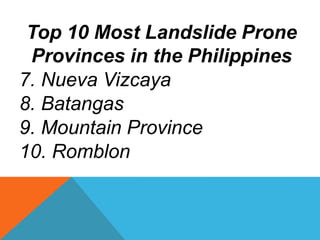
Top 10 Most Landslide Prone
Provinces in the Philippines
7. Nueva Vizcaya
8. Batangas
9. Mountain Province
10. Romblon
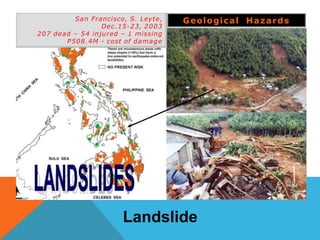
Geological Hazards
San Francisco, S. Leyte,
Dec.15-23, 2003
207 dead – 54 injured – 1 missing
P508.4M - cost of damage
Landslide
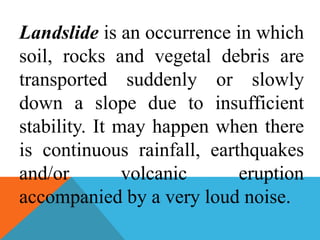
Landslide is an occurrence in which
soil, rocks and vegetal debris are
transported suddenly or slowly
down a slope due to insufficient
stability. It may happen when there
is continuous rainfall, earthquakes
and/or volcanic eruption
accompanied by a very loud noise.
Human Activities that trigger
landslides:
a. Overloading slopes
b. Mining which uses explosives
underground
c. Excavation or displacement of rocks.
d. Land use such as modification of
slopes by construction of roads,
railways, buildings, houses, etc.
e. Quarrying which includes excavation
or pit, open to the air, from which
building stone, slate, or the like is
obtained by cutting, blasting, etc.
f. Land pollution which is the
degradation of earth’s land surface,
exploitation of minerals and improper
use of soil by inadequate agricultural
practices.
g. Excavation which pertains
to exposure, processing, and
recording of archaeological
remains
h. Cutting Trees that can lead
to deforestation and may
encourage landslide
Precautionary measures to observe
and follow in preparing for landslides:
a. Stay alert and awake. Many debris-
flow fatalities occur when people
are sleeping.
b. If you are in areas susceptible to
landslides and debris flows, consider
leaving if it is safe to do so.
c. Listen for any unusual sounds that
might indicate moving debris, such as
trees cracking or boulders knocking
together.
d. If you are near a stream or channel,
be alert for any sudden increase or
decrease in water flow and for a
change from clear to muddy water.
e. Be especially alert when
driving. Bridges may be washed
out, and culverts overtop.
f. Be aware that strong shaking
from earthquakes can induce or
intensify the effects of landslides.
Let’s Apply!
“Be Prepared”
Directions. Hazards may pose danger to
our lives. Let us be prepared and protect
ourselves. As students, how are you
going to protect your lives in times of
hazards? Write a step-by-step procedure
of preparing and protecting yourselves in
times of geologic hazards.
Present Your
Work
What are your realizations for the day?
Let us assess what you learned
Directions. Read each
statement and choose the
letter of the correct answer.
Write your answer on a
separate sheet of paper.

10 Geologic Processes and Hazards.pptx

  • 1.
  • 2.
    What is thegeologic time scale?
  • 3.
    Describe the varioushazards that may happen in the event of earthquakes, volcanic eruptions, and landslides Using hazard maps, identify areas prone to hazards brought about by earthquakes, volcanic eruptions, and landslides Identify human activities that speed up or trigger landslides
  • 4.
    “Draw Me” Directions. Ina piece of paper draw an erupting volcano. Based on your drawing, can you name five geologic hazards posed by an erupting volcano.
  • 5.
  • 6.
    Geological processes arenaturally occurring events that directly or indirectly impact the geology of the Earth. Examples of geological processes include events such as plate tectonics, weathering, earthquakes, volcanic eruptions, mountain formation, deposition, erosion, droughts, flooding, and landslides.
  • 7.
    Geological processes affectevery human on the Earth all of the time, but are most noticeable when they cause loss of life or property. These threatening processes are called natural disasters.
  • 8.
    -an extreme naturalevent in the crust of the earth that poses a threat to life and property. -these hazards can cause immense damage, loss of property, and sometimes life. What is a geological hazard?
  • 9.
    July 16, 1990;Intensity 8 1,666 dead – 3,500 injured P11B cost of damage in property P1.2B in agriculture Geological Hazards a. Earthquake
  • 10.
    a. Earthquake - Anearthquake is a shaking of the ground caused by sudden slippage of rock masses below or at the surface of the earth. - It is a wave-like movement of the earth’s surface.
  • 11.
    Hazards caused byan Earthquake 1. Ground Shaking 2. Surface Faulting 3. Landslide 4. Liquefaction 5. Tsunamis
  • 12.
    Affects the country’’scoastal areas up to four meters above sea level. The coastal areas of southwest Mindanao are most vulnerable Geological Hazards (Effect of an Earthquake)
  • 13.
    TSUNAMI - Tsunamis aregiant sea waves generated by under-the sea earthquakes and volcanic eruptions. Not all submarine earthquakes, however, can cause the occurrenc e of tsunamis.
  • 14.
    Mt. Pinatubo The worstvolcanic eruption of the century June 1991 800 - dead P10.6B - damage Geological Hazards b. Volcanic Eruption
  • 15.
    b. Volcanic Eruption -occurswhen magma is released from a volcano. Volcanic eruptions are major natural hazards on Earth. Volcanic eruptions can have a devastating effect on people and the environment.
  • 16.
    Hazards caused byVolcanic Eruption 1. Tephra 2. Pyroclastic Flow 3. Lahar 4. Flood 5. Lava Domes 6. Poisonous Gases
  • 17.
    The Philippines hassuffered from an inexhaustible number of deadly typhoons, earthquakes, volcanic eruptions and other natural disasters. This is due to its location along the Ring of Fire, or typhoon belt – a large Pacific Ocean region where many of Earth’s volcanic eruptions and earthquakes occur.
  • 18.
    Top 10 Provincesat Risk of Earthquakes 1. Surigao Del Sur 2. La Union 3. Benguet 4. Pangasinan 5. Pampanga 6. Tarlac
  • 19.
    Top 10 Provincesat Risk of Earthquakes 7. Ifugao 8. Davao Oriental 9. Nueva Vizcaya 10. Nueva Ecija
  • 20.
    Top 10 Provincesat Risk of Volcanic Eruptions 1. Camiguin 2. Sulu 3. Biliran 4. Albay 5. Bataan 6. Sorsogon
  • 21.
    Top 10 Provincesat Risk of Volcanic Eruptions 7. South Cotabato 8. Laguna 9. Camarines Sur 10. Batanes
  • 22.
    Top 10 MostLandslide Prone Provinces in the Philippines 1. Marinduque 2. Rizal 3. Cebu 4. La Union 5. Southern Leyte 6. Benguet
  • 23.
    Top 10 MostLandslide Prone Provinces in the Philippines 7. Nueva Vizcaya 8. Batangas 9. Mountain Province 10. Romblon
  • 24.
    Geological Hazards San Francisco,S. Leyte, Dec.15-23, 2003 207 dead – 54 injured – 1 missing P508.4M - cost of damage Landslide
  • 25.
    Landslide is anoccurrence in which soil, rocks and vegetal debris are transported suddenly or slowly down a slope due to insufficient stability. It may happen when there is continuous rainfall, earthquakes and/or volcanic eruption accompanied by a very loud noise.
  • 26.
    Human Activities thattrigger landslides: a. Overloading slopes b. Mining which uses explosives underground c. Excavation or displacement of rocks. d. Land use such as modification of slopes by construction of roads, railways, buildings, houses, etc.
  • 27.
    e. Quarrying whichincludes excavation or pit, open to the air, from which building stone, slate, or the like is obtained by cutting, blasting, etc. f. Land pollution which is the degradation of earth’s land surface, exploitation of minerals and improper use of soil by inadequate agricultural practices.
  • 28.
    g. Excavation whichpertains to exposure, processing, and recording of archaeological remains h. Cutting Trees that can lead to deforestation and may encourage landslide
  • 29.
    Precautionary measures toobserve and follow in preparing for landslides: a. Stay alert and awake. Many debris- flow fatalities occur when people are sleeping. b. If you are in areas susceptible to landslides and debris flows, consider leaving if it is safe to do so.
  • 30.
    c. Listen forany unusual sounds that might indicate moving debris, such as trees cracking or boulders knocking together. d. If you are near a stream or channel, be alert for any sudden increase or decrease in water flow and for a change from clear to muddy water.
  • 31.
    e. Be especiallyalert when driving. Bridges may be washed out, and culverts overtop. f. Be aware that strong shaking from earthquakes can induce or intensify the effects of landslides.
  • 32.
    Let’s Apply! “Be Prepared” Directions.Hazards may pose danger to our lives. Let us be prepared and protect ourselves. As students, how are you going to protect your lives in times of hazards? Write a step-by-step procedure of preparing and protecting yourselves in times of geologic hazards.
  • 33.
  • 34.
    What are yourrealizations for the day?
  • 35.
    Let us assesswhat you learned Directions. Read each statement and choose the letter of the correct answer. Write your answer on a separate sheet of paper.