Chapter 4: Earth
Materials and Processes
EXOGENIC
PROCESS
•These are processes that
take place at or near
the earths surface, that
makes the surface wear
away.
EXOGENIC PROCESS
•WEATHERING
•EROSION
•MASS MOVEMENT
(Mass Wasting)
DIFFERENT TYPES OF
EXOGENIC PROCESS
W E A T H E R I N G
 mechanical and chemical hammer
that breaks down and sculpts rock.
•PHYSICAL
Weathering
•CHEMICAL
Weathering
TYPES OF
WEATHERING
• mechanical weathering
• the breakdown of rocks
without a change in its
composition.
• Breakdown would mean that the rock is
fractured, cracked or fragmented into
smaller pieces.
Physical Weathering
Physical Weathering
• decomposition of rocks due
to chemical reactions
occurring between the
minerals in rocks and the
environment.
• transforms rocks and minerals exposed to
water and gases in the atmosphere into new
chemical compounds thus, forming different
rocks and minerals.
Chemical Weathering
Chemical Weathering
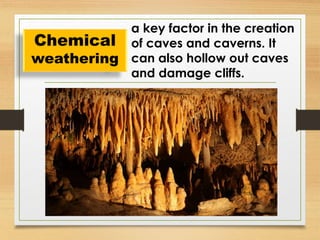
a key factor in the creation
of caves and caverns. It
can also hollow out caves
and damage cliffs.
Chemical
weathering
1.THERMAL AND PRESSURE CHANGE
• Rocks crumble and break into fragments
because they are subjected to alternating
hot and cold temperatures many times.
• When a rock gets hot, it expands an
increase in volume), while at night, the rock
gets cold causing contraction (a decrease
in volume).
Processes that can Cause
Physical Weathering
• Temperature weaken the rock and in the process, mineral grains
are loosened from the rocks and eventually the rocks break down
into pieces. Best examples are the stone in the arid desert that
slowly turn to sand.
• The rates of expansion and contraction of the outer and inner
parts of the rock differ. The outer part expands and contracts
much more than the inner part because it is directly exposed to
the heat of the sun.
2. WIND AND WAVES
• Wind and waves can all cause physical
weathering. Tiny grains of sand are
picked up and carried off by the wind,
which are then blasted on the surface of
rocks, smoothening them.
• On the seashore, the action of waves
chips away and cracks the rocks.
Processes that can Cause
Physical Weathering
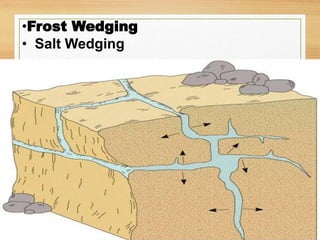
3. FREEZE AND THAW
• You know that if you put a glass in the
freezer it will soon break. This is because
water expands when it freezes. Similarly,
when water collects in the rock pores
and slits, it expands when it freezes.
Processes that can Cause
Physical Weathering
•Frost Wedging
• Salt Wedging
4. ORGANIC ACIVITY
• Animals and plants also take a heavy
toll on rocks and cause them to wear
away.
• For example, there are animals that
dig holes on the ground and exposed
rocks.
Processes that can Cause
Physical Weathering
1.HYDRATION/ HYDROLYSIS
•Process where molecules
of some substance in rocks
chemically combine with
water molecules
Processes that can Cause
Chemical weathering
2. CARBONATION
• Process where Carbon Dioxide may
bond with other substances.
• A mixture of water and carbon
dioxide is called carbonic acid.
• Two examples of carbonation weathering are The
Limestone Pavement and The Stalactites.
Processes that can Cause
Chemical weathering
This land form is made entirely of limestone and formed
by rainwater carbonation and the freezing and thawing
process.
This land form is also made of limestone. It was created by
large amount of calcium being dissolved in them.
3. OXIDATION
• Iron, aluminum, copper, and sodium
are examples of minerals that readily
react with oxygen which then form
mineral oxides.
• In nature, physical and chemical weathering typically
occur together, affecting the rocks. When the latter is
destroyed, valuable products are created.
Processes that can Cause
Chemical Weathering
Erosion
• Involves the movement of the
weathered rock (snow, soil,
sand and pebbles) from their
site of weathering by the
agents of erosion such as wind,
moving water, ice and gravity.
Erosion
• Weathering dos not always occur
before erosion. Erosion always follows
after the weathering.
• Transport makes erosion complete. It
complete the movement of the
eroded materials and sediments.
Weathering can continue during
transport.
Erosion
Transport by the water
• Rainwater is the most important force or agent of
erosion. When there is heavy rain, rock pieces
are carried downstream to a suited depositional
environment with the action of gravity.
• Gravity is the driving force and it gives water the
energy to erode and carry away rock materials.
• Physical weathering dominates at higher
elevation while Chemical weathering takes on a
more active role at lower elevation.
Transport by the
water
• Water can carry almost any size of rocks. The
greater the volume of water and the steeper the
slope, the bigger and more rocks can be
transported.
• Serious problems in the Philippines are soil erosion
and mudslide
• Rock materials are loosened by heavy rains and
strong winds and they can come speeding down
slopes, sweeping everything in its path.
Transport by the
water
• Wind continuously blows away loose particles of
rocks and soil from place to place.
• This is common in dry areas such as deserts.
• Wind transport can result in stunning landscapes
as sand is blown away and creates sand dunes.
• Wind can create sandstorms that contain dust
particles and deposit them in wide areas.
Transport by the
wind
Mass movement
(mass wasting)
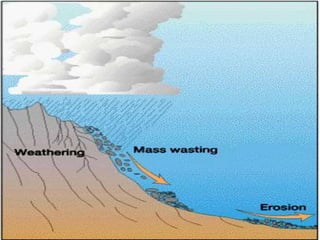
• slope movement
• bulk movements of soil, sand, and rock
debris downslopes in response to the
force of gravity or the rapid or gradual
sinking of the Earth’s ground surface in
a vertical direction.
• The term “mass wasting” was limited only to the variety of
processes by which large masses of crustal materials are
moved by the action of gravity form one place to another.
Mass movement
(mass wasting)
• Recently, the term “mass wasting”
has been substituted to include mass
wasting processes and the sinking of
the Earth’s ground.
• Mass wasting is a type of erosion that
is capable of making big chances to
a mountain.
Mass movement
(mass wasting)
• Sinking mass movement that occurs
in a relatively rapid fashion is known
as subsidence; and a gradual
movement is called settlement.
• Subsidence involves the roof collapse or breakdown of a
subsurface cavity forming a cave.
• There is also subsidence in the form of sinkholes caused by
underground drainage.
Mass movement
(mass wasting)
A massive 300-ton boulder blocks
a road in Southern California
Landslides
Can cause much
destruction
Talus Cones
in the Canadian Rockies
Talus – pieces of rock
at bottom of a rock fall
La Conchita Landslide, January 10, 2005
Monterey Park Debris Flow, 1980
PCH near Pacific Palisades, November 1956
REFERENCE:
• Moncada, M. et. al (2016). Earth and Life Science for Senior High School.
Disclaimer:
The pictures used in this slideshow presentation were obtained from various internet
websites and will be only used for educational purposes only.

Earth Materials and Processes : EXOGENIC PROCESS

  • 1.
    Chapter 4: Earth Materialsand Processes EXOGENIC PROCESS
  • 2.
    •These are processesthat take place at or near the earths surface, that makes the surface wear away. EXOGENIC PROCESS
  • 3.
  • 4.
    W E AT H E R I N G  mechanical and chemical hammer that breaks down and sculpts rock.
  • 5.
  • 6.
    • mechanical weathering •the breakdown of rocks without a change in its composition. • Breakdown would mean that the rock is fractured, cracked or fragmented into smaller pieces. Physical Weathering
  • 7.
  • 11.
    • decomposition ofrocks due to chemical reactions occurring between the minerals in rocks and the environment. • transforms rocks and minerals exposed to water and gases in the atmosphere into new chemical compounds thus, forming different rocks and minerals. Chemical Weathering
  • 12.
  • 14.
    a key factorin the creation of caves and caverns. It can also hollow out caves and damage cliffs. Chemical weathering
  • 15.
    1.THERMAL AND PRESSURECHANGE • Rocks crumble and break into fragments because they are subjected to alternating hot and cold temperatures many times. • When a rock gets hot, it expands an increase in volume), while at night, the rock gets cold causing contraction (a decrease in volume). Processes that can Cause Physical Weathering
  • 16.
    • Temperature weakenthe rock and in the process, mineral grains are loosened from the rocks and eventually the rocks break down into pieces. Best examples are the stone in the arid desert that slowly turn to sand. • The rates of expansion and contraction of the outer and inner parts of the rock differ. The outer part expands and contracts much more than the inner part because it is directly exposed to the heat of the sun.
  • 19.
    2. WIND ANDWAVES • Wind and waves can all cause physical weathering. Tiny grains of sand are picked up and carried off by the wind, which are then blasted on the surface of rocks, smoothening them. • On the seashore, the action of waves chips away and cracks the rocks. Processes that can Cause Physical Weathering
  • 22.
    3. FREEZE ANDTHAW • You know that if you put a glass in the freezer it will soon break. This is because water expands when it freezes. Similarly, when water collects in the rock pores and slits, it expands when it freezes. Processes that can Cause Physical Weathering
  • 24.
  • 26.
    4. ORGANIC ACIVITY •Animals and plants also take a heavy toll on rocks and cause them to wear away. • For example, there are animals that dig holes on the ground and exposed rocks. Processes that can Cause Physical Weathering
  • 28.
    1.HYDRATION/ HYDROLYSIS •Process wheremolecules of some substance in rocks chemically combine with water molecules Processes that can Cause Chemical weathering
  • 30.
    2. CARBONATION • Processwhere Carbon Dioxide may bond with other substances. • A mixture of water and carbon dioxide is called carbonic acid. • Two examples of carbonation weathering are The Limestone Pavement and The Stalactites. Processes that can Cause Chemical weathering
  • 31.
    This land formis made entirely of limestone and formed by rainwater carbonation and the freezing and thawing process.
  • 32.
    This land formis also made of limestone. It was created by large amount of calcium being dissolved in them.
  • 33.
    3. OXIDATION • Iron,aluminum, copper, and sodium are examples of minerals that readily react with oxygen which then form mineral oxides. • In nature, physical and chemical weathering typically occur together, affecting the rocks. When the latter is destroyed, valuable products are created. Processes that can Cause Chemical Weathering
  • 34.
  • 35.
    • Involves themovement of the weathered rock (snow, soil, sand and pebbles) from their site of weathering by the agents of erosion such as wind, moving water, ice and gravity. Erosion
  • 36.
    • Weathering dosnot always occur before erosion. Erosion always follows after the weathering. • Transport makes erosion complete. It complete the movement of the eroded materials and sediments. Weathering can continue during transport. Erosion
  • 37.
    Transport by thewater • Rainwater is the most important force or agent of erosion. When there is heavy rain, rock pieces are carried downstream to a suited depositional environment with the action of gravity. • Gravity is the driving force and it gives water the energy to erode and carry away rock materials. • Physical weathering dominates at higher elevation while Chemical weathering takes on a more active role at lower elevation. Transport by the water
  • 38.
    • Water cancarry almost any size of rocks. The greater the volume of water and the steeper the slope, the bigger and more rocks can be transported. • Serious problems in the Philippines are soil erosion and mudslide • Rock materials are loosened by heavy rains and strong winds and they can come speeding down slopes, sweeping everything in its path. Transport by the water
  • 40.
    • Wind continuouslyblows away loose particles of rocks and soil from place to place. • This is common in dry areas such as deserts. • Wind transport can result in stunning landscapes as sand is blown away and creates sand dunes. • Wind can create sandstorms that contain dust particles and deposit them in wide areas. Transport by the wind
  • 41.
  • 42.
    • slope movement •bulk movements of soil, sand, and rock debris downslopes in response to the force of gravity or the rapid or gradual sinking of the Earth’s ground surface in a vertical direction. • The term “mass wasting” was limited only to the variety of processes by which large masses of crustal materials are moved by the action of gravity form one place to another. Mass movement (mass wasting)
  • 43.
    • Recently, theterm “mass wasting” has been substituted to include mass wasting processes and the sinking of the Earth’s ground. • Mass wasting is a type of erosion that is capable of making big chances to a mountain. Mass movement (mass wasting)
  • 44.
    • Sinking massmovement that occurs in a relatively rapid fashion is known as subsidence; and a gradual movement is called settlement. • Subsidence involves the roof collapse or breakdown of a subsurface cavity forming a cave. • There is also subsidence in the form of sinkholes caused by underground drainage. Mass movement (mass wasting)
  • 47.
    A massive 300-tonboulder blocks a road in Southern California
  • 48.
  • 49.
    Talus Cones in theCanadian Rockies Talus – pieces of rock at bottom of a rock fall
  • 50.
    La Conchita Landslide,January 10, 2005
  • 51.
  • 52.
    PCH near PacificPalisades, November 1956
  • 53.
    REFERENCE: • Moncada, M.et. al (2016). Earth and Life Science for Senior High School. Disclaimer: The pictures used in this slideshow presentation were obtained from various internet websites and will be only used for educational purposes only.