Geologic
Timeline
How important is your past to
who you are today?
After going through this lesson, you are
expected to:
1. Describe how the Earth’s history can be
interpreted from the geologic time scale.
2. Define fossils and its type.
3. Determine the guide fossils that are used to
define and identify subdivision of the geologic
time scale.
4. Track the Earth’s history using the geologic
time scale.
5. Identify the different divisions in the
geologic time scale.
Review the vocabulary words
1. Fossils – remains of ancient life
that have been turned to stone
2. Body Fossils – actual parts of
plants and animals that have been
turned to stone (i.e. bone, shells,
leaves)
3. Coprolite – fossilized dinosaur
dung (scat)
4. Fossilization – process by which the
remains of ancient living things are
turned to rock
5. Paleontologist – a scientist who
studies fossils and ancient life
6. Sedimentary Rock – rock made of
layers of tightly packed sand and clay
The necessity of knowing how life began in
the past, the events, and principles behind
the Earth’s history enable us to conform with
the alterations or consequences that we might
encounter or experience in the near future. As a
part of the new generation, we should be
appreciative and accept that all things that are
present in our time were the outcome of Earth’s
history.
Geologic Timeline
• “calendar” for events in Earth’s history.
• it serves as standard timeline used to describe the
age of rocks, fossils, and the events that formed
them.
• A device which is of great help to the science of
geology owed to the explorations and studied
made by the geologists that were recorded.
• The geologic time scale provides a system of
chronologic measurement relating stratigraphy to
time that is used by geologists, paleontologists
and other Earth scientists to describe the timing
and relationships between events that have
occurred during the history of the Earth.
Deposition of sediments contribute to
reshaping the surface of the Earth.
Deposits are laid down by different
environmental factors such as volcanic
eruption, erosion, weathering debris of
rocks (clay and silts) and even all its
fossil content and historical information.
Earth history including its rock strata, the
rock study, and discovery, as well as the
fossils, are engraved in one of the
most important materials known as
geologic record.
Fossils are the remains or evidence of
prehistoric plants and animals that have
fossilized. Fossils were used as markers when
building up the geologic time scale. The names
of most of the eons and eras end in “zoic”,
because these time periods were recognized by
the animal life present at the time. Rocks
formed during the Proterozoic Eon have fossil
evidence of simple organisms, such as bacteria,
algae, and wormlike animals. In the
Phanerozoic Eon, the rocks formed have fossils
of animals and plants such as dinosaurs,
mammals, and trees.
And with that, geologists have developed
the geological time scale, which divides
the Earth’s history into eons that are
subdivided into eras, which are further
divided into periods and then into
epochs. The geologic time scale is the
“calendar” for events in Earth’s history.
It subdivides all time since the end of the
Earth’s formative period as a planet
(nearly 4 billion years ago) into named
units of abstract time: in descending
order of duration, which are eons, eras,
periods, and epochs.
Division of Geologic
Timescale
EONS
• First and largest division of
geologic time
• Greatest expanse of time
The eons are: Cryptozoic
(Precambrian) eon and
Phanerozoic eon.
Precambrian and Phanerozoic
eon both consists of three eras
as shown in the figure.
Precambrian
• Was the “Age of Early Life” the geologic time
period between the Earth formed in the Solar
System.
• This is where rocks from this age were first
studied. The Precambrian accounts for 88% of
the Earth's geologic time.
• The Precambrian time is essentially the
Hadean, Archean, and Proterozoic eons
combined. It represents the formative and
ancient history of Earth, before complex life
truly flourished during the Phanerozoic Eon,
which began around five hundred forty million
years ago and continues to the present day.
Common Precambrian fossils include stromatolites
and similar structures, which are traces of mats of
algae-like microorganisms, and microfossils of other
microorganisms.
Hadean
• The Hadean is the very
beginning, around 4.6 to 4
billion years ago. This is when
Earth was forming from cosmic
debris. It was extremely hot,
with molten rock, frequent
meteorite impacts, and a thick,
toxic atmosphere. No life
existed yet, and the surface
was too hostile for it.
Archean
• The Archean lasted from
about 4 to 2.5 billion
years ago. This is when
the Earth began cooling,
continents started to
form, and the first simple
life, mainly microbes,
emerged. The
atmosphere was still
mostly non-oxygenic, but
cyanobacteria began
producing oxygen
through photosynthesis
toward the end.
Proterozoic
• The Proterozoic followed, lasting from 2.5 billion
to about 540 million years ago. During this time,
oxygen levels rose significantly, leading to the
Great Oxidation Event, which transformed
Earth's atmosphere and made it suitable for
more complex life. Multicellular life forms began
to emerge, and Earth experienced several
major ice ages.
Red and
Green Algae
Dickinsonia
Charnia
Ediacaran Biota
1. For how long has there been life on
Earth?
__________________________________________________
Scientific evidence points of life beginning even earlier
around 4 to 2.5 billion years ago.
2. For what percentage of time has life
existed on Earth (round to the nearest whole
number)?
______________________________________________
_
The Earth is estimated to be around 4.6
billion years old.
Life has existed for about 4 to 2.5 billion
years old.
So life has existed for 78% to 88% of Earth’s
history.
Phanerozoic Eon
The Phanerozoic eon is the current eon in Earth’s
history, beginning around 541 million years ago
and extending to the present day.
It is known for a rich fossil record and significant
biological evolution, which includes the rise and
diversification of complex life forms like plants,
animals, and fungi
Trilobite Stegosaurus Glyptodon
Paleozoic Era
The Paleozoic era lasted from about 540 million to
250 million years ago. It saw the rise of fish,
amphibians, and early reptiles, as well as the
development of extensive forests and diverse
marine life. Major events include the Cambrian
explosion, which marked a rapid increase in the
diversity of life forms.
- Early fish such as jawless fish and armored fish (like
placoderms).
Dunkleosteus
Amphibians, which evolved from lobe-finned fish.
Tiktaalik
- Early reptiles that appeared towards the end of
this era, including the first amniotes.
Hylonomus
Mesozoic Era
The Mesozoic era, often called the Age of
Dinosaurs, lasted from around 250 million to 65
million years ago. This era is characterized by the
dominance of reptiles, including dinosaurs, and
the emergence of the first mammals and birds. It
ended with a mass extinction event that wiped
out many species.
- Dinosaurs, which dominated terrestrial
ecosystems.
Velociraptor Spinosaurus Tyrannosaurus rex
- Pterosaurs, flying reptiles that lived alongside
dinosaurs.
- Marine reptiles like ichthyosaurs and plesiosaurs.
Cenozoic Era
The Cenozoic era began 65 million years ago and
continues to the present. It is characterized by the
rise of mammals and birds, significant changes in
climate and geography, and the development of
modern ecosystems. This era includes the
evolution of humans and the spread of various
species across the globe. “Age of Mammals”
Woolly mammoth Basilosaurus Smilodon
- Mammals such as elephants, whales, and large
predators like saber-toothed cats.
Cenozoic Era – Recent Life
• It is also known as the age of recent life or age of
mammals.
• It has the most complete record of any era because the
rocks are more accessible.
• Began about 65 million years ago and continues today!!!!!
– Climate was warm and mild.
– Marine animals such as whales and dolphins evolved.
• Mammals began to increase and evolve adaptations that
allowed them to live in many different environments – land, air
and the sea.
– Grasses increased and provided a food source for grazing
animals
Cenozoic Era
• Many mountain ranges formed during the
Cenozoic Era
– Alps in Europe and Himalayas in India; Rocky
Mountains in the USA.
• Growth of these mountains may have helped to
cool down the climate
– Ice Ages occurred late in the Cenozoic Era
(Quaternary Period).
• As the climate changed, the animals had to adapt
to the rise and fall of the oceans caused by melting
glaciers.
- Birds that evolved from theropod dinosaurs.
Archaeopteryx bird-
like dinosaurs
Diverse reptiles, including modern crocodiles, lizards, and
snakes.
Megalania Purussaurus Titanoboa
The rise of mammals, leading to the dominance of
species like humans.
Paleozoic Era
• At the end of the Paleozoic, the largest
mass extinction in history wiped out
approximately 90% of all marine animal
species and 70% of land animals.
– Possible causes of this Mass Extinction
Event
• Lowering of sea levels when the continents
were rejoined as Pangaea (convergent
boundary)
• Increased volcanic activity (ash and dust)
• Climate changes – cooler climate
Mesozoic Era – Middle Life
• At the beginning of this era the
continents were joined as Pangaea.
• Pangaea broke up around the middle of
this era. Pangea rifted into Laurasia and
Gondwanaland.
• Reptiles became the most abundant
animals because of their ability to adapt
to the drier climate of the Mesozoic Era.
– Skin maintains body fluids
– Embryos live in shells
Mesozoic Era – Middle Life
• Dinosaurs were also very active in this era.
– First small dinosaurs appeared in the Triassic
Period.
– Larger and more abundant dinosaurs
appeared in the Jurassic Period.
• Small mammals and birds also appeared during
this era.
– The mammals were small, warm-blooded
animals. Hair covering their bodies.
These characteristics help them survive in
changing environments.
Mesozoic Era – Middle Life
• The main plant life of this time
were Gymnosperms or plants
that produce seeds, but no
flowers.
– Pine Trees
• Flowering plants appeared
during the END of this era
Cambrian Epochs (Early, Middle, Late Cambrian,
~541–485 million years ago)
Marked by the “Cambrian Explosion,” when diverse life
forms rapidly appeared, especially in the oceans.
In that time, the first undoubted fossil annelids,
arthropods, brachiopods, echinoderms, mollusk,
onychophorans, poriferans, and priapulids show up in
rocks all over the world.
Opabinia a small creature with five eyes and
a unique, trunk-like proboscis.
Ordovician Epochs (Early, Middle, Late Ordovician,
~485–444 million years ago)
Saw a great increase in marine biodiversity, with
the first coral reefs and jawless fish.
typical marine community consisted of these
animals, plus red and green algae, primitive fish,
cephalopods, corals, crinoids, and gastropods.
Eurypterus – a
sea scorpion that
was one of the first
large predators.
Silurian Epochs (444–419 million years ago)
Life started to move onto land, with the earliest
vascular plants and arachnids.
Being a period of the Paleozoic era of
geological history marked by the first
appearance of land plants.
Cooksonia is considered
one of the first vascular
plants, with a simple structure
consisting of stem and spore-
producing structures. It is
famous as the first land plant
that had true "veins"
(conductive tissue) to
transport water and sugars
around the plant.
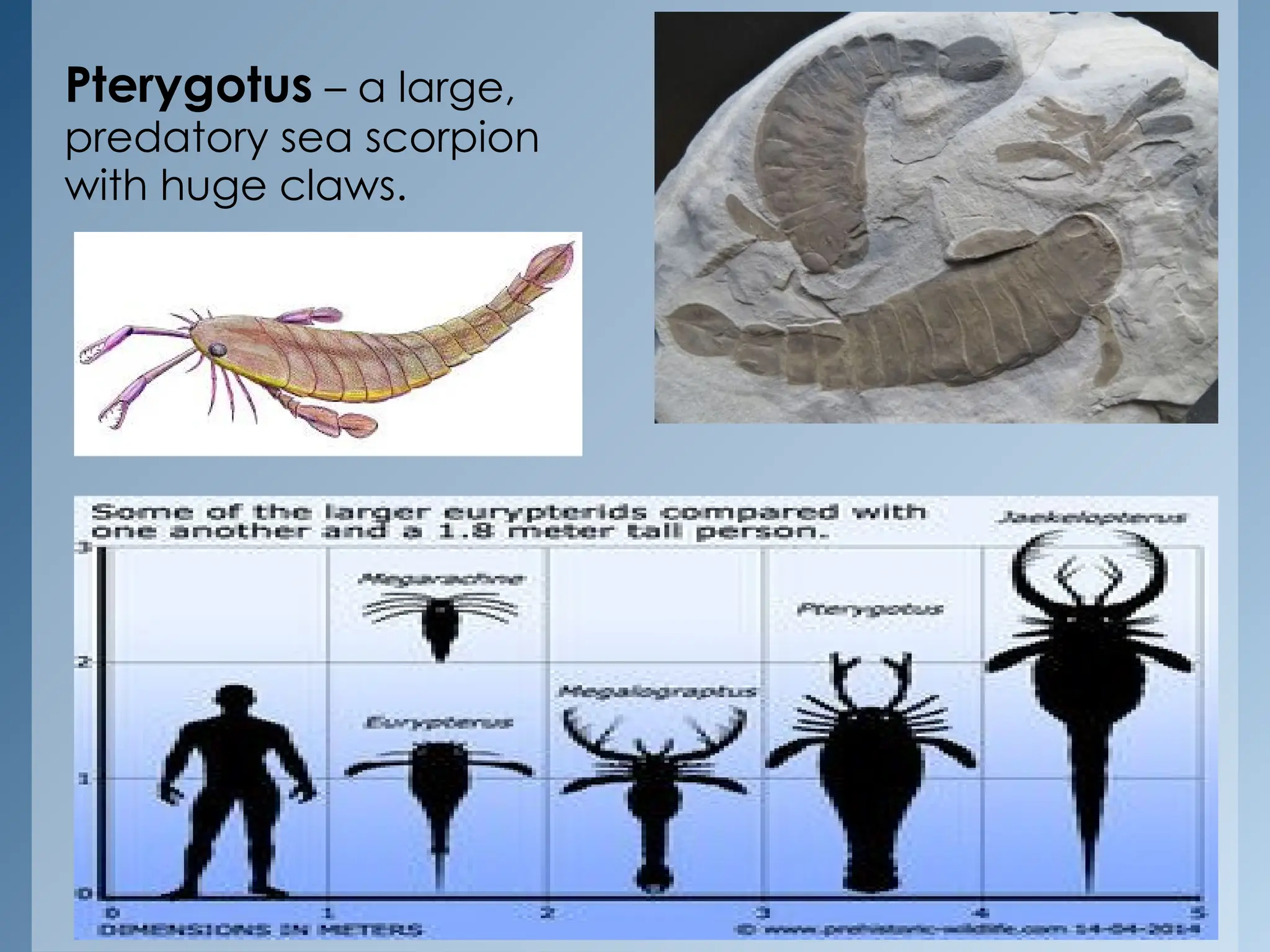
Pterygotus – a large,
predatory sea scorpion
with huge claws.
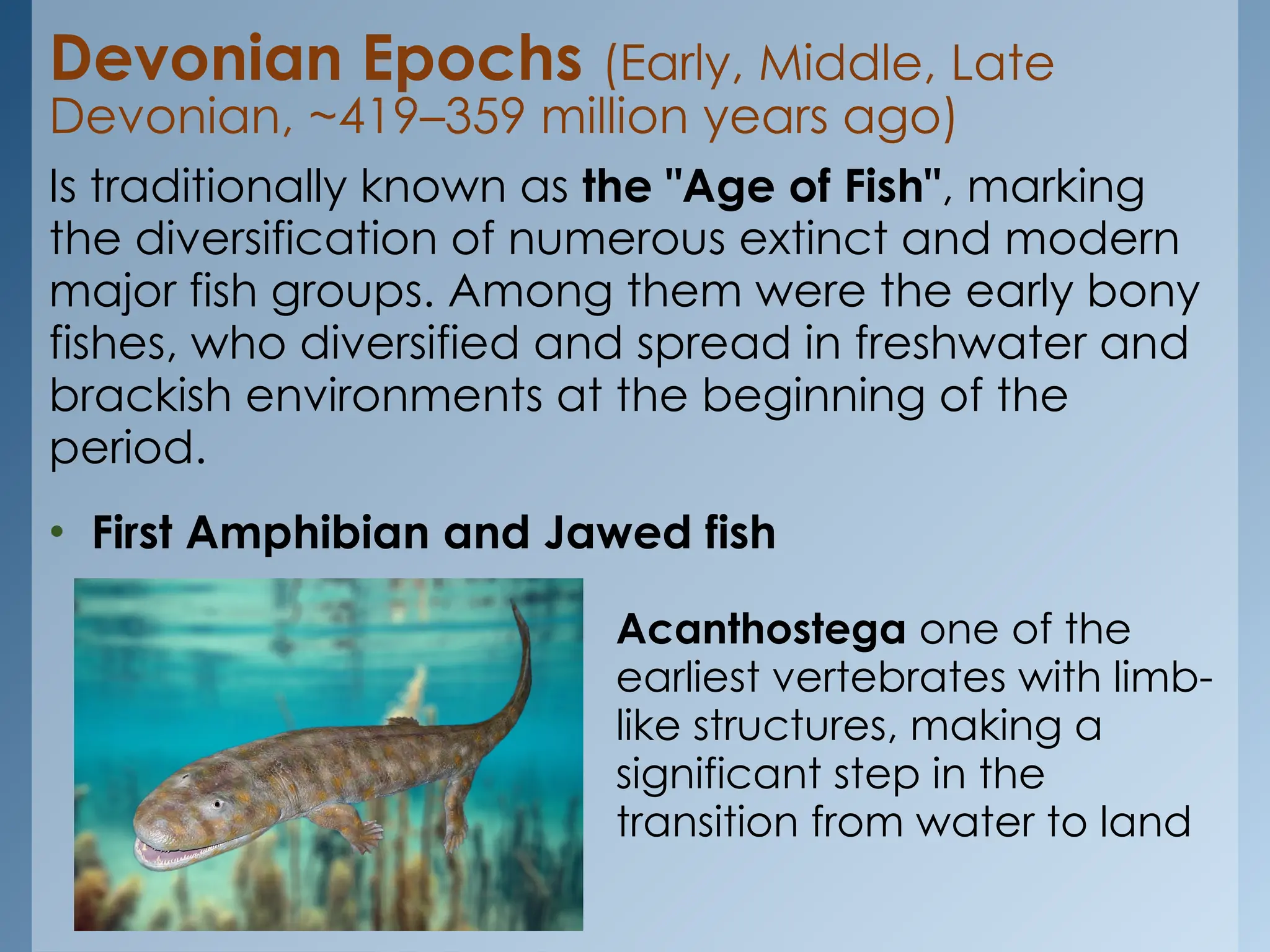
Devonian Epochs (Early, Middle, Late
Devonian, ~419–359 million years ago)
Is traditionally known as the "Age of Fish", marking
the diversification of numerous extinct and modern
major fish groups. Among them were the early bony
fishes, who diversified and spread in freshwater and
brackish environments at the beginning of the
period.
• First Amphibian and Jawed fish
Acanthostega one of the
earliest vertebrates with limb-
like structures, making a
significant step in the
transition from water to land
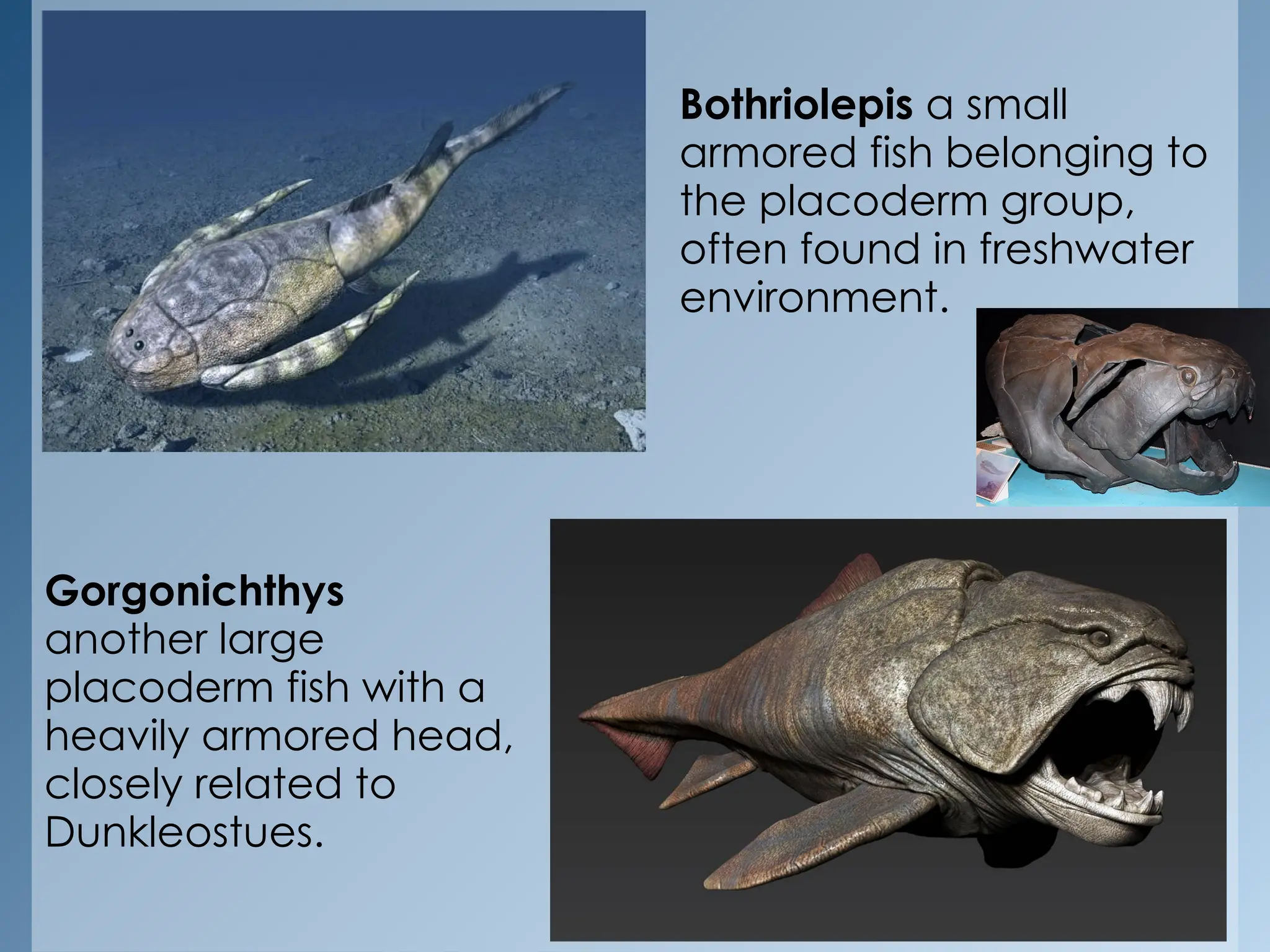
Bothriolepis a small
armored fish belonging to
the placoderm group,
often found in freshwater
environment.
Gorgonichthys
another large
placoderm fish with a
heavily armored head,
closely related to
Dunkleostues.
GEOLOGICAL TIMELINE EARTH AND LIFE SCIENCES.pptx

GEOLOGICAL TIMELINE EARTH AND LIFE SCIENCES.pptx

  • 1.
  • 2.
    How important isyour past to who you are today?
  • 3.
    After going throughthis lesson, you are expected to: 1. Describe how the Earth’s history can be interpreted from the geologic time scale. 2. Define fossils and its type. 3. Determine the guide fossils that are used to define and identify subdivision of the geologic time scale. 4. Track the Earth’s history using the geologic time scale. 5. Identify the different divisions in the geologic time scale.
  • 4.
    Review the vocabularywords 1. Fossils – remains of ancient life that have been turned to stone 2. Body Fossils – actual parts of plants and animals that have been turned to stone (i.e. bone, shells, leaves) 3. Coprolite – fossilized dinosaur dung (scat)
  • 5.
    4. Fossilization –process by which the remains of ancient living things are turned to rock 5. Paleontologist – a scientist who studies fossils and ancient life 6. Sedimentary Rock – rock made of layers of tightly packed sand and clay
  • 6.
    The necessity ofknowing how life began in the past, the events, and principles behind the Earth’s history enable us to conform with the alterations or consequences that we might encounter or experience in the near future. As a part of the new generation, we should be appreciative and accept that all things that are present in our time were the outcome of Earth’s history.
  • 7.
    Geologic Timeline • “calendar”for events in Earth’s history. • it serves as standard timeline used to describe the age of rocks, fossils, and the events that formed them. • A device which is of great help to the science of geology owed to the explorations and studied made by the geologists that were recorded. • The geologic time scale provides a system of chronologic measurement relating stratigraphy to time that is used by geologists, paleontologists and other Earth scientists to describe the timing and relationships between events that have occurred during the history of the Earth.
  • 8.
    Deposition of sedimentscontribute to reshaping the surface of the Earth. Deposits are laid down by different environmental factors such as volcanic eruption, erosion, weathering debris of rocks (clay and silts) and even all its fossil content and historical information. Earth history including its rock strata, the rock study, and discovery, as well as the fossils, are engraved in one of the most important materials known as geologic record.
  • 9.
    Fossils are theremains or evidence of prehistoric plants and animals that have fossilized. Fossils were used as markers when building up the geologic time scale. The names of most of the eons and eras end in “zoic”, because these time periods were recognized by the animal life present at the time. Rocks formed during the Proterozoic Eon have fossil evidence of simple organisms, such as bacteria, algae, and wormlike animals. In the Phanerozoic Eon, the rocks formed have fossils of animals and plants such as dinosaurs, mammals, and trees.
  • 10.
    And with that,geologists have developed the geological time scale, which divides the Earth’s history into eons that are subdivided into eras, which are further divided into periods and then into epochs. The geologic time scale is the “calendar” for events in Earth’s history. It subdivides all time since the end of the Earth’s formative period as a planet (nearly 4 billion years ago) into named units of abstract time: in descending order of duration, which are eons, eras, periods, and epochs.
  • 12.
    Division of Geologic Timescale EONS •First and largest division of geologic time • Greatest expanse of time The eons are: Cryptozoic (Precambrian) eon and Phanerozoic eon. Precambrian and Phanerozoic eon both consists of three eras as shown in the figure.
  • 13.
    Precambrian • Was the“Age of Early Life” the geologic time period between the Earth formed in the Solar System. • This is where rocks from this age were first studied. The Precambrian accounts for 88% of the Earth's geologic time. • The Precambrian time is essentially the Hadean, Archean, and Proterozoic eons combined. It represents the formative and ancient history of Earth, before complex life truly flourished during the Phanerozoic Eon, which began around five hundred forty million years ago and continues to the present day.
  • 15.
    Common Precambrian fossilsinclude stromatolites and similar structures, which are traces of mats of algae-like microorganisms, and microfossils of other microorganisms.
  • 16.
    Hadean • The Hadeanis the very beginning, around 4.6 to 4 billion years ago. This is when Earth was forming from cosmic debris. It was extremely hot, with molten rock, frequent meteorite impacts, and a thick, toxic atmosphere. No life existed yet, and the surface was too hostile for it.
  • 17.
    Archean • The Archeanlasted from about 4 to 2.5 billion years ago. This is when the Earth began cooling, continents started to form, and the first simple life, mainly microbes, emerged. The atmosphere was still mostly non-oxygenic, but cyanobacteria began producing oxygen through photosynthesis toward the end.
  • 18.
    Proterozoic • The Proterozoicfollowed, lasting from 2.5 billion to about 540 million years ago. During this time, oxygen levels rose significantly, leading to the Great Oxidation Event, which transformed Earth's atmosphere and made it suitable for more complex life. Multicellular life forms began to emerge, and Earth experienced several major ice ages. Red and Green Algae
  • 19.
  • 20.
    1. For howlong has there been life on Earth? __________________________________________________ Scientific evidence points of life beginning even earlier around 4 to 2.5 billion years ago.
  • 21.
    2. For whatpercentage of time has life existed on Earth (round to the nearest whole number)? ______________________________________________ _ The Earth is estimated to be around 4.6 billion years old. Life has existed for about 4 to 2.5 billion years old. So life has existed for 78% to 88% of Earth’s history.
  • 22.
    Phanerozoic Eon The Phanerozoiceon is the current eon in Earth’s history, beginning around 541 million years ago and extending to the present day. It is known for a rich fossil record and significant biological evolution, which includes the rise and diversification of complex life forms like plants, animals, and fungi Trilobite Stegosaurus Glyptodon
  • 23.
    Paleozoic Era The Paleozoicera lasted from about 540 million to 250 million years ago. It saw the rise of fish, amphibians, and early reptiles, as well as the development of extensive forests and diverse marine life. Major events include the Cambrian explosion, which marked a rapid increase in the diversity of life forms. - Early fish such as jawless fish and armored fish (like placoderms). Dunkleosteus
  • 28.
    Amphibians, which evolvedfrom lobe-finned fish. Tiktaalik - Early reptiles that appeared towards the end of this era, including the first amniotes. Hylonomus
  • 30.
    Mesozoic Era The Mesozoicera, often called the Age of Dinosaurs, lasted from around 250 million to 65 million years ago. This era is characterized by the dominance of reptiles, including dinosaurs, and the emergence of the first mammals and birds. It ended with a mass extinction event that wiped out many species. - Dinosaurs, which dominated terrestrial ecosystems. Velociraptor Spinosaurus Tyrannosaurus rex
  • 34.
    - Pterosaurs, flyingreptiles that lived alongside dinosaurs. - Marine reptiles like ichthyosaurs and plesiosaurs.
  • 36.
    Cenozoic Era The Cenozoicera began 65 million years ago and continues to the present. It is characterized by the rise of mammals and birds, significant changes in climate and geography, and the development of modern ecosystems. This era includes the evolution of humans and the spread of various species across the globe. “Age of Mammals” Woolly mammoth Basilosaurus Smilodon - Mammals such as elephants, whales, and large predators like saber-toothed cats.
  • 37.
    Cenozoic Era –Recent Life • It is also known as the age of recent life or age of mammals. • It has the most complete record of any era because the rocks are more accessible. • Began about 65 million years ago and continues today!!!!! – Climate was warm and mild. – Marine animals such as whales and dolphins evolved. • Mammals began to increase and evolve adaptations that allowed them to live in many different environments – land, air and the sea. – Grasses increased and provided a food source for grazing animals
  • 38.
    Cenozoic Era • Manymountain ranges formed during the Cenozoic Era – Alps in Europe and Himalayas in India; Rocky Mountains in the USA. • Growth of these mountains may have helped to cool down the climate – Ice Ages occurred late in the Cenozoic Era (Quaternary Period). • As the climate changed, the animals had to adapt to the rise and fall of the oceans caused by melting glaciers.
  • 39.
    - Birds thatevolved from theropod dinosaurs. Archaeopteryx bird- like dinosaurs Diverse reptiles, including modern crocodiles, lizards, and snakes. Megalania Purussaurus Titanoboa
  • 42.
    The rise ofmammals, leading to the dominance of species like humans.
  • 43.
    Paleozoic Era • Atthe end of the Paleozoic, the largest mass extinction in history wiped out approximately 90% of all marine animal species and 70% of land animals. – Possible causes of this Mass Extinction Event • Lowering of sea levels when the continents were rejoined as Pangaea (convergent boundary) • Increased volcanic activity (ash and dust) • Climate changes – cooler climate
  • 44.
    Mesozoic Era –Middle Life • At the beginning of this era the continents were joined as Pangaea. • Pangaea broke up around the middle of this era. Pangea rifted into Laurasia and Gondwanaland. • Reptiles became the most abundant animals because of their ability to adapt to the drier climate of the Mesozoic Era. – Skin maintains body fluids – Embryos live in shells
  • 45.
    Mesozoic Era –Middle Life • Dinosaurs were also very active in this era. – First small dinosaurs appeared in the Triassic Period. – Larger and more abundant dinosaurs appeared in the Jurassic Period. • Small mammals and birds also appeared during this era. – The mammals were small, warm-blooded animals. Hair covering their bodies. These characteristics help them survive in changing environments.
  • 46.
    Mesozoic Era –Middle Life • The main plant life of this time were Gymnosperms or plants that produce seeds, but no flowers. – Pine Trees • Flowering plants appeared during the END of this era
  • 48.
    Cambrian Epochs (Early,Middle, Late Cambrian, ~541–485 million years ago) Marked by the “Cambrian Explosion,” when diverse life forms rapidly appeared, especially in the oceans. In that time, the first undoubted fossil annelids, arthropods, brachiopods, echinoderms, mollusk, onychophorans, poriferans, and priapulids show up in rocks all over the world. Opabinia a small creature with five eyes and a unique, trunk-like proboscis.
  • 49.
    Ordovician Epochs (Early,Middle, Late Ordovician, ~485–444 million years ago) Saw a great increase in marine biodiversity, with the first coral reefs and jawless fish. typical marine community consisted of these animals, plus red and green algae, primitive fish, cephalopods, corals, crinoids, and gastropods. Eurypterus – a sea scorpion that was one of the first large predators.
  • 50.
    Silurian Epochs (444–419million years ago) Life started to move onto land, with the earliest vascular plants and arachnids. Being a period of the Paleozoic era of geological history marked by the first appearance of land plants. Cooksonia is considered one of the first vascular plants, with a simple structure consisting of stem and spore- producing structures. It is famous as the first land plant that had true "veins" (conductive tissue) to transport water and sugars around the plant.
  • 51.
    Pterygotus – alarge, predatory sea scorpion with huge claws.
  • 52.
    Devonian Epochs (Early,Middle, Late Devonian, ~419–359 million years ago) Is traditionally known as the "Age of Fish", marking the diversification of numerous extinct and modern major fish groups. Among them were the early bony fishes, who diversified and spread in freshwater and brackish environments at the beginning of the period. • First Amphibian and Jawed fish Acanthostega one of the earliest vertebrates with limb- like structures, making a significant step in the transition from water to land
  • 53.
    Bothriolepis a small armoredfish belonging to the placoderm group, often found in freshwater environment. Gorgonichthys another large placoderm fish with a heavily armored head, closely related to Dunkleostues.

Editor's Notes

  • #7 Deposition of sediments contribute to reshaping the surface of the Earth. Deposits are laid down by different environmental factors such as volcanic eruption, erosion, weathering debris of rocks (clay and silts) and even all its fossil content and historical information. Earth history including its rock strata, the rock study, and discovery, as well as the fossils, are engraved in one of the most important materials known as geologic record.
  • #47 Relative dating does not determine the exact age of rock or fossils but does learn which one is older or younger than the other.  Relative age of rocks based on the order gives its physical division in the geologic time scale.  Absolute dating or age measures the amount of radioactive elements in rocks to give the ages to each division of time in the geologic time scale.  Absolute time refers to the numerical ages in millions of years or some other measurement.