__ __ __ __
THE EARTH’S INTERNAL
HEAT
Describe where the Earth’s internal heat comes
from.
Identify the sources of Earth’s internal heat;
namely: radiogenic heat and primordial heat
Describe the parts and function of Earth’s
interior.
Describe the processes of heat transfer in Earth’s
mantle.
ACTIVITY
Scenario 1: A boy grabs a penny
from his tabletop, and it feels
very cold to touch. After holding
it for a few seconds, the coin gets
hot. Why?
ACTIVITY
Scenario 2: A cube of ice is
placed into the hand of a man.
Over time, the ice cube melted
in his hands. Why?
What is Heat energy?
- the result of the movement of tiny particles
called atoms, molecules or ions in solids,
liquids and gases. Heat energy can be
transferred from one object to another. The
transfer or flow due to the difference in
temperature between the two objects is
called heat.
Sources of heat in our planet
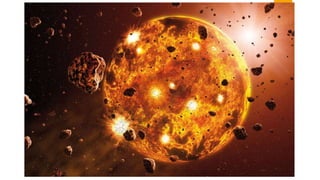
1.Primordial Heat
the internal heat energy that
gradually gathered together by
means of dispersion in the planet
during its few million years of
evolution.
Sources of heat in our planet
2. Radiogenic Heat
the thermal energy
released as a result of
spontaneous nuclear
disintegration.
Sources of heat in our planet
2. Radiogenic Heat
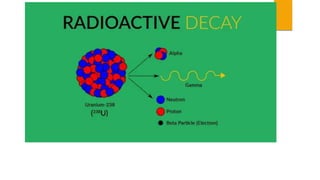
disintegration of natural radioactive
elements inside Earth.
Uranium, Thorium, and Potassium.
THREE PROCESSES OF HEAT
TRANSFER
THREE PROCESSES OF HEAT
TRANSFER
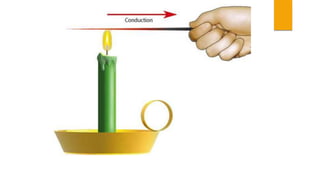
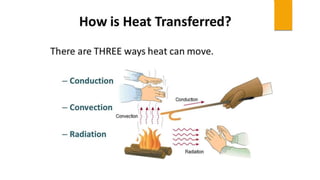
1. CONDUCTION- governs the
thermal conditions in almost entire
solid portions of the Earth and plays
a very important role in the
lithosphere.
Heat from the Earth's core and radiation
from the Sun is transferred to the surface
of the Earth by conduction.
THREE PROCESSES OF HEAT
TRANSFER
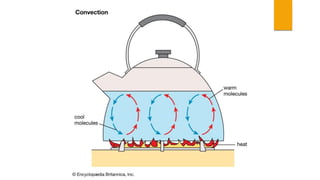
2. CONVECTION- involves transfer of
heat by the movement of mass,
which is a more efficient means of
heat transport in the Earth compared
to pure conduction.
THREE PROCESSES OF HEAT
TRANSFER
3. Radiation- the process of heat
exchange between the Sun and the
Earth, through radiation, controls the
temperatures at the Earth’s surface.
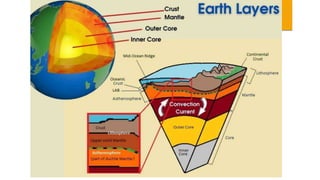
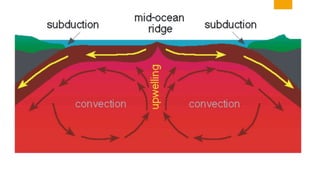
CONVECTION IN THE MANTLE

THE EARTH’s INTERNAL HEAT.pptx

  • 2.
  • 3.
  • 4.
    Describe where theEarth’s internal heat comes from. Identify the sources of Earth’s internal heat; namely: radiogenic heat and primordial heat Describe the parts and function of Earth’s interior. Describe the processes of heat transfer in Earth’s mantle.
  • 5.
    ACTIVITY Scenario 1: Aboy grabs a penny from his tabletop, and it feels very cold to touch. After holding it for a few seconds, the coin gets hot. Why?
  • 6.
    ACTIVITY Scenario 2: Acube of ice is placed into the hand of a man. Over time, the ice cube melted in his hands. Why?
  • 7.
    What is Heatenergy? - the result of the movement of tiny particles called atoms, molecules or ions in solids, liquids and gases. Heat energy can be transferred from one object to another. The transfer or flow due to the difference in temperature between the two objects is called heat.
  • 8.
    Sources of heatin our planet 1.Primordial Heat the internal heat energy that gradually gathered together by means of dispersion in the planet during its few million years of evolution.
  • 10.
    Sources of heatin our planet 2. Radiogenic Heat the thermal energy released as a result of spontaneous nuclear disintegration.
  • 11.
    Sources of heatin our planet 2. Radiogenic Heat disintegration of natural radioactive elements inside Earth. Uranium, Thorium, and Potassium.
  • 13.
    THREE PROCESSES OFHEAT TRANSFER
  • 14.
    THREE PROCESSES OFHEAT TRANSFER 1. CONDUCTION- governs the thermal conditions in almost entire solid portions of the Earth and plays a very important role in the lithosphere.
  • 15.
    Heat from theEarth's core and radiation from the Sun is transferred to the surface of the Earth by conduction.
  • 17.
    THREE PROCESSES OFHEAT TRANSFER 2. CONVECTION- involves transfer of heat by the movement of mass, which is a more efficient means of heat transport in the Earth compared to pure conduction.
  • 21.
    THREE PROCESSES OFHEAT TRANSFER 3. Radiation- the process of heat exchange between the Sun and the Earth, through radiation, controls the temperatures at the Earth’s surface.
  • 24.

Editor's Notes

  • #6 the heat from his hand is conducted to the metal coin.
  • #7 heat conducted from the man's hand to the ice cube will cause the ice to melt.
  • #8 Heat energy plays a vital role in our planet. It is one of the extreme factors in what makes the world livable. you know Earth must be hot inside. The heat inside of our planet moves continents, build mountains and causes earthquakes, but where does all this heat inside the earth come from?
  • #10 The major contribution of this internal heat is the accretional energy – the energy deposited during the early formation of a planet. The core is a storage of primordial heat that originates from times of accretion when kinetic energy of colliding particles was transformed into thermal energy. This heat is constantly lost to the outer silicate layers of the mantle and crust of the earth through convection and conduction.
  • #13 It involves the disintegration of natural radioactive elements inside the earth – like Uranium, Thorium and Potassium. Uranium is a special kind of element because when it decays, heat (radiogenic) is produced. Estimated at 47 terawatts (TW), the flow of heat from Earth's interior to the surface and it comes from two main sources in equal amounts: the radiogenic heat produced by the radioactive decay of isotopes in the mantle and crust, and the primordial heat left over from the formation of the Earth. Radioactive elements exist everywhere on the earth in a fairly significant concentration. Without the process of radioactive decay, there would be fewer volcanoes and earthquakes – and less formation of earth’s vast mountain ranges.
  • #15 Its processes happen in the earth’s surface.
  • #17 The heat energy from the candle is transferred to the stick because of direct contact.
  • #18 governs the heat transport in the fluid outer core and the mantle. In convection current, the mantle of the earth moves slowly because of transfer of heat from the interior of the earth up to the surface. This result to the movement of tectonic plates. Hot materials are added at the edges of a plate and then it cools. At those edges, it becomes dense by its exposure from the heat and sinks into the earth at an ocean trench. This start the formation of volcanoes
  • #20 1.How the convection current affects the movement of tectonic plates? Convection currents drive the movement of Earth's rigid tectonic plates in the planet's fluid molten mantle. In places where convection currents rise up towards the crust's surface, tectonic plates move away from each other in a process known as seafloor spreading 2. How subduction cause the formation of land mass like mountains and volcano? When the tectonic plate continues to sink, the heat from beneath the Earth shall result in its melting state. Therefore, it shall mix along with the magma underneath the surface. Moreover, a volcano occurs when the continental and ocean crust collide
  • #21 Convection dominates the thermal conditions in the zones where large quantities of fluids (molten rocks) exist, and thus governs the heat transport in the fluid outer core and the mantle. I
  • #22 The process of heat exchange between the Sun and the Earth, through radiation, controls the temperatures at the Earth's surface. Inside the Earth, radiation is significant only in the hottest parts of the core and the lower mantle When the land and water become warm in summer, they emit long – wavelength infrared radiation that is readily absorbed by the atmosphere. This continues during night time too. Convection in the air then spreads out the thermal energy throughout the atmosphere
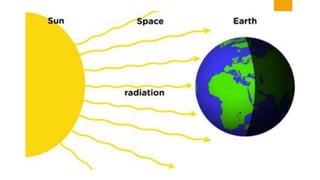
  • #23 Inside the Earth, radiation is significant only in the hottest parts of the core and the lower mantle. When the land and water become warm in summer, they emit long – wavelength infrared radiation that is readily absorbed by the atmosphere. This continues during night time too. Convection in the air then spreads out the thermal energy throughout the atmosphere