Introduction to Computer ScienceComputer HistoryMr. OeiICS 2O1
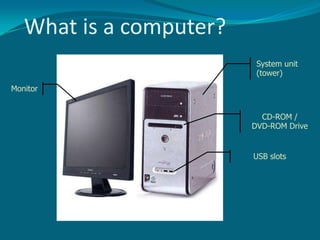
What is a computer?System unit (tower)MonitorCD-ROM / DVD-ROM DriveUSB slots
com·put·er1) A person who makes calculations, esp. with a calculating machineor2) A machine that calculates!Before we had the modern digital machines we possess today, computers started off as Analog Devices
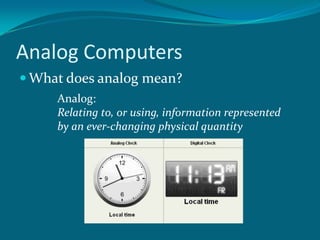
Analog ComputersWhat does analog mean?Analog:Relating to, or using, information represented by an ever-changing physical quantity
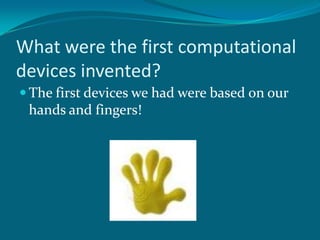
What were the first computational devices invented?The first devices we had were based on our hands and fingers!
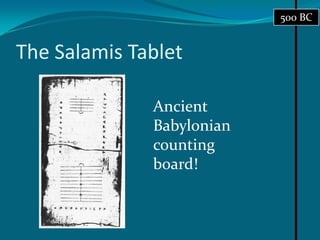
The Salamis Tablet500 BCAncient Babylonian counting board!
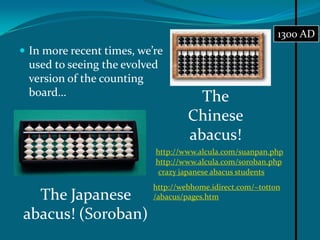
1300 ADIn more recent times, we’re used to seeing the evolved version of the counting board…The Chinese abacus!http://www.alcula.com/suanpan.phphttp://www.alcula.com/soroban.phpcrazy japanese abacus studentshttp://webhome.idirect.com/~totton/abacus/pages.htmThe Japanese abacus! (Soroban)
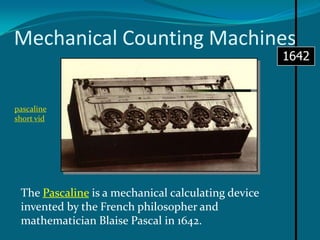
Mechanical Counting Machines1642pascaline short vidThe Pascalineis a mechanical calculating deviceinvented by the French philosopher and mathematician Blaise Pascal in 1642.
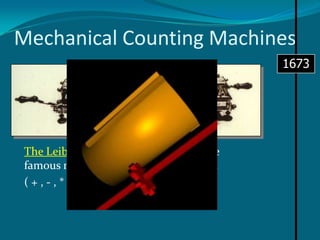
Mechanical Counting Machines1673The Leibniz Wheelwas invented by the famous mathematician Leibniz in 1673.	( + , - , * , / )
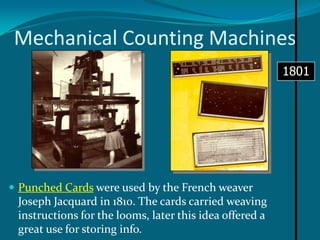
Mechanical Counting Machines1801Punched Cards were used by the French weaver Joseph Jacquard in 1810. The cards carried weaving instructions for the looms, later this idea offered a great use for storing info.
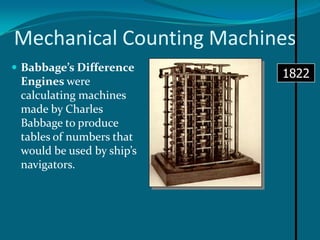
Mechanical Counting MachinesBabbage’s Difference Engines were calculating machines made by Charles Babbage to produce tables of numbers that would be used by ship’s navigators.1822
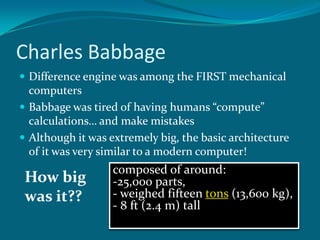
Charles BabbageDifference engine was among the FIRST mechanical computersBabbage was tired of having humans “compute” calculations… and make mistakesAlthough it was extremely big, the basic architecture of it was very similar to a modern computer!composed of around: 25,000 parts,
 weighed fifteen tons (13,600 kg),
 8 ft (2.4 m) tallHow big was it??
Charles Babbage	This device had mechanical problems similar to those that Pascal and Leibniz had, and was not completed until 1991 by the London Science Museum. Babbage did not give up –went on to make a more general purpose, and complex machine…
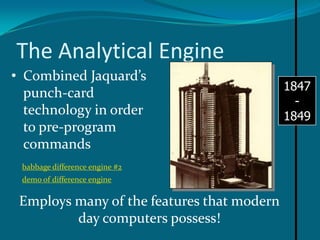
The Analytical EngineCombined Jaquard’s punch-card technology in order to pre-program  commands1847-1849babbage difference engine #2demo of difference engineEmploys many of the features that modern day computers possess!
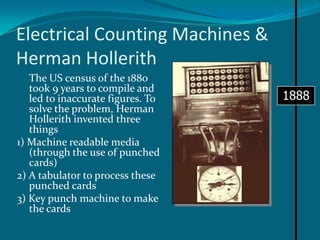
Electrical Counting Machines & Herman Hollerith	The US census of the 1880 took 9 years to compile and led to inaccurate figures. To solve the problem, Herman Hollerith invented three things1) Machine readable media (through the use of punched cards)2) A tabulator to process these punched cards3) Key punch machine to make the cards 1888
IBMHollerith’s machine was immensely successful. The general count of the population, then 63 million, took only 6 weeks to calculate!
Based on the success of his invention, Herman Hollerith and some friends formed a company that sold his invention all over the world. The company eventually became known as:International Business Machines   IBM1888
Electrical Counting Machines194351 feet long and weighed over 5 tonsMARK I was built by a team from IBM and Harvard University. Mark I used mechanical telephone switches to store information. It accepted data on punched cards, processed and then output the new data.Was also used to control weapons during the war!
A summary of analog computersTruly parallel - Therefore can perform multiple calculations at the same timeStrength in calculating mathematical, physical and technical problems through the interaction of continuously  varying (or dynamic) physical quantities or measuresUsed mechanical, electrical, and hydraulic means to perform calculationsex. 	speedometers, simulating weather patterns, analyzing 	hydraulic networks
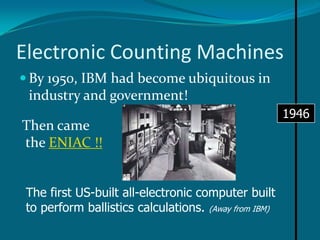
Electronic Counting MachinesBy 1950, IBM had become ubiquitous in industry and government!1946Then camethe ENIAC !!The first US-built all-electronic computer built to perform ballistics calculations. (Away from IBM)
Electronic Counting Machines* It was 1000X faster than Mark I, but drew a lot of power …even dimmed the lights of Philadelphia when switched on!!* Mark I: 5 Additions / sec.* ENIAC: 5,000 Additions / sec.* ENIAC was made of 18,000 vacuum tubes.1946

Introduction to computer science

  • 1.
    Introduction to ComputerScienceComputer HistoryMr. OeiICS 2O1
  • 2.
    What is acomputer?System unit (tower)MonitorCD-ROM / DVD-ROM DriveUSB slots
  • 3.
    com·put·er1) A personwho makes calculations, esp. with a calculating machineor2) A machine that calculates!Before we had the modern digital machines we possess today, computers started off as Analog Devices
  • 4.
    Analog ComputersWhat doesanalog mean?Analog:Relating to, or using, information represented by an ever-changing physical quantity
  • 5.
    What were thefirst computational devices invented?The first devices we had were based on our hands and fingers!
  • 6.
    The Salamis Tablet500BCAncient Babylonian counting board!
  • 7.
    1300 ADIn morerecent times, we’re used to seeing the evolved version of the counting board…The Chinese abacus!http://www.alcula.com/suanpan.phphttp://www.alcula.com/soroban.phpcrazy japanese abacus studentshttp://webhome.idirect.com/~totton/abacus/pages.htmThe Japanese abacus! (Soroban)
  • 8.
    Mechanical Counting Machines1642pascalineshort vidThe Pascalineis a mechanical calculating deviceinvented by the French philosopher and mathematician Blaise Pascal in 1642.
  • 9.
    Mechanical Counting Machines1673TheLeibniz Wheelwas invented by the famous mathematician Leibniz in 1673. ( + , - , * , / )
  • 10.
    Mechanical Counting Machines1801PunchedCards were used by the French weaver Joseph Jacquard in 1810. The cards carried weaving instructions for the looms, later this idea offered a great use for storing info.
  • 11.
    Mechanical Counting MachinesBabbage’sDifference Engines were calculating machines made by Charles Babbage to produce tables of numbers that would be used by ship’s navigators.1822
  • 12.
    Charles BabbageDifference enginewas among the FIRST mechanical computersBabbage was tired of having humans “compute” calculations… and make mistakesAlthough it was extremely big, the basic architecture of it was very similar to a modern computer!composed of around: 25,000 parts,
  • 13.
  • 14.
    8 ft (2.4 m)tallHow big was it??
  • 15.
    Charles Babbage This devicehad mechanical problems similar to those that Pascal and Leibniz had, and was not completed until 1991 by the London Science Museum. Babbage did not give up –went on to make a more general purpose, and complex machine…
  • 16.
    The Analytical EngineCombinedJaquard’s punch-card technology in order to pre-program commands1847-1849babbage difference engine #2demo of difference engineEmploys many of the features that modern day computers possess!
  • 17.
    Electrical Counting Machines& Herman Hollerith The US census of the 1880 took 9 years to compile and led to inaccurate figures. To solve the problem, Herman Hollerith invented three things1) Machine readable media (through the use of punched cards)2) A tabulator to process these punched cards3) Key punch machine to make the cards 1888
  • 18.
    IBMHollerith’s machine wasimmensely successful. The general count of the population, then 63 million, took only 6 weeks to calculate!
  • 19.
    Based on thesuccess of his invention, Herman Hollerith and some friends formed a company that sold his invention all over the world. The company eventually became known as:International Business Machines IBM1888
  • 20.
    Electrical Counting Machines194351feet long and weighed over 5 tonsMARK I was built by a team from IBM and Harvard University. Mark I used mechanical telephone switches to store information. It accepted data on punched cards, processed and then output the new data.Was also used to control weapons during the war!
  • 21.
    A summary ofanalog computersTruly parallel - Therefore can perform multiple calculations at the same timeStrength in calculating mathematical, physical and technical problems through the interaction of continuously varying (or dynamic) physical quantities or measuresUsed mechanical, electrical, and hydraulic means to perform calculationsex. speedometers, simulating weather patterns, analyzing hydraulic networks
  • 22.
    Electronic Counting MachinesBy1950, IBM had become ubiquitous in industry and government!1946Then camethe ENIAC !!The first US-built all-electronic computer built to perform ballistics calculations. (Away from IBM)
  • 23.
    Electronic Counting Machines*It was 1000X faster than Mark I, but drew a lot of power …even dimmed the lights of Philadelphia when switched on!!* Mark I: 5 Additions / sec.* ENIAC: 5,000 Additions / sec.* ENIAC was made of 18,000 vacuum tubes.1946