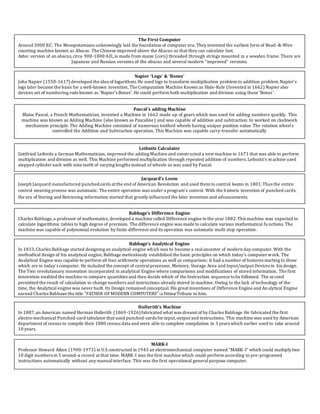
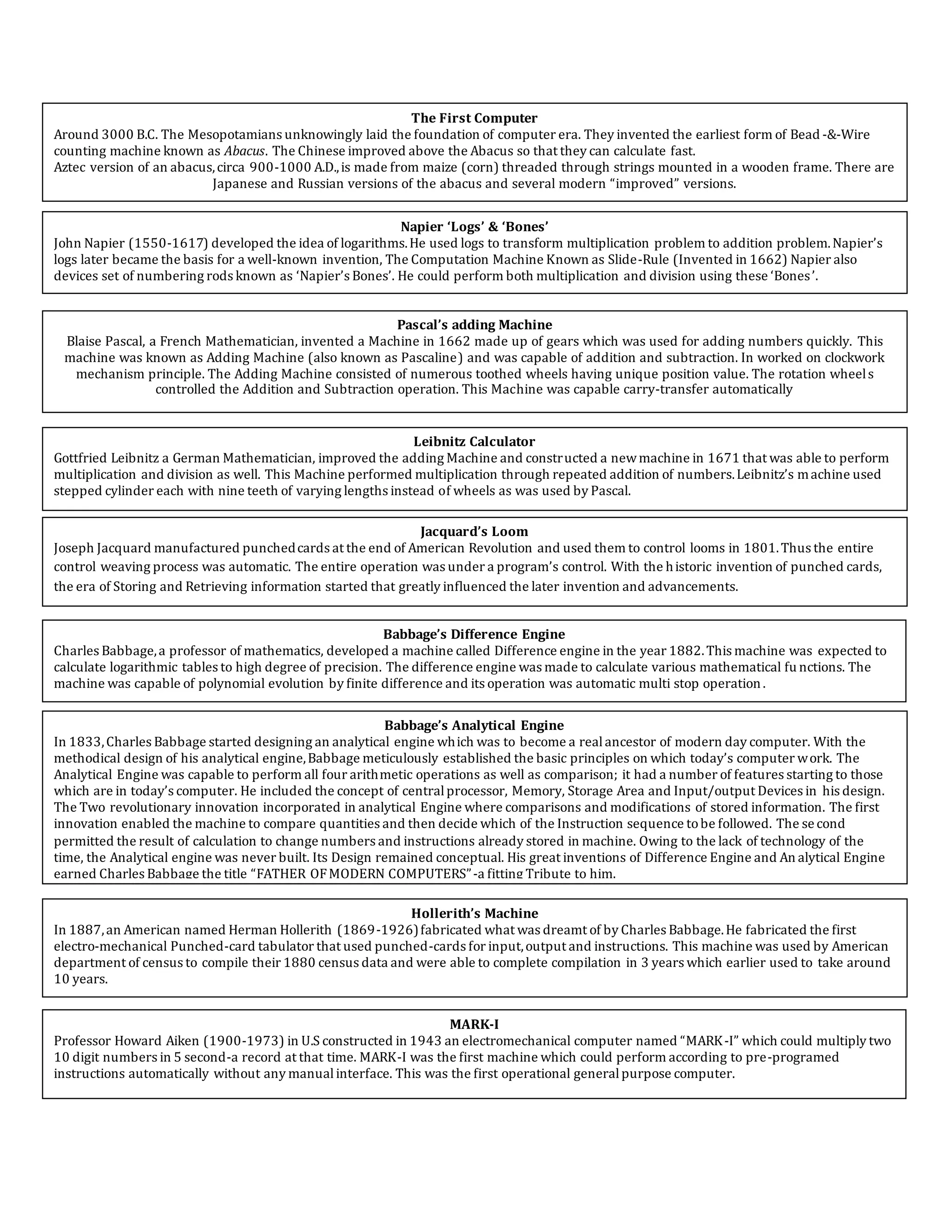
The First Computer
Around 3000 B.C. The Mesopotamians unknowingly laid the foundation of computer era. They invented the earliest form of Bead -&-Wire
counting machine known as Abacus. The Chinese improved above the Abacus so that they can calculate fast.
Aztec version of an abacus,circa 900-1000 A.D.,is made from maize (corn) threaded through strings mounted in a wooden frame. There are
Japanese and Russian versions of the abacus and several modern “improved” versions.
Napier ‘Logs’ & ‘Bones’
John Napier (1550-1617) developed the idea of logarithms.He used logs to transform multiplication problem to addition problem.Napier’s
logs later became the basis for a well-known invention, The Computation Machine Known as Slide-Rule (Invented in 1662) Napier also
devices set of numbering rods known as ‘Napier’s Bones’. He could perform both multiplication and division using these ‘Bones’.
Pascal’s adding Machine
Blaise Pascal, a French Mathematician, invented a Machine in 1662 made up of gears which was used for adding numbers quickly. This
machine was known as Adding Machine (also known as Pascaline) and was capable of addition and subtraction. In worked on clockwork
mechanism principle. The Adding Machine consisted of numerous toothed wheels having unique position value. The rotation wheels
controlled the Addition and Subtraction operation. This Machine was capable carry-transfer automatically
Leibnitz Calculator
Gottfried Leibnitz a German Mathematician, improved the adding Machine and constructed a newmachine in 1671 that was able to perform
multiplication and division as well. This Machine performed multiplication through repeated addition of numbers.Leibnitz’s machine used
stepped cylinder each with nine teeth of varying lengths instead of wheels as was used by Pascal.
Jacquard’s Loom
Joseph Jacquard manufactured punchedcards at the end of American Revolution and used them to control looms in 1801.Thus the entire
control weaving process was automatic. The entire operation was under a program’s control. With the historic invention of punched cards,
the era of Storing and Retrieving information started that greatly influenced the later invention and advancements.
Babbage’s Difference Engine
Charles Babbage,a professor of mathematics, developed a machine called Difference engine in the year 1882.This machine was expected to
calculate logarithmic tables to high degree of precision. The difference engine was made to calculate various mathematical fu nctions. The
machine was capable of polynomial evolution by finite difference and its operation was automatic multi stop operation.
Babbage’s Analytical Engine
In 1833,Charles Babbage started designing an analytical engine which was to become a realancestor of modern day computer. With the
methodical design of his analytical engine,Babbage meticulously established the basic principles on which today’s computer work. The
Analytical Engine was capable to perform all four arithmetic operations as well as comparison; it had a number of features starting to those
which are in today’s computer. He included the concept of centralprocessor, Memory, Storage Area and Input/output Devices in his design.
The Two revolutionary innovation incorporated in analytical Engine where comparisons and modifications of stored information. The first
innovation enabled the machine to compare quantities and then decide which of the Instruction sequence tobe followed. The second
permitted the result of calculation to change numbers and instructions already stored in machine. Owing to the lack of technology of the
time, the Analytical engine was never built. Its Design remained conceptual. His great inventions of Difference Engine and An alytical Engine
earned Charles Babbage the title “FATHER OFMODERN COMPUTERS”-a fitting Tribute to him.
Hollerith’s Machine
In 1887,an American named Herman Hollerith (1869-1926)fabricated what was dreamt of by Charles Babbage.He fabricated the first
electro-mechanical Punched-card tabulator that used punched-cards for input,output and instructions. This machine was used by American
department of census to compile their 1880 census data and were able to complete compilation in 3 years which earlier used to take around
10 years.
MARK-I
Professor Howard Aiken (1900-1973) in U.S constructed in 1943 an electromechanical computer named “MARK-I” which could multiply two
10 digit numbers in 5 second-a record at that time. MARK-I was the first machine which could perform according to pre-programed
instructions automatically without any manualinterface. This was the first operational generalpurpose computer.
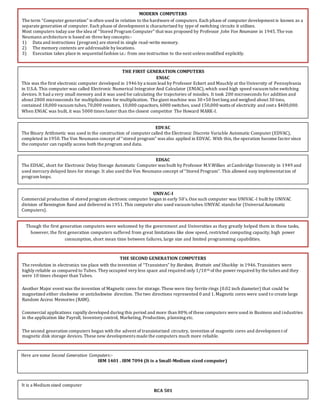
MODERN COMPUTERS
The term “Computer generation” is often used in relation to the hardware of computers. Each phase of computer development is known as a
separate generation of computer. Each phase of development is characterized by type of switching circuits it utilizes.
Most computers today use the idea of “Stored Program Computer” that was proposed by Professor John Von Neumann in 1945.The von
Neumann architecture is based on three key concepts:-
1) Data and instructions (program) are stored in single read-write memory.
2) The memory contents are addressable by locations.
3) Execution takes place in sequentialfashion i.e.: from one instruction to the next unless modified explicitly.
THE FIRST GENERATION COMPUTERS
ENIAC
This was the first electronic computer developed in 1946 by a team lead by Professor Eckert and Mauchly at the University of Pennsylvania
in U.S.A. This computer was called Electronic Numerical Integrator And Calculator (ENIAC),which used high speed vacuum tube switching
devices. It had a very small memory and it was used for calculating the trajectories of missiles. It took 200 microseconds for addition and
about 2800 microseconds for multiplications for multiplication. The giant machine was 30×50 feet long and weighed about 30 tons,
contained 18,000 vacuum tubes,70,000 resistors, 10,000 capacitors, 6000 switches, used 150,000 watts of electricity and costs $400,000.
When ENIAC was built, it was 5000 times faster than the closest competitor The Howard MARK-I.
EDVAC
The Binary Arithmetic was used in the construction of computer called the Electronic Discrete Variable Automatic Computer (EDVAC),
completed in 1950.The Von Neumann concept of “stored program” was also applied in EDVAC. With this, the operation become faster since
the computer can rapidly access both the program and data.
EDSAC
The EDSAC, short for Electronic Delay Storage Automatic Computer was built by Professor M.V.Wilkes at Cambridge University in 1949 and
used mercury delayed lines for storage. It also used the Von Neumann concept of “Stored Program”. This allowed easy implementation of
program loops.
UNIVAC-I
Commercial production of stored program electronic computer began in early 50’s.One such computer was UNIVAC-I built by UNIVAC
division of Remington Rand and delivered in 1951.This computer also used vacuum tubes.UNIVAC stands for (UniversalAutomatic
Computers).
Though the first generation computers were welcomed by the government and Universities as they greatly helped them in these tasks,
however, the first generation computers suffered from great limitations like slow speed, restricted computing capacity, high power
consumption, short mean time between failures, large size and limited programming capabilities.
THE SECOND GENERATION COMPUTERS
The revolution in electronics too place with the invention of “Transistors” by Bardeen, Brattain and Shockley in 1946.Transistors were
highly reliable as compared to Tubes. They occupied very less space and required only 1/10th of the power required by the tubes and they
were 10 times cheaper than Tubes.
Another Major event was the invention of Magnetic cores for storage. These were tiny ferrite rings (0.02 inch diameter) that could be
magnetized either clockwise or anticlockwise direction. The two directions represented 0 and 1.Magnetic cores were used to create large
Random Access Memories (RAM).
Commercial applications rapidly developed during this period and more than 80% of these computers were used in Business and industries
in the application like Payroll, Inventory control, Marketing, Production, planning etc.
The second generation computers began with the advent of transistorized circuitry, invention of magnetic cores and developmen t of
magnetic disk storage devices. These new developments made the computers much more reliable.
Here are some Second Generation Computers:-
IBM 1401 . IBM 7094 (It is a Small-Medium sized computer)
It is a Medium sized computer
RCA 501
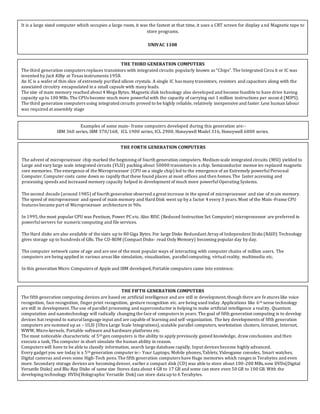
It is a large sized computer which occupies a large room, it was the fastest at that time, it uses a CRT screen for display and Magnetic tape to
store programs.
UNIVAC 1108
THE THIRD GENERATION COMPUTERS
The third generation computers replaces transistors with integrated circuits popularly known as “Chips”.The Integrated Circu it or IC was
invented by Jack Kilby at Texas instruments 1958.
An IC is a wafer of thin slice of extremely purified silicon crystals. A single IC has many transistors, resistors and capacitors along with the
associated circuitry encapsulated in a small capsule with many leads.
The size of main memory reached about 4 Mega Bytes. Magneticdisk technology also developed and become feasible to have drive having
capacity up to 100 MBs. The CPUs become much more powerfulwith the capacity of carrying out 1 million instructions per secon d (MIPS).
The third generation computers using integrated circuits proved to be highly reliable, relatively inexpensive and faster.Less human labour
was required at assembly stage
Examples of some main- frame computers developed during this generation are:-
IBM 360 series, IBM 370/168, ICL 1900 series, ICL 2900, Honeywell Model 316, Honeywell 6000 series.
THE FORTH GENERATION COMPUTERS
The advent of microprocessor chip marked the beginning of fourth generation computers. Medium scale integrated circuits (MSI) yielded to
Large and vary large scale integrated circuits (VLSI) packing about 50000 transistors in a chip. Semiconductor memories replaced magnetic
core memories. The emergence of the Microprocessor (CPU on a single chip) led to the emergence of an Extremely powerfulPersonal
Computer.Computer costs came down so rapidly that these found places at most offices and then homes.The faster accessing and
processing speeds and increased memory capacity helped in development of much more powerfulOperating Systems.
The second decade (around 1985) of fourth generation observed a great increase in the speed of microprocessor and size of main memory.
The speed of microprocessor and speed of main memory and Hard Disk went up by a factor 4 every 3 years. Most of the Main-Frame CPU
features became part of Microprocessor architecture in 90s.
In 1995,the most popular CPU was Pentium, Power PC etc. Also RISC (Reduced Instruction Set Computer) microprocessor are preferred in
powerfulservers for numericcomputing and file services.
The Hard disks are also available of the sizes up to 80 Giga Bytes. For large Disks Redundant Array of Independent Disks (RAID) Technology
gives storage up to hundreds of GBs. The CD-ROM (Compact Disks- read Only Memory) becoming popular day by day.
The computer network came of age and are one of the most popular ways of interacting with computer chains of million users. The
computers are being applied in various areas like simulation, visualization, parallelcomputing, virtualreality, multimedia etc.
In this generation Micro Computers of Apple and IBM developed,Portable computers came into existence.
THE FIFTH GENERATION COMPUTERS
The fifth generation computing devices are based on artificial intelligence and are still in development,though there are features like voice
recognition, face recognition, finger print recognition, gesture recognition etc. are being used today. Applications like 6th sense technology
are still in development.The use of parallel processing and superconductor is helping to make artificial intelligence a reality. Quantum
computation and nanotechnology will radically changing the face of computers in years. The goal of fifth generation computing is to develop
devices hat respond to naturallanguage input and are capable of learning and self-organization. The key developments of fifth generation
computers are summed up as :- ULSI (Ultra Large Scale Integrations),scalable parallel computers, workstation clusters, Intranet, Internet,
WWW, Micro-kernels, Portable software and hardware platforms etc.
The most noticeable characteristic of 5th gen computers is the ability to apply previously gained knowledge, drawconclusions and then
execute a task, The computer in short simulate the human ability in reason.
Computers will have to be able to classify information, search large database rapidly. Input devices become highly advanced.
Every gadget you see today is a 5th generation computer ie:- Your Laptops, Mobile phones,Tablets, Videogame consoles, Smart watches,
Digital cameras and even some High-Tech pens.The fifth generation computers have Huge memories which ranges in Terabytes and even
more. Secondary storage devices are becoming denser, earlier a compact disk (CD) was able to store about 100-200 MBs,now DVDs(Digital
Versatile Disks) and Blu-Ray Disks of same size Stores data about 4 GB to 17 GB and some can store even 50 GB to 100 GB. With the
developing technology HVDs(Holographic Versatile Disk) can store data up to 6 Terabytes.

Evolution of computer_1448075245

  • 1.
    The First Computer Around3000 B.C. The Mesopotamians unknowingly laid the foundation of computer era. They invented the earliest form of Bead -&-Wire counting machine known as Abacus. The Chinese improved above the Abacus so that they can calculate fast. Aztec version of an abacus,circa 900-1000 A.D.,is made from maize (corn) threaded through strings mounted in a wooden frame. There are Japanese and Russian versions of the abacus and several modern “improved” versions. Napier ‘Logs’ & ‘Bones’ John Napier (1550-1617) developed the idea of logarithms.He used logs to transform multiplication problem to addition problem.Napier’s logs later became the basis for a well-known invention, The Computation Machine Known as Slide-Rule (Invented in 1662) Napier also devices set of numbering rods known as ‘Napier’s Bones’. He could perform both multiplication and division using these ‘Bones’. Pascal’s adding Machine Blaise Pascal, a French Mathematician, invented a Machine in 1662 made up of gears which was used for adding numbers quickly. This machine was known as Adding Machine (also known as Pascaline) and was capable of addition and subtraction. In worked on clockwork mechanism principle. The Adding Machine consisted of numerous toothed wheels having unique position value. The rotation wheels controlled the Addition and Subtraction operation. This Machine was capable carry-transfer automatically Leibnitz Calculator Gottfried Leibnitz a German Mathematician, improved the adding Machine and constructed a newmachine in 1671 that was able to perform multiplication and division as well. This Machine performed multiplication through repeated addition of numbers.Leibnitz’s machine used stepped cylinder each with nine teeth of varying lengths instead of wheels as was used by Pascal. Jacquard’s Loom Joseph Jacquard manufactured punchedcards at the end of American Revolution and used them to control looms in 1801.Thus the entire control weaving process was automatic. The entire operation was under a program’s control. With the historic invention of punched cards, the era of Storing and Retrieving information started that greatly influenced the later invention and advancements. Babbage’s Difference Engine Charles Babbage,a professor of mathematics, developed a machine called Difference engine in the year 1882.This machine was expected to calculate logarithmic tables to high degree of precision. The difference engine was made to calculate various mathematical fu nctions. The machine was capable of polynomial evolution by finite difference and its operation was automatic multi stop operation. Babbage’s Analytical Engine In 1833,Charles Babbage started designing an analytical engine which was to become a realancestor of modern day computer. With the methodical design of his analytical engine,Babbage meticulously established the basic principles on which today’s computer work. The Analytical Engine was capable to perform all four arithmetic operations as well as comparison; it had a number of features starting to those which are in today’s computer. He included the concept of centralprocessor, Memory, Storage Area and Input/output Devices in his design. The Two revolutionary innovation incorporated in analytical Engine where comparisons and modifications of stored information. The first innovation enabled the machine to compare quantities and then decide which of the Instruction sequence tobe followed. The second permitted the result of calculation to change numbers and instructions already stored in machine. Owing to the lack of technology of the time, the Analytical engine was never built. Its Design remained conceptual. His great inventions of Difference Engine and An alytical Engine earned Charles Babbage the title “FATHER OFMODERN COMPUTERS”-a fitting Tribute to him. Hollerith’s Machine In 1887,an American named Herman Hollerith (1869-1926)fabricated what was dreamt of by Charles Babbage.He fabricated the first electro-mechanical Punched-card tabulator that used punched-cards for input,output and instructions. This machine was used by American department of census to compile their 1880 census data and were able to complete compilation in 3 years which earlier used to take around 10 years. MARK-I Professor Howard Aiken (1900-1973) in U.S constructed in 1943 an electromechanical computer named “MARK-I” which could multiply two 10 digit numbers in 5 second-a record at that time. MARK-I was the first machine which could perform according to pre-programed instructions automatically without any manualinterface. This was the first operational generalpurpose computer.
  • 2.
    MODERN COMPUTERS The term“Computer generation” is often used in relation to the hardware of computers. Each phase of computer development is known as a separate generation of computer. Each phase of development is characterized by type of switching circuits it utilizes. Most computers today use the idea of “Stored Program Computer” that was proposed by Professor John Von Neumann in 1945.The von Neumann architecture is based on three key concepts:- 1) Data and instructions (program) are stored in single read-write memory. 2) The memory contents are addressable by locations. 3) Execution takes place in sequentialfashion i.e.: from one instruction to the next unless modified explicitly. THE FIRST GENERATION COMPUTERS ENIAC This was the first electronic computer developed in 1946 by a team lead by Professor Eckert and Mauchly at the University of Pennsylvania in U.S.A. This computer was called Electronic Numerical Integrator And Calculator (ENIAC),which used high speed vacuum tube switching devices. It had a very small memory and it was used for calculating the trajectories of missiles. It took 200 microseconds for addition and about 2800 microseconds for multiplications for multiplication. The giant machine was 30×50 feet long and weighed about 30 tons, contained 18,000 vacuum tubes,70,000 resistors, 10,000 capacitors, 6000 switches, used 150,000 watts of electricity and costs $400,000. When ENIAC was built, it was 5000 times faster than the closest competitor The Howard MARK-I. EDVAC The Binary Arithmetic was used in the construction of computer called the Electronic Discrete Variable Automatic Computer (EDVAC), completed in 1950.The Von Neumann concept of “stored program” was also applied in EDVAC. With this, the operation become faster since the computer can rapidly access both the program and data. EDSAC The EDSAC, short for Electronic Delay Storage Automatic Computer was built by Professor M.V.Wilkes at Cambridge University in 1949 and used mercury delayed lines for storage. It also used the Von Neumann concept of “Stored Program”. This allowed easy implementation of program loops. UNIVAC-I Commercial production of stored program electronic computer began in early 50’s.One such computer was UNIVAC-I built by UNIVAC division of Remington Rand and delivered in 1951.This computer also used vacuum tubes.UNIVAC stands for (UniversalAutomatic Computers). Though the first generation computers were welcomed by the government and Universities as they greatly helped them in these tasks, however, the first generation computers suffered from great limitations like slow speed, restricted computing capacity, high power consumption, short mean time between failures, large size and limited programming capabilities. THE SECOND GENERATION COMPUTERS The revolution in electronics too place with the invention of “Transistors” by Bardeen, Brattain and Shockley in 1946.Transistors were highly reliable as compared to Tubes. They occupied very less space and required only 1/10th of the power required by the tubes and they were 10 times cheaper than Tubes. Another Major event was the invention of Magnetic cores for storage. These were tiny ferrite rings (0.02 inch diameter) that could be magnetized either clockwise or anticlockwise direction. The two directions represented 0 and 1.Magnetic cores were used to create large Random Access Memories (RAM). Commercial applications rapidly developed during this period and more than 80% of these computers were used in Business and industries in the application like Payroll, Inventory control, Marketing, Production, planning etc. The second generation computers began with the advent of transistorized circuitry, invention of magnetic cores and developmen t of magnetic disk storage devices. These new developments made the computers much more reliable. Here are some Second Generation Computers:- IBM 1401 . IBM 7094 (It is a Small-Medium sized computer) It is a Medium sized computer RCA 501
  • 3.
    It is alarge sized computer which occupies a large room, it was the fastest at that time, it uses a CRT screen for display and Magnetic tape to store programs. UNIVAC 1108 THE THIRD GENERATION COMPUTERS The third generation computers replaces transistors with integrated circuits popularly known as “Chips”.The Integrated Circu it or IC was invented by Jack Kilby at Texas instruments 1958. An IC is a wafer of thin slice of extremely purified silicon crystals. A single IC has many transistors, resistors and capacitors along with the associated circuitry encapsulated in a small capsule with many leads. The size of main memory reached about 4 Mega Bytes. Magneticdisk technology also developed and become feasible to have drive having capacity up to 100 MBs. The CPUs become much more powerfulwith the capacity of carrying out 1 million instructions per secon d (MIPS). The third generation computers using integrated circuits proved to be highly reliable, relatively inexpensive and faster.Less human labour was required at assembly stage Examples of some main- frame computers developed during this generation are:- IBM 360 series, IBM 370/168, ICL 1900 series, ICL 2900, Honeywell Model 316, Honeywell 6000 series. THE FORTH GENERATION COMPUTERS The advent of microprocessor chip marked the beginning of fourth generation computers. Medium scale integrated circuits (MSI) yielded to Large and vary large scale integrated circuits (VLSI) packing about 50000 transistors in a chip. Semiconductor memories replaced magnetic core memories. The emergence of the Microprocessor (CPU on a single chip) led to the emergence of an Extremely powerfulPersonal Computer.Computer costs came down so rapidly that these found places at most offices and then homes.The faster accessing and processing speeds and increased memory capacity helped in development of much more powerfulOperating Systems. The second decade (around 1985) of fourth generation observed a great increase in the speed of microprocessor and size of main memory. The speed of microprocessor and speed of main memory and Hard Disk went up by a factor 4 every 3 years. Most of the Main-Frame CPU features became part of Microprocessor architecture in 90s. In 1995,the most popular CPU was Pentium, Power PC etc. Also RISC (Reduced Instruction Set Computer) microprocessor are preferred in powerfulservers for numericcomputing and file services. The Hard disks are also available of the sizes up to 80 Giga Bytes. For large Disks Redundant Array of Independent Disks (RAID) Technology gives storage up to hundreds of GBs. The CD-ROM (Compact Disks- read Only Memory) becoming popular day by day. The computer network came of age and are one of the most popular ways of interacting with computer chains of million users. The computers are being applied in various areas like simulation, visualization, parallelcomputing, virtualreality, multimedia etc. In this generation Micro Computers of Apple and IBM developed,Portable computers came into existence. THE FIFTH GENERATION COMPUTERS The fifth generation computing devices are based on artificial intelligence and are still in development,though there are features like voice recognition, face recognition, finger print recognition, gesture recognition etc. are being used today. Applications like 6th sense technology are still in development.The use of parallel processing and superconductor is helping to make artificial intelligence a reality. Quantum computation and nanotechnology will radically changing the face of computers in years. The goal of fifth generation computing is to develop devices hat respond to naturallanguage input and are capable of learning and self-organization. The key developments of fifth generation computers are summed up as :- ULSI (Ultra Large Scale Integrations),scalable parallel computers, workstation clusters, Intranet, Internet, WWW, Micro-kernels, Portable software and hardware platforms etc. The most noticeable characteristic of 5th gen computers is the ability to apply previously gained knowledge, drawconclusions and then execute a task, The computer in short simulate the human ability in reason. Computers will have to be able to classify information, search large database rapidly. Input devices become highly advanced. Every gadget you see today is a 5th generation computer ie:- Your Laptops, Mobile phones,Tablets, Videogame consoles, Smart watches, Digital cameras and even some High-Tech pens.The fifth generation computers have Huge memories which ranges in Terabytes and even more. Secondary storage devices are becoming denser, earlier a compact disk (CD) was able to store about 100-200 MBs,now DVDs(Digital Versatile Disks) and Blu-Ray Disks of same size Stores data about 4 GB to 17 GB and some can store even 50 GB to 100 GB. With the developing technology HVDs(Holographic Versatile Disk) can store data up to 6 Terabytes.