High-Altitude Medicine   Humaid Al Hinai 20-04-2010 Chapter 142 ,, Rosen Emergency Medicine 7 ed
Overview Introduction DEFINITIONS  ACCLIMATIZATION  PATHOPHYSIOLOGY AMS HAPE HACE HARH
High-Altitude Medicine represents a spectrum of clinical entities that have hampered the activities of mountaineers, merchants, military forces, aviators, and explorers throughout time. (AMS) is the relatively benign and self-limited presentation,  (HAPE) and (HACE) represent life-threatening manifestations.
The incidence of high-altitude illness depends on many variables: 1. The rate of ascent 2. previous altitude exposure  3. individual genetic susceptibility  4. Sleeping altitude 5. final altitude reached  6. duration of stay at any altitude The most important factors
All of the followings are true EXCEPT: 1.  Age may be a relative risk factor  2.  Younger individuals (<20) are more likely to  develop HACE  3. HAPE is extremely rare in children younger < 2  4. Gender does not affect the incidence of AMS  5. women may have less risk of developing HAPE
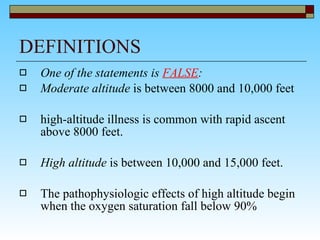
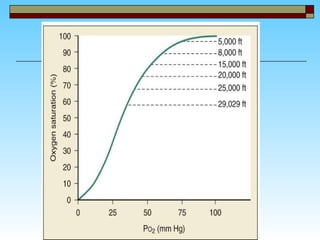
DEFINITIONS  One of the statements is  FALSE : Moderate altitude  is between 8000 and 10,000 feet high-altitude illness is common with rapid ascent above 8000 feet.  High altitude  is between 10,000 and 15,000 feet.  The pathophysiologic effects of high altitude begin when the oxygen saturation fall below 90%
 
One of the followings is True: Barometric pressure increases logarithmically as the altitude rises.  PO2 in the atmosphere also increases as altitude rises the barometric pressure is higher at higher latitudes than it is at the equator atmospheric envelope undergoes a seasonal tide that causes a variation in its local thickness.
ACCLIMATIZATION  refers to series of integrated adaptations that take place at high altitudes, which tend to restore the oxygen pressures within the tissues toward normal sea level values despite the lowered Po2 of the atmosphere. If rapid exposure to extreme altitudes is attempted, acclimatization is impossible, and the individual loses consciousness and may die in a matter of minutes.
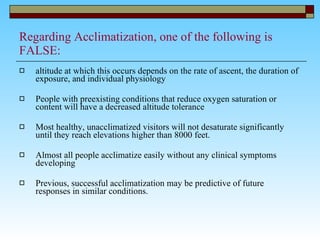
Regarding Acclimatization, one of the following is FALSE: altitude at which this occurs depends on the rate of ascent, the duration of exposure, and individual physiology People with preexisting conditions that reduce oxygen saturation or content will have a decreased altitude tolerance Most healthy, unacclimatized visitors will not desaturate significantly until they reach elevations higher than 8000 feet.  Almost all people acclimatize easily without any clinical symptoms developing Previous, successful acclimatization may be predictive of future responses in similar conditions.
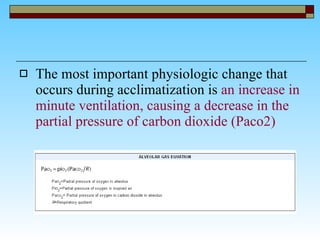
The most important physiologic change that occurs during acclimatization is  an increase in minute ventilation, causing a decrease in the partial pressure of carbon dioxide (Paco2)
peripheral chemosensors in the carotid bodies respond to a decrease in Pao2 and signal increase ventilation.  hypoxic ventilatory response (HVR) The magnitude of the HVR varies among individuals and may be genetically predetermined.
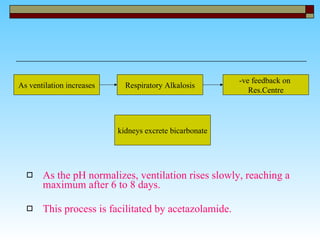
As the pH normalizes, ventilation rises slowly, reaching a maximum after 6 to 8 days.  This process is facilitated by acetazolamide.  As ventilation increases Respiratory Alkalosis -ve feedback on  Res.Centre kidneys excrete bicarbonate
The ability to achieve an adequate HVR varies and is related to the ability to acclimatize a poor HVR makes an individual more likely to fail acclimatization and develop AMS A low HVR and relative hypoventilation are implicated in the pathogenesis of both AMS and HAPE
The release of catecholamines on ascent stimulates the circulatory system to increase cardiac output. This is manifested by an elevation in  heart rate, blood pressure, cardiac output, and venous tone.   Except at extreme altitudes,  acclimatization results in the resting heart rate gradually returning to near sea level values.
One of the following is evidence of poor acclimatization: 1. Resting high BP 2. Resting Tachycardia 3. Normal Resting C.O  4. high C.O during ascent 5. normal venous tone
One of the followings is NOT a component of hematopoietic response to high altitude: 1. increase in  both Hemoglobin & RBCs 2. early increase of up to 15% occurs in MCHC after  rapid ascent to high altitude 3. Decrease in plasma volume and total blood  volume  after long term of acclimitaization 4. Erythropoietin is secreted in response to hypoxemia
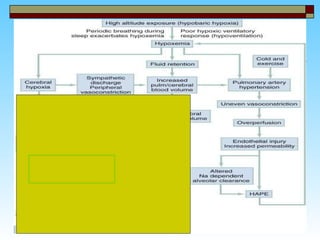
PATHOPHYSIOLOGY   One of the Followings is  FALSE : symptoms of AMS develop several hours after arrival at high altitude  development of HAPE and HACE generally requires several days of altitude exposure   hypobaric hypoxemia occurs within minutes of arrival, it is the direct cause of high-altitude illness it appears to be the initiating factor
 
ACUTE MOUNTAIN SICKNESS The symptoms of mild AMS are very similar to those of a viral syndrome, an ethanol “hangover,” or simple physical exhaustion  In the setting of recent high-altitude exposure, these symptoms warrant a presumptive diagnosis of AMS until proven otherwise.
To diagnose AMS a patient must be in the setting of a recent gain in altitude, be at the new altitude for at least several hours, and report a headache  plus  at least one of the following symptoms: -  gastrointestinal upset (anorexia, nausea, or vomiting)  - general weakness or fatigue,  - dizziness or lightheadedness, or  - difficulty sleeping
All are true regarding the headache in AMS,  Except : -  may vary from mild to severe - is generally bitemporal - throbbing in nature  - worse during the day and on awakening  or suddenly becoming upright.
Symptoms develop within a few hours after arrival at high altitude and maximum severity between 24 and 48 hours, followed by a gradual resolution  Most individuals become symptom free by 3 rd  or 4 th   day Those who do not resolve their symptoms should descend
One of the statements is FALSE: The incidence is 12 to 67% varies with rate of ascent  common below 8000 feet  most common with rapid ascent to altitudes greater than 10,000 feet
There are no diagnostic physical findings in cases of mild AMS any evidence of cerebellar dysfunction, such as mild ataxia or alteration in mentation, mandates descent because of early evidence of HACE ****
In Management of AMS, choose the wrong answer: after symptoms occur, further ascent to a higher sleeping altitude is contraindicated  Halting ascent or activity to allow further acclimatization may worsen the symptoms  presence of neurologic abnormalities (e.g., ataxia or altered mentation) or evidence of severe pulmonary edema mandates immediate descent
In Mx of AMS, One of the followings is TRUE: Supplemental oxygen administration recommended in all cases. Hyperbaric therapy is not effective. Aspirin, ibuprofen, acetaminophen and narcotics are useful for the treatment of headache For nausea and vomiting, prochlorperazine, stimulates the HVR
25 yr old man, presents to Colorado ski resort clinic complaining of headache, nausea and mild weakness. He has no past medical problems and takes no medications but is allergic to sulfa drugs. Physical Examination is unremarkable.  What is the most appropriate initial therapy ? - Acetazolamide  - descent to sea level - dexamethasone - Frusemide - Prochloperazine
Periodic breathing causes insomnia, which is best treated with the respiratory stimulant acetazolamide   Doses of acetazolamide  as low as 62.5 to 125  mg at bedtime accelerates acclimatization and, if given early in the development of AMS, rapidly resolves symptoms
HIGH-ALTITUDE PULMONARY EDEMA   Choose the  False  Answer: most common fatal manifestation of severe high-altitude illness Although HAPE is uncommon below 10,000 feet, it can occur, and even be fatal, at altitudes as low as 8000 feet. 0.01 to 15%, varies with rate of ascent  usually occurs 2–4 weeks after arrival at high altitude
What is reentry HAPE ?? Individuals who have been residents at high-altitude locations for extended periods may have pulmonary edema develop on re-ascent from a trip to low altitude
Marked dyspnea on exertion, fatigue with minimal to moderate effort, prolonged recovery time, and dry cough are early manifestations of the disease.  The symptoms of AMS usually occur concurrently with the development of HAPE .
One of the followings is a red flag that warns of the development of a serious pulmonary problem: - Dyspnea at rest - Productive cough with hemoptysis - dyspnea on exertion  - fatigue with minimal to moderate effort
As the condition intensifies, cerebral edema or simply severe hypoxemia causes central nervous system dysfunction, such as ataxia and altered mentation.   Coma may follow and precede death in a few hours if oxygen therapy or descent is not instituted.
Physical examination in pt with HAPE a few rales in patients with mild HAPE, usually found in the region of the right middle lobe diffuse bilateral rales and also rhonchi and gurgles audible without the stethoscope. Cyanosis of the nail beds alone may progress to severe central cyanosis. Elevated temperatures are common, and a concurrent respiratory tract infection is occasionally seen, especially in children
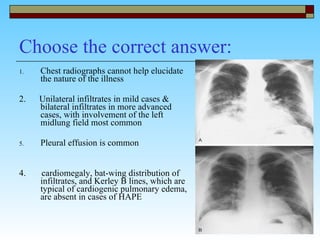
Choose the correct answer: Chest radiographs cannot help elucidate the nature of the illness 2.  Unilateral infiltrates in mild cases & bilateral infiltrates in more advanced cases, with involvement of the left midlung field most common  Pleural effusion is common 4.  cardiomegaly, bat-wing distribution of infiltrates, and Kerley B lines, which are typical of cardiogenic pulmonary edema, are absent in cases of HAPE
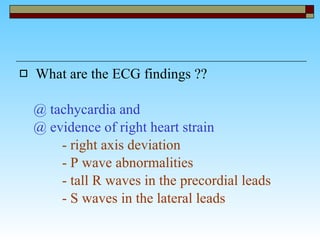
What are the ECG findings ?? @ tachycardia and  @ evidence of right heart strain - right axis deviation  - P wave abnormalities  - tall R waves in the precordial leads  - S waves in the lateral leads
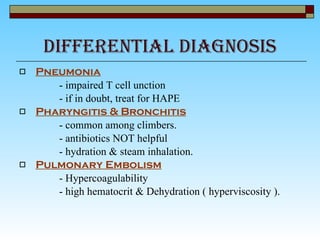
Differential Diagnosis Pneumonia - impaired T cell unction - if in doubt, treat for HAPE Pharyngitis & Bronchitis - common among climbers. - antibiotics NOT helpful - hydration & steam inhalation. Pulmonary Embolism - Hypercoagulability - high hematocrit & Dehydration ( hyperviscosity ).
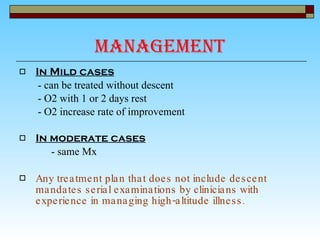
Management In Mild cases - can be treated without descent  - O2 with 1 or 2 days rest - O2 increase rate of improvement In moderate cases - same Mx Any treatment plan that does not include descent mandates serial examinations by clinicians with experience in managing high-altitude illness.
On difficult terrain or in weather conditions that hamper efforts to descend, oxygen administration (or hyperbaric therapy) is a lifesaving measure  High-flow rates of oxygen (6–8 L/min) by mask should be delivered initially to victims with severe HAPE until improvement is seen Delivering oxygen with a continuous positive airway pressure mask is more efficacious than normal oxygen delivery
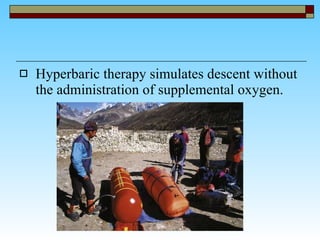
Hyperbaric therapy simulates descent without the administration of supplemental oxygen.
In treating HAPE, agents that lower : # pulmonary artery pressure # pulmonary blood volume  # pulmonary vascular resistance  OR enhance alveolar fluid clearance are useful but not as effective as  oxygen and descent .
Frusemide  80 mg BID Nifedipine  10 mg  q4-6 hours or 10 mg followed by 30 mg of a slow-release preparation administered once or twice daily is effective.
Phosphodiesterase-5 inhibitors are less likely to produce hypotension  inhaled beta-agonists have been used successfully for both prevention and therapy of HAPE
One of the followings is  the most effective measures  in preventing HAPE: gradual ascent & immediate cessation of further ascent at the onset of symptoms acetazolamide  nifedipine  Phosphodiesterase-5 inhibitors  Sildenafil  Dexamethasone
High Altitude Cerebral Edema
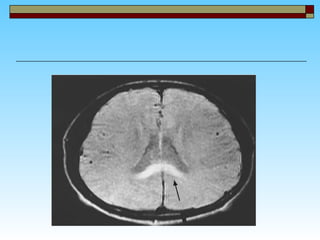
In HACE,All are true EXCEPT: Characterized by evidence of global cerebral dysfunction  symptoms of severe AMS & HAPE are usually present  It is uncommon with 10-20% incidence MRI of patients with HACE reveals white matter changes consistent with vasogenic edema
 
What is the early symptom/sign of HACE ??? Cerebellar Ataxia
All are specific signs of HACE  except : Ataxia generalized seizures  slurred speech  commonly focal neurologic deficits  altered mentation
Management Early recognition and initiation of descent are the keys to successful therapy for HACE  High-flow oxygen & Steroid therapy is recommended and may result in recovery from HACE without neurologic deficits.   The initial dose of dexamethasone is 8 mg parenterally, or orally in mild cases, followed by 4 mg every 6 hours.
Management Patients with severely altered levels of consciousness require tracheal intubation and hyperventilation to control elevated intracranial pressures.  Diuretics (e.g., furosemide) and hypertonic solutions (e.g., mannitol) decrease intracranial pressure. Hyperbaric treatment of HACE is also effective and may result in temporary improvement and allow self-rescue.
HIGH-ALTITUDE RETINAL HEMORRHAGE  All True  Except : most common type of retinopathy in visitors to HA most patients are symptomatic not generally related to the presence of mild AMS but seem to be related to strenuous exercise at HA in the setting of severe HAPE or HACE, retinal hemorrhages are commonly noted
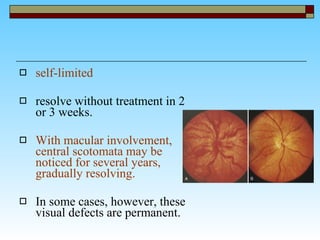
self-limited   resolve without treatment in 2 or 3 weeks. With macular involvement, central scotomata may be noticed for several years, gradually resolving. In some cases, however, these visual defects are permanent.
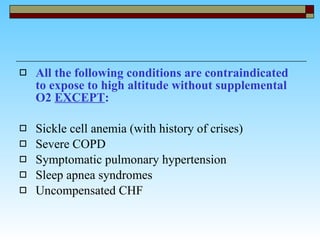
All the following conditions are contraindicated to expose to high altitude without supplemental O2  EXCEPT : Sickle cell anemia (with history of crises)  Severe COPD Symptomatic pulmonary hypertension Sleep apnea syndromes  Uncompensated CHF
Thank You

High altitude medicine

  • 1.
    High-Altitude Medicine Humaid Al Hinai 20-04-2010 Chapter 142 ,, Rosen Emergency Medicine 7 ed
  • 2.
    Overview Introduction DEFINITIONS ACCLIMATIZATION PATHOPHYSIOLOGY AMS HAPE HACE HARH
  • 3.
    High-Altitude Medicine representsa spectrum of clinical entities that have hampered the activities of mountaineers, merchants, military forces, aviators, and explorers throughout time. (AMS) is the relatively benign and self-limited presentation, (HAPE) and (HACE) represent life-threatening manifestations.
  • 4.
    The incidence ofhigh-altitude illness depends on many variables: 1. The rate of ascent 2. previous altitude exposure 3. individual genetic susceptibility 4. Sleeping altitude 5. final altitude reached 6. duration of stay at any altitude The most important factors
  • 5.
    All of thefollowings are true EXCEPT: 1. Age may be a relative risk factor 2. Younger individuals (<20) are more likely to develop HACE 3. HAPE is extremely rare in children younger < 2 4. Gender does not affect the incidence of AMS 5. women may have less risk of developing HAPE
  • 6.
    DEFINITIONS Oneof the statements is FALSE : Moderate altitude is between 8000 and 10,000 feet high-altitude illness is common with rapid ascent above 8000 feet. High altitude is between 10,000 and 15,000 feet. The pathophysiologic effects of high altitude begin when the oxygen saturation fall below 90%
  • 7.
  • 8.
    One of thefollowings is True: Barometric pressure increases logarithmically as the altitude rises. PO2 in the atmosphere also increases as altitude rises the barometric pressure is higher at higher latitudes than it is at the equator atmospheric envelope undergoes a seasonal tide that causes a variation in its local thickness.
  • 9.
    ACCLIMATIZATION refersto series of integrated adaptations that take place at high altitudes, which tend to restore the oxygen pressures within the tissues toward normal sea level values despite the lowered Po2 of the atmosphere. If rapid exposure to extreme altitudes is attempted, acclimatization is impossible, and the individual loses consciousness and may die in a matter of minutes.
  • 10.
    Regarding Acclimatization, oneof the following is FALSE: altitude at which this occurs depends on the rate of ascent, the duration of exposure, and individual physiology People with preexisting conditions that reduce oxygen saturation or content will have a decreased altitude tolerance Most healthy, unacclimatized visitors will not desaturate significantly until they reach elevations higher than 8000 feet. Almost all people acclimatize easily without any clinical symptoms developing Previous, successful acclimatization may be predictive of future responses in similar conditions.
  • 11.
    The most importantphysiologic change that occurs during acclimatization is an increase in minute ventilation, causing a decrease in the partial pressure of carbon dioxide (Paco2)
  • 12.
    peripheral chemosensors inthe carotid bodies respond to a decrease in Pao2 and signal increase ventilation. hypoxic ventilatory response (HVR) The magnitude of the HVR varies among individuals and may be genetically predetermined.
  • 13.
    As the pHnormalizes, ventilation rises slowly, reaching a maximum after 6 to 8 days. This process is facilitated by acetazolamide. As ventilation increases Respiratory Alkalosis -ve feedback on Res.Centre kidneys excrete bicarbonate
  • 14.
    The ability toachieve an adequate HVR varies and is related to the ability to acclimatize a poor HVR makes an individual more likely to fail acclimatization and develop AMS A low HVR and relative hypoventilation are implicated in the pathogenesis of both AMS and HAPE
  • 15.
    The release ofcatecholamines on ascent stimulates the circulatory system to increase cardiac output. This is manifested by an elevation in heart rate, blood pressure, cardiac output, and venous tone. Except at extreme altitudes, acclimatization results in the resting heart rate gradually returning to near sea level values.
  • 16.
    One of thefollowing is evidence of poor acclimatization: 1. Resting high BP 2. Resting Tachycardia 3. Normal Resting C.O 4. high C.O during ascent 5. normal venous tone
  • 17.
    One of thefollowings is NOT a component of hematopoietic response to high altitude: 1. increase in both Hemoglobin & RBCs 2. early increase of up to 15% occurs in MCHC after rapid ascent to high altitude 3. Decrease in plasma volume and total blood volume after long term of acclimitaization 4. Erythropoietin is secreted in response to hypoxemia
  • 18.
    PATHOPHYSIOLOGY One of the Followings is FALSE : symptoms of AMS develop several hours after arrival at high altitude development of HAPE and HACE generally requires several days of altitude exposure hypobaric hypoxemia occurs within minutes of arrival, it is the direct cause of high-altitude illness it appears to be the initiating factor
  • 19.
  • 20.
    ACUTE MOUNTAIN SICKNESSThe symptoms of mild AMS are very similar to those of a viral syndrome, an ethanol “hangover,” or simple physical exhaustion In the setting of recent high-altitude exposure, these symptoms warrant a presumptive diagnosis of AMS until proven otherwise.
  • 21.
    To diagnose AMSa patient must be in the setting of a recent gain in altitude, be at the new altitude for at least several hours, and report a headache plus at least one of the following symptoms: - gastrointestinal upset (anorexia, nausea, or vomiting) - general weakness or fatigue, - dizziness or lightheadedness, or - difficulty sleeping
  • 22.
    All are trueregarding the headache in AMS, Except : - may vary from mild to severe - is generally bitemporal - throbbing in nature - worse during the day and on awakening or suddenly becoming upright.
  • 23.
    Symptoms develop withina few hours after arrival at high altitude and maximum severity between 24 and 48 hours, followed by a gradual resolution Most individuals become symptom free by 3 rd or 4 th day Those who do not resolve their symptoms should descend
  • 24.
    One of thestatements is FALSE: The incidence is 12 to 67% varies with rate of ascent common below 8000 feet most common with rapid ascent to altitudes greater than 10,000 feet
  • 25.
    There are nodiagnostic physical findings in cases of mild AMS any evidence of cerebellar dysfunction, such as mild ataxia or alteration in mentation, mandates descent because of early evidence of HACE ****
  • 26.
    In Management ofAMS, choose the wrong answer: after symptoms occur, further ascent to a higher sleeping altitude is contraindicated Halting ascent or activity to allow further acclimatization may worsen the symptoms presence of neurologic abnormalities (e.g., ataxia or altered mentation) or evidence of severe pulmonary edema mandates immediate descent
  • 27.
    In Mx ofAMS, One of the followings is TRUE: Supplemental oxygen administration recommended in all cases. Hyperbaric therapy is not effective. Aspirin, ibuprofen, acetaminophen and narcotics are useful for the treatment of headache For nausea and vomiting, prochlorperazine, stimulates the HVR
  • 28.
    25 yr oldman, presents to Colorado ski resort clinic complaining of headache, nausea and mild weakness. He has no past medical problems and takes no medications but is allergic to sulfa drugs. Physical Examination is unremarkable. What is the most appropriate initial therapy ? - Acetazolamide - descent to sea level - dexamethasone - Frusemide - Prochloperazine
  • 29.
    Periodic breathing causesinsomnia, which is best treated with the respiratory stimulant acetazolamide Doses of acetazolamide as low as 62.5 to 125  mg at bedtime accelerates acclimatization and, if given early in the development of AMS, rapidly resolves symptoms
  • 30.
    HIGH-ALTITUDE PULMONARY EDEMA Choose the False Answer: most common fatal manifestation of severe high-altitude illness Although HAPE is uncommon below 10,000 feet, it can occur, and even be fatal, at altitudes as low as 8000 feet. 0.01 to 15%, varies with rate of ascent usually occurs 2–4 weeks after arrival at high altitude
  • 31.
    What is reentryHAPE ?? Individuals who have been residents at high-altitude locations for extended periods may have pulmonary edema develop on re-ascent from a trip to low altitude
  • 32.
    Marked dyspnea onexertion, fatigue with minimal to moderate effort, prolonged recovery time, and dry cough are early manifestations of the disease. The symptoms of AMS usually occur concurrently with the development of HAPE .
  • 33.
    One of thefollowings is a red flag that warns of the development of a serious pulmonary problem: - Dyspnea at rest - Productive cough with hemoptysis - dyspnea on exertion - fatigue with minimal to moderate effort
  • 34.
    As the conditionintensifies, cerebral edema or simply severe hypoxemia causes central nervous system dysfunction, such as ataxia and altered mentation. Coma may follow and precede death in a few hours if oxygen therapy or descent is not instituted.
  • 35.
    Physical examination inpt with HAPE a few rales in patients with mild HAPE, usually found in the region of the right middle lobe diffuse bilateral rales and also rhonchi and gurgles audible without the stethoscope. Cyanosis of the nail beds alone may progress to severe central cyanosis. Elevated temperatures are common, and a concurrent respiratory tract infection is occasionally seen, especially in children
  • 36.
    Choose the correctanswer: Chest radiographs cannot help elucidate the nature of the illness 2. Unilateral infiltrates in mild cases & bilateral infiltrates in more advanced cases, with involvement of the left midlung field most common Pleural effusion is common 4. cardiomegaly, bat-wing distribution of infiltrates, and Kerley B lines, which are typical of cardiogenic pulmonary edema, are absent in cases of HAPE
  • 37.
    What are theECG findings ?? @ tachycardia and @ evidence of right heart strain - right axis deviation - P wave abnormalities - tall R waves in the precordial leads - S waves in the lateral leads
  • 38.
    Differential Diagnosis Pneumonia- impaired T cell unction - if in doubt, treat for HAPE Pharyngitis & Bronchitis - common among climbers. - antibiotics NOT helpful - hydration & steam inhalation. Pulmonary Embolism - Hypercoagulability - high hematocrit & Dehydration ( hyperviscosity ).
  • 39.
    Management In Mildcases - can be treated without descent - O2 with 1 or 2 days rest - O2 increase rate of improvement In moderate cases - same Mx Any treatment plan that does not include descent mandates serial examinations by clinicians with experience in managing high-altitude illness.
  • 40.
    On difficult terrainor in weather conditions that hamper efforts to descend, oxygen administration (or hyperbaric therapy) is a lifesaving measure High-flow rates of oxygen (6–8 L/min) by mask should be delivered initially to victims with severe HAPE until improvement is seen Delivering oxygen with a continuous positive airway pressure mask is more efficacious than normal oxygen delivery
  • 41.
    Hyperbaric therapy simulatesdescent without the administration of supplemental oxygen.
  • 42.
    In treating HAPE,agents that lower : # pulmonary artery pressure # pulmonary blood volume # pulmonary vascular resistance OR enhance alveolar fluid clearance are useful but not as effective as oxygen and descent .
  • 43.
    Frusemide 80mg BID Nifedipine 10 mg q4-6 hours or 10 mg followed by 30 mg of a slow-release preparation administered once or twice daily is effective.
  • 44.
    Phosphodiesterase-5 inhibitors areless likely to produce hypotension inhaled beta-agonists have been used successfully for both prevention and therapy of HAPE
  • 45.
    One of thefollowings is the most effective measures in preventing HAPE: gradual ascent & immediate cessation of further ascent at the onset of symptoms acetazolamide nifedipine Phosphodiesterase-5 inhibitors Sildenafil Dexamethasone
  • 46.
  • 47.
    In HACE,All aretrue EXCEPT: Characterized by evidence of global cerebral dysfunction symptoms of severe AMS & HAPE are usually present It is uncommon with 10-20% incidence MRI of patients with HACE reveals white matter changes consistent with vasogenic edema
  • 48.
  • 49.
    What is theearly symptom/sign of HACE ??? Cerebellar Ataxia
  • 50.
    All are specificsigns of HACE except : Ataxia generalized seizures slurred speech commonly focal neurologic deficits altered mentation
  • 51.
    Management Early recognitionand initiation of descent are the keys to successful therapy for HACE High-flow oxygen & Steroid therapy is recommended and may result in recovery from HACE without neurologic deficits. The initial dose of dexamethasone is 8 mg parenterally, or orally in mild cases, followed by 4 mg every 6 hours.
  • 52.
    Management Patients withseverely altered levels of consciousness require tracheal intubation and hyperventilation to control elevated intracranial pressures. Diuretics (e.g., furosemide) and hypertonic solutions (e.g., mannitol) decrease intracranial pressure. Hyperbaric treatment of HACE is also effective and may result in temporary improvement and allow self-rescue.
  • 53.
    HIGH-ALTITUDE RETINAL HEMORRHAGE All True Except : most common type of retinopathy in visitors to HA most patients are symptomatic not generally related to the presence of mild AMS but seem to be related to strenuous exercise at HA in the setting of severe HAPE or HACE, retinal hemorrhages are commonly noted
  • 54.
    self-limited resolve without treatment in 2 or 3 weeks. With macular involvement, central scotomata may be noticed for several years, gradually resolving. In some cases, however, these visual defects are permanent.
  • 55.
    All the followingconditions are contraindicated to expose to high altitude without supplemental O2 EXCEPT : Sickle cell anemia (with history of crises) Severe COPD Symptomatic pulmonary hypertension Sleep apnea syndromes Uncompensated CHF
  • 56.