HIGH ALTITUDE
ILLNESS
Dr. Partha Das
ER, Fortis Hospital, Kolkata
TYPES
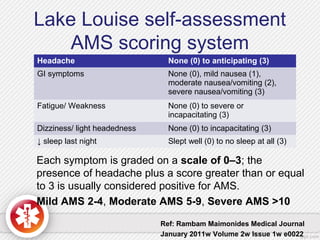
Lake Louise self-assessment
AMS scoring system
Each symptom is graded on a scale of 0–3; the
presence of headache plus a score greater than or equal
to 3 is usually considered positive for AMS.
Mild AMS 2-4, Moderate AMS 5-9, Severe AMS >10
Ref: Rambam Maimonides Medical Journal
January 2011w Volume 2w Issue 1w e0022
Headache None (0) to anticipating (3)
GI symptoms None (0), mild nausea (1),
moderate nausea/vomiting (2),
severe nausea/vomiting (3)
Fatigue/ Weakness None (0) to severe or
incapacitating (3)
Dizziness/ light headedness None (0) to incapacitating (3)
↓ sleep last night Slept well (0) to no sleep at all (3)
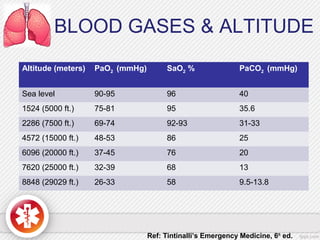
BLOOD GASES & ALTITUDE
Ref: Tintinalli’s Emergency Medicine, 6th
ed.
Altitude (meters) PaO2 (mmHg) SaO2 % PaCO2 (mmHg)
Sea level 90-95 96 40
1524 (5000 ft.) 75-81 95 35.6
2286 (7500 ft.) 69-74 92-93 31-33
4572 (15000 ft.) 48-53 86 25
6096 (20000 ft.) 37-45 76 20
7620 (25000 ft.) 32-39 68 13
8848 (29029 ft.) 26-33 58 9.5-13.8
RISK FACTORS
Rapid ascent
Physical exertion at high altitudes (including
climbing)
P/H/O high altitude sickness
Younger individuals (<50 years)
Obesity
Pre existing lung/cardiac disease
Sleeping @ 7000-9000 ft.
AMS
Typically occurs @ altitudes > 2500m/8200ft
C/F headache/dizziness
Nausea/vomiting
Fatigue/irritability
(Often misdiagnosed as hangovers from alcohol)
Generally benign & self limiting
Onset : 4-12 hours after ascent
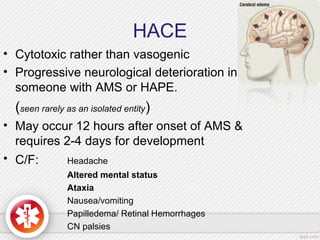
HACE
• Cytotoxic rather than vasogenic
• Progressive neurological deterioration in
someone with AMS or HAPE.
(seen rarely as an isolated entity)
• May occur 12 hours after onset of AMS &
requires 2-4 days for development
• C/F: Headache
Altered mental status
Ataxia
Nausea/vomiting
Papilledema/ Retinal Hemorrhages
CN palsies
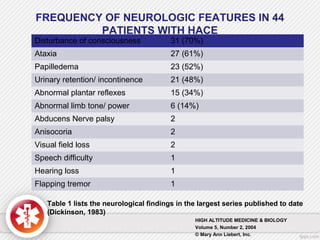
FREQUENCY OF NEUROLOGIC FEATURES IN 44
PATIENTS WITH HACE
Table 1 lists the neurological findings in the largest series published to date
(Dickinson, 1983)
HIGH ALTITUDE MEDICINE & BIOLOGY
Volume 5, Number 2, 2004
© Mary Ann Liebert, Inc.
Disturbance of consciousness 31 (70%)
Ataxia 27 (61%)
Papilledema 23 (52%)
Urinary retention/ incontinence 21 (48%)
Abnormal plantar reflexes 15 (34%)
Abnormal limb tone/ power 6 (14%)
Abducens Nerve palsy 2
Anisocoria 2
Visual field loss 2
Speech difficulty 1
Hearing loss 1
Flapping tremor 1
HAPE
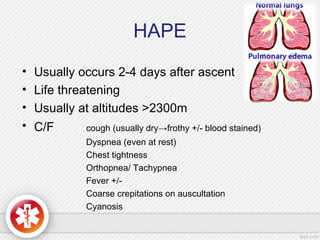
• Usually occurs 2-4 days after ascent
• Life threatening
• Usually at altitudes >2300m
• C/F cough (usually dry→frothy +/- blood stained)
Dyspnea (even at rest)
Chest tightness
Orthopnea/ Tachypnea
Fever +/-
Coarse crepitations on auscultation
Cyanosis
PEOPLE AT RISK FOR HAPE
• Pulmonary hypertension
– Intra cardiac shunts
– Patent ductus arteriosus
– Drug-induced (Fenfluramine/ SSRIs)
– Chronic venous thrombotic disease
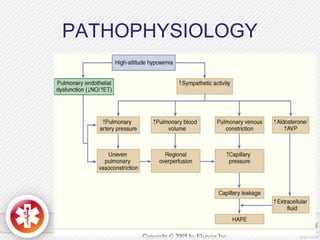
PATHOPHYSIOLOGY
PEDIATRIC
CONSIDERATIONS
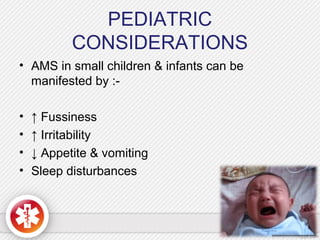
• AMS in small children & infants can be
manifested by :-
• ↑ Fussiness
• ↑ Irritability
• ↓ Appetite & vomiting
• Sleep disturbances
INVESTIGATIONS
• HAPE
• Blood gas – E/o hypoxemia & respiratory
alkalosis
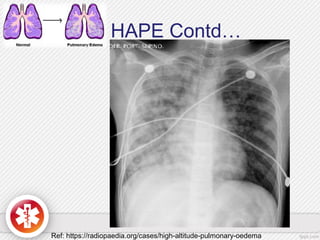
• CXR – Patchy alveolar infiltrates with
batwing distribution
Kerly B lines +/-
• ECG – Sinus tachy
E/o Right heart strain
HAPE Contd…
Ref: https://radiopaedia.org/cases/high-altitude-pulmonary-oedema
Contd…
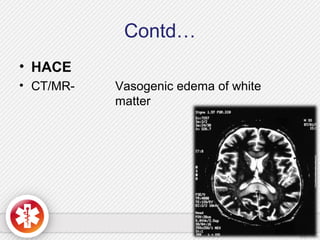
• HACE
• CT/MR- Vasogenic edema of white
matter
DIFFRENTIALS
• AMS: Alcohol hangover
CO poisoning (from wood
combustions inside camps)
Viral syndrome
Encephalitis/ Meningitis
• HAPE: High altitude bronchitis
Pneumonia
PE (more rapid onset +
pleuritic chest pain)
• HACE: CVA/TIA
FND suggests vascular lesions
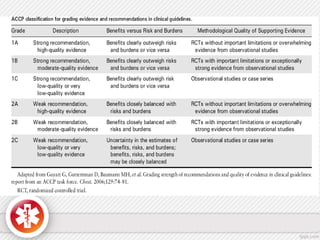
Grade based on ACCP classification of
clinical evidence for guidelines
MANAGEMENT
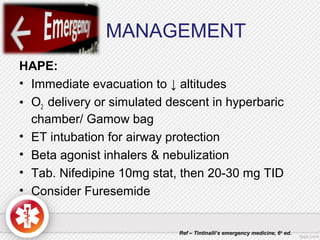
HAPE:
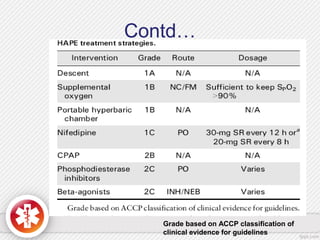
• Immediate evacuation to ↓ altitudes
• O2 delivery or simulated descent in hyperbaric
chamber/ Gamow bag
• ET intubation for airway protection
• Beta agonist inhalers & nebulization
• Tab. Nifedipine 10mg stat, then 20-30 mg TID
• Consider Furesemide
Ref – Tintinalli’s emergency medicine, 6th
ed.
Contd…
Grade based on ACCP classification of
clinical evidence for guidelines
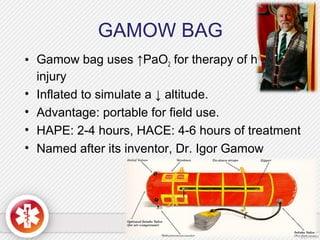
GAMOW BAG
• Gamow bag uses ↑PaO2 for therapy of hypobaric
injury
• Inflated to simulate a ↓ altitude.
• Advantage: portable for field use.
• HAPE: 2-4 hours, HACE: 4-6 hours of treatment
• Named after its inventor, Dr. Igor Gamow
Contd…
HACE:
• Immediate evacuation to ↓ altitude
• Dexamethasone 8mg i/v stat, then 4mg i/v
QID
• Hyperbaric O2
Contd…
AMS:
• Acetazolamide 250-500mg BD (5mg/kg/day in 2-
3 divided doses)
• Prophylaxis 250mg BD (start 24 hours before
ascent)
• Peds 5mg/kg BD
• Paracetamol for headache
• Promethazine/ Ondansetron for vomiting
• Halt ascent until symptoms subside
• Supplemental O2
PREVENTION
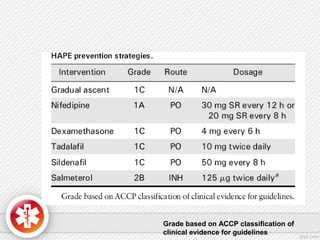
• Gradual ascent (1000-1200 ft. per day) & also
allowing time for pre-acclimatization
• Low sleeping altitudes & avoid sleeping tablets
• Keep warm & well hydrated
• ↑ carb diet & avoid alcohol
• Gingko Bilboa extract (80-120mg BD)
• Acetazolamide 125-250mg BD or Dexa 4mg QID
– 24 hours before or after ascent
• Tadalafil (10mg BD to start 1 day prior ascent)
OTHER HIGH ALTITUDE
CONDITIONS
• High altitude bronchitis/ pharyngitis
• Chronic mountain polycythemia
• UV keratitis (snow blindness)
• Peripheral edema
• High altitude retinopathy
• Acute exacerbation of COPD/CAD
• Hypothermia
REFERENCES
• Hackett PH, Roach RC: High-altitude medicine, in PA
Auerbach (ed): Wilderness Medicine. St Louis, Mosby,
2001, p 2.
• Emedicine.medscape.com
• Tintinalli’s Emergency Medicine, 6th
ed.
• HIGH ALTITUDE MEDICINE & BIOLOGY
Volume 5, Number 2, 2004, © Mary Ann Liebert, Inc.
• www.radiopedia.com
• HAPE Diagnosis, Prevention & Treatment (Vol.12
Number 2 March/April 2013 - Andre Pennardt, MD,
FACEP, FAWM)
High Altitude Illness

High Altitude Illness

  • 1.
    HIGH ALTITUDE ILLNESS Dr. ParthaDas ER, Fortis Hospital, Kolkata
  • 3.
  • 4.
    Lake Louise self-assessment AMSscoring system Each symptom is graded on a scale of 0–3; the presence of headache plus a score greater than or equal to 3 is usually considered positive for AMS. Mild AMS 2-4, Moderate AMS 5-9, Severe AMS >10 Ref: Rambam Maimonides Medical Journal January 2011w Volume 2w Issue 1w e0022 Headache None (0) to anticipating (3) GI symptoms None (0), mild nausea (1), moderate nausea/vomiting (2), severe nausea/vomiting (3) Fatigue/ Weakness None (0) to severe or incapacitating (3) Dizziness/ light headedness None (0) to incapacitating (3) ↓ sleep last night Slept well (0) to no sleep at all (3)
  • 5.
    BLOOD GASES &ALTITUDE Ref: Tintinalli’s Emergency Medicine, 6th ed. Altitude (meters) PaO2 (mmHg) SaO2 % PaCO2 (mmHg) Sea level 90-95 96 40 1524 (5000 ft.) 75-81 95 35.6 2286 (7500 ft.) 69-74 92-93 31-33 4572 (15000 ft.) 48-53 86 25 6096 (20000 ft.) 37-45 76 20 7620 (25000 ft.) 32-39 68 13 8848 (29029 ft.) 26-33 58 9.5-13.8
  • 6.
    RISK FACTORS Rapid ascent Physicalexertion at high altitudes (including climbing) P/H/O high altitude sickness Younger individuals (<50 years) Obesity Pre existing lung/cardiac disease Sleeping @ 7000-9000 ft.
  • 7.
    AMS Typically occurs @altitudes > 2500m/8200ft C/F headache/dizziness Nausea/vomiting Fatigue/irritability (Often misdiagnosed as hangovers from alcohol) Generally benign & self limiting Onset : 4-12 hours after ascent
  • 8.
    HACE • Cytotoxic ratherthan vasogenic • Progressive neurological deterioration in someone with AMS or HAPE. (seen rarely as an isolated entity) • May occur 12 hours after onset of AMS & requires 2-4 days for development • C/F: Headache Altered mental status Ataxia Nausea/vomiting Papilledema/ Retinal Hemorrhages CN palsies
  • 9.
    FREQUENCY OF NEUROLOGICFEATURES IN 44 PATIENTS WITH HACE Table 1 lists the neurological findings in the largest series published to date (Dickinson, 1983) HIGH ALTITUDE MEDICINE & BIOLOGY Volume 5, Number 2, 2004 © Mary Ann Liebert, Inc. Disturbance of consciousness 31 (70%) Ataxia 27 (61%) Papilledema 23 (52%) Urinary retention/ incontinence 21 (48%) Abnormal plantar reflexes 15 (34%) Abnormal limb tone/ power 6 (14%) Abducens Nerve palsy 2 Anisocoria 2 Visual field loss 2 Speech difficulty 1 Hearing loss 1 Flapping tremor 1
  • 10.
    HAPE • Usually occurs2-4 days after ascent • Life threatening • Usually at altitudes >2300m • C/F cough (usually dry→frothy +/- blood stained) Dyspnea (even at rest) Chest tightness Orthopnea/ Tachypnea Fever +/- Coarse crepitations on auscultation Cyanosis
  • 11.
    PEOPLE AT RISKFOR HAPE • Pulmonary hypertension – Intra cardiac shunts – Patent ductus arteriosus – Drug-induced (Fenfluramine/ SSRIs) – Chronic venous thrombotic disease
  • 12.
  • 13.
    PEDIATRIC CONSIDERATIONS • AMS insmall children & infants can be manifested by :- • ↑ Fussiness • ↑ Irritability • ↓ Appetite & vomiting • Sleep disturbances
  • 14.
    INVESTIGATIONS • HAPE • Bloodgas – E/o hypoxemia & respiratory alkalosis • CXR – Patchy alveolar infiltrates with batwing distribution Kerly B lines +/- • ECG – Sinus tachy E/o Right heart strain
  • 15.
  • 16.
    Contd… • HACE • CT/MR-Vasogenic edema of white matter
  • 17.
    DIFFRENTIALS • AMS: Alcoholhangover CO poisoning (from wood combustions inside camps) Viral syndrome Encephalitis/ Meningitis • HAPE: High altitude bronchitis Pneumonia PE (more rapid onset + pleuritic chest pain) • HACE: CVA/TIA FND suggests vascular lesions
  • 18.
    Grade based onACCP classification of clinical evidence for guidelines
  • 19.
    MANAGEMENT HAPE: • Immediate evacuationto ↓ altitudes • O2 delivery or simulated descent in hyperbaric chamber/ Gamow bag • ET intubation for airway protection • Beta agonist inhalers & nebulization • Tab. Nifedipine 10mg stat, then 20-30 mg TID • Consider Furesemide Ref – Tintinalli’s emergency medicine, 6th ed.
  • 20.
    Contd… Grade based onACCP classification of clinical evidence for guidelines
  • 22.
    GAMOW BAG • Gamowbag uses ↑PaO2 for therapy of hypobaric injury • Inflated to simulate a ↓ altitude. • Advantage: portable for field use. • HAPE: 2-4 hours, HACE: 4-6 hours of treatment • Named after its inventor, Dr. Igor Gamow
  • 23.
    Contd… HACE: • Immediate evacuationto ↓ altitude • Dexamethasone 8mg i/v stat, then 4mg i/v QID • Hyperbaric O2
  • 24.
    Contd… AMS: • Acetazolamide 250-500mgBD (5mg/kg/day in 2- 3 divided doses) • Prophylaxis 250mg BD (start 24 hours before ascent) • Peds 5mg/kg BD • Paracetamol for headache • Promethazine/ Ondansetron for vomiting • Halt ascent until symptoms subside • Supplemental O2
  • 25.
    PREVENTION • Gradual ascent(1000-1200 ft. per day) & also allowing time for pre-acclimatization • Low sleeping altitudes & avoid sleeping tablets • Keep warm & well hydrated • ↑ carb diet & avoid alcohol • Gingko Bilboa extract (80-120mg BD) • Acetazolamide 125-250mg BD or Dexa 4mg QID – 24 hours before or after ascent • Tadalafil (10mg BD to start 1 day prior ascent)
  • 26.
    OTHER HIGH ALTITUDE CONDITIONS •High altitude bronchitis/ pharyngitis • Chronic mountain polycythemia • UV keratitis (snow blindness) • Peripheral edema • High altitude retinopathy • Acute exacerbation of COPD/CAD • Hypothermia
  • 27.
    REFERENCES • Hackett PH,Roach RC: High-altitude medicine, in PA Auerbach (ed): Wilderness Medicine. St Louis, Mosby, 2001, p 2. • Emedicine.medscape.com • Tintinalli’s Emergency Medicine, 6th ed. • HIGH ALTITUDE MEDICINE & BIOLOGY Volume 5, Number 2, 2004, © Mary Ann Liebert, Inc. • www.radiopedia.com • HAPE Diagnosis, Prevention & Treatment (Vol.12 Number 2 March/April 2013 - Andre Pennardt, MD, FACEP, FAWM)

Editor's Notes

  • #13 The pathogenesis is considered to be from the altered permeability of the alveolar-capillary barrier secondary to intense pulmonary vasoconstriction and high capillary pressure 1,4. This, in turn, induces endothelial leakage, which results in interstitial and alveolar oedema without diffuse alveolar damage.
  • #16 B/L interstitial oedema with peribronchial cuffing. Batwing distribution. Kerley B lines +/-
  • #17 MR is also helpful in confirming HACE &amp; in evaluating causes of FNDs.