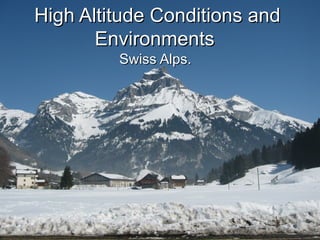
High Altitude Conditions and Environments   Swiss Alps.
Homeostasis The ability or tendency of an organism or cell to maintain internal equilibrium by adjusting its physiological processes.  37 degrees C Properly functioning organ systems
Conditions and Effects  Lack of oxygen Low air pressure Cold temperature and heavy winds Concentrating UV rays headaches, breathlessness, fatigue  nausea or vomiting  inability to sleep  swelling of the face, hands and feet
Adapting to these conditions  The breathing response has to be intact. The blood response, particularly at high altitude, has to be intact so that the blood can carry more oxygen and then the tissues have to be able to utilize the low oxygen better. The mitochondria, the small capillaries in the muscle beds, have to be augmented and all those capabilities have to adapt.
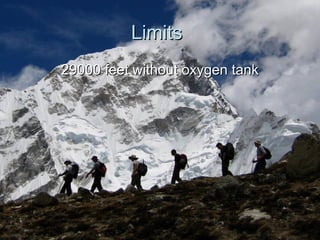
Limits  29000 feet without oxygen tank
Human body in high altitudes  Atmospheric pressure is a gauge of how many oxygen molecules are available per given volume, say a breath. While there is the same percentage of oxygen in the air up high, lower atmospheric pressure at higher altitudes means fewer oxygen molecules are available with each breath.
Adaptations the body make to account for the lack of oxygen  Given time, your body can adapt to the decrease in oxygen molecules at a specific altitude. This process is known as acclimatization and generally takes 1-3 days at that altitude. A number of changes take place in the body to allow it to operate with decreased oxygen.  •   The depth of respiration increases.  •   Pressure in pulmonary arteries is increased, "forcing" blood into portions of the lung which are normally not used during sea level breathing.  •   The body produces more red blood cells to carry oxygen,  •   The body produces more of a particular enzyme that facilitates  •   the release of oxygen from hemoglobin to the body tissues.

High Altitude Conditions And Environments

  • 1.
    High Altitude Conditionsand Environments Swiss Alps.
  • 2.
    Homeostasis The abilityor tendency of an organism or cell to maintain internal equilibrium by adjusting its physiological processes. 37 degrees C Properly functioning organ systems
  • 3.
    Conditions and Effects Lack of oxygen Low air pressure Cold temperature and heavy winds Concentrating UV rays headaches, breathlessness, fatigue nausea or vomiting inability to sleep swelling of the face, hands and feet
  • 4.
    Adapting to theseconditions The breathing response has to be intact. The blood response, particularly at high altitude, has to be intact so that the blood can carry more oxygen and then the tissues have to be able to utilize the low oxygen better. The mitochondria, the small capillaries in the muscle beds, have to be augmented and all those capabilities have to adapt.
  • 5.
    Limits 29000feet without oxygen tank
  • 6.
    Human body inhigh altitudes Atmospheric pressure is a gauge of how many oxygen molecules are available per given volume, say a breath. While there is the same percentage of oxygen in the air up high, lower atmospheric pressure at higher altitudes means fewer oxygen molecules are available with each breath.
  • 7.
    Adaptations the bodymake to account for the lack of oxygen Given time, your body can adapt to the decrease in oxygen molecules at a specific altitude. This process is known as acclimatization and generally takes 1-3 days at that altitude. A number of changes take place in the body to allow it to operate with decreased oxygen. •   The depth of respiration increases. •   Pressure in pulmonary arteries is increased, "forcing" blood into portions of the lung which are normally not used during sea level breathing. •   The body produces more red blood cells to carry oxygen, •   The body produces more of a particular enzyme that facilitates •   the release of oxygen from hemoglobin to the body tissues.