NITROGEN
       By Daniel Rivers
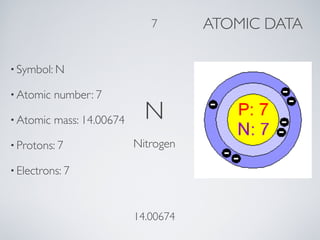
7       ATOMIC DATA

• Symbol: N

• Atomic   number: 7

• Atomic   mass: 14.00674
     N
• Protons: 7
                Nitrogen

• Electrons: 7


                             14.00674
NITROGEN CYCLE
THE HISTORY OF NITROGEN
Nitrogen was discovered in 1772 by a Scottish physician Daniel
Rutherford(1749-1819).

He performed a simple experiment with which he discovered nitrogen. 
Rutherford began with an empty bottle that he turned upside down in
a pan of water, so that the air was trapped.  A burning candle was
placed inside the bottle with the trapped air, causing the water to rise a
bit.  Why did this happen?  The part of the air that seemed to
"disappear" when the candle was burned was oxygen gas, and the part
of the air that did not "disappear" Rutherford discovered was nitrogen.
GASES IN THE ATMOSPHERE
A trace gas is a gas
 which makes up                  1%
 less than 1% by       21%
  volume of the
      Earth's
   atmosphere.
                                               1% are trace gases:
                                      78%       argon, ozone O3,
                                               sulfur dioxide SO2,
                                                 nitrogen oxides
                       Nitrogen       Oxygen
                                                  NOx, carbon
                       Trace gases              dioxide CO2 and
                                                  methane CH4
USES FOR NITROGEN

• Gunpowder
• Fertilizer
• Rocket fuels
• Light bulbs may contain nitrogen as a cheaper
  alternative to argon.
• Nitrogen gas is often used on top of liquid
  explosive to keep them from exploding!
• Nitrogen is used to produce many electrical
  parts such as transistors, diodes and
  integrated circuits.
• Used to manufacture stainless steel.
• Used to reduce the fire hazard in military
  aircraft fuel systems.
• Nitrogen gas is used to fill the tires of aircraft
  and automobiles (cars).
• Nitrogen is a component of nearly every
  pharmacological drug. Laughing gas (nitrous
  oxide) can be used as an anesthetic.

Nitrogen

  • 1.
    NITROGEN By Daniel Rivers
  • 2.
    7 ATOMIC DATA • Symbol: N • Atomic number: 7 • Atomic mass: 14.00674 N • Protons: 7 Nitrogen • Electrons: 7 14.00674
  • 3.
  • 4.
    THE HISTORY OFNITROGEN Nitrogen was discovered in 1772 by a Scottish physician Daniel Rutherford(1749-1819). He performed a simple experiment with which he discovered nitrogen.  Rutherford began with an empty bottle that he turned upside down in a pan of water, so that the air was trapped.  A burning candle was placed inside the bottle with the trapped air, causing the water to rise a bit.  Why did this happen?  The part of the air that seemed to "disappear" when the candle was burned was oxygen gas, and the part of the air that did not "disappear" Rutherford discovered was nitrogen.
  • 5.
    GASES IN THEATMOSPHERE A trace gas is a gas which makes up 1% less than 1% by 21% volume of the Earth's atmosphere. 1% are trace gases: 78% argon, ozone O3, sulfur dioxide SO2, nitrogen oxides Nitrogen Oxygen NOx, carbon Trace gases dioxide CO2 and methane CH4
  • 6.
    USES FOR NITROGEN •Gunpowder • Fertilizer • Rocket fuels • Light bulbs may contain nitrogen as a cheaper alternative to argon. • Nitrogen gas is often used on top of liquid explosive to keep them from exploding! • Nitrogen is used to produce many electrical parts such as transistors, diodes and integrated circuits. • Used to manufacture stainless steel. • Used to reduce the fire hazard in military aircraft fuel systems. • Nitrogen gas is used to fill the tires of aircraft and automobiles (cars). • Nitrogen is a component of nearly every pharmacological drug. Laughing gas (nitrous oxide) can be used as an anesthetic.