Chemical Reaction Analysis
Dr. K. Shahzad Baig
Memorial University of Newfoundland
(MUN)
Canada
Petrucci, et al. 2011. General Chemistry: Principles and Modern Applications. Pearson Canada Inc., Toronto, Ontario.
Tro, N.J. 2010. Principles of Chemistry. : A molecular approach. Pearson Education, Inc.
Combustion Analysis
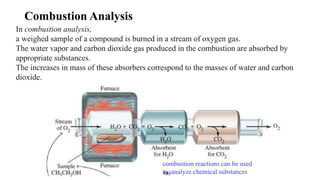
In combustion analysis,
a weighed sample of a compound is burned in a stream of oxygen gas.
The water vapor and carbon dioxide gas produced in the combustion are absorbed by
appropriate substances.
The increases in mass of these absorbers correspond to the masses of water and carbon
dioxide.
combustion reactions can be used
to analyze chemical substances
Oxidation States
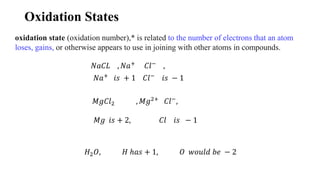
oxidation state (oxidation number),* is related to the number of electrons that an atom
loses, gains, or otherwise appears to use in joining with other atoms in compounds.
𝑁𝑎𝐶𝐿 , 𝑁𝑎+ 𝐶𝑙− ,
𝑁𝑎+ 𝑖𝑠 + 1 𝐶𝑙− 𝑖𝑠 − 1
𝑀𝑔𝐶𝑙2 , 𝑀𝑔2+ 𝐶𝑙−,
𝑀𝑔 𝑖𝑠 + 2, 𝐶𝑙 𝑖𝑠 − 1
𝐻2 𝑂, 𝐻 ℎ𝑎𝑠 + 1, 𝑂 𝑤𝑜𝑢𝑙𝑑 𝑏𝑒 − 2
Assigning Oxidation States
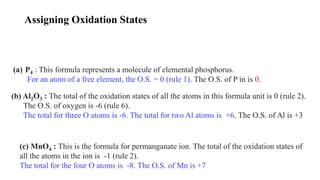
(a) P4 : This formula represents a molecule of elemental phosphorus.
For an atom of a free element, the O.S. = 0 (rule 1). The O.S. of P in is 0.
(b) Al2O3 : The total of the oxidation states of all the atoms in this formula unit is 0 (rule 2).
The O.S. of oxygen is -6 (rule 6).
The total for three O atoms is -6. The total for two Al atoms is +6. The O.S. of Al is +3
(c) MnO4 : This is the formula for permanganate ion. The total of the oxidation states of
all the atoms in the ion is -1 (rule 2).
The total for the four O atoms is -8. The O.S. of Mn is +7
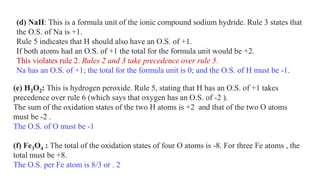
(e) H2O2: This is hydrogen peroxide. Rule 5, stating that H has an O.S. of +1 takes
precedence over rule 6 (which says that oxygen has an O.S. of -2 ).
The sum of the oxidation states of the two H atoms is +2 and that of the two O atoms
must be -2 .
The O.S. of O must be -1
(f) Fe3O4 : The total of the oxidation states of four O atoms is -8. For three Fe atoms , the
total must be +8.
The O.S. per Fe atom is 8/3 or . 2
(d) NaH: This is a formula unit of the ionic compound sodium hydride. Rule 3 states that
the O.S. of Na is +1.
Rule 5 indicates that H should also have an O.S. of +1.
If both atoms had an O.S. of +1 the total for the formula unit would be +2.
This violates rule 2. Rules 2 and 3 take precedence over rule 5.
Na has an O.S. of +1; the total for the formula unit is 0; and the O.S. of H must be -1.
Naming Compounds:
Organic and Inorganic Compounds
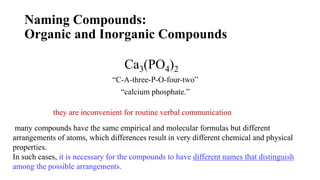
Ca3(PO4)2
“C-A-three-P-O-four-two”
“calcium phosphate.”
they are inconvenient for routine verbal communication
many compounds have the same empirical and molecular formulas but different
arrangements of atoms, which differences result in very different chemical and physical
properties.
In such cases, it is necessary for the compounds to have different names that distinguish
among the possible arrangements.
Names and Formulas of Inorganic Compounds
Binary compounds are those formed between two elements
To name a binary compound
of a metal and a nonmetal,
1. write the unmodified
name of the metal
2. then write the name of the
nonmetal,
3. modified to end in –ide
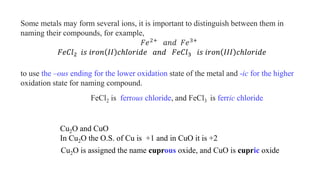
Some metals may form several ions, it is important to distinguish between them in
naming their compounds, for example,
𝐹𝑒2+ 𝑎𝑛𝑑 𝐹𝑒3+
𝐹𝑒𝐶𝑙2 𝑖𝑠 𝑖𝑟𝑜𝑛 𝐼𝐼 𝑐ℎ𝑙𝑜𝑟𝑖𝑑𝑒 𝑎𝑛𝑑 𝐹𝑒𝐶𝑙3 𝑖𝑠 𝑖𝑟𝑜𝑛 𝐼𝐼𝐼 𝑐ℎ𝑙𝑜𝑟𝑖𝑑𝑒
to use the –ous ending for the lower oxidation state of the metal and -ic for the higher
oxidation state for naming compound.
FeCl2 is ferrous chloride, and FeCl3 is ferric chloride.
Cu2O and CuO
In Cu2O the O.S. of Cu is +1 and in CuO it is +2
Cu2O is assigned the name cuprous oxide, and CuO is cupric oxide
Binary Compounds of Two Nonmetals
When both nonmetals forms a molecular compound.
The method of naming these compounds is similar to that just discussed.
For example,
𝑯𝑪𝒍 , 𝑯𝒚𝒅𝒓𝒐𝒈𝒆𝒏 𝒄𝒉𝒍𝒐𝒓𝒊𝒅𝒆
In both the formula and the name, the element with the positive oxidation state comes
first:
HCl and … not ClH.
EXAMPLE 3-8
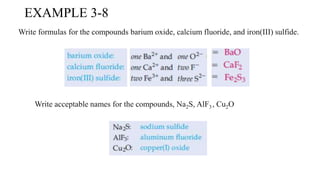
Write formulas for the compounds barium oxide, calcium fluoride, and iron(III) sulfide.
Write acceptable names for the compounds, Na2S, AlF3, Cu2O
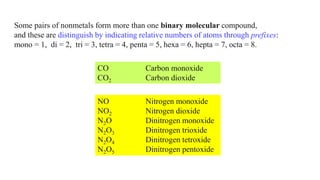
Some pairs of nonmetals form more than one binary molecular compound,
and these are distinguish by indicating relative numbers of atoms through prefixes:
mono = 1, di = 2, tri = 3, tetra = 4, penta = 5, hexa = 6, hepta = 7, octa = 8.
NO Nitrogen monoxide
NO2 Nitrogen dioxide
N2O Dinitrogen monoxide
N2O3 Dinitrogen trioxide
N2O4 Dinitrogen tetroxide
N2O5 Dinitrogen pentoxide
CO Carbon monoxide
CO2 Carbon dioxide
Binary Acids
A binary acid is a two-element compound of hydrogen and a nonmetal.
Naming of binary acids is done by the formula :
ℎ𝑦𝑑𝑟𝑜 𝑛𝑎𝑚𝑒 𝑜𝑓 𝑛𝑜𝑛 − 𝑚𝑒𝑡𝑎𝑙 − 𝑖𝑐 𝑎𝑐𝑖𝑑
HCl(aq) hydrochloric acid
H2S(aq) hydrosulfuric acid
HI(aq) hydroiodic acid
HBr(aq) hydrobromic acid
Polyatomic Ions
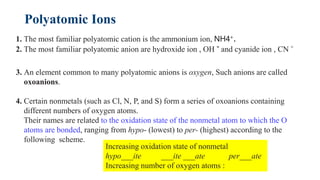
3. An element common to many polyatomic anions is oxygen, Such anions are called
oxoanions.
4. Certain nonmetals (such as Cl, N, P, and S) form a series of oxoanions containing
different numbers of oxygen atoms.
Their names are related to the oxidation state of the nonmetal atom to which the O
atoms are bonded, ranging from hypo- (lowest) to per- (highest) according to the
following scheme.
Increasing oxidation state of nonmetal
hypo___ite ___ite ___ate per___ate
Increasing number of oxygen atoms :
1. The most familiar polyatomic cation is the ammonium ion, NH4+.
2. The most familiar polyatomic anion are hydroxide ion , OH - and cyanide ion , CN -
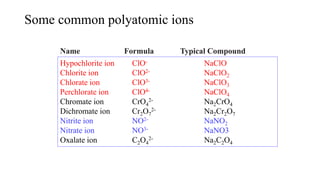
Some common polyatomic ions
Hypochlorite ion ClO- NaClO
Chlorite ion ClO2- NaClO2
Chlorate ion ClO3- NaClO3
Perchlorate ion ClO4- NaClO4
Chromate ion CrO4
2- Na2CrO4
Dichromate ion Cr2O7
2- Na2Cr2O7
Nitrite ion NO2- NaNO2
Nitrate ion NO3- NaNO3
Oxalate ion C2O4
2- Na2C2O4
Name Formula Typical Compound
SO₄²- 𝑆2 𝑂3
2−
7. The prefix thio- signifies that a sulfur atom has been substituted for an oxygen atom.
(The sulfate ion has one S and four O atoms; thiosulfate ion has two S and three O atoms.)
5. All the common oxoanions of Cl, Br, and I carry a charge of 1-
6. Some series of oxoanions also contain various numbers of H atoms and are named
accordingly.
For example, is the hydrogen phosphate ion and the 𝑑𝑖ℎ𝑦𝑑𝑟𝑜𝑔𝑒𝑛 𝑝ℎ𝑜𝑠𝑝ℎ𝑎𝑡𝑒 𝑖𝑜𝑛.
𝐻𝑂4 𝑃2−
𝐻2 𝑂4 𝑃−
𝑂4 𝑃3−
Oxoacids
Oxoacid, contain three different elements hydrogen and two other nonmetals. If one
of the nonmetals is oxygen, the acid is called an oxoacid.
The scheme for naming oxoacids is similar to that outlined for oxoanions, except that
the ending -ous is used instead of –ite and -ic instead of -ate

Chemical Reaction Analysis

  • 1.
    Chemical Reaction Analysis Dr.K. Shahzad Baig Memorial University of Newfoundland (MUN) Canada Petrucci, et al. 2011. General Chemistry: Principles and Modern Applications. Pearson Canada Inc., Toronto, Ontario. Tro, N.J. 2010. Principles of Chemistry. : A molecular approach. Pearson Education, Inc.
  • 2.
    Combustion Analysis In combustionanalysis, a weighed sample of a compound is burned in a stream of oxygen gas. The water vapor and carbon dioxide gas produced in the combustion are absorbed by appropriate substances. The increases in mass of these absorbers correspond to the masses of water and carbon dioxide. combustion reactions can be used to analyze chemical substances
  • 3.
    Oxidation States oxidation state(oxidation number),* is related to the number of electrons that an atom loses, gains, or otherwise appears to use in joining with other atoms in compounds. 𝑁𝑎𝐶𝐿 , 𝑁𝑎+ 𝐶𝑙− , 𝑁𝑎+ 𝑖𝑠 + 1 𝐶𝑙− 𝑖𝑠 − 1 𝑀𝑔𝐶𝑙2 , 𝑀𝑔2+ 𝐶𝑙−, 𝑀𝑔 𝑖𝑠 + 2, 𝐶𝑙 𝑖𝑠 − 1 𝐻2 𝑂, 𝐻 ℎ𝑎𝑠 + 1, 𝑂 𝑤𝑜𝑢𝑙𝑑 𝑏𝑒 − 2
  • 4.
    Assigning Oxidation States (a)P4 : This formula represents a molecule of elemental phosphorus. For an atom of a free element, the O.S. = 0 (rule 1). The O.S. of P in is 0. (b) Al2O3 : The total of the oxidation states of all the atoms in this formula unit is 0 (rule 2). The O.S. of oxygen is -6 (rule 6). The total for three O atoms is -6. The total for two Al atoms is +6. The O.S. of Al is +3 (c) MnO4 : This is the formula for permanganate ion. The total of the oxidation states of all the atoms in the ion is -1 (rule 2). The total for the four O atoms is -8. The O.S. of Mn is +7
  • 5.
    (e) H2O2: Thisis hydrogen peroxide. Rule 5, stating that H has an O.S. of +1 takes precedence over rule 6 (which says that oxygen has an O.S. of -2 ). The sum of the oxidation states of the two H atoms is +2 and that of the two O atoms must be -2 . The O.S. of O must be -1 (f) Fe3O4 : The total of the oxidation states of four O atoms is -8. For three Fe atoms , the total must be +8. The O.S. per Fe atom is 8/3 or . 2 (d) NaH: This is a formula unit of the ionic compound sodium hydride. Rule 3 states that the O.S. of Na is +1. Rule 5 indicates that H should also have an O.S. of +1. If both atoms had an O.S. of +1 the total for the formula unit would be +2. This violates rule 2. Rules 2 and 3 take precedence over rule 5. Na has an O.S. of +1; the total for the formula unit is 0; and the O.S. of H must be -1.
  • 6.
    Naming Compounds: Organic andInorganic Compounds Ca3(PO4)2 “C-A-three-P-O-four-two” “calcium phosphate.” they are inconvenient for routine verbal communication many compounds have the same empirical and molecular formulas but different arrangements of atoms, which differences result in very different chemical and physical properties. In such cases, it is necessary for the compounds to have different names that distinguish among the possible arrangements.
  • 7.
    Names and Formulasof Inorganic Compounds Binary compounds are those formed between two elements To name a binary compound of a metal and a nonmetal, 1. write the unmodified name of the metal 2. then write the name of the nonmetal, 3. modified to end in –ide
  • 8.
    Some metals mayform several ions, it is important to distinguish between them in naming their compounds, for example, 𝐹𝑒2+ 𝑎𝑛𝑑 𝐹𝑒3+ 𝐹𝑒𝐶𝑙2 𝑖𝑠 𝑖𝑟𝑜𝑛 𝐼𝐼 𝑐ℎ𝑙𝑜𝑟𝑖𝑑𝑒 𝑎𝑛𝑑 𝐹𝑒𝐶𝑙3 𝑖𝑠 𝑖𝑟𝑜𝑛 𝐼𝐼𝐼 𝑐ℎ𝑙𝑜𝑟𝑖𝑑𝑒 to use the –ous ending for the lower oxidation state of the metal and -ic for the higher oxidation state for naming compound. FeCl2 is ferrous chloride, and FeCl3 is ferric chloride. Cu2O and CuO In Cu2O the O.S. of Cu is +1 and in CuO it is +2 Cu2O is assigned the name cuprous oxide, and CuO is cupric oxide
  • 9.
    Binary Compounds ofTwo Nonmetals When both nonmetals forms a molecular compound. The method of naming these compounds is similar to that just discussed. For example, 𝑯𝑪𝒍 , 𝑯𝒚𝒅𝒓𝒐𝒈𝒆𝒏 𝒄𝒉𝒍𝒐𝒓𝒊𝒅𝒆 In both the formula and the name, the element with the positive oxidation state comes first: HCl and … not ClH.
  • 10.
    EXAMPLE 3-8 Write formulasfor the compounds barium oxide, calcium fluoride, and iron(III) sulfide. Write acceptable names for the compounds, Na2S, AlF3, Cu2O
  • 11.
    Some pairs ofnonmetals form more than one binary molecular compound, and these are distinguish by indicating relative numbers of atoms through prefixes: mono = 1, di = 2, tri = 3, tetra = 4, penta = 5, hexa = 6, hepta = 7, octa = 8. NO Nitrogen monoxide NO2 Nitrogen dioxide N2O Dinitrogen monoxide N2O3 Dinitrogen trioxide N2O4 Dinitrogen tetroxide N2O5 Dinitrogen pentoxide CO Carbon monoxide CO2 Carbon dioxide
  • 12.
    Binary Acids A binaryacid is a two-element compound of hydrogen and a nonmetal. Naming of binary acids is done by the formula : ℎ𝑦𝑑𝑟𝑜 𝑛𝑎𝑚𝑒 𝑜𝑓 𝑛𝑜𝑛 − 𝑚𝑒𝑡𝑎𝑙 − 𝑖𝑐 𝑎𝑐𝑖𝑑 HCl(aq) hydrochloric acid H2S(aq) hydrosulfuric acid HI(aq) hydroiodic acid HBr(aq) hydrobromic acid
  • 13.
    Polyatomic Ions 3. Anelement common to many polyatomic anions is oxygen, Such anions are called oxoanions. 4. Certain nonmetals (such as Cl, N, P, and S) form a series of oxoanions containing different numbers of oxygen atoms. Their names are related to the oxidation state of the nonmetal atom to which the O atoms are bonded, ranging from hypo- (lowest) to per- (highest) according to the following scheme. Increasing oxidation state of nonmetal hypo___ite ___ite ___ate per___ate Increasing number of oxygen atoms : 1. The most familiar polyatomic cation is the ammonium ion, NH4+. 2. The most familiar polyatomic anion are hydroxide ion , OH - and cyanide ion , CN -
  • 14.
    Some common polyatomicions Hypochlorite ion ClO- NaClO Chlorite ion ClO2- NaClO2 Chlorate ion ClO3- NaClO3 Perchlorate ion ClO4- NaClO4 Chromate ion CrO4 2- Na2CrO4 Dichromate ion Cr2O7 2- Na2Cr2O7 Nitrite ion NO2- NaNO2 Nitrate ion NO3- NaNO3 Oxalate ion C2O4 2- Na2C2O4 Name Formula Typical Compound
  • 15.
    SO₄²- 𝑆2 𝑂3 2− 7.The prefix thio- signifies that a sulfur atom has been substituted for an oxygen atom. (The sulfate ion has one S and four O atoms; thiosulfate ion has two S and three O atoms.) 5. All the common oxoanions of Cl, Br, and I carry a charge of 1- 6. Some series of oxoanions also contain various numbers of H atoms and are named accordingly. For example, is the hydrogen phosphate ion and the 𝑑𝑖ℎ𝑦𝑑𝑟𝑜𝑔𝑒𝑛 𝑝ℎ𝑜𝑠𝑝ℎ𝑎𝑡𝑒 𝑖𝑜𝑛. 𝐻𝑂4 𝑃2− 𝐻2 𝑂4 𝑃− 𝑂4 𝑃3−
  • 16.
    Oxoacids Oxoacid, contain threedifferent elements hydrogen and two other nonmetals. If one of the nonmetals is oxygen, the acid is called an oxoacid. The scheme for naming oxoacids is similar to that outlined for oxoanions, except that the ending -ous is used instead of –ite and -ic instead of -ate

Editor's Notes

  • #3 Products of the combustion are absorbed as they leave the furnace water vapor by magnesium perchlorate, and carbon dioxide gas by sodium hydroxide (producing sodium carbonate). The differences in mass of the absorbers, after and before the combustion, yield the masses of H2O and CO2 produced in the combustion reaction The basic difference is that combustion is heating and no flames are produced whereas in burning most of the energy is converted to light energy and this results in less heat energy as compared to combustion.
  • #7 https://chem.libretexts.org/Bookshelves/General_Chemistry/Map%3A_General_Chemistry_(Petrucci_et_al.)/03%3A_Chemical_Compounds/3.6%3A_Names_and_Formulas_of_Inorganic_Compounds
  • #8 This means one to one in NaCl; one Mg2+ to two I in MgI2 ; -two Al3+to three O2- in Al2O3 and so on
  • #9 The Roman numeral immediately following the name of the metal indicates its oxidation state or simply the charge on the ion. For example, the -ous and -ic endings do not help in naming the four oxides of vanadium: VO, V2O3, VO2 and V2O5.
  • #11 Cu2O is Cu+1
  • #12 H2O = water (dihydrogen monoxide) NH3 = ammonia (H3N = trihydrogen mononitride)
  • #14 Cation, a positively charged ion, i.e. one that would be attracted to the cathode in electrolysis