1
Prof. Ming-Jer ChenProf. Ming-Jer Chen
Department of Electronics EngineeringDepartment of Electronics Engineering
National Chiao-Tung UniversityNational Chiao-Tung University
November 6, 2014November 6, 2014
DEE4521 Semiconductor Device PhysicsDEE4521 Semiconductor Device Physics
Metal-Semiconductor System: ContactMetal-Semiconductor System: Contact
2
PP. 331 – 338PP. 331 – 338
Section 6.4 Metal-Semiconductor JunctionsSection 6.4 Metal-Semiconductor Junctions
Textbook pages involved
3
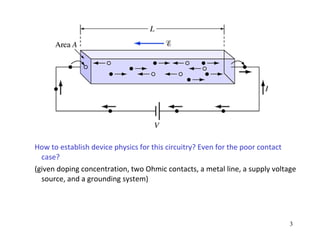
How to establish device physics for this circuitry? Even for the poor contact
case?
(given doping concentration, two Ohmic contacts, a metal line, a supply voltage
source, and a grounding system)
4
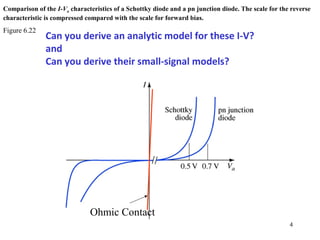
6-22
Comparison of the I-Va characteristics of a Schottky diode and a pn junction diode. The scale for the reverse
characteristic is compressed compared with the scale for forward bias.
Figure 6.22
Ohmic Contact
Can you derive an analytic model for these I-V?
and
Can you derive their small-signal models?
5
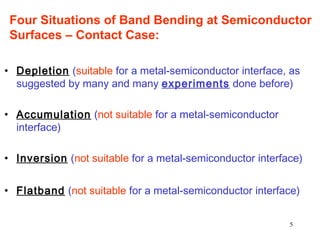
Four Situations of Band Bending at Semiconductor
Surfaces – Contact Case:
• Depletion (suitable for a metal-semiconductor interface, as
suggested by many and many experiments done before)
• Accumulation (not suitable for a metal-semiconductor
interface)
• Inversion (not suitable for a metal-semiconductor interface)
• Flatband (not suitable for a metal-semiconductor interface)
6
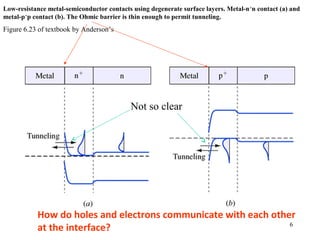
6-23
Low-resistance metal-semiconductor contacts using degenerate surface layers. Metal-n+
n contact (a) and
metal-p+
p contact (b). The Ohmic barrier is thin enough to permit tunneling.
Figure 6.23 of textbook by Anderson’s
How do holes and electrons communicate with each other
at the interface?
Not so clear
7
Metal-Semiconductor Contact System (or
Junction):
• Ohmic Contact
-- Two-way conducting (on)
-- Nearly zero resistance or potential drop
-- Equilibrium at both sides
• Schottky Contact
-- Usually for one-way conducting, with the
other way off
-- Considerable potential drop
-- Fermi level may split off
8
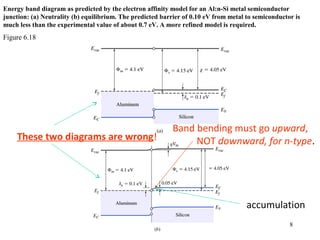
6-18
Energy band diagram as predicted by the electron affinity model for an Al:n-Si metal semiconductor
junction: (a) Neutrality (b) equilibrium. The predicted barrier of 0.10 eV from metal to semiconductor is
much less than the experimental value of about 0.7 eV. A more refined model is required.
Figure 6.18
These two diagrams are wrong!
Band bending must go upward,
NOT downward, for n-type.
accumulation
9
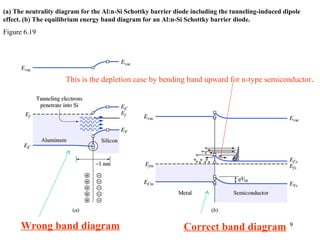
6-19
(a) The neutrality diagram for the Al:n-Si Schottky barrier diode including the tunneling-induced dipole
effect. (b) The equilibrium energy band diagram for an Al:n-Si Schottky barrier diode.
Figure 6.19
This is the depletion case by bending band upward for n-type semiconductor.
Wrong band diagram Correct band diagram
10
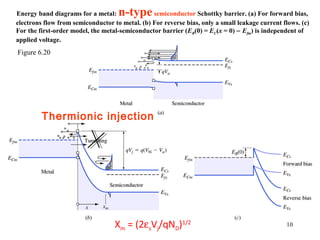
6-20
Energy band diagrams for a metal: n-typesemiconductor Schottky barrier. (a) For forward bias,
electrons flow from semiconductor to metal. (b) For reverse bias, only a small leakage current flows. (c)
For the first-order model, the metal-semiconductor barrier (EB(0) = EC(x = 0) − Efm) is independent of
applied voltage.
Figure 6.20
Xm = (2εsVj/qND)1/2
Thermionic injection
11
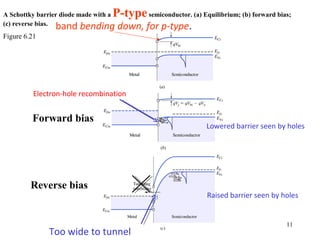
6-21
A Schottky barrier diode made with a P-typesemiconductor. (a) Equilibrium; (b) forward bias;
(c) reverse bias.
Figure 6.21
band bending down, for p-type.
Electron-hole recombination
Lowered barrier seen by holes
Forward bias
Reverse bias
Raised barrier seen by holes
Too wide to tunnel
12
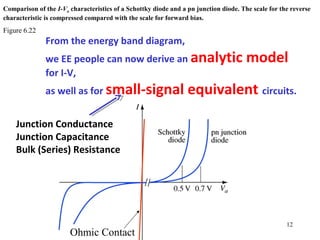
6-22
Comparison of the I-Va characteristics of a Schottky diode and a pn junction diode. The scale for the reverse
characteristic is compressed compared with the scale for forward bias.
Figure 6.22
Ohmic Contact
From the energy band diagram,
we EE people can now derive an analytic model
for I-V,
as well as for small-signal equivalent circuits.
Junction Conductance
Junction Capacitance
Bulk (Series) Resistance

Lecture 4 4521 semiconductor device physics - metal-semiconductor system

  • 1.
    1 Prof. Ming-Jer ChenProf.Ming-Jer Chen Department of Electronics EngineeringDepartment of Electronics Engineering National Chiao-Tung UniversityNational Chiao-Tung University November 6, 2014November 6, 2014 DEE4521 Semiconductor Device PhysicsDEE4521 Semiconductor Device Physics Metal-Semiconductor System: ContactMetal-Semiconductor System: Contact
  • 2.
    2 PP. 331 –338PP. 331 – 338 Section 6.4 Metal-Semiconductor JunctionsSection 6.4 Metal-Semiconductor Junctions Textbook pages involved
  • 3.
    3 How to establishdevice physics for this circuitry? Even for the poor contact case? (given doping concentration, two Ohmic contacts, a metal line, a supply voltage source, and a grounding system)
  • 4.
    4 6-22 Comparison of theI-Va characteristics of a Schottky diode and a pn junction diode. The scale for the reverse characteristic is compressed compared with the scale for forward bias. Figure 6.22 Ohmic Contact Can you derive an analytic model for these I-V? and Can you derive their small-signal models?
  • 5.
    5 Four Situations ofBand Bending at Semiconductor Surfaces – Contact Case: • Depletion (suitable for a metal-semiconductor interface, as suggested by many and many experiments done before) • Accumulation (not suitable for a metal-semiconductor interface) • Inversion (not suitable for a metal-semiconductor interface) • Flatband (not suitable for a metal-semiconductor interface)
  • 6.
    6 6-23 Low-resistance metal-semiconductor contactsusing degenerate surface layers. Metal-n+ n contact (a) and metal-p+ p contact (b). The Ohmic barrier is thin enough to permit tunneling. Figure 6.23 of textbook by Anderson’s How do holes and electrons communicate with each other at the interface? Not so clear
  • 7.
    7 Metal-Semiconductor Contact System(or Junction): • Ohmic Contact -- Two-way conducting (on) -- Nearly zero resistance or potential drop -- Equilibrium at both sides • Schottky Contact -- Usually for one-way conducting, with the other way off -- Considerable potential drop -- Fermi level may split off
  • 8.
    8 6-18 Energy band diagramas predicted by the electron affinity model for an Al:n-Si metal semiconductor junction: (a) Neutrality (b) equilibrium. The predicted barrier of 0.10 eV from metal to semiconductor is much less than the experimental value of about 0.7 eV. A more refined model is required. Figure 6.18 These two diagrams are wrong! Band bending must go upward, NOT downward, for n-type. accumulation
  • 9.
    9 6-19 (a) The neutralitydiagram for the Al:n-Si Schottky barrier diode including the tunneling-induced dipole effect. (b) The equilibrium energy band diagram for an Al:n-Si Schottky barrier diode. Figure 6.19 This is the depletion case by bending band upward for n-type semiconductor. Wrong band diagram Correct band diagram
  • 10.
    10 6-20 Energy band diagramsfor a metal: n-typesemiconductor Schottky barrier. (a) For forward bias, electrons flow from semiconductor to metal. (b) For reverse bias, only a small leakage current flows. (c) For the first-order model, the metal-semiconductor barrier (EB(0) = EC(x = 0) − Efm) is independent of applied voltage. Figure 6.20 Xm = (2εsVj/qND)1/2 Thermionic injection
  • 11.
    11 6-21 A Schottky barrierdiode made with a P-typesemiconductor. (a) Equilibrium; (b) forward bias; (c) reverse bias. Figure 6.21 band bending down, for p-type. Electron-hole recombination Lowered barrier seen by holes Forward bias Reverse bias Raised barrier seen by holes Too wide to tunnel
  • 12.
    12 6-22 Comparison of theI-Va characteristics of a Schottky diode and a pn junction diode. The scale for the reverse characteristic is compressed compared with the scale for forward bias. Figure 6.22 Ohmic Contact From the energy band diagram, we EE people can now derive an analytic model for I-V, as well as for small-signal equivalent circuits. Junction Conductance Junction Capacitance Bulk (Series) Resistance