.

PRESENTED BY:
INUSAH ADAMS
(Ternopil State Medical Univ.)
Nov, 2013
PLAN OF PRESENTATION
 DEFINITION
 EPIDEMIOLOGY
 TYPES
 ANATOMY
 ETIOLOGY
 PATHOGENESIS
 SIGNS &SYMPTOMS
 DIAGNOSIS/INVESTIGATIONS
 DIFFERENTIALS
 TREATMENT
 COMPLICATIONS
 HERNIORRHAPHY
 PROGNOSIS
What is hernia?


It is the outlet of the visceral organs
from their physiological placement
through natural channels or defects of
the abdominal and pelvic wall.
Epidemiology
Hernias comprise approximately 7% of all
surgical outpatient visits.
 Male: female ratio is 8:1.
 They affect 1-3% of young children.
 In men, the incidence rises from 11 per
10,000 person-years, aged 16-24 years,
 200 per 10,000 person-years, aged 75
years or above.[1]

Classification of abdominal
Hernias? hernias
 Etiology: Congenital and acquired

1.
2.
3.
4.
5.
6.
•

•

Anatomical location
Inguinal hernia
Femoral hernia
Umbilical hernia
Epigastric hernia
Diaphragmatic hernia
Incisional/recurrent hernia
clinical presentations: incarcerated hernia
(complete and incomplete), reducible and
nonreducible, complicated and
noncomplicated.
External (through wall of abdomen) and
internal (through the peritoneum) hernias
What is the etiology of hernia?
Risk factors are:
 Malformation of abdominal wall
 sex
 age
 hereditary
 Obesity
 Ascites
 weight loss
 postoperative scar
 improper weight lifting
 Chronic Constipation
 chronic cough
 pregnancy
What is the pathogenesis of
hernia?
1.
2.
3.

incomplete closure of the abdominal
wall in case of congenital hernia
increased abdominal pressure
increasing dehiscence of fascial
structure with accompanying loss of
abdominal wall strength
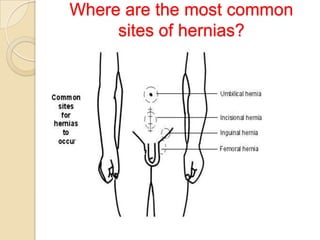
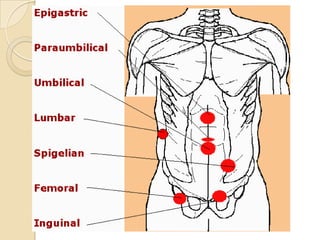
Where are the most common
sites of hernias?
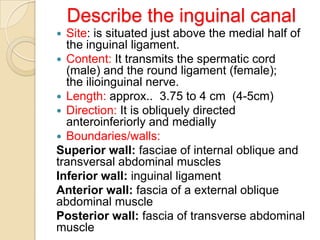
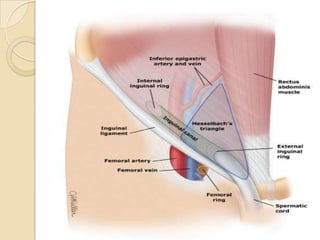
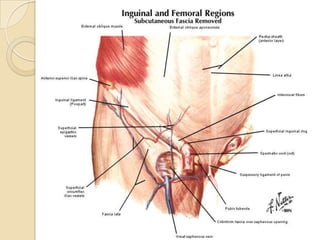
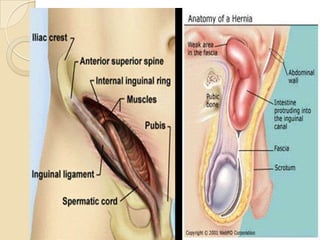
Describe the inguinal canal
Site: is situated just above the medial half of
the inguinal ligament.
 Content: It transmits the spermatic cord
(male) and the round ligament (female);
the ilioinguinal nerve.
 Length: approx.. 3.75 to 4 cm (4-5cm)
 Direction: It is obliquely directed
anteroinferiorly and medially
 Boundaries/walls:
Superior wall: fasciae of internal oblique and
transversal abdominal muscles
Inferior wall: inguinal ligament
Anterior wall: fascia of a external oblique
abdominal muscle
Posterior wall: fascia of transverse abdominal
muscle

What is inguinal hernia?
hernia in which a loop of intestine enters
the inguinal canal
 They make up 75% of all abdominal wall
hernias


Types of inguinal hernia
Direct and indirect
-Reducible vs. irreducible
-Strangulated hernias
-unilateral or bilateral
.
.
Indirect inguinal hernia: protrusion of
parts of the intestines into the inguinal
canal via the internal/deep inguinal ring.
Its sac is lateral to the inferior epigastric
artery


Direct inguinal canal: protrusion of
parts of the intestines into the inguinal
canal through a weak point in the fascia
of the abdominal wall.
Its sac is medial to the inferior epigastric
artery.

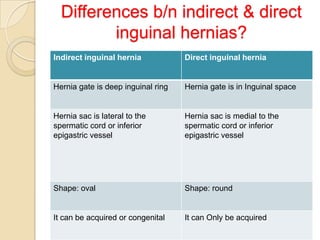
Differences b/n indirect & direct
inguinal hernias?
Indirect inguinal hernia

Direct inguinal hernia

Hernia gate is deep inguinal ring

Hernia gate is in Inguinal space

Hernia sac is lateral to the
spermatic cord or inferior
epigastric vessel

Hernia sac is medial to the
spermatic cord or inferior
epigastric vessel

Shape: oval

Shape: round

It can be acquired or congenital

It can Only be acquired
3 elements of hernia
 Hernia

gate

 Hernia

sac (3 parts; neck, body and
fundus)

 Hernia

content
Signs and symptoms?
 swelling/protrusion
 Weakness

or pressure in the groin

 Pain

or discomfort in the groin, especially
when bending over, coughing or lifting

 Occasionally,

pain and swelling around
the testicles when the protruding
intestine descends into the scrotum
 Severe pain in strangulated hernia
Physical examination of
patient?


Examine the patient (inspection and
palpation) both standing and lying
positions



Place your finger on the swelling and
instruct patient to cough or strain



positive symptom of "cough push“ is
elicited in case of hernia
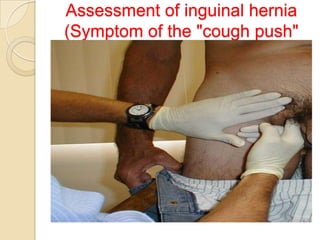
Assessment of inguinal hernia
(Symptom of the "cough push"
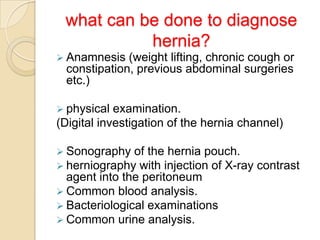
what can be done to diagnose
hernia?
 Anamnesis

(weight lifting, chronic cough or
constipation, previous abdominal surgeries
etc.)

 physical

examination.
(Digital investigation of the hernia channel)
 Sonography of the hernia pouch.
 herniography with injection of X-ray

agent into the peritoneum
 Common blood analysis.
 Bacteriological examinations
 Common urine analysis.

contrast
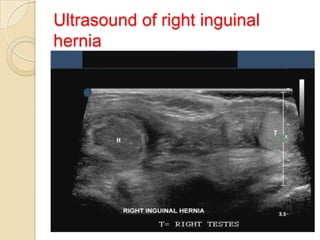
Ultrasound of right inguinal
hernia
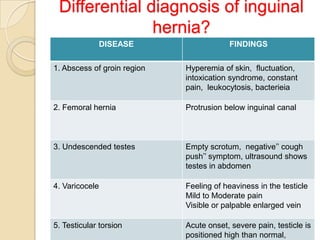
Differential diagnosis of inguinal
hernia?
DISEASE

FINDINGS

1. Abscess of groin region

Hyperemia of skin, fluctuation,
intoxication syndrome, constant
pain, leukocytosis, bacterieia

2. Femoral hernia

Protrusion below inguinal canal

3. Undescended testes

Empty scrotum, negative’’ cough
push’’ symptom, ultrasound shows
testes in abdomen

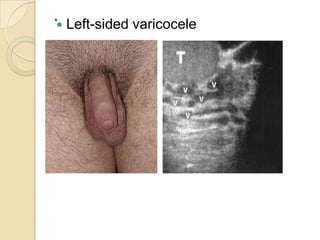
4. Varicocele

Feeling of heaviness in the testicle
Mild to Moderate pain
Visible or palpable enlarged vein

5. Testicular torsion

Acute onset, severe pain, testicle is
positioned high than normal,
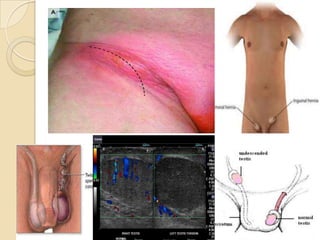
. Left-sided varicocele
How can diagnosis of hernia be
formulated?
Location
 Type
 Reducible vs. irreducible
 Complication (s)


Dx: Indirect Right inguinal
hernia, irreducible with strangulation
What are the treatment options
of inguinal hernia?


Treatment of a hernia depends on whether
it is reducible or irreducible and possibly
strangulated.
◦ Reducible hernia
 Can be treated with surgery but does not have to be.

◦ Irreducible hernia
 Urgent surgical treatment because of the risk of
strangulation.
 An attempt to push the hernia back can be made

◦ Strangulated hernia
 Emergency operation
What are the possible
complications of hernia?


Incarcerated (irreducible hernia)

Strangulated hernia
Signs and symptoms of strangulated
hernia:
 Nausea, vomiting or both
 Fever
 Rapid heart rate
 Sudden pain that quickly intensifies
 A hernia bulge that turns red, purple or
dark
 Absent bowel sounds on auscultation

Herniotomy & Herniorrhaphy


Open method and



Laparoscopic method
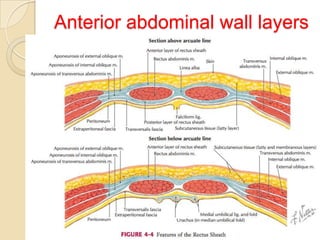
Anterior abdominal wall layers
Preoperative care









History, physical findings, Lab. Works:
blood test, grouping and crossmatching, urinalysis, ultrasound, etc.
signed informed consent form
anesthesiologist examination and
recommendation
NPO, urinary catheter if necessary
correction of hemodynamics; IV access
for fluids, drugs (sedatives, antibiotics
etc.)
Explanation of the procedure to patient
and Reassurance
Steps of Herniotomy













Skin incision (3-5cm) above and parallel to
inguinal ligament, then subcutaneous tissue
Ligation of superficial epigastric vein
Opening of scarpa’s fascia
Opening of external oblique aponeurosis (follow
fiber direction and avoid nerve damage;
ilioinguinal, genitofemoral, iliohypogastric
nerves,)
Identify inguinal ligament (poupart’s ligament)
Isolate spermatic cord (using a Penrose drain for
convenient retraction)
Dissect the spermatic cord (using the index
finger in a sweeping and medially encircling
fashion) to the internal ring
Identify and isolate hernia sac (peritoneum)
Reposition hernia into abdominal cavity
Close the defect
Steps of Herniorrhaphy
(Lichtenstein technique)












Identify the conjoint tendon (lateral rectus border)
First suture on lateral rectus border (not on pubic
tubercle) to the mesh and tie securely but not too
tight
Then over (not through) pubic tubercle
Suture to lower part of inguinal ligament
Proceed until just beyond the internal inguinal ring
Create a new internal ring and attach upper part
of mesh to inguinal ligament
Size the mesh and secure upper part with single
sutures
Close external oblique aponeurosis, then scarpa’s
fascia
Suture skin, infiltrate local anesthetic and apply
sterile dressing
Video (Lichtenstein
technique)
.
Herniorrhapy (Bassini Repair)
tension method
A technique in which the surgeon
sutures the conjoined tendon to the
inguinal ligament, which slides the
patient’s own muscles together to cover
the hole in the abdominal wall and
repair the hernia.
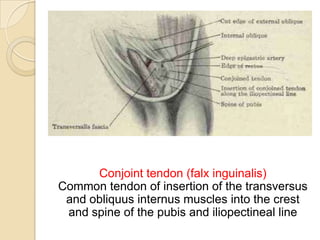
Conjoint tendon (falx inguinalis)
Common tendon of insertion of the transversus
and obliquus internus muscles into the crest
and spine of the pubis and iliopectineal line
Postoperative care
Patient is discharged the same day of
operation once anesthesia wears off,
but some may need to stay in the
hospital overnight.
 Drugs: only analgesic is necessary
 Diet: start with sips of water, if patient
can take it then semi-liquid foods until
he can tolerate solid foods
 Wound dressing until removal of
sutures

Possible complications after
herniorrhapy
chronic pain
 ejaculation disorders
 Hemorrhage
 infection
 adhesions
 Impotency
 Recurrent hernias

Prognosis?
The outcome of this surgery is usually
very good. In a few persons, the hernia
returns.

Hernia and herniorrhaphy

  • 1.
    . PRESENTED BY: INUSAH ADAMS (TernopilState Medical Univ.) Nov, 2013
  • 2.
    PLAN OF PRESENTATION DEFINITION  EPIDEMIOLOGY  TYPES  ANATOMY  ETIOLOGY  PATHOGENESIS  SIGNS &SYMPTOMS  DIAGNOSIS/INVESTIGATIONS  DIFFERENTIALS  TREATMENT  COMPLICATIONS  HERNIORRHAPHY  PROGNOSIS
  • 3.
    What is hernia?  Itis the outlet of the visceral organs from their physiological placement through natural channels or defects of the abdominal and pelvic wall.
  • 4.
    Epidemiology Hernias comprise approximately7% of all surgical outpatient visits.  Male: female ratio is 8:1.  They affect 1-3% of young children.  In men, the incidence rises from 11 per 10,000 person-years, aged 16-24 years,  200 per 10,000 person-years, aged 75 years or above.[1] 
  • 5.
    Classification of abdominal Hernias?hernias  Etiology: Congenital and acquired  1. 2. 3. 4. 5. 6. • • Anatomical location Inguinal hernia Femoral hernia Umbilical hernia Epigastric hernia Diaphragmatic hernia Incisional/recurrent hernia clinical presentations: incarcerated hernia (complete and incomplete), reducible and nonreducible, complicated and noncomplicated. External (through wall of abdomen) and internal (through the peritoneum) hernias
  • 6.
    What is theetiology of hernia? Risk factors are:  Malformation of abdominal wall  sex  age  hereditary  Obesity  Ascites  weight loss  postoperative scar  improper weight lifting  Chronic Constipation  chronic cough  pregnancy
  • 7.
    What is thepathogenesis of hernia? 1. 2. 3. incomplete closure of the abdominal wall in case of congenital hernia increased abdominal pressure increasing dehiscence of fascial structure with accompanying loss of abdominal wall strength
  • 8.
    Where are themost common sites of hernias?
  • 10.
    Describe the inguinalcanal Site: is situated just above the medial half of the inguinal ligament.  Content: It transmits the spermatic cord (male) and the round ligament (female); the ilioinguinal nerve.  Length: approx.. 3.75 to 4 cm (4-5cm)  Direction: It is obliquely directed anteroinferiorly and medially  Boundaries/walls: Superior wall: fasciae of internal oblique and transversal abdominal muscles Inferior wall: inguinal ligament Anterior wall: fascia of a external oblique abdominal muscle Posterior wall: fascia of transverse abdominal muscle 
  • 13.
    What is inguinalhernia? hernia in which a loop of intestine enters the inguinal canal  They make up 75% of all abdominal wall hernias  Types of inguinal hernia Direct and indirect -Reducible vs. irreducible -Strangulated hernias -unilateral or bilateral
  • 14.
  • 15.
    . Indirect inguinal hernia:protrusion of parts of the intestines into the inguinal canal via the internal/deep inguinal ring. Its sac is lateral to the inferior epigastric artery  Direct inguinal canal: protrusion of parts of the intestines into the inguinal canal through a weak point in the fascia of the abdominal wall. Its sac is medial to the inferior epigastric artery. 
  • 16.
    Differences b/n indirect& direct inguinal hernias? Indirect inguinal hernia Direct inguinal hernia Hernia gate is deep inguinal ring Hernia gate is in Inguinal space Hernia sac is lateral to the spermatic cord or inferior epigastric vessel Hernia sac is medial to the spermatic cord or inferior epigastric vessel Shape: oval Shape: round It can be acquired or congenital It can Only be acquired
  • 17.
    3 elements ofhernia  Hernia gate  Hernia sac (3 parts; neck, body and fundus)  Hernia content
  • 18.
    Signs and symptoms? swelling/protrusion  Weakness or pressure in the groin  Pain or discomfort in the groin, especially when bending over, coughing or lifting  Occasionally, pain and swelling around the testicles when the protruding intestine descends into the scrotum  Severe pain in strangulated hernia
  • 19.
    Physical examination of patient?  Examinethe patient (inspection and palpation) both standing and lying positions  Place your finger on the swelling and instruct patient to cough or strain  positive symptom of "cough push“ is elicited in case of hernia
  • 20.
    Assessment of inguinalhernia (Symptom of the "cough push"
  • 21.
    what can bedone to diagnose hernia?  Anamnesis (weight lifting, chronic cough or constipation, previous abdominal surgeries etc.)  physical examination. (Digital investigation of the hernia channel)  Sonography of the hernia pouch.  herniography with injection of X-ray agent into the peritoneum  Common blood analysis.  Bacteriological examinations  Common urine analysis. contrast
  • 22.
    Ultrasound of rightinguinal hernia
  • 23.
    Differential diagnosis ofinguinal hernia? DISEASE FINDINGS 1. Abscess of groin region Hyperemia of skin, fluctuation, intoxication syndrome, constant pain, leukocytosis, bacterieia 2. Femoral hernia Protrusion below inguinal canal 3. Undescended testes Empty scrotum, negative’’ cough push’’ symptom, ultrasound shows testes in abdomen 4. Varicocele Feeling of heaviness in the testicle Mild to Moderate pain Visible or palpable enlarged vein 5. Testicular torsion Acute onset, severe pain, testicle is positioned high than normal,
  • 25.
  • 26.
    How can diagnosisof hernia be formulated? Location  Type  Reducible vs. irreducible  Complication (s)  Dx: Indirect Right inguinal hernia, irreducible with strangulation
  • 27.
    What are thetreatment options of inguinal hernia?  Treatment of a hernia depends on whether it is reducible or irreducible and possibly strangulated. ◦ Reducible hernia  Can be treated with surgery but does not have to be. ◦ Irreducible hernia  Urgent surgical treatment because of the risk of strangulation.  An attempt to push the hernia back can be made ◦ Strangulated hernia  Emergency operation
  • 28.
    What are thepossible complications of hernia?  Incarcerated (irreducible hernia) Strangulated hernia Signs and symptoms of strangulated hernia:  Nausea, vomiting or both  Fever  Rapid heart rate  Sudden pain that quickly intensifies  A hernia bulge that turns red, purple or dark  Absent bowel sounds on auscultation 
  • 29.
    Herniotomy & Herniorrhaphy  Openmethod and  Laparoscopic method
  • 30.
  • 31.
    Preoperative care       History, physicalfindings, Lab. Works: blood test, grouping and crossmatching, urinalysis, ultrasound, etc. signed informed consent form anesthesiologist examination and recommendation NPO, urinary catheter if necessary correction of hemodynamics; IV access for fluids, drugs (sedatives, antibiotics etc.) Explanation of the procedure to patient and Reassurance
  • 32.
    Steps of Herniotomy           Skinincision (3-5cm) above and parallel to inguinal ligament, then subcutaneous tissue Ligation of superficial epigastric vein Opening of scarpa’s fascia Opening of external oblique aponeurosis (follow fiber direction and avoid nerve damage; ilioinguinal, genitofemoral, iliohypogastric nerves,) Identify inguinal ligament (poupart’s ligament) Isolate spermatic cord (using a Penrose drain for convenient retraction) Dissect the spermatic cord (using the index finger in a sweeping and medially encircling fashion) to the internal ring Identify and isolate hernia sac (peritoneum) Reposition hernia into abdominal cavity Close the defect
  • 33.
    Steps of Herniorrhaphy (Lichtensteintechnique)          Identify the conjoint tendon (lateral rectus border) First suture on lateral rectus border (not on pubic tubercle) to the mesh and tie securely but not too tight Then over (not through) pubic tubercle Suture to lower part of inguinal ligament Proceed until just beyond the internal inguinal ring Create a new internal ring and attach upper part of mesh to inguinal ligament Size the mesh and secure upper part with single sutures Close external oblique aponeurosis, then scarpa’s fascia Suture skin, infiltrate local anesthetic and apply sterile dressing
  • 35.
  • 36.
    Herniorrhapy (Bassini Repair) tensionmethod A technique in which the surgeon sutures the conjoined tendon to the inguinal ligament, which slides the patient’s own muscles together to cover the hole in the abdominal wall and repair the hernia.
  • 37.
    Conjoint tendon (falxinguinalis) Common tendon of insertion of the transversus and obliquus internus muscles into the crest and spine of the pubis and iliopectineal line
  • 38.
    Postoperative care Patient isdischarged the same day of operation once anesthesia wears off, but some may need to stay in the hospital overnight.  Drugs: only analgesic is necessary  Diet: start with sips of water, if patient can take it then semi-liquid foods until he can tolerate solid foods  Wound dressing until removal of sutures 
  • 39.
    Possible complications after herniorrhapy chronicpain  ejaculation disorders  Hemorrhage  infection  adhesions  Impotency  Recurrent hernias 
  • 40.
    Prognosis? The outcome ofthis surgery is usually very good. In a few persons, the hernia returns.