Hernias
By-
Dr. K.K.Patel (M.PT)
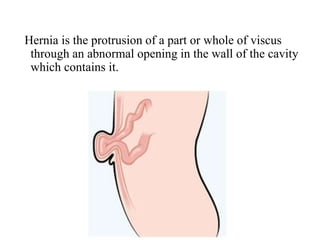
Hernia is the protrusion of a part or whole of viscus
through an abnormal opening in the wall of the cavity
which contains it.
•Common external hernia are
1.Inguinal – about 73%
2.Femoral – about 17%
3.Umbilical – about 8.5%
4.Incisional – its incidence is not included
Other 1.5 % cases are rare hernia e.g.
1.Epigastric
2.Lumbar
3.Spigelian
4.Obturator
5.Gluteal
Etiology
A) Any condition which increase intra-abdominal
pressure
e.g. - Power full muscular effort or strain by lifting
heavy weight
- Whooping cough, chronic cough
- Obesity,
- Repeated pregnancy
- Vomiting, constipation
B- weakness of the abdominal muscle
- Congenital weakness
- Acquired weakness
Pathology
Hernia consists of three part..
The sac
The contents of sac
The covering of sac
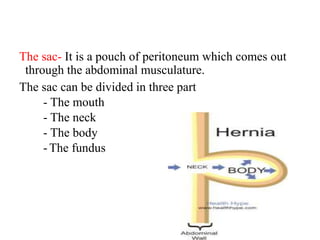
The sac- It is a pouch of peritoneum which comes out
through the abdominal musculature.
The sac can be divided in three part
- The mouth
- The neck
- The body
- The fundus
The contents of sac – Abdominal viscus
(depended upon site)
Fluid – peritoneal exudates
The covering of sac- Depends upon the layers of
abdominal through which the sac passes
Classification
I. Reducible hernia
II. Irreducible hernia
III. Obstructed hernia
IV.Strangulated hernia
Reducible hernia – Hernia reduces itself as the patient
lies down or can be reduced by the patient or by
surgeon
One of the 2 most characteristic features of hernia is its
Reducibility and second feature is Impulses on
coughing.
Irreducible hernia - Here the content cannot be
returned to abdomen because of the adhesion formed
between sac and content
Obstructed hernia
It is irreducible hernia containing intestine which
obstructed from without or from within but doesn't
interfere blood supply to distal
Strangulated hernia
It is irreducible and obstructed hernia ant there is arrest
of blood supply to the contents
An external abdominal hernia is protrusion of
abdominal viscus through a weak spot in the
abdominal wall
Common external hernia are
•Inguinal hernia
•Femoral hernia
•Umbilical hernia
•Incisional hernia
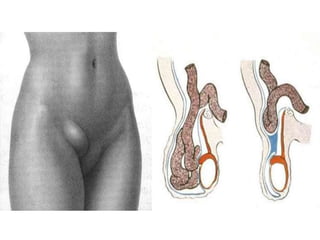
Inguinal hernia
It is the protrusion of part of the contents of the
abdomen through the inguinal region of the abdominal
wall.
It is reducible
Expansible impulse on cough
There are two types of inguinal hernia
1. Indirect inguinal hernia
2. Direct inguinal hernia
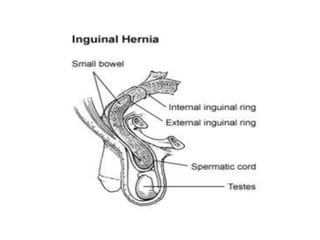
1. Indirect hernia
In indirect hernia the content of abdomen enter the deep
inguinal canal and traverse the whole canal to come
out through the superficial inguinal ring, it is lateral to
the inferior epigastric vessels
Much common than the direct hernia,
Can occur at any age but more common in children
and young adult
It is more commonly seen on right side. only 1/3 of
cases are involved bilateral
Impulses on coughing
When it is complete it is pyriform shape and when it is
incomplete it is oval shape
The hernia has to be reduced by the patient or the
doctor and it dose not reduced by itself
There are three types of indirect hernia
i. BUBONOCELE – hernia is limited to the inguinal
canal
ii.FUNICULAR – the contents of hernia can be felt
separately from the testis and the testis lie below the
hernia
iii.COMPLETE OR SCROTAL HERNIA – the hernia
descends down to the bottom of the scrotum lying in
front and side of the testis
Direct inguinal hernia
Direct inguinal hernias occur medial to the inferior
epigastric vessels through the posterior wall of the
inguinal canal
Female are not affected
More than ½ the case are bilateral. it is usually caused by
poor abdominal muscle.
It is always incomplete and spherical shape
This hernia is appears as forward bulges
It is automatically reduces when the patient lies down
If the impulses is felt on the middle finger it is a direct
hernia
 Invagination test –
When the little finger enters the ring if it goes upward, backwards, and out
wards it is an indirect hernia
If the impulses is felt on the tip of the finger it is an indirect hernia
When the little finger goes directly backwards, it is direct hernia
If the impulses is felt on the pulp of the finger it is an direct hernia
Ring occlusion test
The hernia must be reduced first
A thumb is pressed on the deep inguinal ring then asked to cough
A direct hernia will show bulge medial to the finger but an indirect hernia
will not find assess, so no bulge
Treatment –
Herniotomy- In this operation the neck of the sac is transfixed and ligated
and then the hernial sac is excised
It is indicated –
 In infants and children in whom there is preformed sac
 In case of young adults with very good inguinal musculature
Hernioraphy –
It is consist of herniotomy + repair of posterior wall of the inguinal canal
by opposing the conjoined tendon to the inguinal ligament
Hernioplasty –
Herniotomy + reinforced repair of the posterior wall of the inguinal canal
by filling the gap between the conjoined tendon and ligament by
Autogenous or heterogenous material
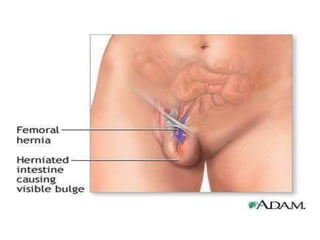
Femoral hernia
Abdominal contents pass through the femoral ring, transverse the femoral
canal and comes out through the saphenous opening.
it is 3rd most common hernia after the inguinal and incisional hernia.
Common in female elderly and most liable to get strangulated
You may see a bulge in the upper thigh next to the groin.
Most femoral hernias cause no symptoms. There may be some groin
discomfort that is worse when you stand, lift heavy objects, or strain.
Sometimes, the first symptoms are abdominal pain, nausea, and vomiting.
This may mean that the intestine is blocked, which is an emergency.
Umbilical hernia
This is due to failure of all part of mid gut return to the colon during early
fetal life. So the abdominal organ remain protruded.
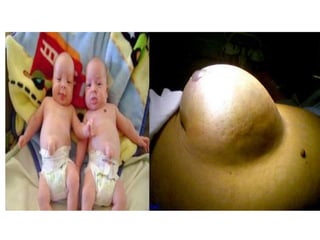
Umbilical hernia in infants and children –
This is hernia through a weak umbilical scar,
The hernia is usually symptomless and increase in size during crying
If small, symptomless then conservative treatment.
Operation is only justified when the hernia fails to disappear after 18
months – Herniorapphy
Para- umbilical hernia of adult –
In the adults the hernia does not protrude through the umbilical. But it is
protrusion through the linea alba just above the umbilicus or occasionally
below the umbilicus
That is why its called para umbilical hernia
Women are by far the major victims,
Obese patient are mainly involved.
Treatment – operation is the treatment of choice
MAYO’ S OPERATION
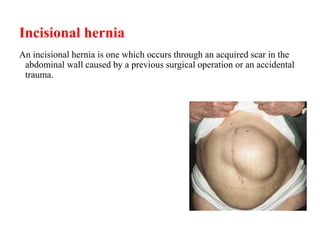
Incisional hernia
An incisional hernia is one which occurs through an acquired scar in the
abdominal wall caused by a previous surgical operation or an accidental
trauma.
Etiology
1. Defect with patient
- Obese individual
- Chronic cough
- Abdominal distension in the early POD
- Malnutrision
2- Fault during operation
- Injury to the motor nerve supplying the area.
- Improper closer of wound
- Tube drainage through the laparotomy wound
- Haemostasis was not perfect
- Certain incision are more liable to causes incisional hernia
3-Postoperative causes
- Infection
- Postoperative cough and distension
- Postoperative peritonitis due to more chance
of wound infection.
- To early removal of sutures
Hernia may occur through the small portion of scar at lower end
Diffuse bulging of whole length of incision
Gradually size become increased and irreducible
Mostly asymptomatic and broad neck don’t need any treatment
Treatment
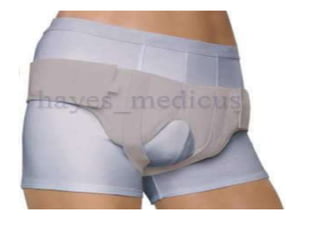
Conservative treatment – abdominal belt
Operative management
Physiotherapy management –
For the undergoing surgery for an inguinal hernia pulmonary
complications may be a risk when there is a chronic chest condition
Pre and post operative breathing exercise and chest physiotherapy are
important
DVT is possible complication after herniorraphy and so exercise for legs
should be given before and after surgery
These patients likely to have weak abdominal muscles which should be
strengthen after surgery
A progressive scheme of exercise starting with static in middle to inner
range and following with free active exercise should be implemented,
care should be taken not to go beyond the ability of the patient and
exercise in outer range of the abdomen should be avoided
Patients should be instructed in correct lifting techniques.
Patient undergoing surgery for a femoral hernia should have similar
physiotherapy
The risk of pulmonary complications is smaller but there may be a greater
risk of developing a DVT
Correct lifting techniques should be taught so that the intra abdominal
pressure is not abnormally high during lifting
Patients undergoing for the umbilical and
insicional hernia surgery physiotherapy is as
for abdominal surgery
 To prevent pulmonary and circulatory
complication.
 Strengthen abdominal muscle
 Teach postural correction
 Scar management
 Advice on back care
 Advice on progression of activities to
function
Hernia and physiotherapy management

Hernia and physiotherapy management

  • 1.
  • 2.
    Hernia is theprotrusion of a part or whole of viscus through an abnormal opening in the wall of the cavity which contains it.
  • 3.
    •Common external herniaare 1.Inguinal – about 73% 2.Femoral – about 17% 3.Umbilical – about 8.5% 4.Incisional – its incidence is not included Other 1.5 % cases are rare hernia e.g. 1.Epigastric 2.Lumbar 3.Spigelian 4.Obturator 5.Gluteal
  • 4.
    Etiology A) Any conditionwhich increase intra-abdominal pressure e.g. - Power full muscular effort or strain by lifting heavy weight - Whooping cough, chronic cough - Obesity, - Repeated pregnancy - Vomiting, constipation
  • 5.
    B- weakness ofthe abdominal muscle - Congenital weakness - Acquired weakness
  • 6.
    Pathology Hernia consists ofthree part.. The sac The contents of sac The covering of sac
  • 7.
    The sac- Itis a pouch of peritoneum which comes out through the abdominal musculature. The sac can be divided in three part - The mouth - The neck - The body - The fundus
  • 8.
    The contents ofsac – Abdominal viscus (depended upon site) Fluid – peritoneal exudates The covering of sac- Depends upon the layers of abdominal through which the sac passes
  • 9.
    Classification I. Reducible hernia II.Irreducible hernia III. Obstructed hernia IV.Strangulated hernia
  • 10.
    Reducible hernia –Hernia reduces itself as the patient lies down or can be reduced by the patient or by surgeon One of the 2 most characteristic features of hernia is its Reducibility and second feature is Impulses on coughing. Irreducible hernia - Here the content cannot be returned to abdomen because of the adhesion formed between sac and content
  • 11.
    Obstructed hernia It isirreducible hernia containing intestine which obstructed from without or from within but doesn't interfere blood supply to distal Strangulated hernia It is irreducible and obstructed hernia ant there is arrest of blood supply to the contents
  • 12.
    An external abdominalhernia is protrusion of abdominal viscus through a weak spot in the abdominal wall Common external hernia are •Inguinal hernia •Femoral hernia •Umbilical hernia •Incisional hernia
  • 13.
    Inguinal hernia It isthe protrusion of part of the contents of the abdomen through the inguinal region of the abdominal wall. It is reducible Expansible impulse on cough
  • 15.
    There are twotypes of inguinal hernia 1. Indirect inguinal hernia 2. Direct inguinal hernia
  • 16.
    1. Indirect hernia Inindirect hernia the content of abdomen enter the deep inguinal canal and traverse the whole canal to come out through the superficial inguinal ring, it is lateral to the inferior epigastric vessels
  • 18.
    Much common thanthe direct hernia, Can occur at any age but more common in children and young adult It is more commonly seen on right side. only 1/3 of cases are involved bilateral Impulses on coughing When it is complete it is pyriform shape and when it is incomplete it is oval shape The hernia has to be reduced by the patient or the doctor and it dose not reduced by itself
  • 19.
    There are threetypes of indirect hernia i. BUBONOCELE – hernia is limited to the inguinal canal ii.FUNICULAR – the contents of hernia can be felt separately from the testis and the testis lie below the hernia iii.COMPLETE OR SCROTAL HERNIA – the hernia descends down to the bottom of the scrotum lying in front and side of the testis
  • 20.
    Direct inguinal hernia Directinguinal hernias occur medial to the inferior epigastric vessels through the posterior wall of the inguinal canal Female are not affected More than ½ the case are bilateral. it is usually caused by poor abdominal muscle. It is always incomplete and spherical shape This hernia is appears as forward bulges
  • 21.
    It is automaticallyreduces when the patient lies down If the impulses is felt on the middle finger it is a direct hernia
  • 22.
     Invagination test– When the little finger enters the ring if it goes upward, backwards, and out wards it is an indirect hernia If the impulses is felt on the tip of the finger it is an indirect hernia When the little finger goes directly backwards, it is direct hernia If the impulses is felt on the pulp of the finger it is an direct hernia
  • 23.
    Ring occlusion test Thehernia must be reduced first A thumb is pressed on the deep inguinal ring then asked to cough A direct hernia will show bulge medial to the finger but an indirect hernia will not find assess, so no bulge
  • 24.
    Treatment – Herniotomy- Inthis operation the neck of the sac is transfixed and ligated and then the hernial sac is excised It is indicated –  In infants and children in whom there is preformed sac  In case of young adults with very good inguinal musculature
  • 25.
    Hernioraphy – It isconsist of herniotomy + repair of posterior wall of the inguinal canal by opposing the conjoined tendon to the inguinal ligament Hernioplasty – Herniotomy + reinforced repair of the posterior wall of the inguinal canal by filling the gap between the conjoined tendon and ligament by Autogenous or heterogenous material
  • 26.
    Femoral hernia Abdominal contentspass through the femoral ring, transverse the femoral canal and comes out through the saphenous opening. it is 3rd most common hernia after the inguinal and incisional hernia. Common in female elderly and most liable to get strangulated
  • 28.
    You may seea bulge in the upper thigh next to the groin. Most femoral hernias cause no symptoms. There may be some groin discomfort that is worse when you stand, lift heavy objects, or strain. Sometimes, the first symptoms are abdominal pain, nausea, and vomiting. This may mean that the intestine is blocked, which is an emergency.
  • 29.
    Umbilical hernia This isdue to failure of all part of mid gut return to the colon during early fetal life. So the abdominal organ remain protruded. Umbilical hernia in infants and children – This is hernia through a weak umbilical scar, The hernia is usually symptomless and increase in size during crying
  • 31.
    If small, symptomlessthen conservative treatment. Operation is only justified when the hernia fails to disappear after 18 months – Herniorapphy Para- umbilical hernia of adult – In the adults the hernia does not protrude through the umbilical. But it is protrusion through the linea alba just above the umbilicus or occasionally below the umbilicus That is why its called para umbilical hernia
  • 32.
    Women are byfar the major victims, Obese patient are mainly involved. Treatment – operation is the treatment of choice MAYO’ S OPERATION
  • 33.
    Incisional hernia An incisionalhernia is one which occurs through an acquired scar in the abdominal wall caused by a previous surgical operation or an accidental trauma.
  • 34.
    Etiology 1. Defect withpatient - Obese individual - Chronic cough - Abdominal distension in the early POD - Malnutrision
  • 35.
    2- Fault duringoperation - Injury to the motor nerve supplying the area. - Improper closer of wound - Tube drainage through the laparotomy wound - Haemostasis was not perfect - Certain incision are more liable to causes incisional hernia
  • 36.
    3-Postoperative causes - Infection -Postoperative cough and distension - Postoperative peritonitis due to more chance of wound infection. - To early removal of sutures
  • 37.
    Hernia may occurthrough the small portion of scar at lower end Diffuse bulging of whole length of incision Gradually size become increased and irreducible Mostly asymptomatic and broad neck don’t need any treatment Treatment Conservative treatment – abdominal belt Operative management
  • 38.
    Physiotherapy management – Forthe undergoing surgery for an inguinal hernia pulmonary complications may be a risk when there is a chronic chest condition Pre and post operative breathing exercise and chest physiotherapy are important DVT is possible complication after herniorraphy and so exercise for legs should be given before and after surgery
  • 39.
    These patients likelyto have weak abdominal muscles which should be strengthen after surgery A progressive scheme of exercise starting with static in middle to inner range and following with free active exercise should be implemented, care should be taken not to go beyond the ability of the patient and exercise in outer range of the abdomen should be avoided Patients should be instructed in correct lifting techniques.
  • 40.
    Patient undergoing surgeryfor a femoral hernia should have similar physiotherapy The risk of pulmonary complications is smaller but there may be a greater risk of developing a DVT Correct lifting techniques should be taught so that the intra abdominal pressure is not abnormally high during lifting
  • 41.
    Patients undergoing forthe umbilical and insicional hernia surgery physiotherapy is as for abdominal surgery  To prevent pulmonary and circulatory complication.  Strengthen abdominal muscle  Teach postural correction  Scar management  Advice on back care  Advice on progression of activities to function