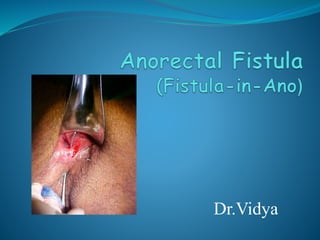
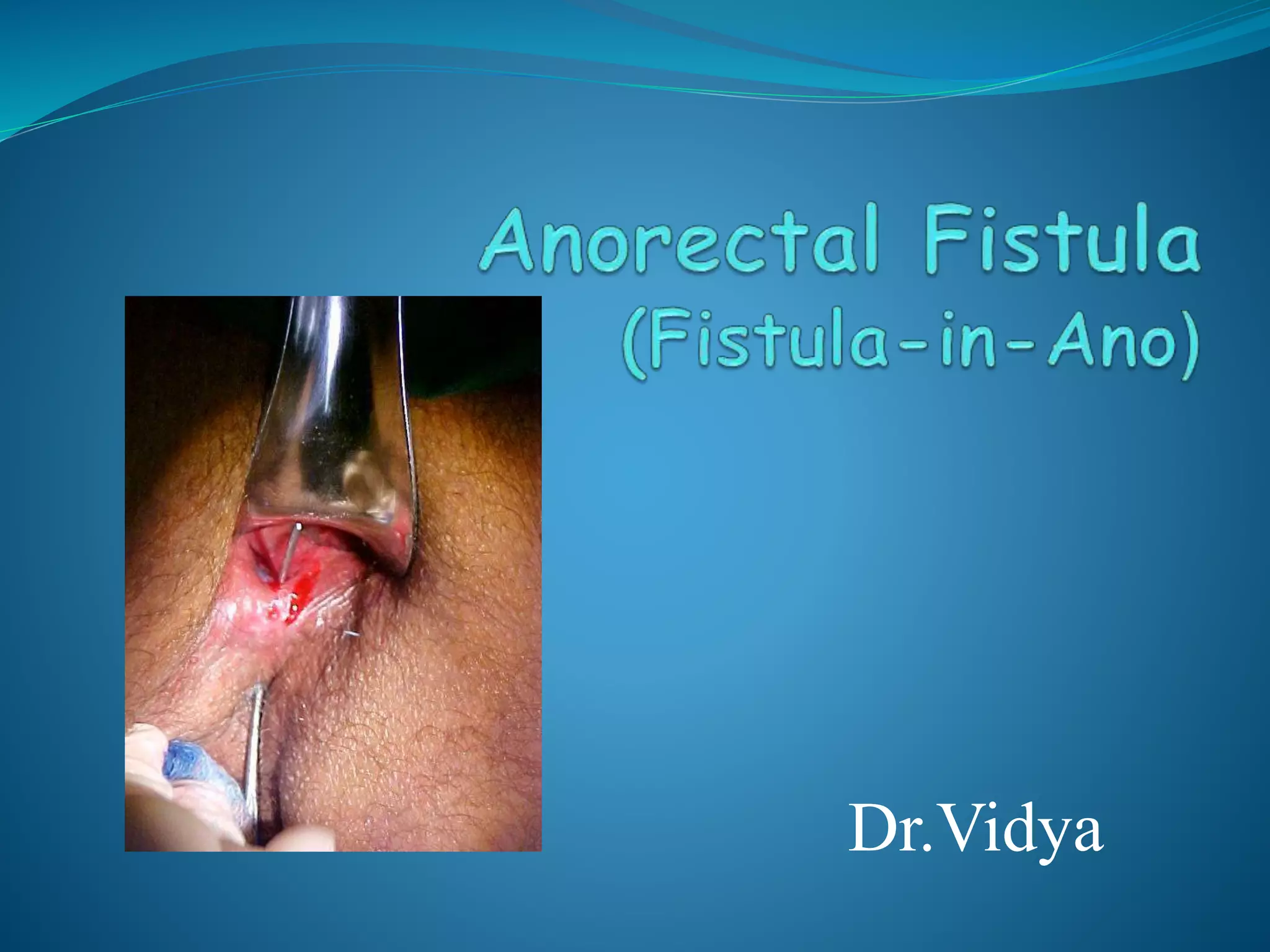
Dr.Vidya
 FISTULA - Abnormal connection b/w two epithelium lined
organs or vessels.
It is generally a disease condition.
It may be surgically created for therapeutic reasons.
 ANORECTAL FISTULA - Abnormal connection b/w
epithelialised surface of anal canal & the Perianal skin.
 Internal opening- Anorectal lumen
 External opening- Perianal skin
 Pre-existing anorectal abscess burst spontaneously .
 Other: rectovesicular, rectovaginal, rectourethral fistula.
Etiology
 Non specific - cryptoglandular in origin
 Specific :
- Crohn’s disease
- tuberculosis
- lymphogranuloma venereum
- actinomycosis
- rectal duplication
- foreign body
- malignancy
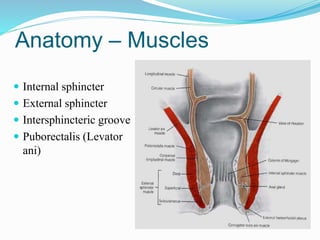
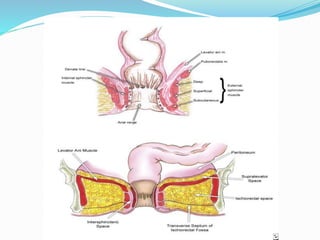
Anatomy – Muscles
 Internal sphincter
 External sphincter
 Intersphincteric groove
 Puborectalis (Levator
ani)
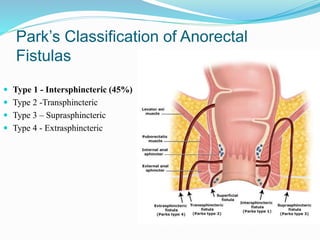
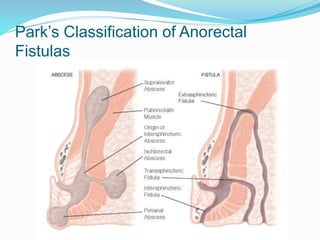
Park’s Classification of Anorectal
Fistulas
 Type 1 - Intersphincteric (45%)
 Type 2 -Transphincteric
 Type 3 – Suprasphincteric
 Type 4 - Extrasphincteric
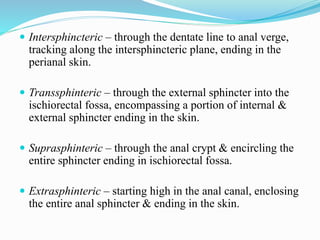
 Intersphincteric – through the dentate line to anal verge,
tracking along the intersphincteric plane, ending in the
perianal skin.
 Transsphinteric – through the external sphincter into the
ischiorectal fossa, encompassing a portion of internal &
external sphincter ending in the skin.
 Suprasphinteric – through the anal crypt & encircling the
entire sphincter ending in ischiorectal fossa.
 Extrasphinteric – starting high in the anal canal, enclosing
the entire anal sphincter & ending in the skin.
Park’s Classification of Anorectal
Fistulas
Clinical Presentation
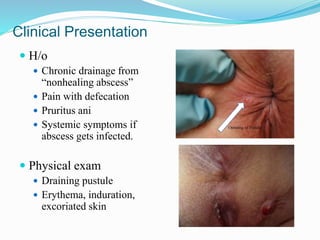
 H/o
 Chronic drainage from
“nonhealing abscess”
 Pain with defecation
 Pruritus ani
 Systemic symptoms if
abscess gets infected.
 Physical exam
 Draining pustule
 Erythema, induration,
excoriated skin
Goodsall’s Rule
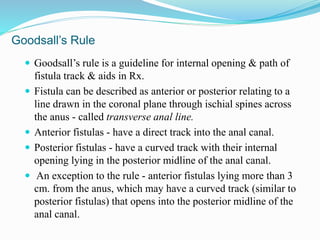
 Goodsall’s rule is a guideline for internal opening & path of
fistula track & aids in Rx.
 Fistula can be described as anterior or posterior relating to a
line drawn in the coronal plane through ischial spines across
the anus - called transverse anal line.
 Anterior fistulas - have a direct track into the anal canal.
 Posterior fistulas - have a curved track with their internal
opening lying in the posterior midline of the anal canal.
 An exception to the rule - anterior fistulas lying more than 3
cm. from the anus, which may have a curved track (similar to
posterior fistulas) that opens into the posterior midline of the
anal canal.
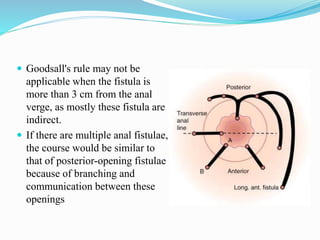
 Goodsall's rule may not be
applicable when the fistula is
more than 3 cm from the anal
verge, as mostly these fistula are
indirect.
 If there are multiple anal fistulae,
the course would be similar to
that of posterior-opening fistulae
because of branching and
communication between these
openings
Diagnosis
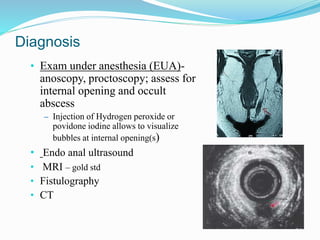
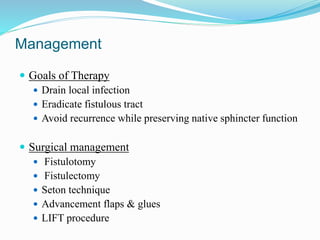
‱ Exam under anesthesia (EUA)-
anoscopy, proctoscopy; assess for
internal opening and occult
abscess
– Injection of Hydrogen peroxide or
povidone iodine allows to visualize
bubbles at internal opening(s)
‱ Endo anal ultrasound
‱ MRI – gold std
‱ Fistulography
‱ CT
Management
 Goals of Therapy
 Drain local infection
 Eradicate fistulous tract
 Avoid recurrence while preserving native sphincter function
 Surgical management
 Fistulotomy
 Fistulectomy
 Seton technique
 Advancement flaps & glues
 LIFT procedure
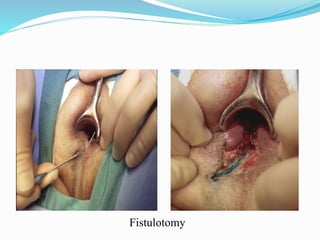
Fistulotomy
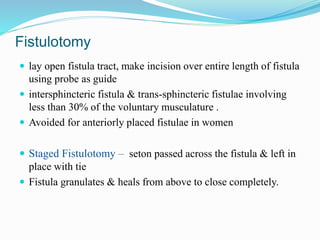
 lay open fistula tract, make incision over entire length of fistula
using probe as guide
 intersphincteric fistula & trans-sphincteric fistulae involving
less than 30% of the voluntary musculature .
 Avoided for anteriorly placed fistulae in women
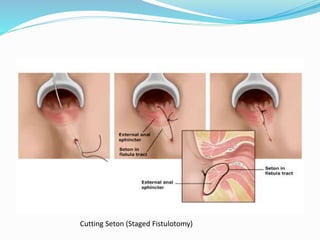
 Staged Fistulotomy – seton passed across the fistula & left in
place with tie
 Fistula granulates & heals from above to close completely.
Fistulotomy
Cutting Seton (Staged Fistulotomy)
Fistulectomy
 involves coring out of the fistula by diathermy cautery
 Better for fistula that cross level of sphincters and the
presence of secondary extensions.
 Post-op: sitz bath, antibiotics, analgesics, laxatives
Setons
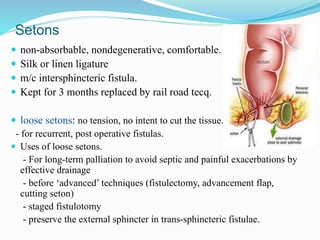
 non-absorbable, nondegenerative, comfortable.
 Silk or linen ligature
 m/c intersphincteric fistula.
 Kept for 3 months replaced by rail road tecq.
 loose setons: no tension, no intent to cut the tissue.
- for recurrent, post operative fistulas.
 Uses of loose setons.
- For long-term palliation to avoid septic and painful exacerbations by
effective drainage
- before ‘advanced’ techniques (fistulectomy, advancement flap,
cutting seton)
- staged fistulotomy
- preserve the external sphincter in trans-sphincteric fistulae.
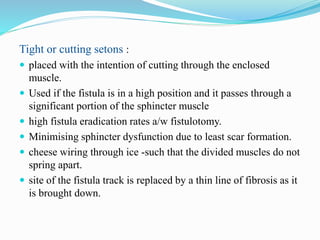
Tight or cutting setons :
 placed with the intention of cutting through the enclosed
muscle.
 Used if the fistula is in a high position and it passes through a
significant portion of the sphincter muscle
 high fistula eradication rates a/w fistulotomy.
 Minimising sphincter dysfunction due to least scar formation.
 cheese wiring through ice -such that the divided muscles do not
spring apart.
 site of the fistula track is replaced by a thin line of fibrosis as it
is brought down.
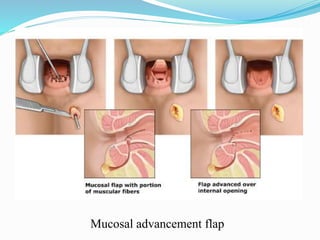
Advancement flaps
 Endorectal advancement flaps:-coring out of the entire
track; and closure of the communication with the anal lumen
with an adequately vascularised flap consisting of mucosa and
internal sphincter, sutured without tension to the anoderm.
 Success rate is variable.
 high recurrence rates are directly related to previous attempts to
correct the fistula.
Mucosal advancement flap
Fibrin plugs & Glues :
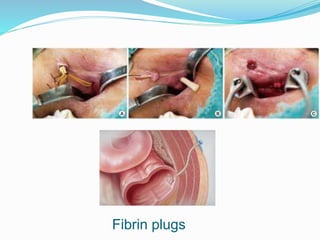
Fibrin plug-
 Plugging the fistula with a device made from small intestinal
submucosa.
 The fistula plug is positioned from the inside of the anus with
suture.
 Success rate with this method is as high as 80%.
 Fistula plug procedure requires hospitalization for only about
24 hours.
Fibrin plugs
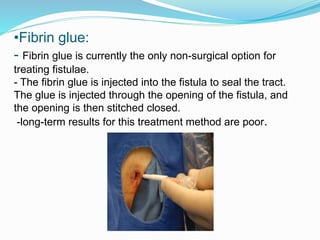
‱Fibrin glue:
- Fibrin glue is currently the only non-surgical option for
treating fistulae.
- The fibrin glue is injected into the fistula to seal the tract.
The glue is injected through the opening of the fistula, and
the opening is then stitched closed.
-long-term results for this treatment method are poor.
LIFT Procedure
 Ligation of intersphinteric fistula tract procedure.
 Based on secure closure of the internal opening and removal
of infected cryptoglandular tissue through the
intersphincteric approach.
 Essential steps -
 incision at the intersphincteric groove
 identification of the intersphincteric tract
ligation of intersphincteric tract close to the internal opening
and removal of intersphincteric tract
 scraping out all granulation tissue in the rest of the fistulous
tract
suturing of the defect at the external sphincter muscle
Differential diagnosis
 Anal carcinoma
 Anorectal abscess
 Constipation
 Diverticular Disease
 Foreign Bodies, Rectum
 Herpes Simplex
 Inflammatory Bowel Disease
 Pilonidal Cyst and Sinus
 Proctitis
Thank you

Anorectal fistula

  • 1.
  • 2.
     FISTULA -Abnormal connection b/w two epithelium lined organs or vessels. It is generally a disease condition. It may be surgically created for therapeutic reasons.  ANORECTAL FISTULA - Abnormal connection b/w epithelialised surface of anal canal & the Perianal skin.  Internal opening- Anorectal lumen  External opening- Perianal skin  Pre-existing anorectal abscess burst spontaneously .  Other: rectovesicular, rectovaginal, rectourethral fistula.
  • 3.
    Etiology  Non specific- cryptoglandular in origin  Specific : - Crohn’s disease - tuberculosis - lymphogranuloma venereum - actinomycosis - rectal duplication - foreign body - malignancy
  • 4.
    Anatomy – Muscles Internal sphincter  External sphincter  Intersphincteric groove  Puborectalis (Levator ani)
  • 6.
    Park’s Classification ofAnorectal Fistulas  Type 1 - Intersphincteric (45%)  Type 2 -Transphincteric  Type 3 – Suprasphincteric  Type 4 - Extrasphincteric
  • 7.
     Intersphincteric –through the dentate line to anal verge, tracking along the intersphincteric plane, ending in the perianal skin.  Transsphinteric – through the external sphincter into the ischiorectal fossa, encompassing a portion of internal & external sphincter ending in the skin.  Suprasphinteric – through the anal crypt & encircling the entire sphincter ending in ischiorectal fossa.  Extrasphinteric – starting high in the anal canal, enclosing the entire anal sphincter & ending in the skin.
  • 8.
  • 9.
    Clinical Presentation  H/o Chronic drainage from “nonhealing abscess”  Pain with defecation  Pruritus ani  Systemic symptoms if abscess gets infected.  Physical exam  Draining pustule  Erythema, induration, excoriated skin
  • 10.
    Goodsall’s Rule  Goodsall’srule is a guideline for internal opening & path of fistula track & aids in Rx.  Fistula can be described as anterior or posterior relating to a line drawn in the coronal plane through ischial spines across the anus - called transverse anal line.  Anterior fistulas - have a direct track into the anal canal.  Posterior fistulas - have a curved track with their internal opening lying in the posterior midline of the anal canal.  An exception to the rule - anterior fistulas lying more than 3 cm. from the anus, which may have a curved track (similar to posterior fistulas) that opens into the posterior midline of the anal canal.
  • 11.
     Goodsall's rulemay not be applicable when the fistula is more than 3 cm from the anal verge, as mostly these fistula are indirect.  If there are multiple anal fistulae, the course would be similar to that of posterior-opening fistulae because of branching and communication between these openings
  • 12.
    Diagnosis ‱ Exam underanesthesia (EUA)- anoscopy, proctoscopy; assess for internal opening and occult abscess – Injection of Hydrogen peroxide or povidone iodine allows to visualize bubbles at internal opening(s) ‱ Endo anal ultrasound ‱ MRI – gold std ‱ Fistulography ‱ CT
  • 13.
    Management  Goals ofTherapy  Drain local infection  Eradicate fistulous tract  Avoid recurrence while preserving native sphincter function  Surgical management  Fistulotomy  Fistulectomy  Seton technique  Advancement flaps & glues  LIFT procedure
  • 14.
    Fistulotomy  lay openfistula tract, make incision over entire length of fistula using probe as guide  intersphincteric fistula & trans-sphincteric fistulae involving less than 30% of the voluntary musculature .  Avoided for anteriorly placed fistulae in women  Staged Fistulotomy – seton passed across the fistula & left in place with tie  Fistula granulates & heals from above to close completely.
  • 15.
  • 16.
  • 17.
    Fistulectomy  involves coringout of the fistula by diathermy cautery  Better for fistula that cross level of sphincters and the presence of secondary extensions.  Post-op: sitz bath, antibiotics, analgesics, laxatives
  • 18.
    Setons  non-absorbable, nondegenerative,comfortable.  Silk or linen ligature  m/c intersphincteric fistula.  Kept for 3 months replaced by rail road tecq.  loose setons: no tension, no intent to cut the tissue. - for recurrent, post operative fistulas.  Uses of loose setons. - For long-term palliation to avoid septic and painful exacerbations by effective drainage - before ‘advanced’ techniques (fistulectomy, advancement flap, cutting seton) - staged fistulotomy - preserve the external sphincter in trans-sphincteric fistulae.
  • 19.
    Tight or cuttingsetons :  placed with the intention of cutting through the enclosed muscle.  Used if the fistula is in a high position and it passes through a significant portion of the sphincter muscle  high fistula eradication rates a/w fistulotomy.  Minimising sphincter dysfunction due to least scar formation.  cheese wiring through ice -such that the divided muscles do not spring apart.  site of the fistula track is replaced by a thin line of fibrosis as it is brought down.
  • 20.
    Advancement flaps  Endorectaladvancement flaps:-coring out of the entire track; and closure of the communication with the anal lumen with an adequately vascularised flap consisting of mucosa and internal sphincter, sutured without tension to the anoderm.  Success rate is variable.  high recurrence rates are directly related to previous attempts to correct the fistula.
  • 21.
  • 22.
    Fibrin plugs &Glues : Fibrin plug-  Plugging the fistula with a device made from small intestinal submucosa.  The fistula plug is positioned from the inside of the anus with suture.  Success rate with this method is as high as 80%.  Fistula plug procedure requires hospitalization for only about 24 hours.
  • 23.
  • 24.
    ‱Fibrin glue: - Fibringlue is currently the only non-surgical option for treating fistulae. - The fibrin glue is injected into the fistula to seal the tract. The glue is injected through the opening of the fistula, and the opening is then stitched closed. -long-term results for this treatment method are poor.
  • 25.
    LIFT Procedure  Ligationof intersphinteric fistula tract procedure.  Based on secure closure of the internal opening and removal of infected cryptoglandular tissue through the intersphincteric approach.  Essential steps -  incision at the intersphincteric groove  identification of the intersphincteric tract ligation of intersphincteric tract close to the internal opening and removal of intersphincteric tract  scraping out all granulation tissue in the rest of the fistulous tract suturing of the defect at the external sphincter muscle
  • 26.
    Differential diagnosis  Analcarcinoma  Anorectal abscess  Constipation  Diverticular Disease  Foreign Bodies, Rectum  Herpes Simplex  Inflammatory Bowel Disease  Pilonidal Cyst and Sinus  Proctitis
  • 27.