By Dr. Ahmed Azhad
Moderator: Dr. Zubair
         2nd July 2012
   Definition
   Anemia – The World Health Organisation
    defines anemia as a hemoglobin level < 130
    g/L (13g/dL) in men and <120g/L (12g/dL)
    in women.
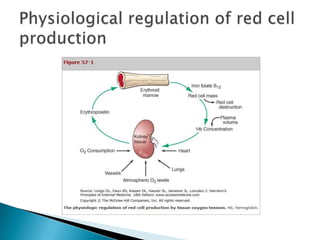
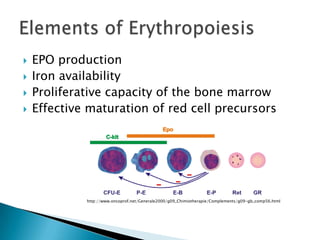
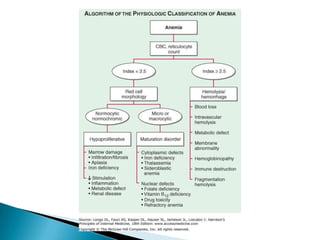
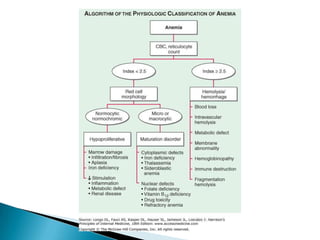
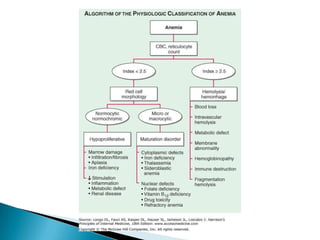
   The critical elements of erythropoesis are
    used for the initial classification of anemia.
   EPO production
   Iron availability
   Proliferative capacity of the bone marrow
   Effective maturation of red cell precursors


             http://www.oncoprof.net/Generale2000/g09_Chimiotherapie/Complements/g09-gb_comp56.html
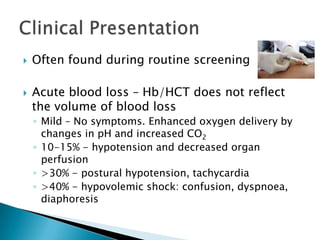
   Often found during routine screening

   Acute blood loss – Hb/HCT does not reflect
    the volume of blood loss
    ◦ Mild – No symptoms. Enhanced oxygen delivery by
      changes in pH and increased CO2
    ◦ 10-15% - hypotension and decreased organ
      perfusion
    ◦ >30% - postural hypotension, tachycardia
    ◦ >40% - hypovolemic shock: confusion, dyspnoea,
      diaphoresis
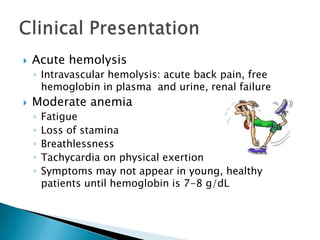
   Acute hemolysis
    ◦ Intravascular hemolysis: acute back pain, free
      hemoglobin in plasma and urine, renal failure
   Moderate anemia
    ◦   Fatigue
    ◦   Loss of stamina
    ◦   Breathlessness
    ◦   Tachycardia on physical exertion
    ◦   Symptoms may not appear in young, healthy
        patients until hemoglobin is 7-8 g/dL
   Diseases in which patient presents with
    anemia
    ◦   Infections
    ◦   Rheumatoid Arthritis
    ◦   Cancer
    ◦   Lymphoproliferative disorders (CLL, B cell
        neoplasm)

   Anemia – a major sign of disease
   Evaluation by History:
    ◦ Symptoms of known diseases causing anemia:
      Gastric ulceration
      Rheumatoid arthritis
      Renal failure
    ◦ Duration of symptoms:
      Hemoglobinopathies in longer duration
    ◦ Treatment history
      Medications for pain, hematinics
    ◦ Nutritional history
◦ Physical examination
    Build, nourishment
    Signs of disease
    Vitals – fever, tachycardia, blood pressure
    Pallor
    Jaundice
    Lymphadenopathy
    Bone tenderness
    Petechiae
    CVS: Flow murmurs
    RS: Dyspnoea
    Abdomen: Splenomegaly
   Hb, Hematocrit
   RBC count
   MCV (Hct x 10 / RBC x 106)     [ 90±8 fl ]
   MCH (Hb x 10 / RBC x 106)     [ 30 ± 3 pg ]
   MCHC (MCH/MCV)                [ 33 ± 2 % ]
   Reticulocyte count

   Indices vary with age, gender and pregnancy

   WBC count including differential count, neutrophil
    segment count

   Platelet count
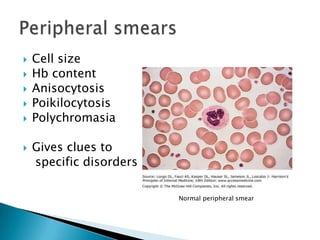
   Cell size
   Hb content
   Anisocytosis
   Poikilocytosis
   Polychromasia

   Gives clues to
    specific disorders

                         Normal peripheral smear
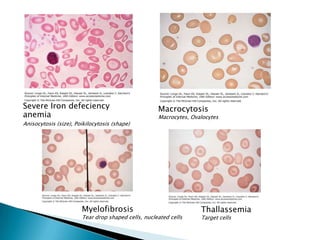
Severe Iron defeciency                              Macrocytosis
anemia                                              Macrocytes, Ovalocytes
Anisocytosis (size), Poikilocytosis (shape)


                       Myelofibrosis                               Thallassemia
                       Tear drop shaped cells, nucleated cells     Target cells
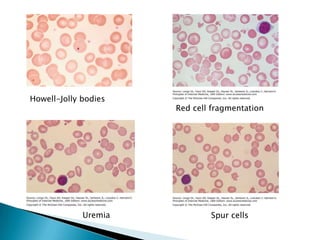
Howell-Jolly bodies
                      Red cell fragmentation


             Uremia           Spur cells
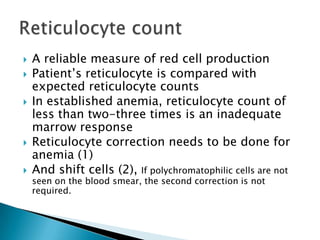
   A reliable measure of red cell production
   Patient’s reticulocyte is compared with
    expected reticulocyte counts
   In established anemia, reticulocyte count of
    less than two-three times is an inadequate
    marrow response
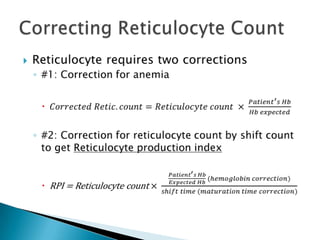
   Reticulocyte correction needs to be done for
    anemia (1)
   And shift cells (2), If polychromatophilic cells are not
    seen on the blood smear, the second correction is not
    required.

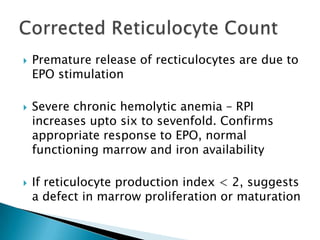
   Premature release of recticulocytes are due to
    EPO stimulation

   Severe chronic hemolytic anemia – RPI
    increases upto six to sevenfold. Confirms
    appropriate response to EPO, normal
    functioning marrow and iron availability

   If reticulocyte production index < 2, suggests
    a defect in marrow proliferation or maturation
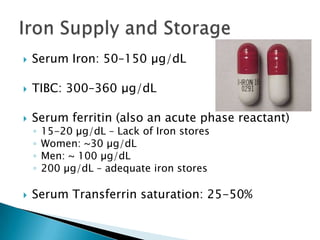
   Serum Iron: 50–150 µg/dL

   TIBC: 300–360 μg/dL

   Serum ferritin (also an acute phase reactant)
    ◦   15-20 µg/dL – Lack of Iron stores
    ◦   Women: ~30 µg/dL
    ◦   Men: ~ 100 µg/dL
    ◦   200 µg/dL – adequate iron stores

   Serum Transferrin saturation: 25-50%
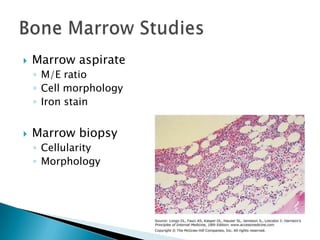
   Marrow aspirate
    ◦ M/E ratio
    ◦ Cell morphology
    ◦ Iron stain


   Marrow biopsy
    ◦ Cellularity
    ◦ Morphology
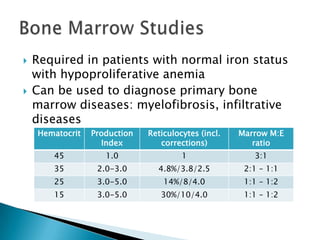
   Required in patients with normal iron status
    with hypoproliferative anemia
   Can be used to diagnose primary bone
    marrow diseases: myelofibrosis, infiltrative
    diseases
    Hematocrit   Production   Reticulocytes (incl.   Marrow M:E
                   Index         corrections)           ratio
       45           1.0                1                3:1
       35         2.0-3.0       4.8%/3.8/2.5          2:1 – 1:1
       25         3.0-5.0         14%/8/4.0           1:1 – 1:2
       15         3.0-5.0        30%/10/4.0           1:1 – 1:2
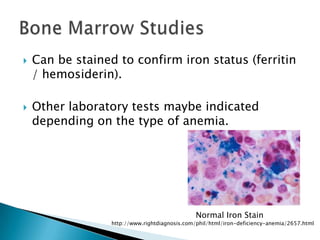
   Can be stained to confirm iron status (ferritin
    / hemosiderin).

   Other laboratory tests maybe indicated
    depending on the type of anemia.


                                               Normal Iron Stain
                  http://www.rightdiagnosis.com/phil/html/iron-deficiency-anemia/2657.html
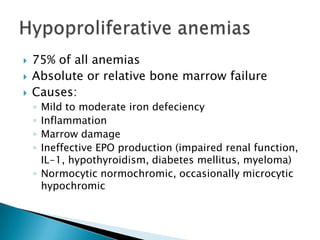
   75% of all anemias
   Absolute or relative bone marrow failure
   Causes:
    ◦ Mild to moderate iron defeciency
    ◦ Inflammation
    ◦ Marrow damage
    ◦ Ineffective EPO production (impaired renal function,
      IL-1, hypothyroidism, diabetes mellitus, myeloma)
    ◦ Normocytic normochromic, occasionally microcytic
      hypochromic
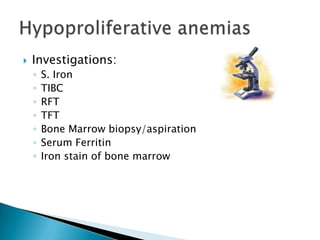
   Investigations:
    ◦   S. Iron
    ◦   TIBC
    ◦   RFT
    ◦   TFT
    ◦   Bone Marrow biopsy/aspiration
    ◦   Serum Ferritin
    ◦   Iron stain of bone marrow
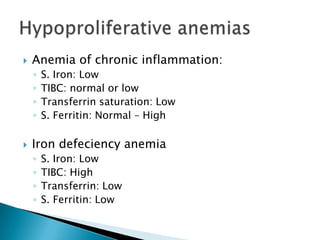
   Anemia of chronic inflammation:
    ◦   S. Iron: Low
    ◦   TIBC: normal or low
    ◦   Transferrin saturation: Low
    ◦   S. Ferritin: Normal – High

   Iron defeciency anemia
    ◦   S. Iron: Low
    ◦   TIBC: High
    ◦   Transferrin: Low
    ◦   S. Ferritin: Low
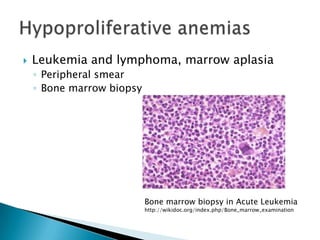
   Leukemia and lymphoma, marrow aplasia
    ◦ Peripheral smear
    ◦ Bone marrow biopsy


                           Bone marrow biopsy in Acute Leukemia
                           http://wikidoc.org/index.php/Bone_marrow_examination
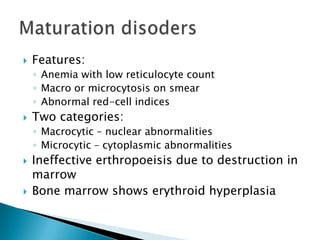
   Features:
    ◦ Anemia with low reticulocyte count
    ◦ Macro or microcytosis on smear
    ◦ Abnormal red-cell indices
   Two categories:
    ◦ Macrocytic – nuclear abnormalities
    ◦ Microcytic – cytoplasmic abnormalities
   Ineffective erthropoeisis due to destruction in
    marrow
   Bone marrow shows erythroid hyperplasia
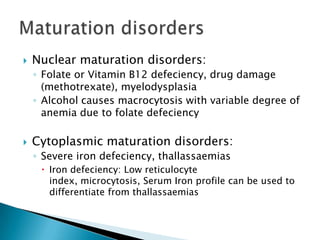
   Nuclear maturation disorders:
    ◦ Folate or Vitamin B12 defeciency, drug damage
      (methotrexate), myelodysplasia
    ◦ Alcohol causes macrocytosis with variable degree of
      anemia due to folate defeciency

   Cytoplasmic maturation disorders:
    ◦ Severe iron defeciency, thallassaemias
      Iron defeciency: Low reticulocyte
       index, microcytosis, Serum Iron profile can be used to
       differentiate from thallassaemias
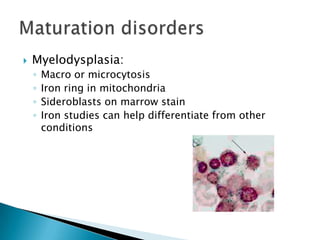
   Myelodysplasia:
    ◦   Macro or microcytosis
    ◦   Iron ring in mitochondria
    ◦   Sideroblasts on marrow stain
    ◦   Iron studies can help differentiate from other
        conditions
   Red cell production indices > 2.5 or normal
   Polychromatophilic macrocytes on smear
   Red cells indices: Normocytic to Macrocytic
    due to increased reticulocytes

   Acute blood loss: Not associated with
    increased reticulocyte production because of
    time required for EPO production
   Subacute blood loss: Moderate reticulocytosis
   Chronic blood loss: Iron defeciency with
    increased red cell production
   Least common form of anemia
   High reticulocyte count – marrow able to sustain
    erythropoesis with efficient recycling of iron in
    case of extravascular hemolysis
   Intravascular hemolysis – Paroxysmal nocturnal
    hemoglobinuria – Loss of iron may limit marrow
    response

   Hemoglobinopathies like sickle cell
    disease/thallassemias present a mixed picture
    and may have a high reticulocyte count which is
    low compared to marrow hyperplasia.
   Acute: specific patterns like autoimmune
    hemolysis, glutathione reductase.
   Inherited hemolytic anemias: have a lifelong
    history of typical of disease process
   Chronic hemolytic diseases like hereditary
    spherocytosis may present with complication
    of increased red cell destruction (bilrubin
    gallstones, splenomegaly).
   Susceptible to aplastic crises
   Differential diagnosis of acute or chronic
    hemolysis requires careful investigation of
    family history and specialised laboratory tests
    like hemoglobin electrophoresis or screening
    for red cell enzymes.
   Acquired defects in red cell survival – may
    requires testing of indirect antiglobulin test,
    cold agglutinin titres to detect hemolytic
    antibodies or complement mediated
    destruction.
   Mild to moderate anemia: Treatment once
    specific diagnosis in made
   Acute causes may require treatment before
    diagnosis is made.
   Some causes of anemia are multifactoral and
    it is important to check iron status before and
    during treatment.
   43yrs / F, k/c/o Beta Thal Carrier
   Generalised weakness x 7 days
   Hb – 6.4g% (17/6)
   7.0/26.4% on admission, 7 days later after
    starting Mumfer
   Tot RBC: 4.42 x 10⁶ cells/mm3
   MCV – 60 fl [78-98]
   MCH – 16pg [27-32]
   MCHC 27% [31-34]
   TLC: 8000cells/cumm, N46 L44 M7 E2.1 B0.1
   Plt: 289,000/cumm
   RBC: Microcytic Hypochromic with many
    ovalocytes, few dacryocytes and schistocytes
   WBC: normal maturation
   Platelets: adequate in number
   Parasites: not seen

   Corrected Retic count = 4 x 9/12 = 3
   Harrison’s Principles of Internal Medicine,
    18th Edition
Approach to Anemia

Approach to Anemia

  • 1.
    By Dr. AhmedAzhad Moderator: Dr. Zubair 2nd July 2012
  • 2.
    Definition
  • 3.
    Anemia – The World Health Organisation defines anemia as a hemoglobin level < 130 g/L (13g/dL) in men and <120g/L (12g/dL) in women.  The critical elements of erythropoesis are used for the initial classification of anemia.
  • 5.
    EPO production  Iron availability  Proliferative capacity of the bone marrow  Effective maturation of red cell precursors http://www.oncoprof.net/Generale2000/g09_Chimiotherapie/Complements/g09-gb_comp56.html
  • 6.
    Often found during routine screening  Acute blood loss – Hb/HCT does not reflect the volume of blood loss ◦ Mild – No symptoms. Enhanced oxygen delivery by changes in pH and increased CO2 ◦ 10-15% - hypotension and decreased organ perfusion ◦ >30% - postural hypotension, tachycardia ◦ >40% - hypovolemic shock: confusion, dyspnoea, diaphoresis
  • 7.
    Acute hemolysis ◦ Intravascular hemolysis: acute back pain, free hemoglobin in plasma and urine, renal failure  Moderate anemia ◦ Fatigue ◦ Loss of stamina ◦ Breathlessness ◦ Tachycardia on physical exertion ◦ Symptoms may not appear in young, healthy patients until hemoglobin is 7-8 g/dL
  • 8.
    Diseases in which patient presents with anemia ◦ Infections ◦ Rheumatoid Arthritis ◦ Cancer ◦ Lymphoproliferative disorders (CLL, B cell neoplasm)  Anemia – a major sign of disease
  • 9.
    Evaluation by History: ◦ Symptoms of known diseases causing anemia:  Gastric ulceration  Rheumatoid arthritis  Renal failure ◦ Duration of symptoms:  Hemoglobinopathies in longer duration ◦ Treatment history  Medications for pain, hematinics ◦ Nutritional history
  • 10.
    ◦ Physical examination  Build, nourishment  Signs of disease  Vitals – fever, tachycardia, blood pressure  Pallor  Jaundice  Lymphadenopathy  Bone tenderness  Petechiae  CVS: Flow murmurs  RS: Dyspnoea  Abdomen: Splenomegaly
  • 11.
    Hb, Hematocrit  RBC count  MCV (Hct x 10 / RBC x 106) [ 90±8 fl ]  MCH (Hb x 10 / RBC x 106) [ 30 ± 3 pg ]  MCHC (MCH/MCV) [ 33 ± 2 % ]  Reticulocyte count  Indices vary with age, gender and pregnancy  WBC count including differential count, neutrophil segment count  Platelet count
  • 12.
    Cell size  Hb content  Anisocytosis  Poikilocytosis  Polychromasia  Gives clues to specific disorders Normal peripheral smear
  • 13.
    Severe Iron defeciency Macrocytosis anemia Macrocytes, Ovalocytes Anisocytosis (size), Poikilocytosis (shape) Myelofibrosis Thallassemia Tear drop shaped cells, nucleated cells Target cells
  • 14.
    Howell-Jolly bodies Red cell fragmentation Uremia Spur cells
  • 15.
    A reliable measure of red cell production  Patient’s reticulocyte is compared with expected reticulocyte counts  In established anemia, reticulocyte count of less than two-three times is an inadequate marrow response  Reticulocyte correction needs to be done for anemia (1)  And shift cells (2), If polychromatophilic cells are not seen on the blood smear, the second correction is not required.
  • 16.
  • 17.
    Premature release of recticulocytes are due to EPO stimulation  Severe chronic hemolytic anemia – RPI increases upto six to sevenfold. Confirms appropriate response to EPO, normal functioning marrow and iron availability  If reticulocyte production index < 2, suggests a defect in marrow proliferation or maturation
  • 18.
    Serum Iron: 50–150 µg/dL  TIBC: 300–360 μg/dL  Serum ferritin (also an acute phase reactant) ◦ 15-20 µg/dL – Lack of Iron stores ◦ Women: ~30 µg/dL ◦ Men: ~ 100 µg/dL ◦ 200 µg/dL – adequate iron stores  Serum Transferrin saturation: 25-50%
  • 19.
    Marrow aspirate ◦ M/E ratio ◦ Cell morphology ◦ Iron stain  Marrow biopsy ◦ Cellularity ◦ Morphology
  • 20.
    Required in patients with normal iron status with hypoproliferative anemia  Can be used to diagnose primary bone marrow diseases: myelofibrosis, infiltrative diseases Hematocrit Production Reticulocytes (incl. Marrow M:E Index corrections) ratio 45 1.0 1 3:1 35 2.0-3.0 4.8%/3.8/2.5 2:1 – 1:1 25 3.0-5.0 14%/8/4.0 1:1 – 1:2 15 3.0-5.0 30%/10/4.0 1:1 – 1:2
  • 21.
    Can be stained to confirm iron status (ferritin / hemosiderin).  Other laboratory tests maybe indicated depending on the type of anemia. Normal Iron Stain http://www.rightdiagnosis.com/phil/html/iron-deficiency-anemia/2657.html
  • 23.
    75% of all anemias  Absolute or relative bone marrow failure  Causes: ◦ Mild to moderate iron defeciency ◦ Inflammation ◦ Marrow damage ◦ Ineffective EPO production (impaired renal function, IL-1, hypothyroidism, diabetes mellitus, myeloma) ◦ Normocytic normochromic, occasionally microcytic hypochromic
  • 24.
    Investigations: ◦ S. Iron ◦ TIBC ◦ RFT ◦ TFT ◦ Bone Marrow biopsy/aspiration ◦ Serum Ferritin ◦ Iron stain of bone marrow
  • 25.
    Anemia of chronic inflammation: ◦ S. Iron: Low ◦ TIBC: normal or low ◦ Transferrin saturation: Low ◦ S. Ferritin: Normal – High  Iron defeciency anemia ◦ S. Iron: Low ◦ TIBC: High ◦ Transferrin: Low ◦ S. Ferritin: Low
  • 26.
    Leukemia and lymphoma, marrow aplasia ◦ Peripheral smear ◦ Bone marrow biopsy Bone marrow biopsy in Acute Leukemia http://wikidoc.org/index.php/Bone_marrow_examination
  • 28.
    Features: ◦ Anemia with low reticulocyte count ◦ Macro or microcytosis on smear ◦ Abnormal red-cell indices  Two categories: ◦ Macrocytic – nuclear abnormalities ◦ Microcytic – cytoplasmic abnormalities  Ineffective erthropoeisis due to destruction in marrow  Bone marrow shows erythroid hyperplasia
  • 29.
    Nuclear maturation disorders: ◦ Folate or Vitamin B12 defeciency, drug damage (methotrexate), myelodysplasia ◦ Alcohol causes macrocytosis with variable degree of anemia due to folate defeciency  Cytoplasmic maturation disorders: ◦ Severe iron defeciency, thallassaemias  Iron defeciency: Low reticulocyte index, microcytosis, Serum Iron profile can be used to differentiate from thallassaemias
  • 30.
    Myelodysplasia: ◦ Macro or microcytosis ◦ Iron ring in mitochondria ◦ Sideroblasts on marrow stain ◦ Iron studies can help differentiate from other conditions
  • 32.
    Red cell production indices > 2.5 or normal  Polychromatophilic macrocytes on smear  Red cells indices: Normocytic to Macrocytic due to increased reticulocytes  Acute blood loss: Not associated with increased reticulocyte production because of time required for EPO production  Subacute blood loss: Moderate reticulocytosis  Chronic blood loss: Iron defeciency with increased red cell production
  • 33.
    Least common form of anemia  High reticulocyte count – marrow able to sustain erythropoesis with efficient recycling of iron in case of extravascular hemolysis  Intravascular hemolysis – Paroxysmal nocturnal hemoglobinuria – Loss of iron may limit marrow response  Hemoglobinopathies like sickle cell disease/thallassemias present a mixed picture and may have a high reticulocyte count which is low compared to marrow hyperplasia.
  • 34.
    Acute: specific patterns like autoimmune hemolysis, glutathione reductase.  Inherited hemolytic anemias: have a lifelong history of typical of disease process  Chronic hemolytic diseases like hereditary spherocytosis may present with complication of increased red cell destruction (bilrubin gallstones, splenomegaly).  Susceptible to aplastic crises
  • 35.
    Differential diagnosis of acute or chronic hemolysis requires careful investigation of family history and specialised laboratory tests like hemoglobin electrophoresis or screening for red cell enzymes.  Acquired defects in red cell survival – may requires testing of indirect antiglobulin test, cold agglutinin titres to detect hemolytic antibodies or complement mediated destruction.
  • 36.
    Mild to moderate anemia: Treatment once specific diagnosis in made  Acute causes may require treatment before diagnosis is made.  Some causes of anemia are multifactoral and it is important to check iron status before and during treatment.
  • 37.
    43yrs / F, k/c/o Beta Thal Carrier  Generalised weakness x 7 days  Hb – 6.4g% (17/6)  7.0/26.4% on admission, 7 days later after starting Mumfer  Tot RBC: 4.42 x 10⁶ cells/mm3  MCV – 60 fl [78-98]  MCH – 16pg [27-32]  MCHC 27% [31-34]  TLC: 8000cells/cumm, N46 L44 M7 E2.1 B0.1  Plt: 289,000/cumm
  • 38.
    RBC: Microcytic Hypochromic with many ovalocytes, few dacryocytes and schistocytes  WBC: normal maturation  Platelets: adequate in number  Parasites: not seen  Corrected Retic count = 4 x 9/12 = 3
  • 39.
    Harrison’s Principles of Internal Medicine, 18th Edition