Thalassemia in OBGYN
Introduction
• Thalassemia refers to a spectrum of diseases characterized by reduced or absent
production of one or more globin chains
• Greek word thalassa – sea
• inherited in an autosomal recessive manner
• Epidemiology
– Common: sub-Saharan Africa, the Asian-Indian subcontinent, Southeast Asia, and the
Mediterranean region
– Thalassemia is the most common hemoglobinopathy
• Pathology
– abnormal production of globin chains
– production can be diminished or can be absent for one or more of the globin chains
– imbalance of globin chain production impairs the production of normal hemoglobin →
ineffective erythropoiesis → Anemia
2
• Classification – based on deficient globin chain
– AlphaThalassemia and Beta Thalassemia
• The diagnosis of a thalassemia is best confirmed by globin gene
testing
– If no DNA testing → HB electrophoresis
• hypochromic microcytic anemia is the hallmark of the thalassemia
syndromes
• Preconception and prenatal testing
– Indications for preimplantation genetic diagnosis (PGD)
• individuals with thalassemia and their first-degree relatives
• likelihood of thalassemia based on ethnicity, country of origin, or any other patient
concerns
– In endemic areas, counseling and other prevention strategies have reduced
the incidence of new cases by up to 80 percent
3
• Prognosis of thalassemia
– is highly variable
– Survival - increase with advances in therapy
– Cardiovascular complications are the major cause of death in thalassemia
major
• Pregnancy & thalassemia
– favorable outcomes: thalassemia minor and intermedia
– In beta thalassemia major - pursue pregnancy only if they have normal
cardiac function and have undergone chronic transfusion therapy with iron
chelation
4
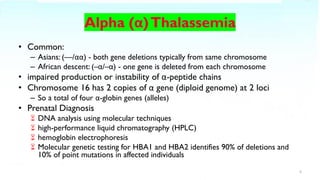
• Common:
– Asians: (––/αα) - both gene deletions typically from same chromosome
– African descent: (–α/–α) - one gene is deleted from each chromosome
• impaired production or instability of α-peptide chains
• Chromosome 16 has 2 copies of α gene (diploid genome) at 2 loci
– So a total of four α-globin genes (alleles)
• Prenatal Diagnosis
 DNA analysis using molecular techniques
 high-performance liquid chromatography (HPLC)
 hemoglobin electrophoresis
 Molecular genetic testing for HBA1 and HBA2 identifies 90% of deletions and
10% of point mutations in affected individuals
5
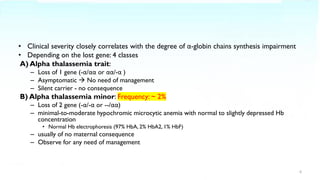
• Clinical severity closely correlates with the degree of α-globin chains synthesis impairment
• Depending on the lost gene: 4 classes
A) Alpha thalassemia trait:
– Loss of 1 gene (-α/αα or αα/-α )
– Asymptomatic → No need of management
– Silent carrier - no consequence
B) Alpha thalassemia minor: Frequency: ~ 2%
– Loss of 2 gene (-α/-α or --/αα)
– minimal-to-moderate hypochromic microcytic anemia with normal to slightly depressed Hb
concentration
• Normal Hb electrophoresis (97% HbA, 2% HbA2, 1% HbF)
– usually of no maternal consequence
– Observe for any need of management
6
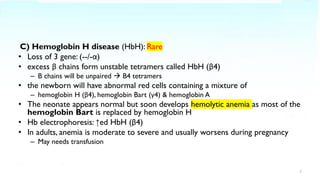
C) Hemoglobin H disease (HbH): Rare
• Loss of 3 gene: (--/-α)
• excess β chains form unstable tetramers called HbH (β4)
– B chains will be unpaired → B4 tetramers
• the newborn will have abnormal red cells containing a mixture of
– hemoglobin H (β4), hemoglobin Bart (γ4) & hemoglobin A
• The neonate appears normal but soon develops hemolytic anemia as most of the
hemoglobin Bart is replaced by hemoglobin H
• Hb electrophoresis: ↑ed HbH (β4)
• In adults, anemia is moderate to severe and usually worsens during pregnancy
– May needs transfusion
7
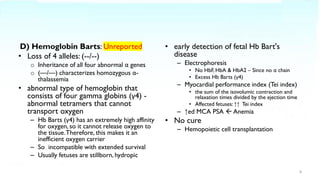
D) Hemoglobin Barts: Unreported
• Loss of 4 alleles: (--/--)
o Inheritance of all four abnormal α genes
o (––/––) characterizes homozygous α-
thalassemia
• abnormal type of hemoglobin that
consists of four gamma globins (γ4) -
abnormal tetramers that cannot
transport oxygen
– Hb Barts (γ4) has an extremely high affinity
for oxygen, so it cannot release oxygen to
the tissue.Therefore, this makes it an
inefficient oxygen carrier
– So incompatible with extended survival
– Usually fetuses are stillborn, hydropic
• early detection of fetal Hb Bart's
disease
– Electrophoresis
• No HbF, HbA & HbA2 – Since no α chain
• Excess Hb Barts (γ4)
– Myocardial performance index (Tei index)
• the sum of the isovolumic contraction and
relaxation times divided by the ejection time
• Affected fetuses: ↑↑ Tei index
– ↑ed MCA PSA  Anemia
• No cure
– Hemopoietic cell transplantation
8
• impaired β-globin chain production instability
• Genes that encode control of β-globin synthesis are in the δγβ-gene
“cluster” located on chromosome 11
• Prenatal diagnosis
– Difficult, since it is caused by numerous mutations
– identification of the familial mutation
– Chorionic villus sampling
– Noninvasive testing of circulating fetal nucleic acids in maternal plasma
• HB electrophoresis
– ↑ed HbF and/or HbA2
– But it doesn’t specify which β thalassemia is
9
• Based on amount of affected β-gene
– Three classes
1) Beta thalassemia minor or thalassemia trait
• Only one gene is damaged
• most commonly encountered
• less severe anemia (hypochromic, microcytic)
– Normal iron study
– Hb electrophoresis: ↓ HbA, ↑ed HbA2 (>3.5%) & ↑HbF (> 2%)
• 50% chance of passing the gene to their children
2) β-Thalassemia intermedia
• α/β chain imbalance and symptoms fall between those observed in β-thalassemia minor and β-thalassemia major
– There is co inheritance with α thalassemia trait
– Minor qualitative defect of β globin
– ↑↑HbF (α2, γ2) – since no β globin
• No need for regular transfusion therapy
10
3) Beta thalassemia major (Cooley's
anemia)
• no β-globin production - serious and
frequently fatal
• α globins precipitate & form hemotetramers
• In bone marrow those RBC containing
tetramers will die early (Ineffective
erythropoiesis)
• Spleen destroy RBC with tetramer →
Hemolysis
– Physiologic response: ↑ EPO production which
leads to erythroid hyperplasia
o Medullary ➔
 Skull: Hair-on- end” sign or “crew cut” appearance
 Marrow overgrowth in maxillary bone - Chipmunk
facies
 ribs and the bones of the extremities - box-like
 Osteopenia/osteoporosis
 Bone pain
o extra medullary: ➔ Hepatosplenomegaly
• Hemolysis → unconjugated hyperbilirubinemia
Treatment
• Usually Blood transfusion dependent
– This will result in iron overload (Hemosiderosis)
and secondary Hemochromatosis
o So need Iron chelation therapy to help excrete
excess iron
• Splenectomy: If the hypersplenism is
accompanied with leucopenia and
thrombocytopenia
• Manage Orofacial defects and malocclusions
• Best Rx
– Allogeneic hematopoietic cell transplantation
(Stem cell transplantation) is a potentially curative
therapy for thalassemia that may be appropriate
for those with severe disease
• Pregnancy
– Need transfusion (maintain Hb ≥ 10) + Iron
chelation
– 63 pregnancies were reported and suffered no
serious complications
– Pregnancy is considered reasonably safe if
maternal cardiac function is normal
11
Hair-on- end” sign or “crew
cut” appearance
• long, thin vertical lines that
cross the thickened calvarium
beyond the outer table looking
like hair standing on end
• marked calvarial thickening,
external displacement and
thinning of the inner table
12
Chipmunk facies
• include frontal bossing,
maxillary expansion, saddle
nose, and depressed cranial
vault
• Due to extramedullary
hematopoiesis
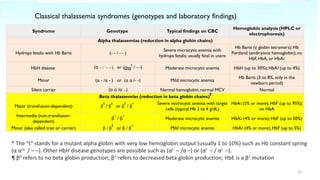
Classical thalassemia syndromes (genotypes and laboratory findings)
13
Syndrome Genotype Typical findings on CBC
Hemoglobin analysis (HPLC or
electrophoresis)
Alpha thalassemias (reduction in alpha globin chains)
Hydrops fetalis with Hb Barts (- - / - - )
Severe microcytic anemia with
hydrops fetalis; usually fatal in utero
Hb Barts (γ globin tetramers); Hb
Portland (embryonic hemoglobin); no
HbF, HbA, or HbA2
HbH disease (α - / - -) or (αα
t
/ - -) Moderate microcytic anemia HbH (up to 30%); HbA2 (up to 4%)
Minor (α - /α - ) or (α α /- -) Mild microcytic anemia
Hb Barts (3 to 8%, only in the
newborn period)
Silent carrier (α α /α -) Normal hemoglobin, normal MCV Normal
Beta thalassemias (reduction in beta globin chains)

Major (transfusion-dependent) β
0
/ β
0
or β
0
/ β
+ Severe microcytic anemia with target
cells (typical Hb 3 to 4 g/dL)
HbA2 (5% or more); HbF (up to 95%);
no HbA
Intermedia (non-transfusion-
dependent)
β
+
/ β
+
Moderate microcytic anemia HbA2 (4% or more); HbF (up to 50%)
Minor (also called trait or carrier) β / β
0
or β / β
+
Mild microcytic anemia HbA2 (4% or more); HbF (up to 5%)
* The "t" stands for a mutant alpha globin with very low hemoglobin output (usually 1 to 10%) such as Hb constant spring
(α αcs / – –). Other HbH disease genotypes are possible such as (αt – /α –) or (αt – / αt –).
¶ β0 refers to no beta globin production; β+ refers to decreased beta globin production; HbE is a β+ mutation
Complications of Thalassemia
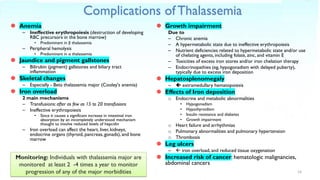
 Anemia
– Ineffective erythropoiesis (destruction of developing
RBC precursors in the bone marrow)
• Predominant in β thalassemia
– Peripheral hemolysis
• Predominant in α thalassemia
 Jaundice and pigment gallstones
– Bilirubin (pigment) gallstones and biliary tract
inflammation
 Skeletal changes
– Especially - Beta thalassemia major (Cooley's anemia)
 Iron overload
2 main mechanisms
– Transfusions: after as few as 15 to 20 transfusions
– Ineffective erythropoiesis
• Since it causes a significant increase in intestinal iron
absorption by an incompletely understood mechanism
thought to involve reduced levels of hepcidin
– Iron overload can affect the heart, liver, kidneys,
endocrine organs (thyroid, pancreas, gonads), and bone
marrow
 Growth impairment
Due to
– Chronic anemia
– A hypermetabolic state due to ineffective erythropoiesis
– Nutrient deficiencies related to hypermetabolic state and/or use
of chelating agents, including folate, zinc, and vitamin E
– Toxicities of excess iron stores and/or iron chelation therapy
– Endocrinopathies (eg, hypogonadism with delayed puberty),
typically due to excess iron deposition
 Hepatosplenomegaly
–  extramedullary hematopoiesis
 Effects of Iron deposition
o Endocrine and metabolic abnormalities
• Hypogonadism
• Hypothyroidism
• Insulin resistance and diabetes
• Growth impairment
o Heart failure and arrhythmias
o Pulmonary abnormalities and pulmonary hypertension
o Thrombosis
 Leg ulcers
–  iron overload, and reduced tissue oxygenation
 Increased risk of cancer: hematologic malignancies,
abdominal cancers
14
Monitoring: Individuals with thalassemia major are
monitored at least 2 -4 times a year to monitor
progression of any of the major morbidities
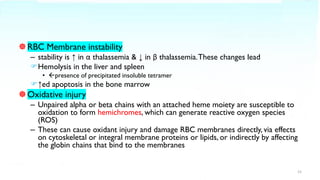
RBC Membrane instability
– stability is ↑ in α thalassemia & ↓ in β thalassemia.These changes lead
Hemolysis in the liver and spleen
• presence of precipitated insoluble tetramer
↑ed apoptosis in the bone marrow
Oxidative injury
– Unpaired alpha or beta chains with an attached heme moiety are susceptible to
oxidation to form hemichromes, which can generate reactive oxygen species
(ROS)
– These can cause oxidant injury and damage RBC membranes directly, via effects
on cytoskeletal or integral membrane proteins or lipids, or indirectly by affecting
the globin chains that bind to the membranes
15
References
• UpToDate 2021
• Williams Obstetrics 25th Edition
16

Thalassemia in OBGYN (July 2021)

  • 1.
  • 2.
    Introduction • Thalassemia refersto a spectrum of diseases characterized by reduced or absent production of one or more globin chains • Greek word thalassa – sea • inherited in an autosomal recessive manner • Epidemiology – Common: sub-Saharan Africa, the Asian-Indian subcontinent, Southeast Asia, and the Mediterranean region – Thalassemia is the most common hemoglobinopathy • Pathology – abnormal production of globin chains – production can be diminished or can be absent for one or more of the globin chains – imbalance of globin chain production impairs the production of normal hemoglobin → ineffective erythropoiesis → Anemia 2
  • 3.
    • Classification –based on deficient globin chain – AlphaThalassemia and Beta Thalassemia • The diagnosis of a thalassemia is best confirmed by globin gene testing – If no DNA testing → HB electrophoresis • hypochromic microcytic anemia is the hallmark of the thalassemia syndromes • Preconception and prenatal testing – Indications for preimplantation genetic diagnosis (PGD) • individuals with thalassemia and their first-degree relatives • likelihood of thalassemia based on ethnicity, country of origin, or any other patient concerns – In endemic areas, counseling and other prevention strategies have reduced the incidence of new cases by up to 80 percent 3
  • 4.
    • Prognosis ofthalassemia – is highly variable – Survival - increase with advances in therapy – Cardiovascular complications are the major cause of death in thalassemia major • Pregnancy & thalassemia – favorable outcomes: thalassemia minor and intermedia – In beta thalassemia major - pursue pregnancy only if they have normal cardiac function and have undergone chronic transfusion therapy with iron chelation 4
  • 5.
    • Common: – Asians:(––/αα) - both gene deletions typically from same chromosome – African descent: (–α/–α) - one gene is deleted from each chromosome • impaired production or instability of α-peptide chains • Chromosome 16 has 2 copies of α gene (diploid genome) at 2 loci – So a total of four α-globin genes (alleles) • Prenatal Diagnosis  DNA analysis using molecular techniques  high-performance liquid chromatography (HPLC)  hemoglobin electrophoresis  Molecular genetic testing for HBA1 and HBA2 identifies 90% of deletions and 10% of point mutations in affected individuals 5
  • 6.
    • Clinical severityclosely correlates with the degree of α-globin chains synthesis impairment • Depending on the lost gene: 4 classes A) Alpha thalassemia trait: – Loss of 1 gene (-α/αα or αα/-α ) – Asymptomatic → No need of management – Silent carrier - no consequence B) Alpha thalassemia minor: Frequency: ~ 2% – Loss of 2 gene (-α/-α or --/αα) – minimal-to-moderate hypochromic microcytic anemia with normal to slightly depressed Hb concentration • Normal Hb electrophoresis (97% HbA, 2% HbA2, 1% HbF) – usually of no maternal consequence – Observe for any need of management 6
  • 7.
    C) Hemoglobin Hdisease (HbH): Rare • Loss of 3 gene: (--/-α) • excess β chains form unstable tetramers called HbH (β4) – B chains will be unpaired → B4 tetramers • the newborn will have abnormal red cells containing a mixture of – hemoglobin H (β4), hemoglobin Bart (γ4) & hemoglobin A • The neonate appears normal but soon develops hemolytic anemia as most of the hemoglobin Bart is replaced by hemoglobin H • Hb electrophoresis: ↑ed HbH (β4) • In adults, anemia is moderate to severe and usually worsens during pregnancy – May needs transfusion 7
  • 8.
    D) Hemoglobin Barts:Unreported • Loss of 4 alleles: (--/--) o Inheritance of all four abnormal α genes o (––/––) characterizes homozygous α- thalassemia • abnormal type of hemoglobin that consists of four gamma globins (γ4) - abnormal tetramers that cannot transport oxygen – Hb Barts (γ4) has an extremely high affinity for oxygen, so it cannot release oxygen to the tissue.Therefore, this makes it an inefficient oxygen carrier – So incompatible with extended survival – Usually fetuses are stillborn, hydropic • early detection of fetal Hb Bart's disease – Electrophoresis • No HbF, HbA & HbA2 – Since no α chain • Excess Hb Barts (γ4) – Myocardial performance index (Tei index) • the sum of the isovolumic contraction and relaxation times divided by the ejection time • Affected fetuses: ↑↑ Tei index – ↑ed MCA PSA  Anemia • No cure – Hemopoietic cell transplantation 8
  • 9.
    • impaired β-globinchain production instability • Genes that encode control of β-globin synthesis are in the δγβ-gene “cluster” located on chromosome 11 • Prenatal diagnosis – Difficult, since it is caused by numerous mutations – identification of the familial mutation – Chorionic villus sampling – Noninvasive testing of circulating fetal nucleic acids in maternal plasma • HB electrophoresis – ↑ed HbF and/or HbA2 – But it doesn’t specify which β thalassemia is 9
  • 10.
    • Based onamount of affected β-gene – Three classes 1) Beta thalassemia minor or thalassemia trait • Only one gene is damaged • most commonly encountered • less severe anemia (hypochromic, microcytic) – Normal iron study – Hb electrophoresis: ↓ HbA, ↑ed HbA2 (>3.5%) & ↑HbF (> 2%) • 50% chance of passing the gene to their children 2) β-Thalassemia intermedia • α/β chain imbalance and symptoms fall between those observed in β-thalassemia minor and β-thalassemia major – There is co inheritance with α thalassemia trait – Minor qualitative defect of β globin – ↑↑HbF (α2, γ2) – since no β globin • No need for regular transfusion therapy 10
  • 11.
    3) Beta thalassemiamajor (Cooley's anemia) • no β-globin production - serious and frequently fatal • α globins precipitate & form hemotetramers • In bone marrow those RBC containing tetramers will die early (Ineffective erythropoiesis) • Spleen destroy RBC with tetramer → Hemolysis – Physiologic response: ↑ EPO production which leads to erythroid hyperplasia o Medullary ➔  Skull: Hair-on- end” sign or “crew cut” appearance  Marrow overgrowth in maxillary bone - Chipmunk facies  ribs and the bones of the extremities - box-like  Osteopenia/osteoporosis  Bone pain o extra medullary: ➔ Hepatosplenomegaly • Hemolysis → unconjugated hyperbilirubinemia Treatment • Usually Blood transfusion dependent – This will result in iron overload (Hemosiderosis) and secondary Hemochromatosis o So need Iron chelation therapy to help excrete excess iron • Splenectomy: If the hypersplenism is accompanied with leucopenia and thrombocytopenia • Manage Orofacial defects and malocclusions • Best Rx – Allogeneic hematopoietic cell transplantation (Stem cell transplantation) is a potentially curative therapy for thalassemia that may be appropriate for those with severe disease • Pregnancy – Need transfusion (maintain Hb ≥ 10) + Iron chelation – 63 pregnancies were reported and suffered no serious complications – Pregnancy is considered reasonably safe if maternal cardiac function is normal 11
  • 12.
    Hair-on- end” signor “crew cut” appearance • long, thin vertical lines that cross the thickened calvarium beyond the outer table looking like hair standing on end • marked calvarial thickening, external displacement and thinning of the inner table 12 Chipmunk facies • include frontal bossing, maxillary expansion, saddle nose, and depressed cranial vault • Due to extramedullary hematopoiesis
  • 13.
    Classical thalassemia syndromes(genotypes and laboratory findings) 13 Syndrome Genotype Typical findings on CBC Hemoglobin analysis (HPLC or electrophoresis) Alpha thalassemias (reduction in alpha globin chains) Hydrops fetalis with Hb Barts (- - / - - ) Severe microcytic anemia with hydrops fetalis; usually fatal in utero Hb Barts (γ globin tetramers); Hb Portland (embryonic hemoglobin); no HbF, HbA, or HbA2 HbH disease (α - / - -) or (αα t / - -) Moderate microcytic anemia HbH (up to 30%); HbA2 (up to 4%) Minor (α - /α - ) or (α α /- -) Mild microcytic anemia Hb Barts (3 to 8%, only in the newborn period) Silent carrier (α α /α -) Normal hemoglobin, normal MCV Normal Beta thalassemias (reduction in beta globin chains) ¶ Major (transfusion-dependent) β 0 / β 0 or β 0 / β + Severe microcytic anemia with target cells (typical Hb 3 to 4 g/dL) HbA2 (5% or more); HbF (up to 95%); no HbA Intermedia (non-transfusion- dependent) β + / β + Moderate microcytic anemia HbA2 (4% or more); HbF (up to 50%) Minor (also called trait or carrier) β / β 0 or β / β + Mild microcytic anemia HbA2 (4% or more); HbF (up to 5%) * The "t" stands for a mutant alpha globin with very low hemoglobin output (usually 1 to 10%) such as Hb constant spring (α αcs / – –). Other HbH disease genotypes are possible such as (αt – /α –) or (αt – / αt –). ¶ β0 refers to no beta globin production; β+ refers to decreased beta globin production; HbE is a β+ mutation
  • 14.
    Complications of Thalassemia Anemia – Ineffective erythropoiesis (destruction of developing RBC precursors in the bone marrow) • Predominant in β thalassemia – Peripheral hemolysis • Predominant in α thalassemia  Jaundice and pigment gallstones – Bilirubin (pigment) gallstones and biliary tract inflammation  Skeletal changes – Especially - Beta thalassemia major (Cooley's anemia)  Iron overload 2 main mechanisms – Transfusions: after as few as 15 to 20 transfusions – Ineffective erythropoiesis • Since it causes a significant increase in intestinal iron absorption by an incompletely understood mechanism thought to involve reduced levels of hepcidin – Iron overload can affect the heart, liver, kidneys, endocrine organs (thyroid, pancreas, gonads), and bone marrow  Growth impairment Due to – Chronic anemia – A hypermetabolic state due to ineffective erythropoiesis – Nutrient deficiencies related to hypermetabolic state and/or use of chelating agents, including folate, zinc, and vitamin E – Toxicities of excess iron stores and/or iron chelation therapy – Endocrinopathies (eg, hypogonadism with delayed puberty), typically due to excess iron deposition  Hepatosplenomegaly –  extramedullary hematopoiesis  Effects of Iron deposition o Endocrine and metabolic abnormalities • Hypogonadism • Hypothyroidism • Insulin resistance and diabetes • Growth impairment o Heart failure and arrhythmias o Pulmonary abnormalities and pulmonary hypertension o Thrombosis  Leg ulcers –  iron overload, and reduced tissue oxygenation  Increased risk of cancer: hematologic malignancies, abdominal cancers 14 Monitoring: Individuals with thalassemia major are monitored at least 2 -4 times a year to monitor progression of any of the major morbidities
  • 15.
    RBC Membrane instability –stability is ↑ in α thalassemia & ↓ in β thalassemia.These changes lead Hemolysis in the liver and spleen • presence of precipitated insoluble tetramer ↑ed apoptosis in the bone marrow Oxidative injury – Unpaired alpha or beta chains with an attached heme moiety are susceptible to oxidation to form hemichromes, which can generate reactive oxygen species (ROS) – These can cause oxidant injury and damage RBC membranes directly, via effects on cytoskeletal or integral membrane proteins or lipids, or indirectly by affecting the globin chains that bind to the membranes 15
  • 16.
    References • UpToDate 2021 •Williams Obstetrics 25th Edition 16