EMBEDDING
SUNIL KUMAR.P
St.John’s Medical College
Bangalore
10/13/2018 1
SUNIL KUMAR.P ST.JOHN'S MEDICAL
COLLEGE
Introduction
• Embedding is the process in which the tissues
or the specimens are enclosed in a mass of
the embedding medium using a mould.
• Since the tissue blocks are very thin in
thickness they need a supporting medium in
which the tissue blocks are embedded.
• This supporting medium is called embedding
medium.
10/13/2018 2
SUNIL KUMAR.P ST.JOHN'S MEDICAL
COLLEGE
The Choice of Embedding medium
depends upon
• 1. Type of Microscope
• 2. Type of Microtome
• 3.Type of Tissue. Eg : Hard tissue like Bone or
Soft tissue liver biopsy.
10/13/2018 3
SUNIL KUMAR.P ST.JOHN'S MEDICAL
COLLEGE
TYPES OF EMBEDDING MEDIUMS/
AGENTS
• 1.Paraffin wax
• 2.Celloidin
• 3.Resin
• 4.Agar
• 5.Gelatin
• 6.Carbowax
• 7.Methacrylate
10/13/2018 4
SUNIL KUMAR.P ST.JOHN'S MEDICAL
COLLEGE
PARAFFIN WAX
• Paraffin wax with higher melting point (56-
62oC) is used for embedding.
• The molten wax is filtered inside the oven
through a course filter paper into another
container.
• This will protect the knife edge.
10/13/2018 5
SUNIL KUMAR.P ST.JOHN'S MEDICAL
COLLEGE
AGAR EMBEDDING
• It is mainly used in double embedding.
• Multiple fragments and friable tissue may be
impregnated in one block when sectioning on
the cryostat.
• Another use of agar embedding is for FNAC
specimens.
10/13/2018 6
SUNIL KUMAR.P ST.JOHN'S MEDICAL
COLLEGE
CELLOIDIN MEDIA
• Celloidin is a purified form of nitrocellulose.
• It is used for cutting hard tissues.
10/13/2018 7
SUNIL KUMAR.P ST.JOHN'S MEDICAL
COLLEGE
GELATIN
• Its melting point is less than the melting point
of agar.
• Gelatin may be used when frozen sections are
required on friable and necrotic tissues.
10/13/2018 8
SUNIL KUMAR.P ST.JOHN'S MEDICAL
COLLEGE
TYPES OF MOULDS
• A variety of moulds are used for embedding .
• - These may be LEUKHARD embedding mould
(L mould)
• - Paper Blocks
• - Plastic moulds
10/13/2018 9
SUNIL KUMAR.P ST.JOHN'S MEDICAL
COLLEGE
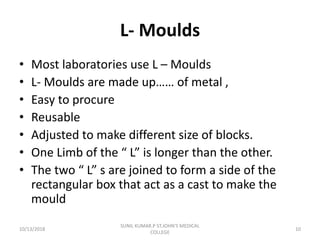
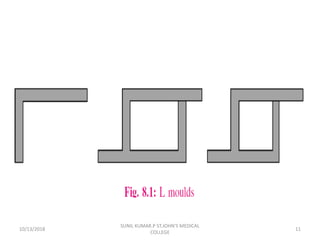
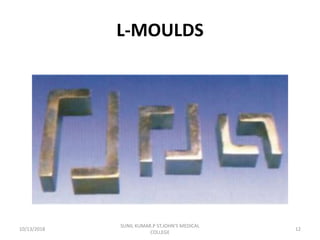
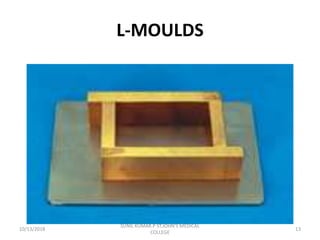
L- Moulds
• Most laboratories use L – Moulds
• L- Moulds are made up…… of metal ,
• Easy to procure
• Reusable
• Adjusted to make different size of blocks.
• One Limb of the “ L” is longer than the other.
• The two “ L” s are joined to form a side of the
rectangular box that act as a cast to make the
mould
10/13/2018 10
SUNIL KUMAR.P ST.JOHN'S MEDICAL
COLLEGE
10/13/2018 11
SUNIL KUMAR.P ST.JOHN'S MEDICAL
COLLEGE
L-MOULDS
10/13/2018 12
SUNIL KUMAR.P ST.JOHN'S MEDICAL
COLLEGE
L-MOULDS
10/13/2018 13
SUNIL KUMAR.P ST.JOHN'S MEDICAL
COLLEGE
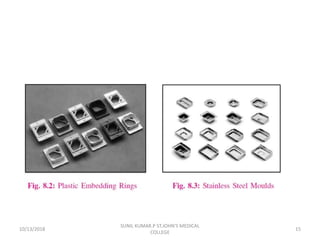
PLASTIC MOULDS
• Most of the laboratories use plastic
embedding rings now.
• These are relatively inexpensive Convenient &
Support the block during sectioning And are
designed to fit it on the microtome.
• This eliminates the step of mounting or
attaching the block on a holder
10/13/2018 14
SUNIL KUMAR.P ST.JOHN'S MEDICAL
COLLEGE
10/13/2018 15
SUNIL KUMAR.P ST.JOHN'S MEDICAL
COLLEGE
TISSUE-TEK SYSTEM OR MARK 1
SYSTEM
• In this system plastic embedding rings with
stainless steel moulds allow rapid embedding
and cutting of tissues.
• The disadvantage of this method is space
required for storage is more.
10/13/2018 16
SUNIL KUMAR.P ST.JOHN'S MEDICAL
COLLEGE
10/13/2018 17
SUNIL KUMAR.P ST.JOHN'S MEDICAL
COLLEGE
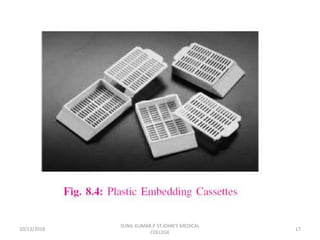
ADVANTAGES OF PLASTIC CASSESTS
• Since the cassette is processed with the
tissues and afterwards used for embedding,
the writing has to be done once.
• Cassettes are thin so less wax is required.
• The space required for filing the blocks is less
10/13/2018 18
SUNIL KUMAR.P ST.JOHN'S MEDICAL
COLLEGE
Disadvantages
• A special clamp has to be used in the
microtome for this technique.
• The cassettes are shallow hence thin sections
should be taken for processing
10/13/2018 19
SUNIL KUMAR.P ST.JOHN'S MEDICAL
COLLEGE
PARAFFIN WAX ADDITIVES
• Various substances can be added to paraffin
wax in order to modify its consistency and
melting point to improve the efficiency during
microscopy.
• Additives increase the hardness of blocks
• This helps in cutting thinner sections at higher
temperature.
10/13/2018 20
SUNIL KUMAR.P ST.JOHN'S MEDICAL
COLLEGE
Commonly used additives
• Ceresin
• Bees’ wax
• Bayberry wax
10/13/2018 21
SUNIL KUMAR.P ST.JOHN'S MEDICAL
COLLEGE
Tissue embedding machine
• All the blocking steps can be performed with
the help of tissue embedding machine.
• The embedding machine contains the
following parts –
• 1.Mould warmer
• 2.cassette bath working surface warmer with
a nozzle for pouring the wax
• 3. forceps well and cold plate.
10/13/2018 22
SUNIL KUMAR.P ST.JOHN'S MEDICAL
COLLEGE
• ( The cold plate is of high efficiency
refrigeration system having temperature
control ranging from different freezing points
to 4 or 5 degree C.)
• It can occupy about 50-60 blocks.
• 4.Large 3-5 litre capacity paraffin reservoir
with adjustable temperature of 45- 75 degree
C.
10/13/2018 23
SUNIL KUMAR.P ST.JOHN'S MEDICAL
COLLEGE
• 5.Optional vacuum lids, which allows for
vacuum infiltration of tissues.
• 6.It has a forceps warmer convenient drain for
excess wax.
• The embedding machines are available with
many other features.
10/13/2018 24
SUNIL KUMAR.P ST.JOHN'S MEDICAL
COLLEGE
Method of Embedding
• 1.Open the tissue cassette, check requisition form entry to ensure
the correct number of tissue pieces is present.
• 2. Select the mould; there should be sufficient room for the tissue
with allowance for at least a 2 mm surrounding margin of wax.
• 3.Leuckhart mould method-This is the traditional embedding
method.
• 4.The “L moulds are adjusted according to the shape and size of the
tissue.
• Glycerine may be applied to the L pieces and also to the metal or
glass plate on which the moulds are placed for embedding. Simple
glossed wall or floor tiles may also be used in place of glass plate.
• Fill the mould with paraffin wax.
10/13/2018 25
SUNIL KUMAR.P ST.JOHN'S MEDICAL
COLLEGE
• 5.Using warm forceps select the tissue, taking care that
it does not cool in the air; at the same time, Place the
tissue in the mould according to the side to be
sectioned.
• 6.This side should be facing down against the mould. A
small amount of pressure may be used in order to have
more even embedding.
• 7. Chill the mould on the cold plate, orienting the
tissue and firming it into the wax with warmed forceps.
This ensures that the correct orientation is maintained
and the tissue surface to be sectioned is kept flat.
10/13/2018 26
SUNIL KUMAR.P ST.JOHN'S MEDICAL
COLLEGE
• 7. Insert the identifying label or place the
labelled embedding ring or cassette base onto
the mould
• 8. Add more paraffin into the mould to fill the
cassette and mould.
• 9. Cool the block on the cold plate.
• 10. Remove the block from the mould.
• 11. Cross check block, label and requisition
form.
10/13/2018 27
SUNIL KUMAR.P ST.JOHN'S MEDICAL
COLLEGE
Orientation of different tissue
• During embedding the orientation of tissue is
important.
• Correct orientation of tissue in a mould is the
most important step in embedding.
• Incorrect placement of tissues may result in
diagnostically important tissue elements being
missed or damaged during microtomy.
• During embedding it is important to orient the
tissue in a way that will provide the best
information to the pathologist.
10/13/2018 28
SUNIL KUMAR.P ST.JOHN'S MEDICAL
COLLEGE
• At the time of grossing, mark with India ink
may be put on the side of the tissue opposite
that to be cut.
• The embedding should be done according to
the type of tissue.
• The requisition form should always be read
during embedding for proper orientation.
10/13/2018 29
SUNIL KUMAR.P ST.JOHN'S MEDICAL
COLLEGE

Embedding

  • 1.
    EMBEDDING SUNIL KUMAR.P St.John’s MedicalCollege Bangalore 10/13/2018 1 SUNIL KUMAR.P ST.JOHN'S MEDICAL COLLEGE
  • 2.
    Introduction • Embedding isthe process in which the tissues or the specimens are enclosed in a mass of the embedding medium using a mould. • Since the tissue blocks are very thin in thickness they need a supporting medium in which the tissue blocks are embedded. • This supporting medium is called embedding medium. 10/13/2018 2 SUNIL KUMAR.P ST.JOHN'S MEDICAL COLLEGE
  • 3.
    The Choice ofEmbedding medium depends upon • 1. Type of Microscope • 2. Type of Microtome • 3.Type of Tissue. Eg : Hard tissue like Bone or Soft tissue liver biopsy. 10/13/2018 3 SUNIL KUMAR.P ST.JOHN'S MEDICAL COLLEGE
  • 4.
    TYPES OF EMBEDDINGMEDIUMS/ AGENTS • 1.Paraffin wax • 2.Celloidin • 3.Resin • 4.Agar • 5.Gelatin • 6.Carbowax • 7.Methacrylate 10/13/2018 4 SUNIL KUMAR.P ST.JOHN'S MEDICAL COLLEGE
  • 5.
    PARAFFIN WAX • Paraffinwax with higher melting point (56- 62oC) is used for embedding. • The molten wax is filtered inside the oven through a course filter paper into another container. • This will protect the knife edge. 10/13/2018 5 SUNIL KUMAR.P ST.JOHN'S MEDICAL COLLEGE
  • 6.
    AGAR EMBEDDING • Itis mainly used in double embedding. • Multiple fragments and friable tissue may be impregnated in one block when sectioning on the cryostat. • Another use of agar embedding is for FNAC specimens. 10/13/2018 6 SUNIL KUMAR.P ST.JOHN'S MEDICAL COLLEGE
  • 7.
    CELLOIDIN MEDIA • Celloidinis a purified form of nitrocellulose. • It is used for cutting hard tissues. 10/13/2018 7 SUNIL KUMAR.P ST.JOHN'S MEDICAL COLLEGE
  • 8.
    GELATIN • Its meltingpoint is less than the melting point of agar. • Gelatin may be used when frozen sections are required on friable and necrotic tissues. 10/13/2018 8 SUNIL KUMAR.P ST.JOHN'S MEDICAL COLLEGE
  • 9.
    TYPES OF MOULDS •A variety of moulds are used for embedding . • - These may be LEUKHARD embedding mould (L mould) • - Paper Blocks • - Plastic moulds 10/13/2018 9 SUNIL KUMAR.P ST.JOHN'S MEDICAL COLLEGE
  • 10.
    L- Moulds • Mostlaboratories use L – Moulds • L- Moulds are made up…… of metal , • Easy to procure • Reusable • Adjusted to make different size of blocks. • One Limb of the “ L” is longer than the other. • The two “ L” s are joined to form a side of the rectangular box that act as a cast to make the mould 10/13/2018 10 SUNIL KUMAR.P ST.JOHN'S MEDICAL COLLEGE
  • 11.
    10/13/2018 11 SUNIL KUMAR.PST.JOHN'S MEDICAL COLLEGE
  • 12.
    L-MOULDS 10/13/2018 12 SUNIL KUMAR.PST.JOHN'S MEDICAL COLLEGE
  • 13.
    L-MOULDS 10/13/2018 13 SUNIL KUMAR.PST.JOHN'S MEDICAL COLLEGE
  • 14.
    PLASTIC MOULDS • Mostof the laboratories use plastic embedding rings now. • These are relatively inexpensive Convenient & Support the block during sectioning And are designed to fit it on the microtome. • This eliminates the step of mounting or attaching the block on a holder 10/13/2018 14 SUNIL KUMAR.P ST.JOHN'S MEDICAL COLLEGE
  • 15.
    10/13/2018 15 SUNIL KUMAR.PST.JOHN'S MEDICAL COLLEGE
  • 16.
    TISSUE-TEK SYSTEM ORMARK 1 SYSTEM • In this system plastic embedding rings with stainless steel moulds allow rapid embedding and cutting of tissues. • The disadvantage of this method is space required for storage is more. 10/13/2018 16 SUNIL KUMAR.P ST.JOHN'S MEDICAL COLLEGE
  • 17.
    10/13/2018 17 SUNIL KUMAR.PST.JOHN'S MEDICAL COLLEGE
  • 18.
    ADVANTAGES OF PLASTICCASSESTS • Since the cassette is processed with the tissues and afterwards used for embedding, the writing has to be done once. • Cassettes are thin so less wax is required. • The space required for filing the blocks is less 10/13/2018 18 SUNIL KUMAR.P ST.JOHN'S MEDICAL COLLEGE
  • 19.
    Disadvantages • A specialclamp has to be used in the microtome for this technique. • The cassettes are shallow hence thin sections should be taken for processing 10/13/2018 19 SUNIL KUMAR.P ST.JOHN'S MEDICAL COLLEGE
  • 20.
    PARAFFIN WAX ADDITIVES •Various substances can be added to paraffin wax in order to modify its consistency and melting point to improve the efficiency during microscopy. • Additives increase the hardness of blocks • This helps in cutting thinner sections at higher temperature. 10/13/2018 20 SUNIL KUMAR.P ST.JOHN'S MEDICAL COLLEGE
  • 21.
    Commonly used additives •Ceresin • Bees’ wax • Bayberry wax 10/13/2018 21 SUNIL KUMAR.P ST.JOHN'S MEDICAL COLLEGE
  • 22.
    Tissue embedding machine •All the blocking steps can be performed with the help of tissue embedding machine. • The embedding machine contains the following parts – • 1.Mould warmer • 2.cassette bath working surface warmer with a nozzle for pouring the wax • 3. forceps well and cold plate. 10/13/2018 22 SUNIL KUMAR.P ST.JOHN'S MEDICAL COLLEGE
  • 23.
    • ( Thecold plate is of high efficiency refrigeration system having temperature control ranging from different freezing points to 4 or 5 degree C.) • It can occupy about 50-60 blocks. • 4.Large 3-5 litre capacity paraffin reservoir with adjustable temperature of 45- 75 degree C. 10/13/2018 23 SUNIL KUMAR.P ST.JOHN'S MEDICAL COLLEGE
  • 24.
    • 5.Optional vacuumlids, which allows for vacuum infiltration of tissues. • 6.It has a forceps warmer convenient drain for excess wax. • The embedding machines are available with many other features. 10/13/2018 24 SUNIL KUMAR.P ST.JOHN'S MEDICAL COLLEGE
  • 25.
    Method of Embedding •1.Open the tissue cassette, check requisition form entry to ensure the correct number of tissue pieces is present. • 2. Select the mould; there should be sufficient room for the tissue with allowance for at least a 2 mm surrounding margin of wax. • 3.Leuckhart mould method-This is the traditional embedding method. • 4.The “L moulds are adjusted according to the shape and size of the tissue. • Glycerine may be applied to the L pieces and also to the metal or glass plate on which the moulds are placed for embedding. Simple glossed wall or floor tiles may also be used in place of glass plate. • Fill the mould with paraffin wax. 10/13/2018 25 SUNIL KUMAR.P ST.JOHN'S MEDICAL COLLEGE
  • 26.
    • 5.Using warmforceps select the tissue, taking care that it does not cool in the air; at the same time, Place the tissue in the mould according to the side to be sectioned. • 6.This side should be facing down against the mould. A small amount of pressure may be used in order to have more even embedding. • 7. Chill the mould on the cold plate, orienting the tissue and firming it into the wax with warmed forceps. This ensures that the correct orientation is maintained and the tissue surface to be sectioned is kept flat. 10/13/2018 26 SUNIL KUMAR.P ST.JOHN'S MEDICAL COLLEGE
  • 27.
    • 7. Insertthe identifying label or place the labelled embedding ring or cassette base onto the mould • 8. Add more paraffin into the mould to fill the cassette and mould. • 9. Cool the block on the cold plate. • 10. Remove the block from the mould. • 11. Cross check block, label and requisition form. 10/13/2018 27 SUNIL KUMAR.P ST.JOHN'S MEDICAL COLLEGE
  • 28.
    Orientation of differenttissue • During embedding the orientation of tissue is important. • Correct orientation of tissue in a mould is the most important step in embedding. • Incorrect placement of tissues may result in diagnostically important tissue elements being missed or damaged during microtomy. • During embedding it is important to orient the tissue in a way that will provide the best information to the pathologist. 10/13/2018 28 SUNIL KUMAR.P ST.JOHN'S MEDICAL COLLEGE
  • 29.
    • At thetime of grossing, mark with India ink may be put on the side of the tissue opposite that to be cut. • The embedding should be done according to the type of tissue. • The requisition form should always be read during embedding for proper orientation. 10/13/2018 29 SUNIL KUMAR.P ST.JOHN'S MEDICAL COLLEGE