Understanding Heat Transfer,
Conduction, Convection and
Radiation
Heat Transfer
• Heat always moves from a warmer place to
a cooler place.
• Hot objects in a cooler room will cool to
room temperature.
• Cold objects in a warmer room will heat up
to room temperature.
Question
• If a cup of coffee and a red ice-cream were
left on the table in this room what would
happen to them? Why?
• The cup of coffee will cool until it reaches
room temperature. The ice-cream will melt
and then the liquid will warm to room
temperature.
What is Heat Transfer?
• Thermal energy is related to the temperature of matter.
• For a given material and mass, the higher the temperature,
the greater its thermal energy.
• Heat transfer is a study of the exchange of thermal energy
through a body or between bodies which occurs when
there is a temperature difference.
• When system and its surroundings are at different
temperatures, thermal energy transfers from the one with
higher temperature to the one with lower temperature.
• Thermal Energy always travels from hot to cold.
• This spontaneous act is called Heat Action or Heat
Transfer.
Heat Transfer Between System & Surroundings
• Heat transfer is typically given the symbol Q, and is
expressed in joules (J) in SI units.
• The rate of heat transfer is measured in watts (W), equal to
joules per second, and is denoted by Q.
• The heat flux, or the rate of heat transfer per unit area, is
measured in watts per area (W/m2), and uses q" for the
symbol.
Heat Transfer in Manufacturing
• The need/role of heat transfer is a two fold issue.
• Heat Transfer by design.
– Casting
– Hot working
– Sintering
• Heat Transfer due to unavoidable conditions.
– Machining process.
What Causes Heat Transfer in Machining?
• First, almost all (90%-100%) of the work consumed in
a machining operation finally convert into the thermal
energy.
• There are several sources of thermal energy
in cutting with a sharp tool:
• Viscous dissipation transformed into heat if the cut
material are viscoplastic.
• Work done by friction converted to heat.
• Ambient heat source sometimes need be considered if
thermal deformation is concerned.
• In non-traditional machining, other types of heat
sources exist
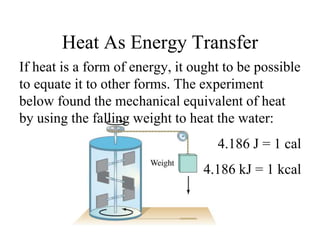
If heat is a form of energy, it ought to be possible
to equate it to other forms. The experiment
below found the mechanical equivalent of heat
by using the falling weight to heat the water:
4.186 J = 1 cal
4.186 kJ = 1 kcal
Heat As Energy Transfer
Heat Transfer Methods
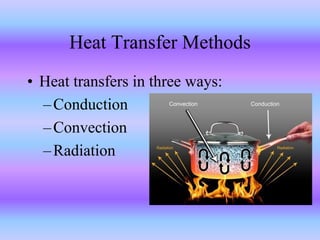
• Heat transfers in three ways:
–Conduction
–Convection
–Radiation
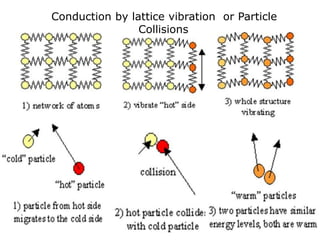
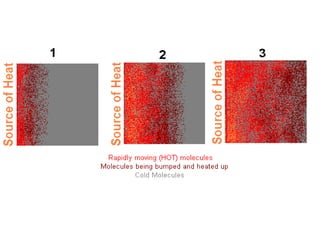
Conduction
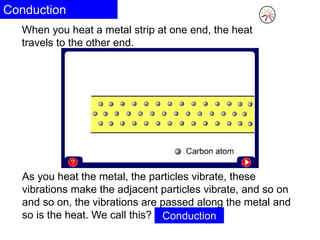
When you heat a metal strip at one end, the heat
travels to the other end.
As you heat the metal, the particles vibrate, these
vibrations make the adjacent particles vibrate, and so on
and so on, the vibrations are passed along the metal and
so is the heat. We call this? Conduction
Conduction by lattice vibration or Particle
Collisions
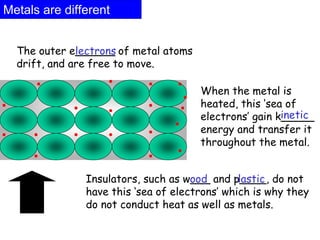
Metals are different
The outer e______ of metal atoms
drift, and are free to move.
When the metal is
heated, this ‘sea of
electrons’ gain k_____
energy and transfer it
throughout the metal.
Insulators, such as w___ and p____, do not
have this ‘sea of electrons’ which is why they
do not conduct heat as well as metals.
lectrons
inetic
ood lastic
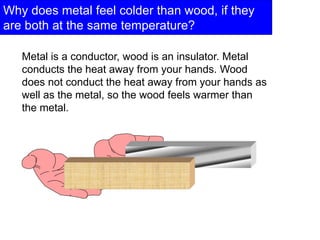
Why does metal feel colder than wood, if they
are both at the same temperature?
Metal is a conductor, wood is an insulator. Metal
conducts the heat away from your hands. Wood
does not conduct the heat away from your hands as
well as the metal, so the wood feels warmer than
the metal.
Convection
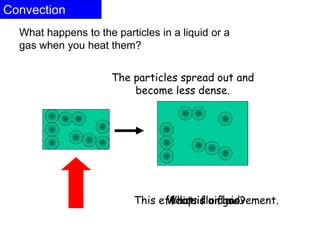
What happens to the particles in a liquid or a
gas when you heat them?
The particles spread out and
become less dense.
This effects fluid movement.
What is a fluid?
A liquid or gas.
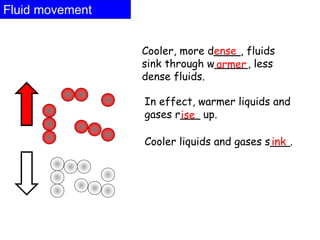
Fluid movement
Cooler, more d____, fluids
sink through w_____, less
dense fluids.
In effect, warmer liquids and
gases r___ up.
Cooler liquids and gases s___.
ense
armer
ise
ink
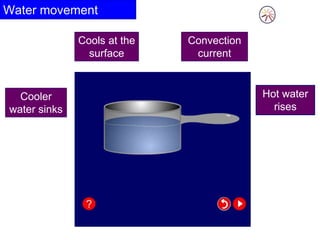
Water movement
Hot water
rises
Cooler
water sinks
Convection
current
Cools at the
surface
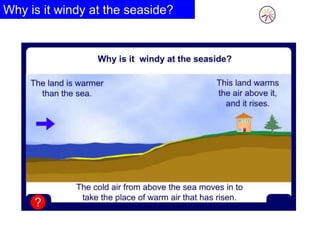
Why is it windy at the seaside?
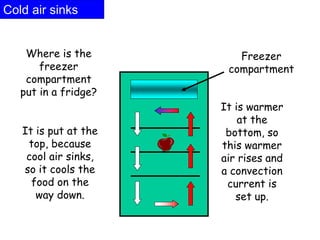
Cold air sinks
Where is the
freezer
compartment
put in a fridge?
Freezer
compartment
It is put at the
top, because
cool air sinks,
so it cools the
food on the
way down.
It is warmer
at the
bottom, so
this warmer
air rises and
a convection
current is
set up.
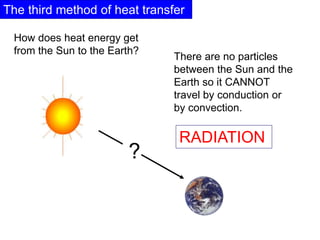
The third method of heat transfer
How does heat energy get
from the Sun to the Earth?
There are no particles
between the Sun and the
Earth so it CANNOT
travel by conduction or
by convection.
?
RADIATION
Radiation
Radiation travels in straight lines
True/False
Radiation can travel through a vacuum
True/False
Radiation requires particles to travel
True/False
Radiation travels at the speed of light
True/False
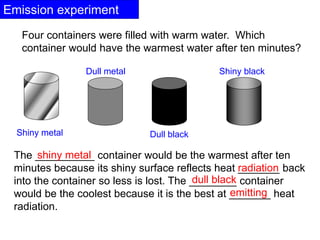
Emission experiment
Four containers were filled with warm water. Which
container would have the warmest water after ten minutes?
Shiny metal
Dull metal
Dull black
Shiny black
The __________ container would be the warmest after ten
minutes because its shiny surface reflects heat _______ back
into the container so less is lost. The ________ container
would be the coolest because it is the best at _______ heat
radiation.
shiny metal
radiation
dull black
emitting
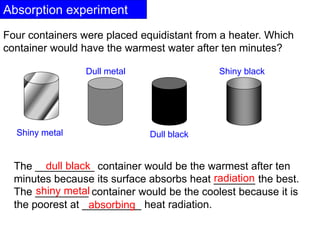
Absorption experiment
Four containers were placed equidistant from a heater. Which
container would have the warmest water after ten minutes?
The __________ container would be the warmest after ten
minutes because its surface absorbs heat _______ the best.
The _________ container would be the coolest because it is
the poorest at __________ heat radiation.
dull black
radiation
shiny metal
absorbing
Shiny metal
Dull metal
Dull black
Shiny black
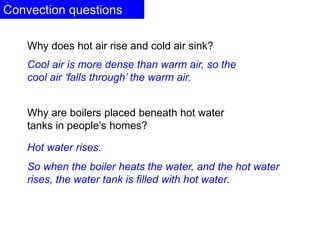
Convection questions
Why are boilers placed beneath hot water
tanks in people’s homes?
Hot water rises.
So when the boiler heats the water, and the hot water
rises, the water tank is filled with hot water.
Why does hot air rise and cold air sink?
Cool air is more dense than warm air, so the
cool air ‘falls through’ the warm air.
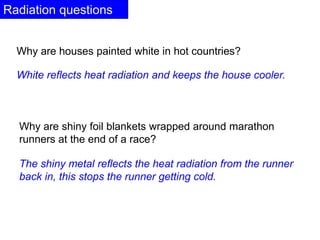
Radiation questions
Why are houses painted white in hot countries?
White reflects heat radiation and keeps the house cooler.
Why are shiny foil blankets wrapped around marathon
runners at the end of a race?
The shiny metal reflects the heat radiation from the runner
back in, this stops the runner getting cold.
1. Which of the following is not a
method of heat transfer?
A. Radiation
B. Insulation
C. Conduction
D. Convection
2. In which of the following are
the particles closest together?
A. Solid
B. Liquid
C. Gas
D. Fluid
3. How does heat energy reach
the Earth from the Sun?
A. Radiation
B. Conduction
C. Convection
D. Insulation
4. Which is the best surface for
reflecting heat radiation?
A. Shiny white
B. Dull white
C. Shiny black
D. Dull black
5. Which is the best surface for
absorbing heat radiation?
A. Shiny white
B. Dull white
C. Shiny black
D. Dull black
Definition of heat:
Heat is energy transferred from one object to
another because of a difference in temperature.
• Remember that the temperature of a gas is a
measure of the kinetic energy of its molecules.
Heat As Energy Transfer
14-2 Internal Energy
The sum total of all the energy of all the
molecules in a substance is its internal (or
thermal) energy.
Temperature: measures molecules’ average
kinetic energy
Internal energy: total energy of all molecules
Heat: transfer of energy due to difference in
temperature
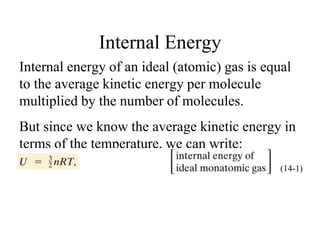
Internal Energy
Internal energy of an ideal (atomic) gas is equal
to the average kinetic energy per molecule
multiplied by the number of molecules.
But since we know the average kinetic energy in
terms of the temperature, we can write:
(14-1)
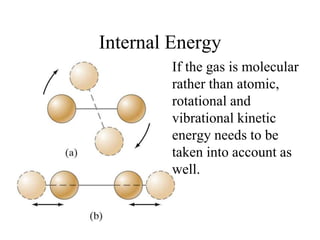
If the gas is molecular
rather than atomic,
rotational and
vibrational kinetic
energy needs to be
taken into account as
well.
Internal Energy
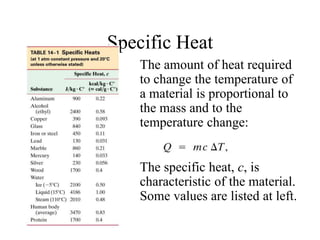
Specific Heat
The amount of heat required
to change the temperature of
a material is proportional to
the mass and to the
temperature change:
The specific heat, c, is
characteristic of the material.
Some values are listed at left.
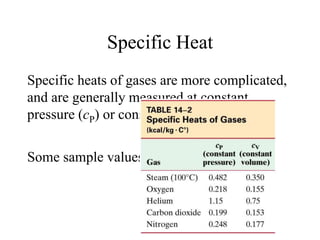
Specific Heat
Specific heats of gases are more complicated,
and are generally measured at constant
pressure (cP) or constant volume (cV).
Some sample values:

Lect-1-intro.ppt

  • 1.
  • 3.
    Heat Transfer • Heatalways moves from a warmer place to a cooler place. • Hot objects in a cooler room will cool to room temperature. • Cold objects in a warmer room will heat up to room temperature.
  • 4.
    Question • If acup of coffee and a red ice-cream were left on the table in this room what would happen to them? Why? • The cup of coffee will cool until it reaches room temperature. The ice-cream will melt and then the liquid will warm to room temperature.
  • 6.
    What is HeatTransfer? • Thermal energy is related to the temperature of matter. • For a given material and mass, the higher the temperature, the greater its thermal energy. • Heat transfer is a study of the exchange of thermal energy through a body or between bodies which occurs when there is a temperature difference. • When system and its surroundings are at different temperatures, thermal energy transfers from the one with higher temperature to the one with lower temperature. • Thermal Energy always travels from hot to cold. • This spontaneous act is called Heat Action or Heat Transfer.
  • 7.
    Heat Transfer BetweenSystem & Surroundings • Heat transfer is typically given the symbol Q, and is expressed in joules (J) in SI units. • The rate of heat transfer is measured in watts (W), equal to joules per second, and is denoted by Q. • The heat flux, or the rate of heat transfer per unit area, is measured in watts per area (W/m2), and uses q" for the symbol.
  • 8.
    Heat Transfer inManufacturing • The need/role of heat transfer is a two fold issue. • Heat Transfer by design. – Casting – Hot working – Sintering • Heat Transfer due to unavoidable conditions. – Machining process.
  • 9.
    What Causes HeatTransfer in Machining? • First, almost all (90%-100%) of the work consumed in a machining operation finally convert into the thermal energy. • There are several sources of thermal energy in cutting with a sharp tool: • Viscous dissipation transformed into heat if the cut material are viscoplastic. • Work done by friction converted to heat. • Ambient heat source sometimes need be considered if thermal deformation is concerned. • In non-traditional machining, other types of heat sources exist
  • 10.
    If heat isa form of energy, it ought to be possible to equate it to other forms. The experiment below found the mechanical equivalent of heat by using the falling weight to heat the water: 4.186 J = 1 cal 4.186 kJ = 1 kcal Heat As Energy Transfer
  • 11.
    Heat Transfer Methods •Heat transfers in three ways: –Conduction –Convection –Radiation
  • 12.
    Conduction When you heata metal strip at one end, the heat travels to the other end. As you heat the metal, the particles vibrate, these vibrations make the adjacent particles vibrate, and so on and so on, the vibrations are passed along the metal and so is the heat. We call this? Conduction
  • 13.
    Conduction by latticevibration or Particle Collisions
  • 15.
    Metals are different Theouter e______ of metal atoms drift, and are free to move. When the metal is heated, this ‘sea of electrons’ gain k_____ energy and transfer it throughout the metal. Insulators, such as w___ and p____, do not have this ‘sea of electrons’ which is why they do not conduct heat as well as metals. lectrons inetic ood lastic
  • 16.
    Why does metalfeel colder than wood, if they are both at the same temperature? Metal is a conductor, wood is an insulator. Metal conducts the heat away from your hands. Wood does not conduct the heat away from your hands as well as the metal, so the wood feels warmer than the metal.
  • 17.
    Convection What happens tothe particles in a liquid or a gas when you heat them? The particles spread out and become less dense. This effects fluid movement. What is a fluid? A liquid or gas.
  • 18.
    Fluid movement Cooler, mored____, fluids sink through w_____, less dense fluids. In effect, warmer liquids and gases r___ up. Cooler liquids and gases s___. ense armer ise ink
  • 19.
    Water movement Hot water rises Cooler watersinks Convection current Cools at the surface
  • 20.
    Why is itwindy at the seaside?
  • 21.
    Cold air sinks Whereis the freezer compartment put in a fridge? Freezer compartment It is put at the top, because cool air sinks, so it cools the food on the way down. It is warmer at the bottom, so this warmer air rises and a convection current is set up.
  • 22.
    The third methodof heat transfer How does heat energy get from the Sun to the Earth? There are no particles between the Sun and the Earth so it CANNOT travel by conduction or by convection. ? RADIATION
  • 23.
    Radiation Radiation travels instraight lines True/False Radiation can travel through a vacuum True/False Radiation requires particles to travel True/False Radiation travels at the speed of light True/False
  • 24.
    Emission experiment Four containerswere filled with warm water. Which container would have the warmest water after ten minutes? Shiny metal Dull metal Dull black Shiny black The __________ container would be the warmest after ten minutes because its shiny surface reflects heat _______ back into the container so less is lost. The ________ container would be the coolest because it is the best at _______ heat radiation. shiny metal radiation dull black emitting
  • 25.
    Absorption experiment Four containerswere placed equidistant from a heater. Which container would have the warmest water after ten minutes? The __________ container would be the warmest after ten minutes because its surface absorbs heat _______ the best. The _________ container would be the coolest because it is the poorest at __________ heat radiation. dull black radiation shiny metal absorbing Shiny metal Dull metal Dull black Shiny black
  • 26.
    Convection questions Why areboilers placed beneath hot water tanks in people’s homes? Hot water rises. So when the boiler heats the water, and the hot water rises, the water tank is filled with hot water. Why does hot air rise and cold air sink? Cool air is more dense than warm air, so the cool air ‘falls through’ the warm air.
  • 27.
    Radiation questions Why arehouses painted white in hot countries? White reflects heat radiation and keeps the house cooler. Why are shiny foil blankets wrapped around marathon runners at the end of a race? The shiny metal reflects the heat radiation from the runner back in, this stops the runner getting cold.
  • 28.
    1. Which ofthe following is not a method of heat transfer? A. Radiation B. Insulation C. Conduction D. Convection
  • 29.
    2. In whichof the following are the particles closest together? A. Solid B. Liquid C. Gas D. Fluid
  • 30.
    3. How doesheat energy reach the Earth from the Sun? A. Radiation B. Conduction C. Convection D. Insulation
  • 31.
    4. Which isthe best surface for reflecting heat radiation? A. Shiny white B. Dull white C. Shiny black D. Dull black
  • 32.
    5. Which isthe best surface for absorbing heat radiation? A. Shiny white B. Dull white C. Shiny black D. Dull black
  • 33.
    Definition of heat: Heatis energy transferred from one object to another because of a difference in temperature. • Remember that the temperature of a gas is a measure of the kinetic energy of its molecules. Heat As Energy Transfer
  • 34.
    14-2 Internal Energy Thesum total of all the energy of all the molecules in a substance is its internal (or thermal) energy. Temperature: measures molecules’ average kinetic energy Internal energy: total energy of all molecules Heat: transfer of energy due to difference in temperature
  • 35.
    Internal Energy Internal energyof an ideal (atomic) gas is equal to the average kinetic energy per molecule multiplied by the number of molecules. But since we know the average kinetic energy in terms of the temperature, we can write: (14-1)
  • 36.
    If the gasis molecular rather than atomic, rotational and vibrational kinetic energy needs to be taken into account as well. Internal Energy
  • 37.
    Specific Heat The amountof heat required to change the temperature of a material is proportional to the mass and to the temperature change: The specific heat, c, is characteristic of the material. Some values are listed at left.
  • 38.
    Specific Heat Specific heatsof gases are more complicated, and are generally measured at constant pressure (cP) or constant volume (cV). Some sample values: