T- 1-855-694-8886
Email- info@iTutor.com
By iTutor.com
Location
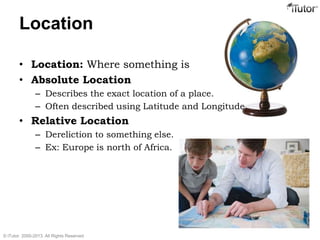
• Location: Where something is
• Absolute Location
– Describes the exact location of a place.
– Often described using Latitude and Longitude.
• Relative Location
– Dereliction to something else.
– Ex: Europe is north of Africa.
© iTutor. 2000-2013. All Rights Reserved
Latitude and Longitude
• Latitude
– Lines of latitude are measured
north and south of the equator.
– The Equator is zero (0) degrees of
latitude.
– Other lines of latitude are called
parallels because they are
parallel to the equator.
– Lines of latitude are measured
from zero to 90 degrees north
latitude . . .
– and from zero to 90 degrees
south latitude.
0º
90ºN
90ºS© iTutor. 2000-2013. All Rights Reserved
Lines of Longitude are called Meridians
The Prime Meridian, or Greenwich
Meridian is zero (0) degrees Longitude.
All other lines of longitude are measured east or
west of the Prime Meridian.
0º
Longitude is measured from 0-180º east
and west from the Prime Meridian
These lines meet at 180º , this is
called the International Date Line.
This line is both east and west.
Longitude
© iTutor. 2000-2013. All Rights Reserved
The Global Grid: Using Latitude and Longitude
Coordinates
Every measurement using
latitude and longitude
has a set of coordinates.
One coordinate will be
for degrees latitude north
or south of the equator
Ex: 30º North lat. is this line
30º South lat. is this line
The other coordinate will be
degrees east or west of the
Prime (Greenwich) Meridian.
Ex: 30º East Longitude is this line
30º West Longitude is this line
Put the two together and you
have a location.
Ex: 30 ºN, 30 ºE
Latitude should always be
listed first. Your north/south
will be before your east/west
coordinate.
© iTutor. 2000-2013. All Rights Reserved
Find the Latitude and Longitude of the following cities
Alice Springs 22ºS, 133ºE Sydney 34ºS, 150ºE
Darwin 14ºS, 131ºE
Which city is closest to 20ºS Latitude? La Grange
© iTutor. 2000-2013. All Rights Reserved
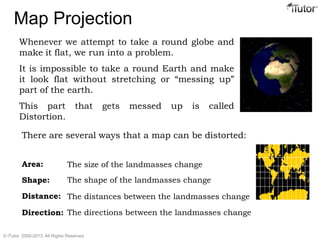
Whenever we attempt to take a round globe and
make it flat, we run into a problem.
It is impossible to take a round Earth and make
it look flat without stretching or “messing up”
part of the earth.
This part that gets messed up is called
Distortion.
There are several ways that a map can be distorted:
Area: The size of the landmasses change
Shape: The shape of the landmasses change
Distance: The distances between the landmasses change
Direction: The directions between the landmasses change
Map Projection
© iTutor. 2000-2013. All Rights Reserved
Orientation
Which way is up?
Actually, which way is north?
North
South
East
West
NE
SE
NW
SW
Maps will usually give you a
way to determine orientation.
This may be a single direction
arrow or a compass rose.
Compass
Rose
A Compass rose tells you two things
Cardinal Directions
Intermediate Directions
© iTutor. 2000-2013. All Rights Reserved
Map Scale
The map scale tells you the relationship between
the distance on the map and the true distance on
the surface of the Earth.
To calculate distance measure the
distance on the map and then
place on the scale to measure the
true difference.
Be careful to make
sure you have the
correct unit.
Many maps have
both miles and
kilometers
© iTutor. 2000-2013. All Rights Reserved
Comparing maps of different scale
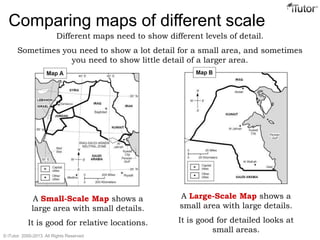
Different maps need to show different levels of detail.
Sometimes you need to show a lot detail for a small area, and sometimes
you need to show little detail of a larger area.
A Small-Scale Map shows a
large area with small details.
It is good for relative locations.
A Large-Scale Map shows a
small area with large details.
It is good for detailed looks at
small areas.
© iTutor. 2000-2013. All Rights Reserved
The End
For more information call us
1-855-694-8886
Visit www.iTutor.com

Introduction to Maps

  • 1.
  • 2.
    Location • Location: Wheresomething is • Absolute Location – Describes the exact location of a place. – Often described using Latitude and Longitude. • Relative Location – Dereliction to something else. – Ex: Europe is north of Africa. © iTutor. 2000-2013. All Rights Reserved
  • 3.
    Latitude and Longitude •Latitude – Lines of latitude are measured north and south of the equator. – The Equator is zero (0) degrees of latitude. – Other lines of latitude are called parallels because they are parallel to the equator. – Lines of latitude are measured from zero to 90 degrees north latitude . . . – and from zero to 90 degrees south latitude. 0º 90ºN 90ºS© iTutor. 2000-2013. All Rights Reserved
  • 4.
    Lines of Longitudeare called Meridians The Prime Meridian, or Greenwich Meridian is zero (0) degrees Longitude. All other lines of longitude are measured east or west of the Prime Meridian. 0º Longitude is measured from 0-180º east and west from the Prime Meridian These lines meet at 180º , this is called the International Date Line. This line is both east and west. Longitude © iTutor. 2000-2013. All Rights Reserved
  • 5.
    The Global Grid:Using Latitude and Longitude Coordinates Every measurement using latitude and longitude has a set of coordinates. One coordinate will be for degrees latitude north or south of the equator Ex: 30º North lat. is this line 30º South lat. is this line The other coordinate will be degrees east or west of the Prime (Greenwich) Meridian. Ex: 30º East Longitude is this line 30º West Longitude is this line Put the two together and you have a location. Ex: 30 ºN, 30 ºE Latitude should always be listed first. Your north/south will be before your east/west coordinate. © iTutor. 2000-2013. All Rights Reserved
  • 6.
    Find the Latitudeand Longitude of the following cities Alice Springs 22ºS, 133ºE Sydney 34ºS, 150ºE Darwin 14ºS, 131ºE Which city is closest to 20ºS Latitude? La Grange © iTutor. 2000-2013. All Rights Reserved
  • 7.
    Whenever we attemptto take a round globe and make it flat, we run into a problem. It is impossible to take a round Earth and make it look flat without stretching or “messing up” part of the earth. This part that gets messed up is called Distortion. There are several ways that a map can be distorted: Area: The size of the landmasses change Shape: The shape of the landmasses change Distance: The distances between the landmasses change Direction: The directions between the landmasses change Map Projection © iTutor. 2000-2013. All Rights Reserved
  • 8.
    Orientation Which way isup? Actually, which way is north? North South East West NE SE NW SW Maps will usually give you a way to determine orientation. This may be a single direction arrow or a compass rose. Compass Rose A Compass rose tells you two things Cardinal Directions Intermediate Directions © iTutor. 2000-2013. All Rights Reserved
  • 9.
    Map Scale The mapscale tells you the relationship between the distance on the map and the true distance on the surface of the Earth. To calculate distance measure the distance on the map and then place on the scale to measure the true difference. Be careful to make sure you have the correct unit. Many maps have both miles and kilometers © iTutor. 2000-2013. All Rights Reserved
  • 10.
    Comparing maps ofdifferent scale Different maps need to show different levels of detail. Sometimes you need to show a lot detail for a small area, and sometimes you need to show little detail of a larger area. A Small-Scale Map shows a large area with small details. It is good for relative locations. A Large-Scale Map shows a small area with large details. It is good for detailed looks at small areas. © iTutor. 2000-2013. All Rights Reserved
  • 11.
    The End For moreinformation call us 1-855-694-8886 Visit www.iTutor.com