©AH SIZAN
Today we will discuss about
Heat and Thermodynamics
©AH SIZAN
First we need to know
about:
Thermodynamics
Heat
Temperature
©AH SIZAN
Thermodynamics is a branch of physics
concerned with heat and temperature
and their relation to energy and work.
©AH SIZAN
Heat is a form of energy which flows
from higher temperature to lower
temperature by conduction, convection
and radiation processes.
©AH SIZAN
Temperature is the thermal state of a
body which controls the flow of heat
from one body to another and
determines the direction of heat flow.
©AH SIZAN
 If:
◦ Objects A and B are the same temperature
◦ Objects B and C are the same temperature
 Then:
◦ Objects A and C are the same temperature
◦ Just the transitive property of mathematics.
©AH SIZAN
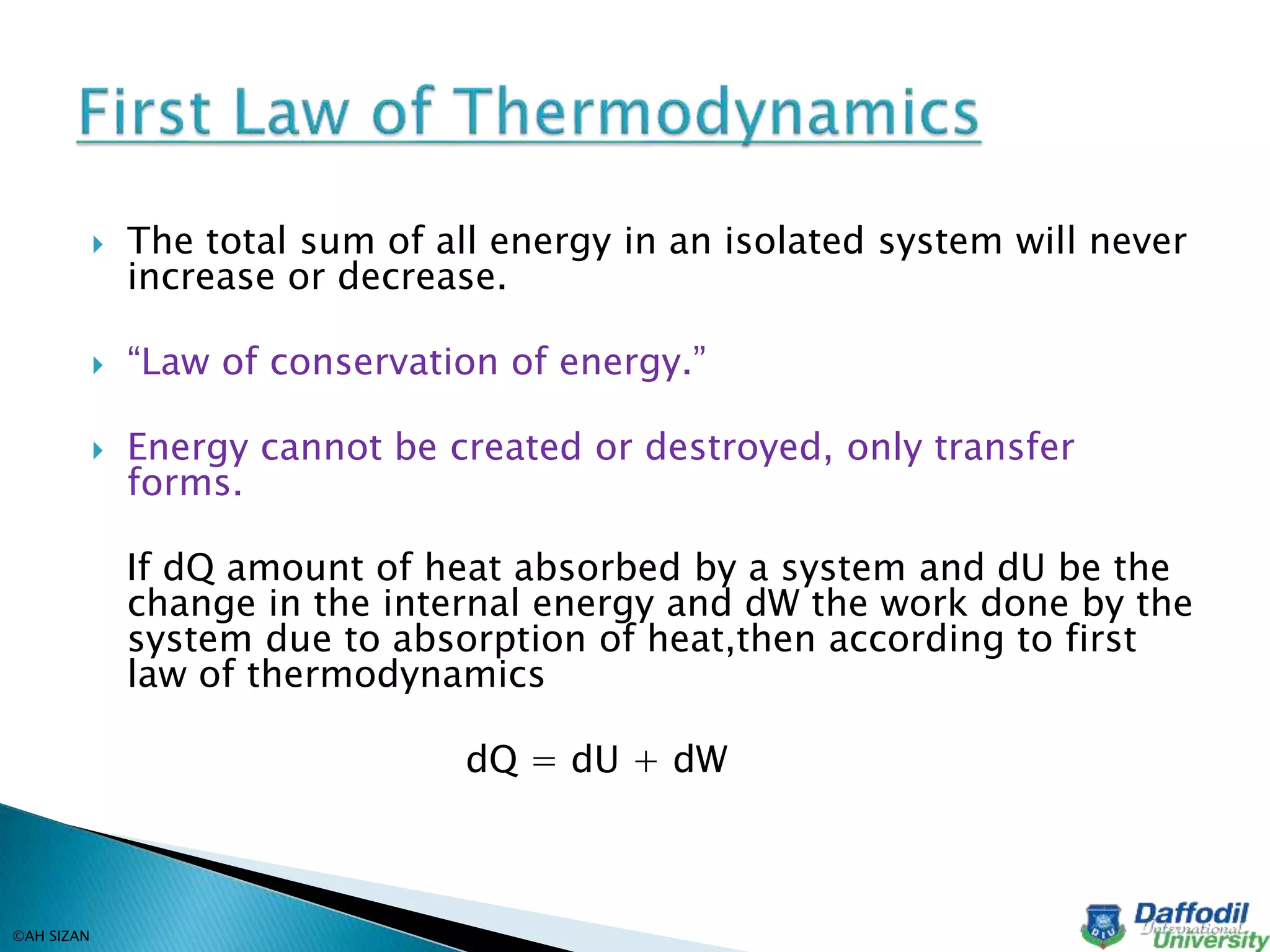
 The total sum of all energy in an isolated system will never
increase or decrease.
 “Law of conservation of energy.”
 Energy cannot be created or destroyed, only transfer
forms.
If dQ amount of heat absorbed by a system and dU be the
change in the internal energy and dW the work done by the
system due to absorption of heat,then according to first
law of thermodynamics
dQ = dU + dW
©AH SIZAN
 Clausius statement: It is impossible for a self-acting machine
to convey heat from a cool body to hot body without unaided
by an external agency.
 Planck’s statement: It is impossible to construct an engine
which can extract heat continuously from a heat source and
completely transforms into work.
 Kelvin’s statement: Continuous flow of energy cannot be
obtained from an object cooling it from its surrounding.
 Carnot’s statement: No engine can be built which can extract
a fixed amount of heat and will convert totally into work.
©AH SIZAN
 the entropy of any pure substance in
thermodynamic
equilibrium approaches zero as
the temperature approaches
zero (Kelvin), or conversely
 the temperature (Kelvin) of any pure
substance in thermodynamic
equilibrium approaches zero when
the entropy approaches zero
©AH SIZAN
A reversible process is one which can be
retraced in opposite direction so that all
changes occurring in direct process are
reversed exactly with corresponding parts
Example:
1) All isothermal and adiabatic process, when
performed very slowly.
2) 2) An extremely slow contraction or
extension of spring.
©AH SIZAN
Those processes which cannot be retraced in
opposite direction by reversing the
controlling factors are called irreversible
processes
Example:
1) Exchanging of heat from one body to
another.
2) Frictional force.
3) Heat produced by current in a resistance.
©AH SIZAN
Isothermal process:
When a gas undergoes a change in pressure and volume at
constant temperature, the gas is said to undergo an isothermal
change, and the process in which the change takes place is
called isothermal process.
In isothermal process the relation between pressure and volume
of a gas follows the Boyle's law.
Conditions for isothermal Change:
(i) Container of the gas must be good conductor of heat.
(ii) Thermal capacity of the surroundings should be high.
(iii) Change of pressure should be made very slowly
(iv) By absorption or rejection of necessary heat the temperature is to be kept
constant.
©AH SIZAN
Adiabatic process:
The process in which a system neither receives heat
nor rejects heat is called adiabatic process.
In this process a gas undergoes changes in pressure,
volume and temperature under thermal
isolation.
Conditions for adiabatic process:
(i) The container of the gas should be non-conducting.
(ii) Thermal capacity of the surrounding should be low.
(iii) Change of pressure of the gas must be very rapid so that heat exchange with the
surrounding does not take place.
©AH SIZAN
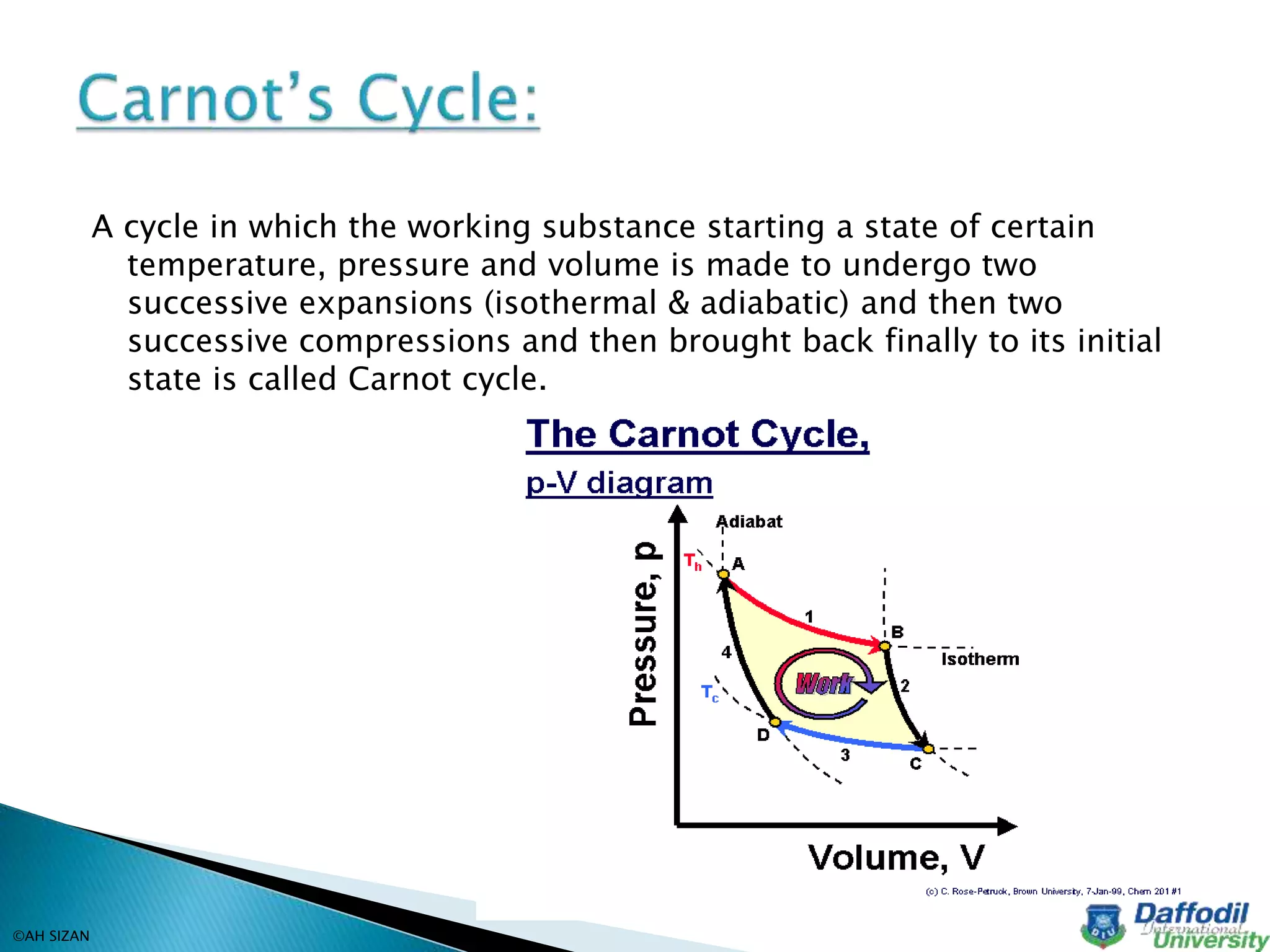
A cycle in which the working substance starting a state of certain
temperature, pressure and volume is made to undergo two
successive expansions (isothermal & adiabatic) and then two
successive compressions and then brought back finally to its initial
state is called Carnot cycle.
©AH SIZAN
©AH SIZAN
Created By
AHAD UDDIN SIZAN
ID : 163-15-8522
©AH SIZAN

Heat and thermodynamics

  • 1.
  • 2.
    Today we willdiscuss about Heat and Thermodynamics ©AH SIZAN
  • 3.
    First we needto know about: Thermodynamics Heat Temperature ©AH SIZAN
  • 4.
    Thermodynamics is abranch of physics concerned with heat and temperature and their relation to energy and work. ©AH SIZAN
  • 5.
    Heat is aform of energy which flows from higher temperature to lower temperature by conduction, convection and radiation processes. ©AH SIZAN
  • 6.
    Temperature is thethermal state of a body which controls the flow of heat from one body to another and determines the direction of heat flow. ©AH SIZAN
  • 7.
     If: ◦ ObjectsA and B are the same temperature ◦ Objects B and C are the same temperature  Then: ◦ Objects A and C are the same temperature ◦ Just the transitive property of mathematics. ©AH SIZAN
  • 8.
     The totalsum of all energy in an isolated system will never increase or decrease.  “Law of conservation of energy.”  Energy cannot be created or destroyed, only transfer forms. If dQ amount of heat absorbed by a system and dU be the change in the internal energy and dW the work done by the system due to absorption of heat,then according to first law of thermodynamics dQ = dU + dW ©AH SIZAN
  • 9.
     Clausius statement:It is impossible for a self-acting machine to convey heat from a cool body to hot body without unaided by an external agency.  Planck’s statement: It is impossible to construct an engine which can extract heat continuously from a heat source and completely transforms into work.  Kelvin’s statement: Continuous flow of energy cannot be obtained from an object cooling it from its surrounding.  Carnot’s statement: No engine can be built which can extract a fixed amount of heat and will convert totally into work. ©AH SIZAN
  • 10.
     the entropyof any pure substance in thermodynamic equilibrium approaches zero as the temperature approaches zero (Kelvin), or conversely  the temperature (Kelvin) of any pure substance in thermodynamic equilibrium approaches zero when the entropy approaches zero ©AH SIZAN
  • 11.
    A reversible processis one which can be retraced in opposite direction so that all changes occurring in direct process are reversed exactly with corresponding parts Example: 1) All isothermal and adiabatic process, when performed very slowly. 2) 2) An extremely slow contraction or extension of spring. ©AH SIZAN
  • 12.
    Those processes whichcannot be retraced in opposite direction by reversing the controlling factors are called irreversible processes Example: 1) Exchanging of heat from one body to another. 2) Frictional force. 3) Heat produced by current in a resistance. ©AH SIZAN
  • 13.
    Isothermal process: When agas undergoes a change in pressure and volume at constant temperature, the gas is said to undergo an isothermal change, and the process in which the change takes place is called isothermal process. In isothermal process the relation between pressure and volume of a gas follows the Boyle's law. Conditions for isothermal Change: (i) Container of the gas must be good conductor of heat. (ii) Thermal capacity of the surroundings should be high. (iii) Change of pressure should be made very slowly (iv) By absorption or rejection of necessary heat the temperature is to be kept constant. ©AH SIZAN
  • 14.
    Adiabatic process: The processin which a system neither receives heat nor rejects heat is called adiabatic process. In this process a gas undergoes changes in pressure, volume and temperature under thermal isolation. Conditions for adiabatic process: (i) The container of the gas should be non-conducting. (ii) Thermal capacity of the surrounding should be low. (iii) Change of pressure of the gas must be very rapid so that heat exchange with the surrounding does not take place. ©AH SIZAN
  • 15.
    A cycle inwhich the working substance starting a state of certain temperature, pressure and volume is made to undergo two successive expansions (isothermal & adiabatic) and then two successive compressions and then brought back finally to its initial state is called Carnot cycle. ©AH SIZAN
  • 16.
  • 17.
    Created By AHAD UDDINSIZAN ID : 163-15-8522 ©AH SIZAN