HUMAN EAR & TESTS OF
HEARING
DR. RAJENDRA SINGH LAKHAWAT
MS ENT (SMS MEDICAL COLLEGE, JAIPUR)
FIND THIS PRENSENTATION AT SLIDESHARE.NET/RSLAKHAWAT
What hearing tests do??
Hearing tests should answer 3 questions:
 Is there a hearing loss?
 If there is, how bad is it?
 What kind of hearing loss does patient have?
 Is it conductive?
 Is it sensorineural?
 Is it a mix of the two?
 Is it bilateral or just one ear i.e. unilateral?
types of hearing loss
1. Conductive Hearing Loss
“Caused by an abnormal reduction or attenuation of
sound as it travels from the outer ear to the cochlea”
2. Sensorineural Hearing Loss
“Caused by a failure in the cochlea to transduce the sound
from the middle ear to neural impulses in the VIII Nerve.”
3. Mixed Hearing Loss
“A loss with both conductive and sensorineural
component.”
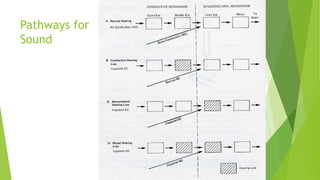
Pathways for
Sound
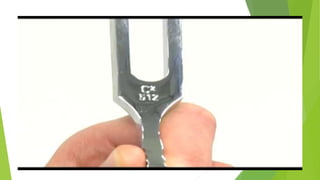
Tuning Fork Tests
Types of Tests
Rinne
Weber
Absolute bone conduction
Schwabach
Bing
Rinne’s Test
First: Bone Conduction
Vibrating Tuning Fork held on Mastoid
process
Patient covers opposite ear with hand
Patient signals when sound ceases
 Next: Air Conduction
 Move the vibrating tuning fork over the ear canal
(Near, but not touching the ear)
 Patient indicates when the sound ceases
 Normal: Air Conduction is better than Bone Conduction
 Air conduction usually persists twice as long as bone
 Referred to as "positive test"
 Abnormal: Bone conduction better than air conduction
 Suggests Conductive Hearing Loss.
 Referred to as "negative test"
False Negative Rinne :
 It is seen in severe unilateral SNHL. Patient
doesn’t perceive any sound of tuning fork by AC
but responds to BC testing.
 This response to BC is, in reality, from the
opposite ear because of transcranial
transmission of sound.
 In such cases, correct diagnosis can be made by
masking the non- test ear with Baraney’s noise
box while testing for bone conduction.
Weber Test
 Tuning Fork placed at midline forehead
 Normal: Sound radiates to both ears equally
 Abnormal: Sound lateralizes to one ear
 Ipsilateral – Conductive Hearing Loss
 Contralateral -Sensorineural Hearing Loss.
Absolute Bone Conduction test
 Bone conduction is a measure of cochlear function.
 In ABC test, patient’s bone conduction is compared with that of
examiner ( presuming that the examiner has normal hearing)
 External auditory meatus of both the patient & examiner should
be occluded( by pressing the tragus inwards), to prevent the
ambient noise entering through AC route
 In conductive deafness, the patient and the examiner hear the
fork for the same duration of time
 In sensorineural deafness, the patient hears a fork for shorter
duration
Schwabach Test
 It compares pt’s hearing sensitivity with that of an examiner
(assuming that he/she has a normal hearing)
 Examiner places TF on patient’s mastoid
 Patient lets examiner know when they no longer hear tone.
 Examiner places TF on their own mastoid.
 Interpertation :
 If examiner hears longer patient has a diminished schwabach
which is consistent with a sensorineural loss.
 If patient hears tone longer patient has a prolonged
schwabach consistent with a conductive loss.
Bing Test
 Assesses the presence of CHL
 Tuning fork is placed on the pt.'s mastoid, while the ear canal
is alternatively opened and closed by the examiner by
depressing tragus and the pt. is asked to state which position
is louder
 When the ear canal is closed on a person with normal hearing
or SNHL, low-frequency bone conducted signals are heard more
loudly (Occlusion Effect), the is a "Positive Bing“
 Pts. with CHL will not experience this sensation and the tone
will be the same when the ear canal is open and closed and the
test will be a "Negative Bing" because the ear already has a
conductive impairment
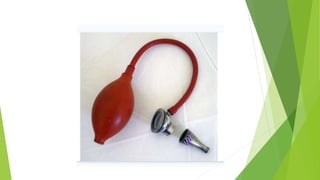
Gelle’s Test
 It is also a test of bone conduction & examines the effect of
increased air pressure in ear canal on the hearing.
 It is performed by placing a vibrating fork on the mastoid while
changes in air pressure in the ear canal are brought about by
Siegle’s speculum.
 Normally, when air pressure is increased in the ear canal by
Seigle’s speculum, it pushes the TM & ossicles inwards, raises the
intra labyrinthine pressure & causes immobility of basilar
membrane & decreased hearing, but no change in hearing is
observed when ossicular chain is fixed or disconnected.
 Positive in Normal persons & in SNHL.
 Negative when ossicular chain is fixed or disconnected.
Pure Tone Audiometry (PTA)
 “The aim of pure tone audiometry is to establish
hearing threshold sensitivity across the range of
audible frequencies important for
communication”
 A pure tone is a single frequency tone with no
harmonic content (no overtones). This
corresponds to a sine wave.
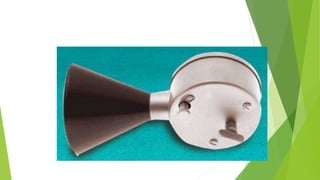
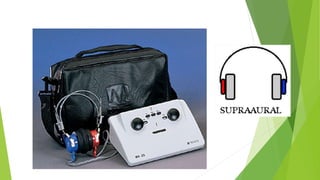
The Audiometer
• Components
 Pure tone oscillator
 Attenuator
 Interrupter switch
 Output transducer
o Headphones
• Supra-aural
• Insert
o Bone conduction vibrators
• Forehead
• Mastoid
o Loudspeakers
Pure tone Audiometry procedure
 In a sound proof room person is seated comfortably.
 Ear phones are applied which are color coded. (Red for
right ear, Blue for left ear.)
 Masking sound is delivered to the non-test ear.
 Start with a frequency of 125Hz. & 0 dB.
 Gradually increase the dB. till person hears the sound &
respond.
 Mark the threshold intensity on the audiogram paper.
 Find the threshold of hearing from 125 Hz. to 8000Hz. &
mark on the audiogram paper.
 Join the points to make air conduction audiogram.
 Place the bone vibrator over the mastoid process.
 Deliver the sound through the vibrator & find out the
threshold of hearing for different frequencies of sound.
 Use different sign to mark the bone conduction
audiogram.
 Select the other ear and repeat the whole procedure.
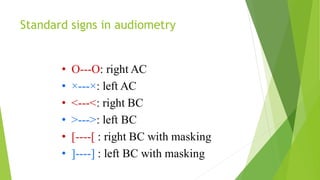
Standard signs in audiometry
masking
 “Masking presents a constant noise to the non-test ear so
that the non-test ear is acoustically blocked and doesn’t
participate in the hearing test”
 The purpose of masking is to prevent the non-test ear
from detecting the signal, so only the test ear can
respond.
Conductive Hearing loss
 The abnormality reduces the effective intensity of the air-
conducted signal reaching the cochlea, but it does not affect the
bone-conducted signal that does not pass through the outer or
middle ear.
 Examples of abnormalities include perforated tympanic membranes,
fluid in the middle ear system, or scarring of the tympanic
membrane.
 Pure-tone air-conduction thresholds are poorer than bone-conduction
thresholds by more than 10 dB
Conductive
deafness
Sensorineural Hearing Loss
 This type of hearing loss is secondary to cochlear
abnormality and/or abnormality of the auditory nerve or
central auditory pathways.
 Because the outer ear and middle ear do not reduce the
signal intensity of the air-conducted signal, both air- and
bone-conducted signals are effective in stimulating the
cochlea.
 Pure-tone air- and bone-conduction thresholds are within
20 dB. (Air bone gap)
SNHL
MIXED Hearing loss
 This type of hearing loss has sensorineural and conductive
components.
 Pure-tone air-conduction thresholds are poorer than bone-
conduction thresholds by more than 20 dB, and
 bone-conduction thresholds are poorer than 25 dB
Mixed HL
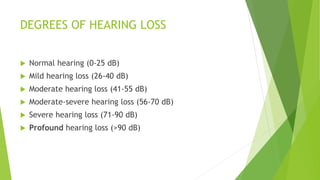
DEGREES OF HEARING LOSS
 Normal hearing (0-25 dB)
 Mild hearing loss (26-40 dB)
 Moderate hearing loss (41-55 dB)
 Moderate-severe hearing loss (56-70 dB)
 Severe hearing loss (71-90 dB)
 Profound hearing loss (>90 dB)
COMMON AUDITORY DISORDERS
 Presbyacusis (age related hearing loss)
 Otitis media: This condition is marked by fluid in the
middle ear space usually secondary to an infection.
 Noise-induced hearing loss.
 Otosclerosis: The condition is caused by stapedial fixation
in the oval window, stiffening the middle ear system.
 Ménière disease
audiogram
 The audiogram is a chart of hearing sensitivity with frequency
charted on the X- axis and intensity on the Y-axis.
 Intensity is the level of sound power measured in decibels;
loudness is the perceptual correlate of intensity.
 It shows the softest sounds a person can hear at different
frequencies or pitches. These sounds are called thresholds. The
audiologist marks on a graph patient’s threshold at different
pitches.
This is an audiogram of normal hearing.
The red and blue marks show the softest
sounds this person could hear in his right
(red) and left (blue) ears.
The shaded areas show the range of
speech sounds. This is called the "speech
banana“
This person can hear sounds even softer
than the speech sounds.
But if he can't hear sounds in the area of
the speech banana, he will have trouble
understanding what people say.
HOW TO READ AN AUDIOGRA
From left to right – Frequency
 Frequency refers to how high- or low-pitched a sound is
 Frequency is measured in Hertz (Hz).
 Low-pitched sounds are towards the left of the audiogram.
(Vowels like "a," e" and "i" are examples of low-pitched sounds)
 High-pitched sounds are towards the right of the audiogram.
(Sounds like "th," "f" and "s" are examples of high-pitched sounds)
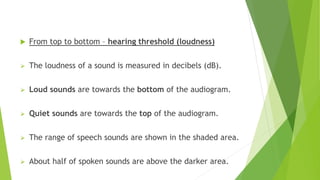
 From top to bottom – hearing threshold (loudness)
 The loudness of a sound is measured in decibels (dB).
 Loud sounds are towards the bottom of the audiogram.
 Quiet sounds are towards the top of the audiogram.
 The range of speech sounds are shown in the shaded area.
 About half of spoken sounds are above the darker area.
Mild to Moderate Conductive Hearing
Loss in the Right ear
Mild to moderate means that the
hearing loss can range from 15dB to
40dB. This means that the quietest
sounds the patient can hear range
between 15 and 40 dB.
Conductive hearing loss is when sound
can't reach the inner ear.
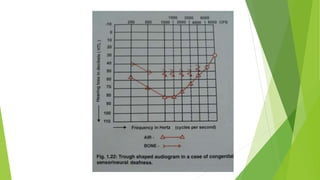
Bilateral Mild to Moderate Sensorineural
Hearing Loss
 Sensorineural hearing loss is when the
cochlea or auditory nerve isn't working
correctly.
The hearing loss in the picture is also
called a "Cookie-Bite" hearing loss. This
kind of hearing loss has the worst hearing
loss in the middle frequencies. Many
children with hearing loss from birth
(or congenital hearing loss) have this kind
of hearing loss.
 A pat with this much hearing loss will
need to use hearing aids as well as assistive
listening devices.
Bilateral Mild Sloping to Profound
Sensorineural Hearing Loss
This kind of hearing is most often seen in
older adults, but is also seen in some
children.
Because of the very severe hearing loss at
the highest frequencies, this patient may
not be able to hear some speech sounds at
all.
A patient with this amount of hearing loss
will need to use hearing aids as well as
other assistive listening.
Bilateral Mild Precipitously Sloping
to Profound Hearing Loss
This kind of hearing loss is also called "Ski
Slope Loss“
Patient with this kind of hearing loss can
work just fine in quiet rooms. But they
may have a lot more trouble working in big
or noisy rooms.
A patient with this amount of hearing loss
will need to use hearing aids as well as
other assistive listening.
Profound means that the hearing loss is 90dB or
greater. This means that the patient may not be
able to hear anything softer than 90dB.
This kind of hearing loss is sometimes called a
"Left Corner" audiogram.
A patient with this much hearing loss may not be
able to hear much, even with hearing aids. So he
may not be able to learn to speak through hearing
alone.
He may benefit from using sign language and by
reading lips.
He may also be a candidate for a cochlear
implant.
Mild CHL
Rt. ear
Immitance Audiometry
 Detection of middle ear pathology
 Differentiating cochlear from retrocochlear pathology
 Estimate sensitivity
 Use in cross-check with pure tone results
 Major components
 Probe tone oscillator and loudspeaker
 Monitor microphone
 Pressure pump and manometer
 Ipsilateral reflex oscillator and loudspeaker
 Probe tip
 Immittance is a physical characteristic of all
mechanical vibratory systems, of which the middle
ear is one example”
 Immittance audiometry is an objective technique which
evaluates middle ear function by three procedures: ]
 static immittance,
 tympanometry, and
 the measurement of acoustic reflex threshold sensitivity
Auditory Immittance
“ A way of assessing the manner in which
energy flows through the outer and middle
ear into the cochlea”
Tympanometry
“A way of measuring how acoustic immittance
of the middle ear system changes as air
pressure is varied in the external ear canal”
Tympanometry
Concepts of immittance applied in practice
Some Useful Terminology
1) Ear Canal Volume
The equivalent ear canal volume (ECV) is an estimate
of the volume of air medial to the probe, which
includes,
 the volume between the probe tip and the tympanic
membrane if the tympanic membrane is intact or,
 the volume of the ear canal and the middle ear space if
the tympanic membrane is perforated.
2) Tympanometric Peak Pressure(TPP)/Middle Ear
Pressure(MEP)
“Ear canal pressure at which the peak of the
tympanogram occurs”
3) Static Compliance
“The greatest amount of acoustic energy absorbed by
the middle ear system (the vertical peak of the
tympanic tracing)”
4) Gradient
 “Tympanogram gradient is an objective measure that
describes the steepness of the slope of the tympanogram
near the peak”
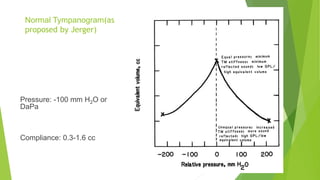
Normal Tympanogram(as
proposed by Jerger)
Pressure: -100 mm H2O or
DaPa
Compliance: 0.3-1.6 cc
The blue shaded area in the figures below shows the range for
normal middle ear function.
Jerger classification of Type A tympanogram suggesting normal middle ear
function
Tympanometry showed no measureable middle ear pressure or static compliance,
consistent with middle ear pathology.
Tympanometry showed significant negative middle ear pressure in the
presence of normal static compliance, consistent with Eustachian tube
dysfunction/middle ear pathology.
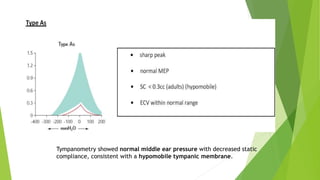
Tympanometry showed normal middle ear pressure with decreased static
compliance, consistent with a hypomobile tympanic membrane.
Tympanometry showed normal middle ear pressure with increased static
compliance, consistent with a hypermobile tympanic membrane.
Compliance
Pathologies with
increased compliance
• Ossicular chain
discontinuity
• Scarring of the
tympanic membrane
• Post-stapedectomy
ear
• Very large tympanic
membrane(rare)
Pathologies with
decreased compliance
• Otoscelerosis
• Adhesive or secretory
otitis media
• Tumors in the middle
ear like glomus
jugulare
• Ossicular fixations
like fixed malleus
syndrome
• Some cases of
tympanosclerosis or
thickening of the
tympanic membrane
Pathologies with
normal compliance
• ET obstruction only,
without secretory
changes in the
middle ear.
• Some cases of
otosclerosis.
Middle Ear Pressure
Negative middle
ear pressure
• Blocked
Eustachian
tube.
• Secretory
Otitis media.
Normal middle
ear pressure
• Stapedial
otosclerosis.
• Ossicular chain
discontinuity.
• Scarring of TM.
• Fixation or
adhesions
among the
ossicles like
fixed malleus.
Positive middle
ear pressure
• Early acute
otits media.
Absence of any peak
pressure
• Adhesive otitis media.
• Perforation of TM.
• Artifact( eg. Blocked
probetip)
• Patent gromet in TM
• External earcanal
completely blocked by
cerumen
THANK YOU
Find this presentation at
SLIDESHARE.NET/RSLAKHAWAT

Hearing tests

  • 1.
    HUMAN EAR &TESTS OF HEARING DR. RAJENDRA SINGH LAKHAWAT MS ENT (SMS MEDICAL COLLEGE, JAIPUR) FIND THIS PRENSENTATION AT SLIDESHARE.NET/RSLAKHAWAT
  • 4.
    What hearing testsdo?? Hearing tests should answer 3 questions:  Is there a hearing loss?  If there is, how bad is it?  What kind of hearing loss does patient have?  Is it conductive?  Is it sensorineural?  Is it a mix of the two?  Is it bilateral or just one ear i.e. unilateral?
  • 5.
    types of hearingloss 1. Conductive Hearing Loss “Caused by an abnormal reduction or attenuation of sound as it travels from the outer ear to the cochlea”
  • 6.
    2. Sensorineural HearingLoss “Caused by a failure in the cochlea to transduce the sound from the middle ear to neural impulses in the VIII Nerve.”
  • 7.
    3. Mixed HearingLoss “A loss with both conductive and sensorineural component.”
  • 8.
  • 9.
    Tuning Fork Tests Typesof Tests Rinne Weber Absolute bone conduction Schwabach Bing
  • 10.
    Rinne’s Test First: BoneConduction Vibrating Tuning Fork held on Mastoid process Patient covers opposite ear with hand Patient signals when sound ceases
  • 12.
     Next: AirConduction  Move the vibrating tuning fork over the ear canal (Near, but not touching the ear)  Patient indicates when the sound ceases
  • 14.
     Normal: AirConduction is better than Bone Conduction  Air conduction usually persists twice as long as bone  Referred to as "positive test"  Abnormal: Bone conduction better than air conduction  Suggests Conductive Hearing Loss.  Referred to as "negative test"
  • 15.
    False Negative Rinne:  It is seen in severe unilateral SNHL. Patient doesn’t perceive any sound of tuning fork by AC but responds to BC testing.  This response to BC is, in reality, from the opposite ear because of transcranial transmission of sound.  In such cases, correct diagnosis can be made by masking the non- test ear with Baraney’s noise box while testing for bone conduction.
  • 17.
    Weber Test  TuningFork placed at midline forehead  Normal: Sound radiates to both ears equally  Abnormal: Sound lateralizes to one ear  Ipsilateral – Conductive Hearing Loss  Contralateral -Sensorineural Hearing Loss.
  • 19.
    Absolute Bone Conductiontest  Bone conduction is a measure of cochlear function.  In ABC test, patient’s bone conduction is compared with that of examiner ( presuming that the examiner has normal hearing)  External auditory meatus of both the patient & examiner should be occluded( by pressing the tragus inwards), to prevent the ambient noise entering through AC route  In conductive deafness, the patient and the examiner hear the fork for the same duration of time  In sensorineural deafness, the patient hears a fork for shorter duration
  • 20.
    Schwabach Test  Itcompares pt’s hearing sensitivity with that of an examiner (assuming that he/she has a normal hearing)  Examiner places TF on patient’s mastoid  Patient lets examiner know when they no longer hear tone.  Examiner places TF on their own mastoid.  Interpertation :  If examiner hears longer patient has a diminished schwabach which is consistent with a sensorineural loss.  If patient hears tone longer patient has a prolonged schwabach consistent with a conductive loss.
  • 21.
    Bing Test  Assessesthe presence of CHL  Tuning fork is placed on the pt.'s mastoid, while the ear canal is alternatively opened and closed by the examiner by depressing tragus and the pt. is asked to state which position is louder  When the ear canal is closed on a person with normal hearing or SNHL, low-frequency bone conducted signals are heard more loudly (Occlusion Effect), the is a "Positive Bing“  Pts. with CHL will not experience this sensation and the tone will be the same when the ear canal is open and closed and the test will be a "Negative Bing" because the ear already has a conductive impairment
  • 22.
    Gelle’s Test  Itis also a test of bone conduction & examines the effect of increased air pressure in ear canal on the hearing.  It is performed by placing a vibrating fork on the mastoid while changes in air pressure in the ear canal are brought about by Siegle’s speculum.  Normally, when air pressure is increased in the ear canal by Seigle’s speculum, it pushes the TM & ossicles inwards, raises the intra labyrinthine pressure & causes immobility of basilar membrane & decreased hearing, but no change in hearing is observed when ossicular chain is fixed or disconnected.  Positive in Normal persons & in SNHL.  Negative when ossicular chain is fixed or disconnected.
  • 25.
    Pure Tone Audiometry(PTA)  “The aim of pure tone audiometry is to establish hearing threshold sensitivity across the range of audible frequencies important for communication”
  • 26.
     A puretone is a single frequency tone with no harmonic content (no overtones). This corresponds to a sine wave.
  • 27.
    The Audiometer • Components Pure tone oscillator  Attenuator  Interrupter switch  Output transducer o Headphones • Supra-aural • Insert o Bone conduction vibrators • Forehead • Mastoid o Loudspeakers
  • 31.
    Pure tone Audiometryprocedure  In a sound proof room person is seated comfortably.  Ear phones are applied which are color coded. (Red for right ear, Blue for left ear.)  Masking sound is delivered to the non-test ear.  Start with a frequency of 125Hz. & 0 dB.  Gradually increase the dB. till person hears the sound & respond.  Mark the threshold intensity on the audiogram paper.
  • 32.
     Find thethreshold of hearing from 125 Hz. to 8000Hz. & mark on the audiogram paper.  Join the points to make air conduction audiogram.  Place the bone vibrator over the mastoid process.  Deliver the sound through the vibrator & find out the threshold of hearing for different frequencies of sound.
  • 33.
     Use differentsign to mark the bone conduction audiogram.  Select the other ear and repeat the whole procedure.
  • 34.
  • 35.
    masking  “Masking presentsa constant noise to the non-test ear so that the non-test ear is acoustically blocked and doesn’t participate in the hearing test”  The purpose of masking is to prevent the non-test ear from detecting the signal, so only the test ear can respond.
  • 36.
    Conductive Hearing loss The abnormality reduces the effective intensity of the air- conducted signal reaching the cochlea, but it does not affect the bone-conducted signal that does not pass through the outer or middle ear.  Examples of abnormalities include perforated tympanic membranes, fluid in the middle ear system, or scarring of the tympanic membrane.  Pure-tone air-conduction thresholds are poorer than bone-conduction thresholds by more than 10 dB
  • 37.
  • 38.
    Sensorineural Hearing Loss This type of hearing loss is secondary to cochlear abnormality and/or abnormality of the auditory nerve or central auditory pathways.  Because the outer ear and middle ear do not reduce the signal intensity of the air-conducted signal, both air- and bone-conducted signals are effective in stimulating the cochlea.  Pure-tone air- and bone-conduction thresholds are within 20 dB. (Air bone gap)
  • 39.
  • 40.
    MIXED Hearing loss This type of hearing loss has sensorineural and conductive components.  Pure-tone air-conduction thresholds are poorer than bone- conduction thresholds by more than 20 dB, and  bone-conduction thresholds are poorer than 25 dB
  • 41.
  • 42.
    DEGREES OF HEARINGLOSS  Normal hearing (0-25 dB)  Mild hearing loss (26-40 dB)  Moderate hearing loss (41-55 dB)  Moderate-severe hearing loss (56-70 dB)  Severe hearing loss (71-90 dB)  Profound hearing loss (>90 dB)
  • 43.
    COMMON AUDITORY DISORDERS Presbyacusis (age related hearing loss)  Otitis media: This condition is marked by fluid in the middle ear space usually secondary to an infection.  Noise-induced hearing loss.  Otosclerosis: The condition is caused by stapedial fixation in the oval window, stiffening the middle ear system.  Ménière disease
  • 44.
    audiogram  The audiogramis a chart of hearing sensitivity with frequency charted on the X- axis and intensity on the Y-axis.  Intensity is the level of sound power measured in decibels; loudness is the perceptual correlate of intensity.  It shows the softest sounds a person can hear at different frequencies or pitches. These sounds are called thresholds. The audiologist marks on a graph patient’s threshold at different pitches.
  • 45.
    This is anaudiogram of normal hearing. The red and blue marks show the softest sounds this person could hear in his right (red) and left (blue) ears. The shaded areas show the range of speech sounds. This is called the "speech banana“ This person can hear sounds even softer than the speech sounds. But if he can't hear sounds in the area of the speech banana, he will have trouble understanding what people say.
  • 46.
    HOW TO READAN AUDIOGRA From left to right – Frequency  Frequency refers to how high- or low-pitched a sound is  Frequency is measured in Hertz (Hz).  Low-pitched sounds are towards the left of the audiogram. (Vowels like "a," e" and "i" are examples of low-pitched sounds)  High-pitched sounds are towards the right of the audiogram. (Sounds like "th," "f" and "s" are examples of high-pitched sounds)
  • 47.
     From topto bottom – hearing threshold (loudness)  The loudness of a sound is measured in decibels (dB).  Loud sounds are towards the bottom of the audiogram.  Quiet sounds are towards the top of the audiogram.  The range of speech sounds are shown in the shaded area.  About half of spoken sounds are above the darker area.
  • 48.
    Mild to ModerateConductive Hearing Loss in the Right ear Mild to moderate means that the hearing loss can range from 15dB to 40dB. This means that the quietest sounds the patient can hear range between 15 and 40 dB. Conductive hearing loss is when sound can't reach the inner ear.
  • 49.
    Bilateral Mild toModerate Sensorineural Hearing Loss  Sensorineural hearing loss is when the cochlea or auditory nerve isn't working correctly. The hearing loss in the picture is also called a "Cookie-Bite" hearing loss. This kind of hearing loss has the worst hearing loss in the middle frequencies. Many children with hearing loss from birth (or congenital hearing loss) have this kind of hearing loss.  A pat with this much hearing loss will need to use hearing aids as well as assistive listening devices.
  • 50.
    Bilateral Mild Slopingto Profound Sensorineural Hearing Loss This kind of hearing is most often seen in older adults, but is also seen in some children. Because of the very severe hearing loss at the highest frequencies, this patient may not be able to hear some speech sounds at all. A patient with this amount of hearing loss will need to use hearing aids as well as other assistive listening.
  • 51.
    Bilateral Mild PrecipitouslySloping to Profound Hearing Loss This kind of hearing loss is also called "Ski Slope Loss“ Patient with this kind of hearing loss can work just fine in quiet rooms. But they may have a lot more trouble working in big or noisy rooms. A patient with this amount of hearing loss will need to use hearing aids as well as other assistive listening.
  • 52.
    Profound means thatthe hearing loss is 90dB or greater. This means that the patient may not be able to hear anything softer than 90dB. This kind of hearing loss is sometimes called a "Left Corner" audiogram. A patient with this much hearing loss may not be able to hear much, even with hearing aids. So he may not be able to learn to speak through hearing alone. He may benefit from using sign language and by reading lips. He may also be a candidate for a cochlear implant.
  • 53.
  • 64.
    Immitance Audiometry  Detectionof middle ear pathology  Differentiating cochlear from retrocochlear pathology  Estimate sensitivity  Use in cross-check with pure tone results
  • 65.
     Major components Probe tone oscillator and loudspeaker  Monitor microphone  Pressure pump and manometer  Ipsilateral reflex oscillator and loudspeaker  Probe tip
  • 67.
     Immittance isa physical characteristic of all mechanical vibratory systems, of which the middle ear is one example”  Immittance audiometry is an objective technique which evaluates middle ear function by three procedures: ]  static immittance,  tympanometry, and  the measurement of acoustic reflex threshold sensitivity
  • 69.
    Auditory Immittance “ Away of assessing the manner in which energy flows through the outer and middle ear into the cochlea”
  • 70.
    Tympanometry “A way ofmeasuring how acoustic immittance of the middle ear system changes as air pressure is varied in the external ear canal”
  • 71.
  • 72.
    Some Useful Terminology 1)Ear Canal Volume The equivalent ear canal volume (ECV) is an estimate of the volume of air medial to the probe, which includes,  the volume between the probe tip and the tympanic membrane if the tympanic membrane is intact or,  the volume of the ear canal and the middle ear space if the tympanic membrane is perforated.
  • 74.
    2) Tympanometric PeakPressure(TPP)/Middle Ear Pressure(MEP) “Ear canal pressure at which the peak of the tympanogram occurs” 3) Static Compliance “The greatest amount of acoustic energy absorbed by the middle ear system (the vertical peak of the tympanic tracing)” 4) Gradient  “Tympanogram gradient is an objective measure that describes the steepness of the slope of the tympanogram near the peak”
  • 75.
    Normal Tympanogram(as proposed byJerger) Pressure: -100 mm H2O or DaPa Compliance: 0.3-1.6 cc
  • 76.
    The blue shadedarea in the figures below shows the range for normal middle ear function. Jerger classification of Type A tympanogram suggesting normal middle ear function
  • 77.
    Tympanometry showed nomeasureable middle ear pressure or static compliance, consistent with middle ear pathology.
  • 78.
    Tympanometry showed significantnegative middle ear pressure in the presence of normal static compliance, consistent with Eustachian tube dysfunction/middle ear pathology.
  • 79.
    Tympanometry showed normalmiddle ear pressure with decreased static compliance, consistent with a hypomobile tympanic membrane.
  • 80.
    Tympanometry showed normalmiddle ear pressure with increased static compliance, consistent with a hypermobile tympanic membrane.
  • 81.
    Compliance Pathologies with increased compliance •Ossicular chain discontinuity • Scarring of the tympanic membrane • Post-stapedectomy ear • Very large tympanic membrane(rare) Pathologies with decreased compliance • Otoscelerosis • Adhesive or secretory otitis media • Tumors in the middle ear like glomus jugulare • Ossicular fixations like fixed malleus syndrome • Some cases of tympanosclerosis or thickening of the tympanic membrane Pathologies with normal compliance • ET obstruction only, without secretory changes in the middle ear. • Some cases of otosclerosis.
  • 82.
    Middle Ear Pressure Negativemiddle ear pressure • Blocked Eustachian tube. • Secretory Otitis media. Normal middle ear pressure • Stapedial otosclerosis. • Ossicular chain discontinuity. • Scarring of TM. • Fixation or adhesions among the ossicles like fixed malleus. Positive middle ear pressure • Early acute otits media.
  • 83.
    Absence of anypeak pressure • Adhesive otitis media. • Perforation of TM. • Artifact( eg. Blocked probetip) • Patent gromet in TM • External earcanal completely blocked by cerumen
  • 84.
    THANK YOU Find thispresentation at SLIDESHARE.NET/RSLAKHAWAT

Editor's Notes

  • #3 Book for reference only. Anirban Biswas
  • #7 What is transduce?
  • #30 Supra aural earphone
  • #31 Basic Out line of audiometer
  • #35 Color coding is important
  • #53 Bilateral Profound Sensorineural Hearing Loss
  • #56 Indicators are mislabelled. Severe mixedHL
  • #57 OME
  • #58 Ossicular discontinuity
  • #59 OTOSCLEROSIS. CARHART NOTCH, +nt in BC not in AC
  • #60 PRESBYACUSIS
  • #61 OTOTOXICITY. High freq. loss
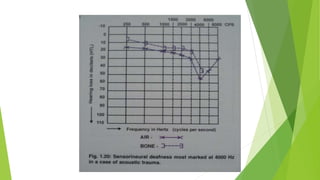
  • #62 Acoustic trauma
  • #63 Lower freq SNHL in meniere ds
  • #65 Immitance = Impedance + admittance
  • #68 Audiometry is subjective