Topic 
1 
LEARNING OUTCOMES 
By the end of this topic, you should be able to: 
1. State the meaning of the term „curriculum‰; 
2. Discuss the philosophical considerations in formulating a curriculum; 
3. Discuss the psychological considerations in formulating a curriculum; 
 INTRODUCTION 
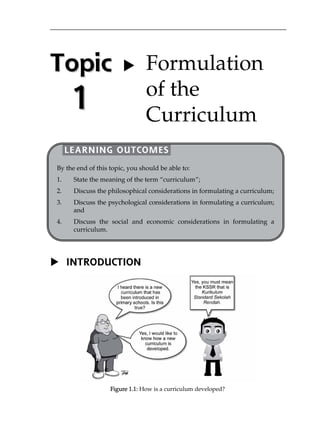
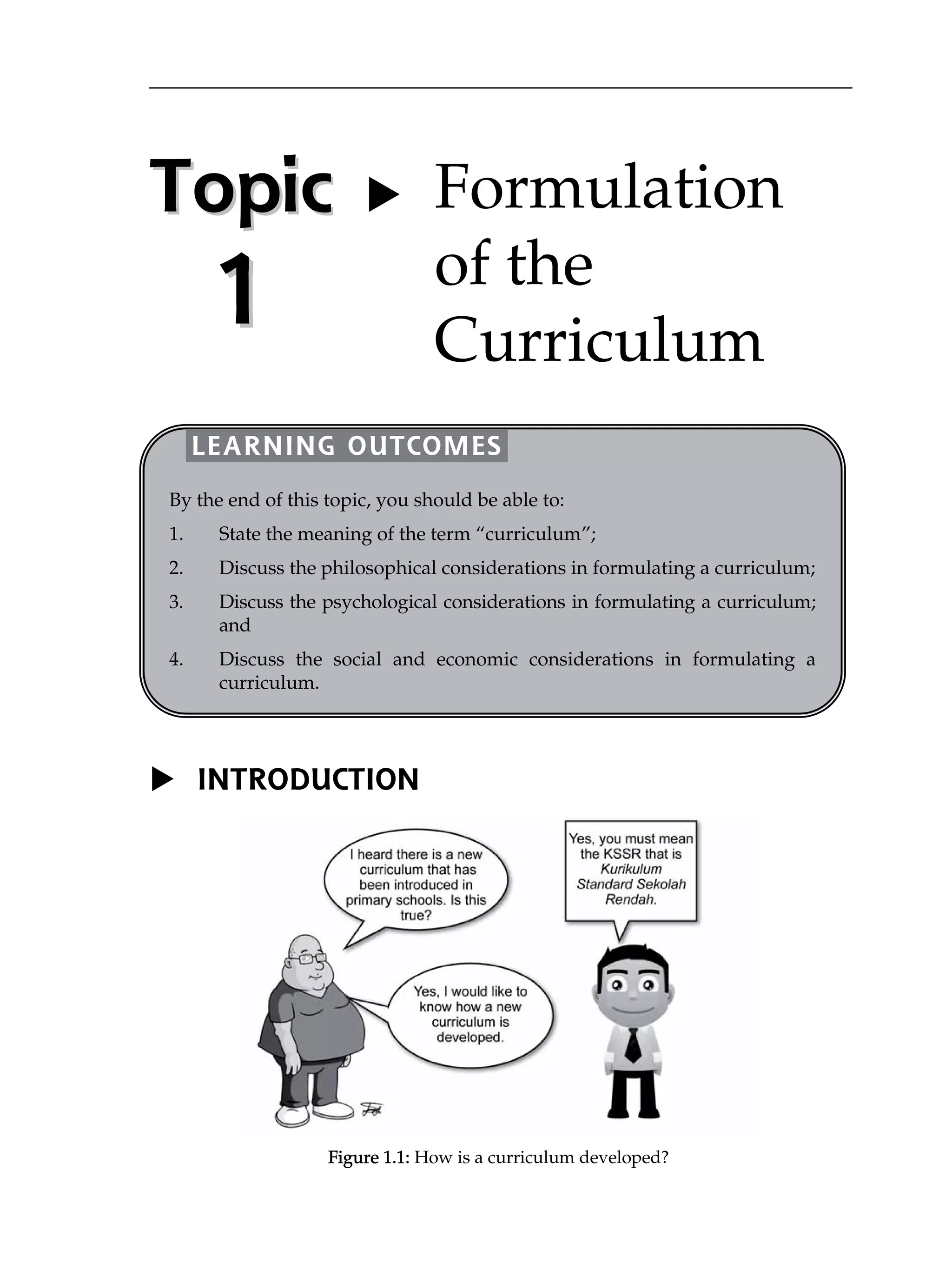
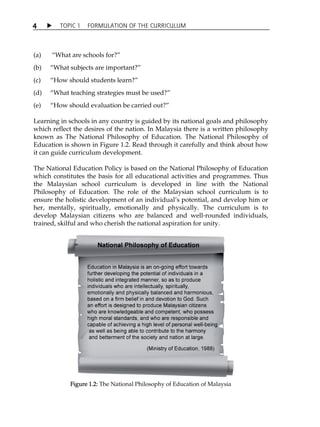
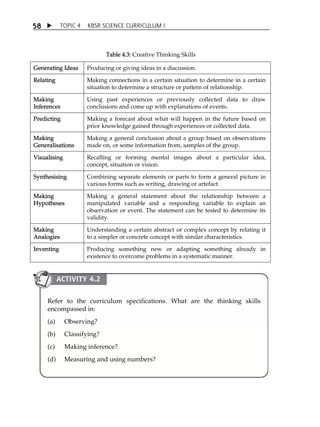
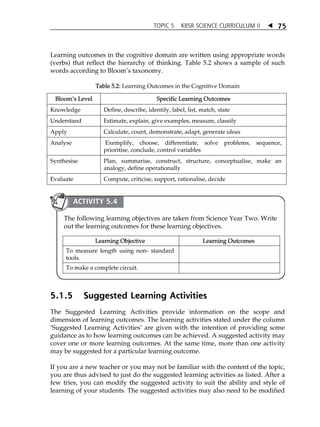
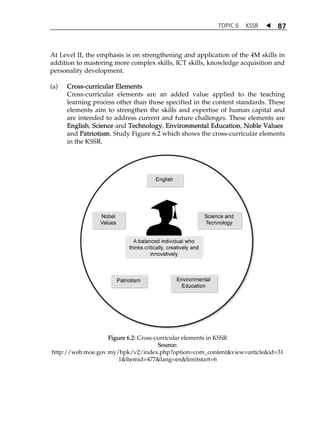
Figure 1.1: How is a curriculum developed? 
and 
4. Discuss the social and economic considerations in formulating a 
curriculum. 
 Formulation 
of the 
Curriculum
2  TOPIC 1 FORMULATION OF THE CURRICULUM 
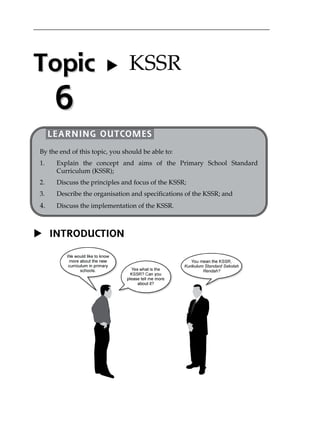
Look at the scenario in Figure 1.1. If you were the teacher how would you answer 
the question posed by the parent? 
ACTIVITY 1.1 
What do you understand by the term „curriculum‰? 
Browse the Internet or use reference books to find out what „curriculum‰ 
means. 
While doing Activity 1.1, you would have come across many different definitions 
of the term „curriculum‰. The word curriculum is derived from an ancient Latin 
word currere which means „running course‰. Over time the word curriculum 
has come to mean „sequence of courses or learning experiences.‰ Many attempts 
have been made to provide more specific definitions of curriculum. 
The Merriam Webster Dictionary defines curriculum as: 
This view defines curriculum as an organised body of knowledge to be conveyed 
to students. This is a general way of defining curriculum and refers to the subject 
matter, content or syllabus. However, views such as these are narrow and 
simplify the complexity of the curriculum. Curriculum is a broad term and refers 
to more than just courses offered. 
Tanner and Tanner (1995) describe curriculum as a plan or programme of all 
experiences which the learner encounters under the direction of a school. 
Another definition by Taba (1962) is: 
The curriculum usually contains a statement of aims of specific objectives, it 
indicates some selection and organisation of content, it implies certain 
patterns of learning and teaching, whether because the objectives demand 
them or because the content organisation requires them. Finally it includes a 
programme of evaluation of the outcomes. 
Taba (1962) 
„The courses offered by an educational institution‰.
TOPIC 1 FORMULATION OF THE CURRICULUM  
3 
From the above definitions we can conclude that a curriculum has the following 
elements: 
(a) Learning objectives; 
(b) Content; 
(c) Instructional strategies; 
(d) Learning experiences for the learners; and 
(e) Programme of evaluation. 
Now, if you were a curriculum developer and had to formulate a new science 
curriculum where would you start? How would you decide the learning 
objectives and choose what content is relevant? How would you choose suitable 
instructional strategies and learning experiences to fulfil the curriculum? 
Curriculum developers use different curriculum development models or 
approaches when formulating a curriculum. Their main concern would be what 
should be included in the curriculum (the content) and how to present and 
arrange what is selected (learning experiences). Regardless of the model or 
approach used, curriculum developers need to consider the philosophical, 
psychological, social and economic needs of the society when planning the 
curriculum. 
In this topic, you will learn about the philosophical, psychological, social and 
economic considerations in formulating a curriculum. A sound understanding of 
this will reflect on how you think and approach the teaching and learning 
process in your classroom. You will also be able to give informed answers to 
parents if the need arises. 
PHILOSOPHICAL CONSIDERATIONS IN 
FORMULATING A CURRICULUM 
1.1 
What is the connection between philosophy and the curriculum? Philosophy 
provides curriculum developers, educators and teachers with a framework of 
values and beliefs related to the goals of education that they can use for planning, 
implementing and evaluating the curriculum in school. Curriculum developers 
need to identify an educational vision or philosophy which will form the basis of 
planning the curriculum. Philosophy helps in answering questions like:
4  TOPIC 1 FORMULATION OF THE CURRICULUM 
(a) „What are schools for?‰ 
(b) „What subjects are important?‰ 
(c) „How should students learn?‰ 
(d) „What teaching strategies must be used?‰ 
(e) „How should evaluation be carried out?‰ 
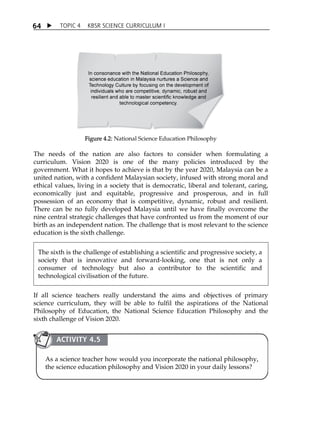
Learning in schools in any country is guided by its national goals and philosophy 
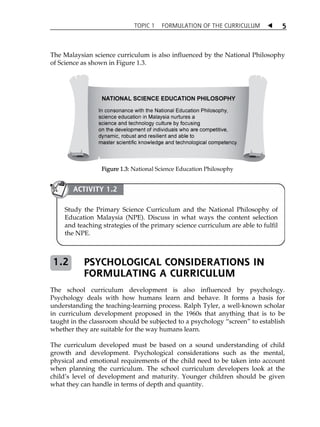
which reflect the desires of the nation. In Malaysia there is a written philosophy 
known as The National Philosophy of Education. The National Philosophy of 
Education is shown in Figure 1.2. Read through it carefully and think about how 
it can guide curriculum development. 
The National Education Policy is based on the National Philosophy of Education 
which constitutes the basis for all educational activities and programmes. Thus 
the Malaysian school curriculum is developed in line with the National 
Philosophy of Education. The role of the Malaysian school curriculum is to 
ensure the holistic development of an individualÊs potential, and develop him or 
her, mentally, spiritually, emotionally and physically. The curriculum is to 
develop Malaysian citizens who are balanced and well-rounded individuals, 
trained, skilful and who cherish the national aspiration for unity. 
Figure 1.2: The National Philosophy of Education of Malaysia
TOPIC 1 FORMULATION OF THE CURRICULUM  
5 
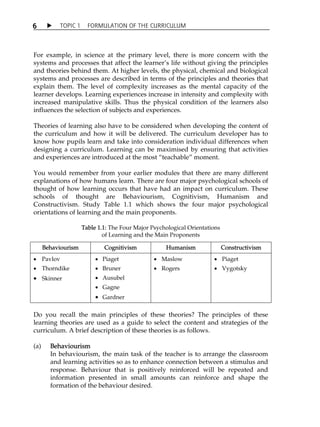
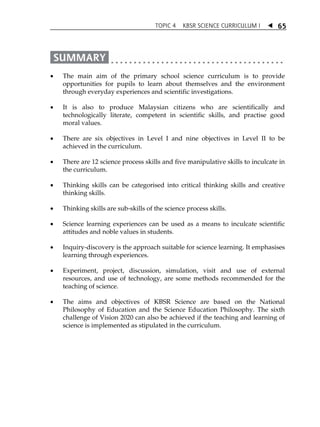
The Malaysian science curriculum is also influenced by the National Philosophy 
of Science as shown in Figure 1.3. 
Figure 1.3: National Science Education Philosophy 
ACTIVITY 1.2 
Study the Primary Science Curriculum and the National Philosophy of 
Education Malaysia (NPE). Discuss in what ways the content selection 
and teaching strategies of the primary science curriculum are able to fulfil 
the NPE. 
PSYCHOLOGICAL CONSIDERATIONS IN 
FORMULATING A CURRICULUM 
1.2 
The school curriculum development is also influenced by psychology. 
Psychology deals with how humans learn and behave. It forms a basis for 
understanding the teaching-learning process. Ralph Tyler, a well-known scholar 
in curriculum development proposed in the 1960s that anything that is to be 
taught in the classroom should be subjected to a psychology „screen‰ to establish 
whether they are suitable for the way humans learn. 
The curriculum developed must be based on a sound understanding of child 
growth and development. Psychological considerations such as the mental, 
physical and emotional requirements of the child need to be taken into account 
when planning the curriculum. The school curriculum developers look at the 
childÊs level of development and maturity. Younger children should be given 
what they can handle in terms of depth and quantity.
6  TOPIC 1 FORMULATION OF THE CURRICULUM 
For example, in science at the primary level, there is more concern with the 
systems and processes that affect the learnerÊs life without giving the principles 
and theories behind them. At higher levels, the physical, chemical and biological 
systems and processes are described in terms of the principles and theories that 
explain them. The level of complexity increases as the mental capacity of the 
learner develops. Learning experiences increase in intensity and complexity with 
increased manipulative skills. Thus the physical condition of the learners also 
influences the selection of subjects and experiences. 
Theories of learning also have to be considered when developing the content of 
the curriculum and how it will be delivered. The curriculum developer has to 
know how pupils learn and take into consideration individual differences when 
designing a curriculum. Learning can be maximised by ensuring that activities 
and experiences are introduced at the most „teachable‰ moment. 
You would remember from your earlier modules that there are many different 
explanations of how humans learn. There are four major psychological schools of 
thought of how learning occurs that have had an impact on curriculum. These 
schools of thought are Behaviourism, Cognitivism, Humanism and 
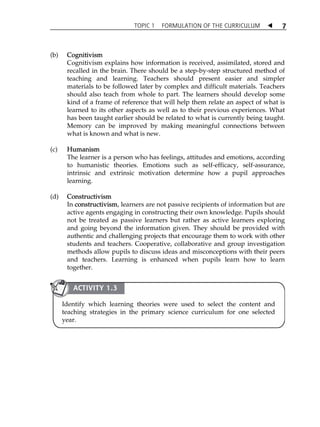
Constructivism. Study Table 1.1 which shows the four major psychological 
orientations of learning and the main proponents. 
Table 1.1: The Four Major Psychological Orientations 
of Learning and the Main Proponents 
Behaviourism Cognitivism Humanism Constructivism 
 Pavlov 
 Thorndike 
 Skinner 
 Piaget 
 Bruner 
 Ausubel 
 Gagne 
 Gardner 
 Maslow 
 Rogers 
 Piaget 
 Vygotsky 
Do you recall the main principles of these theories? The principles of these 
learning theories are used as a guide to select the content and strategies of the 
curriculum. A brief description of these theories is as follows. 
(a) Behaviourism 
In behaviourism, the main task of the teacher is to arrange the classroom 
and learning activities so as to enhance connection between a stimulus and 
response. Behaviour that is positively reinforced will be repeated and 
information presented in small amounts can reinforce and shape the 
formation of the behaviour desired.
TOPIC 1 FORMULATION OF THE CURRICULUM  
7 
(b) Cognitivism 
Cognitivism explains how information is received, assimilated, stored and 
recalled in the brain. There should be a step-by-step structured method of 
teaching and learning. Teachers should present easier and simpler 
materials to be followed later by complex and difficult materials. Teachers 
should also teach from whole to part. The learners should develop some 
kind of a frame of reference that will help them relate an aspect of what is 
learned to its other aspects as well as to their previous experiences. What 
has been taught earlier should be related to what is currently being taught. 
Memory can be improved by making meaningful connections between 
what is known and what is new. 
(c) Humanism 
The learner is a person who has feelings, attitudes and emotions, according 
to humanistic theories. Emotions such as self-efficacy, self-assurance, 
intrinsic and extrinsic motivation determine how a pupil approaches 
learning. 
(d) Constructivism 
In constructivism, learners are not passive recipients of information but are 
active agents engaging in constructing their own knowledge. Pupils should 
not be treated as passive learners but rather as active learners exploring 
and going beyond the information given. They should be provided with 
authentic and challenging projects that encourage them to work with other 
students and teachers. Cooperative, collaborative and group investigation 
methods allow pupils to discuss ideas and misconceptions with their peers 
and teachers. Learning is enhanced when pupils learn how to learn 
together. 
ACTIVITY 1.3 
Identify which learning theories were used to select the content and 
teaching strategies in the primary science curriculum for one selected 
year.
8  TOPIC 1 FORMULATION OF THE CURRICULUM 
SOCIAL AND ECONOMIC 
CONSIDERATIONS IN FORMULATING A 
CURRICULUM 
1.3 
„Education is a major contributor to the development of our social and 
economic capital. It inspires creativity and fosters innovation; provides our 
youth with the necessary skills to be able to compete in the modern labour 
market; and is a key driver of growth in the economy‰ 
(DatoÊ Sri Mohd Najib bin Tun Haji Abdul Razak 
Malaysian Education Blueprint 2013-2025) 
Read the statement given above. Do you see the importance of education in the 
development of Malaysian social and economic capital? 
1.3.1 Social Considerations in Formulating a 
Curriculum 
We must understand that schools are part of society and exist for society. 
Schools, through their execution of the curriculum, can shape and mould a 
society. Therefore curriculum developers need to take into account societal 
considerations when planning the curriculum. If this does not happen, the 
curriculum becomes irrelevant. 
So what do you think society wants from the curriculum? The main societal 
consideration in Malaysia is that the curriculum must promote a sense of 
national pride and identity. In Malaysia, which has a heterogeneous ethnic 
population, the school curriculum is expected to promote a sense of cohesion and 
unity amongst the various ethnic groups. The curriculum must assist the 
individual to understand the process of harmonisation and develop values and 
attitudes such as compassion, understanding, tolerance, sensitivity and 
awareness. The curriculum should also be able to impart social norms, social 
order and morality. 
The design of the curricular materials should be of relevance to the culture of the 
society. For example, would pupils in Malaysia need to learn about the customs 
of the Eskimo people in detail? It would not be relevant to them. On the other 
hand, they would need to learn the beliefs, values and culture of the various 
ethnic groups in Malaysian society to promote understanding and tolerance of 
other cultures in the society that they live in.
TOPIC 1 FORMULATION OF THE CURRICULUM  
9 
A continuous examination of the goals and demands of society which are 
continuously changing is needed to determine what knowledge is most 
worthwhile and which values are relevant. 
ACTIVITY 1.4 
1. The concerns of society twenty years ago is different from the 
concerns of society today. Discuss how this has affected the present 
science curriculum. 
2. Social factors are very critical in formulating a curriculum. Identify 
at least two social factors that should be considered when 
formulating a curriculum. 
1.3.2 Economic Considerations in Formulating a 
Curriculum 
The national economy is an important consideration when formulating a 
curriculum. Are you wondering how the economy of the country affects the 
curriculum? 
The children you teach will one day be employed. Schools need to meet the 
workforce demands of a changing world. The 21st century world is a 
technologically advanced world. Modern careers require skills that are 
technologically complex. There is a demand for skilled and literate workers. 
Successful workers in the modern world must possess both an understanding of 
electronic technology, and the ability to work more cooperatively with others to 
solve problems of a highly intricate nature, are able to communicate their ideas 
confidently. 
The curriculum offered has to provide appropriate education for the students to 
develop the skills, knowledge and attitudes required by the workforce so as to 
sustain the countryÊs progress with a competent labour force. It is therefore 
important that serious consideration is given to economic demands when 
designing the curriculum.
1 0  TOPIC 1 FORMULATION OF THE CURRICULUM 
SELF-CHECK 1.1 
1. Explain what you understand by the term „curriculum‰. 
2. A country has been using the same curriculum for the last 10 
years. Do you think this is a good practice? Why? 
3. How do the philosophical foundations of education influence 
curriculum formulation? 
4. How do the psychological foundations of education influence 
curriculum formulation? 
5. To what extent can the school curriculum equip individuals to 
cope with the challenges and requirements of the 21st century? 
 A curriculum consists of learning objectives, content, instructional strategies, 
learning experiences of the learner and a programme for evaluation of 
outcomes. 
 Curriculum developers need to consider the philosophical, psychological, 
social and economic needs of the society when planning the curriculum. 
 Philosophy provides a framework of values and beliefs related to the goals 
of education that can be used for planning, implementing and evaluating the 
curriculum in school. 
 The National Philosophy of Education is the basis for all educational 
activities and programmes in Malaysia. 
 The Malaysian school curriculum is developed in line with the National 
Philosophy of Education. 
 The Malaysian science curriculum is also influenced by the National 
Philosophy of Science.
TOPIC 1 FORMULATION OF THE CURRICULUM  
11 
 The curriculum developed must be based on a sound understanding of 
psychological factors such as child growth, child development and learning 
theories. 
 Psychological considerations such as the mental, physical and emotional 
requirements of the child need to be taken into account when planning the 
curriculum. 
 Schools, through their teaching of the curriculum, can shape and mould a 
society. 
 Curriculum developers need to take into account societal considerations 
when planning the curriculum. 
 Consideration must be given to economic demands when designing the 
curriculum so as to develop the skills, knowledge and attitudes required by 
the workforce to sustain the countryÊs progress with a competent labour 
force. 
Curriculum 
Economic considerations 
National Philosophy of Education 
National Science Education Philosophy 
Philosophical considerations 
Psychological considerations 
Social considerations 
 
Educational Planning and Research Division, Ministry of Education Malaysia. 
(2008). Education in Malaysia - A journey to excellence. Retrieved from 
http://www.slideshare.net/Fadzliaton/education-in-malaysia 
Heslep, R. (1997). Philosophical thinking in educational practice . London: 
Greenwood Publishing. 
Ornstein, A. C.  Hunkins, F. (1998). Curriculum foundations, principles and 
theory. USA: Allyn and Bacon.
1 2  TOPIC 1 FORMULATION OF THE CURRICULUM 
Psychological Influences in the Curriculum Decision Making Process. Anne 
Syomwene (Ph.D) 1*; Kisilu Kitainge (Ph.D) 2; Marcella Mwaka (PhD) 
3*Moi University, Kenya 2University of Eldoret, Kenya 3Moi University, 
Kenya . Retrieved from (http://www.iiste.org/Journals/index.php/JEP/ 
article/view/5201/5319) 
Sharifah, Maimunah Syed Zin  Lewin, K. M. (1991). Curriculum development 
in Malaysia in curriculum development in east Asia. Ed by Marsh, C.  
Morris, P. London: The Falmer Press. 
Taba, H. (1962). Curriculum development: Theory and practice. New York, NY: 
Harcourt, Brace,  World. 
Tanner, D.,  Tanner, L. (1995). Curriculum development: Theory into practice 
(3rd ed.). Englewood Cliffs, NJ: Merrill. 
Tyler, R. W. (1949). Basic principles of curriculum and instruction. Chicago: 
University of Chicago Press.
Topic 
2 
 Issues in 
Science 
Education 
LEARNING OUTCOMES 
By the end of this topic, you should be able to: 
1. Examine the goals of a science curriculum; 
2. Analyse the content of a science curriculum; 
3. List the relevant methods for teaching science; 
4. Explain the meaning of scientific literacy; 
5. Discuss the meaning of scientific language; and 
6. Discuss some of the contemporay issues of science education. 
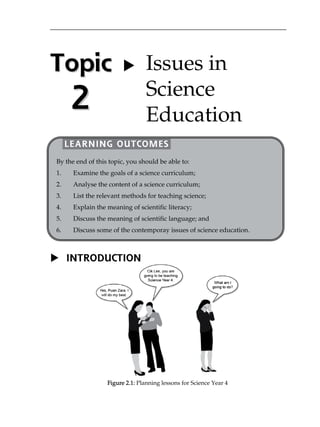
 INTRODUCTION 
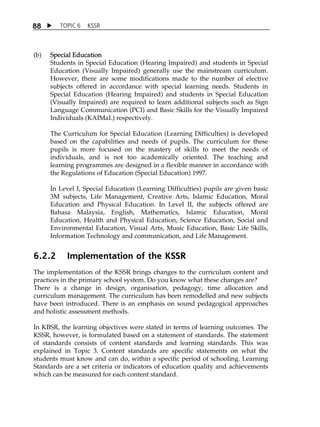
Figure 2.1: Planning lessons for Science Year 4
TOPIC 2 ISSUES IN SCIENCE EDUCATION 
14 
What should Cik Lee do? What documents should she refer to in planning the 
teaching of the subject? Yes, she should study the science curriculum. She should 
refer to the primary science syllabus and curriculum specifications for Year Four. 
Then only should she look at the textbook and other resources to plan the 
lessons. 
The curriculum is a course or path. It is meant to be connected and integrated 
and it should lead to educational attainment. Thus, by understanding the science 
curriculum, Cik Lee would be clear about the aspirations of the curriculum, the 
topics to be taught, and how to assess her pupilsÊ learning. 
In this topic you will be looking at the details of any science curriculum  goals of 
a science curriculum, the contents of the curriculum, how to teach them, the 
language of science, the concept of scientific literacy and the issues pertaining to 
the science curriculum. 
ACTIVITY 2.1 
Recall how science was taught when you were in primary school. Take 
time to list down the characteristics of the science lesson. 
GOALS OF SCIENCE EDUCATION 
2.1 
Knowing where you want to go will make it easier for you to plan your 
destination. Thus knowing the goals of science education will make it easier for a 
curriculum planner to plan the appropriate curriculum needed. And for you as a 
teacher, knowing the goals will make it easier to plan how to teach and assess the 
teaching and learning of science. 
Let us study a few of the goals of science curriculum in different countries.
TOPIC 2 ISSUES IN SCIENCE EDUCATION  15 
ILLINOIS LEARNING STANDARDS 
According to Illinois Learning Standards (ISBE, 1997), the general and 
subsidiary goals of the science curriculum are as follows: 
Goal 1: Understand and apply the methods of scientific inquiry and 
technological design to investigate questions, solve problems and analyse 
claims. 
 Explain the principles and practices of scientific research. 
 Apply the steps and methods of scientific inquiry to conduct experiments 
and investigate research questions. 
 Apply the principles and methods of technological design to solve 
problems. 
 Assess the credibility of scientific claims. 
Goal 2: Understand the facts and unifying concepts of the life, physical and 
earth/space sciences. 
 Apply concepts of systems within the sciences. 
 Apply concepts of form and function within the sciences. 
 Apply concepts of change and constancy within the sciences. 
 Apply concepts of models and explanations within the sciences. 
Goal 3: Understand connections and relationships among science, technology 
and society. 
 Explain the historical development and importance of science and 
technology. 
 Explain conceptual relationships between science and technology. 
 Describe and analyse relationships among science, technology and 
society in practical situations.
TOPIC 2 ISSUES IN SCIENCE EDUCATION 
16 
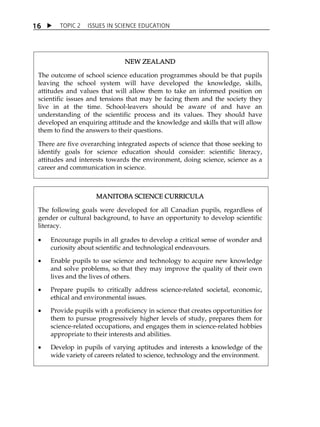
NEW ZEALAND 
The outcome of school science education programmes should be that pupils 
leaving the school system will have developed the knowledge, skills, 
attitudes and values that will allow them to take an informed position on 
scientific issues and tensions that may be facing them and the society they 
live in at the time. School-leavers should be aware of and have an 
understanding of the scientific process and its values. They should have 
developed an enquiring attitude and the knowledge and skills that will allow 
them to find the answers to their questions. 
There are five overarching integrated aspects of science that those seeking to 
identify goals for science education should consider: scientific literacy, 
attitudes and interests towards the environment, doing science, science as a 
career and communication in science. 
MANITOBA SCIENCE CURRICULA 
The following goals were developed for all Canadian pupils, regardless of 
gender or cultural background, to have an opportunity to develop scientific 
literacy. 
 Encourage pupils in all grades to develop a critical sense of wonder and 
curiosity about scientific and technological endeavours. 
 Enable pupils to use science and technology to acquire new knowledge 
and solve problems, so that they may improve the quality of their own 
lives and the lives of others. 
 Prepare pupils to critically address science-related societal, economic, 
ethical and environmental issues. 
 Provide pupils with a proficiency in science that creates opportunities for 
them to pursue progressively higher levels of study, prepares them for 
science-related occupations, and engages them in science-related hobbies 
appropriate to their interests and abilities. 
 Develop in pupils of varying aptitudes and interests a knowledge of the 
wide variety of careers related to science, technology and the environment.
TOPIC 2 ISSUES IN SCIENCE EDUCATION  17 
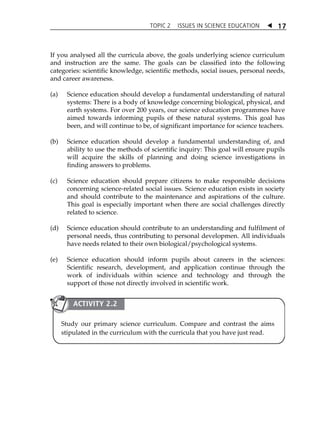
If you analysed all the curricula above, the goals underlying science curriculum 
and instruction are the same. The goals can be classified into the following 
categories: scientific knowledge, scientific methods, social issues, personal needs, 
and career awareness. 
(a) Science education should develop a fundamental understanding of natural 
systems: There is a body of knowledge concerning biological, physical, and 
earth systems. For over 200 years, our science education programmes have 
aimed towards informing pupils of these natural systems. This goal has 
been, and will continue to be, of significant importance for science teachers. 
(b) Science education should develop a fundamental understanding of, and 
ability to use the methods of scientific inquiry: This goal will ensure pupils 
will acquire the skills of planning and doing science investigations in 
finding answers to problems. 
(c) Science education should prepare citizens to make responsible decisions 
concerning science-related social issues. Science education exists in society 
and should contribute to the maintenance and aspirations of the culture. 
This goal is especially important when there are social challenges directly 
related to science. 
(d) Science education should contribute to an understanding and fulfilment of 
personal needs, thus contributing to personal developmen. All individuals 
have needs related to their own biological/psychological systems. 
(e) Science education should inform pupils about careers in the sciences: 
Scientific research, development, and application continue through the 
work of individuals within science and technology and through the 
support of those not directly involved in scientific work. 
ACTIVITY 2.2 
Study our primary science curriculum. Compare and contrast the aims 
stipulated in the curriculum with the curricula that you have just read.
TOPIC 2 ISSUES IN SCIENCE EDUCATION 
18 
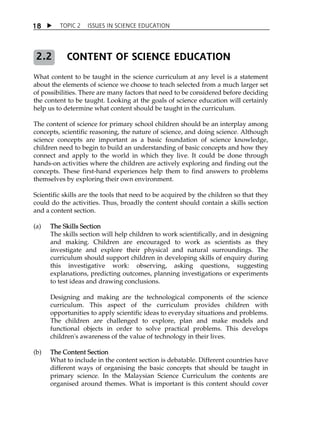
CONTENT OF SCIENCE EDUCATION 
2.2 
What content to be taught in the science curriculum at any level is a statement 
about the elements of science we choose to teach selected from a much larger set 
of possibilities. There are many factors that need to be considered before deciding 
the content to be taught. Looking at the goals of science education will certainly 
help us to determine what content should be taught in the curriculum. 
The content of science for primary school children should be an interplay among 
concepts, scientific reasoning, the nature of science, and doing science. Although 
science concepts are important as a basic foundation of science knowledge, 
children need to begin to build an understanding of basic concepts and how they 
connect and apply to the world in which they live. It could be done through 
hands-on activities where the children are actively exploring and finding out the 
concepts. These first-hand experiences help them to find answers to problems 
themselves by exploring their own environment. 
Scientific skills are the tools that need to be acquired by the children so that they 
could do the activities. Thus, broadly the content should contain a skills section 
and a content section. 
(a) The Skills Section 
The skills section will help children to work scientifically, and in designing 
and making. Children are encouraged to work as scientists as they 
investigate and explore their physical and natural surroundings. The 
curriculum should support children in developing skills of enquiry during 
this investigative work: observing, asking questions, suggesting 
explanations, predicting outcomes, planning investigations or experiments 
to test ideas and drawing conclusions. 
Designing and making are the technological components of the science 
curriculum. This aspect of the curriculum provides children with 
opportunities to apply scientific ideas to everyday situations and problems. 
The children are challenged to explore, plan and make models and 
functional objects in order to solve practical problems. This develops 
children's awareness of the value of technology in their lives. 
(b) The Content Section 
What to include in the content section is debatable. Different countries have 
different ways of organising the basic concepts that should be taught in 
primary science. In the Malaysian Science Curriculum the contents are 
organised around themes. What is important is this content should cover
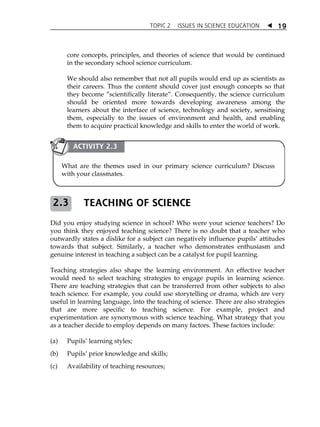
TOPIC 2 ISSUES IN SCIENCE EDUCATION  19 
core concepts, principles, and theories of science that would be continued 
in the secondary school science curriculum. 
We should also remember that not all pupils would end up as scientists as 
their careers. Thus the content should cover just enough concepts so that 
they become ‰scientifically literate‰. Consequently, the science curriculum 
should be oriented more towards developing awareness among the 
learners about the interface of science, technology and society, sensitising 
them, especially to the issues of environment and health, and enabling 
them to acquire practical knowledge and skills to enter the world of work. 
ACTIVITY 2.3 
What are the themes used in our primary science curriculum? Discuss 
with your classmates. 
TEACHING OF SCIENCE 
2.3 
Did you enjoy studying science in school? Who were your science teachers? Do 
you think they enjoyed teaching science? There is no doubt that a teacher who 
outwardly states a dislike for a subject can negatively influence pupilsÊ attitudes 
towards that subject. Similarly, a teacher who demonstrates enthusiasm and 
genuine interest in teaching a subject can be a catalyst for pupil learning. 
Teaching strategies also shape the learning environment. An effective teacher 
would need to select teaching strategies to engage pupils in learning science. 
There are teaching strategies that can be transferred from other subjects to also 
teach science. For example, you could use storytelling or drama, which are very 
useful in learning language, into the teaching of science. There are also strategies 
that are more specific to teaching science. For example, project and 
experimentation are synonymous with science teaching. What strategy that you 
as a teacher decide to employ depends on many factors. These factors include: 
(a) PupilsÊ learning styles; 
(b) PupilsÊ prior knowledge and skills; 
(c) Availability of teaching resources;
TOPIC 2 ISSUES IN SCIENCE EDUCATION 
20 
(d) TeachersÊ knowledge and skills; and 
(e) SocietyÊs expectations. 
The nature of science should be the most, or at least, a big consideration when 
deciding on the pedagogy when teaching science. 
The main complaint of pupils about science is that it is not sufficiently relevant. 
What is learnt in the science classroom is only used in the classroom and has no 
connection with the real world, although science is in fact the study of the natural 
world. 
For activities to be meaningful and engaging they should help the understanding 
of things pupils have encountered directly in their day-to-day experience and 
indirectly through films and television programmes. It should be possible for 
children to make a link between new experiences and previous experiences. 
There can be a dilemma here in relation to whether science activities should be 
taken from real-life events  often complex and with several ideas involved  or 
whether they should be „tidied up‰ to demonstrate certain relationships or 
principles. Some degree of abstraction from real events is generally necessary, 
but it should always be possible for the children to link what is learned to real 
events. 
Inquiry-based is the essence of science teaching and learning. It „fits‰ with the 
nature of science. Pupils should be actively engaged in exploring the concepts 
through hands-on activities. Pupils learn effectively when they are actively 
engaged in the discovery process, often working in small groups. They should be 
provided opportunities to have direct experience with common objects, 
materials, and living things in their environment. Good instruction focuses on 
understanding important relationships, processes, mechanisms and applications 
of concepts. 
Teachers act as facilitators. Managing inquiry during a lesson is not the only 
thing that a science teacher must do. Her work starts before the lesson begins. 
She decides the concepts and the skills that should be developed during the 
lesson. Then, throughout the lesson, the teacher should be listening to the 
discussion about the concepts and observing the skills as the pupils are doing 
their work. This information or formative assessment can later be used as 
feedback for the teacher and pupils about learning. Have they understood the 
lesson? Have they mastered the skills? Do the concepts need to be explored 
again? These are some of the questions that the teacher can answer from 
formative assessments.
TOPIC 2 ISSUES IN SCIENCE EDUCATION  21 
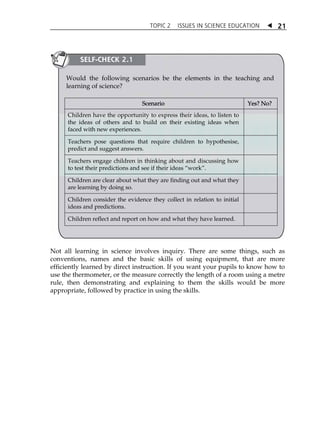
SELF-CHECK 2.1 
Would the following scenarios be the elements in the teaching and 
learning of science? 
Scenario Yes? No? 
Children have the opportunity to express their ideas, to listen to 
the ideas of others and to build on their existing ideas when 
faced with new experiences. 
Teachers pose questions that require children to hypothesise, 
predict and suggest answers. 
Teachers engage children in thinking about and discussing how 
to test their predictions and see if their ideas „work‰. 
Children are clear about what they are finding out and what they 
are learning by doing so. 
Children consider the evidence they collect in relation to initial 
ideas and predictions. 
Children reflect and report on how and what they have learned. 
Not all learning in science involves inquiry. There are some things, such as 
conventions, names and the basic skills of using equipment, that are more 
efficiently learned by direct instruction. If you want your pupils to know how to 
use the thermometer, or the measure correctly the length of a room using a metre 
rule, then demonstrating and explaining to them the skills would be more 
appropriate, followed by practice in using the skills.
TOPIC 2 ISSUES IN SCIENCE EDUCATION 
22 
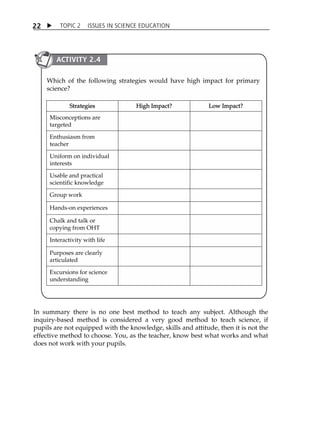
ACTIVITY 2.4 
Which of the following strategies would have high impact for primary 
science? 
Strategies High Impact? Low Impact? 
Misconceptions are 
targeted 
Enthusiasm from 
teacher 
Uniform on individual 
interests 
Usable and practical 
scientific knowledge 
Group work 
Hands-on experiences 
Chalk and talk or 
copying from OHT 
Interactivity with life 
Purposes are clearly 
articulated 
Excursions for science 
understanding 
In summary there is no one best method to teach any subject. Although the 
inquiry-based method is considered a very good method to teach science, if 
pupils are not equipped with the knowledge, skills and attitude, then it is not the 
effective method to choose. You, as the teacher, know best what works and what 
does not work with your pupils.
TOPIC 2 ISSUES IN SCIENCE EDUCATION  23 
SCIENTIFIC LITERACY 
2.4 
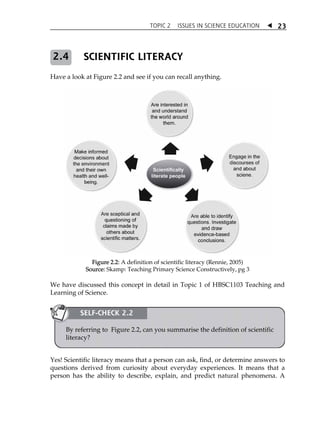
Have a look at Figure 2.2 and see if you can recall anything. 
Figure 2.2: A definition of scientific literacy (Rennie, 2005) 
Source: Skamp: Teaching Primary Science Constructively, pg 3 
We have discussed this concept in detail in Topic 1 of HBSC1103 Teaching and 
Learning of Science. 
SELF-CHECK 2.2 
By referring to Figure 2.2, can you summarise the definition of scientific 
literacy? 
Yes! Scientific literacy means that a person can ask, find, or determine answers to 
questions derived from curiosity about everyday experiences. It means that a 
person has the ability to describe, explain, and predict natural phenomena. A
TOPIC 2 ISSUES IN SCIENCE EDUCATION 
24 
literate citizen should be able to evaluate the quality of scientific information on 
the basis of its source and the methods used to generate it. 
As mentioned above, one of the goals of the science is to develop a scientifically 
literate population. Feasey (1996) suggests that most people are scientifically 
illiterate and often hold negative and contradictory viewpoints of science. The 
public think that science belongs to the scientists and is too difficult for them to 
understand. 
Skamp (2004) mentioned that Feasey and Gott (1996) suggest two elements that 
can provide a foundation for a scientifically literate individual. 
(a) Factual background which relates to the understanding of key ideas and 
facts in science. A sound knowledge and ability to apply such concepts in a 
range of contexts is essential. 
(b) An understanding of evidence that focuses on the individualÊs 
understanding of how and why scientists collect evidence and an ability to 
challenge the reliability and validity of evidence in order to decide on its 
believability. 
Why do you think we need to be scientifically literate? One of the main reasons is 
that the society we live in depends to an ever-increasing extent on technology 
and scientific knowledge that makes it possible. Decisions we make every day 
have the capacity to affect energy consumption, our personal health, natural 
resources, and the environment  ultimately our well-being and that of our 
community and the world. Individual decisions may not seem to be critical, but 
when they are multiplied by 300 million nationwide, or nearly seven billion 
worldwide, they have the power to change the face of the planet (Scearce, 2007). 
ACTIVITY 2.5 
1. Draw your image of a typical scientist and list the characteristics of 
the person that you have drawn. 
2. What work does he or she do?
TOPIC 2 ISSUES IN SCIENCE EDUCATION  25 
SCIENTIFIC LANGUAGE 
2.5 
Teachers often say: „I have explained so many times, yet pupils cannot 
understand!‰ What could the reason be? One of the reasons is because the pupils 
do not understand the scientific language that the teacher is using. What and 
how is scientific language different from everyday language? This section will 
discuss these points. 
2.5.1 Difficulties in Language 
The use of scientific language and terminology enables scientists around the 
world to communicate effectively with each other. However, the use of scientific 
words and phrases is often confusing for non-specialists, let alone non-scientists. 
There are a number of ways language can make understanding science more 
difficult, such as alternative meanings of words, pupilsÊ lack of appropriate 
vocabulary, the specialised vocabulary used by scientists, and English as a 
second language. Pupils may begin to separate school explanations and home 
explanations. Or, pupils may begin to believe they are unable to learn science  it 
is just too difficult to figure out. Still others may reject the scientific explanation 
as too difficult and accept their own, or their community's explanation instead. 
Learners may develop an understanding of the meaning of certain words that is 
different from the scientists' meaning of these words. People outside the scientific 
community and scientists themselves give these same words other meanings 
and/or use them in other contexts, resulting in slight nuances to the original 
meaning. These alternative meanings can make understanding and/or accepting 
the scientist's use of the word or term difficult. Table 2.1 illustrates the different 
meaning of certain terms.
TOPIC 2 ISSUES IN SCIENCE EDUCATION 
26 
Table 2.1: Examples of the Meaning of Words in 
Scientific Language and Everyday Language 
Concepts Scientific Language Everyday Language 
Living and 
non-living 
Living and non-living are 
associated with the terms 
alive and dead. 
Describe those and other non-living 
objects as being alive, e.g. a live wire or 
the fire „came to life‰ when we added 
wood, or as having died, e.g. the car or 
battery died. 
Community The interaction of living 
organisms within a bounded 
system. 
Within the general culture, communities 
are determined by groups of residents 
who have some common identity. 
Communities in this sense focus on the 
activities, needs and care of human 
beings. 
Force We talk about force as one 
aspect of a field of influence 
surrounding objects. That is, 
a force field is a complex 
system of pushes and pulls. 
However, the everyday use of the term 
force includes such phrases as, „I was 
forced to go to bed without my dinner‰, 
„Someone forced their way into the 
house‰, „My mom works in the police 
force,‰ and in the movies, „May the 
force be with you.‰ 
The language used by scientists to communicate their work reflects the nature of 
science. Scientific language used by scientists includes: 
(a) Appeals to evidence. E.g., „Based upon the evidence gathered in this 
investigation, ....‰ 
(b) Expressions about the validity and reliability of the evidence. E.g., „The 
design called for the control of ....‰, „A new technology allowed for ....‰, 
„This procedure ....‰, „The skill of the technician was such that we were 
able to ....‰, 
(c) Appeals to prominent scientists. E.g., „Ian Stirling found in his research 
that ....‰ 
(d) Appeals to accepted literature. E.g., „A research study reported in 
Science indicated that ....‰, „Peer reviewed research in Nature suggests 
that ....‰
TOPIC 2 ISSUES IN SCIENCE EDUCATION  27 
(e) Expressions of (un)certainty. E.g., „This was an initial study ....‰, „The 
These characteristics are typically found in scientific research papers and ideally 
in science educational materials such as science textbooks. Popular science 
magazines and newspaper articles about science often take liberties with 
scientific language by translating it into more common everyday language. This 
translation often removes important aspects about the nature of science, or 
worse, misrepresents the nature of science. Two common problems with popular 
science articles are a lack of expression of appropriate uncertainty (tending to 
more absolute statements) and confusion between evidence and interpretation. 
Evidence is the ultimate authority in science even though all evidence is 
uncertain to some degree. Expressions such as „facts‰, „exactly‰, „absolutely‰ or 
„we proved ‰ are not appropriate in the context of a scientific investigation. 
Evidence can support or fail to support a prediction and/or hypothesis, but 
cannot „prove‰ either. „Proof‰ is considered too absolute and does not connote 
the uncertainty accompanying all scientific evidence and knowledge. Table 2.2 
shows more examples of the use of scientific language. 
Table 2.2: Some Examples of the Use of Scientific Language 
Expressing the Authority Expressing the Degree of Certainty 
Based on the concept of  The certainty is three significant digits. 
According to the law of  Based upon the limited evidence gathered, 
 
Using the theory of  Without full control of all variables  
Based on the evidence obtained in this 
investigation  
The experiment needs to be replicated by 
another group but  
In our judgment,  Careful control of all known variables 
suggests  
sample size was small but ...‰, 
(f) Appeals to the nature of science. E.g., „Although science requires us to 
be open-minded about this counter-claim,‰, „This is only a correlational 
study and not a cause and effect study so ...‰. 
(g) Appeals to logical reasoning. E.g., „If ..., then ....‰, „If ... and ...., then 
....‰, Logical consistency requires that ....‰
TOPIC 2 ISSUES IN SCIENCE EDUCATION 
28 
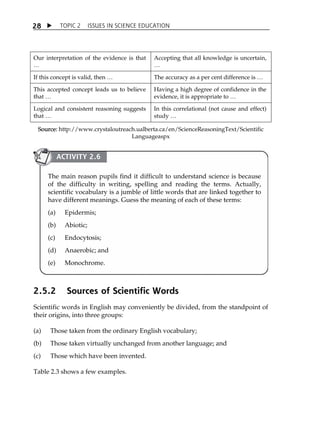
Our interpretation of the evidence is that 
 
Accepting that all knowledge is uncertain, 
 
If this concept is valid, then  The accuracy as a per cent difference is  
This accepted concept leads us to believe 
that  
Having a high degree of confidence in the 
evidence, it is appropriate to  
Logical and consistent reasoning suggests 
that  
In this correlational (not cause and effect) 
study  
Source: http://www.crystaloutreach.ualberta.ca/en/ScienceReasoningText/Scientific 
Languageaspx 
ACTIVITY 2.6 
The main reason pupils find it difficult to understand science is because 
of the difficulty in writing, spelling and reading the terms. Actually, 
scientific vocabulary is a jumble of little words that are linked together to 
have different meanings. Guess the meaning of each of these terms: 
(a) Epidermis; 
(b) Abiotic; 
(c) Endocytosis; 
(d) Anaerobic; and 
(e) Monochrome. 
2.5.2 Sources of Scientific Words 
Scientific words in English may conveniently be divided, from the standpoint of 
their origins, into three groups: 
(a) Those taken from the ordinary English vocabulary; 
(b) Those taken virtually unchanged from another language; and 
(c) Those which have been invented. 
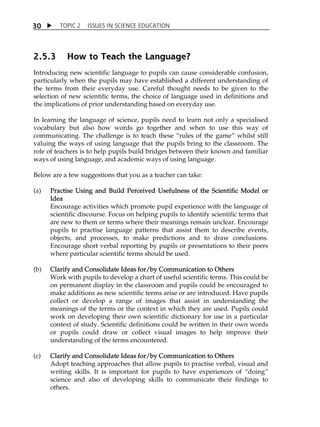
Table 2.3 shows a few examples.
TOPIC 2 ISSUES IN SCIENCE EDUCATION  29 
Table 2.3: Examples of Scientific Words and Their Origin 
Sources Examples of Words 
(a) Taken from the ordinary English 
vocabulary. 
Although the scientist may give 
them precise meanings, they are 
liable to be interpreted more loosely 
(or even differently) by the non-scientist. 
Energy, work, power, salt, base, fruit 
(b) Taken virtually unchanged from 
another language. 
Many of the Greek or Latin terms 
have retained their original meaning 
but in some cases the meanings have 
been restricted and rendered more 
precise. 
Latin words: axis, fulcrum, larva, radius, 
locus, nimbus, cortex, cerebrum, pelvis, 
cornea 
Greek words: thorax, stigma, iris, helix 
(c) Those which have been invented. 
Ester for a compound formed by the 
interaction of an alcohol and an organic 
acid. 
ScientistsÊ names have also been used to 
provide the names of units (e.g. watt, volt, 
gauss, joule) 
Scientists have taken „bits and pieces‰  
roots, prefixes, suffixes  from different 
languages and joined them together to form 
the terms. Thus, when they needed a 
general name for animals such as snails and 
slugs which apparently walk on their 
stomachs, they have taken the Greek roots 
gast(e)ro- (stomach) and -pod (foot) and 
formed the new word gastropod. When he 
wanted a word to describe a speed greater 
than that of sound he took the Latin prefix 
super- (above, beyond) and the Latin root 
son- (sound) and coined the adjective 
supersonic.
TOPIC 2 ISSUES IN SCIENCE EDUCATION 
30 
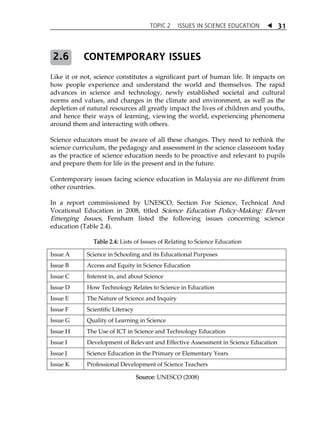
2.5.3 How to Teach the Language? 
Introducing new scientific language to pupils can cause considerable confusion, 
particularly when the pupils may have established a different understanding of 
the terms from their everyday use. Careful thought needs to be given to the 
selection of new scientific terms, the choice of language used in definitions and 
the implications of prior understanding based on everyday use. 
In learning the language of science, pupils need to learn not only a specialised 
vocabulary but also how words go together and when to use this way of 
communicating. The challenge is to teach these „rules of the game‰ whilst still 
valuing the ways of using language that the pupils bring to the classroom. The 
role of teachers is to help pupils build bridges between their known and familiar 
ways of using language, and academic ways of using language. 
Below are a few suggestions that you as a teacher can take: 
(a) Practise Using and Build Perceived Usefulness of the Scientific Model or 
Idea 
Encourage activities which promote pupil experience with the language of 
scientific discourse. Focus on helping pupils to identify scientific terms that 
are new to them or terms where their meanings remain unclear. Encourage 
pupils to practise language patterns that assist them to describe events, 
objects, and processes, to make predictions and to draw conclusions. 
Encourage short verbal reporting by pupils or presentations to their peers 
where particular scientific terms should be used. 
(b) Clarify and Consolidate Ideas for/by Communication to Others 
Work with pupils to develop a chart of useful scientific terms. This could be 
on permanent display in the classroom and pupils could be encouraged to 
make additions as new scientific terms arise or are introduced. Have pupils 
collect or develop a range of images that assist in understanding the 
meanings of the terms or the context in which they are used. Pupils could 
work on developing their own scientific dictionary for use in a particular 
context of study. Scientific definitions could be written in their own words 
or pupils could draw or collect visual images to help improve their 
understanding of the terms encountered. 
(c) Clarify and Consolidate Ideas for/by Communication to Others 
Adopt teaching approaches that allow pupils to practise verbal, visual and 
writing skills. It is important for pupils to have experiences of „doing‰ 
science and also of developing skills to communicate their findings to 
others.
TOPIC 2 ISSUES IN SCIENCE EDUCATION  31 
CONTEMPORARY ISSUES 
Like it or not, science constitutes a significant part of human life. It impacts on 
how people experience and understand the world and themselves. The rapid 
advances in science and technology, newly established societal and cultural 
norms and values, and changes in the climate and environment, as well as the 
depletion of natural resources all greatly impact the lives of children and youths, 
and hence their ways of learning, viewing the world, experiencing phenomena 
around them and interacting with others. 
Science educators must be aware of all these changes. They need to rethink the 
science curriculum, the pedagogy and assessment in the science classroom today 
as the practice of science education needs to be proactive and relevant to pupils 
and prepare them for life in the present and in the future. 
Contemporary issues facing science education in Malaysia are no different from 
other countries. 
In a report commissioned by UNESCO, Section For Science, Technical And 
Vocational Education in 2008, titled Science Education Policy-Making: Eleven 
Emerging Issues, Fensham listed the following issues concerning science 
education (Table 2.4). 
Table 2.4: Lists of Issues of Relating to Science Education 
Issue A Science in Schooling and its Educational Purposes 
Issue B Access and Equity in Science Education 
Issue C Interest in, and about Science 
Issue D How Technology Relates to Science in Education 
Issue E The Nature of Science and Inquiry 
Issue F Scientific Literacy 
Issue G Quality of Learning in Science 
Issue H The Use of ICT in Science and Technology Education 
Issue I Development of Relevant and Effective Assessment in Science Education 
Issue J Science Education in the Primary or Elementary Years 
Issue K Professional Development of Science Teachers 
Source: UNESCO (2008) 
2.6
TOPIC 2 ISSUES IN SCIENCE EDUCATION 
32 
One of the issues that had and is still faced by science education in our country is 
Issue C  Interest in, and about science. Professor of Mathematics, CK Raju, a 
visiting professor at the Mathematics department in Universiti Sains Malaysia 
(USM), calls for a review of teaching methods for science stream subjects as a 
way to raise pupilsÊ interest, following reports that the percentage of science 
stream pupils had dropped to 29 per cent in 2012 (New Straits Times  19 
February 2012). 
The same issue is also commented by Prof. Datin Dr Azizan Baharuddin, the 
Deputy Director-General of Institute of Islamic Understanding Malaysia. This 
issue perhaps needs elaboration and continued engagement because in the 
context of the K-economy and MalaysiaÊs developmental policies, science, 
technology and innovation are critical drivers. The current data seems to show 
that our manpower needs in important areas such as engineering, ICT, health 
and agriculture are still far from adequate as our unfulfilled needs range from 30 
percent to 50 percent. (The STAR, February 28, 2012). 
ACTIVITY 2.7 
1. Conduct a survey in your school on the interest in science. 
2. Find out the reasons why pupils like or dislike science. 
3. As a science teacher, list out different ways that you can adopt to 
raise the interest of these pupils. 
4. Choose any of the issues in Table 2.4. Research and find out the 
current status of the issue in our country. 
 Knowing the goals of science education will make it easier for a curriculum 
planner to plan the appropriate curriculum needed. 
 It also makes it easier for a teacher to plan how to teach and assess the 
teaching and learning of science.
TOPIC 2 ISSUES IN SCIENCE EDUCATION  33 
 The goals can be classified into the following categories: scientific 
knowledge, scientific methods, social issues, personal needs, and career 
awareness. 
 What content to be taught in the science curriculum at any level is a 
statement about the elements of science we choose to teach selected from a 
much larger set of possibilities. 
 The content of science for primary school children should be interplay 
among concepts, scientific reasoning, the nature of science, and doing 
science. 
 The content of science curriculum should contain a skills section and a 
content section. 
 The skills section would help children to work scientifically. This would 
develop skills of enquiry during the investigative work. 
 Designing and making are the technological components of the Science 
Curriculum. 
 Different countries have different ways of organising the basic concepts that 
should be taught in primary science. 
 The science content should cover just enough concepts so that they become 
„scientifically literate‰ as not all pupils are going to be working as scientists. 
 Inquiry-based method is always associated with science teaching and 
learning. 
 Managing inquiry during a lesson is not the only thing that a science teacher 
must do. She should first plan the lesson before acting as facilitator during 
the lesson. 
 Formative assessment should also be carried out so that it can be used as 
feedback for the teacher and pupils about learning. 
 Teaching methods used in teaching other subjects are also used in science 
teaching when necessary. 
 Scientific literacy means that a person has the ability to describe, explain, and 
predict natural phenomena.
TOPIC 2 ISSUES IN SCIENCE EDUCATION 
34 
 The use of scientific language and terminology enables scientists around the 
world to communicate effectively with each other. 
 There are a number of ways language can make understanding science more 
difficult, such as alternative meanings of words, pupils' lack of appropriate 
vocabulary, the specialised vocabulary used by scientists, and English as a 
second language. 
 Learners may develop an understanding of the meaning of certain words 
that is different from the scientists' meaning for these words. 
 The language used by scientists to communicate their work reflects the 
nature of science. 
 Scientific words in English may be divided into three groups: those taken 
from the ordinary English vocabulary; those taken virtually unchanged from 
another language; and those which have been invented. 
Designing and making 
Formative assessment 
Inquiry-based 
Nature of science 
Scientific language 
Scientific literacy 
Scientific reasoning 
Scientific skills 
Aims and goals of science education. Retrieved from http://www.tki.org. 
nzcurriculum/whats_happening/index_e.php 
Carin, A.,  Sund, R. B. (1989). Teaching science through discovery (6th ed.). 
Belmont: Thomson Wadsworth. 
Content of science. Retrieved from http://www.curriculumonline.ie/en/ 
Primary_School_Curriculum/Social_Environmental_and_Scientific_Educat 
ion_SESE_/Science/
TOPIC 2 ISSUES IN SCIENCE EDUCATION  35 
Critical reflections on Malaysian science curriculum. Retrieved from http:// 
www.recsam.edu.my/cosmed/cosmed05/AbstractsFullPapers2005/Files% 
5Csubtheme1%5CKAM.pdf 
Esler, W.K.,  Esler, M. K. (2001). Teaching elementary science (8th ed.). Belmont: 
Thomson Wadsworth. 
Martin, D. J. (2006). Elementary science methods: A constructivist approach. 
Methods for constructing understanding. Boston: Allyn and Bacon. 
Perspectives on education primary science. Retrieved from http://www. 
wellcome.ac.uk/stellent/groups/corporatesite/@msh_peda/documents/ 
web_document/wtd042076.pdf 
Reimagining science  Learning curve  New Straits Times, 19 February 2012. 
Retrieved from www.nst.com.my/channels/learning-curve/issues 
reimagining-science-1.48634#xzz2jAaHEwtA. 
Science in primary school. Retrieved from http://archivefuturelab.org.uk/ 
resources/publications-reports-articles/literature-reviews/Literature- 
Review381 
Scientific language. Retrieved from http://www.crystaloutreach.ualberta.ca/ 
en/ScienceReasoningText/ScientificLanguage.aspx 
Skamp, K. (2004). Teaching primary science constructively. Southbank, Victoria: 
Wadsworth Publishing Company. 
WhoÊs getting it right and WhoÊs getting it wrong in the debate about science 
literacy? Retrieved from http://www.csicop.org/specialarticles/show/ 
whos_getting_it_right_and_whos_getting_it_wrong_in_the_debate_about_ 
science/
Topic 
3 
 Historical 
Development 
of the Science 
Curriculum 
LEARNING OUTCOMES 
By the end of this topic, you should be able to: 
1. Describe the historical development of the science curriculum; 
2. Analyse the strengths and weaknesses of Nature Study, Special 
Project, Man and the Environment, KBSR and KSSR curricula; and 
3. Compare and contrast the Nature Study, Special Project, Man and the 
Environment, KBSR and KSSR curricula. 
 INTRODUCTION
TOPIC 3 HISTORICAL DEVELOPMENT OF THE SCIENCE CURRICULUM  
37 
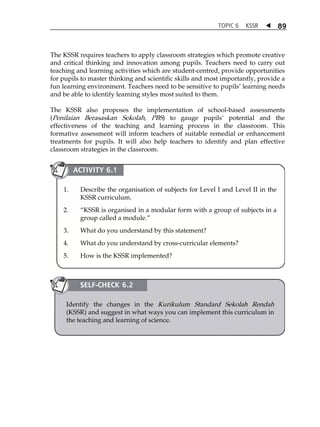
The scenario above is a conversation between two parents outside a science 
classroom. You must have heard similar conversations in your school too. Why 
do you think there have been so many changes in the science curriculum? 
Remember what you studied in Topic 1? We discussed philosophical, 
psychological, social and economic considerations when developing a 
curriculum. These factors are not constant. Society is constantly evolving. Social 
and economic factors may change. There might be new psychological theories 
that need to be addressed. Curriculum developers believe that the curriculum 
has to be dynamic and responsive in order to remain current and relevant. 
The Malaysian school science curriculumÊs main aim is national unity and to 
produce a workforce that can contribute to the development of the nation. The 
pattern of changes and development in science education in Malaysia is largely 
based on National Education Policies and current trends in science teaching. 
Study Table 3.1 which shows the different primary science curricula in Malaysia 
and the years they were implemented. 
Table 3.1: Historical Development of Primary Science Curricula in Malaysia 
Science Curriculum Year of Implementation 
Nature Study Before 1965 
Primary Science curriculum 1965-1968 
Primary Science Special Project 1968-1984 
Man and The Environment 
1985-1993 
(Kurikulum Baru Sekolah Rendah, KBSR) 
Primary School Science 
(Kurikulum Bersepadu Sekolah Rendah, KBSR) 
1994-2010 
Primary School Science (Revised in English) 2003 
KSSR 2011 
In this topic you will learn about the historical development of the primary 
science curriculum in Malaysia. You will be able to compare the past science 
curricula with the present science curriculum and understand the rationale for 
the changes.
TOPIC 3 HISTORICAL DEVELOPMENT OF THE SCIENCE CURRICULUM 
38 
ACTIVITY 3.1 
Try asking your parents, grandparents or even great grandparents about 
their school days. Do they remember learning science? How did they 
learn science? Read through the science curricula in Malaysia in this topic 
and see if you can identify what curriculum they were using. 
NATURE STUDY 
3.1 
At the end of the 19th century and until the middle of the 20th century, science 
was taught as „Nature Study‰ in primary schools. The Nature Study curriculum 
focused on knowledge of facts and laws of nature based on scientific 
investigation of the natural world. 
Pupils were asked to learn the facts and laws of nature through careful 
observation and classification of nature. However, the curriculum ignored much 
of the natural environment that had an impact on pupilsÊ lives. The teaching 
approach mainly focused on textbooks and rote learning. There was a need to 
teach science that linked together ideas from all fields of science and relate to 
studentsÊ surroundings and everyday experiences. 
The science curriculum was only made uniform and official after 1956 when the 
Razak Report recommended that a single syllabus be implemented in schools. 
The Nature Study curriculum was replaced by the Primary Science curriculum in 
1965. This new curriculum was adapted for local needs from the Nuffield Junior 
Science Project, United Kingdom (1964). The Primary Science curriculum focused 
on mastery of scientific facts. 
Many primary science teachers especially in rural schools had poor educational 
backgrounds and had not received adequate teacher training in science content 
and methodology. They had been trained as general subject teachers and as such 
the teaching of science was textbook-centred focusing on rote learning and 
memorisation. The academic achievement in science of pupils was weak 
especially in the rural areas. Can you see that a change was needed to overcome 
these problems?
TOPIC 3 HISTORICAL DEVELOPMENT OF THE SCIENCE CURRICULUM  
39 
SPECIAL PROJECT (PROJEK KHAS) 
In 1968, the Ministry of Education started a project called Primary School Special 
Project. The main aim of this project was to raise the teaching standard of science 
and mathematics in Malaysia. The development of the Special Project was a 
historic event as it was the first large-scale curriculum reform undertaken by the 
Ministry of Education. 
The Primary School Special Project used new teaching approaches but the 
content remained the same as it was assumed that the teachers had mastered the 
content. The focus was to help teachers gain more confidence in using the inquiry 
approach so as to be able to instil an interest and understanding in pupils of the 
world around them. 
In 1971, the Ministry of Education formulated the Primary School Syllabus for 
Science. Its content did not differ much from the previous curriculum, except for 
the aspects of the teaching-learning approach, strategy and methods. The Special 
Project was introduced in schools for Standard 1 in 1970. Services and facilities 
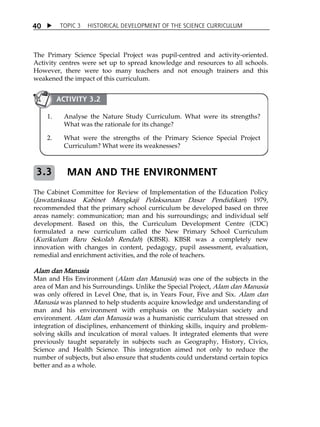
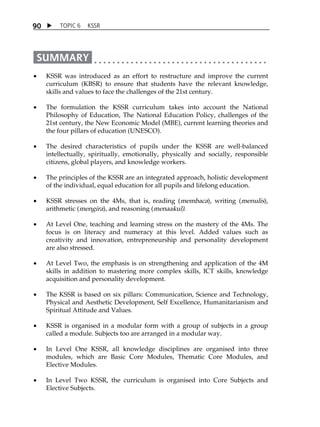
were provided to the teachers as support. Study Figure 3.1 which shows the 
services and facilities given to science teachers under the Special Project. 
Figure 3.1: Support given to science teachers under special project 
3.2
TOPIC 3 HISTORICAL DEVELOPMENT OF THE SCIENCE CURRICULUM 
40 
The Primary Science Special Project was pupil-centred and activity-oriented. 
Activity centres were set up to spread knowledge and resources to all schools. 
However, there were too many teachers and not enough trainers and this 
weakened the impact of this curriculum. 
ACTIVITY 3.2 
1. Analyse the Nature Study Curriculum. What were its strengths? 
What was the rationale for its change? 
2. What were the strengths of the Primary Science Special Project 
Curriculum? What were its weaknesses? 
MAN AND THE ENVIRONMENT 
3.3 
The Cabinet Committee for Review of Implementation of the Education Policy 
(Jawatankuasa Kabinet Mengkaji Pelaksanaan Dasar Pendidikan) 1979, 
recommended that the primary school curriculum be developed based on three 
areas namely: communication; man and his surroundings; and individual self 
development. Based on this, the Curriculum Development Centre (CDC) 
formulated a new curriculum called the New Primary School Curriculum 
(Kurikulum Baru Sekolah Rendah) (KBSR). KBSR was a completely new 
innovation with changes in content, pedagogy, pupil assessment, evaluation, 
remedial and enrichment activities, and the role of teachers. 
Alam dan Manusia 
Man and His Environment (Alam dan Manusia) was one of the subjects in the 
area of Man and his Surroundings. Unlike the Special Project, Alam dan Manusia 
was only offered in Level One, that is, in Years Four, Five and Six. Alam dan 
Manusia was planned to help students acquire knowledge and understanding of 
man and his environment with emphasis on the Malaysian society and 
environment. Alam dan Manusia was a humanistic curriculum that stressed on 
integration of disciplines, enhancement of thinking skills, inquiry and problem-solving 
skills and inculcation of moral values. It integrated elements that were 
previously taught separately in subjects such as Geography, History, Civics, 
Science and Health Science. This integration aimed not only to reduce the 
number of subjects, but also ensure that students could understand certain topics 
better and as a whole.
TOPIC 3 HISTORICAL DEVELOPMENT OF THE SCIENCE CURRICULUM  
41 
The CDC published teacherÊs guides called Buku Panduan Khas Alam dan 
Manusia for Years Four, Five and Six. These teachersÊ guides specified the 
curriculum in detail by listing objectives to be achieved by pupils for each topic. 
It also contained suggested lesson plans and teaching-learning strategies. Dewan 
Bahasa dan Pustaka also published Alam dan Manusia textbooks for each year. 
Did you teach this curriculum or do you have any experience of it? What do you 
think the constraints of this curriculum were? There were physical constraints 
when implementing this curriculum such as large class size and lack of facilities. 
There was also inadequate in-service training and professional support. Due to 
this, teachers lacked competency in integrating subject content and using an 
inquiry approach. Teachers were also stressed and overburdened. 
ACTIVITY 3.3 
What were the strengths and weaknesses of the Man and Environment 
(Alam dan Manusia) Curriculum? 
KBSR (INTEGRATED CURRICULUM FOR 
PRIMARY SCHOOL) (KURIKULUM 
BERSEPADU SEKOLAH RENDAH) 
3.4 
The Kurikulum Baru Sekolah Rendah was revised based on the evaluation 
findings and also the future needs and challenges of the country. Alam dan 
Manusia was replaced by two new subjects, namely the Primary School Science 
Curriculum and Local Studies (Kajian Tempatan) in 1994 with the 
implementation of the Integrated Curriculum for Primary Schools (Kurikulum 
Bersepadu Sekolah Rendah), (KBSR). 
The Integrated Curriculum for Primary Schools was formulated to improve and 
enhance the standard of education in primary schools and to achieve the 
aspirations of the National Philosophy of Education (NPE). The aims of this 
primary school science curriculum were to: 
(a) Provide opportunities for pupils to learn about themselves and the 
environment through everyday experiences and scientific investigations; 
(b) Acquire knowledge and skills in science and technology;
TOPIC 3 HISTORICAL DEVELOPMENT OF THE SCIENCE CURRICULUM 
42 
(c) Enable pupils to apply these knowledge and skills based on scientific 
attitudes; and 
(d) Acquire noble values to make decisions and solve problems in everyday 
life. 
The curriculum also aimed to provide a strong foundation in science and 
technology to prepare pupils for the learning of science in secondary school. 
(Integrated curriculum for primary schools: Science syllabus, 2003) 
Huraian Sukatan Pelajaran Sains Sekolah Rendah 
The CDC developed the curriculum specifications called Huraian Sukatan 
Pelajaran Sains Sekolah Rendah in 1993. The Huraian Sukatan Pelajaran Sains 
Sekolah Rendah contained general and specific learning objectives and suggested 
learning experiences. Besides this, CDC also published training packages called 
Pukal Latihan Sains Rendah (PuLSaR). These training packages contained 
modules on teaching-learning strategies accompanied by video cassettes. 
Science was taught as both content and a process which included scientific 
knowledge, scientific skills, thinking skills and scientific attitude and values. A 
thematic approach was used. School-based assessment in the form of PEKA 
(Penilaian Kemahiran Amali) was introduced to measure the pupilsÊ mastery of 
science process skills and manipulative skills. The science curriculum 
emphasised constructivism, the inquiry-discovery approach and the use of 
technology. 
Science Taught in English 
In 2003, the science curriculum was revised and science was introduced as a 
subject in Level One. The medium of instruction was English. Globalisation and 
the need to keep abreast with the advances of science using technology as a 
means to acquire knowledge had convinced the government to change its policy 
of using English in the teaching of these two subjects. The teaching of Science 
using English enables pupils to obtain various sources of information written in 
English either in electronic or print form. This helps to keep them abreast with 
the latest developments in science and technology. Pupils will be able to relate 
their knowledge to the world beyond the school. Teachers were trained to teach 
Science in English and textbooks and courseware were developed. 
However in 2009, this policy was changed and the medium of instruction for 
Science and Mathematics reverted to the Malay language (Bahasa Malaysia).
TOPIC 3 HISTORICAL DEVELOPMENT OF THE SCIENCE CURRICULUM  
43 
ACTIVITY 3.4 
Answer the following questions based on your understanding of the 
KBSR primary science curriculum. 
(a) What is science education for? 
(b) What kind of pupils and society do we want to produce? 
KURIKULUM STANDARD SEKOLAH 
RENDAH (KSSR) 
3.5 
The Primary School Standard Curriculum, KSSR (Kurikulum Standard Sekolah 
Rendah) was introduced in 2011 as an effort to transform, restructure and 
improve the current curriculum to ensure that students have the relevant 
knowledge, skills and values to face the challenges of the 21st century. You will 
learn more about the KSSR in Topic 6. Here we will look at how science is taught 
in this new curriculum and the differences between the KBSR and KSSR. 
KSSR was formulated based on a statement of standards. The statement of 
standards consists of content standards and learning standards. This is shown in 
Table 3.2 below: 
Table 3.2: KSSR Standards 
Content Standards Learning Standards 
Specific statements on what the students 
must know and can do, within a specific 
period of schooling 
Set criteria or indicators of education 
quality and achievements which can be 
measured for each content standard 
Under KSSR, primary education is divided into two levels similar to KBSR: Level 
One from Years One to Three, and Level Two from Years Four to Six. Level One 
KSSR focuses on the mastery of the 4Ms (Reading, Writing, Counting and 
Reasoning), basic information and technology (ICT) skills, social, emotional, 
spiritual, cognitive, physical development, attitudes and values. Level Two 
focuses on reinforcing and the application of 4Ms, basic ICT skills, social, 
emotional, spiritual, cognitive, physical development, attitudes and values.
TOPIC 3 HISTORICAL DEVELOPMENT OF THE SCIENCE CURRICULUM 
44 
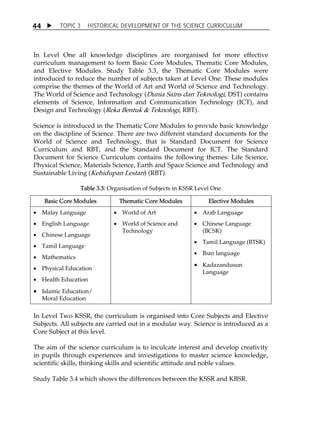
In Level One all knowledge disciplines are reorganised for more effective 
curriculum management to form Basic Core Modules, Thematic Core Modules, 
and Elective Modules. Study Table 3.3, the Thematic Core Modules were 
introduced to reduce the number of subjects taken at Level One. These modules 
comprise the themes of the World of Art and World of Science and Technology. 
The World of Science and Technology (Dunia Sains dan Teknologi, DST) contains 
elements of Science, Information and Communication Technology (ICT), and 
Design and Technology (Reka Bentuk  Teknologi, RBT). 
Science is introduced in the Thematic Core Modules to provide basic knowledge 
on the discipline of Science. There are two different standard documents for the 
World of Science and Technology, that is Standard Document for Science 
Curriculum and RBT, and the Standard Document for ICT. The Standard 
Document for Science Curriculum contains the following themes: Life Science, 
Physical Science, Materials Science, Earth and Space Science and Technology and 
Sustainable Living (Kehidupan Lestari) (RBT). 
Table 3.3: Organisation of Subjects in KSSR Level One 
Basic Core Modules Thematic Core Modules Elective Modules 
 Malay Language 
 English Language 
 Chinese Language 
 Tamil Language 
 Mathematics 
 Physical Education 
 Health Education 
 Islamic Education/ 
Moral Education 
 World of Art 
 World of Science and 
Technology 
 Arab Language 
 Chinese Language 
(BCSK) 
 Tamil Language (BTSK) 
 Iban language 
 Kadazandusun 
Language 
In Level Two KSSR, the curriculum is organised into Core Subjects and Elective 
Subjects. All subjects are carried out in a modular way. Science is introduced as a 
Core Subject at this level. 
The aim of the science curriculum is to inculcate interest and develop creativity 
in pupils through experiences and investigations to master science knowledge, 
scientific skills, thinking skills and scientific attitude and noble values. 
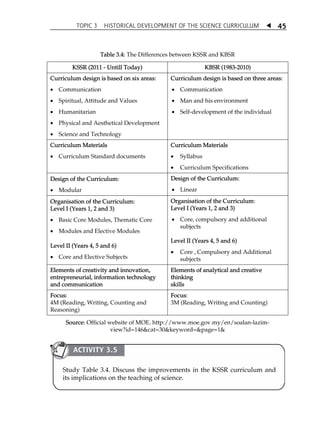
Study Table 3.4 which shows the differences between the KSSR and KBSR.
TOPIC 3 HISTORICAL DEVELOPMENT OF THE SCIENCE CURRICULUM  
45 
Table 3.4: The Differences between KSSR and KBSR 
KSSR (2011 - Untill Today) KBSR (1983-2010) 
Curriculum design is based on six areas: 
 Communication 
 Spiritual, Attitude and Values 
 Humanitarian 
 Physical and Aesthetical Development 
 Science and Technology 
Curriculum design is based on three areas: 
 Communication 
 Man and his environment 
 Self-development of the individual 
Curriculum Materials 
 Curriculum Standard documents 
Curriculum Materials 
 Syllabus 
 Curriculum Specifications 
Design of the Curriculum: 
 Modular 
Design of the Curriculum: 
 Linear 
Organisation of the Curriculum: 
Level I (Years 1, 2 and 3) 
 Basic Core Modules, Thematic Core 
 Modules and Elective Modules 
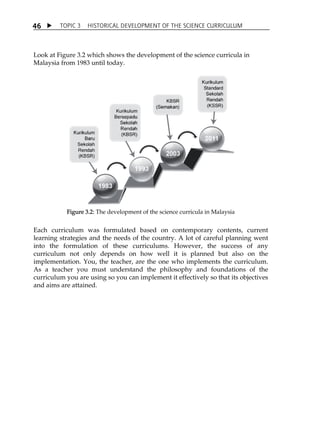
Level II (Years 4, 5 and 6) 
 Core and Elective Subjects 
Organisation of the Curriculum: 
Level I (Years 1, 2 and 3) 
 Core, compulsory and additional 
subjects 
Level II (Years 4, 5 and 6) 
 Core , Compulsory and Additional 
subjects 
Elements of creativity and innovation, 
entrepreneurial, information technology 
and communication 
Elements of analytical and creative 
thinking 
skills 
Focus: 
4M (Reading, Writing, Counting and 
Reasoning) 
Focus: 
3M (Reading, Writing and Counting) 
Source: Official website of MOE. http://www.moe.gov.my/en/soalan-lazim-view? 
id=146cat=30keyword=page=1 
ACTIVITY 3.5 
Study Table 3.4. Discuss the improvements in the KSSR curriculum and 
its implications on the teaching of science.
TOPIC 3 HISTORICAL DEVELOPMENT OF THE SCIENCE CURRICULUM 
46 
Look at Figure 3.2 which shows the development of the science curricula in 
Malaysia from 1983 until today. 
Figure 3.2: The development of the science curricula in Malaysia 
Each curriculum was formulated based on contemporary contents, current 
learning strategies and the needs of the country. A lot of careful planning went 
into the formulation of these curriculums. However, the success of any 
curriculum not only depends on how well it is planned but also on the 
implementation. You, the teacher, are the one who implements the curriculum. 
As a teacher you must understand the philosophy and foundations of the 
curriculum you are using so you can implement it effectively so that its objectives 
and aims are attained.
TOPIC 3 HISTORICAL DEVELOPMENT OF THE SCIENCE CURRICULUM  
47 
SELF-CHECK 3.1 
1. Compare and contrast the Special Project Science Curriculum, 
Man and The Environment and the Primary School Science 
Curriculum (KBSR) in the following aspects: 
(a) Background of curriculum formulation 
(b) Rationale for curriculum formulation 
(c) What conclusion can you make? 
2. Use a suitable graphic organiser to show the similarities and 
differences between the following science curricula: 
(a) Nature Study 
(b) Special Project Science Curriculum. 
(c) Man and the Environment 
(d) Primary School Science Curriculum (KBSR) 
(e) KSSR 
Discuss the similarities and differences using the following 
aspects: 
(a) Rationale 
(b) Strengths 
(c) Weakenesses 
 The curriculum has to be dynamic and responsive in order to remain current 
and relevant. 
 At the end of the 19th century and until the mid-20th century science was 
taught as „Nature Study‰ in primary schools. 
 The Nature Study curriculum focused on knowledge of facts and laws of 
nature based on scientific investigation of the natural world.
TOPIC 3 HISTORICAL DEVELOPMENT OF THE SCIENCE CURRICULUM 
48 
 The Nature Study did not take into account the pupilsÊ natural environment. 
The teaching approach mainly focused on textbooks and rote learning. 
 The Primary School Special Project was started in 1968. The main aim of this 
project was to raise the teaching standard of science and mathematics in 
Malaysia. 
 The Primary School Special Project used new teaching approaches but the 
content remained the same. 
 Services and facilities were provided to the teachers as support under the 
Special Project. 
 The Primary Science Special Project was pupil-centred and activity-oriented. 
But there were too many teachers and not enough trainers. 
 Man and His Environment was one of the subjects offered in the New 
Primary School Curriculum (Kurikulum Baru Sekolah Rendah) (KBSR). 
 Alam dan Manusia stressed on integration of disciplines, enhancement of 
thinking skills, inquiry and problem-solving skills and inculcation of moral 
values. 
 The problems encountered in this curriculum were physical constraints such 
as large class size and lack of facilities. There was also inadequate in-service 
training and professional support. Teachers were also stressed and 
overburdened. 
 Primary School Science Curriculum was implemented in 1994 under the 
Integrated Curriculum for Primary Schools (Kurikulum Bersepadu Sekolah 
Rendah), (KBSR). 
 The objectives of this primary school science curriculum were to provide 
opportunities for pupils to learn about themselves and the environment 
through everyday experiences and scientific investigations, to acquire 
knowledge and skills in science and technology and to enable pupils to 
apply these knowledge and skills based on scientific attitudes and noble 
values to make decisions and solve problems in everyday life. 
 In the KSSR, Science is taught under the Thematic Core Modules at Level 
One under the World of Art and World of Science and Technology.
TOPIC 3 HISTORICAL DEVELOPMENT OF THE SCIENCE CURRICULUM  
49 
 The World of Science and technology (Dunia Sains dan Teknologi, DST) 
contains elements of Science, Information  Communication Technology 
(ICT), and Design  Technology (Reka Bentuk  Teknologi, RBT). 
 Science is introduced under the Thematic Core Modules to provide basic 
knowledge in the discipline of Science. 
 In Level Two KSSR, Science is introduced as a Core Subject. 
 The aim of the KSSR science curriculum is to inculcate interest and develop 
creativity in pupils through experiences and investigations to master science 
knowledge, scientific skills, thinking skills and scientific attitude and noble 
values. 
Kurikulum Baru Sekolah Rendah, 
(KBSR) 
Kurikulum Bersepadu Sekolah Rendah, 
(KBSR) 
Kurikulum Standard Sekolah Rendah, 
(KSSR) 
Man and the Environment 
Nature Study 
Primary Science curriculum 
Primary Science Special Project 
Bahagian Pembangunan Kurikulum. (2012). Kurikulum Standard Sekolah 
Rendah Tahun Tiga. Kementerian Pelajaran Malaysia. 
Buku Penerangan Kurikulum Bersepadu Sekolah Rendah, Kementerian Pendidikan 
Malaysia. Retrieved from http://web.moe.gov.my/bpk/v2/ index.php? 
option=com_contentview=articleid=313Itemid=482lang=en. 
. 
Ministry of Education Malaysia. Integrated curriculum for primary schools. 
Science syllabus. Retrieved from http://web.moe.gov.my/bpk/sp_ 
hsp/sains/kbsr/sp_science_primary_school.pdf. 
Pusat Pembangunan Kurikulum. (2002). Huraian sukatan pelajaran Sains. 
Kementerian Pelajaran Malaysia.
TOPIC 3 HISTORICAL DEVELOPMENT OF THE SCIENCE CURRICULUM 
50 
Poh, S. H. (2003). Pedagogy Science 1: Science curriculum. Kuala Lumpur: 
Kumpulan Budiman. 
Razak Report, 1956. Malaysia Fact Book. Retrieved from http://malaysiafact 
book.com/Razak_Report_1956 . 
Sharifah Maimunah Syed Zin (1990) Curriculum Innovation: Case Studies Of 
Man and the Environment in the Malaysian Primary School Curriculum 
PhD thesis, University of East Anglia (unpublished). 
Tan, J. N. (1999). The Development and Implementation of the Primary 
School Science Currriculum in Malaysia. Unpublished PhD thesis of the 
University of East Anglia, Norwich, United Kingdom. 
Wong, Francis Hoy Kee,  Yee Hean Gwee (1980). Official Reports on Education: 
Straits Settlements and the Federated Malay States, 1870-1939. Singapore: 
Pan Pacific Book Distributors.
Topic 
4 


 KBSR Science 
Curriculum I 
LEARNING OUTCOMES 
By the end of this topic, you should be able to: 
1. State the aims of primary school science; 
2. List the objectives of primary school science; 
3. Describe the scientific skills that are listed in the science curriculum; 
4. Identify thinking skills encompassed in any given scientific skill; 
5. Explain various teaching methods used in science teaching and 
learning; and 
6. Relate between KBSR Science Curriculum with National Philosophy, 
National Science Philosophy and Vision 2020. 
 INTRODUCTION 
Science is always viewed as a difficult subject, full of abstract concepts that need 
to be remembered. But if we start introducing science as early as possible and 
with the right approach, children will end up being innovative scientists 
contributing to the nation. 
Young children are naturally curious and constantly exploring the world around 
them. Classroom science provides the opportunity for children to extend this 
natural curiosity and building of theories. With the help of teachers, children can 
develop a greater appreciation and understanding of the natural world.
5 2  TOPIC 4 KBSR SCIENCE CURRICULUM I 
In this topic we will study the KBSR Science Curriculum. We will look at the 
aims, objectives, scientific skills, scientific attitudes and values, the teaching and 
learning strategies that can be used in the science classroom. Lastly, we will 
discuss how the National Philosophy, Science Education Philosophy and Vision 
2020 relate to one another. 
KBSR SCIENCE CURRICULUM 
4.1 
Science is being offered as one subject in primary schools in Malaysia. It has 
undergone a few changes in the last few years. It was first introduced as KBSR 
Science under the Man and His Environment component of the curriculum in 
1994. When it was first introduced, the subject was taught in Years Four, Five and 
Six. Later, the subject was taught starting from Year One to Year Six. Then, in 
2003, the government introduced Pengajaran dan Pembelajaran Sains dan 
Matematik Dalam Bahasa Inggeris (PPSMI) (the teaching and learning of science 
and mathematics in English). 
The policy was the result of a Cabinet meeting on July 19, 2002 under the 
administration of the fourth prime minister, Tun Dr Mahathir bin Mohamad. 
According to the Ministry of Education, the policy would run in stages, starting 
with the 2003 school session, pioneered by all students of Year One at primary 
education level, and Form One at the secondary education level. The teaching of 
science in English was then fully implemented in secondary schools in 2007, and 
in primary schools in 2008. Under this policy, the science curriculum itself did 
not change, only the language of instruction. But in 2009 this policy was 
discontinued. 
CURRICULUM SPECIFICATIONS OF KBSR 
SCIENCE SYLLABUS 
4.2 
In this subtopic, we will look at the KBSR curriculum specifications. 
4.2.1 Aims and Objectives 
The aims of the primary school science curriculum are to provide opportunities 
for pupils to learn about themselves and the environment through everyday 
experiences and scientific investigations, to acquire knowledge and skills in 
science and technology and to enable pupils to apply these knowledge and skills 
based on scientific attitudes and noble values to make decisions and solve 
problems in everyday life. It is hoped that this curriculum will develop the
TOPIC 4 KBSR SCIENCE CURRICULUM I  
53 
potential of individuals in an overall and integrated manner so as to produce 
Malaysian citizens who are scientifically and technologically literate, competent 
in scientific skills, practise good moral values, capable of coping with the changes 
in scientific and technological advances and be able to manage nature with 
wisdom and responsibility for the betterment of mankind. 
Emphasis is given to the mastery of scientific skills needed to study and 
understand the world. Scientific skills refer to process skills and manipulative 
skills. 
The curriculum also aims to provide a strong foundation in science and 
technology to prepare pupils for the learning of science in secondary school. 
(a) Level One 
The aim of the Primary School Science Curriculum for level one is to 
develop studentsÊ interest in science and to nurture their creativity and 
their curiosity. 
The objectives of the Primary School Science Curriculum for Level One are 
to: 
(i) Stimulate pupilsÊ curiosity and develop their interest in the world 
around them; 
(ii) Provide pupils with opportunities to develop science process skills 
and thinking skills; 
(iii) Develop pupilsÊ creativity; 
(iv) Provide pupils with basic science knowledge and concepts; 
(v) Inculcate scientific attitudes and positive values; and 
(vi) Create awareness on the need to love and care for the environment. 
(b) Level Two 
The aims of the Primary School Science Curriculum for level two are to 
produce human beings who are experienced, skilful and morally sound in 
order to form a society with a culture of science and technology and which 
is compassionate, dynamic, and progressive so that people are more 
responsible towards the environment and are more appreciative of natureÊs 
creations.
5 4  TOPIC 4 KBSR SCIENCE CURRICULUM I 
The objectives of the Primary School Science Curriculum for level two are 
to: 
(i) Develop thinking skills so as to enhance intellectual ability; 
(ii) Develop scientific skills and attitude through inquiry; 
(iii) Enhance natural interest in their surroundings; 
(iv) Gain knowledge and understanding of scientific facts and concepts to 
assist in understanding themselves and the environment; 
(v) Solve problems and make responsible decisions; 
(vi) Handle the latest contributions and innovations in science and 
technology; 
(vii) Practise scientific attitudes and noble values in daily lives; 
(viii) Appreciate the contributions of science and technology towards the 
comfort of life; and 
(ix) Appreciate arrangement and order in nature. 
ACTIVITY 4.1 
Choose science activities that you have done before. Which objectives 
were included in the activities? 
4.2.2 Scientific Skills 
You have also explored scientific skills in detail in HBSC2203  Tools in Learning 
Science. Thus in this section we will just mention and list them briefly. Science 
emphasises inquiry and problem-solving. In inquiry and problem-solving 
processes, scientific and thinking skills are utilised. Scientific skills are important 
in any scientific investigation such as conducting and carrying out projects. 
Scientific skills encompass science process skills and manipulative skills. 
(a) Science Process Skills 
Science process skills enable students to formulate their questions and find 
the answers systematically. Descriptions of the science process skills are as 
shown in Table 4.1.
TOPIC 4 KBSR SCIENCE CURRICULUM I  
55 
Table 4.1: Description of Science Process Skills 
Observing Using the senses of hearing, touch, smell, taste and sight to find 
out about objects or events. 
Classifying Using observations to group objects or events according to 
similarities or differences. 
Measuring and 
Using Numbers 
Making quantitative observations by comparing with a 
conventional or non-conventional standard. 
Making Inferences Using past experiences or previously collected data to draw 
conclusions and come up with explanations of events 
Predicting Making a forecast about what will happen in the future based on 
prior knowledge gained through experiences or collected data. 
Communicating Using words or graphic symbols such as tables, graphs, figures 
or models to describe an action, object or event. 
Using space-time 
relationship 
Describing changes in parameters with time. Examples of 
parameters are location, direction, shape, size, volume, weight 
and mass. 
Interpreting data Giving rational explanations about an object, events or pattern 
derived from collected data. 
Defining 
operationally 
Defining all variables as they are used in an experiment by 
describing what must be done and what should be observed. 
Controlling variables Naming the fixed variables, manipulated variables, and 
responding variables in an investigation. 
Making Hypotheses Making a general statement about the relationship between a 
manipulated variable and a responding variable to explain an 
observation or event. The statement can be tested to determine 
its validity. 
Experimenting Planning and conducting activities including collecting, 
analysing and interpreting data and making conclusions. 
SELF-CHECK 4.1 
What are the basic skills encompassed in the experimenting skill?
5 6  TOPIC 4 KBSR SCIENCE CURRICULUM I 
(b) Manipulative Skills 
Manipulative skills in scientific investigation are psychomotor skills that 
enable students to: 
(i) Use and handle science apparatus and substances; 
(ii) Handle specimens correctly and carefully; 
(iii) Draw specimens, apparatus; 
(iv) Clean science apparatus; and 
(v) Store science apparatus. 
4.2.3 Thinking Skills 
Thinking is a mental process that requires an individual to integrate knowledge, 
skills and attitude in an effort to understand the environment. 
One of the objectives of the national education system is to enhance the thinking 
ability of students. This objective can be achieved through a curriculum that 
emphasises thoughtful learning. Teaching and learning that emphasises thinking 
skills is a foundation for thoughtful learning. 
Thoughtful learning is achieved if students are actively involved in the teaching 
and learning process. Activities should be organised to provide opportunities for 
students to apply thinking skills in conceptualisation, problem-solving and 
decision-making. 
Thinking skills can be categorised into critical thinking skills and creative 
thinking skills. A person who thinks critically always evaluates an idea in a 
systematic manner before accepting it. A person who thinks creatively has a high 
level of imagination, is able to generate original and innovative ideas, and 
modify ideas and products. 
Thinking strategies are higher order thinking processes that involve various 
steps. Each step involves various critical and creative thinking skills. The ability 
to formulate thinking strategies is the ultimate aim of introducing thinking 
activities in the teaching and learning process.
TOPIC 4 KBSR SCIENCE CURRICULUM I  
57 
(a) Critical Thinking Skills 
A brief description of each critical thinking skill is as follows (Table 4.2): 
Table 4.2: Critical Thinking Skills 
Attributing Identifying criteria such as characteristics, features, qualities and 
elements of a concept or an object. 
Comparing and 
Contrasting 
Finding similarities and differences based on criteria such as 
characteristics, features, qualities and elements of a concept or 
event. 
Grouping and 
Classifying 
Separating and grouping objects or phenomena into categories 
based on certain criteria such as common characteristics or features 
Sequencing Arranging objects and information in order based on the quality or 
quantity of common characteristics or features such as size, time, 
shape or number. 
Prioritising Arranging objects and information in order based on their 
importance or priority 
Analysing Examining information in detail by breaking it down into smaller 
parts to find implicit meaning and relationships. 
Detecting Bias Identifying views or opinions that have the tendency to support or 
oppose something in an unfair or misleading way. 
Evaluating Making judgments on the quality or value of something based on 
valid reasons or evidence. 
Making 
Conclusions 
Making a statement about the outcome of an investigation that is 
based on a hypothesis. 
(b) Creative Thinking Skills 
A brief description of each creative thinking skill is as follows (Table 4.3):
5 8  TOPIC 4 KBSR SCIENCE CURRICULUM I 
Table 4.3: Creative Thinking Skills 
Generating Ideas Producing or giving ideas in a discussion. 
Relating Making connections in a certain situation to determine in a certain 
situation to determine a structure or pattern of relationship. 
Making 
Inferences 
Using past experiences or previously collected data to draw 
conclusions and come up with explanations of events. 
Predicting Making a forecast about what will happen in the future based on 
prior knowledge gained through experiences or collected data. 
Making 
Generalisations 
Making a general conclusion about a group based on observations 
made on, or some information from, samples of the group. 
Visualising Recalling or forming mental images about a particular idea, 
concept, situation or vision. 
Synthesising Combining separate elements or parts to form a general picture in 
various forms such as writing, drawing or artefact. 
Making 
Hypotheses 
Making a general statement about the relationship between a 
manipulated variable and a responding variable to explain an 
observation or event. The statement can be tested to determine its 
validity. 
Making 
Analogies 
Understanding a certain abstract or complex concept by relating it 
to a simpler or concrete concept with similar characteristics. 
Inventing Producing something new or adapting something already in 
existence to overcome problems in a systematic manner. 
ACTIVITY 4.2 
Refer to the curriculum specifications. What are the thinking skills 
encompassed in: 
(a) Observing? 
(b) Classifying? 
(c) Making inference? 
(d) Measuring and using numbers?
TOPIC 4 KBSR SCIENCE CURRICULUM I  
59 
4.2.4 Scientific Attitudes and Noble Values 
Science learning experiences can be used as a means to inculcate scientific 
attitudes and noble values in students. These attitudes and values encompass the 
following: 
(a) Having an interest and curiosity in the environment; 
(b) Being honest and accurate in recording and validating data; 
(c) Being diligent and persevering; 
(d) Being responsible about the safety of oneself, others, and the environment; 
(e) Realising that science is a means to understand nature; 
(f) Appreciating and practising clean and healthy living; 
(g) Appreciating the balance of nature; 
(h) Being respectful and well mannered; 
(i) Appreciating the contribution of science and technology; 
(j) Being thankful to God; 
(k) Having analytical and critical thinking skills; 
(l) Being flexible and open-minded; 
(m) Being kind-hearted and caring; 
(n) Being objective; 
(o) Being systematic; 
(p) Being cooperative; 
(q) Being fair and just; 
(r) Daring to try; 
(s) Thinking rationally; and 
(t) Being confident and independent.
6 0  TOPIC 4 KBSR SCIENCE CURRICULUM I 
The inculcation of scientific attitudes and noble values generally occurs through 
the following stages: 
(a) Stage 1: Being aware of the importance and the need for scientific attitudes 
and noble values. 
(b) Stage 2: Giving emphasis to these attitudes and values. 
(c) Stage 3: Practising and internalising these scientific attitudes and noble 
values. 
ACTIVITY 4.3 
1. Think of science activities that you can do. 
2. What are suitable attitudes and noble values that can be 
incorporated in those activities? 
4.2.5 Teaching and Learning Strategies 
Teaching and learning strategies in science curriculum emphasise thoughtful 
learning. Thoughtful learning is a process that helps students acquire knowledge 
and master skills that will help them develop their minds to the optimum level. 
Thoughtful learning can occur through various learning approaches such as 
inquiry, constructivism, contextual learning and mastery learning. 
Learning activities should therefore be geared towards activating studentsÊ 
critical and creative thinking skills and not be confined to routine or rote 
learning. Students should be made aware of the thinking skills and thinking 
strategies that they use in their learning. They should be challenged with higher 
order questions and problems and be required to solve problems utilising their 
creativity and critical thinking. The teaching and learning process should enable 
students to acquire knowledge, master skills and develop scientific attitudes and 
noble values in an integrated manner. 
Inquiry-discovery emphasises learning through experiences. Inquiry generally 
means to find information, to question and to investigate a phenomenon that 
occurs in the environment. Discovery is the main characteristic of inquiry. 
Learning through discovery occurs when the main concepts and principles of 
science are investigated and discovered by students themselves. Through
TOPIC 4 KBSR SCIENCE CURRICULUM I  
61 
activities such as experiments, students investigate a phenomenon and draw 
conclusions by themselves. Teachers then lead students to understand the science 
concepts though the results of the inquiry. Thinking skills and scientific skills are 
thus developed further during the inquiry process. However, the inquiry 
approach may not be suitable for all teaching and learning situations. Sometimes, 
it may be more appropriate for teachers to present concepts and principles 
directly to students. 
The use of variety of teaching and learning methods can enhance studentsÊ 
interest in science. Science lessons that are not interesting will not motivate 
students to learn and subsequently will affect their performance. The choice of 
teaching methods should be based on the curriculum content, studentsÊ abilities, 
studentsÊ repertoire of intelligences, and the availability of resources and 
infrastructure. Different teaching and learning activities should be planned to 
cater for students with different learning styles and intelligences. 
The following are brief descriptions of some teaching and learning methods. 
(a) Experiment 
An experiment is a method commonly used in science lessons. In 
experiments, students test hypotheses through investigations to discover 
specific science concepts and principles. Conducting an experiment 
involves thinking skills, scientific skills and manipulative skills. 
In the implementation of this curriculum, besides guiding students to carry 
out experiments, where appropriate, teachers should provide students with 
the opportunities to design their own experiments. This involves students 
drawing up plans as to how to conduct experiments, how to measure and 
analyse data and how to present the results of their experiment. 
(b) Discussion 
A discussion is an activity in which students exchange questions and 
opinions based on valid reasons. Discussions can be conducted before, 
during or after an activity. Teachers should play the role of facilitator and 
lead a discussion by asking questions that stimulate thinking and getting 
students to express themselves. 
(c) Simulation 
In simulation, an activity that resembles the actual situation is carried out. 
Examples of simulation are role play, games and the use of models. In role 
play, students play out a particular role based on certain pre-determined 
conditions. Games require procedures that need to be followed. Students 
play games in order to learn a particular principle or to understand the
6 2  TOPIC 4 KBSR SCIENCE CURRICULUM I 
process of decision-making. Models are used to represent objects or actual 
situations so that students can visualise the said objects or situations and 
thus understand the concepts and principles to be learned. 
(d) Project 
A project is a learning activity that is generally undertaken by an 
individual or a group of students to achieve a particular learning objective. 
A project generally requires several lessons to complete. The outcome of 
the project either in the form of a report, an artefact or in other forms needs 
to be presented to the teacher and other students. Project work promotes 
the development of problem-solving skills, time management skills, and 
independent learning. 
SELF-CHECK 4.2 
„Several experiments can be included while completing a project.‰ 
Explain the given statement. 
(e) Visits and Use of External Resources 
The learning of science is not limited to activities carried out in the school. 
Learning of science can be enhanced through the use of external resources 
such as zoos, museums, science centres, research institutes, mangrove 
swamps, and factories. Visits to these places make the learning of science 
more interesting, meaningful and effective. To optimise learning 
opportunities, visits need to be carefully planned. Students should be 
assigned tasks during the visit. No educational visit is complete without a 
post-visit discussion. 
(f) Use of Technology 
Technology is a powerful tool that has great potential in enhancing the 
learning of science. Through the use of technology such as television, radio, 
video, computer, and the Internet, the teaching and learning of science can 
be made more interesting and effective. 
Computer simulation and animation are effective tools for the teaching and 
learning of abstract or difficult science concepts. Computer simulation and 
animation can be presented through courseware or webpages. Application 
tools such as word processors, graphic presentation software and electronic 
spreadsheets are valuable tools for the analysis and presentation of data.
TOPIC 4 KBSR SCIENCE CURRICULUM I  
63 
ACTIVITY 4.4 
What would be the suitable methods that can be used to teach the 
following learning outcomes? 
Learning Outcome Method 
Specify the parts of the human body. 
Mimic animal sounds. 
Simulate animal movements. 
Design a book cover. 
4.2.6 Relationship between KBSR Science Curriculum 
and National Philosophy, National Science 
Philosophy and Vision 2020 
All efforts in education in Malaysia are based on the National Philosophy of 
Education (Figure 4.1). In consonant with this philosophy the National Science 
Education Philosophy (Figure 4.2) is derived. With these two main references, the 
KBSR Science Curriculum was formulated. The aims and objectives when 
fulfilled will lead to the achievement of the two philosophies. The contents are 
just the tools to achieve the aims and objectives through appropriate teaching 
and learning strategies. 
Figure 4.1: National Philosophy of Education
6 4  TOPIC 4 KBSR SCIENCE CURRICULUM I 
Figure 4.2: National Science Education Philosophy 
The needs of the nation are also factors to consider when formulating a 
curriculum. Vision 2020 is one of the many policies introduced by the 
government. What it hopes to achieve is that by the year 2020, Malaysia can be a 
united nation, with a confident Malaysian society, infused with strong moral and 
ethical values, living in a society that is democratic, liberal and tolerant, caring, 
economically just and equitable, progressive and prosperous, and in full 
possession of an economy that is competitive, dynamic, robust and resilient. 
There can be no fully developed Malaysia until we have finally overcome the 
nine central strategic challenges that have confronted us from the moment of our 
birth as an independent nation. The challenge that is most relevant to the science 
education is the sixth challenge. 
The sixth is the challenge of establishing a scientific and progressive society, a 
society that is innovative and forward-looking, one that is not only a 
consumer of technology but also a contributor to the scientific and 
technological civilisation of the future. 
If all science teachers really understand the aims and objectives of primary 
science curriculum, they will be able to fulfil the aspirations of the National 
Philosophy of Education, the National Science Education Philosophy and the 
sixth challenge of Vision 2020. 
ACTIVITY 4.5 
As a science teacher how would you incorporate the national philosophy, 
the science education philosophy and Vision 2020 in your daily lessons?
TOPIC 4 KBSR SCIENCE CURRICULUM I  
65 
 The main aim of the primary school science curriculum is to provide 
opportunities for pupils to learn about themselves and the environment 
through everyday experiences and scientific investigations. 
 It is also to produce Malaysian citizens who are scientifically and 
technologically literate, competent in scientific skills, and practise good 
moral values. 
 There are six objectives in Level I and nine objectives in Level II to be 
achieved in the curriculum. 
 There are 12 science process skills and five manipulative skills to inculcate in 
the curriculum. 
 Thinking skills can be categorised into critical thinking skills and creative 
thinking skills. 
 Thinking skills are sub-skills of the science process skills. 
 Science learning experiences can be used as a means to inculcate scientific 
attitudes and noble values in students. 
 Inquiry-discovery is the approach suitable for science learning. It emphasises 
learning through experiences. 
 Experiment, project, discussion, simulation, visit and use of external 
resources, and use of technology, are some methods recommended for the 
teaching of science. 
 The aims and objectives of KBSR Science are based on the National 
Philosophy of Education and the Science Education Philosophy. The sixth 
challenge of Vision 2020 can also be achieved if the teaching and learning of 
science is implemented as stipulated in the curriculum.
6 6  TOPIC 4 KBSR SCIENCE CURRICULUM I 
Creative thinking skills 
Critical thinking skills 
Discussion 
Experiment 
Manipulative skills 
National Philosophy of Education 
Project 
Science Education Philosophy 
Science process skills 
Scientific attitudes and values 
Scientific skills 
Simulation 
Thinking skills 
Use of technology 
Vision 2020 
Visit and external resources 
Esler, W. K.,  Esler, M. K. (2001). Teaching elementary science (8th ed.). 
Washington: Wadsworth Publishing Company. 
Green, N. P., Stout, G. W.,  Taylor, D. J. (1993). Biological science (2nd ed.). 
Oxford, UK: Oxford University Press. 
Martin, D. J. (2006). Elementary science methods: A constructivist approach (4th 
ed.). Belmont: Thomson Wadsworth. 
Martin, R., Sexton, C.,  Gerlovich, J. (2002). Teaching science for all children  
Methods for constructing understanding. Boston: Allyn and Bacon. 
Skamp, K. (2004). Teaching primary science constructively. Southbank, Victoria: 
Harcourt Brace. 
Yap, K. C., Toh, K. A., Goh, N. K.,  Bak, H. K. (2004). Teaching primary science. 
Singapore: Pearson Prentice Hall.
Topic 
5 


 KBSR Science 
Curriculum II 
LEARNING OUTCOMES 
By the end of this topic, you should be able to: 
1. Describe the content organisation of the KBSR science curriculum; 
2. List the themes, learning areas, learning objectives, and learning 
outcomes of Level I and Level II of the KBSR science curriculum; 
3. Explain the role of the „Suggested Learning Activities‰ column in the 
curriculum specifications; and 
4. Explain the role of the „Notes and vocabulary‰ column in the 
curriculum specifications. 
 INTRODUCTION 
You have learnt about the background of the KBSR Science Curriculum that is 
currently being implemented in our primary schools in the last topic. This 
curriculum is being phased out and replaced by Kurikulum Standard Sekolah 
Rendah (KSSR). This curriculum began in 2011. Thus currently this year, students 
in Years One, Two and Three are using the KKSR while students in Years Four, 
Five and Six are still using the KBSR Science Curriculum. We will discuss KSSR 
in detail in Topic 6. 
In Topic 4 we looked at the aims and objectives of the curriculum, and the main 
emphases of the curriculum. In this topic we will study how those aims and 
objectives are going to be achieved in any daily science lesson. Specifically, we 
will look at the content organisation of the KBSR Science Curriculum. The main 
reference that you need to enable you to fully understand this topic are the KBSR 
Science Syllabus and the Curriculum Specifications of Level I and Level II.
TOPIC 5 KBSR SCIENCE CURRICULUM II 
68 
CONTENT ORGANISATION OF KBSR 
SCIENCE SYLLABUS 
5.1 
The content is organised under different themes (see Figure 5.1). The themes are 
then divided into learning areas. These define the scope of science content that is 
needed to be taught in each year. Learning objectives can be regarded as targets 
that a teacher has to achieve for each learning area. These are further clarified by 
the learning outcome statements. 
Figure 5.1: Content organisation of the KBSR Science Curriculum 
5.1.1 Themes 
The science curriculum is organised around themes. Each theme consists of 
various learning areas, each of which consists of a number of learning objectives. 
A learning objective has one or more learning outcomes. 
There are two themes for Level I and five themes for Level II.
TOPIC 5 KBSR SCIENCE CURRICULUM II  
69 
Level I 
 Learning about Living Things (Benda Hidup) 
The theme introduces pupils to living things and non-living things. 
Pupils learn about themselves, animals and plants around them. Pupils 
also learn about senses, good health, good habits and some of the life 
processes that humans undergo. 
 Learning about the World Around Us (Dunia di sekeliling kita) 
The theme introduces pupils to the senses of sight, touch, smell, hearing 
and taste. Pupils also learn about batteries, magnet, light, soil and force. 
Pupils learn about properties of materials such as sink and float, 
absorption and magnetism. 
Level II 
 Investigating Living Things (Menyiasat Benda Hidup) 
The theme introduces pupils to the basic understanding of the basic 
needs of living things, life processes, and interactions among living 
things and how living things survive and create a balance in nature. This 
theme also focuses on life processes in man for pupils to understand 
themselves. It also explains why man is special compared with other 
living things. 
 Investigating Force and Energy (Menyiasat Daya dan Tenaga) 
The theme introduces the basic physical quantities through which pupils 
are exposed to the principles of measurement, the use of standard units 
and the importance of using standard units. The theme also includes 
light, heat, sound, energy, movement and electricity. Pupils are 
introduced to force and speed too at this level. 
 Investigating Materials (Menyiasat Bahan) 
This theme aims to provide pupils the opportunities to investigate 
natural materials and man-made materials. Pupils use their knowledge 
about physical properties of materials and relate them to their use. The 
theme also includes the study of the formation of clouds and rains. 
Acid, alkali and neutral substances are also introduced. It also enables 
pupils to understand how things around them rust and how food is 
preserved. Finally an exposure to issues on waste disposal will create an 
awareness that man needs to play a responsible role in an effort to 
manage nature wisely.
TOPIC 5 KBSR SCIENCE CURRICULUM II 
70 
 Investigating the Earth and the Universe (Menyiasat Bumi dan Alam 
Semester) 
The theme aims to provide the understanding of the Earth, Moon, Sun 
and Solar System as a whole. The theme also provides understanding of 
the effects of the earth, moon and sun movements and how these 
movements can be beneficial to mankind. 
 Investigating Technology (Menyiasat Teknologi) 
The theme aims to provide an introduction to the study of the 
development of technology and current technologies in agriculture, 
communication, transportation and construction. Pupils are given the 
chance to design their own working models based on the science 
concepts they have learnt. 
[Science Syllabus, PPK 2003] 
5.1.2 Learning Areas 
The basic science concepts that need to be mastered by the primary school 
students is organised into learning areas under each theme. These concepts are 
sequentially arranged from easy to complex. The easy concepts are to be taught 
first before moving to the next concepts. The concepts included in the syllabus 
are also those that are suitable for the cognitive developments of primary school 
students. 
Each theme consists of many learning areas. Fill in the various learning 
areas for each theme from Year One to Year Six. (Refer to the curriculum 
specifications). You can use the following table as a guide. 
Theme Year 
One 
Year 
Two 
Year 
Three 
Year 
Four 
Year 
Five Year Six 
ACTIVITY 5.1
TOPIC 5 KBSR SCIENCE CURRICULUM II  
71 
5.1.3 Learning Objectives 
The terms „goals‰ and „objectives‰ are different. Goals are broad and sometimes 
difficult to directly measure. Goals help us to focus on the big and important 
picture. From a particular goal we could write a set of related and specific 
learning objectives. For example, the goal is that students should understand the 
relationship between protein structure and function. To achieve this goal the 
following objectives might have to be met: describe amino acid structure, list 
common categories of amino acid, explain how peptide bonds are formed, 
describe how covalent, ionic and hydrophobic interactions create secondary and 
tertiary structures. 
A learning objective should describe what students should know or be able to do 
at the end of the course that they would not have been able to do before. 
Learning objectives should be about student performance. Each individual 
learning objective should support the overarching goal of the course, that is, the 
thread that unites all the topics that will be covered and all the skills students 
that should have been mastered by the end of the semester. 
SELF-CHECK 5.1 
Which statements are true? 
(a) Goals are general; objectives are specific. 
(b) There are more objectives than goals. 
(c) Goals are like strategies; objectives are like tactics. 
Learning objectives are also statements that describe what a learner will be able 
to do as a result of teaching. However, the connection between teaching and 
learning is not a simple one. Just because knowledge or skills are taught does not 
mean that particular knowledge or skills are learned. Many factors can interfere 
with the achievement of objectives: the existing knowledge of the learner, the 
relevance or usefulness of the material presented, and the skills of the teacher. 
Learning objectives are aimed at the three domains of learning: knowledge, skills 
and attitudes. For example: 
(a) Knowledge: Microorganism is a living thing. 
(b) Skill: Make inferences about microorganism. 
(c) Attitude: Appreciate the importance of microorganism.
TOPIC 5 KBSR SCIENCE CURRICULUM II 
72 
ACTIVITY 5.2 
Get any science curriculum specifications. Identify and list examples of 
learning objectives that refer to knowledge, skills, and attitudes. 
The scope of science concepts that the students have to achieve for each learning 
area is stated as learning objectives in our science curriculum specifications. The 
learning objectives are worded differently in Level I and Level II. Table 5.1 shows 
some examples of learning objectives. 
Table 5.1: Examples of Learning Objectives according to Year 
Year Learning Objectives 
Two  To observe and compare lengths; and 
 To measure length using non-standard tools. 
Three  To observe and recognise external features of plants; and 
 That plants can be grouped according to external features. 
Four  Being aware that certain behaviour can disturb life processes; and 
 Understanding the life processes in plants. 
Five  Understanding that some microorganisms are harmful and some are 
useful; and 
 Understanding the uses of energy. 
SELF-CHECK 5.2 
Study all the learning objective statements in Level I and Level II. How 
do they differ?
TOPIC 5 KBSR SCIENCE CURRICULUM II  
73 
5.1.4 Learning Outcomes 
What is the difference between learning objective and learning outcome 
statements in our curriculum specifications? Yes! Learning outcome statements 
are more specific than learning objective statements. 
In our curriculum specifications, one learning objective could contain one 
learning outcome or a few learning outcomes. 
For example: 
Learning objective: 
 What animals need to live? 
Learning outcome: 
 State that animals need food, water and air to stay alive. 
Learning objective: 
 The different foods that animals eat. 
Learning outcomes: 
 List the foods eaten by some animals 
 State that some animals 
 eat plants 
 eat other animals 
 eat plants and other animals 
Learning outcomes are written in the form of measurable behavioural terms. In 
general, the learning outcomes for a particular learning objective are organised in 
order of complexity. However, in the process of teaching and learning, learning 
activities should be planned in a holistic and integrated manner that enables the 
achievement of multiple learning outcomes according to needs and context. 
Teachers should avoid employing a teaching strategy that tries to achieve each 
learning outcome separately according to the order stated in the curriculum 
specifications.
TOPIC 5 KBSR SCIENCE CURRICULUM II 
74 
A good learning outcome should contain three parts: 
(a) What the students will do to demonstrate learning. 
(b) The context within which the students will demonstrate learning. 
(c) How well the students demonstrate their learning. 
Here is one example of a learning outcome with each of the three parts. 
The student will be able to design and draft a company report using 
information provided in case study materials such that the final report is 
suitable for discussion at Board level. 
(a) What the student will do: design and draft a company report 
(b) In which context: using information provided in case study materials 
(c) How well she/he will do it: suitable for discussion at Board level. 
ACTIVITY 5.3 
Do the following learning outcomes contain the three components? 
Learning Outcomes Yes No What is Missing? 
State examples of use of microorganisms 
State various ways plants disperse their 
seeds and fruits 
Give examples of plants that disperse 
seeds and fruits by water 
Construct a food chain 
SELF-CHECK 5.1 
Must you write down the three components of the learning outcomes 
when you are planning the daily lesson plan? Why?
TOPIC 5 KBSR SCIENCE CURRICULUM II  
75 
Learning outcomes in the cognitive domain are written using appropriate words 
(verbs) that reflect the hierarchy of thinking. Table 5.2 shows a sample of such 
words according to BloomÊs taxonomy. 
Table 5.2: Learning Outcomes in the Cognitive Domain 
BloomÊs Level Specific Learning Outcomes 
Knowledge Define, describe, identify, label, list, match, state 
Understand Estimate, explain, give examples, measure, classify 
Apply Calculate, count, demonstrate, adapt, generate ideas 
Analyse Exemplify, choose, differentiate, solve problems, sequence, 
prioritise, conclude, control variables 
Synthesise Plan, summarise, construct, structure, conceptualise, make an 
analogy, define operationally 
Evaluate Compute, criticise, support, rationalise, decide 
ACTIVITY 5.4 
The following learning objectives are taken from Science Year Two. Write 
out the learning outcomes for these learning objectives. 
Learning Objective Learning Outcomes 
To measure length using non- standard 
tools. 
To make a complete circuit. 
5.1.5 Suggested Learning Activities 
The Suggested Learning Activities provide information on the scope and 
dimension of learning outcomes. The learning activities stated under the column 
ÂSuggested Learning ActivitiesÊ are given with the intention of providing some 
guidance as to how learning outcomes can be achieved. A suggested activity may 
cover one or more learning outcomes. At the same time, more than one activity 
may be suggested for a particular learning outcome. 
If you are a new teacher or you may not be familiar with the content of the topic, 
you are thus advised to just do the suggested learning activities as listed. After a 
few tries, you can modify the suggested activity to suit the ability and style of 
learning of your students. The suggested activities may also need to be modified
TOPIC 5 KBSR SCIENCE CURRICULUM II 
76 
because you cannot get the resources, or maybe just to make learning more 
meaningful when it is contextualised to things that are familiar to your students. 
Experienced teachers are encouraged to design other innovative and effective 
learning activities to enhance the learning of science. You could include the use 
of ICT into the lesson as your students adapt to those resources. You could assign 
projects to be done individually or in groups if your students are more 
independent. And later you could ask the students to present their projects in a 
science fair so that students could share with the rest of the schools and even 
show their parents. 
Prepare the mapping of the curriculum specifications for two selected 
learning objectives using the following table. 
Topic Teaching and 
Learning Strategy Scientific Skills Values 
ACTIVITY 5.5 
ACTIVITY 5.6 
Select a few learning objectives from the curriculum specifications for 
Science Year Five and suggest learning activities other than the suggested 
learning activities given.
TOPIC 5 KBSR SCIENCE CURRICULUM II  
77 
5.1.6 Notes and Vocabulary 
In the `notesÊ column, additional information is given to teachers to help them to 
plan the teaching and learning activities more effectively. You may use this 
information if you wish. It also contains safety measures that you need to take 
note of to ensure your studentsÊ safety while doing the activities. 
The `vocabularyÊ column contains important vocabulary that is included in each 
learning objective. You can use these as a checklist in the beginning when you are 
planning the lesson, so that you can attract your studentsÊ attention to these 
concepts. You could also use these at the end of the lesson as a check whether 
students have understood these concepts. 
ACTIVITY 5.7 
Select any learning objectives from the curriculum specifications and 
study the notes described in those sections. 
(a) How does the description help you to plan the daily lesson plan? 
(b) What additional notes can you add that could further help to 
achieve the learning objectives? 
 The science curriculum is organised around themes. 
 Each theme consists of various learning areas, each of which consists of a 
number of learning objectives. 
 There are two themes for Level I and five themes for Level II. 
 A learning objective has one or more learning outcomes. 
 The scope of science concepts that the students have to achieve for each 
learning area are stated as learning objectives in our science curriculum 
specifications. 
 Learning outcomes are written in the form of measurable behavioural terms.
TOPIC 5 KBSR SCIENCE CURRICULUM II 
78 
 A good learning outcome should contain three parts, what the students will 
do that demonstrates learning, the context within which the students will 
demonstrate learning, and how well they can demonstrate their learning. 
 The Suggested Learning Activities provide information on the scope and 
dimension of learning outcomes and how learning outcomes can be 
achieved. 
 A suggested activity may cover one or more learning outcomes. 
 The suggested learning activities can be used as it is, modified, or changed 
completely. 
 The Notes and Vocabulary are additional guides that can further help 
teachers to plan and conduct lesson plans. 
Learning area 
Learning objectives 
Learning outcomes 
Notes and vocabulary 
Suggested learning activities 
Themes 
Bahagian Perkembangan Kurikulum. (2012). Spesifikasi Kurikulum Sains Tahun 
4. Kuala Lumpur: Ministry of Education Malaysia. 
Curriculum Development Centre. (2002). Curriculum specifications Science Year 
2. Kuala Lumpur: Ministry of Education Malaysia. 
Curriculum Development Centre. (2003). Science Syllabus. Kuala Lumpur: 
Ministry of Education Malaysia. 
Esler, W.K.  Esler, M. K. (2001). Teaching elementary science (8th ed.). 
Washington: Wadsworth Publishing Company.
TOPIC 5 KBSR SCIENCE CURRICULUM II  
79 
Green, N.P., Stout, G.W,  Taylor, D.J. (1993). Biological science (2nd ed.). 
Oxford, UK: Oxford University Press. 
Learning Objectives. Retrieved from http://www.nottingham.ac.uk/medical-school/ 
tips/aims_objectives.html 
Martin, D. J. (2006). Elementary science methods: A constructivist approach(4th 
ed.). Belmont: Thomson Wadsworth. 
Martin, R.; Sexton, C.; Gerlovich, J. (2002). Teaching Science for all children: 
Methods for constructing understanding. Boston: Allyn and Bacon. 
Skamp, K. (2004). Teaching primary science constructively. Southbank, Victoria: 
Harcourt Brace. 
Writing Learning Outcomes: Some Suggestions. Retrieved from http://www. 
brookes.ac.uk/services/ocsld/resources/writing_learning_outcomes.html 
Yap, K. C., Toh, K. A., Goh, N. K., and Bak, H. K. (2004). Teaching primary 
science. Singapore: Pearson Prentice Hall.
Topic 
6 
 KSSR 
LEARNING OUTCOMES 
By the end of this topic, you should be able to: 
1. Explain the concept and aims of the Primary School Standard 
Curriculum (KSSR); 
2. Discuss the principles and focus of the KSSR; 
3. Describe the organisation and specifications of the KSSR; and 
4. Discuss the implementation of the KSSR. 
 INTRODUCTION
TOPIC 6 KSSR  81 
Look at the scenario above. Many parents will be asking such questions 
especially when a new curriculum has been implemented. If you were the 
teacher how would you go about explaining the KSSR to parents? 
You would need to explain the concept, aims, main principles and focus of the 
KSSR followed by its organisation and how it will be implemented. In this topic 
you will learn about the Primary School Standard Curriculum, KSSR. This 
knowledge will enable you to understand the curriculum fully and carry out the 
teaching and learning process more effectively. 
CONCEPT AND AIMS OF THE KSSR 
6.1 
The Primary School Standard Curriculum (Kurikulum Standard Sekolah 
Rendah), or KSSR, was introduced in stages starting in 2011. The KSSR replaced 
the Primary School Integrated Curriculum (KBSR) which was first introduced in 
1983, and subsequently reviewed in 2003. KSSR will be fully implemented by 
2016. 
Why do you think there was a transformation of the curriculum? Try to recall 
what you learnt in Topic 1 about the factors of how a curriculum is formulated. 
There was a need to develop a curriculum that was on par globally with other 
developed nations. KSSR was introduced as an effort to restructure and improve 
the current curriculum (KBSR) to ensure that students have the relevant 
knowledge, skills and values to face the challenges of the 21st century. 
6.1.1 The Aims of the KSSR 
The KSSR is based on the National Philosophy of Education and the National 
Education Policy. The KSSR also takes into account the challenges of the 21st 
century, the New Economic Model (MBE), current learning theories and the four 
pillars of education. The four pillars of education according to United Nations 
Educational, Scientific and Cultural Organisation (UNESCO) are the 
fundamental principles for reshaping education. These pillars are: Learn to 
Learn, Learn to Do, Learn to Be and Learn to Live Together. This is illustrated in 
Table 6.1.
8 2  TOPIC 6 KSSR 
Table 6.1: The Four Pillars of Education 
Pillar Description 
Learning 
to know 
To provide the cognitive tools required to better comprehend the world and 
its complexities, and to provide an appropriate and adequate foundation for 
future learning. 
Learning 
to do 
To provide the skills that would enable individuals to effectively participate 
in the global economy and society. 
Learning 
to be 
To provide self-analytical and social skills to enable individuals to develop 
to their fullest potential psychosocially, affectively as well as physically, to 
become an all-round ÂcompleteÊ person. 
Learning 
to live 
together 
To expose individuals to the values implicit within human rights, 
democratic principles, intercultural understanding and respect, and peace 
at all levels of society and human relationships and also to enable 
individuals and societies to live in peace and harmony. 
Source: http://www.unesco.org/new/en/education/networks/global-networks/ 
aspnet/about-us/strategy/the-four-pillars-of-learning/ 
Pupils under the KSSR will be well balanced intellectually, spiritually, emotionally, 
physically and socially. They will become responsible citizens, global players, and 
knowledge workers. Table 6.2 shows the desired characteristics of pupils under the 
KSSR. 
Table 6.2: Desired Characteristics of Pupils Under KSSR 
Pupils who are well balanced intellectually, 
spiritually, emotionally, physically and socially 
 Knowledgeable 
 Competent 
 Belief in God 
 High moral fibre 
 Confident 
 Independent 
Responsible Citizens 
 Courteous 
 United 
 Patriotic 
 Fair 
 Loving 
 Dedicated 
Global Players 
 Competitive 
 Resilient 
 Communication skills 
 Identity 
Knowledge Workers 
 Innovative 
 Creative 
 Knowledge seeking 
 ICT competent 
 Inventors of Technology 
 Lifelong learners 
(Adapted from Hasrat KSSR) 
Source: 
http://web.moe.gov.my/bpk/v2/index.php?option=com_contentview=articleid=31 
1Itemid=477lang=enlimitstart=1
TOPIC 6 KSSR  83 
6.1.2 Principles of the KSSR 
The principles of the KSSR are given below: 
(a) Integrated approach; 
(b) Holistic development of the individual; 
(c) Equal education for all pupils; and 
(d) Lifelong education. 
Do you see any similarities with the principles of the KBSR? The KSSR upholds 
all the principles of the KBSR because of its relevance in developing well-balanced 
holistic individuals. 
6.1.3 Focus of the KSSR 
KSSR stresses on the 4Ms, that is, reading (membaca), writing (menulis), 
arithmetic (mengira), and reasoning (menaakul). 
At Level I, teaching and learning stresses on the mastery of the 4Ms. The focus is 
on literacy and numeracy at this level. Added values such as creativity and 
innovation, entrepreneurship and personality development are also stressed. 
At Level II, the emphasis is on strengthening and application of the 4M skills in 
addition to mastering more complex skills, ICT skills, knowledge acquisition and 
personality development. 
SELF-CHECK 6.1 
1. Why was there a need for the transformation of the primary 
school curriculum? 
2. What are the main aims of the KSSR?
8 4  TOPIC 6 KSSR 
THE ORGANISATION AND 
IMPLEMENTATION OF THE KSSR 
The KBSR was based on three areas namely: Communication; Man and His 
Surroundings; and Individual Self Development. The KSSR has been redesigned 
and the primary school curriculum is now based on six pillars, namely: 
(a) Communication; 
(b) Spiritual Attitude and Values; 
(c) Humanitarianism; 
(d) Physical and Aesthetic Development; 
(e) Science and Technology; and 
(f) Self-Excellence. 
This is shown and explained in Table 6.3. 
Table 6.3: The 6 Pillars of KSSR 
Pillars of KSSR Description 
COMMUNICATION 
(Komunikasi) 
 Integration of verbal and non-verbal communication 
during interaction. 
SPIRITUAL ATTITUDE 
AND VALUES 
(Kerohanian, Sikap dan 
Nilai) 
 Appreciation of religious practices, beliefs, attitudes and 
values. 
HUMANITARIANISM 
(Kemanusiaan) 
 Mastery of knowledge and practices about the local 
community and environment as well as about the national 
and global environment. 
 Inculcation of the spirit of patriotism and unity. 
PHYSICAL AND 
AESTHETIC 
DEVELOPMENT 
(Perkembangan Fizikal 
dan Estetika) 
 Physical development and health for well being. 
 Fostering imagination, creativity, talent and appreciation. 
SCIENCE AND 
TECHNOLOGY 
(Sains dan Teknologi) 
 Mastery of scientific knowledge, skills and attitudes. 
 Mastery of mathematical knowledge and skills. 
 Mastery of technological knowledge and skills. 
SELF EXCELLENCE 
(Ketrampilan Diri) 
 Fostering leadership and personal development through 
curricular and co-curricular activities. 
6.2
TOPIC 6 KSSR  85 
6.2.1 Organisation of the KSSR 
What are the changes in the organisation of the primary school curriculum? 
KSSR is organised in a modular form with a group of subjects in a group called a 
module. Subjects too are arranged in a modular way, that is, the subject content is 
arranged in self-contained modules. Each module contains the knowledge, skills 
and values that have been identified for each module. Different disciplines have 
been integrated to make the teaching and learning process more interesting, fun 
and meaningful. 
In Level I KSSR, all knowledge disciplines are reorganised for more effective 
curriculum management to form Basic Core Modules, Thematic Core Modules, 
and Elective Modules. Study Table 6.4. 
Table 6.4: Level One Modules of KSSR 
Basic Core Modules Thematic Modules Elective Modules 
 Bahasa Malaysia 
 English Language 
 Chinese Language 
 Tamil Language 
 Mathematics 
 Physical Education 
 Health Education 
 Islamic Education/ 
Moral Education 
 World of Art 
(Integrates Visual Arts 
and Thematic Music) 
 World of Science and 
Technology (DST) 
(Integrates Science, 
RBT and ICT) 
 Arab Language 
 Chinese Language 
(BCSK) 
 Tamil Language 
(BTSK) 
 Iban language 
 Kadazandusun 
Language 
 These subjects are 
compulsory. 
 Islamic Education for 
Muslim pupils, and 
Moral Education for 
non-Muslim pupils. 
 These subjects are 
compulsory. 
 Schools must offer at 
least one language 
subject based on 
teacher preparation, 
pupilsÊ request and 
school infrastructure 
Level I emphasises the mastery of the 4Ms, basic ICT and the development of 
socio-emotional, spiritual, physical, cognitive, attitudes and values.
8 6  TOPIC 6 KSSR 
In Level II KSSR, the curriculum is organised into Core Subjects and Elective 
Subjects. Study Figure 6.1 which shows the core and elective subjects together 
with the respective pillars. 
Figure 6.1: Level II subjects of KSSR 
Source: 
http://web.moe.gov.my/bpk/v2/index.php?option=com_contentview=articleid=31 
1Itemid=477lang=enlimitstart=5
TOPIC 6 KSSR  87 
At Level II, the emphasis is on strengthening and application of the 4M skills in 
addition to mastering more complex skills, ICT skills, knowledge acquisition and 
personality development. 
(a) Cross-curricular Elements 
Cross-curricular elements are an added value applied to the teaching 
learning process other than those specified in the content standards. These 
elements aim to strengthen the skills and expertise of human capital and 
are intended to address current and future challenges. These elements are 
English, Science and Technology, Environmental Education, Noble Values 
and Patriotism. Study Figure 6.2 which shows the cross-curricular elements 
in the KSSR. 
Figure 6.2: Cross-curricular elements in KSSR 
Source: 
http://web.moe.gov.my/bpk/v2/index.php?option=com_contentview=articleid=31 
1Itemid=477lang=enlimitstart=6
8 8  TOPIC 6 KSSR 
(b) Special Education 
Students in Special Education (Hearing Impaired) and students in Special 
Education (Visually Impaired) generally use the mainstream curriculum. 
However, there are some modifications made to the number of elective 
subjects offered in accordance with special learning needs. Students in 
Special Education (Hearing Impaired) and students in Special Education 
(Visually Impaired) are required to learn additional subjects such as Sign 
Language Communication (PCI) and Basic Skills for the Visually Impaired 
Individuals (KAIMaL) respectively. 
The Curriculum for Special Education (Learning Difficulties) is developed 
based on the capabilities and needs of pupils. The curriculum for these 
pupils is more focused on the mastery of skills to meet the needs of 
individuals, and is not too academically oriented. The teaching and 
learning programmes are designed in a flexible manner in accordance with 
the Regulations of Education (Special Education) 1997. 
In Level I, Special Education (Learning Difficulties) pupils are given basic 
3M subjects, Life Management, Creative Arts, Islamic Education, Moral 
Education and Physical Education. In Level II, the subjects offered are 
Bahasa Malaysia, English, Mathematics, Islamic Education, Moral 
Education, Health and Physical Education, Science Education, Social and 
Environmental Education, Visual Arts, Music Education, Basic Life Skills, 
Information Technology and communication, and Life Management. 
6.2.2 Implementation of the KSSR 
The implementation of the KSSR brings changes to the curriculum content and 
practices in the primary school system. Do you know what these changes are? 
There is a change in design, organisation, pedagogy, time allocation and 
curriculum management. The curriculum has been remodelled and new subjects 
have been introduced. There is an emphasis on sound pedagogical approaches 
and holistic assessment methods. 
In KBSR, the learning objectives were stated in terms of learning outcomes. The 
KSSR, however, is formulated based on a statement of standards. The statement 
of standards consists of content standards and learning standards. This was 
explained in Topic 3. Content standards are specific statements on what the 
students must know and can do, within a specific period of schooling. Learning 
Standards are a set criteria or indicators of education quality and achievements 
which can be measured for each content standard.
TOPIC 6 KSSR  89 
The KSSR requires teachers to apply classroom strategies which promote creative 
and critical thinking and innovation among pupils. Teachers need to carry out 
teaching and learning activities which are student-centred, provide opportunities 
for pupils to master thinking and scientific skills and most importantly, provide a 
fun learning environment. Teachers need to be sensitive to pupilsÊ learning needs 
and be able to identify learning styles most suited to them. 
The KSSR also proposes the implementation of school-based assessments 
(Penilaian Berasaskan Sekolah, PBS) to gauge pupils potential and the 
effectiveness of the teaching and learning process in the classroom. This 
formative assessment will inform teachers of suitable remedial or enhancement 
treatments for pupils. It will also help teachers to identify and plan effective 
classroom strategies in the classroom. 
ACTIVITY 6.1 
1. Describe the organisation of subjects for Level I and Level II in the 
KSSR curriculum. 
2. „KSSR is organised in a modular form with a group of subjects in a 
group called a module.‰ 
3. What do you understand by this statement? 
4. What do you understand by cross-curricular elements? 
5. How is the KSSR implemented? 
SELF-CHECK 6.2 
Identify the changes in the Kurikulum Standard Sekolah Rendah 
(KSSR) and suggest in what ways you can implement this curriculum in 
the teaching and learning of science.
9 0  TOPIC 6 KSSR 
 KSSR was introduced as an effort to restructure and improve the current 
curriculum (KBSR) to ensure that students have the relevant knowledge, 
skills and values to face the challenges of the 21st century. 
 The formulation the KSSR curriculum takes into account the National 
Philosophy of Education, The National Education Policy, challenges of the 
21st century, the New Economic Model (MBE), current learning theories and 
the four pillars of education (UNESCO). 
 The desired characteristics of pupils under the KSSR are well-balanced 
intellectually, spiritually, emotionally, physically and socially, responsible 
citizens, global players, and knowledge workers. 
 The principles of the KSSR are an integrated approach, holistic development 
of the individual, equal education for all pupils and lifelong education. 
 KSSR stresses on the 4Ms, that is, reading (membaca), writing (menulis), 
arithmetic (mengira), and reasoning (menaakul). 
 At Level One, teaching and learning stress on the mastery of the 4Ms. The 
focus is on literacy and numeracy at this level. Added values such as 
creativity and innovation, entrepreneurship and personality development 
are also stressed. 
 At Level Two, the emphasis is on strengthening and application of the 4M 
skills in addition to mastering more complex skills, ICT skills, knowledge 
acquisition and personality development. 
 The KSSR is based on six pillars: Communication, Science and Technology, 
Physical and Aesthetic Development, Self Excellence, Humanitarianism and 
Spiritual Attitude and Values. 
 KSSR is organised in a modular form with a group of subjects in a group 
called a module. Subjects too are arranged in a modular way. 
 In Level One KSSR, all knowledge disciplines are organised into three 
modules, which are Basic Core Modules, Thematic Core Modules, and 
Elective Modules. 
 In Level Two KSSR, the curriculum is organised into Core Subjects and 
Elective Subjects.
TOPIC 6 KSSR  91 
 Cross-curricular elements are an added value applied to the teaching and 
learning process. These elements are English, Science and Technology, 
Environmental Education, Noble Values and Patriotism. 
 The Curriculum for Special Education is developed based on the capabilities 
and needs of pupils. The curriculum for these pupils is more focused on the 
mastery of skills to meet the needs of individuals, and is not too 
academically oriented. 
 The KSSR is formulated based on a statement of standards. The statement of 
standards consists of content standards and learning standards. 
 Teachers need to carry out teaching and learning activities which are 
student-centred, provide opportunities for pupils to master thinking and 
scientific skills and most importantly, provide a fun learning environment. 
 Teachers need to be sensitive to pupilsÊ learning needs and be able to 
identify learning styles most suited to them. 
 The KSSR proposes the implementation of school-based formative 
assessments (PBS) to gauge pupils potential and the effectiveness of the 
teaching and learning process in the classroom. This formative assessment 
will inform teachers of suitable remedial or enhancement treatments for 
pupils. 
Basic core modules 
Content Standards 
Core subjects 
Cross-curricular elements 
Elective modules 
Elective subjects 
Global players 
Holistic development 
Integrated 
Knowledge workers 
KSSR 
Learning Standards 
Lifelong education 
Modular 
Pillars of KSSR 
School-based formative assessment 
(PBS) 
Standards 
Thematic core modules
9 2  TOPIC 6 KSSR 
Bahagian Pelajaran Malaysia. (2010). KSSR Kurikulum Standard Sekolah Rendah. 
Kementerian Pelajaran Malaysia. 
UNESCO. Education. The Four Pillars of Education. Retrieved from http:// 
www.unesco.org/new/en/education/networks/global-networks/ 
aspnet/about-us/strategy/the-four-pillars-of-learning/
Topic 
7 
 Teaching 
Science to 
All Children 
LEARNING OUTCOMES 
By the end of this topic, you should be able to: 
1. Define cultural diversity; 
2. Discuss strategies for adapting science instructions for children with 
cultural differences; 
3. Define gender bias; and 
4. Explain strategies to avoid gender bias in the science classroom. 
 INTRODUCTION 
Year Five Melati is made up of 15 Malay, 12 Chinese and 10 Indian pupils. Of 
these, there are 18 boys and 19 girls. On the first day of the school year, the 
pupils were greeted by their science teacher En Razak. As each one of them 
entered the classroom En Razak said,‰ Hello, I am glad you are going to be in 
my class. This is the place where everyone learns science‰. 
Read the above scenario. What do you think En Razak meant? What did he mean 
when he said „everyone‰? 
If you study the composition of En RazakÊs class, you can see that the class is 
made up of different ethnic or cultural groups. In terms of gender, there are both 
males and females in his class. En RazakÊs class is a diverse class but he believes 
in one very important principle, that is, everyone regardless of these differences 
must have an equal opportunity to learn science.
TOPIC 7 TEACHING SCIENCE TO ALL CHILDREN 
94 
In this topic, you will learn about cultural diversity and gender differences. You 
will look at strategies for adapting science instruction for children with cultural 
differences. You will also learn how to avoid gender bias in your science 
classroom. 
CULTURAL DIVERSITY 
We live in a multicultural country with a variety of different races and cultures. 
Schools too reflect this variety. This variety is even more pronounced in this era 
of globalisation where there might even be foreign pupils in your classroom. 
What are the challenges in this to you as a teacher? We must understand that the 
future will be in a culturally pluralistic nation with a diversity of cultural, ethnic, 
religious and socioeconomic groups. The main goal of teachers will be to inspire 
the intellectual, social, and personal development of all their pupils to the highest 
potential regardless of the differences. Teachers need to provide each pupil with 
an equal opportunity to learn. 
7.1.1 Definition of Cultural Diversity 
Let us look at the term „cultural diversity‰. The word „cultural‰ according to the 
Oxford Online Dictionary means relating to the „ideas, customs and social 
behaviour of a society.‰ Diversity means a range of different things. So what do 
you think cultural diversity means? Cultural diversity refers to the existence of a 
variety of cultural or ethnic groups in a society. Figure 7.1 shows a culturally 
diverse classroom. 
Figure 7.1: A culturally diverse classroom 
Source: http://chrome.blogspot.com/2013/04/for-malaysia-bringing-google-apps-and. 
html 
7.1
TOPIC 7 TEACHING SCIENCE TO ALL CHILDREN  
95 
7.1.2 Strategies for Adapting Science Instruction for 
Children with Cultural Differences 
En RazakÊs classroom shows cultural diversity. There are differences in terms of 
ethnic groups, beliefs, customs, experiences, learning styles and socioeconomic 
status. All of these dimensions shape who the pupils are and how they learn 
science. According to Martin (2006), ethnic and cultural factors exert powerful 
influences on the way children learn science. From the constructivist perspective, 
pupils with different cultures have different prior experiences and thus bring 
different perceptions and understanding to the classroom. How can En Razak 
adapt his instructions to ensure that these differences are taken into account and 
every pupil has an equal opportunity to learn? 
The strategies for adapting science instruction for children with cultural 
differences are given below: 
(a) Recognise and Understand Cultural Differences 
„Nothing inherent in culture itself, or in other forms of human 
diversity, creates pedagogical problems  It is that attitude of the 
educator towards diversity that creates problems in the education 
setting. When educators do not notice diversity they create a bogus 
reality for teaching and learning. 
(Hilliard, 1994) 
The first thing the teacher has to do is to be aware that differences exist. 
Sometimes, as teachers we might overlook this and think that all pupils are 
the same. The teachersÊ knowledge and understanding of culture can help 
all students reach their potential. As a teacher, you need to be sensitive to 
pupilsÊ learning needs and abilities, to their personal interests and 
motivation as well as cultural differences and similarities. 
(b) Vary Your Teaching Style to Accommodate Different Learning Styles 
Teachers tend to teach in a dominant style that consists of multiple factors, 
including those related to the teacherÊs background. When a childÊs 
learning style is similar to the teacherÊs, the child tends to learn more and 
retain it longer (Martin, 2006). However, in a culturally diverse class, there 
are pupils from a variety of different cultures and ethnic groups whose 
behaviours and cognitive styles differ from the teacherÊs. The teacher must 
be responsive to the needs of all pupils and vary the teaching styles.
TOPIC 7 TEACHING SCIENCE TO ALL CHILDREN 
96 
(c) Examine All Curriculum Material for Ethnic and Cultural Bias 
As a teacher you must be sensitive to racist content in reference materials 
and also in classroom interactions. Use science teaching as an opportunity 
to select and use curriculum materials and teaching strategies that reflect 
and incorporate diversity. 
(d) Include the Experiences of Different Cultural Groups in the Classroom 
The teacher can also select classroom teaching examples that show the 
contributions and participation of different cultural groups. These 
contributions can be displayed on the bulletin boards. Projects or pupil 
presentations which infuse multicultural concepts can be planned. 
(e) Role Model Respect 
Show respect for and interest in differences in opinions and perspectives of 
different groups. Correct pupilsÊ misinformation based on cultural groups 
whenever possible. 
(f) Provide Hands-On, Discovery-Based Science Experiences 
Hands-on activities and discovery-based experiences help build pupil 
confidence and cultivate a positive attitude towards school. 
(g) Promote and Foster Healthy Interaction among Diverse Groups 
Collaborative learning and group work among diverse groups can be 
carried out for making decisions and solving problems. 
ACTIVITY 7.1 
1. Explain what you understand by the term „cultural diversity‰. 
2. Study each strategy given in 7.1.2 and discuss how you can apply it 
to your science classroom.
TOPIC 7 TEACHING SCIENCE TO ALL CHILDREN  
97 
GENDER BIAS 
Statement A 
7.2 
„Girls donÊt need to learn about 
electricity or light‰ 
Statement B 
„A woman can be a great 
scientist „ 
Read Statements A and B above. Which statement do you agree with? If you 
agreed with Statement A, then you might want to examine your belief system 
about science and gender. 
7.2.1 Definition of Gender Bias 
Gender bias refers to different views of males and females, often favouring one 
gender over the other (Woolfolk, 2001). These different views are sometimes seen 
in school textbooks and also in the practices of the teachers themselves. Why do 
you think there is gender inequality in the learning of science? 
Let us look at how females are socialised in society. In most cultures, females are 
seen to be the softer, weaker sex. Males are seen to be more dominant and 
adventurous. These sex stereotyped attitudes are sometimes portrayed in school 
textbooks where the female character is shown as a homemaker and child 
minder, behaving passively and being helpless. The males are shown as the ones 
who are more active and who go out to earn a living. 
How do you treat male and female pupils in your class? Research shows that 
teachers tend to interact more with male pupils. The imbalances of teacher 
attention given to boys and girls are more dramatic in science classes. In one 
study, boys were questioned on the subject matter 80% more often than girls 
(Baker, 1986). Boys also dominate the use of equipment in science labs, often 
dismantling the apparatus before the girls in the class have a chance to perform 
the experiments (Rennie  Parker, 1987). 
Parents, teachers, school counsellors and peers also tend to discourage females 
from pursuing scientific careers. There is a low enrolment of women in advanced 
science careers.
TOPIC 7 TEACHING SCIENCE TO ALL CHILDREN 
98 
7.2.2 Strategies to Avoid Gender Bias in the Science 
Classroom 
How can you as a teacher avoid gender bias in the science classroom? 
Firstly you need to form high expectations of all pupils and believe that both 
sexes are capable in science. You would also need to give equal amounts of 
attention and opportunities for success to both males and females. 
The following are strategies to help you avoid gender bias in your science 
classroom. 
(a) Check to See that Textbooks and Other Instructional Materials You are 
Using are Not Gender Biased 
Select and use resources that reflect the current and evolving roles of 
women and men in society. Posters, textbooks, videos and other media 
should have equal representation of both males and females. 
(b) Watch Out for Any Unintended Biases in Your Own Classroom Practices 
For example, do you group pupils by sex or do you call on one sex more for 
answers. You would also need to use teaching examples that are gender 
balanced. 
(c) Make Sure Your Expectations are the Same for All of Your Pupils 
You must believe that both sexes can succeed in science. 
(d) Use Gender-Free Language as Much as Possible 
„You guys‰ may be a popular way of addressing groups, but it is an 
example of gender bias. Try to put the placement of girls first in the 
sentence and balance this. Make the classroom atmosphere one where both 
girls and boys are encouraged, questioned and reinforced. 
(e) Avoid Stereotyping Jobs for Pupils 
Avoid having girls clean up and boys carry things. Make sure all pupils 
have a chance to do complex technical work. Provide equal opportunities 
for both sexes to participate in class and take on leadership roles. 
(f) Model Gender Balance by What You Say or Do 
Show respect for each gender and correct pupil misconceptions or 
attitudes.
TOPIC 7 TEACHING SCIENCE TO ALL CHILDREN  
99 
(g) Diversify References 
Use a variety of ethnic names in test questions and examples. Balance 
names with roles, so that sometimes the professional has a female name 
and sometimes the professional has a male name. Pupils should see 
opportunities for people like themselves. 
SELF-CHECK 7.1 
1. Explain why there is gender inequality in the instruction of 
science. 
2. How can teachers overcome gender problems in the teaching and 
learning of science? 
Reflect on En RazakÊs aspirations for his classroom. His pupils are fortunate to 
have him as their science teacher. He will provide them with learning 
experiences irrespective of gender, language and cultural barriers. By having a 
classroom that respects cultural diversity and avoids gender bias, you can make a 
real difference in the lives of your pupils. 
SELF-CHECK 7.2 
1. Which of the following is NOT a way to support your pupilsÊ 
diversity through your teaching? 
(a) Plan special lessons on different cultures. 
(b) Use different types of teaching strategies. 
(c) Create classroom displays that reflect your pupilsÊ cultures. 
(d) Plan your teaching to include quiet pupils in classroom 
discussions. 
2. List three instructional strategies or techniques that are effective 
for teaching pupils of diverse backgrounds. 
3. Cultural differences can have a positive impact on the social 
climate of the classroom.‰ Discuss this statement.
TOPIC 7 TEACHING SCIENCE TO ALL CHILDREN 
100 
4. Which of the following help to avoid gender bias in the science 
classroom? 
(a) Using gender to group pupils. 
(b) Stereotyping jobs for male and female pupils. 
(c) Modeling gender balance by what you say and do. 
(d) Having different expectations for male and female pupils. 
 Cultural diversity refers to the existence of a variety of cultural or ethnic 
groups in a society. 
 The main goal of teachers will be to provide every pupil with an equal 
opportunity to learn. 
 The strategies for adapting science instruction for children with cultural 
differences are recognising and understanding cultural differences, varying 
teaching styles, making sure teaching materials are free from cultural bias, 
including the multicultural experiences in teaching, being a role model, 
providing hands-on, discovery-based science experiences and promoting 
healthy interaction among diverse groups. 
 Gender bias refers to different views of males and females, often favouring 
one gender over the other. 
 The strategies to avoid gender bias in the science classroom are ensuring 
instructional materials are free from gender bias, ensuring there are no biases 
in classroom practice, having same expectations of all pupils, using gender 
free language, avoiding stereotyping jobs for pupils, modelling gender 
balance and diversifying references in test questions and examples.
TOPIC 7 TEACHING SCIENCE TO ALL CHILDREN  
101 
Cultural diversity 
Cultural differences 
Gender bias 
Gender stereotyping 
Abruscato, J.  DeRosa, D.A. (2010). Teaching children science: A discovery 
approach (7th ed.). Boston: Allyn  Bacon. 
Baker, D. (1986). Sex differences in classroom interaction in secondary science. 
Journal of Classroom Interaction, 22,212-218. 
Hilliard, A.G. (1994). Educating young children in a diverse society. Boston: 
Allyn  Bacon. 
Martin, R. et al. (2008). Teaching science for all children: An inquiry approach 
(5th ed.). Boston: Allyn  Bacon. 
NARST. Teaching for Gender Differences. Retreived from https://www.narst. 
org/publications/research/gender.cf. 
Rennie L. J.,  Parker,L.H.(1987). Detecting and accounting for gender differnces 
in mixed-sex and single-sex groupings in science lessons. Educational 
Review, 39(1), 65-73. 
Woolfolk, A. (2001). Educational psychology. Boston: Allyn and Bacon.
Topic 
8 


 Strategies 
for Diverse 
Learners 
LEARNING OUTCOMES 
By the end of this topic, you should be able to: 
1. Identify slow learners, gifted and talented learners, minority learners, 
and learners with physical and learning disabilities; 
2. Describe strategies for slow learners; 
3. Describe strategies for gifted and talented learners; 
4. Describe strategies for students with physical and learning 
disabilities; and 
5. Describe strategies for minority students. 
 INTRODUCTION 
In this topic we will discuss different groups of students that may be present in 
your class or in your school. We will discuss slow learners, gifted and talented 
learners, learners who have physical disabilities or learning disabilities, and 
learners that come from minority groups. 
ACTIVITY 8.1 
What comes to your mind when you hear the term „diverse learners‰?
TOPIC 8 STRATEGIES FOR DIVERSE LEARNERS  
103 
STRATEGIES FOR DIVERSE LEARNERS 
8.1 
All classes have students with varied characteristics and a range of abilities. 
Meeting ACTIVITY the diverse 1.1 
learning needs of students can be a challenge for teachers. 
Designing effective lesson plans is the best course of action to meet this challenge 
(Kaméenui  Simmons, 1999). 
Students come from diverse cultures and ethnicities, with varied experiences and 
learning styles, among other influencing factors. All these shape who they are 
and how they learn. 
Effective teachers understand this and use a variety of teaching methods to 
promote student learning. Below are some basic tips on how to teach effectively 
in a diverse learning environment as suggested in Module 2.8 produced by The 
Centre for Excellence in Teaching, University of Southern California. 
(a) Having a „colour-blind‰ classroom is probably neither possible nor a good 
idea. Trying to do so inevitably privileges a particular perspective (usually 
that of the teacher) and fails to recognise the experiences and needs of the 
learners. It is preferable to use strategies that recognise and capitalise on 
this diversity. 
(b) Appreciating the individuality of each student is important. While 
generalisations sensitise us to important differences between groups, each 
individual student has unique values, perspectives, experiences and needs. 
(c) Articulate early in the course that you are committed to meeting the needs 
of all students and that you are open to conversations about how to help 
them learn. 
(d) As teachers, it is important that we recognise our own learning styles and 
cultural assumptions, because these styles and assumptions influence how 
we teach and what we expect from our students. Being aware of them 
allows us to develop a more inclusive teaching style. 
(e) As you plan your course, and each class, prepare multiple examples to 
illustrate your points. Try to have these examples reflect different cultures, 
experiences, sexual orientations, genders, etc., to include all students in 
learning.
1 04  TOPIC 8 STRATEGIES FOR DIVERSE LEARNERS 
(f) Help students move between abstract, theoretical knowledge and concrete, 
specific experiences, to expand everyoneÊs learning. 
(g) Use different teaching methods (lectures, small groups, discussions, 
collaborative learning) to meet the variety of learning needs. 
Source: 
http://cet.usc.edu/resources/teaching_learning/docs/teaching_nuggets_docs/ 
2.8_Teaching_in_a_Diverse_Classroom.pdf 
SLOW LEARNERS 
8.2 
It is an admitted fact that every class has a composition of 20% to 30% or more of 
slow learners. They are defined as „children who are doing poorly in school, yet 
are not eligible for special education‰ (Shaw, Grimes  Bulman, 2005: 11). They 
do well outside the classroom and show no evidence of having a medical 
problem. 
According to research, the difference between slow learners and other 
mainstream students is that their intelligence is usually only 75 per cent to 90 per 
cent of other students their age. They learn at a rate which is 80 per cent to 90 per 
cent of that of normal students, and they learn to read approximately one year 
later than the majority of children. Most authorities agree that slow learners may 
be slow in reading and arithmetic, but not necessarily slow to the same extent in 
mechanical or social activities. They may also be adept in peer play activities, 
work or sports. Most elementary school classes in an average community can be 
expected to include three to five slow learners. Abstract thinking is difficult for a 
slow learner and their attention span is short. A slow learner reacts slower than 
average, self-expression is awkward and self-esteem is low. 
Science concepts are sometimes difficult to grasp even for average students, 
especially concepts related to earth sciences, force and energy. How do you 
explain such concepts to slow learners? 
(a) Begin with Simple Concepts 
Begin with simple science concepts that they can see and touch like 
concepts of living things, animals, plants, man-made objects and natural 
objects. Use plenty of examples and non-examples to explain the concepts. 
The slow learner may encounter difficulties if too many concepts are 
presented at one time. Use simple and short sentences or even non-verbal 
explanations. Use plenty of concrete materials to illustrate the concepts. Let 
us say you want to introduce the concept of external features of animals; it
TOPIC 8 STRATEGIES FOR DIVERSE LEARNERS  
105 
would be easier to understand when students can see and touch real 
animals rather than pictures of animals. When you say „the beak is 
smooth‰, students can touch the bird and experience what smoothness is. 
Slow learners need more time to understand concepts being taught to them. 
So do not rush them and repeat the explanation a few times using different 
methods. When you use different modes of instruction to convey the same 
lesson, it is called a multimodal approach. Show pictures and videos, 
conduct games and group activities and provide hands-on tools that can 
reinforce learning. Have students build models, paint pictures or act out 
scenes that explain an idea. Give students mnemonics that will help them 
memorise the names of the planets or trigonometric ratios. 
(b) Give and Seek Feedback 
Feedback is also crucial to help the student with their low self-esteem and 
to ensure that they continue to work hard and volunteer. Check for 
understanding often and giving immediate feedback will let the slow 
learner know that they are doing the activity right, which supports their 
self-esteem so that they are motivated to continue with their efforts. It also 
helps for the teacher to touch the student on the shoulder or call their name 
before important information is given to make sure they stay focused. 
(c) Use Appropriate Material 
The materials that a slow learner works with can be adapted to help them 
learn better. The teacher should utilise a variety of materials. For example, 
computers help to drill the students and provide reinforcement. 
(d) Make Targets Easier to Achieve 
Another effective method to use is to simplify or shorten the assignment 
given to these students. When you set out to achieve three learning 
outcomes for the class, why not set just one learning outcome for the slow 
learner? It is imperative for the teacher not to discourage the student by 
overwhelming them with work. A teacher should give this child the 
amount of work they can comfortably do in the time allotted. 
(e) Hands-on Activities and Giving Proper Instructions 
Involve them in hands-on activities so that they have plenty of chances to 
practise and acquire the scientific skills. Before doing the activities, give 
students instructions, and have them repeat the activities back to the 
teacher. The slow learner needs to hear or see directions more than once to 
fully understand what you want them to do. Slower learners need to have 
repetition for everything; it is a key factor in how they optimally learn.
1 06  TOPIC 8 STRATEGIES FOR DIVERSE LEARNERS 
(f) Make the Environment Suitable 
There are environmental changes that a teacher can make to help these 
students (Danielle, 2007). They include parent volunteers, changes in 
seating, and the reduction of distractions. The teacher simply has to let the 
slow child learn in a quiet, private place where they have space to work. It 
is crucial that the teacher does not put the slow learner next to students 
who would be a distraction. Danielle also points out that it is important not 
to overwhelm the slow learner. Small groups and one-on-one instruction, 
either with a peer, parent or teacher, provide the most beneficial value to 
the student. Over and above, repetition is key to the success of the slow 
learner. 
The average student placed in a stimulating environment naturally picks 
up information and ideas. A slow learner needs a mediator who can 
interpret the environment and each learning step for the student. Critical 
skills, such as making connections between lessons taught in different 
areas, can be explicitly taught through the process of mediation. 
ACTIVITY 8.2 
Study the following suggestions. Will these suggestions help the slow 
learner to learn? 
Strategies Yes No 
Reduce distractions by providing a quiet, private place to 
work. 
Emphasise strengths. Use lots of praise and reinforcement 
frequently. 
Make lessons short. Limit the working time and have several 
short work periods rather than one long one. 
Make learning fun and comfortable. Your positive attitude is 
very important. 
Go over his/her daily work to reinforce the learning. Slower 
learners need repetition. 
Provide interesting, creative and abstract activities. 
Work on material that is somewhat challenging so that they 
feel motivated.
TOPIC 8 STRATEGIES FOR DIVERSE LEARNERS  
107 
THE CONCEPT OF GIFTED AND TALENTED 
8.3 
How do we define gifted and talented? There is no universal definition for the 
concept of gifted and talented. Some professionals define „gifted‰ as an 
intelligence test score above 130, two or more standard deviations above the 
norm, or the top 2.5%. Others define „gifted‰ based on scholastic achievement: a 
gifted child works two or more grade levels above his or her age. Still others see 
giftedness as prodigious accomplishment. For example, adult-level work 
produced by children. 
According to the US Department of Education (1993) „ gifted and talented 
children and youth show outstanding talent when they perform or show the 
potential for performing at remarkably high levels of accomplishment when 
compared with others of their age, experience, or environment.‰ 
Whereas Renzulli (1997) considers three factors important for the development of 
gifted behaviour: above average ability, creativity, and task commitment. See 
Figure 8.1. 
Figure 8.1: RenzulliÊs three-ring concept of giftedness 
Source: http://www.gigers.com/matthias/gifted/three_rings.html 
Within the above average ability, Renzulli makes a difference between general 
abilities (like processing information, integrating experiences, and abstract 
thinking) and specific abilities (like the capacity to acquire knowledge or perform 
in an activity). 
By creativity Renzulli understands the fluency, flexibility, and originality of 
thought, openness to experience, sensitivity to stimulations, and a willingness to 
take risks.
1 08  TOPIC 8 STRATEGIES FOR DIVERSE LEARNERS 
Under task commitment, he understands motivation turned into action (like 
perseverance, endurance, hard work, but also self-confidence, perceptiveness and 
a special fascination with a special subject). Renzulli argues that without task 
commitment, high achievement is simply not possible. 
Only when characteristics from all three rings work together can high 
achievement or gifted behaviour be witnessed. 
Another theory to explain „gifted‰ and „talented‰ is proposed by Francoys 
Gagné (Figure 8.2 ). 
Figure 8.2: GagneÊs differentiated model of gifted and talented DGMT 
Source: http://www.gigers.com/matthias/gifted/gagne_dmgt.html 
Gagné thinks that all talents are developed from natural abilities through 
learning influenced by inner and outer catalysts. The main components of 
Gagné's model, which he refined several times, are: 
(a) Natural Abilities 
Gagné lists four domains of natural abilities, which according to him are 
mostly genetically determined: 
(i) Intellectual abilities: reasoning, memory, sense of observation, 
judgment, and metacognition; 
(ii) Creative abilities: inventiveness, imagination, originality, and 
fluency;
TOPIC 8 STRATEGIES FOR DIVERSE LEARNERS  
109 
(iii) Socioaffective abilities: perceptiveness, communication (empathy and 
tact), and influence; and 
(iv) Sensorimotor abilities: sensitivity (the senses), strength, endurance, 
coordination and others. 
(b) Talent 
The different fields are open to wider argumentation than the natural 
abilities. Gagné thinks the following fields are relevant for school-aged 
youths: 
(i) Academics; 
(ii) Arts; 
(iii) Business; 
(iv) Leisure; 
(v) Social affection; 
(vi) Sports; and 
(vii) Technology. 
(c) Developmental Processes 
Without learning processes, whether they are informal (as the learning of a 
first language by a child) or formal (as most learning in school) and 
practice, gifts do not turn into talents. 
(d) Intrapersonal Catalysts 
Several characteristics of the person influence the learning process 
positively or negatively. They are: 
(i) Physical characteristics like health; 
(ii) Motivation and volition; 
(iii) Self-management; and 
(iv) Personality (temperament, self-esteem, adaptability etc.).
1 10  TOPIC 8 STRATEGIES FOR DIVERSE LEARNERS 
(e) Environmental Catalysts 
Gagné names four groups of environmental influences on the development 
of talents: 
(i) Milieu (culture, family); 
(ii) Persons; 
(iii) Provisions (programmes, activities, services); and 
(iv) Events. 
(f) Chance 
One last factor influencing the catalysts (intrapersonal and environmental) 
and the natural abilities (gifts) is chance. Most importantly, chance 
determines, through the recombination of paternal genes, which types of 
giftedness a child possesses and to what extent. 
ACTIVITY 8.3 
Compare the three views of the concept of gifted and talented. Is the 
concept of gifted and talented the same, or are they two different concepts? 
8.3.1 Characteristics/Signs of Gifted Children 
Some general characteristics of gifted and talented children are listed below. It is 
important to note that academically, gifted and talented children will not 
necessarily demonstrate all of these characteristics. 
A gifted student: 
(a) Learns rapidly and quickly grasps new concepts; 
(b) Has an excellent memory; 
(c) Is creative or imaginative, e.g. produces many ideas or is highly original; 
(d) Is independent  may prefer to work alone; 
(e) Has a keen sense of humour; 
(f) May be highly motivated, particularly in self-selected tasks; 
(g) Has unusual or advanced interests;
TOPIC 8 STRATEGIES FOR DIVERSE LEARNERS  
111 
(h) Demonstrates exceptional critical thinking skills or problem-solving ability; 
(i) May have superior leadership and interpersonal skills; 
(j) Frequently asks in-depth, probing questions; 
(k) May demonstrate a high degree of social responsibility or moral reasoning; 
(l) Possesses a large, advanced vocabulary; 
(m) Has superior insight and the ability to draw inferences or is intuitive; and 
(n) Is an advanced reader either in English or in the home language. 
Source: http://www.schools.nsw.edu.au/learning/k-6assessments/oc_character. 
php 
ACTIVITY 8.4 
Do any of your students have those characteristics? 
8.3.2 Strategies for Gifted and Talented Learners 
There are many things that a teacher can do to help these groups of students. 
Remember, there are only a few gifted students in every class, probably only one 
or two. We could separate them from the regular class and plan a special 
programme for them, or we could let them remain in the regular class and plan 
strategies to help them. 
(a) Differentiation 
One way to help them is by doing differentiation strategies. Differentiation 
within the classroom provides students with the best environment for 
having their academic needs met. Differentiation is the least intrusive 
intervention for gifted students, who  like all students  should be seen to 
be „only as special as necessary‰. 
We could differentiate in four aspects  content, process, product, and 
learning environment.
1 12  TOPIC 8 STRATEGIES FOR DIVERSE LEARNERS 
(i) Content 
 Provide more challenging reading materials; 
 Focus on the overall trends, patterns and themes rather than 
small details and facts; 
 Study problems that do not have a clear solution; and 
 Use topics of interest to the student, relevant to how the world 
works, complex, and worthwhile. 
(ii) Process 
 Allow for flexible groupings of students: individual, pairs, small 
groups; 
 Create specialised learning centres for skill work; 
 Encourage creativity and reward risk-taking; 
 Provide opportunities for divergent (many answers) and 
convergent (best answer) thinking; and 
 Explicitly teach skills needed to learn independently (research, 
organisation, etc.) 
(iii) Product 
 Allow a variety of acceptable products (using Multiple 
Intelligences, for example); 
 Offer levelled projects (For an A..., For a B..., etc.); 
 Involve the student in creating the scoring guide; 
 Assign tasks that are authentic and for a real audience; and 
 Match the product to the outcomes being met. 
(iv) Learning Environment 
 Physical space: Can the student move freely within the room? 
The school? Who has control over materials? 
 Conditions: Are humour and creativity appreciated? Is the 
atmosphere welcoming? Is discovery encouraged?
TOPIC 8 STRATEGIES FOR DIVERSE LEARNERS  
113 
 Teacher: Is the teacher committed to differentiation? Curious and 
enthusiastic? Willing to relinquish control of the learning? 
 Groupings: Do gifted students have opportunities to work with 
others like them  even across grades? 
(b) Acceleration 
Another strategy to use is acceleration strategies. Acceleration means that 
the student advances in a subject more quickly than others. He/she may 
complete the year's work in less time or move to a higher level earlier, with 
support to fill in any gaps. Acceleration strategies include: 
(i) Whole-grade acceleration; 
(ii) Subject acceleration; and 
(iii) Curriculum compacting. 
ACTIVITY 8.5 
Search and read more about how to accelerate through whole-grade, 
subject and curriculum compacting. 
(c) Enrichment 
You could also use enrichment strategies. Enrichment means that the 
student is working on a topic in more depth or breadth than others. The 
student keeps pace with the rest of his/her classmates but has more time to 
explore topics of interest. Enrichment strategies include: 
(i) Independent study; 
(ii) Study contract; 
(iii) Mentorship; 
(iv) Complete a learning log; 
(v) Create an interest centre; 
(vi) Tiered assignments; 
(vii) Specialised grading criteria; 
(viii) Extension activities;
1 14  TOPIC 8 STRATEGIES FOR DIVERSE LEARNERS 
(ix) School-wide enrichment; and 
(x) Enrichment clusters. 
ACTIVITY 8.6 
Choose one of the the enrichment strategies. Search and read about the 
strategy. Plan the activity for a particular topic and share it with your 
peers. 
(d) Project-based Learning 
Yet another strategy that you can use is project-based learning. You have 
learnt in detail about this strategy in HBSC1103. 
ACTIVITY 8.7 
Why donÊt you get that module and review again this strategy. Plan a 
project-based learning programme that could benefit the gifted student. 
What to remember is that these students cannot learn on their own. Even though 
they are rapid learners, they are still children; they still need you as a teacher to 
plan and guide them, so that they can learn and develop their potential. 
Challenging them is the key! Gifted students generally like a challenge, and want 
to dig deeper and get more out of the material they are offered. They do not like 
repetition, and have a desire to learn as much as possible. 
PHYSICAL AND LEARNING DISABILITIES 
8.4 
In our country, these special groups of students usually do not attend regular 
school as a regular classroom is not equipped with the needed learning 
environment for them. Also, the teacher may not have the knowledge and skills 
to manage and help these students to learn effectively. Normally, they attend 
special needs class in a regular school or a special needs school. Thus, in a regular 
classroom you might only have students who have minimal visual, hearing or 
physical impairment.
TOPIC 8 STRATEGIES FOR DIVERSE LEARNERS  
115 
8.4.1 Visual Impairment 
There are three limitations that are imposed on children with visual impairments. 
These include: a loss in the range and variety of experiences; restrictions in the 
ability to get around, which influences opportunities both for gaining access to 
experiences and for developing social relationships; and restrictions in 
interaction with the environment. 
What can you do to help these students? 
(a) Provide them with meaningful experiences and interaction with real objects 
that they can touch, hear, smell and see. They may also need guided 
exploration and explanations of what they are interacting with. 
Explanations will provide vocabulary associated with the experience and 
will help the students make sense of what they are feeling and make 
connections to previous experiences. These experiences will help develop 
the studentsÊ understanding of new concepts, develop their language, and 
motivate them to explore their environment which will subsequently lead 
to motor development. 
(b) Students should be directly involved in the activity even though they have 
visual impairment. Involvement in these repeated routines will promote 
independence and minimise the student's dependence on others. 
(iii) If a student cannot participate independently, explore ways that the 
student can be assisted through the activity, allowing him to complete the 
steps that he can do independently. Gradually withdraw assistance until 
the student can be independent. 
(c) You should not be afraid to rearrange the classroom for the purpose of 
improving the environment. Try to avoid changing it too frequently and 
keep in mind that when you do rearrange the environment, you will need 
to orient the student to the room. It is essential to have a well-organised 
classroom that is free of visual and physical clutter. 
(d) You could also provide materials that could enhance their learning by: 
(i) Increasing contrast in order to view materials presented; 
(ii) Increasing size of materials; and 
(iii) Reducing visual clutter and increasing visual clarity.
1 16  TOPIC 8 STRATEGIES FOR DIVERSE LEARNERS 
8.4.2 Hearing impairment 
Hearing impairment is defined as a reduction in the ability to perceive sound. It 
is usually expressed in terms of decibels (dB), the unit used to measure the 
intensity of sound. The degree of loss is measured by the number of decibels 
needed to amplify a sound above the normal hearing level before it is heard. 
Therefore, the larger the number of decibels needed the more severe the hearing 
loss. The SERC Report provides a useful summary that illustrates the levels of 
hearing impairment. (See Table 8.1) 
Table 8.1: Levels of Hearing Impairment 
Minimum Audible Intensity Level of Impairment 
2030 Decibels Mildly Hard of Hearing 
3060 Decibels Moderately Hard of Hearing 
6089 Decibels Severely Hard of Hearing 
90 Decibels or over Profoundly Deaf 
Source: http://www.sess.ie/categories/sensory-impairments/hearing-impairment 
(a) Mildly Hard of Hearing 
The student hears nearly all speech but may hear incorrectly if not looking 
at the speaker or if there is background noise. It can be very difficult to 
identify this condition. Students may have difficulties responding to 
conversational speech especially with background noise. 
(b) Moderately Hard of Hearing 
The student will experience difficulty hearing others who are close by 
speaking. The student may subconsciously augment his/her 
understanding with lip-reading and visual cues. It is difficult to identify the 
studentÊs hearing loss from his/her speaking voice, but on close 
examination the student misses word endings and omits definite and 
indefinite articles. 
(c) Severely Hard of Hearing 
The student requires a hearing aid and needs to use lip-reading and body 
language to augment understanding. The studentÊs speaking voice is 
characterised by shortened sentences.
TOPIC 8 STRATEGIES FOR DIVERSE LEARNERS  
117 
(d) Profoundly Deaf 
The student may use a hearing aid but relies on visual cues and/or sign 
language to communicate. The studentÊs speaking voice may seem 
incomprehensible but some students can achieve good oral skills. Radio 
aids may be used to transmit the speakerÊs voice to the listener. 
There are a variety of teaching strategies that can be implemented to support the 
learning experiences for a student who is deaf or hearing impaired. These can 
include making adjustments to: 
(a) The method of presenting information to a student: 
(i) Make eye contact and get the full attention of the pupil before 
speaking. 
(ii) Use lively gestures and facial expressions. 
(iii) Give the pupil time to process information and respond. 
(iv) Give plenty of encouragement. 
(v) Ensure the pupil is sitting where they can clearly see the teacher. 
(vi) Be clear about how to use any aids. 
(vii) Encourage social communication with classmates. 
(viii) Check understanding. 
(b) The setting they are taught in. 
(c) The amount of time they are provided with to engage with new 
information, work through activities and present. 
8.4.3 Other Disabilities 
There are other types of physical disabilities. These can be permanent or 
temporary. 
They may use wheelchairs, braces, crutches, rotators, canes or prostheses. So 
their main concern is the room to move around in. A larger desk would be better 
for these students so that they could balance books, papers, and classroom 
supplies. Educating them may require modifications and different methods of 
teaching. You could set up a buddy system so that another student can take notes 
for the student with the disability. The buddy would be very helpful while the 
student is doing experiments in the science laboratory.
1 18  TOPIC 8 STRATEGIES FOR DIVERSE LEARNERS 
Specific assignments can be adjusted or modified for students, too. A student 
who has difficulty speaking due to cerebral palsy may need an alternative 
presentation format in place of an oral presentation. Do not assume, however, 
that the student cannot or does not want to give the presentation. He may need 
more time to speak  and better attention from his audience. 
The key to successfully educating students with physical disabilities is making 
the classroom environment accessible. A well-planned classroom design and the 
right technology greatly enhance the learning environment for the physically 
disabled student. The teacher, parents, doctors and school counsellors should 
work together as a team to design an individual education plan for each disabled 
student. 
ACTIVITY 8.6 
Have you heard about assistive technology that could be very helpful to 
students with physical disabilities? Find out and list these special 
technologies that you can use in the science classroom. 
8.4.4 Learning Disabilities 
A learning disability is not a problem with intelligence or motivation. Students 
with learning disabilities are not lazy or dumb. Their brains are simply wired 
differently. This difference affects how they receive and process information. 
Simply put, children and adults with learning disabilities see, hear, and 
understand things differently. This can lead to trouble with learning new 
information and skills, and putting them to use. 
Most learning disabilities fall into one of two categories: verbal and nonverbal. 
People with verbal learning disabilities have difficulty with words, both spoken 
and written. The most common and best-known verbal learning disability 
is dyslexia, which causes people to have trouble recognising or processing letters 
and the sounds associated with them. For this reason, someone with dyslexia will 
have trouble with reading and writing tasks or assignments. 
Some people with verbal learning disabilities may be able to read or write just 
fine but struggle with other aspects of language. For example, they may be able 
to sound out a sentence or paragraph perfectly, making them good readers, but 
they can't relate to the words in ways that will allow them to make sense of what 
they're reading (such as forming a picture of a thing or situation).
TOPIC 8 STRATEGIES FOR DIVERSE LEARNERS  
119 
And some people have trouble with the act of writing as their brains struggle to 
control the many things that go into it  from moving their hand to form letter 
shapes to remembering the correct grammar rules involved in writing a sentence. 
People with nonverbal learning disabilities may have difficulty processing what 
they see. They may have trouble making sense of visual details like numbers on a 
blackboard. Someone with a nonverbal learning disability may confuse the plus 
sign with the sign for division, for example. Some abstract concepts like fractions 
may be difficult to master for people with nonverbal learning disabilities. 
SELF-CHECK 8.1 
What is a special term for those students that have problem 
understanding numbers? 
How Can One Tell if a Person has a Learning Disability? 
The following could signify that a person might be having a learning disability: 
(a) A distinct gap between the level of achievement that is expected and what 
is actually achieved; 
(b) Difficulties that become apparent in different ways with different people; 
(c) Difficulties that manifest themselves differently throughout development; 
and 
(d) Difficulties with socio-emotional skills and behaviour. 
As a regular classroom teacher you might not have the knowledge and skill to 
identify the specific learning disabilities and also probably how to manage and 
teach them. What is important is when you notice that your student is not 
achieving as well as the other children in your classroom; the first thing you 
should do is to refer them to an expert to identify the learning disability. Then try 
reading more or ask experts about the disability in order to modify your 
strategies. 
Learning science is demanding for most students, because of the need to learn 
through experiential techniques and complexity of concepts; having a learning 
disability increases the degree of difficulty. Teaching science to special needs 
students must be customised to their stage of disability, along with other factors 
which may affect learning disabled students.
1 20  TOPIC 8 STRATEGIES FOR DIVERSE LEARNERS 
Teaching strategies benefit learning disabled students when teachers make 
accommodations and address a variety of learning styles. Teaching techniques 
include the use of graphic organisers, scaffolding, extra practice, extra time, 
large-print materials, and electronic materials. Direct and explicit instruction 
ensure that students are given clear directions for tasks, along with clear 
explanations of what they are expected to learn from a science activity. 
One example is reading the procedural steps of a science investigation, along 
with discussing expected observations, and how data collected is to be recorded 
on the laboratory report. You could also teach and model reading and study 
strategies for science textbooks. Students could complete a partially filled outline 
or graphic organiser of the main ideas and details of the cell transport reading 
assignment in their textbook. After several similar assignments, students can 
generate outlines for themselves. 
Teaching effective ways to organise, revise and review science notes would be 
very helpful to these students. Suggest that students highlight main ideas in one 
colour and details in another colour. Then in teams, they can compare, contrast 
and discuss their highlighting choices. 
MINORITY GROUPS 
8.5 
A minority group is a group that has characteristics different from the majority 
group. The differentiation can be based on one or more observable human 
characteristics, including, for example, ethnicity, race, gender, wealth, health or 
sexual orientation. 
Marshall (1998) quoted sociologist Louis WirthÊs definition of a minority group 
as „a group of people who, because of their physical or cultural characteristics, 
are singled out from the others in the society in which they live for differential 
and unequal treatment, and who therefore regard themselves as objects of 
collective discrimination‰. 
The first thing that you as a teacher teaching science or any other subject should 
do is to help the student to acknowledge that they are different and there is 
nothing wrong or inferior about being different from others. Motivation and 
emotional support are what they need from you as a teacher. Then you need to 
help the rest of the students to accept that there are other groups of students 
different from them. This will make them feel safe and comfortable in the class, 
thus making learning easier.
TOPIC 8 STRATEGIES FOR DIVERSE LEARNERS  
121 
Their style of life, language, culture and origin can differ from the majority. As a 
teacher you could: 
(a) Understand students' home cultures to better comprehend their behaviour 
in and out of the classroom; 
(b) Show students you care by getting to know their individual needs and 
strengths and sharing their concerns, hopes, and dreams; 
(c) Tap into students' backgrounds to enhance learning; and 
(d) Incorporate multiple forms of assessment as they have difficulty in 
understanding the language of instruction. You could use informal 
assessments such as observations, checklists and rating skills. 
Gender bias is sometimes an issue that could arise in your class. As a teacher you 
could lessen it by: 
(a) Avoiding Stereotypes 
Teachers should avoid promoting sexual stereotypes. For example, they 
can assign jobs in the classroom without regard to gender, avoiding 
automatically appointing males as group leader and females as secretary, 
and can ask both males and females to help in physical activities. Teachers 
should also refrain from stating stereotypes, such as „Boys donÊt cry‰ and 
„Girls donÊt fight,‰ and should avoid labelling students with such terms as 
tomboy. 
(b) Promoting Integration 
One factor that leads to gender stereotyping is the tendency for boys and 
girls (particularly in elementary school) to have few friends of the opposite 
sex and to engage mostly in activities with members of their own sex. 
Teachers sometimes encourage this by assigning them to sex-segregated 
tables, and organising separate sports activities for males and females. As a 
result, interaction between boys and girls in schools is less frequent than 
between students of the same sex. 
(c) Treating Females and Males Equally 
Observational studies of classroom interactions have found that teachers 
interact more with boys than with girls and ask boys more questions, 
especially more abstract questions (Sadker et al., 1997). In one study, 
researchers showed teachers videotapes of classroom scenes and asked 
them whether boys or girls participated more. Most teachers responded 
that the girls talked more, even though in fact the boys participated more 
than the girls by a ratio of 3 to 1 (Sadker et al., 1997).
1 22  TOPIC 8 STRATEGIES FOR DIVERSE LEARNERS 
When you are explaining a science concept, use examples that can be recognised 
by the minority group as well. For example, when you are explaining examples 
of plants use local plants rather than foreign plants that students cannot relate to. 
When using examples, be aware and be sensitive to the fact that there is diversity 
of religion in your class. For example, do not bring any sample that is connected 
to pigs if there are Muslims in the class. 
A guide titled ÂStrategies for Teaching Science to African American StudentsÊ has 
been produced to help improve science learning of the minority group  the 
African American. The following are some suggestions: 
(a) Permit students to bring life experiences into the science learning 
environment. All students, especially minority students, tend to perform 
best when content is related to previous experience. 
(b) Devise science exercises and activities that foster success on the part of all 
students. 
(c) Have alternative testing methods appropriate for minority students. 
(d) Recognise effort as well as accomplishment, especially for minority and 
female students. 
(e) Recognise that cultural backgrounds may discourage some students from 
active participation in the science classroom. Among some ethnic groups, 
volunteering a response or comment is a sign of disrespect for authority. 
(f) Present science as a subject that everyone can learn rather than as an elite 
and difficult subject. 
Source: http://www.easted.org/resources/aisne_science.pdf) 
ACTIVITY 8.7 
Lila is an orang asli child. She has just been transferred into your class. 
She has been in your class for two weeks now but she does not have any 
friends. She has not participated in any of the hands-on activities and she 
scored low marks in a test. 
What steps will you take to help Lila?
TOPIC 8 STRATEGIES FOR DIVERSE LEARNERS  
123 
 Slow learners are defined as „children who are doing poorly in school, yet 
are not eligible for special education‰. 
 Renzulli (1997) considers three factors important for the development of 
gifted behaviour: above average ability, creativity, and task commitment. 
Only when characteristics from all three rings work together can high 
achievement or gifted behaviour be witnessed . 
 Gagne proposed the Differentiated Model of the Gifted and Talented to 
differentiate between the concept of gifted and talented. 
 Some strategies that can be used to manage gifted and talented students are 
differentiation, acceleration, and project-based learning. 
 Physical disabilities that students face could be connected to their vision, 
hearing or movement. 
 General rules to manage these students are to modify the strategies to 
accommodate their disabilities, use modified teaching and learning resources 
and to arrange the classroom to accommodate their disabilities. 
 The brains of students with learning disabilities are wired differently. This 
difference affects how they receive and process information. 
 Using a variety of teaching strategies to accommodate their learning styles 
and helping them with their study skills are the key to help the students with 
learning disabilities. 
 A minority group is a group that has characteristics different from the 
majority group. 
 Acknowledging the minorityÊs right to be educated and treated fairly is the 
first step in helping the minority group. 
 Bringing their culture into the classroom will help the minority group to 
learn more effectively.
1 24  TOPIC 8 STRATEGIES FOR DIVERSE LEARNERS 
Acceleration 
Differentiation 
Diversity 
Gifted and talented 
Hearing impairment 
Learning disability 
Minority 
Physical disability 
Project-based learning 
Slow learner 
Visual impairment 
Esler, W. K.  Esler, M. K. (2001). Teaching elementary science (8th ed.). 
Washington: Wadsworth Publishing Company. 
Getting help for children with learning disabilities. Retrieved from http://www. 
helpguide.org/mental/learning_disabilities.htm 
Green, N. P., Stout, G.W,  Taylor, D.J. (1993). Biological science (2nd ed.). 
Oxford, UK: Oxford University Press. 
Helping your slow-learning child. Retrieved from http://www.reacheverychild. 
com/feature/slowlearners.html 
Martin, D. J. (2006). Elementary Science methods : A constructivist approach (4th 
ed.). Belmont: Thomson Wadsworth. 
Martin, R.; Sexton, C.; Gerlovich, J. (2002). Teaching Science for all children  
Methods for constructing understanding. Boston: Allyn and Bacon. 
Minority group. A Dictionary of Sociology. (1998).Encyclopedia.com. (September 
24, 2013). Retrieved from http://www.encyclopedia.com/doc/1O88- 
minoritygroup.html 
Skamp, K. (2004). Teaching primary science constructively. Southbank, Victoria: 
Harcourt Brace.
TOPIC 8 STRATEGIES FOR DIVERSE LEARNERS  
125 
Teaching Science to Special Needs Students. Retrieved from http://suite101. 
com/article/teaching-science-to-special-needs-students-a164863 
Yap, K. C.; Toh, K. A.; Goh, N. K.; Bak, H. K. (eds). (2004). Teaching primary 
science. Singapore: Pearson Prentice Hall.

HBSC3303 School Science Curriculum

  • 1.
    Topic 1 LEARNINGOUTCOMES By the end of this topic, you should be able to: 1. State the meaning of the term „curriculum‰; 2. Discuss the philosophical considerations in formulating a curriculum; 3. Discuss the psychological considerations in formulating a curriculum; INTRODUCTION Figure 1.1: How is a curriculum developed? and 4. Discuss the social and economic considerations in formulating a curriculum. Formulation of the Curriculum
  • 2.
    2 TOPIC1 FORMULATION OF THE CURRICULUM Look at the scenario in Figure 1.1. If you were the teacher how would you answer the question posed by the parent? ACTIVITY 1.1 What do you understand by the term „curriculum‰? Browse the Internet or use reference books to find out what „curriculum‰ means. While doing Activity 1.1, you would have come across many different definitions of the term „curriculum‰. The word curriculum is derived from an ancient Latin word currere which means „running course‰. Over time the word curriculum has come to mean „sequence of courses or learning experiences.‰ Many attempts have been made to provide more specific definitions of curriculum. The Merriam Webster Dictionary defines curriculum as: This view defines curriculum as an organised body of knowledge to be conveyed to students. This is a general way of defining curriculum and refers to the subject matter, content or syllabus. However, views such as these are narrow and simplify the complexity of the curriculum. Curriculum is a broad term and refers to more than just courses offered. Tanner and Tanner (1995) describe curriculum as a plan or programme of all experiences which the learner encounters under the direction of a school. Another definition by Taba (1962) is: The curriculum usually contains a statement of aims of specific objectives, it indicates some selection and organisation of content, it implies certain patterns of learning and teaching, whether because the objectives demand them or because the content organisation requires them. Finally it includes a programme of evaluation of the outcomes. Taba (1962) „The courses offered by an educational institution‰.
  • 3.
    TOPIC 1 FORMULATIONOF THE CURRICULUM 3 From the above definitions we can conclude that a curriculum has the following elements: (a) Learning objectives; (b) Content; (c) Instructional strategies; (d) Learning experiences for the learners; and (e) Programme of evaluation. Now, if you were a curriculum developer and had to formulate a new science curriculum where would you start? How would you decide the learning objectives and choose what content is relevant? How would you choose suitable instructional strategies and learning experiences to fulfil the curriculum? Curriculum developers use different curriculum development models or approaches when formulating a curriculum. Their main concern would be what should be included in the curriculum (the content) and how to present and arrange what is selected (learning experiences). Regardless of the model or approach used, curriculum developers need to consider the philosophical, psychological, social and economic needs of the society when planning the curriculum. In this topic, you will learn about the philosophical, psychological, social and economic considerations in formulating a curriculum. A sound understanding of this will reflect on how you think and approach the teaching and learning process in your classroom. You will also be able to give informed answers to parents if the need arises. PHILOSOPHICAL CONSIDERATIONS IN FORMULATING A CURRICULUM 1.1 What is the connection between philosophy and the curriculum? Philosophy provides curriculum developers, educators and teachers with a framework of values and beliefs related to the goals of education that they can use for planning, implementing and evaluating the curriculum in school. Curriculum developers need to identify an educational vision or philosophy which will form the basis of planning the curriculum. Philosophy helps in answering questions like:
  • 4.
    4 TOPIC1 FORMULATION OF THE CURRICULUM (a) „What are schools for?‰ (b) „What subjects are important?‰ (c) „How should students learn?‰ (d) „What teaching strategies must be used?‰ (e) „How should evaluation be carried out?‰ Learning in schools in any country is guided by its national goals and philosophy which reflect the desires of the nation. In Malaysia there is a written philosophy known as The National Philosophy of Education. The National Philosophy of Education is shown in Figure 1.2. Read through it carefully and think about how it can guide curriculum development. The National Education Policy is based on the National Philosophy of Education which constitutes the basis for all educational activities and programmes. Thus the Malaysian school curriculum is developed in line with the National Philosophy of Education. The role of the Malaysian school curriculum is to ensure the holistic development of an individualÊs potential, and develop him or her, mentally, spiritually, emotionally and physically. The curriculum is to develop Malaysian citizens who are balanced and well-rounded individuals, trained, skilful and who cherish the national aspiration for unity. Figure 1.2: The National Philosophy of Education of Malaysia
  • 5.
    TOPIC 1 FORMULATIONOF THE CURRICULUM 5 The Malaysian science curriculum is also influenced by the National Philosophy of Science as shown in Figure 1.3. Figure 1.3: National Science Education Philosophy ACTIVITY 1.2 Study the Primary Science Curriculum and the National Philosophy of Education Malaysia (NPE). Discuss in what ways the content selection and teaching strategies of the primary science curriculum are able to fulfil the NPE. PSYCHOLOGICAL CONSIDERATIONS IN FORMULATING A CURRICULUM 1.2 The school curriculum development is also influenced by psychology. Psychology deals with how humans learn and behave. It forms a basis for understanding the teaching-learning process. Ralph Tyler, a well-known scholar in curriculum development proposed in the 1960s that anything that is to be taught in the classroom should be subjected to a psychology „screen‰ to establish whether they are suitable for the way humans learn. The curriculum developed must be based on a sound understanding of child growth and development. Psychological considerations such as the mental, physical and emotional requirements of the child need to be taken into account when planning the curriculum. The school curriculum developers look at the childÊs level of development and maturity. Younger children should be given what they can handle in terms of depth and quantity.
  • 6.
    6 TOPIC1 FORMULATION OF THE CURRICULUM For example, in science at the primary level, there is more concern with the systems and processes that affect the learnerÊs life without giving the principles and theories behind them. At higher levels, the physical, chemical and biological systems and processes are described in terms of the principles and theories that explain them. The level of complexity increases as the mental capacity of the learner develops. Learning experiences increase in intensity and complexity with increased manipulative skills. Thus the physical condition of the learners also influences the selection of subjects and experiences. Theories of learning also have to be considered when developing the content of the curriculum and how it will be delivered. The curriculum developer has to know how pupils learn and take into consideration individual differences when designing a curriculum. Learning can be maximised by ensuring that activities and experiences are introduced at the most „teachable‰ moment. You would remember from your earlier modules that there are many different explanations of how humans learn. There are four major psychological schools of thought of how learning occurs that have had an impact on curriculum. These schools of thought are Behaviourism, Cognitivism, Humanism and Constructivism. Study Table 1.1 which shows the four major psychological orientations of learning and the main proponents. Table 1.1: The Four Major Psychological Orientations of Learning and the Main Proponents Behaviourism Cognitivism Humanism Constructivism Pavlov Thorndike Skinner Piaget Bruner Ausubel Gagne Gardner Maslow Rogers Piaget Vygotsky Do you recall the main principles of these theories? The principles of these learning theories are used as a guide to select the content and strategies of the curriculum. A brief description of these theories is as follows. (a) Behaviourism In behaviourism, the main task of the teacher is to arrange the classroom and learning activities so as to enhance connection between a stimulus and response. Behaviour that is positively reinforced will be repeated and information presented in small amounts can reinforce and shape the formation of the behaviour desired.
  • 7.
    TOPIC 1 FORMULATIONOF THE CURRICULUM 7 (b) Cognitivism Cognitivism explains how information is received, assimilated, stored and recalled in the brain. There should be a step-by-step structured method of teaching and learning. Teachers should present easier and simpler materials to be followed later by complex and difficult materials. Teachers should also teach from whole to part. The learners should develop some kind of a frame of reference that will help them relate an aspect of what is learned to its other aspects as well as to their previous experiences. What has been taught earlier should be related to what is currently being taught. Memory can be improved by making meaningful connections between what is known and what is new. (c) Humanism The learner is a person who has feelings, attitudes and emotions, according to humanistic theories. Emotions such as self-efficacy, self-assurance, intrinsic and extrinsic motivation determine how a pupil approaches learning. (d) Constructivism In constructivism, learners are not passive recipients of information but are active agents engaging in constructing their own knowledge. Pupils should not be treated as passive learners but rather as active learners exploring and going beyond the information given. They should be provided with authentic and challenging projects that encourage them to work with other students and teachers. Cooperative, collaborative and group investigation methods allow pupils to discuss ideas and misconceptions with their peers and teachers. Learning is enhanced when pupils learn how to learn together. ACTIVITY 1.3 Identify which learning theories were used to select the content and teaching strategies in the primary science curriculum for one selected year.
  • 8.
    8 TOPIC1 FORMULATION OF THE CURRICULUM SOCIAL AND ECONOMIC CONSIDERATIONS IN FORMULATING A CURRICULUM 1.3 „Education is a major contributor to the development of our social and economic capital. It inspires creativity and fosters innovation; provides our youth with the necessary skills to be able to compete in the modern labour market; and is a key driver of growth in the economy‰ (DatoÊ Sri Mohd Najib bin Tun Haji Abdul Razak Malaysian Education Blueprint 2013-2025) Read the statement given above. Do you see the importance of education in the development of Malaysian social and economic capital? 1.3.1 Social Considerations in Formulating a Curriculum We must understand that schools are part of society and exist for society. Schools, through their execution of the curriculum, can shape and mould a society. Therefore curriculum developers need to take into account societal considerations when planning the curriculum. If this does not happen, the curriculum becomes irrelevant. So what do you think society wants from the curriculum? The main societal consideration in Malaysia is that the curriculum must promote a sense of national pride and identity. In Malaysia, which has a heterogeneous ethnic population, the school curriculum is expected to promote a sense of cohesion and unity amongst the various ethnic groups. The curriculum must assist the individual to understand the process of harmonisation and develop values and attitudes such as compassion, understanding, tolerance, sensitivity and awareness. The curriculum should also be able to impart social norms, social order and morality. The design of the curricular materials should be of relevance to the culture of the society. For example, would pupils in Malaysia need to learn about the customs of the Eskimo people in detail? It would not be relevant to them. On the other hand, they would need to learn the beliefs, values and culture of the various ethnic groups in Malaysian society to promote understanding and tolerance of other cultures in the society that they live in.
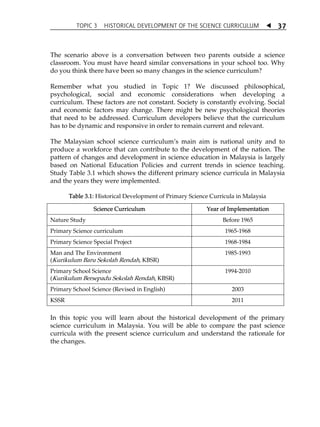
  • 9.
    TOPIC 1 FORMULATIONOF THE CURRICULUM 9 A continuous examination of the goals and demands of society which are continuously changing is needed to determine what knowledge is most worthwhile and which values are relevant. ACTIVITY 1.4 1. The concerns of society twenty years ago is different from the concerns of society today. Discuss how this has affected the present science curriculum. 2. Social factors are very critical in formulating a curriculum. Identify at least two social factors that should be considered when formulating a curriculum. 1.3.2 Economic Considerations in Formulating a Curriculum The national economy is an important consideration when formulating a curriculum. Are you wondering how the economy of the country affects the curriculum? The children you teach will one day be employed. Schools need to meet the workforce demands of a changing world. The 21st century world is a technologically advanced world. Modern careers require skills that are technologically complex. There is a demand for skilled and literate workers. Successful workers in the modern world must possess both an understanding of electronic technology, and the ability to work more cooperatively with others to solve problems of a highly intricate nature, are able to communicate their ideas confidently. The curriculum offered has to provide appropriate education for the students to develop the skills, knowledge and attitudes required by the workforce so as to sustain the countryÊs progress with a competent labour force. It is therefore important that serious consideration is given to economic demands when designing the curriculum.
  • 10.
    1 0 TOPIC 1 FORMULATION OF THE CURRICULUM SELF-CHECK 1.1 1. Explain what you understand by the term „curriculum‰. 2. A country has been using the same curriculum for the last 10 years. Do you think this is a good practice? Why? 3. How do the philosophical foundations of education influence curriculum formulation? 4. How do the psychological foundations of education influence curriculum formulation? 5. To what extent can the school curriculum equip individuals to cope with the challenges and requirements of the 21st century? A curriculum consists of learning objectives, content, instructional strategies, learning experiences of the learner and a programme for evaluation of outcomes. Curriculum developers need to consider the philosophical, psychological, social and economic needs of the society when planning the curriculum. Philosophy provides a framework of values and beliefs related to the goals of education that can be used for planning, implementing and evaluating the curriculum in school. The National Philosophy of Education is the basis for all educational activities and programmes in Malaysia. The Malaysian school curriculum is developed in line with the National Philosophy of Education. The Malaysian science curriculum is also influenced by the National Philosophy of Science.
  • 11.
    TOPIC 1 FORMULATIONOF THE CURRICULUM 11 The curriculum developed must be based on a sound understanding of psychological factors such as child growth, child development and learning theories. Psychological considerations such as the mental, physical and emotional requirements of the child need to be taken into account when planning the curriculum. Schools, through their teaching of the curriculum, can shape and mould a society. Curriculum developers need to take into account societal considerations when planning the curriculum. Consideration must be given to economic demands when designing the curriculum so as to develop the skills, knowledge and attitudes required by the workforce to sustain the countryÊs progress with a competent labour force. Curriculum Economic considerations National Philosophy of Education National Science Education Philosophy Philosophical considerations Psychological considerations Social considerations Educational Planning and Research Division, Ministry of Education Malaysia. (2008). Education in Malaysia - A journey to excellence. Retrieved from http://www.slideshare.net/Fadzliaton/education-in-malaysia Heslep, R. (1997). Philosophical thinking in educational practice . London: Greenwood Publishing. Ornstein, A. C. Hunkins, F. (1998). Curriculum foundations, principles and theory. USA: Allyn and Bacon.
  • 12.
    1 2 TOPIC 1 FORMULATION OF THE CURRICULUM Psychological Influences in the Curriculum Decision Making Process. Anne Syomwene (Ph.D) 1*; Kisilu Kitainge (Ph.D) 2; Marcella Mwaka (PhD) 3*Moi University, Kenya 2University of Eldoret, Kenya 3Moi University, Kenya . Retrieved from (http://www.iiste.org/Journals/index.php/JEP/ article/view/5201/5319) Sharifah, Maimunah Syed Zin Lewin, K. M. (1991). Curriculum development in Malaysia in curriculum development in east Asia. Ed by Marsh, C. Morris, P. London: The Falmer Press. Taba, H. (1962). Curriculum development: Theory and practice. New York, NY: Harcourt, Brace, World. Tanner, D., Tanner, L. (1995). Curriculum development: Theory into practice (3rd ed.). Englewood Cliffs, NJ: Merrill. Tyler, R. W. (1949). Basic principles of curriculum and instruction. Chicago: University of Chicago Press.
  • 13.
    Topic 2 Issues in Science Education LEARNING OUTCOMES By the end of this topic, you should be able to: 1. Examine the goals of a science curriculum; 2. Analyse the content of a science curriculum; 3. List the relevant methods for teaching science; 4. Explain the meaning of scientific literacy; 5. Discuss the meaning of scientific language; and 6. Discuss some of the contemporay issues of science education. INTRODUCTION Figure 2.1: Planning lessons for Science Year 4
  • 14.
    TOPIC 2 ISSUESIN SCIENCE EDUCATION 14 What should Cik Lee do? What documents should she refer to in planning the teaching of the subject? Yes, she should study the science curriculum. She should refer to the primary science syllabus and curriculum specifications for Year Four. Then only should she look at the textbook and other resources to plan the lessons. The curriculum is a course or path. It is meant to be connected and integrated and it should lead to educational attainment. Thus, by understanding the science curriculum, Cik Lee would be clear about the aspirations of the curriculum, the topics to be taught, and how to assess her pupilsÊ learning. In this topic you will be looking at the details of any science curriculum goals of a science curriculum, the contents of the curriculum, how to teach them, the language of science, the concept of scientific literacy and the issues pertaining to the science curriculum. ACTIVITY 2.1 Recall how science was taught when you were in primary school. Take time to list down the characteristics of the science lesson. GOALS OF SCIENCE EDUCATION 2.1 Knowing where you want to go will make it easier for you to plan your destination. Thus knowing the goals of science education will make it easier for a curriculum planner to plan the appropriate curriculum needed. And for you as a teacher, knowing the goals will make it easier to plan how to teach and assess the teaching and learning of science. Let us study a few of the goals of science curriculum in different countries.
  • 15.
    TOPIC 2 ISSUESIN SCIENCE EDUCATION 15 ILLINOIS LEARNING STANDARDS According to Illinois Learning Standards (ISBE, 1997), the general and subsidiary goals of the science curriculum are as follows: Goal 1: Understand and apply the methods of scientific inquiry and technological design to investigate questions, solve problems and analyse claims. Explain the principles and practices of scientific research. Apply the steps and methods of scientific inquiry to conduct experiments and investigate research questions. Apply the principles and methods of technological design to solve problems. Assess the credibility of scientific claims. Goal 2: Understand the facts and unifying concepts of the life, physical and earth/space sciences. Apply concepts of systems within the sciences. Apply concepts of form and function within the sciences. Apply concepts of change and constancy within the sciences. Apply concepts of models and explanations within the sciences. Goal 3: Understand connections and relationships among science, technology and society. Explain the historical development and importance of science and technology. Explain conceptual relationships between science and technology. Describe and analyse relationships among science, technology and society in practical situations.
  • 16.
    TOPIC 2 ISSUESIN SCIENCE EDUCATION 16 NEW ZEALAND The outcome of school science education programmes should be that pupils leaving the school system will have developed the knowledge, skills, attitudes and values that will allow them to take an informed position on scientific issues and tensions that may be facing them and the society they live in at the time. School-leavers should be aware of and have an understanding of the scientific process and its values. They should have developed an enquiring attitude and the knowledge and skills that will allow them to find the answers to their questions. There are five overarching integrated aspects of science that those seeking to identify goals for science education should consider: scientific literacy, attitudes and interests towards the environment, doing science, science as a career and communication in science. MANITOBA SCIENCE CURRICULA The following goals were developed for all Canadian pupils, regardless of gender or cultural background, to have an opportunity to develop scientific literacy. Encourage pupils in all grades to develop a critical sense of wonder and curiosity about scientific and technological endeavours. Enable pupils to use science and technology to acquire new knowledge and solve problems, so that they may improve the quality of their own lives and the lives of others. Prepare pupils to critically address science-related societal, economic, ethical and environmental issues. Provide pupils with a proficiency in science that creates opportunities for them to pursue progressively higher levels of study, prepares them for science-related occupations, and engages them in science-related hobbies appropriate to their interests and abilities. Develop in pupils of varying aptitudes and interests a knowledge of the wide variety of careers related to science, technology and the environment.
  • 17.
    TOPIC 2 ISSUESIN SCIENCE EDUCATION 17 If you analysed all the curricula above, the goals underlying science curriculum and instruction are the same. The goals can be classified into the following categories: scientific knowledge, scientific methods, social issues, personal needs, and career awareness. (a) Science education should develop a fundamental understanding of natural systems: There is a body of knowledge concerning biological, physical, and earth systems. For over 200 years, our science education programmes have aimed towards informing pupils of these natural systems. This goal has been, and will continue to be, of significant importance for science teachers. (b) Science education should develop a fundamental understanding of, and ability to use the methods of scientific inquiry: This goal will ensure pupils will acquire the skills of planning and doing science investigations in finding answers to problems. (c) Science education should prepare citizens to make responsible decisions concerning science-related social issues. Science education exists in society and should contribute to the maintenance and aspirations of the culture. This goal is especially important when there are social challenges directly related to science. (d) Science education should contribute to an understanding and fulfilment of personal needs, thus contributing to personal developmen. All individuals have needs related to their own biological/psychological systems. (e) Science education should inform pupils about careers in the sciences: Scientific research, development, and application continue through the work of individuals within science and technology and through the support of those not directly involved in scientific work. ACTIVITY 2.2 Study our primary science curriculum. Compare and contrast the aims stipulated in the curriculum with the curricula that you have just read.
  • 18.
    TOPIC 2 ISSUESIN SCIENCE EDUCATION 18 CONTENT OF SCIENCE EDUCATION 2.2 What content to be taught in the science curriculum at any level is a statement about the elements of science we choose to teach selected from a much larger set of possibilities. There are many factors that need to be considered before deciding the content to be taught. Looking at the goals of science education will certainly help us to determine what content should be taught in the curriculum. The content of science for primary school children should be an interplay among concepts, scientific reasoning, the nature of science, and doing science. Although science concepts are important as a basic foundation of science knowledge, children need to begin to build an understanding of basic concepts and how they connect and apply to the world in which they live. It could be done through hands-on activities where the children are actively exploring and finding out the concepts. These first-hand experiences help them to find answers to problems themselves by exploring their own environment. Scientific skills are the tools that need to be acquired by the children so that they could do the activities. Thus, broadly the content should contain a skills section and a content section. (a) The Skills Section The skills section will help children to work scientifically, and in designing and making. Children are encouraged to work as scientists as they investigate and explore their physical and natural surroundings. The curriculum should support children in developing skills of enquiry during this investigative work: observing, asking questions, suggesting explanations, predicting outcomes, planning investigations or experiments to test ideas and drawing conclusions. Designing and making are the technological components of the science curriculum. This aspect of the curriculum provides children with opportunities to apply scientific ideas to everyday situations and problems. The children are challenged to explore, plan and make models and functional objects in order to solve practical problems. This develops children's awareness of the value of technology in their lives. (b) The Content Section What to include in the content section is debatable. Different countries have different ways of organising the basic concepts that should be taught in primary science. In the Malaysian Science Curriculum the contents are organised around themes. What is important is this content should cover
  • 19.
    TOPIC 2 ISSUESIN SCIENCE EDUCATION 19 core concepts, principles, and theories of science that would be continued in the secondary school science curriculum. We should also remember that not all pupils would end up as scientists as their careers. Thus the content should cover just enough concepts so that they become ‰scientifically literate‰. Consequently, the science curriculum should be oriented more towards developing awareness among the learners about the interface of science, technology and society, sensitising them, especially to the issues of environment and health, and enabling them to acquire practical knowledge and skills to enter the world of work. ACTIVITY 2.3 What are the themes used in our primary science curriculum? Discuss with your classmates. TEACHING OF SCIENCE 2.3 Did you enjoy studying science in school? Who were your science teachers? Do you think they enjoyed teaching science? There is no doubt that a teacher who outwardly states a dislike for a subject can negatively influence pupilsÊ attitudes towards that subject. Similarly, a teacher who demonstrates enthusiasm and genuine interest in teaching a subject can be a catalyst for pupil learning. Teaching strategies also shape the learning environment. An effective teacher would need to select teaching strategies to engage pupils in learning science. There are teaching strategies that can be transferred from other subjects to also teach science. For example, you could use storytelling or drama, which are very useful in learning language, into the teaching of science. There are also strategies that are more specific to teaching science. For example, project and experimentation are synonymous with science teaching. What strategy that you as a teacher decide to employ depends on many factors. These factors include: (a) PupilsÊ learning styles; (b) PupilsÊ prior knowledge and skills; (c) Availability of teaching resources;
  • 20.
    TOPIC 2 ISSUESIN SCIENCE EDUCATION 20 (d) TeachersÊ knowledge and skills; and (e) SocietyÊs expectations. The nature of science should be the most, or at least, a big consideration when deciding on the pedagogy when teaching science. The main complaint of pupils about science is that it is not sufficiently relevant. What is learnt in the science classroom is only used in the classroom and has no connection with the real world, although science is in fact the study of the natural world. For activities to be meaningful and engaging they should help the understanding of things pupils have encountered directly in their day-to-day experience and indirectly through films and television programmes. It should be possible for children to make a link between new experiences and previous experiences. There can be a dilemma here in relation to whether science activities should be taken from real-life events often complex and with several ideas involved or whether they should be „tidied up‰ to demonstrate certain relationships or principles. Some degree of abstraction from real events is generally necessary, but it should always be possible for the children to link what is learned to real events. Inquiry-based is the essence of science teaching and learning. It „fits‰ with the nature of science. Pupils should be actively engaged in exploring the concepts through hands-on activities. Pupils learn effectively when they are actively engaged in the discovery process, often working in small groups. They should be provided opportunities to have direct experience with common objects, materials, and living things in their environment. Good instruction focuses on understanding important relationships, processes, mechanisms and applications of concepts. Teachers act as facilitators. Managing inquiry during a lesson is not the only thing that a science teacher must do. Her work starts before the lesson begins. She decides the concepts and the skills that should be developed during the lesson. Then, throughout the lesson, the teacher should be listening to the discussion about the concepts and observing the skills as the pupils are doing their work. This information or formative assessment can later be used as feedback for the teacher and pupils about learning. Have they understood the lesson? Have they mastered the skills? Do the concepts need to be explored again? These are some of the questions that the teacher can answer from formative assessments.
  • 21.
    TOPIC 2 ISSUESIN SCIENCE EDUCATION 21 SELF-CHECK 2.1 Would the following scenarios be the elements in the teaching and learning of science? Scenario Yes? No? Children have the opportunity to express their ideas, to listen to the ideas of others and to build on their existing ideas when faced with new experiences. Teachers pose questions that require children to hypothesise, predict and suggest answers. Teachers engage children in thinking about and discussing how to test their predictions and see if their ideas „work‰. Children are clear about what they are finding out and what they are learning by doing so. Children consider the evidence they collect in relation to initial ideas and predictions. Children reflect and report on how and what they have learned. Not all learning in science involves inquiry. There are some things, such as conventions, names and the basic skills of using equipment, that are more efficiently learned by direct instruction. If you want your pupils to know how to use the thermometer, or the measure correctly the length of a room using a metre rule, then demonstrating and explaining to them the skills would be more appropriate, followed by practice in using the skills.
  • 22.
    TOPIC 2 ISSUESIN SCIENCE EDUCATION 22 ACTIVITY 2.4 Which of the following strategies would have high impact for primary science? Strategies High Impact? Low Impact? Misconceptions are targeted Enthusiasm from teacher Uniform on individual interests Usable and practical scientific knowledge Group work Hands-on experiences Chalk and talk or copying from OHT Interactivity with life Purposes are clearly articulated Excursions for science understanding In summary there is no one best method to teach any subject. Although the inquiry-based method is considered a very good method to teach science, if pupils are not equipped with the knowledge, skills and attitude, then it is not the effective method to choose. You, as the teacher, know best what works and what does not work with your pupils.
  • 23.
    TOPIC 2 ISSUESIN SCIENCE EDUCATION 23 SCIENTIFIC LITERACY 2.4 Have a look at Figure 2.2 and see if you can recall anything. Figure 2.2: A definition of scientific literacy (Rennie, 2005) Source: Skamp: Teaching Primary Science Constructively, pg 3 We have discussed this concept in detail in Topic 1 of HBSC1103 Teaching and Learning of Science. SELF-CHECK 2.2 By referring to Figure 2.2, can you summarise the definition of scientific literacy? Yes! Scientific literacy means that a person can ask, find, or determine answers to questions derived from curiosity about everyday experiences. It means that a person has the ability to describe, explain, and predict natural phenomena. A
  • 24.
    TOPIC 2 ISSUESIN SCIENCE EDUCATION 24 literate citizen should be able to evaluate the quality of scientific information on the basis of its source and the methods used to generate it. As mentioned above, one of the goals of the science is to develop a scientifically literate population. Feasey (1996) suggests that most people are scientifically illiterate and often hold negative and contradictory viewpoints of science. The public think that science belongs to the scientists and is too difficult for them to understand. Skamp (2004) mentioned that Feasey and Gott (1996) suggest two elements that can provide a foundation for a scientifically literate individual. (a) Factual background which relates to the understanding of key ideas and facts in science. A sound knowledge and ability to apply such concepts in a range of contexts is essential. (b) An understanding of evidence that focuses on the individualÊs understanding of how and why scientists collect evidence and an ability to challenge the reliability and validity of evidence in order to decide on its believability. Why do you think we need to be scientifically literate? One of the main reasons is that the society we live in depends to an ever-increasing extent on technology and scientific knowledge that makes it possible. Decisions we make every day have the capacity to affect energy consumption, our personal health, natural resources, and the environment ultimately our well-being and that of our community and the world. Individual decisions may not seem to be critical, but when they are multiplied by 300 million nationwide, or nearly seven billion worldwide, they have the power to change the face of the planet (Scearce, 2007). ACTIVITY 2.5 1. Draw your image of a typical scientist and list the characteristics of the person that you have drawn. 2. What work does he or she do?
  • 25.
    TOPIC 2 ISSUESIN SCIENCE EDUCATION 25 SCIENTIFIC LANGUAGE 2.5 Teachers often say: „I have explained so many times, yet pupils cannot understand!‰ What could the reason be? One of the reasons is because the pupils do not understand the scientific language that the teacher is using. What and how is scientific language different from everyday language? This section will discuss these points. 2.5.1 Difficulties in Language The use of scientific language and terminology enables scientists around the world to communicate effectively with each other. However, the use of scientific words and phrases is often confusing for non-specialists, let alone non-scientists. There are a number of ways language can make understanding science more difficult, such as alternative meanings of words, pupilsÊ lack of appropriate vocabulary, the specialised vocabulary used by scientists, and English as a second language. Pupils may begin to separate school explanations and home explanations. Or, pupils may begin to believe they are unable to learn science it is just too difficult to figure out. Still others may reject the scientific explanation as too difficult and accept their own, or their community's explanation instead. Learners may develop an understanding of the meaning of certain words that is different from the scientists' meaning of these words. People outside the scientific community and scientists themselves give these same words other meanings and/or use them in other contexts, resulting in slight nuances to the original meaning. These alternative meanings can make understanding and/or accepting the scientist's use of the word or term difficult. Table 2.1 illustrates the different meaning of certain terms.
  • 26.
    TOPIC 2 ISSUESIN SCIENCE EDUCATION 26 Table 2.1: Examples of the Meaning of Words in Scientific Language and Everyday Language Concepts Scientific Language Everyday Language Living and non-living Living and non-living are associated with the terms alive and dead. Describe those and other non-living objects as being alive, e.g. a live wire or the fire „came to life‰ when we added wood, or as having died, e.g. the car or battery died. Community The interaction of living organisms within a bounded system. Within the general culture, communities are determined by groups of residents who have some common identity. Communities in this sense focus on the activities, needs and care of human beings. Force We talk about force as one aspect of a field of influence surrounding objects. That is, a force field is a complex system of pushes and pulls. However, the everyday use of the term force includes such phrases as, „I was forced to go to bed without my dinner‰, „Someone forced their way into the house‰, „My mom works in the police force,‰ and in the movies, „May the force be with you.‰ The language used by scientists to communicate their work reflects the nature of science. Scientific language used by scientists includes: (a) Appeals to evidence. E.g., „Based upon the evidence gathered in this investigation, ....‰ (b) Expressions about the validity and reliability of the evidence. E.g., „The design called for the control of ....‰, „A new technology allowed for ....‰, „This procedure ....‰, „The skill of the technician was such that we were able to ....‰, (c) Appeals to prominent scientists. E.g., „Ian Stirling found in his research that ....‰ (d) Appeals to accepted literature. E.g., „A research study reported in Science indicated that ....‰, „Peer reviewed research in Nature suggests that ....‰
  • 27.
    TOPIC 2 ISSUESIN SCIENCE EDUCATION 27 (e) Expressions of (un)certainty. E.g., „This was an initial study ....‰, „The These characteristics are typically found in scientific research papers and ideally in science educational materials such as science textbooks. Popular science magazines and newspaper articles about science often take liberties with scientific language by translating it into more common everyday language. This translation often removes important aspects about the nature of science, or worse, misrepresents the nature of science. Two common problems with popular science articles are a lack of expression of appropriate uncertainty (tending to more absolute statements) and confusion between evidence and interpretation. Evidence is the ultimate authority in science even though all evidence is uncertain to some degree. Expressions such as „facts‰, „exactly‰, „absolutely‰ or „we proved ‰ are not appropriate in the context of a scientific investigation. Evidence can support or fail to support a prediction and/or hypothesis, but cannot „prove‰ either. „Proof‰ is considered too absolute and does not connote the uncertainty accompanying all scientific evidence and knowledge. Table 2.2 shows more examples of the use of scientific language. Table 2.2: Some Examples of the Use of Scientific Language Expressing the Authority Expressing the Degree of Certainty Based on the concept of The certainty is three significant digits. According to the law of Based upon the limited evidence gathered, Using the theory of Without full control of all variables Based on the evidence obtained in this investigation The experiment needs to be replicated by another group but In our judgment, Careful control of all known variables suggests sample size was small but ...‰, (f) Appeals to the nature of science. E.g., „Although science requires us to be open-minded about this counter-claim,‰, „This is only a correlational study and not a cause and effect study so ...‰. (g) Appeals to logical reasoning. E.g., „If ..., then ....‰, „If ... and ...., then ....‰, Logical consistency requires that ....‰
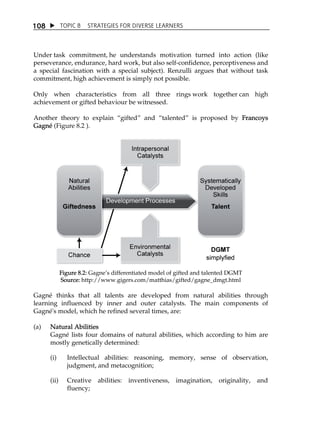
  • 28.
    TOPIC 2 ISSUESIN SCIENCE EDUCATION 28 Our interpretation of the evidence is that Accepting that all knowledge is uncertain, If this concept is valid, then The accuracy as a per cent difference is This accepted concept leads us to believe that Having a high degree of confidence in the evidence, it is appropriate to Logical and consistent reasoning suggests that In this correlational (not cause and effect) study Source: http://www.crystaloutreach.ualberta.ca/en/ScienceReasoningText/Scientific Languageaspx ACTIVITY 2.6 The main reason pupils find it difficult to understand science is because of the difficulty in writing, spelling and reading the terms. Actually, scientific vocabulary is a jumble of little words that are linked together to have different meanings. Guess the meaning of each of these terms: (a) Epidermis; (b) Abiotic; (c) Endocytosis; (d) Anaerobic; and (e) Monochrome. 2.5.2 Sources of Scientific Words Scientific words in English may conveniently be divided, from the standpoint of their origins, into three groups: (a) Those taken from the ordinary English vocabulary; (b) Those taken virtually unchanged from another language; and (c) Those which have been invented. Table 2.3 shows a few examples.
  • 29.
    TOPIC 2 ISSUESIN SCIENCE EDUCATION 29 Table 2.3: Examples of Scientific Words and Their Origin Sources Examples of Words (a) Taken from the ordinary English vocabulary. Although the scientist may give them precise meanings, they are liable to be interpreted more loosely (or even differently) by the non-scientist. Energy, work, power, salt, base, fruit (b) Taken virtually unchanged from another language. Many of the Greek or Latin terms have retained their original meaning but in some cases the meanings have been restricted and rendered more precise. Latin words: axis, fulcrum, larva, radius, locus, nimbus, cortex, cerebrum, pelvis, cornea Greek words: thorax, stigma, iris, helix (c) Those which have been invented. Ester for a compound formed by the interaction of an alcohol and an organic acid. ScientistsÊ names have also been used to provide the names of units (e.g. watt, volt, gauss, joule) Scientists have taken „bits and pieces‰ roots, prefixes, suffixes from different languages and joined them together to form the terms. Thus, when they needed a general name for animals such as snails and slugs which apparently walk on their stomachs, they have taken the Greek roots gast(e)ro- (stomach) and -pod (foot) and formed the new word gastropod. When he wanted a word to describe a speed greater than that of sound he took the Latin prefix super- (above, beyond) and the Latin root son- (sound) and coined the adjective supersonic.
  • 30.
    TOPIC 2 ISSUESIN SCIENCE EDUCATION 30 2.5.3 How to Teach the Language? Introducing new scientific language to pupils can cause considerable confusion, particularly when the pupils may have established a different understanding of the terms from their everyday use. Careful thought needs to be given to the selection of new scientific terms, the choice of language used in definitions and the implications of prior understanding based on everyday use. In learning the language of science, pupils need to learn not only a specialised vocabulary but also how words go together and when to use this way of communicating. The challenge is to teach these „rules of the game‰ whilst still valuing the ways of using language that the pupils bring to the classroom. The role of teachers is to help pupils build bridges between their known and familiar ways of using language, and academic ways of using language. Below are a few suggestions that you as a teacher can take: (a) Practise Using and Build Perceived Usefulness of the Scientific Model or Idea Encourage activities which promote pupil experience with the language of scientific discourse. Focus on helping pupils to identify scientific terms that are new to them or terms where their meanings remain unclear. Encourage pupils to practise language patterns that assist them to describe events, objects, and processes, to make predictions and to draw conclusions. Encourage short verbal reporting by pupils or presentations to their peers where particular scientific terms should be used. (b) Clarify and Consolidate Ideas for/by Communication to Others Work with pupils to develop a chart of useful scientific terms. This could be on permanent display in the classroom and pupils could be encouraged to make additions as new scientific terms arise or are introduced. Have pupils collect or develop a range of images that assist in understanding the meanings of the terms or the context in which they are used. Pupils could work on developing their own scientific dictionary for use in a particular context of study. Scientific definitions could be written in their own words or pupils could draw or collect visual images to help improve their understanding of the terms encountered. (c) Clarify and Consolidate Ideas for/by Communication to Others Adopt teaching approaches that allow pupils to practise verbal, visual and writing skills. It is important for pupils to have experiences of „doing‰ science and also of developing skills to communicate their findings to others.
  • 31.
    TOPIC 2 ISSUESIN SCIENCE EDUCATION 31 CONTEMPORARY ISSUES Like it or not, science constitutes a significant part of human life. It impacts on how people experience and understand the world and themselves. The rapid advances in science and technology, newly established societal and cultural norms and values, and changes in the climate and environment, as well as the depletion of natural resources all greatly impact the lives of children and youths, and hence their ways of learning, viewing the world, experiencing phenomena around them and interacting with others. Science educators must be aware of all these changes. They need to rethink the science curriculum, the pedagogy and assessment in the science classroom today as the practice of science education needs to be proactive and relevant to pupils and prepare them for life in the present and in the future. Contemporary issues facing science education in Malaysia are no different from other countries. In a report commissioned by UNESCO, Section For Science, Technical And Vocational Education in 2008, titled Science Education Policy-Making: Eleven Emerging Issues, Fensham listed the following issues concerning science education (Table 2.4). Table 2.4: Lists of Issues of Relating to Science Education Issue A Science in Schooling and its Educational Purposes Issue B Access and Equity in Science Education Issue C Interest in, and about Science Issue D How Technology Relates to Science in Education Issue E The Nature of Science and Inquiry Issue F Scientific Literacy Issue G Quality of Learning in Science Issue H The Use of ICT in Science and Technology Education Issue I Development of Relevant and Effective Assessment in Science Education Issue J Science Education in the Primary or Elementary Years Issue K Professional Development of Science Teachers Source: UNESCO (2008) 2.6
  • 32.
    TOPIC 2 ISSUESIN SCIENCE EDUCATION 32 One of the issues that had and is still faced by science education in our country is Issue C Interest in, and about science. Professor of Mathematics, CK Raju, a visiting professor at the Mathematics department in Universiti Sains Malaysia (USM), calls for a review of teaching methods for science stream subjects as a way to raise pupilsÊ interest, following reports that the percentage of science stream pupils had dropped to 29 per cent in 2012 (New Straits Times 19 February 2012). The same issue is also commented by Prof. Datin Dr Azizan Baharuddin, the Deputy Director-General of Institute of Islamic Understanding Malaysia. This issue perhaps needs elaboration and continued engagement because in the context of the K-economy and MalaysiaÊs developmental policies, science, technology and innovation are critical drivers. The current data seems to show that our manpower needs in important areas such as engineering, ICT, health and agriculture are still far from adequate as our unfulfilled needs range from 30 percent to 50 percent. (The STAR, February 28, 2012). ACTIVITY 2.7 1. Conduct a survey in your school on the interest in science. 2. Find out the reasons why pupils like or dislike science. 3. As a science teacher, list out different ways that you can adopt to raise the interest of these pupils. 4. Choose any of the issues in Table 2.4. Research and find out the current status of the issue in our country. Knowing the goals of science education will make it easier for a curriculum planner to plan the appropriate curriculum needed. It also makes it easier for a teacher to plan how to teach and assess the teaching and learning of science.
  • 33.
    TOPIC 2 ISSUESIN SCIENCE EDUCATION 33 The goals can be classified into the following categories: scientific knowledge, scientific methods, social issues, personal needs, and career awareness. What content to be taught in the science curriculum at any level is a statement about the elements of science we choose to teach selected from a much larger set of possibilities. The content of science for primary school children should be interplay among concepts, scientific reasoning, the nature of science, and doing science. The content of science curriculum should contain a skills section and a content section. The skills section would help children to work scientifically. This would develop skills of enquiry during the investigative work. Designing and making are the technological components of the Science Curriculum. Different countries have different ways of organising the basic concepts that should be taught in primary science. The science content should cover just enough concepts so that they become „scientifically literate‰ as not all pupils are going to be working as scientists. Inquiry-based method is always associated with science teaching and learning. Managing inquiry during a lesson is not the only thing that a science teacher must do. She should first plan the lesson before acting as facilitator during the lesson. Formative assessment should also be carried out so that it can be used as feedback for the teacher and pupils about learning. Teaching methods used in teaching other subjects are also used in science teaching when necessary. Scientific literacy means that a person has the ability to describe, explain, and predict natural phenomena.
  • 34.
    TOPIC 2 ISSUESIN SCIENCE EDUCATION 34 The use of scientific language and terminology enables scientists around the world to communicate effectively with each other. There are a number of ways language can make understanding science more difficult, such as alternative meanings of words, pupils' lack of appropriate vocabulary, the specialised vocabulary used by scientists, and English as a second language. Learners may develop an understanding of the meaning of certain words that is different from the scientists' meaning for these words. The language used by scientists to communicate their work reflects the nature of science. Scientific words in English may be divided into three groups: those taken from the ordinary English vocabulary; those taken virtually unchanged from another language; and those which have been invented. Designing and making Formative assessment Inquiry-based Nature of science Scientific language Scientific literacy Scientific reasoning Scientific skills Aims and goals of science education. Retrieved from http://www.tki.org. nzcurriculum/whats_happening/index_e.php Carin, A., Sund, R. B. (1989). Teaching science through discovery (6th ed.). Belmont: Thomson Wadsworth. Content of science. Retrieved from http://www.curriculumonline.ie/en/ Primary_School_Curriculum/Social_Environmental_and_Scientific_Educat ion_SESE_/Science/
  • 35.
    TOPIC 2 ISSUESIN SCIENCE EDUCATION 35 Critical reflections on Malaysian science curriculum. Retrieved from http:// www.recsam.edu.my/cosmed/cosmed05/AbstractsFullPapers2005/Files% 5Csubtheme1%5CKAM.pdf Esler, W.K., Esler, M. K. (2001). Teaching elementary science (8th ed.). Belmont: Thomson Wadsworth. Martin, D. J. (2006). Elementary science methods: A constructivist approach. Methods for constructing understanding. Boston: Allyn and Bacon. Perspectives on education primary science. Retrieved from http://www. wellcome.ac.uk/stellent/groups/corporatesite/@msh_peda/documents/ web_document/wtd042076.pdf Reimagining science Learning curve New Straits Times, 19 February 2012. Retrieved from www.nst.com.my/channels/learning-curve/issues reimagining-science-1.48634#xzz2jAaHEwtA. Science in primary school. Retrieved from http://archivefuturelab.org.uk/ resources/publications-reports-articles/literature-reviews/Literature- Review381 Scientific language. Retrieved from http://www.crystaloutreach.ualberta.ca/ en/ScienceReasoningText/ScientificLanguage.aspx Skamp, K. (2004). Teaching primary science constructively. Southbank, Victoria: Wadsworth Publishing Company. WhoÊs getting it right and WhoÊs getting it wrong in the debate about science literacy? Retrieved from http://www.csicop.org/specialarticles/show/ whos_getting_it_right_and_whos_getting_it_wrong_in_the_debate_about_ science/
  • 36.
    Topic 3 Historical Development of the Science Curriculum LEARNING OUTCOMES By the end of this topic, you should be able to: 1. Describe the historical development of the science curriculum; 2. Analyse the strengths and weaknesses of Nature Study, Special Project, Man and the Environment, KBSR and KSSR curricula; and 3. Compare and contrast the Nature Study, Special Project, Man and the Environment, KBSR and KSSR curricula. INTRODUCTION
  • 37.
    TOPIC 3 HISTORICALDEVELOPMENT OF THE SCIENCE CURRICULUM 37 The scenario above is a conversation between two parents outside a science classroom. You must have heard similar conversations in your school too. Why do you think there have been so many changes in the science curriculum? Remember what you studied in Topic 1? We discussed philosophical, psychological, social and economic considerations when developing a curriculum. These factors are not constant. Society is constantly evolving. Social and economic factors may change. There might be new psychological theories that need to be addressed. Curriculum developers believe that the curriculum has to be dynamic and responsive in order to remain current and relevant. The Malaysian school science curriculumÊs main aim is national unity and to produce a workforce that can contribute to the development of the nation. The pattern of changes and development in science education in Malaysia is largely based on National Education Policies and current trends in science teaching. Study Table 3.1 which shows the different primary science curricula in Malaysia and the years they were implemented. Table 3.1: Historical Development of Primary Science Curricula in Malaysia Science Curriculum Year of Implementation Nature Study Before 1965 Primary Science curriculum 1965-1968 Primary Science Special Project 1968-1984 Man and The Environment 1985-1993 (Kurikulum Baru Sekolah Rendah, KBSR) Primary School Science (Kurikulum Bersepadu Sekolah Rendah, KBSR) 1994-2010 Primary School Science (Revised in English) 2003 KSSR 2011 In this topic you will learn about the historical development of the primary science curriculum in Malaysia. You will be able to compare the past science curricula with the present science curriculum and understand the rationale for the changes.
  • 38.
    TOPIC 3 HISTORICALDEVELOPMENT OF THE SCIENCE CURRICULUM 38 ACTIVITY 3.1 Try asking your parents, grandparents or even great grandparents about their school days. Do they remember learning science? How did they learn science? Read through the science curricula in Malaysia in this topic and see if you can identify what curriculum they were using. NATURE STUDY 3.1 At the end of the 19th century and until the middle of the 20th century, science was taught as „Nature Study‰ in primary schools. The Nature Study curriculum focused on knowledge of facts and laws of nature based on scientific investigation of the natural world. Pupils were asked to learn the facts and laws of nature through careful observation and classification of nature. However, the curriculum ignored much of the natural environment that had an impact on pupilsÊ lives. The teaching approach mainly focused on textbooks and rote learning. There was a need to teach science that linked together ideas from all fields of science and relate to studentsÊ surroundings and everyday experiences. The science curriculum was only made uniform and official after 1956 when the Razak Report recommended that a single syllabus be implemented in schools. The Nature Study curriculum was replaced by the Primary Science curriculum in 1965. This new curriculum was adapted for local needs from the Nuffield Junior Science Project, United Kingdom (1964). The Primary Science curriculum focused on mastery of scientific facts. Many primary science teachers especially in rural schools had poor educational backgrounds and had not received adequate teacher training in science content and methodology. They had been trained as general subject teachers and as such the teaching of science was textbook-centred focusing on rote learning and memorisation. The academic achievement in science of pupils was weak especially in the rural areas. Can you see that a change was needed to overcome these problems?
  • 39.
    TOPIC 3 HISTORICALDEVELOPMENT OF THE SCIENCE CURRICULUM 39 SPECIAL PROJECT (PROJEK KHAS) In 1968, the Ministry of Education started a project called Primary School Special Project. The main aim of this project was to raise the teaching standard of science and mathematics in Malaysia. The development of the Special Project was a historic event as it was the first large-scale curriculum reform undertaken by the Ministry of Education. The Primary School Special Project used new teaching approaches but the content remained the same as it was assumed that the teachers had mastered the content. The focus was to help teachers gain more confidence in using the inquiry approach so as to be able to instil an interest and understanding in pupils of the world around them. In 1971, the Ministry of Education formulated the Primary School Syllabus for Science. Its content did not differ much from the previous curriculum, except for the aspects of the teaching-learning approach, strategy and methods. The Special Project was introduced in schools for Standard 1 in 1970. Services and facilities were provided to the teachers as support. Study Figure 3.1 which shows the services and facilities given to science teachers under the Special Project. Figure 3.1: Support given to science teachers under special project 3.2
  • 40.
    TOPIC 3 HISTORICALDEVELOPMENT OF THE SCIENCE CURRICULUM 40 The Primary Science Special Project was pupil-centred and activity-oriented. Activity centres were set up to spread knowledge and resources to all schools. However, there were too many teachers and not enough trainers and this weakened the impact of this curriculum. ACTIVITY 3.2 1. Analyse the Nature Study Curriculum. What were its strengths? What was the rationale for its change? 2. What were the strengths of the Primary Science Special Project Curriculum? What were its weaknesses? MAN AND THE ENVIRONMENT 3.3 The Cabinet Committee for Review of Implementation of the Education Policy (Jawatankuasa Kabinet Mengkaji Pelaksanaan Dasar Pendidikan) 1979, recommended that the primary school curriculum be developed based on three areas namely: communication; man and his surroundings; and individual self development. Based on this, the Curriculum Development Centre (CDC) formulated a new curriculum called the New Primary School Curriculum (Kurikulum Baru Sekolah Rendah) (KBSR). KBSR was a completely new innovation with changes in content, pedagogy, pupil assessment, evaluation, remedial and enrichment activities, and the role of teachers. Alam dan Manusia Man and His Environment (Alam dan Manusia) was one of the subjects in the area of Man and his Surroundings. Unlike the Special Project, Alam dan Manusia was only offered in Level One, that is, in Years Four, Five and Six. Alam dan Manusia was planned to help students acquire knowledge and understanding of man and his environment with emphasis on the Malaysian society and environment. Alam dan Manusia was a humanistic curriculum that stressed on integration of disciplines, enhancement of thinking skills, inquiry and problem-solving skills and inculcation of moral values. It integrated elements that were previously taught separately in subjects such as Geography, History, Civics, Science and Health Science. This integration aimed not only to reduce the number of subjects, but also ensure that students could understand certain topics better and as a whole.
  • 41.
    TOPIC 3 HISTORICALDEVELOPMENT OF THE SCIENCE CURRICULUM 41 The CDC published teacherÊs guides called Buku Panduan Khas Alam dan Manusia for Years Four, Five and Six. These teachersÊ guides specified the curriculum in detail by listing objectives to be achieved by pupils for each topic. It also contained suggested lesson plans and teaching-learning strategies. Dewan Bahasa dan Pustaka also published Alam dan Manusia textbooks for each year. Did you teach this curriculum or do you have any experience of it? What do you think the constraints of this curriculum were? There were physical constraints when implementing this curriculum such as large class size and lack of facilities. There was also inadequate in-service training and professional support. Due to this, teachers lacked competency in integrating subject content and using an inquiry approach. Teachers were also stressed and overburdened. ACTIVITY 3.3 What were the strengths and weaknesses of the Man and Environment (Alam dan Manusia) Curriculum? KBSR (INTEGRATED CURRICULUM FOR PRIMARY SCHOOL) (KURIKULUM BERSEPADU SEKOLAH RENDAH) 3.4 The Kurikulum Baru Sekolah Rendah was revised based on the evaluation findings and also the future needs and challenges of the country. Alam dan Manusia was replaced by two new subjects, namely the Primary School Science Curriculum and Local Studies (Kajian Tempatan) in 1994 with the implementation of the Integrated Curriculum for Primary Schools (Kurikulum Bersepadu Sekolah Rendah), (KBSR). The Integrated Curriculum for Primary Schools was formulated to improve and enhance the standard of education in primary schools and to achieve the aspirations of the National Philosophy of Education (NPE). The aims of this primary school science curriculum were to: (a) Provide opportunities for pupils to learn about themselves and the environment through everyday experiences and scientific investigations; (b) Acquire knowledge and skills in science and technology;
  • 42.
    TOPIC 3 HISTORICALDEVELOPMENT OF THE SCIENCE CURRICULUM 42 (c) Enable pupils to apply these knowledge and skills based on scientific attitudes; and (d) Acquire noble values to make decisions and solve problems in everyday life. The curriculum also aimed to provide a strong foundation in science and technology to prepare pupils for the learning of science in secondary school. (Integrated curriculum for primary schools: Science syllabus, 2003) Huraian Sukatan Pelajaran Sains Sekolah Rendah The CDC developed the curriculum specifications called Huraian Sukatan Pelajaran Sains Sekolah Rendah in 1993. The Huraian Sukatan Pelajaran Sains Sekolah Rendah contained general and specific learning objectives and suggested learning experiences. Besides this, CDC also published training packages called Pukal Latihan Sains Rendah (PuLSaR). These training packages contained modules on teaching-learning strategies accompanied by video cassettes. Science was taught as both content and a process which included scientific knowledge, scientific skills, thinking skills and scientific attitude and values. A thematic approach was used. School-based assessment in the form of PEKA (Penilaian Kemahiran Amali) was introduced to measure the pupilsÊ mastery of science process skills and manipulative skills. The science curriculum emphasised constructivism, the inquiry-discovery approach and the use of technology. Science Taught in English In 2003, the science curriculum was revised and science was introduced as a subject in Level One. The medium of instruction was English. Globalisation and the need to keep abreast with the advances of science using technology as a means to acquire knowledge had convinced the government to change its policy of using English in the teaching of these two subjects. The teaching of Science using English enables pupils to obtain various sources of information written in English either in electronic or print form. This helps to keep them abreast with the latest developments in science and technology. Pupils will be able to relate their knowledge to the world beyond the school. Teachers were trained to teach Science in English and textbooks and courseware were developed. However in 2009, this policy was changed and the medium of instruction for Science and Mathematics reverted to the Malay language (Bahasa Malaysia).
  • 43.
    TOPIC 3 HISTORICALDEVELOPMENT OF THE SCIENCE CURRICULUM 43 ACTIVITY 3.4 Answer the following questions based on your understanding of the KBSR primary science curriculum. (a) What is science education for? (b) What kind of pupils and society do we want to produce? KURIKULUM STANDARD SEKOLAH RENDAH (KSSR) 3.5 The Primary School Standard Curriculum, KSSR (Kurikulum Standard Sekolah Rendah) was introduced in 2011 as an effort to transform, restructure and improve the current curriculum to ensure that students have the relevant knowledge, skills and values to face the challenges of the 21st century. You will learn more about the KSSR in Topic 6. Here we will look at how science is taught in this new curriculum and the differences between the KBSR and KSSR. KSSR was formulated based on a statement of standards. The statement of standards consists of content standards and learning standards. This is shown in Table 3.2 below: Table 3.2: KSSR Standards Content Standards Learning Standards Specific statements on what the students must know and can do, within a specific period of schooling Set criteria or indicators of education quality and achievements which can be measured for each content standard Under KSSR, primary education is divided into two levels similar to KBSR: Level One from Years One to Three, and Level Two from Years Four to Six. Level One KSSR focuses on the mastery of the 4Ms (Reading, Writing, Counting and Reasoning), basic information and technology (ICT) skills, social, emotional, spiritual, cognitive, physical development, attitudes and values. Level Two focuses on reinforcing and the application of 4Ms, basic ICT skills, social, emotional, spiritual, cognitive, physical development, attitudes and values.
  • 44.
    TOPIC 3 HISTORICALDEVELOPMENT OF THE SCIENCE CURRICULUM 44 In Level One all knowledge disciplines are reorganised for more effective curriculum management to form Basic Core Modules, Thematic Core Modules, and Elective Modules. Study Table 3.3, the Thematic Core Modules were introduced to reduce the number of subjects taken at Level One. These modules comprise the themes of the World of Art and World of Science and Technology. The World of Science and Technology (Dunia Sains dan Teknologi, DST) contains elements of Science, Information and Communication Technology (ICT), and Design and Technology (Reka Bentuk Teknologi, RBT). Science is introduced in the Thematic Core Modules to provide basic knowledge on the discipline of Science. There are two different standard documents for the World of Science and Technology, that is Standard Document for Science Curriculum and RBT, and the Standard Document for ICT. The Standard Document for Science Curriculum contains the following themes: Life Science, Physical Science, Materials Science, Earth and Space Science and Technology and Sustainable Living (Kehidupan Lestari) (RBT). Table 3.3: Organisation of Subjects in KSSR Level One Basic Core Modules Thematic Core Modules Elective Modules Malay Language English Language Chinese Language Tamil Language Mathematics Physical Education Health Education Islamic Education/ Moral Education World of Art World of Science and Technology Arab Language Chinese Language (BCSK) Tamil Language (BTSK) Iban language Kadazandusun Language In Level Two KSSR, the curriculum is organised into Core Subjects and Elective Subjects. All subjects are carried out in a modular way. Science is introduced as a Core Subject at this level. The aim of the science curriculum is to inculcate interest and develop creativity in pupils through experiences and investigations to master science knowledge, scientific skills, thinking skills and scientific attitude and noble values. Study Table 3.4 which shows the differences between the KSSR and KBSR.
  • 45.
    TOPIC 3 HISTORICALDEVELOPMENT OF THE SCIENCE CURRICULUM 45 Table 3.4: The Differences between KSSR and KBSR KSSR (2011 - Untill Today) KBSR (1983-2010) Curriculum design is based on six areas: Communication Spiritual, Attitude and Values Humanitarian Physical and Aesthetical Development Science and Technology Curriculum design is based on three areas: Communication Man and his environment Self-development of the individual Curriculum Materials Curriculum Standard documents Curriculum Materials Syllabus Curriculum Specifications Design of the Curriculum: Modular Design of the Curriculum: Linear Organisation of the Curriculum: Level I (Years 1, 2 and 3) Basic Core Modules, Thematic Core Modules and Elective Modules Level II (Years 4, 5 and 6) Core and Elective Subjects Organisation of the Curriculum: Level I (Years 1, 2 and 3) Core, compulsory and additional subjects Level II (Years 4, 5 and 6) Core , Compulsory and Additional subjects Elements of creativity and innovation, entrepreneurial, information technology and communication Elements of analytical and creative thinking skills Focus: 4M (Reading, Writing, Counting and Reasoning) Focus: 3M (Reading, Writing and Counting) Source: Official website of MOE. http://www.moe.gov.my/en/soalan-lazim-view? id=146cat=30keyword=page=1 ACTIVITY 3.5 Study Table 3.4. Discuss the improvements in the KSSR curriculum and its implications on the teaching of science.
  • 46.
    TOPIC 3 HISTORICALDEVELOPMENT OF THE SCIENCE CURRICULUM 46 Look at Figure 3.2 which shows the development of the science curricula in Malaysia from 1983 until today. Figure 3.2: The development of the science curricula in Malaysia Each curriculum was formulated based on contemporary contents, current learning strategies and the needs of the country. A lot of careful planning went into the formulation of these curriculums. However, the success of any curriculum not only depends on how well it is planned but also on the implementation. You, the teacher, are the one who implements the curriculum. As a teacher you must understand the philosophy and foundations of the curriculum you are using so you can implement it effectively so that its objectives and aims are attained.
  • 47.
    TOPIC 3 HISTORICALDEVELOPMENT OF THE SCIENCE CURRICULUM 47 SELF-CHECK 3.1 1. Compare and contrast the Special Project Science Curriculum, Man and The Environment and the Primary School Science Curriculum (KBSR) in the following aspects: (a) Background of curriculum formulation (b) Rationale for curriculum formulation (c) What conclusion can you make? 2. Use a suitable graphic organiser to show the similarities and differences between the following science curricula: (a) Nature Study (b) Special Project Science Curriculum. (c) Man and the Environment (d) Primary School Science Curriculum (KBSR) (e) KSSR Discuss the similarities and differences using the following aspects: (a) Rationale (b) Strengths (c) Weakenesses The curriculum has to be dynamic and responsive in order to remain current and relevant. At the end of the 19th century and until the mid-20th century science was taught as „Nature Study‰ in primary schools. The Nature Study curriculum focused on knowledge of facts and laws of nature based on scientific investigation of the natural world.
  • 48.
    TOPIC 3 HISTORICALDEVELOPMENT OF THE SCIENCE CURRICULUM 48 The Nature Study did not take into account the pupilsÊ natural environment. The teaching approach mainly focused on textbooks and rote learning. The Primary School Special Project was started in 1968. The main aim of this project was to raise the teaching standard of science and mathematics in Malaysia. The Primary School Special Project used new teaching approaches but the content remained the same. Services and facilities were provided to the teachers as support under the Special Project. The Primary Science Special Project was pupil-centred and activity-oriented. But there were too many teachers and not enough trainers. Man and His Environment was one of the subjects offered in the New Primary School Curriculum (Kurikulum Baru Sekolah Rendah) (KBSR). Alam dan Manusia stressed on integration of disciplines, enhancement of thinking skills, inquiry and problem-solving skills and inculcation of moral values. The problems encountered in this curriculum were physical constraints such as large class size and lack of facilities. There was also inadequate in-service training and professional support. Teachers were also stressed and overburdened. Primary School Science Curriculum was implemented in 1994 under the Integrated Curriculum for Primary Schools (Kurikulum Bersepadu Sekolah Rendah), (KBSR). The objectives of this primary school science curriculum were to provide opportunities for pupils to learn about themselves and the environment through everyday experiences and scientific investigations, to acquire knowledge and skills in science and technology and to enable pupils to apply these knowledge and skills based on scientific attitudes and noble values to make decisions and solve problems in everyday life. In the KSSR, Science is taught under the Thematic Core Modules at Level One under the World of Art and World of Science and Technology.
  • 49.
    TOPIC 3 HISTORICALDEVELOPMENT OF THE SCIENCE CURRICULUM 49 The World of Science and technology (Dunia Sains dan Teknologi, DST) contains elements of Science, Information Communication Technology (ICT), and Design Technology (Reka Bentuk Teknologi, RBT). Science is introduced under the Thematic Core Modules to provide basic knowledge in the discipline of Science. In Level Two KSSR, Science is introduced as a Core Subject. The aim of the KSSR science curriculum is to inculcate interest and develop creativity in pupils through experiences and investigations to master science knowledge, scientific skills, thinking skills and scientific attitude and noble values. Kurikulum Baru Sekolah Rendah, (KBSR) Kurikulum Bersepadu Sekolah Rendah, (KBSR) Kurikulum Standard Sekolah Rendah, (KSSR) Man and the Environment Nature Study Primary Science curriculum Primary Science Special Project Bahagian Pembangunan Kurikulum. (2012). Kurikulum Standard Sekolah Rendah Tahun Tiga. Kementerian Pelajaran Malaysia. Buku Penerangan Kurikulum Bersepadu Sekolah Rendah, Kementerian Pendidikan Malaysia. Retrieved from http://web.moe.gov.my/bpk/v2/ index.php? option=com_contentview=articleid=313Itemid=482lang=en. . Ministry of Education Malaysia. Integrated curriculum for primary schools. Science syllabus. Retrieved from http://web.moe.gov.my/bpk/sp_ hsp/sains/kbsr/sp_science_primary_school.pdf. Pusat Pembangunan Kurikulum. (2002). Huraian sukatan pelajaran Sains. Kementerian Pelajaran Malaysia.
  • 50.
    TOPIC 3 HISTORICALDEVELOPMENT OF THE SCIENCE CURRICULUM 50 Poh, S. H. (2003). Pedagogy Science 1: Science curriculum. Kuala Lumpur: Kumpulan Budiman. Razak Report, 1956. Malaysia Fact Book. Retrieved from http://malaysiafact book.com/Razak_Report_1956 . Sharifah Maimunah Syed Zin (1990) Curriculum Innovation: Case Studies Of Man and the Environment in the Malaysian Primary School Curriculum PhD thesis, University of East Anglia (unpublished). Tan, J. N. (1999). The Development and Implementation of the Primary School Science Currriculum in Malaysia. Unpublished PhD thesis of the University of East Anglia, Norwich, United Kingdom. Wong, Francis Hoy Kee, Yee Hean Gwee (1980). Official Reports on Education: Straits Settlements and the Federated Malay States, 1870-1939. Singapore: Pan Pacific Book Distributors.
  • 51.
    Topic 4 KBSR Science Curriculum I LEARNING OUTCOMES By the end of this topic, you should be able to: 1. State the aims of primary school science; 2. List the objectives of primary school science; 3. Describe the scientific skills that are listed in the science curriculum; 4. Identify thinking skills encompassed in any given scientific skill; 5. Explain various teaching methods used in science teaching and learning; and 6. Relate between KBSR Science Curriculum with National Philosophy, National Science Philosophy and Vision 2020. INTRODUCTION Science is always viewed as a difficult subject, full of abstract concepts that need to be remembered. But if we start introducing science as early as possible and with the right approach, children will end up being innovative scientists contributing to the nation. Young children are naturally curious and constantly exploring the world around them. Classroom science provides the opportunity for children to extend this natural curiosity and building of theories. With the help of teachers, children can develop a greater appreciation and understanding of the natural world.
  • 52.
    5 2 TOPIC 4 KBSR SCIENCE CURRICULUM I In this topic we will study the KBSR Science Curriculum. We will look at the aims, objectives, scientific skills, scientific attitudes and values, the teaching and learning strategies that can be used in the science classroom. Lastly, we will discuss how the National Philosophy, Science Education Philosophy and Vision 2020 relate to one another. KBSR SCIENCE CURRICULUM 4.1 Science is being offered as one subject in primary schools in Malaysia. It has undergone a few changes in the last few years. It was first introduced as KBSR Science under the Man and His Environment component of the curriculum in 1994. When it was first introduced, the subject was taught in Years Four, Five and Six. Later, the subject was taught starting from Year One to Year Six. Then, in 2003, the government introduced Pengajaran dan Pembelajaran Sains dan Matematik Dalam Bahasa Inggeris (PPSMI) (the teaching and learning of science and mathematics in English). The policy was the result of a Cabinet meeting on July 19, 2002 under the administration of the fourth prime minister, Tun Dr Mahathir bin Mohamad. According to the Ministry of Education, the policy would run in stages, starting with the 2003 school session, pioneered by all students of Year One at primary education level, and Form One at the secondary education level. The teaching of science in English was then fully implemented in secondary schools in 2007, and in primary schools in 2008. Under this policy, the science curriculum itself did not change, only the language of instruction. But in 2009 this policy was discontinued. CURRICULUM SPECIFICATIONS OF KBSR SCIENCE SYLLABUS 4.2 In this subtopic, we will look at the KBSR curriculum specifications. 4.2.1 Aims and Objectives The aims of the primary school science curriculum are to provide opportunities for pupils to learn about themselves and the environment through everyday experiences and scientific investigations, to acquire knowledge and skills in science and technology and to enable pupils to apply these knowledge and skills based on scientific attitudes and noble values to make decisions and solve problems in everyday life. It is hoped that this curriculum will develop the
  • 53.
    TOPIC 4 KBSRSCIENCE CURRICULUM I 53 potential of individuals in an overall and integrated manner so as to produce Malaysian citizens who are scientifically and technologically literate, competent in scientific skills, practise good moral values, capable of coping with the changes in scientific and technological advances and be able to manage nature with wisdom and responsibility for the betterment of mankind. Emphasis is given to the mastery of scientific skills needed to study and understand the world. Scientific skills refer to process skills and manipulative skills. The curriculum also aims to provide a strong foundation in science and technology to prepare pupils for the learning of science in secondary school. (a) Level One The aim of the Primary School Science Curriculum for level one is to develop studentsÊ interest in science and to nurture their creativity and their curiosity. The objectives of the Primary School Science Curriculum for Level One are to: (i) Stimulate pupilsÊ curiosity and develop their interest in the world around them; (ii) Provide pupils with opportunities to develop science process skills and thinking skills; (iii) Develop pupilsÊ creativity; (iv) Provide pupils with basic science knowledge and concepts; (v) Inculcate scientific attitudes and positive values; and (vi) Create awareness on the need to love and care for the environment. (b) Level Two The aims of the Primary School Science Curriculum for level two are to produce human beings who are experienced, skilful and morally sound in order to form a society with a culture of science and technology and which is compassionate, dynamic, and progressive so that people are more responsible towards the environment and are more appreciative of natureÊs creations.
  • 54.
    5 4 TOPIC 4 KBSR SCIENCE CURRICULUM I The objectives of the Primary School Science Curriculum for level two are to: (i) Develop thinking skills so as to enhance intellectual ability; (ii) Develop scientific skills and attitude through inquiry; (iii) Enhance natural interest in their surroundings; (iv) Gain knowledge and understanding of scientific facts and concepts to assist in understanding themselves and the environment; (v) Solve problems and make responsible decisions; (vi) Handle the latest contributions and innovations in science and technology; (vii) Practise scientific attitudes and noble values in daily lives; (viii) Appreciate the contributions of science and technology towards the comfort of life; and (ix) Appreciate arrangement and order in nature. ACTIVITY 4.1 Choose science activities that you have done before. Which objectives were included in the activities? 4.2.2 Scientific Skills You have also explored scientific skills in detail in HBSC2203 Tools in Learning Science. Thus in this section we will just mention and list them briefly. Science emphasises inquiry and problem-solving. In inquiry and problem-solving processes, scientific and thinking skills are utilised. Scientific skills are important in any scientific investigation such as conducting and carrying out projects. Scientific skills encompass science process skills and manipulative skills. (a) Science Process Skills Science process skills enable students to formulate their questions and find the answers systematically. Descriptions of the science process skills are as shown in Table 4.1.
  • 55.
    TOPIC 4 KBSRSCIENCE CURRICULUM I 55 Table 4.1: Description of Science Process Skills Observing Using the senses of hearing, touch, smell, taste and sight to find out about objects or events. Classifying Using observations to group objects or events according to similarities or differences. Measuring and Using Numbers Making quantitative observations by comparing with a conventional or non-conventional standard. Making Inferences Using past experiences or previously collected data to draw conclusions and come up with explanations of events Predicting Making a forecast about what will happen in the future based on prior knowledge gained through experiences or collected data. Communicating Using words or graphic symbols such as tables, graphs, figures or models to describe an action, object or event. Using space-time relationship Describing changes in parameters with time. Examples of parameters are location, direction, shape, size, volume, weight and mass. Interpreting data Giving rational explanations about an object, events or pattern derived from collected data. Defining operationally Defining all variables as they are used in an experiment by describing what must be done and what should be observed. Controlling variables Naming the fixed variables, manipulated variables, and responding variables in an investigation. Making Hypotheses Making a general statement about the relationship between a manipulated variable and a responding variable to explain an observation or event. The statement can be tested to determine its validity. Experimenting Planning and conducting activities including collecting, analysing and interpreting data and making conclusions. SELF-CHECK 4.1 What are the basic skills encompassed in the experimenting skill?
  • 56.
    5 6 TOPIC 4 KBSR SCIENCE CURRICULUM I (b) Manipulative Skills Manipulative skills in scientific investigation are psychomotor skills that enable students to: (i) Use and handle science apparatus and substances; (ii) Handle specimens correctly and carefully; (iii) Draw specimens, apparatus; (iv) Clean science apparatus; and (v) Store science apparatus. 4.2.3 Thinking Skills Thinking is a mental process that requires an individual to integrate knowledge, skills and attitude in an effort to understand the environment. One of the objectives of the national education system is to enhance the thinking ability of students. This objective can be achieved through a curriculum that emphasises thoughtful learning. Teaching and learning that emphasises thinking skills is a foundation for thoughtful learning. Thoughtful learning is achieved if students are actively involved in the teaching and learning process. Activities should be organised to provide opportunities for students to apply thinking skills in conceptualisation, problem-solving and decision-making. Thinking skills can be categorised into critical thinking skills and creative thinking skills. A person who thinks critically always evaluates an idea in a systematic manner before accepting it. A person who thinks creatively has a high level of imagination, is able to generate original and innovative ideas, and modify ideas and products. Thinking strategies are higher order thinking processes that involve various steps. Each step involves various critical and creative thinking skills. The ability to formulate thinking strategies is the ultimate aim of introducing thinking activities in the teaching and learning process.
  • 57.
    TOPIC 4 KBSRSCIENCE CURRICULUM I 57 (a) Critical Thinking Skills A brief description of each critical thinking skill is as follows (Table 4.2): Table 4.2: Critical Thinking Skills Attributing Identifying criteria such as characteristics, features, qualities and elements of a concept or an object. Comparing and Contrasting Finding similarities and differences based on criteria such as characteristics, features, qualities and elements of a concept or event. Grouping and Classifying Separating and grouping objects or phenomena into categories based on certain criteria such as common characteristics or features Sequencing Arranging objects and information in order based on the quality or quantity of common characteristics or features such as size, time, shape or number. Prioritising Arranging objects and information in order based on their importance or priority Analysing Examining information in detail by breaking it down into smaller parts to find implicit meaning and relationships. Detecting Bias Identifying views or opinions that have the tendency to support or oppose something in an unfair or misleading way. Evaluating Making judgments on the quality or value of something based on valid reasons or evidence. Making Conclusions Making a statement about the outcome of an investigation that is based on a hypothesis. (b) Creative Thinking Skills A brief description of each creative thinking skill is as follows (Table 4.3):
  • 58.
    5 8 TOPIC 4 KBSR SCIENCE CURRICULUM I Table 4.3: Creative Thinking Skills Generating Ideas Producing or giving ideas in a discussion. Relating Making connections in a certain situation to determine in a certain situation to determine a structure or pattern of relationship. Making Inferences Using past experiences or previously collected data to draw conclusions and come up with explanations of events. Predicting Making a forecast about what will happen in the future based on prior knowledge gained through experiences or collected data. Making Generalisations Making a general conclusion about a group based on observations made on, or some information from, samples of the group. Visualising Recalling or forming mental images about a particular idea, concept, situation or vision. Synthesising Combining separate elements or parts to form a general picture in various forms such as writing, drawing or artefact. Making Hypotheses Making a general statement about the relationship between a manipulated variable and a responding variable to explain an observation or event. The statement can be tested to determine its validity. Making Analogies Understanding a certain abstract or complex concept by relating it to a simpler or concrete concept with similar characteristics. Inventing Producing something new or adapting something already in existence to overcome problems in a systematic manner. ACTIVITY 4.2 Refer to the curriculum specifications. What are the thinking skills encompassed in: (a) Observing? (b) Classifying? (c) Making inference? (d) Measuring and using numbers?
  • 59.
    TOPIC 4 KBSRSCIENCE CURRICULUM I 59 4.2.4 Scientific Attitudes and Noble Values Science learning experiences can be used as a means to inculcate scientific attitudes and noble values in students. These attitudes and values encompass the following: (a) Having an interest and curiosity in the environment; (b) Being honest and accurate in recording and validating data; (c) Being diligent and persevering; (d) Being responsible about the safety of oneself, others, and the environment; (e) Realising that science is a means to understand nature; (f) Appreciating and practising clean and healthy living; (g) Appreciating the balance of nature; (h) Being respectful and well mannered; (i) Appreciating the contribution of science and technology; (j) Being thankful to God; (k) Having analytical and critical thinking skills; (l) Being flexible and open-minded; (m) Being kind-hearted and caring; (n) Being objective; (o) Being systematic; (p) Being cooperative; (q) Being fair and just; (r) Daring to try; (s) Thinking rationally; and (t) Being confident and independent.
  • 60.
    6 0 TOPIC 4 KBSR SCIENCE CURRICULUM I The inculcation of scientific attitudes and noble values generally occurs through the following stages: (a) Stage 1: Being aware of the importance and the need for scientific attitudes and noble values. (b) Stage 2: Giving emphasis to these attitudes and values. (c) Stage 3: Practising and internalising these scientific attitudes and noble values. ACTIVITY 4.3 1. Think of science activities that you can do. 2. What are suitable attitudes and noble values that can be incorporated in those activities? 4.2.5 Teaching and Learning Strategies Teaching and learning strategies in science curriculum emphasise thoughtful learning. Thoughtful learning is a process that helps students acquire knowledge and master skills that will help them develop their minds to the optimum level. Thoughtful learning can occur through various learning approaches such as inquiry, constructivism, contextual learning and mastery learning. Learning activities should therefore be geared towards activating studentsÊ critical and creative thinking skills and not be confined to routine or rote learning. Students should be made aware of the thinking skills and thinking strategies that they use in their learning. They should be challenged with higher order questions and problems and be required to solve problems utilising their creativity and critical thinking. The teaching and learning process should enable students to acquire knowledge, master skills and develop scientific attitudes and noble values in an integrated manner. Inquiry-discovery emphasises learning through experiences. Inquiry generally means to find information, to question and to investigate a phenomenon that occurs in the environment. Discovery is the main characteristic of inquiry. Learning through discovery occurs when the main concepts and principles of science are investigated and discovered by students themselves. Through
  • 61.
    TOPIC 4 KBSRSCIENCE CURRICULUM I 61 activities such as experiments, students investigate a phenomenon and draw conclusions by themselves. Teachers then lead students to understand the science concepts though the results of the inquiry. Thinking skills and scientific skills are thus developed further during the inquiry process. However, the inquiry approach may not be suitable for all teaching and learning situations. Sometimes, it may be more appropriate for teachers to present concepts and principles directly to students. The use of variety of teaching and learning methods can enhance studentsÊ interest in science. Science lessons that are not interesting will not motivate students to learn and subsequently will affect their performance. The choice of teaching methods should be based on the curriculum content, studentsÊ abilities, studentsÊ repertoire of intelligences, and the availability of resources and infrastructure. Different teaching and learning activities should be planned to cater for students with different learning styles and intelligences. The following are brief descriptions of some teaching and learning methods. (a) Experiment An experiment is a method commonly used in science lessons. In experiments, students test hypotheses through investigations to discover specific science concepts and principles. Conducting an experiment involves thinking skills, scientific skills and manipulative skills. In the implementation of this curriculum, besides guiding students to carry out experiments, where appropriate, teachers should provide students with the opportunities to design their own experiments. This involves students drawing up plans as to how to conduct experiments, how to measure and analyse data and how to present the results of their experiment. (b) Discussion A discussion is an activity in which students exchange questions and opinions based on valid reasons. Discussions can be conducted before, during or after an activity. Teachers should play the role of facilitator and lead a discussion by asking questions that stimulate thinking and getting students to express themselves. (c) Simulation In simulation, an activity that resembles the actual situation is carried out. Examples of simulation are role play, games and the use of models. In role play, students play out a particular role based on certain pre-determined conditions. Games require procedures that need to be followed. Students play games in order to learn a particular principle or to understand the
  • 62.
    6 2 TOPIC 4 KBSR SCIENCE CURRICULUM I process of decision-making. Models are used to represent objects or actual situations so that students can visualise the said objects or situations and thus understand the concepts and principles to be learned. (d) Project A project is a learning activity that is generally undertaken by an individual or a group of students to achieve a particular learning objective. A project generally requires several lessons to complete. The outcome of the project either in the form of a report, an artefact or in other forms needs to be presented to the teacher and other students. Project work promotes the development of problem-solving skills, time management skills, and independent learning. SELF-CHECK 4.2 „Several experiments can be included while completing a project.‰ Explain the given statement. (e) Visits and Use of External Resources The learning of science is not limited to activities carried out in the school. Learning of science can be enhanced through the use of external resources such as zoos, museums, science centres, research institutes, mangrove swamps, and factories. Visits to these places make the learning of science more interesting, meaningful and effective. To optimise learning opportunities, visits need to be carefully planned. Students should be assigned tasks during the visit. No educational visit is complete without a post-visit discussion. (f) Use of Technology Technology is a powerful tool that has great potential in enhancing the learning of science. Through the use of technology such as television, radio, video, computer, and the Internet, the teaching and learning of science can be made more interesting and effective. Computer simulation and animation are effective tools for the teaching and learning of abstract or difficult science concepts. Computer simulation and animation can be presented through courseware or webpages. Application tools such as word processors, graphic presentation software and electronic spreadsheets are valuable tools for the analysis and presentation of data.
  • 63.
    TOPIC 4 KBSRSCIENCE CURRICULUM I 63 ACTIVITY 4.4 What would be the suitable methods that can be used to teach the following learning outcomes? Learning Outcome Method Specify the parts of the human body. Mimic animal sounds. Simulate animal movements. Design a book cover. 4.2.6 Relationship between KBSR Science Curriculum and National Philosophy, National Science Philosophy and Vision 2020 All efforts in education in Malaysia are based on the National Philosophy of Education (Figure 4.1). In consonant with this philosophy the National Science Education Philosophy (Figure 4.2) is derived. With these two main references, the KBSR Science Curriculum was formulated. The aims and objectives when fulfilled will lead to the achievement of the two philosophies. The contents are just the tools to achieve the aims and objectives through appropriate teaching and learning strategies. Figure 4.1: National Philosophy of Education
  • 64.
    6 4 TOPIC 4 KBSR SCIENCE CURRICULUM I Figure 4.2: National Science Education Philosophy The needs of the nation are also factors to consider when formulating a curriculum. Vision 2020 is one of the many policies introduced by the government. What it hopes to achieve is that by the year 2020, Malaysia can be a united nation, with a confident Malaysian society, infused with strong moral and ethical values, living in a society that is democratic, liberal and tolerant, caring, economically just and equitable, progressive and prosperous, and in full possession of an economy that is competitive, dynamic, robust and resilient. There can be no fully developed Malaysia until we have finally overcome the nine central strategic challenges that have confronted us from the moment of our birth as an independent nation. The challenge that is most relevant to the science education is the sixth challenge. The sixth is the challenge of establishing a scientific and progressive society, a society that is innovative and forward-looking, one that is not only a consumer of technology but also a contributor to the scientific and technological civilisation of the future. If all science teachers really understand the aims and objectives of primary science curriculum, they will be able to fulfil the aspirations of the National Philosophy of Education, the National Science Education Philosophy and the sixth challenge of Vision 2020. ACTIVITY 4.5 As a science teacher how would you incorporate the national philosophy, the science education philosophy and Vision 2020 in your daily lessons?
  • 65.
    TOPIC 4 KBSRSCIENCE CURRICULUM I 65 The main aim of the primary school science curriculum is to provide opportunities for pupils to learn about themselves and the environment through everyday experiences and scientific investigations. It is also to produce Malaysian citizens who are scientifically and technologically literate, competent in scientific skills, and practise good moral values. There are six objectives in Level I and nine objectives in Level II to be achieved in the curriculum. There are 12 science process skills and five manipulative skills to inculcate in the curriculum. Thinking skills can be categorised into critical thinking skills and creative thinking skills. Thinking skills are sub-skills of the science process skills. Science learning experiences can be used as a means to inculcate scientific attitudes and noble values in students. Inquiry-discovery is the approach suitable for science learning. It emphasises learning through experiences. Experiment, project, discussion, simulation, visit and use of external resources, and use of technology, are some methods recommended for the teaching of science. The aims and objectives of KBSR Science are based on the National Philosophy of Education and the Science Education Philosophy. The sixth challenge of Vision 2020 can also be achieved if the teaching and learning of science is implemented as stipulated in the curriculum.
  • 66.
    6 6 TOPIC 4 KBSR SCIENCE CURRICULUM I Creative thinking skills Critical thinking skills Discussion Experiment Manipulative skills National Philosophy of Education Project Science Education Philosophy Science process skills Scientific attitudes and values Scientific skills Simulation Thinking skills Use of technology Vision 2020 Visit and external resources Esler, W. K., Esler, M. K. (2001). Teaching elementary science (8th ed.). Washington: Wadsworth Publishing Company. Green, N. P., Stout, G. W., Taylor, D. J. (1993). Biological science (2nd ed.). Oxford, UK: Oxford University Press. Martin, D. J. (2006). Elementary science methods: A constructivist approach (4th ed.). Belmont: Thomson Wadsworth. Martin, R., Sexton, C., Gerlovich, J. (2002). Teaching science for all children Methods for constructing understanding. Boston: Allyn and Bacon. Skamp, K. (2004). Teaching primary science constructively. Southbank, Victoria: Harcourt Brace. Yap, K. C., Toh, K. A., Goh, N. K., Bak, H. K. (2004). Teaching primary science. Singapore: Pearson Prentice Hall.
  • 67.
    Topic 5 KBSR Science Curriculum II LEARNING OUTCOMES By the end of this topic, you should be able to: 1. Describe the content organisation of the KBSR science curriculum; 2. List the themes, learning areas, learning objectives, and learning outcomes of Level I and Level II of the KBSR science curriculum; 3. Explain the role of the „Suggested Learning Activities‰ column in the curriculum specifications; and 4. Explain the role of the „Notes and vocabulary‰ column in the curriculum specifications. INTRODUCTION You have learnt about the background of the KBSR Science Curriculum that is currently being implemented in our primary schools in the last topic. This curriculum is being phased out and replaced by Kurikulum Standard Sekolah Rendah (KSSR). This curriculum began in 2011. Thus currently this year, students in Years One, Two and Three are using the KKSR while students in Years Four, Five and Six are still using the KBSR Science Curriculum. We will discuss KSSR in detail in Topic 6. In Topic 4 we looked at the aims and objectives of the curriculum, and the main emphases of the curriculum. In this topic we will study how those aims and objectives are going to be achieved in any daily science lesson. Specifically, we will look at the content organisation of the KBSR Science Curriculum. The main reference that you need to enable you to fully understand this topic are the KBSR Science Syllabus and the Curriculum Specifications of Level I and Level II.
  • 68.
    TOPIC 5 KBSRSCIENCE CURRICULUM II 68 CONTENT ORGANISATION OF KBSR SCIENCE SYLLABUS 5.1 The content is organised under different themes (see Figure 5.1). The themes are then divided into learning areas. These define the scope of science content that is needed to be taught in each year. Learning objectives can be regarded as targets that a teacher has to achieve for each learning area. These are further clarified by the learning outcome statements. Figure 5.1: Content organisation of the KBSR Science Curriculum 5.1.1 Themes The science curriculum is organised around themes. Each theme consists of various learning areas, each of which consists of a number of learning objectives. A learning objective has one or more learning outcomes. There are two themes for Level I and five themes for Level II.
  • 69.
    TOPIC 5 KBSRSCIENCE CURRICULUM II 69 Level I Learning about Living Things (Benda Hidup) The theme introduces pupils to living things and non-living things. Pupils learn about themselves, animals and plants around them. Pupils also learn about senses, good health, good habits and some of the life processes that humans undergo. Learning about the World Around Us (Dunia di sekeliling kita) The theme introduces pupils to the senses of sight, touch, smell, hearing and taste. Pupils also learn about batteries, magnet, light, soil and force. Pupils learn about properties of materials such as sink and float, absorption and magnetism. Level II Investigating Living Things (Menyiasat Benda Hidup) The theme introduces pupils to the basic understanding of the basic needs of living things, life processes, and interactions among living things and how living things survive and create a balance in nature. This theme also focuses on life processes in man for pupils to understand themselves. It also explains why man is special compared with other living things. Investigating Force and Energy (Menyiasat Daya dan Tenaga) The theme introduces the basic physical quantities through which pupils are exposed to the principles of measurement, the use of standard units and the importance of using standard units. The theme also includes light, heat, sound, energy, movement and electricity. Pupils are introduced to force and speed too at this level. Investigating Materials (Menyiasat Bahan) This theme aims to provide pupils the opportunities to investigate natural materials and man-made materials. Pupils use their knowledge about physical properties of materials and relate them to their use. The theme also includes the study of the formation of clouds and rains. Acid, alkali and neutral substances are also introduced. It also enables pupils to understand how things around them rust and how food is preserved. Finally an exposure to issues on waste disposal will create an awareness that man needs to play a responsible role in an effort to manage nature wisely.
  • 70.
    TOPIC 5 KBSRSCIENCE CURRICULUM II 70 Investigating the Earth and the Universe (Menyiasat Bumi dan Alam Semester) The theme aims to provide the understanding of the Earth, Moon, Sun and Solar System as a whole. The theme also provides understanding of the effects of the earth, moon and sun movements and how these movements can be beneficial to mankind. Investigating Technology (Menyiasat Teknologi) The theme aims to provide an introduction to the study of the development of technology and current technologies in agriculture, communication, transportation and construction. Pupils are given the chance to design their own working models based on the science concepts they have learnt. [Science Syllabus, PPK 2003] 5.1.2 Learning Areas The basic science concepts that need to be mastered by the primary school students is organised into learning areas under each theme. These concepts are sequentially arranged from easy to complex. The easy concepts are to be taught first before moving to the next concepts. The concepts included in the syllabus are also those that are suitable for the cognitive developments of primary school students. Each theme consists of many learning areas. Fill in the various learning areas for each theme from Year One to Year Six. (Refer to the curriculum specifications). You can use the following table as a guide. Theme Year One Year Two Year Three Year Four Year Five Year Six ACTIVITY 5.1
  • 71.
    TOPIC 5 KBSRSCIENCE CURRICULUM II 71 5.1.3 Learning Objectives The terms „goals‰ and „objectives‰ are different. Goals are broad and sometimes difficult to directly measure. Goals help us to focus on the big and important picture. From a particular goal we could write a set of related and specific learning objectives. For example, the goal is that students should understand the relationship between protein structure and function. To achieve this goal the following objectives might have to be met: describe amino acid structure, list common categories of amino acid, explain how peptide bonds are formed, describe how covalent, ionic and hydrophobic interactions create secondary and tertiary structures. A learning objective should describe what students should know or be able to do at the end of the course that they would not have been able to do before. Learning objectives should be about student performance. Each individual learning objective should support the overarching goal of the course, that is, the thread that unites all the topics that will be covered and all the skills students that should have been mastered by the end of the semester. SELF-CHECK 5.1 Which statements are true? (a) Goals are general; objectives are specific. (b) There are more objectives than goals. (c) Goals are like strategies; objectives are like tactics. Learning objectives are also statements that describe what a learner will be able to do as a result of teaching. However, the connection between teaching and learning is not a simple one. Just because knowledge or skills are taught does not mean that particular knowledge or skills are learned. Many factors can interfere with the achievement of objectives: the existing knowledge of the learner, the relevance or usefulness of the material presented, and the skills of the teacher. Learning objectives are aimed at the three domains of learning: knowledge, skills and attitudes. For example: (a) Knowledge: Microorganism is a living thing. (b) Skill: Make inferences about microorganism. (c) Attitude: Appreciate the importance of microorganism.
  • 72.
    TOPIC 5 KBSRSCIENCE CURRICULUM II 72 ACTIVITY 5.2 Get any science curriculum specifications. Identify and list examples of learning objectives that refer to knowledge, skills, and attitudes. The scope of science concepts that the students have to achieve for each learning area is stated as learning objectives in our science curriculum specifications. The learning objectives are worded differently in Level I and Level II. Table 5.1 shows some examples of learning objectives. Table 5.1: Examples of Learning Objectives according to Year Year Learning Objectives Two To observe and compare lengths; and To measure length using non-standard tools. Three To observe and recognise external features of plants; and That plants can be grouped according to external features. Four Being aware that certain behaviour can disturb life processes; and Understanding the life processes in plants. Five Understanding that some microorganisms are harmful and some are useful; and Understanding the uses of energy. SELF-CHECK 5.2 Study all the learning objective statements in Level I and Level II. How do they differ?
  • 73.
    TOPIC 5 KBSRSCIENCE CURRICULUM II 73 5.1.4 Learning Outcomes What is the difference between learning objective and learning outcome statements in our curriculum specifications? Yes! Learning outcome statements are more specific than learning objective statements. In our curriculum specifications, one learning objective could contain one learning outcome or a few learning outcomes. For example: Learning objective: What animals need to live? Learning outcome: State that animals need food, water and air to stay alive. Learning objective: The different foods that animals eat. Learning outcomes: List the foods eaten by some animals State that some animals eat plants eat other animals eat plants and other animals Learning outcomes are written in the form of measurable behavioural terms. In general, the learning outcomes for a particular learning objective are organised in order of complexity. However, in the process of teaching and learning, learning activities should be planned in a holistic and integrated manner that enables the achievement of multiple learning outcomes according to needs and context. Teachers should avoid employing a teaching strategy that tries to achieve each learning outcome separately according to the order stated in the curriculum specifications.
  • 74.
    TOPIC 5 KBSRSCIENCE CURRICULUM II 74 A good learning outcome should contain three parts: (a) What the students will do to demonstrate learning. (b) The context within which the students will demonstrate learning. (c) How well the students demonstrate their learning. Here is one example of a learning outcome with each of the three parts. The student will be able to design and draft a company report using information provided in case study materials such that the final report is suitable for discussion at Board level. (a) What the student will do: design and draft a company report (b) In which context: using information provided in case study materials (c) How well she/he will do it: suitable for discussion at Board level. ACTIVITY 5.3 Do the following learning outcomes contain the three components? Learning Outcomes Yes No What is Missing? State examples of use of microorganisms State various ways plants disperse their seeds and fruits Give examples of plants that disperse seeds and fruits by water Construct a food chain SELF-CHECK 5.1 Must you write down the three components of the learning outcomes when you are planning the daily lesson plan? Why?
  • 75.
    TOPIC 5 KBSRSCIENCE CURRICULUM II 75 Learning outcomes in the cognitive domain are written using appropriate words (verbs) that reflect the hierarchy of thinking. Table 5.2 shows a sample of such words according to BloomÊs taxonomy. Table 5.2: Learning Outcomes in the Cognitive Domain BloomÊs Level Specific Learning Outcomes Knowledge Define, describe, identify, label, list, match, state Understand Estimate, explain, give examples, measure, classify Apply Calculate, count, demonstrate, adapt, generate ideas Analyse Exemplify, choose, differentiate, solve problems, sequence, prioritise, conclude, control variables Synthesise Plan, summarise, construct, structure, conceptualise, make an analogy, define operationally Evaluate Compute, criticise, support, rationalise, decide ACTIVITY 5.4 The following learning objectives are taken from Science Year Two. Write out the learning outcomes for these learning objectives. Learning Objective Learning Outcomes To measure length using non- standard tools. To make a complete circuit. 5.1.5 Suggested Learning Activities The Suggested Learning Activities provide information on the scope and dimension of learning outcomes. The learning activities stated under the column ÂSuggested Learning ActivitiesÊ are given with the intention of providing some guidance as to how learning outcomes can be achieved. A suggested activity may cover one or more learning outcomes. At the same time, more than one activity may be suggested for a particular learning outcome. If you are a new teacher or you may not be familiar with the content of the topic, you are thus advised to just do the suggested learning activities as listed. After a few tries, you can modify the suggested activity to suit the ability and style of learning of your students. The suggested activities may also need to be modified
  • 76.
    TOPIC 5 KBSRSCIENCE CURRICULUM II 76 because you cannot get the resources, or maybe just to make learning more meaningful when it is contextualised to things that are familiar to your students. Experienced teachers are encouraged to design other innovative and effective learning activities to enhance the learning of science. You could include the use of ICT into the lesson as your students adapt to those resources. You could assign projects to be done individually or in groups if your students are more independent. And later you could ask the students to present their projects in a science fair so that students could share with the rest of the schools and even show their parents. Prepare the mapping of the curriculum specifications for two selected learning objectives using the following table. Topic Teaching and Learning Strategy Scientific Skills Values ACTIVITY 5.5 ACTIVITY 5.6 Select a few learning objectives from the curriculum specifications for Science Year Five and suggest learning activities other than the suggested learning activities given.
  • 77.
    TOPIC 5 KBSRSCIENCE CURRICULUM II 77 5.1.6 Notes and Vocabulary In the `notesÊ column, additional information is given to teachers to help them to plan the teaching and learning activities more effectively. You may use this information if you wish. It also contains safety measures that you need to take note of to ensure your studentsÊ safety while doing the activities. The `vocabularyÊ column contains important vocabulary that is included in each learning objective. You can use these as a checklist in the beginning when you are planning the lesson, so that you can attract your studentsÊ attention to these concepts. You could also use these at the end of the lesson as a check whether students have understood these concepts. ACTIVITY 5.7 Select any learning objectives from the curriculum specifications and study the notes described in those sections. (a) How does the description help you to plan the daily lesson plan? (b) What additional notes can you add that could further help to achieve the learning objectives? The science curriculum is organised around themes. Each theme consists of various learning areas, each of which consists of a number of learning objectives. There are two themes for Level I and five themes for Level II. A learning objective has one or more learning outcomes. The scope of science concepts that the students have to achieve for each learning area are stated as learning objectives in our science curriculum specifications. Learning outcomes are written in the form of measurable behavioural terms.
  • 78.
    TOPIC 5 KBSRSCIENCE CURRICULUM II 78 A good learning outcome should contain three parts, what the students will do that demonstrates learning, the context within which the students will demonstrate learning, and how well they can demonstrate their learning. The Suggested Learning Activities provide information on the scope and dimension of learning outcomes and how learning outcomes can be achieved. A suggested activity may cover one or more learning outcomes. The suggested learning activities can be used as it is, modified, or changed completely. The Notes and Vocabulary are additional guides that can further help teachers to plan and conduct lesson plans. Learning area Learning objectives Learning outcomes Notes and vocabulary Suggested learning activities Themes Bahagian Perkembangan Kurikulum. (2012). Spesifikasi Kurikulum Sains Tahun 4. Kuala Lumpur: Ministry of Education Malaysia. Curriculum Development Centre. (2002). Curriculum specifications Science Year 2. Kuala Lumpur: Ministry of Education Malaysia. Curriculum Development Centre. (2003). Science Syllabus. Kuala Lumpur: Ministry of Education Malaysia. Esler, W.K. Esler, M. K. (2001). Teaching elementary science (8th ed.). Washington: Wadsworth Publishing Company.
  • 79.
    TOPIC 5 KBSRSCIENCE CURRICULUM II 79 Green, N.P., Stout, G.W, Taylor, D.J. (1993). Biological science (2nd ed.). Oxford, UK: Oxford University Press. Learning Objectives. Retrieved from http://www.nottingham.ac.uk/medical-school/ tips/aims_objectives.html Martin, D. J. (2006). Elementary science methods: A constructivist approach(4th ed.). Belmont: Thomson Wadsworth. Martin, R.; Sexton, C.; Gerlovich, J. (2002). Teaching Science for all children: Methods for constructing understanding. Boston: Allyn and Bacon. Skamp, K. (2004). Teaching primary science constructively. Southbank, Victoria: Harcourt Brace. Writing Learning Outcomes: Some Suggestions. Retrieved from http://www. brookes.ac.uk/services/ocsld/resources/writing_learning_outcomes.html Yap, K. C., Toh, K. A., Goh, N. K., and Bak, H. K. (2004). Teaching primary science. Singapore: Pearson Prentice Hall.
  • 80.
    Topic 6 KSSR LEARNING OUTCOMES By the end of this topic, you should be able to: 1. Explain the concept and aims of the Primary School Standard Curriculum (KSSR); 2. Discuss the principles and focus of the KSSR; 3. Describe the organisation and specifications of the KSSR; and 4. Discuss the implementation of the KSSR. INTRODUCTION
  • 81.
    TOPIC 6 KSSR 81 Look at the scenario above. Many parents will be asking such questions especially when a new curriculum has been implemented. If you were the teacher how would you go about explaining the KSSR to parents? You would need to explain the concept, aims, main principles and focus of the KSSR followed by its organisation and how it will be implemented. In this topic you will learn about the Primary School Standard Curriculum, KSSR. This knowledge will enable you to understand the curriculum fully and carry out the teaching and learning process more effectively. CONCEPT AND AIMS OF THE KSSR 6.1 The Primary School Standard Curriculum (Kurikulum Standard Sekolah Rendah), or KSSR, was introduced in stages starting in 2011. The KSSR replaced the Primary School Integrated Curriculum (KBSR) which was first introduced in 1983, and subsequently reviewed in 2003. KSSR will be fully implemented by 2016. Why do you think there was a transformation of the curriculum? Try to recall what you learnt in Topic 1 about the factors of how a curriculum is formulated. There was a need to develop a curriculum that was on par globally with other developed nations. KSSR was introduced as an effort to restructure and improve the current curriculum (KBSR) to ensure that students have the relevant knowledge, skills and values to face the challenges of the 21st century. 6.1.1 The Aims of the KSSR The KSSR is based on the National Philosophy of Education and the National Education Policy. The KSSR also takes into account the challenges of the 21st century, the New Economic Model (MBE), current learning theories and the four pillars of education. The four pillars of education according to United Nations Educational, Scientific and Cultural Organisation (UNESCO) are the fundamental principles for reshaping education. These pillars are: Learn to Learn, Learn to Do, Learn to Be and Learn to Live Together. This is illustrated in Table 6.1.
  • 82.
    8 2 TOPIC 6 KSSR Table 6.1: The Four Pillars of Education Pillar Description Learning to know To provide the cognitive tools required to better comprehend the world and its complexities, and to provide an appropriate and adequate foundation for future learning. Learning to do To provide the skills that would enable individuals to effectively participate in the global economy and society. Learning to be To provide self-analytical and social skills to enable individuals to develop to their fullest potential psychosocially, affectively as well as physically, to become an all-round ÂcompleteÊ person. Learning to live together To expose individuals to the values implicit within human rights, democratic principles, intercultural understanding and respect, and peace at all levels of society and human relationships and also to enable individuals and societies to live in peace and harmony. Source: http://www.unesco.org/new/en/education/networks/global-networks/ aspnet/about-us/strategy/the-four-pillars-of-learning/ Pupils under the KSSR will be well balanced intellectually, spiritually, emotionally, physically and socially. They will become responsible citizens, global players, and knowledge workers. Table 6.2 shows the desired characteristics of pupils under the KSSR. Table 6.2: Desired Characteristics of Pupils Under KSSR Pupils who are well balanced intellectually, spiritually, emotionally, physically and socially Knowledgeable Competent Belief in God High moral fibre Confident Independent Responsible Citizens Courteous United Patriotic Fair Loving Dedicated Global Players Competitive Resilient Communication skills Identity Knowledge Workers Innovative Creative Knowledge seeking ICT competent Inventors of Technology Lifelong learners (Adapted from Hasrat KSSR) Source: http://web.moe.gov.my/bpk/v2/index.php?option=com_contentview=articleid=31 1Itemid=477lang=enlimitstart=1
  • 83.
    TOPIC 6 KSSR 83 6.1.2 Principles of the KSSR The principles of the KSSR are given below: (a) Integrated approach; (b) Holistic development of the individual; (c) Equal education for all pupils; and (d) Lifelong education. Do you see any similarities with the principles of the KBSR? The KSSR upholds all the principles of the KBSR because of its relevance in developing well-balanced holistic individuals. 6.1.3 Focus of the KSSR KSSR stresses on the 4Ms, that is, reading (membaca), writing (menulis), arithmetic (mengira), and reasoning (menaakul). At Level I, teaching and learning stresses on the mastery of the 4Ms. The focus is on literacy and numeracy at this level. Added values such as creativity and innovation, entrepreneurship and personality development are also stressed. At Level II, the emphasis is on strengthening and application of the 4M skills in addition to mastering more complex skills, ICT skills, knowledge acquisition and personality development. SELF-CHECK 6.1 1. Why was there a need for the transformation of the primary school curriculum? 2. What are the main aims of the KSSR?
  • 84.
    8 4 TOPIC 6 KSSR THE ORGANISATION AND IMPLEMENTATION OF THE KSSR The KBSR was based on three areas namely: Communication; Man and His Surroundings; and Individual Self Development. The KSSR has been redesigned and the primary school curriculum is now based on six pillars, namely: (a) Communication; (b) Spiritual Attitude and Values; (c) Humanitarianism; (d) Physical and Aesthetic Development; (e) Science and Technology; and (f) Self-Excellence. This is shown and explained in Table 6.3. Table 6.3: The 6 Pillars of KSSR Pillars of KSSR Description COMMUNICATION (Komunikasi) Integration of verbal and non-verbal communication during interaction. SPIRITUAL ATTITUDE AND VALUES (Kerohanian, Sikap dan Nilai) Appreciation of religious practices, beliefs, attitudes and values. HUMANITARIANISM (Kemanusiaan) Mastery of knowledge and practices about the local community and environment as well as about the national and global environment. Inculcation of the spirit of patriotism and unity. PHYSICAL AND AESTHETIC DEVELOPMENT (Perkembangan Fizikal dan Estetika) Physical development and health for well being. Fostering imagination, creativity, talent and appreciation. SCIENCE AND TECHNOLOGY (Sains dan Teknologi) Mastery of scientific knowledge, skills and attitudes. Mastery of mathematical knowledge and skills. Mastery of technological knowledge and skills. SELF EXCELLENCE (Ketrampilan Diri) Fostering leadership and personal development through curricular and co-curricular activities. 6.2
  • 85.
    TOPIC 6 KSSR 85 6.2.1 Organisation of the KSSR What are the changes in the organisation of the primary school curriculum? KSSR is organised in a modular form with a group of subjects in a group called a module. Subjects too are arranged in a modular way, that is, the subject content is arranged in self-contained modules. Each module contains the knowledge, skills and values that have been identified for each module. Different disciplines have been integrated to make the teaching and learning process more interesting, fun and meaningful. In Level I KSSR, all knowledge disciplines are reorganised for more effective curriculum management to form Basic Core Modules, Thematic Core Modules, and Elective Modules. Study Table 6.4. Table 6.4: Level One Modules of KSSR Basic Core Modules Thematic Modules Elective Modules Bahasa Malaysia English Language Chinese Language Tamil Language Mathematics Physical Education Health Education Islamic Education/ Moral Education World of Art (Integrates Visual Arts and Thematic Music) World of Science and Technology (DST) (Integrates Science, RBT and ICT) Arab Language Chinese Language (BCSK) Tamil Language (BTSK) Iban language Kadazandusun Language These subjects are compulsory. Islamic Education for Muslim pupils, and Moral Education for non-Muslim pupils. These subjects are compulsory. Schools must offer at least one language subject based on teacher preparation, pupilsÊ request and school infrastructure Level I emphasises the mastery of the 4Ms, basic ICT and the development of socio-emotional, spiritual, physical, cognitive, attitudes and values.
  • 86.
    8 6 TOPIC 6 KSSR In Level II KSSR, the curriculum is organised into Core Subjects and Elective Subjects. Study Figure 6.1 which shows the core and elective subjects together with the respective pillars. Figure 6.1: Level II subjects of KSSR Source: http://web.moe.gov.my/bpk/v2/index.php?option=com_contentview=articleid=31 1Itemid=477lang=enlimitstart=5
  • 87.
    TOPIC 6 KSSR 87 At Level II, the emphasis is on strengthening and application of the 4M skills in addition to mastering more complex skills, ICT skills, knowledge acquisition and personality development. (a) Cross-curricular Elements Cross-curricular elements are an added value applied to the teaching learning process other than those specified in the content standards. These elements aim to strengthen the skills and expertise of human capital and are intended to address current and future challenges. These elements are English, Science and Technology, Environmental Education, Noble Values and Patriotism. Study Figure 6.2 which shows the cross-curricular elements in the KSSR. Figure 6.2: Cross-curricular elements in KSSR Source: http://web.moe.gov.my/bpk/v2/index.php?option=com_contentview=articleid=31 1Itemid=477lang=enlimitstart=6
  • 88.
    8 8 TOPIC 6 KSSR (b) Special Education Students in Special Education (Hearing Impaired) and students in Special Education (Visually Impaired) generally use the mainstream curriculum. However, there are some modifications made to the number of elective subjects offered in accordance with special learning needs. Students in Special Education (Hearing Impaired) and students in Special Education (Visually Impaired) are required to learn additional subjects such as Sign Language Communication (PCI) and Basic Skills for the Visually Impaired Individuals (KAIMaL) respectively. The Curriculum for Special Education (Learning Difficulties) is developed based on the capabilities and needs of pupils. The curriculum for these pupils is more focused on the mastery of skills to meet the needs of individuals, and is not too academically oriented. The teaching and learning programmes are designed in a flexible manner in accordance with the Regulations of Education (Special Education) 1997. In Level I, Special Education (Learning Difficulties) pupils are given basic 3M subjects, Life Management, Creative Arts, Islamic Education, Moral Education and Physical Education. In Level II, the subjects offered are Bahasa Malaysia, English, Mathematics, Islamic Education, Moral Education, Health and Physical Education, Science Education, Social and Environmental Education, Visual Arts, Music Education, Basic Life Skills, Information Technology and communication, and Life Management. 6.2.2 Implementation of the KSSR The implementation of the KSSR brings changes to the curriculum content and practices in the primary school system. Do you know what these changes are? There is a change in design, organisation, pedagogy, time allocation and curriculum management. The curriculum has been remodelled and new subjects have been introduced. There is an emphasis on sound pedagogical approaches and holistic assessment methods. In KBSR, the learning objectives were stated in terms of learning outcomes. The KSSR, however, is formulated based on a statement of standards. The statement of standards consists of content standards and learning standards. This was explained in Topic 3. Content standards are specific statements on what the students must know and can do, within a specific period of schooling. Learning Standards are a set criteria or indicators of education quality and achievements which can be measured for each content standard.
  • 89.
    TOPIC 6 KSSR 89 The KSSR requires teachers to apply classroom strategies which promote creative and critical thinking and innovation among pupils. Teachers need to carry out teaching and learning activities which are student-centred, provide opportunities for pupils to master thinking and scientific skills and most importantly, provide a fun learning environment. Teachers need to be sensitive to pupilsÊ learning needs and be able to identify learning styles most suited to them. The KSSR also proposes the implementation of school-based assessments (Penilaian Berasaskan Sekolah, PBS) to gauge pupils potential and the effectiveness of the teaching and learning process in the classroom. This formative assessment will inform teachers of suitable remedial or enhancement treatments for pupils. It will also help teachers to identify and plan effective classroom strategies in the classroom. ACTIVITY 6.1 1. Describe the organisation of subjects for Level I and Level II in the KSSR curriculum. 2. „KSSR is organised in a modular form with a group of subjects in a group called a module.‰ 3. What do you understand by this statement? 4. What do you understand by cross-curricular elements? 5. How is the KSSR implemented? SELF-CHECK 6.2 Identify the changes in the Kurikulum Standard Sekolah Rendah (KSSR) and suggest in what ways you can implement this curriculum in the teaching and learning of science.
  • 90.
    9 0 TOPIC 6 KSSR KSSR was introduced as an effort to restructure and improve the current curriculum (KBSR) to ensure that students have the relevant knowledge, skills and values to face the challenges of the 21st century. The formulation the KSSR curriculum takes into account the National Philosophy of Education, The National Education Policy, challenges of the 21st century, the New Economic Model (MBE), current learning theories and the four pillars of education (UNESCO). The desired characteristics of pupils under the KSSR are well-balanced intellectually, spiritually, emotionally, physically and socially, responsible citizens, global players, and knowledge workers. The principles of the KSSR are an integrated approach, holistic development of the individual, equal education for all pupils and lifelong education. KSSR stresses on the 4Ms, that is, reading (membaca), writing (menulis), arithmetic (mengira), and reasoning (menaakul). At Level One, teaching and learning stress on the mastery of the 4Ms. The focus is on literacy and numeracy at this level. Added values such as creativity and innovation, entrepreneurship and personality development are also stressed. At Level Two, the emphasis is on strengthening and application of the 4M skills in addition to mastering more complex skills, ICT skills, knowledge acquisition and personality development. The KSSR is based on six pillars: Communication, Science and Technology, Physical and Aesthetic Development, Self Excellence, Humanitarianism and Spiritual Attitude and Values. KSSR is organised in a modular form with a group of subjects in a group called a module. Subjects too are arranged in a modular way. In Level One KSSR, all knowledge disciplines are organised into three modules, which are Basic Core Modules, Thematic Core Modules, and Elective Modules. In Level Two KSSR, the curriculum is organised into Core Subjects and Elective Subjects.
  • 91.
    TOPIC 6 KSSR 91 Cross-curricular elements are an added value applied to the teaching and learning process. These elements are English, Science and Technology, Environmental Education, Noble Values and Patriotism. The Curriculum for Special Education is developed based on the capabilities and needs of pupils. The curriculum for these pupils is more focused on the mastery of skills to meet the needs of individuals, and is not too academically oriented. The KSSR is formulated based on a statement of standards. The statement of standards consists of content standards and learning standards. Teachers need to carry out teaching and learning activities which are student-centred, provide opportunities for pupils to master thinking and scientific skills and most importantly, provide a fun learning environment. Teachers need to be sensitive to pupilsÊ learning needs and be able to identify learning styles most suited to them. The KSSR proposes the implementation of school-based formative assessments (PBS) to gauge pupils potential and the effectiveness of the teaching and learning process in the classroom. This formative assessment will inform teachers of suitable remedial or enhancement treatments for pupils. Basic core modules Content Standards Core subjects Cross-curricular elements Elective modules Elective subjects Global players Holistic development Integrated Knowledge workers KSSR Learning Standards Lifelong education Modular Pillars of KSSR School-based formative assessment (PBS) Standards Thematic core modules
  • 92.
    9 2 TOPIC 6 KSSR Bahagian Pelajaran Malaysia. (2010). KSSR Kurikulum Standard Sekolah Rendah. Kementerian Pelajaran Malaysia. UNESCO. Education. The Four Pillars of Education. Retrieved from http:// www.unesco.org/new/en/education/networks/global-networks/ aspnet/about-us/strategy/the-four-pillars-of-learning/
  • 93.
    Topic 7 Teaching Science to All Children LEARNING OUTCOMES By the end of this topic, you should be able to: 1. Define cultural diversity; 2. Discuss strategies for adapting science instructions for children with cultural differences; 3. Define gender bias; and 4. Explain strategies to avoid gender bias in the science classroom. INTRODUCTION Year Five Melati is made up of 15 Malay, 12 Chinese and 10 Indian pupils. Of these, there are 18 boys and 19 girls. On the first day of the school year, the pupils were greeted by their science teacher En Razak. As each one of them entered the classroom En Razak said,‰ Hello, I am glad you are going to be in my class. This is the place where everyone learns science‰. Read the above scenario. What do you think En Razak meant? What did he mean when he said „everyone‰? If you study the composition of En RazakÊs class, you can see that the class is made up of different ethnic or cultural groups. In terms of gender, there are both males and females in his class. En RazakÊs class is a diverse class but he believes in one very important principle, that is, everyone regardless of these differences must have an equal opportunity to learn science.
  • 94.
    TOPIC 7 TEACHINGSCIENCE TO ALL CHILDREN 94 In this topic, you will learn about cultural diversity and gender differences. You will look at strategies for adapting science instruction for children with cultural differences. You will also learn how to avoid gender bias in your science classroom. CULTURAL DIVERSITY We live in a multicultural country with a variety of different races and cultures. Schools too reflect this variety. This variety is even more pronounced in this era of globalisation where there might even be foreign pupils in your classroom. What are the challenges in this to you as a teacher? We must understand that the future will be in a culturally pluralistic nation with a diversity of cultural, ethnic, religious and socioeconomic groups. The main goal of teachers will be to inspire the intellectual, social, and personal development of all their pupils to the highest potential regardless of the differences. Teachers need to provide each pupil with an equal opportunity to learn. 7.1.1 Definition of Cultural Diversity Let us look at the term „cultural diversity‰. The word „cultural‰ according to the Oxford Online Dictionary means relating to the „ideas, customs and social behaviour of a society.‰ Diversity means a range of different things. So what do you think cultural diversity means? Cultural diversity refers to the existence of a variety of cultural or ethnic groups in a society. Figure 7.1 shows a culturally diverse classroom. Figure 7.1: A culturally diverse classroom Source: http://chrome.blogspot.com/2013/04/for-malaysia-bringing-google-apps-and. html 7.1
  • 95.
    TOPIC 7 TEACHINGSCIENCE TO ALL CHILDREN 95 7.1.2 Strategies for Adapting Science Instruction for Children with Cultural Differences En RazakÊs classroom shows cultural diversity. There are differences in terms of ethnic groups, beliefs, customs, experiences, learning styles and socioeconomic status. All of these dimensions shape who the pupils are and how they learn science. According to Martin (2006), ethnic and cultural factors exert powerful influences on the way children learn science. From the constructivist perspective, pupils with different cultures have different prior experiences and thus bring different perceptions and understanding to the classroom. How can En Razak adapt his instructions to ensure that these differences are taken into account and every pupil has an equal opportunity to learn? The strategies for adapting science instruction for children with cultural differences are given below: (a) Recognise and Understand Cultural Differences „Nothing inherent in culture itself, or in other forms of human diversity, creates pedagogical problems It is that attitude of the educator towards diversity that creates problems in the education setting. When educators do not notice diversity they create a bogus reality for teaching and learning. (Hilliard, 1994) The first thing the teacher has to do is to be aware that differences exist. Sometimes, as teachers we might overlook this and think that all pupils are the same. The teachersÊ knowledge and understanding of culture can help all students reach their potential. As a teacher, you need to be sensitive to pupilsÊ learning needs and abilities, to their personal interests and motivation as well as cultural differences and similarities. (b) Vary Your Teaching Style to Accommodate Different Learning Styles Teachers tend to teach in a dominant style that consists of multiple factors, including those related to the teacherÊs background. When a childÊs learning style is similar to the teacherÊs, the child tends to learn more and retain it longer (Martin, 2006). However, in a culturally diverse class, there are pupils from a variety of different cultures and ethnic groups whose behaviours and cognitive styles differ from the teacherÊs. The teacher must be responsive to the needs of all pupils and vary the teaching styles.
  • 96.
    TOPIC 7 TEACHINGSCIENCE TO ALL CHILDREN 96 (c) Examine All Curriculum Material for Ethnic and Cultural Bias As a teacher you must be sensitive to racist content in reference materials and also in classroom interactions. Use science teaching as an opportunity to select and use curriculum materials and teaching strategies that reflect and incorporate diversity. (d) Include the Experiences of Different Cultural Groups in the Classroom The teacher can also select classroom teaching examples that show the contributions and participation of different cultural groups. These contributions can be displayed on the bulletin boards. Projects or pupil presentations which infuse multicultural concepts can be planned. (e) Role Model Respect Show respect for and interest in differences in opinions and perspectives of different groups. Correct pupilsÊ misinformation based on cultural groups whenever possible. (f) Provide Hands-On, Discovery-Based Science Experiences Hands-on activities and discovery-based experiences help build pupil confidence and cultivate a positive attitude towards school. (g) Promote and Foster Healthy Interaction among Diverse Groups Collaborative learning and group work among diverse groups can be carried out for making decisions and solving problems. ACTIVITY 7.1 1. Explain what you understand by the term „cultural diversity‰. 2. Study each strategy given in 7.1.2 and discuss how you can apply it to your science classroom.
  • 97.
    TOPIC 7 TEACHINGSCIENCE TO ALL CHILDREN 97 GENDER BIAS Statement A 7.2 „Girls donÊt need to learn about electricity or light‰ Statement B „A woman can be a great scientist „ Read Statements A and B above. Which statement do you agree with? If you agreed with Statement A, then you might want to examine your belief system about science and gender. 7.2.1 Definition of Gender Bias Gender bias refers to different views of males and females, often favouring one gender over the other (Woolfolk, 2001). These different views are sometimes seen in school textbooks and also in the practices of the teachers themselves. Why do you think there is gender inequality in the learning of science? Let us look at how females are socialised in society. In most cultures, females are seen to be the softer, weaker sex. Males are seen to be more dominant and adventurous. These sex stereotyped attitudes are sometimes portrayed in school textbooks where the female character is shown as a homemaker and child minder, behaving passively and being helpless. The males are shown as the ones who are more active and who go out to earn a living. How do you treat male and female pupils in your class? Research shows that teachers tend to interact more with male pupils. The imbalances of teacher attention given to boys and girls are more dramatic in science classes. In one study, boys were questioned on the subject matter 80% more often than girls (Baker, 1986). Boys also dominate the use of equipment in science labs, often dismantling the apparatus before the girls in the class have a chance to perform the experiments (Rennie Parker, 1987). Parents, teachers, school counsellors and peers also tend to discourage females from pursuing scientific careers. There is a low enrolment of women in advanced science careers.
  • 98.
    TOPIC 7 TEACHINGSCIENCE TO ALL CHILDREN 98 7.2.2 Strategies to Avoid Gender Bias in the Science Classroom How can you as a teacher avoid gender bias in the science classroom? Firstly you need to form high expectations of all pupils and believe that both sexes are capable in science. You would also need to give equal amounts of attention and opportunities for success to both males and females. The following are strategies to help you avoid gender bias in your science classroom. (a) Check to See that Textbooks and Other Instructional Materials You are Using are Not Gender Biased Select and use resources that reflect the current and evolving roles of women and men in society. Posters, textbooks, videos and other media should have equal representation of both males and females. (b) Watch Out for Any Unintended Biases in Your Own Classroom Practices For example, do you group pupils by sex or do you call on one sex more for answers. You would also need to use teaching examples that are gender balanced. (c) Make Sure Your Expectations are the Same for All of Your Pupils You must believe that both sexes can succeed in science. (d) Use Gender-Free Language as Much as Possible „You guys‰ may be a popular way of addressing groups, but it is an example of gender bias. Try to put the placement of girls first in the sentence and balance this. Make the classroom atmosphere one where both girls and boys are encouraged, questioned and reinforced. (e) Avoid Stereotyping Jobs for Pupils Avoid having girls clean up and boys carry things. Make sure all pupils have a chance to do complex technical work. Provide equal opportunities for both sexes to participate in class and take on leadership roles. (f) Model Gender Balance by What You Say or Do Show respect for each gender and correct pupil misconceptions or attitudes.
  • 99.
    TOPIC 7 TEACHINGSCIENCE TO ALL CHILDREN 99 (g) Diversify References Use a variety of ethnic names in test questions and examples. Balance names with roles, so that sometimes the professional has a female name and sometimes the professional has a male name. Pupils should see opportunities for people like themselves. SELF-CHECK 7.1 1. Explain why there is gender inequality in the instruction of science. 2. How can teachers overcome gender problems in the teaching and learning of science? Reflect on En RazakÊs aspirations for his classroom. His pupils are fortunate to have him as their science teacher. He will provide them with learning experiences irrespective of gender, language and cultural barriers. By having a classroom that respects cultural diversity and avoids gender bias, you can make a real difference in the lives of your pupils. SELF-CHECK 7.2 1. Which of the following is NOT a way to support your pupilsÊ diversity through your teaching? (a) Plan special lessons on different cultures. (b) Use different types of teaching strategies. (c) Create classroom displays that reflect your pupilsÊ cultures. (d) Plan your teaching to include quiet pupils in classroom discussions. 2. List three instructional strategies or techniques that are effective for teaching pupils of diverse backgrounds. 3. Cultural differences can have a positive impact on the social climate of the classroom.‰ Discuss this statement.
  • 100.
    TOPIC 7 TEACHINGSCIENCE TO ALL CHILDREN 100 4. Which of the following help to avoid gender bias in the science classroom? (a) Using gender to group pupils. (b) Stereotyping jobs for male and female pupils. (c) Modeling gender balance by what you say and do. (d) Having different expectations for male and female pupils. Cultural diversity refers to the existence of a variety of cultural or ethnic groups in a society. The main goal of teachers will be to provide every pupil with an equal opportunity to learn. The strategies for adapting science instruction for children with cultural differences are recognising and understanding cultural differences, varying teaching styles, making sure teaching materials are free from cultural bias, including the multicultural experiences in teaching, being a role model, providing hands-on, discovery-based science experiences and promoting healthy interaction among diverse groups. Gender bias refers to different views of males and females, often favouring one gender over the other. The strategies to avoid gender bias in the science classroom are ensuring instructional materials are free from gender bias, ensuring there are no biases in classroom practice, having same expectations of all pupils, using gender free language, avoiding stereotyping jobs for pupils, modelling gender balance and diversifying references in test questions and examples.
  • 101.
    TOPIC 7 TEACHINGSCIENCE TO ALL CHILDREN 101 Cultural diversity Cultural differences Gender bias Gender stereotyping Abruscato, J. DeRosa, D.A. (2010). Teaching children science: A discovery approach (7th ed.). Boston: Allyn Bacon. Baker, D. (1986). Sex differences in classroom interaction in secondary science. Journal of Classroom Interaction, 22,212-218. Hilliard, A.G. (1994). Educating young children in a diverse society. Boston: Allyn Bacon. Martin, R. et al. (2008). Teaching science for all children: An inquiry approach (5th ed.). Boston: Allyn Bacon. NARST. Teaching for Gender Differences. Retreived from https://www.narst. org/publications/research/gender.cf. Rennie L. J., Parker,L.H.(1987). Detecting and accounting for gender differnces in mixed-sex and single-sex groupings in science lessons. Educational Review, 39(1), 65-73. Woolfolk, A. (2001). Educational psychology. Boston: Allyn and Bacon.
  • 102.
    Topic 8 Strategies for Diverse Learners LEARNING OUTCOMES By the end of this topic, you should be able to: 1. Identify slow learners, gifted and talented learners, minority learners, and learners with physical and learning disabilities; 2. Describe strategies for slow learners; 3. Describe strategies for gifted and talented learners; 4. Describe strategies for students with physical and learning disabilities; and 5. Describe strategies for minority students. INTRODUCTION In this topic we will discuss different groups of students that may be present in your class or in your school. We will discuss slow learners, gifted and talented learners, learners who have physical disabilities or learning disabilities, and learners that come from minority groups. ACTIVITY 8.1 What comes to your mind when you hear the term „diverse learners‰?
  • 103.
    TOPIC 8 STRATEGIESFOR DIVERSE LEARNERS 103 STRATEGIES FOR DIVERSE LEARNERS 8.1 All classes have students with varied characteristics and a range of abilities. Meeting ACTIVITY the diverse 1.1 learning needs of students can be a challenge for teachers. Designing effective lesson plans is the best course of action to meet this challenge (Kaméenui Simmons, 1999). Students come from diverse cultures and ethnicities, with varied experiences and learning styles, among other influencing factors. All these shape who they are and how they learn. Effective teachers understand this and use a variety of teaching methods to promote student learning. Below are some basic tips on how to teach effectively in a diverse learning environment as suggested in Module 2.8 produced by The Centre for Excellence in Teaching, University of Southern California. (a) Having a „colour-blind‰ classroom is probably neither possible nor a good idea. Trying to do so inevitably privileges a particular perspective (usually that of the teacher) and fails to recognise the experiences and needs of the learners. It is preferable to use strategies that recognise and capitalise on this diversity. (b) Appreciating the individuality of each student is important. While generalisations sensitise us to important differences between groups, each individual student has unique values, perspectives, experiences and needs. (c) Articulate early in the course that you are committed to meeting the needs of all students and that you are open to conversations about how to help them learn. (d) As teachers, it is important that we recognise our own learning styles and cultural assumptions, because these styles and assumptions influence how we teach and what we expect from our students. Being aware of them allows us to develop a more inclusive teaching style. (e) As you plan your course, and each class, prepare multiple examples to illustrate your points. Try to have these examples reflect different cultures, experiences, sexual orientations, genders, etc., to include all students in learning.
  • 104.
    1 04 TOPIC 8 STRATEGIES FOR DIVERSE LEARNERS (f) Help students move between abstract, theoretical knowledge and concrete, specific experiences, to expand everyoneÊs learning. (g) Use different teaching methods (lectures, small groups, discussions, collaborative learning) to meet the variety of learning needs. Source: http://cet.usc.edu/resources/teaching_learning/docs/teaching_nuggets_docs/ 2.8_Teaching_in_a_Diverse_Classroom.pdf SLOW LEARNERS 8.2 It is an admitted fact that every class has a composition of 20% to 30% or more of slow learners. They are defined as „children who are doing poorly in school, yet are not eligible for special education‰ (Shaw, Grimes Bulman, 2005: 11). They do well outside the classroom and show no evidence of having a medical problem. According to research, the difference between slow learners and other mainstream students is that their intelligence is usually only 75 per cent to 90 per cent of other students their age. They learn at a rate which is 80 per cent to 90 per cent of that of normal students, and they learn to read approximately one year later than the majority of children. Most authorities agree that slow learners may be slow in reading and arithmetic, but not necessarily slow to the same extent in mechanical or social activities. They may also be adept in peer play activities, work or sports. Most elementary school classes in an average community can be expected to include three to five slow learners. Abstract thinking is difficult for a slow learner and their attention span is short. A slow learner reacts slower than average, self-expression is awkward and self-esteem is low. Science concepts are sometimes difficult to grasp even for average students, especially concepts related to earth sciences, force and energy. How do you explain such concepts to slow learners? (a) Begin with Simple Concepts Begin with simple science concepts that they can see and touch like concepts of living things, animals, plants, man-made objects and natural objects. Use plenty of examples and non-examples to explain the concepts. The slow learner may encounter difficulties if too many concepts are presented at one time. Use simple and short sentences or even non-verbal explanations. Use plenty of concrete materials to illustrate the concepts. Let us say you want to introduce the concept of external features of animals; it
  • 105.
    TOPIC 8 STRATEGIESFOR DIVERSE LEARNERS 105 would be easier to understand when students can see and touch real animals rather than pictures of animals. When you say „the beak is smooth‰, students can touch the bird and experience what smoothness is. Slow learners need more time to understand concepts being taught to them. So do not rush them and repeat the explanation a few times using different methods. When you use different modes of instruction to convey the same lesson, it is called a multimodal approach. Show pictures and videos, conduct games and group activities and provide hands-on tools that can reinforce learning. Have students build models, paint pictures or act out scenes that explain an idea. Give students mnemonics that will help them memorise the names of the planets or trigonometric ratios. (b) Give and Seek Feedback Feedback is also crucial to help the student with their low self-esteem and to ensure that they continue to work hard and volunteer. Check for understanding often and giving immediate feedback will let the slow learner know that they are doing the activity right, which supports their self-esteem so that they are motivated to continue with their efforts. It also helps for the teacher to touch the student on the shoulder or call their name before important information is given to make sure they stay focused. (c) Use Appropriate Material The materials that a slow learner works with can be adapted to help them learn better. The teacher should utilise a variety of materials. For example, computers help to drill the students and provide reinforcement. (d) Make Targets Easier to Achieve Another effective method to use is to simplify or shorten the assignment given to these students. When you set out to achieve three learning outcomes for the class, why not set just one learning outcome for the slow learner? It is imperative for the teacher not to discourage the student by overwhelming them with work. A teacher should give this child the amount of work they can comfortably do in the time allotted. (e) Hands-on Activities and Giving Proper Instructions Involve them in hands-on activities so that they have plenty of chances to practise and acquire the scientific skills. Before doing the activities, give students instructions, and have them repeat the activities back to the teacher. The slow learner needs to hear or see directions more than once to fully understand what you want them to do. Slower learners need to have repetition for everything; it is a key factor in how they optimally learn.
  • 106.
    1 06 TOPIC 8 STRATEGIES FOR DIVERSE LEARNERS (f) Make the Environment Suitable There are environmental changes that a teacher can make to help these students (Danielle, 2007). They include parent volunteers, changes in seating, and the reduction of distractions. The teacher simply has to let the slow child learn in a quiet, private place where they have space to work. It is crucial that the teacher does not put the slow learner next to students who would be a distraction. Danielle also points out that it is important not to overwhelm the slow learner. Small groups and one-on-one instruction, either with a peer, parent or teacher, provide the most beneficial value to the student. Over and above, repetition is key to the success of the slow learner. The average student placed in a stimulating environment naturally picks up information and ideas. A slow learner needs a mediator who can interpret the environment and each learning step for the student. Critical skills, such as making connections between lessons taught in different areas, can be explicitly taught through the process of mediation. ACTIVITY 8.2 Study the following suggestions. Will these suggestions help the slow learner to learn? Strategies Yes No Reduce distractions by providing a quiet, private place to work. Emphasise strengths. Use lots of praise and reinforcement frequently. Make lessons short. Limit the working time and have several short work periods rather than one long one. Make learning fun and comfortable. Your positive attitude is very important. Go over his/her daily work to reinforce the learning. Slower learners need repetition. Provide interesting, creative and abstract activities. Work on material that is somewhat challenging so that they feel motivated.
  • 107.
    TOPIC 8 STRATEGIESFOR DIVERSE LEARNERS 107 THE CONCEPT OF GIFTED AND TALENTED 8.3 How do we define gifted and talented? There is no universal definition for the concept of gifted and talented. Some professionals define „gifted‰ as an intelligence test score above 130, two or more standard deviations above the norm, or the top 2.5%. Others define „gifted‰ based on scholastic achievement: a gifted child works two or more grade levels above his or her age. Still others see giftedness as prodigious accomplishment. For example, adult-level work produced by children. According to the US Department of Education (1993) „ gifted and talented children and youth show outstanding talent when they perform or show the potential for performing at remarkably high levels of accomplishment when compared with others of their age, experience, or environment.‰ Whereas Renzulli (1997) considers three factors important for the development of gifted behaviour: above average ability, creativity, and task commitment. See Figure 8.1. Figure 8.1: RenzulliÊs three-ring concept of giftedness Source: http://www.gigers.com/matthias/gifted/three_rings.html Within the above average ability, Renzulli makes a difference between general abilities (like processing information, integrating experiences, and abstract thinking) and specific abilities (like the capacity to acquire knowledge or perform in an activity). By creativity Renzulli understands the fluency, flexibility, and originality of thought, openness to experience, sensitivity to stimulations, and a willingness to take risks.
  • 108.
    1 08 TOPIC 8 STRATEGIES FOR DIVERSE LEARNERS Under task commitment, he understands motivation turned into action (like perseverance, endurance, hard work, but also self-confidence, perceptiveness and a special fascination with a special subject). Renzulli argues that without task commitment, high achievement is simply not possible. Only when characteristics from all three rings work together can high achievement or gifted behaviour be witnessed. Another theory to explain „gifted‰ and „talented‰ is proposed by Francoys Gagné (Figure 8.2 ). Figure 8.2: GagneÊs differentiated model of gifted and talented DGMT Source: http://www.gigers.com/matthias/gifted/gagne_dmgt.html Gagné thinks that all talents are developed from natural abilities through learning influenced by inner and outer catalysts. The main components of Gagné's model, which he refined several times, are: (a) Natural Abilities Gagné lists four domains of natural abilities, which according to him are mostly genetically determined: (i) Intellectual abilities: reasoning, memory, sense of observation, judgment, and metacognition; (ii) Creative abilities: inventiveness, imagination, originality, and fluency;
  • 109.
    TOPIC 8 STRATEGIESFOR DIVERSE LEARNERS 109 (iii) Socioaffective abilities: perceptiveness, communication (empathy and tact), and influence; and (iv) Sensorimotor abilities: sensitivity (the senses), strength, endurance, coordination and others. (b) Talent The different fields are open to wider argumentation than the natural abilities. Gagné thinks the following fields are relevant for school-aged youths: (i) Academics; (ii) Arts; (iii) Business; (iv) Leisure; (v) Social affection; (vi) Sports; and (vii) Technology. (c) Developmental Processes Without learning processes, whether they are informal (as the learning of a first language by a child) or formal (as most learning in school) and practice, gifts do not turn into talents. (d) Intrapersonal Catalysts Several characteristics of the person influence the learning process positively or negatively. They are: (i) Physical characteristics like health; (ii) Motivation and volition; (iii) Self-management; and (iv) Personality (temperament, self-esteem, adaptability etc.).
  • 110.
    1 10 TOPIC 8 STRATEGIES FOR DIVERSE LEARNERS (e) Environmental Catalysts Gagné names four groups of environmental influences on the development of talents: (i) Milieu (culture, family); (ii) Persons; (iii) Provisions (programmes, activities, services); and (iv) Events. (f) Chance One last factor influencing the catalysts (intrapersonal and environmental) and the natural abilities (gifts) is chance. Most importantly, chance determines, through the recombination of paternal genes, which types of giftedness a child possesses and to what extent. ACTIVITY 8.3 Compare the three views of the concept of gifted and talented. Is the concept of gifted and talented the same, or are they two different concepts? 8.3.1 Characteristics/Signs of Gifted Children Some general characteristics of gifted and talented children are listed below. It is important to note that academically, gifted and talented children will not necessarily demonstrate all of these characteristics. A gifted student: (a) Learns rapidly and quickly grasps new concepts; (b) Has an excellent memory; (c) Is creative or imaginative, e.g. produces many ideas or is highly original; (d) Is independent may prefer to work alone; (e) Has a keen sense of humour; (f) May be highly motivated, particularly in self-selected tasks; (g) Has unusual or advanced interests;
  • 111.
    TOPIC 8 STRATEGIESFOR DIVERSE LEARNERS 111 (h) Demonstrates exceptional critical thinking skills or problem-solving ability; (i) May have superior leadership and interpersonal skills; (j) Frequently asks in-depth, probing questions; (k) May demonstrate a high degree of social responsibility or moral reasoning; (l) Possesses a large, advanced vocabulary; (m) Has superior insight and the ability to draw inferences or is intuitive; and (n) Is an advanced reader either in English or in the home language. Source: http://www.schools.nsw.edu.au/learning/k-6assessments/oc_character. php ACTIVITY 8.4 Do any of your students have those characteristics? 8.3.2 Strategies for Gifted and Talented Learners There are many things that a teacher can do to help these groups of students. Remember, there are only a few gifted students in every class, probably only one or two. We could separate them from the regular class and plan a special programme for them, or we could let them remain in the regular class and plan strategies to help them. (a) Differentiation One way to help them is by doing differentiation strategies. Differentiation within the classroom provides students with the best environment for having their academic needs met. Differentiation is the least intrusive intervention for gifted students, who like all students should be seen to be „only as special as necessary‰. We could differentiate in four aspects content, process, product, and learning environment.
  • 112.
    1 12 TOPIC 8 STRATEGIES FOR DIVERSE LEARNERS (i) Content Provide more challenging reading materials; Focus on the overall trends, patterns and themes rather than small details and facts; Study problems that do not have a clear solution; and Use topics of interest to the student, relevant to how the world works, complex, and worthwhile. (ii) Process Allow for flexible groupings of students: individual, pairs, small groups; Create specialised learning centres for skill work; Encourage creativity and reward risk-taking; Provide opportunities for divergent (many answers) and convergent (best answer) thinking; and Explicitly teach skills needed to learn independently (research, organisation, etc.) (iii) Product Allow a variety of acceptable products (using Multiple Intelligences, for example); Offer levelled projects (For an A..., For a B..., etc.); Involve the student in creating the scoring guide; Assign tasks that are authentic and for a real audience; and Match the product to the outcomes being met. (iv) Learning Environment Physical space: Can the student move freely within the room? The school? Who has control over materials? Conditions: Are humour and creativity appreciated? Is the atmosphere welcoming? Is discovery encouraged?
  • 113.
    TOPIC 8 STRATEGIESFOR DIVERSE LEARNERS 113 Teacher: Is the teacher committed to differentiation? Curious and enthusiastic? Willing to relinquish control of the learning? Groupings: Do gifted students have opportunities to work with others like them even across grades? (b) Acceleration Another strategy to use is acceleration strategies. Acceleration means that the student advances in a subject more quickly than others. He/she may complete the year's work in less time or move to a higher level earlier, with support to fill in any gaps. Acceleration strategies include: (i) Whole-grade acceleration; (ii) Subject acceleration; and (iii) Curriculum compacting. ACTIVITY 8.5 Search and read more about how to accelerate through whole-grade, subject and curriculum compacting. (c) Enrichment You could also use enrichment strategies. Enrichment means that the student is working on a topic in more depth or breadth than others. The student keeps pace with the rest of his/her classmates but has more time to explore topics of interest. Enrichment strategies include: (i) Independent study; (ii) Study contract; (iii) Mentorship; (iv) Complete a learning log; (v) Create an interest centre; (vi) Tiered assignments; (vii) Specialised grading criteria; (viii) Extension activities;
  • 114.
    1 14 TOPIC 8 STRATEGIES FOR DIVERSE LEARNERS (ix) School-wide enrichment; and (x) Enrichment clusters. ACTIVITY 8.6 Choose one of the the enrichment strategies. Search and read about the strategy. Plan the activity for a particular topic and share it with your peers. (d) Project-based Learning Yet another strategy that you can use is project-based learning. You have learnt in detail about this strategy in HBSC1103. ACTIVITY 8.7 Why donÊt you get that module and review again this strategy. Plan a project-based learning programme that could benefit the gifted student. What to remember is that these students cannot learn on their own. Even though they are rapid learners, they are still children; they still need you as a teacher to plan and guide them, so that they can learn and develop their potential. Challenging them is the key! Gifted students generally like a challenge, and want to dig deeper and get more out of the material they are offered. They do not like repetition, and have a desire to learn as much as possible. PHYSICAL AND LEARNING DISABILITIES 8.4 In our country, these special groups of students usually do not attend regular school as a regular classroom is not equipped with the needed learning environment for them. Also, the teacher may not have the knowledge and skills to manage and help these students to learn effectively. Normally, they attend special needs class in a regular school or a special needs school. Thus, in a regular classroom you might only have students who have minimal visual, hearing or physical impairment.
  • 115.
    TOPIC 8 STRATEGIESFOR DIVERSE LEARNERS 115 8.4.1 Visual Impairment There are three limitations that are imposed on children with visual impairments. These include: a loss in the range and variety of experiences; restrictions in the ability to get around, which influences opportunities both for gaining access to experiences and for developing social relationships; and restrictions in interaction with the environment. What can you do to help these students? (a) Provide them with meaningful experiences and interaction with real objects that they can touch, hear, smell and see. They may also need guided exploration and explanations of what they are interacting with. Explanations will provide vocabulary associated with the experience and will help the students make sense of what they are feeling and make connections to previous experiences. These experiences will help develop the studentsÊ understanding of new concepts, develop their language, and motivate them to explore their environment which will subsequently lead to motor development. (b) Students should be directly involved in the activity even though they have visual impairment. Involvement in these repeated routines will promote independence and minimise the student's dependence on others. (iii) If a student cannot participate independently, explore ways that the student can be assisted through the activity, allowing him to complete the steps that he can do independently. Gradually withdraw assistance until the student can be independent. (c) You should not be afraid to rearrange the classroom for the purpose of improving the environment. Try to avoid changing it too frequently and keep in mind that when you do rearrange the environment, you will need to orient the student to the room. It is essential to have a well-organised classroom that is free of visual and physical clutter. (d) You could also provide materials that could enhance their learning by: (i) Increasing contrast in order to view materials presented; (ii) Increasing size of materials; and (iii) Reducing visual clutter and increasing visual clarity.
  • 116.
    1 16 TOPIC 8 STRATEGIES FOR DIVERSE LEARNERS 8.4.2 Hearing impairment Hearing impairment is defined as a reduction in the ability to perceive sound. It is usually expressed in terms of decibels (dB), the unit used to measure the intensity of sound. The degree of loss is measured by the number of decibels needed to amplify a sound above the normal hearing level before it is heard. Therefore, the larger the number of decibels needed the more severe the hearing loss. The SERC Report provides a useful summary that illustrates the levels of hearing impairment. (See Table 8.1) Table 8.1: Levels of Hearing Impairment Minimum Audible Intensity Level of Impairment 2030 Decibels Mildly Hard of Hearing 3060 Decibels Moderately Hard of Hearing 6089 Decibels Severely Hard of Hearing 90 Decibels or over Profoundly Deaf Source: http://www.sess.ie/categories/sensory-impairments/hearing-impairment (a) Mildly Hard of Hearing The student hears nearly all speech but may hear incorrectly if not looking at the speaker or if there is background noise. It can be very difficult to identify this condition. Students may have difficulties responding to conversational speech especially with background noise. (b) Moderately Hard of Hearing The student will experience difficulty hearing others who are close by speaking. The student may subconsciously augment his/her understanding with lip-reading and visual cues. It is difficult to identify the studentÊs hearing loss from his/her speaking voice, but on close examination the student misses word endings and omits definite and indefinite articles. (c) Severely Hard of Hearing The student requires a hearing aid and needs to use lip-reading and body language to augment understanding. The studentÊs speaking voice is characterised by shortened sentences.
  • 117.
    TOPIC 8 STRATEGIESFOR DIVERSE LEARNERS 117 (d) Profoundly Deaf The student may use a hearing aid but relies on visual cues and/or sign language to communicate. The studentÊs speaking voice may seem incomprehensible but some students can achieve good oral skills. Radio aids may be used to transmit the speakerÊs voice to the listener. There are a variety of teaching strategies that can be implemented to support the learning experiences for a student who is deaf or hearing impaired. These can include making adjustments to: (a) The method of presenting information to a student: (i) Make eye contact and get the full attention of the pupil before speaking. (ii) Use lively gestures and facial expressions. (iii) Give the pupil time to process information and respond. (iv) Give plenty of encouragement. (v) Ensure the pupil is sitting where they can clearly see the teacher. (vi) Be clear about how to use any aids. (vii) Encourage social communication with classmates. (viii) Check understanding. (b) The setting they are taught in. (c) The amount of time they are provided with to engage with new information, work through activities and present. 8.4.3 Other Disabilities There are other types of physical disabilities. These can be permanent or temporary. They may use wheelchairs, braces, crutches, rotators, canes or prostheses. So their main concern is the room to move around in. A larger desk would be better for these students so that they could balance books, papers, and classroom supplies. Educating them may require modifications and different methods of teaching. You could set up a buddy system so that another student can take notes for the student with the disability. The buddy would be very helpful while the student is doing experiments in the science laboratory.
  • 118.
    1 18 TOPIC 8 STRATEGIES FOR DIVERSE LEARNERS Specific assignments can be adjusted or modified for students, too. A student who has difficulty speaking due to cerebral palsy may need an alternative presentation format in place of an oral presentation. Do not assume, however, that the student cannot or does not want to give the presentation. He may need more time to speak and better attention from his audience. The key to successfully educating students with physical disabilities is making the classroom environment accessible. A well-planned classroom design and the right technology greatly enhance the learning environment for the physically disabled student. The teacher, parents, doctors and school counsellors should work together as a team to design an individual education plan for each disabled student. ACTIVITY 8.6 Have you heard about assistive technology that could be very helpful to students with physical disabilities? Find out and list these special technologies that you can use in the science classroom. 8.4.4 Learning Disabilities A learning disability is not a problem with intelligence or motivation. Students with learning disabilities are not lazy or dumb. Their brains are simply wired differently. This difference affects how they receive and process information. Simply put, children and adults with learning disabilities see, hear, and understand things differently. This can lead to trouble with learning new information and skills, and putting them to use. Most learning disabilities fall into one of two categories: verbal and nonverbal. People with verbal learning disabilities have difficulty with words, both spoken and written. The most common and best-known verbal learning disability is dyslexia, which causes people to have trouble recognising or processing letters and the sounds associated with them. For this reason, someone with dyslexia will have trouble with reading and writing tasks or assignments. Some people with verbal learning disabilities may be able to read or write just fine but struggle with other aspects of language. For example, they may be able to sound out a sentence or paragraph perfectly, making them good readers, but they can't relate to the words in ways that will allow them to make sense of what they're reading (such as forming a picture of a thing or situation).
  • 119.
    TOPIC 8 STRATEGIESFOR DIVERSE LEARNERS 119 And some people have trouble with the act of writing as their brains struggle to control the many things that go into it from moving their hand to form letter shapes to remembering the correct grammar rules involved in writing a sentence. People with nonverbal learning disabilities may have difficulty processing what they see. They may have trouble making sense of visual details like numbers on a blackboard. Someone with a nonverbal learning disability may confuse the plus sign with the sign for division, for example. Some abstract concepts like fractions may be difficult to master for people with nonverbal learning disabilities. SELF-CHECK 8.1 What is a special term for those students that have problem understanding numbers? How Can One Tell if a Person has a Learning Disability? The following could signify that a person might be having a learning disability: (a) A distinct gap between the level of achievement that is expected and what is actually achieved; (b) Difficulties that become apparent in different ways with different people; (c) Difficulties that manifest themselves differently throughout development; and (d) Difficulties with socio-emotional skills and behaviour. As a regular classroom teacher you might not have the knowledge and skill to identify the specific learning disabilities and also probably how to manage and teach them. What is important is when you notice that your student is not achieving as well as the other children in your classroom; the first thing you should do is to refer them to an expert to identify the learning disability. Then try reading more or ask experts about the disability in order to modify your strategies. Learning science is demanding for most students, because of the need to learn through experiential techniques and complexity of concepts; having a learning disability increases the degree of difficulty. Teaching science to special needs students must be customised to their stage of disability, along with other factors which may affect learning disabled students.
  • 120.
    1 20 TOPIC 8 STRATEGIES FOR DIVERSE LEARNERS Teaching strategies benefit learning disabled students when teachers make accommodations and address a variety of learning styles. Teaching techniques include the use of graphic organisers, scaffolding, extra practice, extra time, large-print materials, and electronic materials. Direct and explicit instruction ensure that students are given clear directions for tasks, along with clear explanations of what they are expected to learn from a science activity. One example is reading the procedural steps of a science investigation, along with discussing expected observations, and how data collected is to be recorded on the laboratory report. You could also teach and model reading and study strategies for science textbooks. Students could complete a partially filled outline or graphic organiser of the main ideas and details of the cell transport reading assignment in their textbook. After several similar assignments, students can generate outlines for themselves. Teaching effective ways to organise, revise and review science notes would be very helpful to these students. Suggest that students highlight main ideas in one colour and details in another colour. Then in teams, they can compare, contrast and discuss their highlighting choices. MINORITY GROUPS 8.5 A minority group is a group that has characteristics different from the majority group. The differentiation can be based on one or more observable human characteristics, including, for example, ethnicity, race, gender, wealth, health or sexual orientation. Marshall (1998) quoted sociologist Louis WirthÊs definition of a minority group as „a group of people who, because of their physical or cultural characteristics, are singled out from the others in the society in which they live for differential and unequal treatment, and who therefore regard themselves as objects of collective discrimination‰. The first thing that you as a teacher teaching science or any other subject should do is to help the student to acknowledge that they are different and there is nothing wrong or inferior about being different from others. Motivation and emotional support are what they need from you as a teacher. Then you need to help the rest of the students to accept that there are other groups of students different from them. This will make them feel safe and comfortable in the class, thus making learning easier.
  • 121.
    TOPIC 8 STRATEGIESFOR DIVERSE LEARNERS 121 Their style of life, language, culture and origin can differ from the majority. As a teacher you could: (a) Understand students' home cultures to better comprehend their behaviour in and out of the classroom; (b) Show students you care by getting to know their individual needs and strengths and sharing their concerns, hopes, and dreams; (c) Tap into students' backgrounds to enhance learning; and (d) Incorporate multiple forms of assessment as they have difficulty in understanding the language of instruction. You could use informal assessments such as observations, checklists and rating skills. Gender bias is sometimes an issue that could arise in your class. As a teacher you could lessen it by: (a) Avoiding Stereotypes Teachers should avoid promoting sexual stereotypes. For example, they can assign jobs in the classroom without regard to gender, avoiding automatically appointing males as group leader and females as secretary, and can ask both males and females to help in physical activities. Teachers should also refrain from stating stereotypes, such as „Boys donÊt cry‰ and „Girls donÊt fight,‰ and should avoid labelling students with such terms as tomboy. (b) Promoting Integration One factor that leads to gender stereotyping is the tendency for boys and girls (particularly in elementary school) to have few friends of the opposite sex and to engage mostly in activities with members of their own sex. Teachers sometimes encourage this by assigning them to sex-segregated tables, and organising separate sports activities for males and females. As a result, interaction between boys and girls in schools is less frequent than between students of the same sex. (c) Treating Females and Males Equally Observational studies of classroom interactions have found that teachers interact more with boys than with girls and ask boys more questions, especially more abstract questions (Sadker et al., 1997). In one study, researchers showed teachers videotapes of classroom scenes and asked them whether boys or girls participated more. Most teachers responded that the girls talked more, even though in fact the boys participated more than the girls by a ratio of 3 to 1 (Sadker et al., 1997).
  • 122.
    1 22 TOPIC 8 STRATEGIES FOR DIVERSE LEARNERS When you are explaining a science concept, use examples that can be recognised by the minority group as well. For example, when you are explaining examples of plants use local plants rather than foreign plants that students cannot relate to. When using examples, be aware and be sensitive to the fact that there is diversity of religion in your class. For example, do not bring any sample that is connected to pigs if there are Muslims in the class. A guide titled ÂStrategies for Teaching Science to African American StudentsÊ has been produced to help improve science learning of the minority group the African American. The following are some suggestions: (a) Permit students to bring life experiences into the science learning environment. All students, especially minority students, tend to perform best when content is related to previous experience. (b) Devise science exercises and activities that foster success on the part of all students. (c) Have alternative testing methods appropriate for minority students. (d) Recognise effort as well as accomplishment, especially for minority and female students. (e) Recognise that cultural backgrounds may discourage some students from active participation in the science classroom. Among some ethnic groups, volunteering a response or comment is a sign of disrespect for authority. (f) Present science as a subject that everyone can learn rather than as an elite and difficult subject. Source: http://www.easted.org/resources/aisne_science.pdf) ACTIVITY 8.7 Lila is an orang asli child. She has just been transferred into your class. She has been in your class for two weeks now but she does not have any friends. She has not participated in any of the hands-on activities and she scored low marks in a test. What steps will you take to help Lila?
  • 123.
    TOPIC 8 STRATEGIESFOR DIVERSE LEARNERS 123 Slow learners are defined as „children who are doing poorly in school, yet are not eligible for special education‰. Renzulli (1997) considers three factors important for the development of gifted behaviour: above average ability, creativity, and task commitment. Only when characteristics from all three rings work together can high achievement or gifted behaviour be witnessed . Gagne proposed the Differentiated Model of the Gifted and Talented to differentiate between the concept of gifted and talented. Some strategies that can be used to manage gifted and talented students are differentiation, acceleration, and project-based learning. Physical disabilities that students face could be connected to their vision, hearing or movement. General rules to manage these students are to modify the strategies to accommodate their disabilities, use modified teaching and learning resources and to arrange the classroom to accommodate their disabilities. The brains of students with learning disabilities are wired differently. This difference affects how they receive and process information. Using a variety of teaching strategies to accommodate their learning styles and helping them with their study skills are the key to help the students with learning disabilities. A minority group is a group that has characteristics different from the majority group. Acknowledging the minorityÊs right to be educated and treated fairly is the first step in helping the minority group. Bringing their culture into the classroom will help the minority group to learn more effectively.
  • 124.
    1 24 TOPIC 8 STRATEGIES FOR DIVERSE LEARNERS Acceleration Differentiation Diversity Gifted and talented Hearing impairment Learning disability Minority Physical disability Project-based learning Slow learner Visual impairment Esler, W. K. Esler, M. K. (2001). Teaching elementary science (8th ed.). Washington: Wadsworth Publishing Company. Getting help for children with learning disabilities. Retrieved from http://www. helpguide.org/mental/learning_disabilities.htm Green, N. P., Stout, G.W, Taylor, D.J. (1993). Biological science (2nd ed.). Oxford, UK: Oxford University Press. Helping your slow-learning child. Retrieved from http://www.reacheverychild. com/feature/slowlearners.html Martin, D. J. (2006). Elementary Science methods : A constructivist approach (4th ed.). Belmont: Thomson Wadsworth. Martin, R.; Sexton, C.; Gerlovich, J. (2002). Teaching Science for all children Methods for constructing understanding. Boston: Allyn and Bacon. Minority group. A Dictionary of Sociology. (1998).Encyclopedia.com. (September 24, 2013). Retrieved from http://www.encyclopedia.com/doc/1O88- minoritygroup.html Skamp, K. (2004). Teaching primary science constructively. Southbank, Victoria: Harcourt Brace.
  • 125.
    TOPIC 8 STRATEGIESFOR DIVERSE LEARNERS 125 Teaching Science to Special Needs Students. Retrieved from http://suite101. com/article/teaching-science-to-special-needs-students-a164863 Yap, K. C.; Toh, K. A.; Goh, N. K.; Bak, H. K. (eds). (2004). Teaching primary science. Singapore: Pearson Prentice Hall.