TODAY’S
AGENDA
1. CURRICULUM HISTORY
2. CURRICULUM THEORIES
3. CURRICULUM DESIGN
4. MICRO-CURRICULUM
BREAK
1. LESSON PLAN
2. ACTIVITY IN GROUPS
3. ORAL PRESENTATION
INTRO: WHY
DID WE
CREATE
PUBLICH
SCHOOLS?
https://www.youtube.com/watch?v=MxZOcT
9wk6M
WHAT IS A
CURRICULUM?
WHAT IS A CURRICULUM?
+ A curriculum is set guidelines that that have been established to help
the educators to decide on the content of a course. It is the curriculum
that gives out the course objectives, the contents, and methods that
will be used to teach. Therefore, it prescribes not only what should be
taught or how it should be taught, but also why something should be
taught.
WHAT IS A CURRICULUM?
+ Curriculum is usually set out by the administration of an institute. In
government educational institutions, the curriculum may be set out by
the government. Educators often make the syllabus using the
curriculum. In addition, the curriculum also lets the teachers measure
the effectiveness of their teaching through standardized testing.
https://www.youtube.com/watch?v=NQmuywW-qTc
CURRICULUM
THEORIES
CURRICULUM THEORIES
+ Macdonald (1971) stated that curriculum theory is one of the least
understood concepts in the curriculum area, but it basically means
examining what kind of a learning environment to have. Beauchamp
(1982) defined curriculum theory as a set of propositions which add
meaning to a school's curriculum acting in relation as a whole.
McCutcheon (1982) also considered curriculum theory as a set of
analysis, interpretation and understanding of curriculum phenomenon.
CURRICULUM THEORIES
+ Curriculum theories handled in different ways and named differently
have been in an effort to create a system of thought about the
curriculum. Although put in different categories by different theorists,
it will be seen that the different curriculum theories express the same
ideas in terms of meaning and content when examined in detail
(Huenecke, 1982)
EISNER AND VALLANCE
(1974)
Academic rationalism curriculum theory is the most
traditional one and emphasizes students’ commitment to
cultural elements. It is important for the students to have
access to great ideas and objects.
Cognitive processes theory argues that students' mental
processes should be improved, and according to the
proponents of this theory, the focus should be on the “how”
rather than “what” of the curriculum.
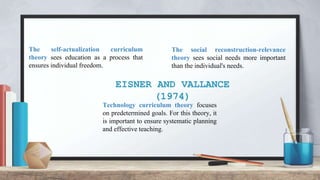
The social reconstruction-relevance
theory sees social needs more important
than the individual's needs.
The self-actualization curriculum
theory sees education as a process that
ensures individual freedom.
Technology curriculum theory focuses
on predetermined goals. For this theory, it
is important to ensure systematic planning
and effective teaching.
EISNER AND VALLANCE
(1974)
MCNEIL’S (1977)
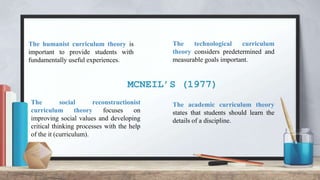
The social reconstructionist
curriculum theory focuses on
improving social values and developing
critical thinking processes with the help
of the it (curriculum).
The humanist curriculum theory is
important to provide students with
fundamentally useful experiences.
The academic curriculum theory
states that students should learn the
details of a discipline.
The technological curriculum
theory considers predetermined and
measurable goals important.
POSNER’S (1995)
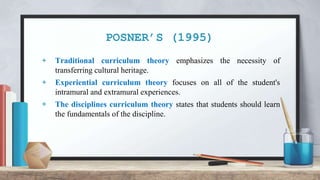
+ Traditional curriculum theory emphasizes the necessity of
transferring cultural heritage.
+ Experiential curriculum theory focuses on all of the student's
intramural and extramural experiences.
+ The disciplines curriculum theory states that students should learn
the fundamentals of the discipline.
POSNER’S (1995)
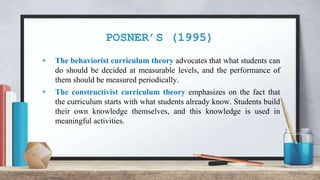
+ The behaviorist curriculum theory advocates that what students can
do should be decided at measurable levels, and the performance of
them should be measured periodically.
+ The constructivist curriculum theory emphasizes on the fact that
the curriculum starts with what students already know. Students build
their own knowledge themselves, and this knowledge is used in
meaningful activities.
KLIEBARD (2004)
The humanist curriculum theory
focuses on the idea of providing liberal
education for all. It focuses on teaching
academic subjects, the power of reason,
and adherence to traditions.
The child study curriculum theory
states that the curriculum should be
arranged in accordance with the child's
natural development by taking the
child's interests and needs into account.
The social meliorist theory gives
importance to social change and
social justice concepts. It emphasizes
addressing the problems in the
society.
The social efficiency curriculum
theory emphasizes that the
curriculum should equip students
with future competencies in society
and prepare them for their future
roles.
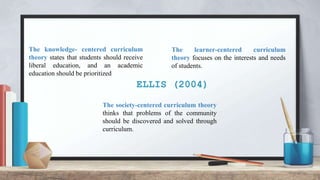
ELLIS (2004)
The learner-centered curriculum
theory focuses on the interests and needs
of students.
The knowledge- centered curriculum
theory states that students should receive
liberal education, and an academic
education should be prioritized
The society-centered curriculum theory
thinks that problems of the community
should be discovered and solved through
curriculum.
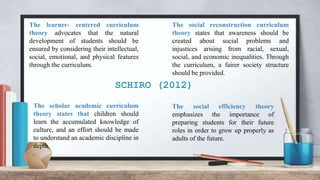
SCHIRO (2012)
The learner- centered curriculum
theory advocates that the natural
development of students should be
ensured by considering their intellectual,
social, emotional, and physical features
through the curriculum.
The scholar academic curriculum
theory states that children should
learn the accumulated knowledge of
culture, and an effort should be made
to understand an academic discipline in
depth.
The social reconstruction curriculum
theory states that awareness should be
created about social problems and
injustices arising from racial, sexual,
social, and economic inequalities. Through
the curriculum, a fairer society structure
should be provided.
The social efficiency theory
emphasizes the importance of
preparing students for their future
roles in order to grow up properly as
adults of the future.
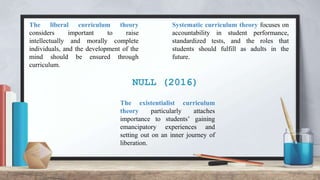
NULL (2016)
The liberal curriculum theory
considers important to raise
intellectually and morally complete
individuals, and the development of the
mind should be ensured through
curriculum.
The existentialist curriculum
theory particularly attaches
importance to students’ gaining
emancipatory experiences and
setting out on an inner journey of
liberation.
Systematic curriculum theory focuses on
accountability in student performance,
standardized tests, and the roles that
students should fulfill as adults in the
future.
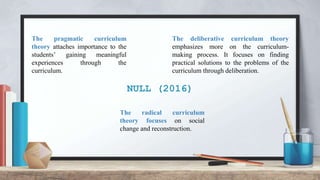
NULL (2016)
The deliberative curriculum theory
emphasizes more on the curriculum-
making process. It focuses on finding
practical solutions to the problems of the
curriculum through deliberation.
The radical curriculum
theory focuses on social
change and reconstruction.
The pragmatic curriculum
theory attaches importance to the
students’ gaining meaningful
experiences through the
curriculum.
CURRICULUM
DESIGN
AND
MICRO-
CURRICULUM
CURRICULUM DESIGN
+ It is the planning period during which instructors organize the
instructional units for their courses in order to achieve and develop
the curriculum.
+ Curriculum design involves planning activities, readings, lessons, and
assessments designed to achieve educational goals.
+ The definition of curriculum design refers to the organization of class
curriculum as educators prepare to deliver lessons and course
material..
CURRICULUM DESIGN (TYPES)
+ Subject-centered design involves giving students key facts and
pieces of information associated with a particular discipline.
+ Learner-centered design prioritizes students’ own interests and
goals in the learning process.
+ Problem-centered design focuses on specific issues and is a model
whereby students are encouraged to source solutions to timely, real-
world problems.
MICRO-
CURRICULUM
We’ll study this topic in a deeper way in week #9
MICRO-CURRICULUM
+ Micro-curriculum refers to the entire course of teaching and learning
activities carried out by teachers according to the requirements of the
curriculum standards and teaching practice.
+ Micro-curriculum is a new type of teaching method that has emerged
in recent years. It not only promotes the reform of the traditional
teaching model, but also shows various advantages.
LESSON PLAN
(Different from curriculum design
or microcurriculum)
LESSON PLAN
+ It is the instructor's road map of what students need to learn and how
it will be done effectively during the class time.
+ Lesson plans help teachers be more effective in the classroom by
providing a detailed outline to follow each class period.
+ It contains topics, objectives of the class, activities, time management,
resources (materials) and assessment to check for student
understanding
+ Example: https://www.typecalendar.com/lesson-plan.html / Drive
STEPS FOR CREATING A LESSON PLAN
1. Identify the learning objectives
+ Before you plan your lesson, you will first need to identify the
learning objectives for the lesson.
+ A learning objective describes what the learner will know or be able
to do after the learning experience.
+ For example: students will be able to identify and name colors of
objects that are around them.
STEPS FOR PREPARING A LESSON PLAN
2. Determine the needs of your students
+ With this particular lesson, are you introducing new material or
reviewing what you’ve already taught in a previous class?
+ At the start of the class, be sure to let students know what to expect so
they can stay focused on meeting your objectives.
+ When reviewing material, some of your students may need more
encouragement than others. Identifying these needs in your lesson
plan will help you prepare.
STEPS FOR PREPARING A LESSON PLAN
3. Plan the specific learning activities
+ When planning learning activities you should consider the types of
activities students will need to engage in, in order to develop the skills
and knowledge required to demonstrate effective learning in the
course.
+ Learning activities should be directly related to the learning
objectives of the course, and provide experiences that will enable
students to engage in, practice, and gain feedback on specific progress
towards those objectives.
STEPS FOR PREPARING A LESSON PLAN
4. Plan your resources and materials
+ Make a list of the resources and materials you’ll need to teach this
lesson, such as paper, pens, and rulers.
+ Don’t forget to include technology resources in your plan when
appropriate — laptops, and gamified learning tools, like apps or
educational websites.
+ Also, take into account the time management to develop each activity.
STEPS FOR PREPARING A LESSON PLAN
4. Plan to assess student understanding
+ Assessments (e.g., tests, papers, problem sets, performances) provide
opportunities for students to demonstrate and practice the knowledge
and skills articulated in the learning objectives, and for instructors to
offer targeted feedback that can guide further learning.
+ Planning for assessment allows you to find out whether your students
are learning.
STEPS FOR PREPARING A LESSON PLAN
5. Ending the lesson (Recommended at high schools (kids))
+ Finish the lesson with a quick wrap-up.
+ Do a brief overview of the lesson, including the main concepts the
class learned.
+ Ask students to identify the key ideas as a refresher, and leave them
with a preview of the next lesson so they know what to expect
ACTIVITY
Please design a lesson plan for teaching a topic in a foreign language.
+ It should be done in groups of 3 – 4 people
+ After designing the lesson plan, please present it to the rest of the
class.
+ The lesson plan should contain: main topic, student’s age, objectives,
activities, materials, time management and assessment to check your
students’ understanding.
THANK YOU
SO MUCH!

Curriculum - Theories -DC -LP.pptx

  • 1.
    TODAY’S AGENDA 1. CURRICULUM HISTORY 2.CURRICULUM THEORIES 3. CURRICULUM DESIGN 4. MICRO-CURRICULUM BREAK 1. LESSON PLAN 2. ACTIVITY IN GROUPS 3. ORAL PRESENTATION
  • 2.
  • 3.
  • 4.
    WHAT IS ACURRICULUM? + A curriculum is set guidelines that that have been established to help the educators to decide on the content of a course. It is the curriculum that gives out the course objectives, the contents, and methods that will be used to teach. Therefore, it prescribes not only what should be taught or how it should be taught, but also why something should be taught.
  • 5.
    WHAT IS ACURRICULUM? + Curriculum is usually set out by the administration of an institute. In government educational institutions, the curriculum may be set out by the government. Educators often make the syllabus using the curriculum. In addition, the curriculum also lets the teachers measure the effectiveness of their teaching through standardized testing. https://www.youtube.com/watch?v=NQmuywW-qTc
  • 6.
  • 7.
    CURRICULUM THEORIES + Macdonald(1971) stated that curriculum theory is one of the least understood concepts in the curriculum area, but it basically means examining what kind of a learning environment to have. Beauchamp (1982) defined curriculum theory as a set of propositions which add meaning to a school's curriculum acting in relation as a whole. McCutcheon (1982) also considered curriculum theory as a set of analysis, interpretation and understanding of curriculum phenomenon.
  • 8.
    CURRICULUM THEORIES + Curriculumtheories handled in different ways and named differently have been in an effort to create a system of thought about the curriculum. Although put in different categories by different theorists, it will be seen that the different curriculum theories express the same ideas in terms of meaning and content when examined in detail (Huenecke, 1982)
  • 9.
    EISNER AND VALLANCE (1974) Academicrationalism curriculum theory is the most traditional one and emphasizes students’ commitment to cultural elements. It is important for the students to have access to great ideas and objects. Cognitive processes theory argues that students' mental processes should be improved, and according to the proponents of this theory, the focus should be on the “how” rather than “what” of the curriculum.
  • 10.
    The social reconstruction-relevance theorysees social needs more important than the individual's needs. The self-actualization curriculum theory sees education as a process that ensures individual freedom. Technology curriculum theory focuses on predetermined goals. For this theory, it is important to ensure systematic planning and effective teaching. EISNER AND VALLANCE (1974)
  • 11.
    MCNEIL’S (1977) The socialreconstructionist curriculum theory focuses on improving social values and developing critical thinking processes with the help of the it (curriculum). The humanist curriculum theory is important to provide students with fundamentally useful experiences. The academic curriculum theory states that students should learn the details of a discipline. The technological curriculum theory considers predetermined and measurable goals important.
  • 12.
    POSNER’S (1995) + Traditionalcurriculum theory emphasizes the necessity of transferring cultural heritage. + Experiential curriculum theory focuses on all of the student's intramural and extramural experiences. + The disciplines curriculum theory states that students should learn the fundamentals of the discipline.
  • 13.
    POSNER’S (1995) + Thebehaviorist curriculum theory advocates that what students can do should be decided at measurable levels, and the performance of them should be measured periodically. + The constructivist curriculum theory emphasizes on the fact that the curriculum starts with what students already know. Students build their own knowledge themselves, and this knowledge is used in meaningful activities.

  • 14.
    KLIEBARD (2004) The humanistcurriculum theory focuses on the idea of providing liberal education for all. It focuses on teaching academic subjects, the power of reason, and adherence to traditions. The child study curriculum theory states that the curriculum should be arranged in accordance with the child's natural development by taking the child's interests and needs into account. The social meliorist theory gives importance to social change and social justice concepts. It emphasizes addressing the problems in the society. The social efficiency curriculum theory emphasizes that the curriculum should equip students with future competencies in society and prepare them for their future roles.
  • 15.
    ELLIS (2004) The learner-centeredcurriculum theory focuses on the interests and needs of students. The knowledge- centered curriculum theory states that students should receive liberal education, and an academic education should be prioritized The society-centered curriculum theory thinks that problems of the community should be discovered and solved through curriculum.
  • 16.
    SCHIRO (2012) The learner-centered curriculum theory advocates that the natural development of students should be ensured by considering their intellectual, social, emotional, and physical features through the curriculum. The scholar academic curriculum theory states that children should learn the accumulated knowledge of culture, and an effort should be made to understand an academic discipline in depth. The social reconstruction curriculum theory states that awareness should be created about social problems and injustices arising from racial, sexual, social, and economic inequalities. Through the curriculum, a fairer society structure should be provided. The social efficiency theory emphasizes the importance of preparing students for their future roles in order to grow up properly as adults of the future.

  • 17.
    NULL (2016) The liberalcurriculum theory considers important to raise intellectually and morally complete individuals, and the development of the mind should be ensured through curriculum. The existentialist curriculum theory particularly attaches importance to students’ gaining emancipatory experiences and setting out on an inner journey of liberation. Systematic curriculum theory focuses on accountability in student performance, standardized tests, and the roles that students should fulfill as adults in the future.
  • 18.
    NULL (2016) The deliberativecurriculum theory emphasizes more on the curriculum- making process. It focuses on finding practical solutions to the problems of the curriculum through deliberation. The radical curriculum theory focuses on social change and reconstruction. The pragmatic curriculum theory attaches importance to the students’ gaining meaningful experiences through the curriculum.
  • 19.
  • 20.
    CURRICULUM DESIGN + Itis the planning period during which instructors organize the instructional units for their courses in order to achieve and develop the curriculum. + Curriculum design involves planning activities, readings, lessons, and assessments designed to achieve educational goals. + The definition of curriculum design refers to the organization of class curriculum as educators prepare to deliver lessons and course material..
  • 21.
    CURRICULUM DESIGN (TYPES) +Subject-centered design involves giving students key facts and pieces of information associated with a particular discipline. + Learner-centered design prioritizes students’ own interests and goals in the learning process. + Problem-centered design focuses on specific issues and is a model whereby students are encouraged to source solutions to timely, real- world problems.
  • 22.
    MICRO- CURRICULUM We’ll study thistopic in a deeper way in week #9
  • 23.
    MICRO-CURRICULUM + Micro-curriculum refersto the entire course of teaching and learning activities carried out by teachers according to the requirements of the curriculum standards and teaching practice. + Micro-curriculum is a new type of teaching method that has emerged in recent years. It not only promotes the reform of the traditional teaching model, but also shows various advantages.
  • 24.
    LESSON PLAN (Different fromcurriculum design or microcurriculum)
  • 25.
    LESSON PLAN + Itis the instructor's road map of what students need to learn and how it will be done effectively during the class time. + Lesson plans help teachers be more effective in the classroom by providing a detailed outline to follow each class period. + It contains topics, objectives of the class, activities, time management, resources (materials) and assessment to check for student understanding + Example: https://www.typecalendar.com/lesson-plan.html / Drive
  • 26.
    STEPS FOR CREATINGA LESSON PLAN 1. Identify the learning objectives + Before you plan your lesson, you will first need to identify the learning objectives for the lesson. + A learning objective describes what the learner will know or be able to do after the learning experience. + For example: students will be able to identify and name colors of objects that are around them.
  • 27.
    STEPS FOR PREPARINGA LESSON PLAN 2. Determine the needs of your students + With this particular lesson, are you introducing new material or reviewing what you’ve already taught in a previous class? + At the start of the class, be sure to let students know what to expect so they can stay focused on meeting your objectives. + When reviewing material, some of your students may need more encouragement than others. Identifying these needs in your lesson plan will help you prepare.
  • 28.
    STEPS FOR PREPARINGA LESSON PLAN 3. Plan the specific learning activities + When planning learning activities you should consider the types of activities students will need to engage in, in order to develop the skills and knowledge required to demonstrate effective learning in the course. + Learning activities should be directly related to the learning objectives of the course, and provide experiences that will enable students to engage in, practice, and gain feedback on specific progress towards those objectives.
  • 29.
    STEPS FOR PREPARINGA LESSON PLAN 4. Plan your resources and materials + Make a list of the resources and materials you’ll need to teach this lesson, such as paper, pens, and rulers. + Don’t forget to include technology resources in your plan when appropriate — laptops, and gamified learning tools, like apps or educational websites. + Also, take into account the time management to develop each activity.
  • 30.
    STEPS FOR PREPARINGA LESSON PLAN 4. Plan to assess student understanding + Assessments (e.g., tests, papers, problem sets, performances) provide opportunities for students to demonstrate and practice the knowledge and skills articulated in the learning objectives, and for instructors to offer targeted feedback that can guide further learning. + Planning for assessment allows you to find out whether your students are learning.
  • 31.
    STEPS FOR PREPARINGA LESSON PLAN 5. Ending the lesson (Recommended at high schools (kids)) + Finish the lesson with a quick wrap-up. + Do a brief overview of the lesson, including the main concepts the class learned. + Ask students to identify the key ideas as a refresher, and leave them with a preview of the next lesson so they know what to expect
  • 32.
    ACTIVITY Please design alesson plan for teaching a topic in a foreign language. + It should be done in groups of 3 – 4 people + After designing the lesson plan, please present it to the rest of the class. + The lesson plan should contain: main topic, student’s age, objectives, activities, materials, time management and assessment to check your students’ understanding.
  • 34.