DIFFERENCE BET WEEN
   KBSR AND KSSR
  by Fatin,Syaza, Jai
ELEMENTS
             AIMS
           OBJECTIVES
        FRAMEWORK
   CURICULUM ORGANIZATION
       ROLE OE TEACHER
       SKILLS INVOLVED
           ASSESSMENT
           WORD LIST
    EDUCATIONAL EMPHASES
AIMS
               KBSR                          KSSR
The English language syllabus   The English Language
  for primary school aims to      Curriculum for Primary
  equip pupils with skills and    Schools aims to equip pupils
  provide a basic                 with basic language skills
  understanding of the            to enable them to
  English language so that        communicate effectively
  they are able to                in a variety of contexts that’s
  communicate, both               appropriate to the
  orally and in writing, in       pupils’ level of
  and out of school.              development.
OBJECTIVES
                  KBSR                                          KSSR
                                                  i. communicate with peers and adults
i) listen to and understand simple spoken
                                                      confidently and appropriately in formal
    English to be able to function in common
                                                      and informal situations;
    everyday situations;
                                                  ii. read and comprehend a range of English
ii) speak and respond clearly and appropriately
                                                      texts for information and enjoyment;
    in common everyday situations using simple
    language;                                     iii. write a range of texts using appropriate
                                                      language, style and form through a
iii) to read and understand different kinds of
                                                      variety of media;
    texts (from print and electronic sources)
    for enjoyment and information;                iv. appreciate and demonstrate
                                                      understanding of English language
iv) write (including e-mail) for different
                                                      literary or creative works for enjoyment;
    purposes using simple language; and
                                                      and
v) show an awareness and appreciation of
                                                  v. use correct and appropriate rules of
    moral values and love towards the nation.
                                                      grammar in speech and writing.
SHAPE
         KBSR                 KSSR
• Communication      • Communication
• Human and          • Spiritual, attitude
environment          and values
• Self development   • Humanity
                     • Physical aesthetical
                     development
                     • Science and
                     technology
ORGANIZATION
                  KBSR                                         KSSR

• According to each subjects (syllabus /     Primary education is divided into two
text books)                                  stages:

The language contents are the sound          Stage One Years 1, 2 and 3
system, grammar and vocabulary.
                                             Stage Two, Years 4, 5 and 6.
Several teaching contexts have been
suggested through which the language skills In Years 1, 2 and 3 in national schools, the
and language content are to be taught.      English language curriculum emphasises the
                                            development of basic
                                            language skills so that pupils will have a
                                            strong foundation to build their proficiency
                                            in the language.
MATERIALS
           KBSR                                KSSR
• Using syllabus containing:    • Using curriculum documents
                                 standard content
 content                        standard learning
 learning outcome
                                In years 1 and 2,
 suggested activities in       there will only be four modules; namely:
teaching and learning process   Module One : Listening and Speaking
• Textbook                      Module Two : Reading
                                Module Three : Writing
                                Module Four : Language Arts
                                In Years 3 - 6, grammar is added to the
                                above four modules

                                • Textbook
SKILL
               KBSR                                      KSSR
 It comprises the four language skills    emphasises the development of
   of listening, speaking, reading, and     basic language skills so that pupils
   writing as well as the language          will have a strong foundation to
   contents                                 build their proficiency in the
                                            language.
                                           Listening and Speaking
                                           Reading
                                           Writing
                                           Language Arts
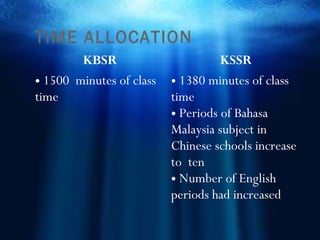
TIME ALLOCATION
        KBSR                        KSSR
• 1500 minutes of class   • 1380 minutes of class
time                      time
                          • Periods of Bahasa
                          Malaysia subject in
                          Chinese schools increase
                          to ten
                          • Number of English
                          periods had increased
WORD LIST
          KBSR                            KSSR
a sample of the more          based on common words
 common words a                high frequency words that
 high frequency words and       can be used repetitively in
 can be used and recycled in     different contexts.
 different contexts and
 topics.
ASSESSMENT METHOD
         KBSR                       KSSR

• Clear emphasis on    •Multiple sources of evidence
summative assessment   •Teachers will build a profile of
                       pupils’ language development and
                       assess them individually.
                       •A combination of formative and
                       summative assessment methods.
EDUCATIONAL EMPHASES

           KBSR                                 KSSR
                              Thinking skill
 Thinking skill
                              Mastery learning
 Learning how to learn skill 
                               ICT
 ICT                         Multiple Intelligence
 Multiple Intelligence       Constructivism
                              Contextual learning
 Values and citizenship
                              Learning how to learn skill
 Knowledge Acquisition       Values and citizenship
 Preparation for the real    Knowledge Acquisition
   world                      Creative and innovation
                              Entrepreneurship
THANK YOU

Difference between kbsr and kssr

  • 1.
    DIFFERENCE BET WEEN KBSR AND KSSR by Fatin,Syaza, Jai
  • 2.
    ELEMENTS AIMS OBJECTIVES FRAMEWORK CURICULUM ORGANIZATION ROLE OE TEACHER SKILLS INVOLVED ASSESSMENT WORD LIST EDUCATIONAL EMPHASES
  • 3.
    AIMS KBSR KSSR The English language syllabus The English Language for primary school aims to Curriculum for Primary equip pupils with skills and Schools aims to equip pupils provide a basic with basic language skills understanding of the to enable them to English language so that communicate effectively they are able to in a variety of contexts that’s communicate, both appropriate to the orally and in writing, in pupils’ level of and out of school. development.
  • 4.
    OBJECTIVES KBSR KSSR i. communicate with peers and adults i) listen to and understand simple spoken confidently and appropriately in formal English to be able to function in common and informal situations; everyday situations; ii. read and comprehend a range of English ii) speak and respond clearly and appropriately texts for information and enjoyment; in common everyday situations using simple language; iii. write a range of texts using appropriate language, style and form through a iii) to read and understand different kinds of variety of media; texts (from print and electronic sources) for enjoyment and information; iv. appreciate and demonstrate understanding of English language iv) write (including e-mail) for different literary or creative works for enjoyment; purposes using simple language; and and v) show an awareness and appreciation of v. use correct and appropriate rules of moral values and love towards the nation. grammar in speech and writing.
  • 5.
    SHAPE KBSR KSSR • Communication • Communication • Human and • Spiritual, attitude environment and values • Self development • Humanity • Physical aesthetical development • Science and technology
  • 6.
    ORGANIZATION KBSR KSSR • According to each subjects (syllabus / Primary education is divided into two text books) stages: The language contents are the sound Stage One Years 1, 2 and 3 system, grammar and vocabulary. Stage Two, Years 4, 5 and 6. Several teaching contexts have been suggested through which the language skills In Years 1, 2 and 3 in national schools, the and language content are to be taught. English language curriculum emphasises the development of basic language skills so that pupils will have a strong foundation to build their proficiency in the language.
  • 7.
    MATERIALS KBSR KSSR • Using syllabus containing: • Using curriculum documents  standard content  content  standard learning  learning outcome In years 1 and 2,  suggested activities in there will only be four modules; namely: teaching and learning process Module One : Listening and Speaking • Textbook Module Two : Reading Module Three : Writing Module Four : Language Arts In Years 3 - 6, grammar is added to the above four modules • Textbook
  • 8.
    SKILL KBSR KSSR  It comprises the four language skills  emphasises the development of of listening, speaking, reading, and basic language skills so that pupils writing as well as the language will have a strong foundation to contents build their proficiency in the language.  Listening and Speaking  Reading  Writing  Language Arts
  • 9.
    TIME ALLOCATION KBSR KSSR • 1500 minutes of class • 1380 minutes of class time time • Periods of Bahasa Malaysia subject in Chinese schools increase to ten • Number of English periods had increased
  • 10.
    WORD LIST KBSR KSSR a sample of the more based on common words common words a high frequency words that  high frequency words and can be used repetitively in can be used and recycled in different contexts. different contexts and topics.
  • 11.
    ASSESSMENT METHOD KBSR KSSR • Clear emphasis on •Multiple sources of evidence summative assessment •Teachers will build a profile of pupils’ language development and assess them individually. •A combination of formative and summative assessment methods.
  • 12.
    EDUCATIONAL EMPHASES KBSR KSSR  Thinking skill Thinking skill  Mastery learning Learning how to learn skill  ICT ICT  Multiple Intelligence Multiple Intelligence  Constructivism  Contextual learning Values and citizenship  Learning how to learn skill Knowledge Acquisition  Values and citizenship Preparation for the real  Knowledge Acquisition world  Creative and innovation  Entrepreneurship
  • 13.