COMMON EMITTER
AMPLIFIER
PRESENTER
YEASIN NEWAJ
TOPIC: COMMON
EMITTER AMPLIFIER
Definitions, Analysis and Many More
01
TRANSISTOR AS
AMPLIFIER
COMMON
EMITTER AMPLIFIER
AMPLIFIER
02 03 04
DC & AC
ANALYSIS
05
05
ADVANTAGES &
DISADVANTAGES
06
INPUT
IMPEDENCE
07
APPLICATION SUMMARY
CONTENTS
AMPLIFIER
01 Definition and Details of Amplifier
AMPLIFIER
An amplifier is one of the most commonly used
electronic devices in the world. It’s a basic building
block of a vast number of circuits, and comes in
various forms.
Amplifiers can be defined simply as an electronic
device that increases the power of a signal. In other
words, it increases the amplitude of a signal, and
makes it stronger than the given input.
Although this sounds simple in theory, amplifiers
have a lot of parameters and conditions in the real
world. Amplification is never perfectly efficient, there
are always losses, distortion and noise to deal with.
Thus, there are a whole load of amplifiers created, that
work best in different situations. Not all amplifiers
provide optimal output in all situations, and there’s
always cost factors to consider.
IMPORTANT CHARACTERISTICS OF AMPLIFER
The quality of an amplifier is measured by a series of specifications called figures of merit. They are as
follows:
 Bandwidth: The frequency range at which the amplifier can operate.
 Noise: The amount of unwanted extra information included in the output.
 Skew Rate: The maximum rate of change of output.
 Gain: Perhaps the most important, the ratio between the magnitudes of input and output signals.
 Stability: The ability to provide constant and reliable output.
 Linearity: The degree of proportionality between input and output signals.
 Efficiency: Another very important characteristic, it is the ratio between the output power and
power consumed.
 Output Dynamic Range: Ratio between the largest and smallest useful output levels.
TRANSISTOR AS AN
AMPLIFIER
How does Transistor act as an Amplifier?
TRANSISTOR AS AN AMPLIFIER
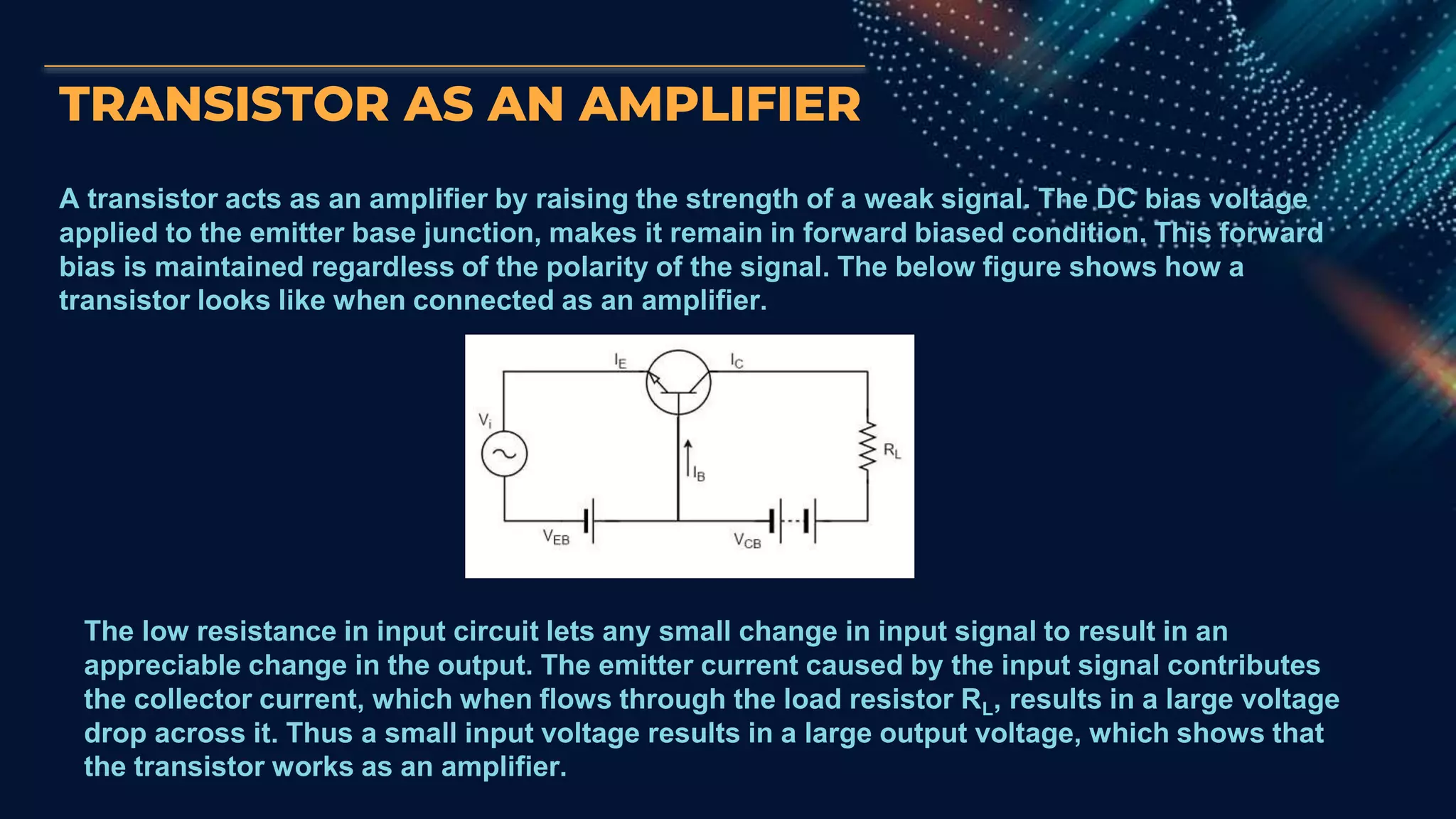
A transistor acts as an amplifier by raising the strength of a weak signal. The DC bias voltage
applied to the emitter base junction, makes it remain in forward biased condition. This forward
bias is maintained regardless of the polarity of the signal. The below figure shows how a
transistor looks like when connected as an amplifier.
The low resistance in input circuit lets any small change in input signal to result in an
appreciable change in the output. The emitter current caused by the input signal contributes
the collector current, which when flows through the load resistor RL, results in a large voltage
drop across it. Thus a small input voltage results in a large output voltage, which shows that
the transistor works as an amplifier.
COMMON EMMITTER AMPLIFIER
02 Definition, Details and Examples of a Common
Emitter Amplifier
DEFINITION
What is Common – Emitter Amplifier?
DEFINITION
The common emitter amplifier is a three basic single-
stage bipolar junction transistor and is used as a voltage
amplifier.
The input of this amplifier is taken from the base terminal, the
output is collected from the collector terminal and the emitter
terminal is common for both the terminals.
The basic symbol of the common emitter amplifier is shown
in the right figure.
CONFIGURATION
Basic Configuration of Common – Emitter
Amplifier
CONFIGURATION
In electronic circuit design, there are three kinds of transistor
configurations are used like common emitter, common base, and
common collector, In that, the most frequently used one is common
emitter due to its main attributes.
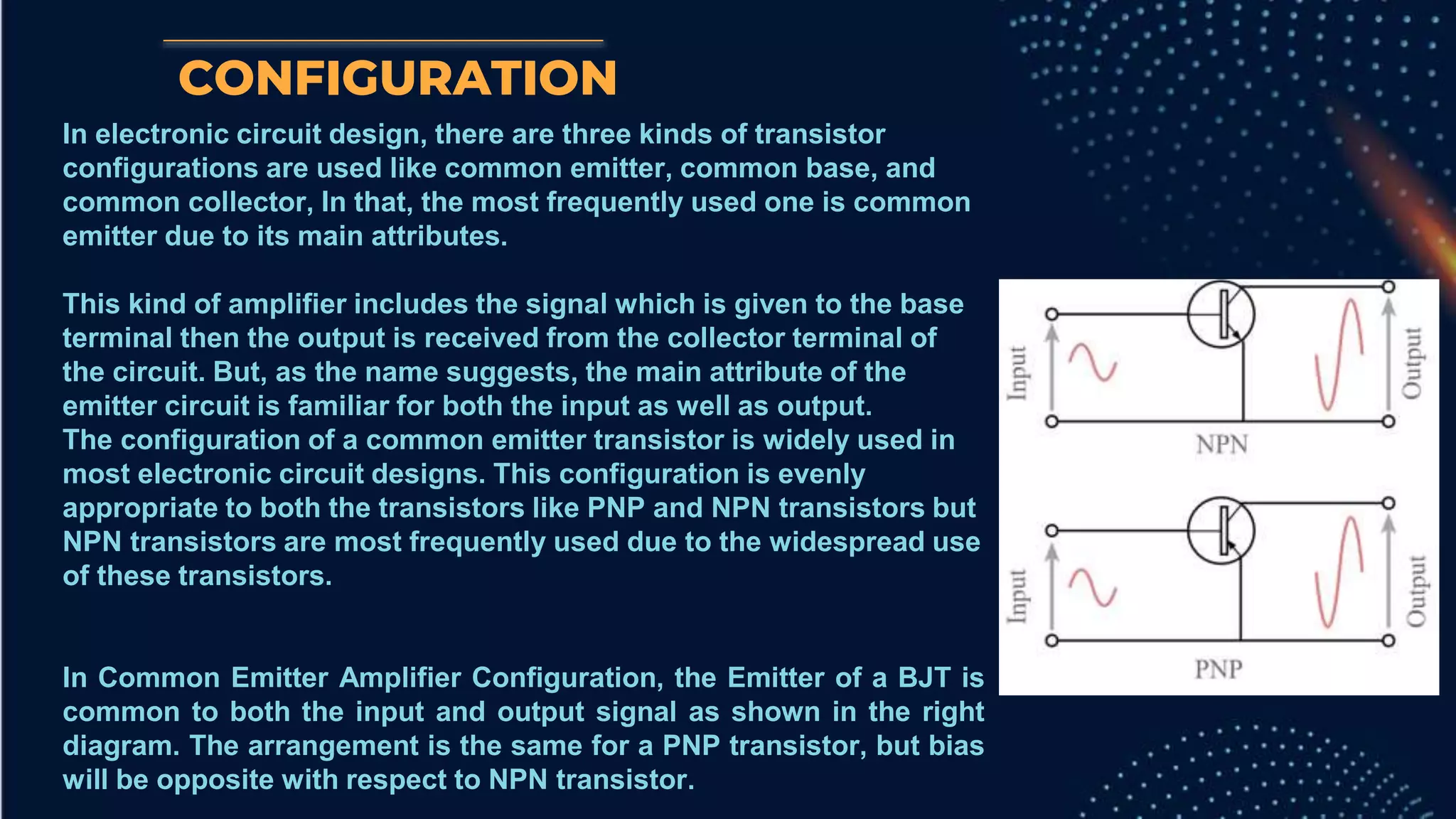
This kind of amplifier includes the signal which is given to the base
terminal then the output is received from the collector terminal of
the circuit. But, as the name suggests, the main attribute of the
emitter circuit is familiar for both the input as well as output.
The configuration of a common emitter transistor is widely used in
most electronic circuit designs. This configuration is evenly
appropriate to both the transistors like PNP and NPN transistors but
NPN transistors are most frequently used due to the widespread use
of these transistors.
In Common Emitter Amplifier Configuration, the Emitter of a BJT is
common to both the input and output signal as shown in the right
diagram. The arrangement is the same for a PNP transistor, but bias
will be opposite with respect to NPN transistor.
DC ANALYSIS AND AC ANALYSIS
03 DC and AC Analysis of Common – Emitter Amplifier
DC ANALYSIS
DC Analysis of Common Emitter Amplifier
DC ANALYSIS
Using the common-emitter amplifier circuit shown in the figure
as an example, the use of equivalent circuits assists with
analyzing circuits.
DC analysis of a common-emitter amplifier circuit begins with
determining the dc bias values and then removing coupling and
bypass capacitors, the load resistor, and the signal source to
produce a dc equivalent circuit by applying Thevenin’s
theorem and Kirchhoff's voltage law.
AC ANALYSIS
AC Analysis of Common Emitter Amplifier
AC ANALYSIS
AC analysis of a common-emitter amplifier circuit begins by recognizing the capacitive reactance (XC)
remains very low at the signal frequency. By considering XC as equal to zero, reducing the circuit to an ac
equivalent circuit requires replacing the three capacitors in the circuit with effective shorts. Then, the
analysis continues by replacing the dc source with ground. From the perspective of ac analysis, a dc
voltage source has an internal resistance of 0 ohms.
Since no ac voltage can develop across the dc source, it serves as an ac ground. Electrically, the ac
ground and actual ground exist at the same point. All this reduces the equivalent circuit to three resistors
and the transistor. Connecting an ac voltage source to the input of the circuit. Because the AC source
voltage has an internal resistance of 0 ohms, the source voltage appears at the base of the transistor.
Finding the ac signal voltage at the transistor base requires combining the source resistance (RS), the bias
resistance, and the ac input resistance at the base to produce the total input resistance seen by the ac
source connected to the input.
Using the voltage divider formula, the signal voltage at the base of the transistor (Vb) equals:
AC EQUIVALENT CIRCUIT
INPUT IMPEDENCE
04 Definition and Details of Input Resistance in Common
Emitter Amplifier
INPUT IMPEDENCE
The Input Impedance of an amplifier
defines its input characteristics with
regards to current and voltage looking
into an amplifiers input terminals
INPUT IMPEDENCE
Input Impedance, ZIN or Input Resistance as it is often called, is an important parameter in the design of a
transistor amplifier and as such allows amplifiers to be characterized according to their effective input and
output impedances as well as their power and current ratings.
An amplifiers impedance value is particularly important for analysis especially when cascading individual
amplifier stages together one after another to minimize distortion of the signal.
The input impedance of an amplifier is the input impedance “seen” by the source driving the input of the
amplifier. If it is too low, it can have an adverse loading effect on the previous stage and possibly affecting the
frequency response and output signal level of that stage. But in most applications, common emitter and
common collector amplifier circuits generally have high input impedances.
Some types of amplifier designs, such as the common collector amplifier circuit automatically have high input
impedance and low output impedance by the very nature of their design. Amplifiers can have high input
impedance, low output impedance, and virtually any arbitrary gain, but were an amplifiers input impedance is
lower than desired, the output impedance of the previous stage can be adjusted to compensate or if this is not
possible then buffer amplifier stages may be needed.
In addition to voltage amplification ( Av ), an amplifier circuit must also have current amplification ( Ai ). Power
amplification ( Ap ) can also be expected from an amplifier circuit. But as well as having these three important
characteristics, an amplifier circuit must also have other characteristics like high input impedance ( ZIN ), low
output impedance ( ZOUT ) and some degree of bandwidth, ( Bw ). Either way, the “perfect” amplifier will have
infinite input impedance and zero output impedance.
INPUT IMPEDENCE
ADVANTAGES AND DISADVANTAGES
05 Pros and Cons of Common Emitter Amplifier
ADVANTAGES
Advantages of Common Emitter
Amplifier
ADVANTAGES
 Common Emitter is most widely used because it provides the voltage gain required for most of
the day to day applications of preamp and power amps. This is not possible in CB mode.
Moreover, the CC has the avatar of CE as in Emitter Follower, This circuit also closely resemble
a Common Emitter, and its work is to provide current gain.
 Common emitter is the most basic configuration for amplifier circuits. It also provide the
maximum transconductance or voltage gain for a given load.
 The common emitter configuration has the highest power gain combined with medium voltage
and current gain.
 The ability of this configuration to increase input signal power by 20dB (100 times) and more is
widely used as signal amplifiers in communications. Weak signals can restore their power
passing through common-emitter amplifier. It is also widely used in speakers, where the
increase in voltage can increase the volume of sound.
 The configuration can also used as switch in embedded systems. Usually, microcontrollers'
output is limited to 5V. With CE switch, the voltage can increase about 5-20 times that allows
the control of more demanding devices, such as DC motors.
DISADVANTAGES
Disadvantages of Common Emitter
Amplifier
DISADVANTAGES
The disadvantages of a common emitter amplifier include the following:
 In the high frequencies, the common emitter amplifier does not respond
 The voltage gain of this amplifier is unstable
 The output resistance is very high in these amplifiers
 In these amplifiers, there is a high thermal instability
 High output resistance
APPLICATION
06 Application of Common Emitter Amplifier
APPLICATION
The applications of a common emitter amplifier include the following:
 The common emitter amplifiers are used in the low-frequency voltage amplifiers.
 These amplifiers are used typically in the RF circuits.
 In general, the amplifiers are used in the Low noise amplifiers.
 The common emitter circuit is popular because it’s well-suited for voltage amplification,
especially at low frequencies.
 Common-emitter amplifiers are also used in radio frequency transceiver circuits.
 Common emitter configuration commonly used in low-noise amplifiers.
SUMMARY
07 Summary of Common Emitter Amplifier
SUMMARY
 The Common Emitter Amplifier circuit has a resistor in its Collector
circuit. The current flowing through this resistor produces the voltage
output of the amplifier. The value of this resistor is chosen so that at
the amplifiers quiescent operating point, Q-point this output voltage
lies half way along the transistors load line.
 The Base of the transistor used in a common emitter amplifier is
biased using two resistors as a potential divider network. This type of
biasing arrangement is commonly used in the design of bipolar
transistor amplifier circuits and greatly reduces the effects of varying
Beta, ( β ) by holding the Base bias at a constant steady voltage. This
type of biasing produces the greatest stability.
 A resistor can be included in the emitter leg in which case the voltage
gain becomes -RL/RE. If there is no external Emitter resistance, the
voltage gain of the amplifier is not infinite as there is a very small
internal resistance, Re in the Emitter leg. The value of this internal
resistance is equal to 25mV/IE
THANK YOU

Common emitter amplifier by YEASIN NEWAJ

  • 1.
  • 2.
  • 3.
  • 4.
    01 TRANSISTOR AS AMPLIFIER COMMON EMITTER AMPLIFIER AMPLIFIER 0203 04 DC & AC ANALYSIS 05 05 ADVANTAGES & DISADVANTAGES 06 INPUT IMPEDENCE 07 APPLICATION SUMMARY CONTENTS
  • 5.
    AMPLIFIER 01 Definition andDetails of Amplifier
  • 6.
    AMPLIFIER An amplifier isone of the most commonly used electronic devices in the world. It’s a basic building block of a vast number of circuits, and comes in various forms. Amplifiers can be defined simply as an electronic device that increases the power of a signal. In other words, it increases the amplitude of a signal, and makes it stronger than the given input. Although this sounds simple in theory, amplifiers have a lot of parameters and conditions in the real world. Amplification is never perfectly efficient, there are always losses, distortion and noise to deal with. Thus, there are a whole load of amplifiers created, that work best in different situations. Not all amplifiers provide optimal output in all situations, and there’s always cost factors to consider.
  • 7.
    IMPORTANT CHARACTERISTICS OFAMPLIFER The quality of an amplifier is measured by a series of specifications called figures of merit. They are as follows:  Bandwidth: The frequency range at which the amplifier can operate.  Noise: The amount of unwanted extra information included in the output.  Skew Rate: The maximum rate of change of output.  Gain: Perhaps the most important, the ratio between the magnitudes of input and output signals.  Stability: The ability to provide constant and reliable output.  Linearity: The degree of proportionality between input and output signals.  Efficiency: Another very important characteristic, it is the ratio between the output power and power consumed.  Output Dynamic Range: Ratio between the largest and smallest useful output levels.
  • 8.
    TRANSISTOR AS AN AMPLIFIER Howdoes Transistor act as an Amplifier?
  • 9.
    TRANSISTOR AS ANAMPLIFIER A transistor acts as an amplifier by raising the strength of a weak signal. The DC bias voltage applied to the emitter base junction, makes it remain in forward biased condition. This forward bias is maintained regardless of the polarity of the signal. The below figure shows how a transistor looks like when connected as an amplifier. The low resistance in input circuit lets any small change in input signal to result in an appreciable change in the output. The emitter current caused by the input signal contributes the collector current, which when flows through the load resistor RL, results in a large voltage drop across it. Thus a small input voltage results in a large output voltage, which shows that the transistor works as an amplifier.
  • 10.
    COMMON EMMITTER AMPLIFIER 02Definition, Details and Examples of a Common Emitter Amplifier
  • 11.
    DEFINITION What is Common– Emitter Amplifier?
  • 12.
    DEFINITION The common emitteramplifier is a three basic single- stage bipolar junction transistor and is used as a voltage amplifier. The input of this amplifier is taken from the base terminal, the output is collected from the collector terminal and the emitter terminal is common for both the terminals. The basic symbol of the common emitter amplifier is shown in the right figure.
  • 13.
    CONFIGURATION Basic Configuration ofCommon – Emitter Amplifier
  • 14.
    CONFIGURATION In electronic circuitdesign, there are three kinds of transistor configurations are used like common emitter, common base, and common collector, In that, the most frequently used one is common emitter due to its main attributes. This kind of amplifier includes the signal which is given to the base terminal then the output is received from the collector terminal of the circuit. But, as the name suggests, the main attribute of the emitter circuit is familiar for both the input as well as output. The configuration of a common emitter transistor is widely used in most electronic circuit designs. This configuration is evenly appropriate to both the transistors like PNP and NPN transistors but NPN transistors are most frequently used due to the widespread use of these transistors. In Common Emitter Amplifier Configuration, the Emitter of a BJT is common to both the input and output signal as shown in the right diagram. The arrangement is the same for a PNP transistor, but bias will be opposite with respect to NPN transistor.
  • 15.
    DC ANALYSIS ANDAC ANALYSIS 03 DC and AC Analysis of Common – Emitter Amplifier
  • 16.
    DC ANALYSIS DC Analysisof Common Emitter Amplifier
  • 17.
    DC ANALYSIS Using thecommon-emitter amplifier circuit shown in the figure as an example, the use of equivalent circuits assists with analyzing circuits. DC analysis of a common-emitter amplifier circuit begins with determining the dc bias values and then removing coupling and bypass capacitors, the load resistor, and the signal source to produce a dc equivalent circuit by applying Thevenin’s theorem and Kirchhoff's voltage law.
  • 18.
    AC ANALYSIS AC Analysisof Common Emitter Amplifier
  • 19.
    AC ANALYSIS AC analysisof a common-emitter amplifier circuit begins by recognizing the capacitive reactance (XC) remains very low at the signal frequency. By considering XC as equal to zero, reducing the circuit to an ac equivalent circuit requires replacing the three capacitors in the circuit with effective shorts. Then, the analysis continues by replacing the dc source with ground. From the perspective of ac analysis, a dc voltage source has an internal resistance of 0 ohms. Since no ac voltage can develop across the dc source, it serves as an ac ground. Electrically, the ac ground and actual ground exist at the same point. All this reduces the equivalent circuit to three resistors and the transistor. Connecting an ac voltage source to the input of the circuit. Because the AC source voltage has an internal resistance of 0 ohms, the source voltage appears at the base of the transistor. Finding the ac signal voltage at the transistor base requires combining the source resistance (RS), the bias resistance, and the ac input resistance at the base to produce the total input resistance seen by the ac source connected to the input. Using the voltage divider formula, the signal voltage at the base of the transistor (Vb) equals:
  • 20.
  • 21.
    INPUT IMPEDENCE 04 Definitionand Details of Input Resistance in Common Emitter Amplifier
  • 22.
    INPUT IMPEDENCE The InputImpedance of an amplifier defines its input characteristics with regards to current and voltage looking into an amplifiers input terminals
  • 23.
    INPUT IMPEDENCE Input Impedance,ZIN or Input Resistance as it is often called, is an important parameter in the design of a transistor amplifier and as such allows amplifiers to be characterized according to their effective input and output impedances as well as their power and current ratings. An amplifiers impedance value is particularly important for analysis especially when cascading individual amplifier stages together one after another to minimize distortion of the signal. The input impedance of an amplifier is the input impedance “seen” by the source driving the input of the amplifier. If it is too low, it can have an adverse loading effect on the previous stage and possibly affecting the frequency response and output signal level of that stage. But in most applications, common emitter and common collector amplifier circuits generally have high input impedances. Some types of amplifier designs, such as the common collector amplifier circuit automatically have high input impedance and low output impedance by the very nature of their design. Amplifiers can have high input impedance, low output impedance, and virtually any arbitrary gain, but were an amplifiers input impedance is lower than desired, the output impedance of the previous stage can be adjusted to compensate or if this is not possible then buffer amplifier stages may be needed. In addition to voltage amplification ( Av ), an amplifier circuit must also have current amplification ( Ai ). Power amplification ( Ap ) can also be expected from an amplifier circuit. But as well as having these three important characteristics, an amplifier circuit must also have other characteristics like high input impedance ( ZIN ), low output impedance ( ZOUT ) and some degree of bandwidth, ( Bw ). Either way, the “perfect” amplifier will have infinite input impedance and zero output impedance.
  • 24.
  • 25.
    ADVANTAGES AND DISADVANTAGES 05Pros and Cons of Common Emitter Amplifier
  • 26.
  • 27.
    ADVANTAGES  Common Emitteris most widely used because it provides the voltage gain required for most of the day to day applications of preamp and power amps. This is not possible in CB mode. Moreover, the CC has the avatar of CE as in Emitter Follower, This circuit also closely resemble a Common Emitter, and its work is to provide current gain.  Common emitter is the most basic configuration for amplifier circuits. It also provide the maximum transconductance or voltage gain for a given load.  The common emitter configuration has the highest power gain combined with medium voltage and current gain.  The ability of this configuration to increase input signal power by 20dB (100 times) and more is widely used as signal amplifiers in communications. Weak signals can restore their power passing through common-emitter amplifier. It is also widely used in speakers, where the increase in voltage can increase the volume of sound.  The configuration can also used as switch in embedded systems. Usually, microcontrollers' output is limited to 5V. With CE switch, the voltage can increase about 5-20 times that allows the control of more demanding devices, such as DC motors.
  • 28.
  • 29.
    DISADVANTAGES The disadvantages ofa common emitter amplifier include the following:  In the high frequencies, the common emitter amplifier does not respond  The voltage gain of this amplifier is unstable  The output resistance is very high in these amplifiers  In these amplifiers, there is a high thermal instability  High output resistance
  • 30.
    APPLICATION 06 Application ofCommon Emitter Amplifier
  • 31.
    APPLICATION The applications ofa common emitter amplifier include the following:  The common emitter amplifiers are used in the low-frequency voltage amplifiers.  These amplifiers are used typically in the RF circuits.  In general, the amplifiers are used in the Low noise amplifiers.  The common emitter circuit is popular because it’s well-suited for voltage amplification, especially at low frequencies.  Common-emitter amplifiers are also used in radio frequency transceiver circuits.  Common emitter configuration commonly used in low-noise amplifiers.
  • 32.
    SUMMARY 07 Summary ofCommon Emitter Amplifier
  • 33.
    SUMMARY  The CommonEmitter Amplifier circuit has a resistor in its Collector circuit. The current flowing through this resistor produces the voltage output of the amplifier. The value of this resistor is chosen so that at the amplifiers quiescent operating point, Q-point this output voltage lies half way along the transistors load line.  The Base of the transistor used in a common emitter amplifier is biased using two resistors as a potential divider network. This type of biasing arrangement is commonly used in the design of bipolar transistor amplifier circuits and greatly reduces the effects of varying Beta, ( β ) by holding the Base bias at a constant steady voltage. This type of biasing produces the greatest stability.  A resistor can be included in the emitter leg in which case the voltage gain becomes -RL/RE. If there is no external Emitter resistance, the voltage gain of the amplifier is not infinite as there is a very small internal resistance, Re in the Emitter leg. The value of this internal resistance is equal to 25mV/IE
  • 34.